LNER’s Cheaper Advanced Tickets Can Be Bought Just Before You Travel
Yesterday, I had a ticket on the 15:47 train, back from Doncaster to London Kings Cross. I had bought it on-line a few days ago for £23.50.
But, I was unable to complete what I wanted to do, so found myself at Doncaster station, with three hours to wait for my train.
Usually, I buy open returns, but LNER have stopped that because of the covids!
So rather than wait, I decided to buy another ticket.
A new Off Peak Single with my Railcard would have been £60, but I found the machine could sell me an Advance Single Ticket for £31.
So I got home in time for the cricket. My ticket also got me two seats, including a window.
LNER seem to be getting their act together.
A Hand Sanitiser In A Quiet Corner
This corner at Moorgate station never gets any passenger traffic, but thousands pass within three or four metres or so.
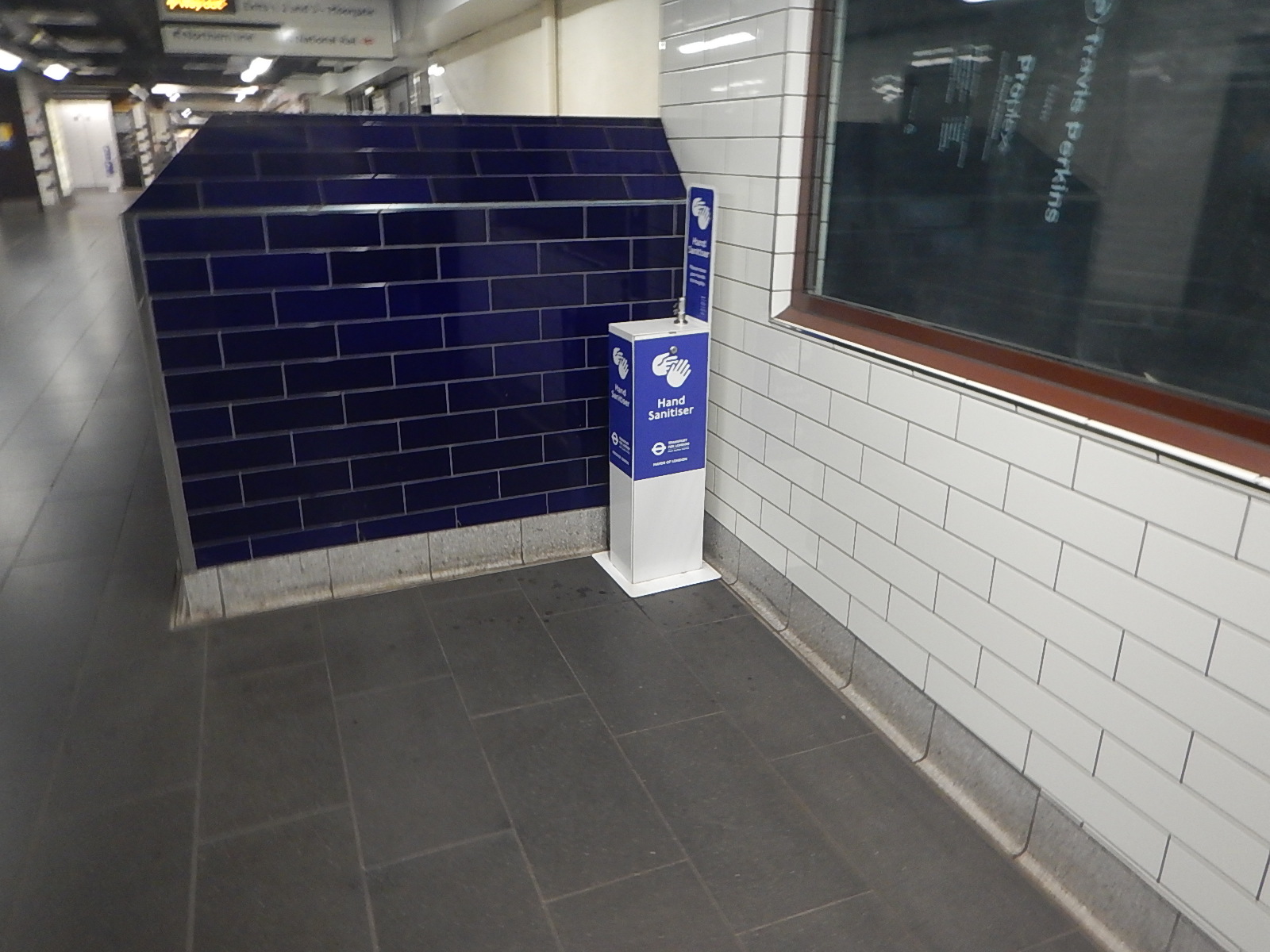
So what a good place to put a hand sanitiser.
I often use these sanitisers, when I pass and wonder if they should be a permanent feature, even after COVID-19 has passed.
Would they help in the control of winter influenza?
A Brief History Of My Left Knee
In March this year I had an accident in my bedroom, which I wrote about in An Accident In My Bedroom.
I said this in the post.
It is now Monday morning and the first picture says a lot. Note the the mat by the step is out of line. It slipped, I then tripped over the step and hit my head on the basin. There is also an overturned stool in the bathroom, which I must have fallen on and this probably did more damage.
My GP thinks I may have a blood pressure problem, so I am regularly taking my blood pressure, sitting and then standing up after five minutes.
But it seems to be behaving itself. If you want to look the figures are in Fighting My Way Through The Covids.
And then last Thursday, I nearly had another fall.
I was getting out of bed at about seven and rolled myself to my feet. I stood up and then my left knee gave way. As I hadn’t fully stood up, I was able to just sit on the bed. So no harm was done!
I didn’t feel light-headed or anything other than fine and I just went to the toilet, brushed my teeth and walked through to my living room and checked the computer, as I always do first thing in the morning.
This isn;t the first time, that my knee has done this.
It must have been in the 1970s, when the knee was doing something similar and I went to see my GP, who recommended seeing a specialist and having an operation. I didn’t.
Nothing much happened again, until perhaps 1980, when after moving to Suffolk, I went to see another GP. He decided, I needed to do a set of exercises, which seemed to work, especially as I was doing a lot of horse-riding, which seemed to help.
Later, when I moved across Suffolk, I swapped real tennis for the horse riding and I’ve never really had any trouble since, until I moved to London.
One strange thing though, was I went to see a specialist fitness trainer after my left-sided stroke in 2010, who said strangely, that my left leg was stronger than my right.
Since the stroke, I’ve had the following falls.
- Two trips on Islington’s bad pavements, where I just picked myself up, dusted myself down and started all over again.
- In one, my knee possibly collapsed, I thought I was having a stroke and I ended up in UCLH.
- I rolled out of bed in a hotel in Strasbourg, when I was dreaming about my late wife.
- I rolled out of bed at home in another vivid dream and needed hospital attention.
- The recent fall, where I ended up in the Royal London.
I certainly feel that 2 and 5 are down to the dodgy knee, I should also say, that in all the falls except for number 2, I felt very normal, although perhaps a bit surprised and stupid.
These are a few random points.
- As a child, I always hopped on my left leg.
- A couple of friends have told me I don’t stand straight.
- My left humerus was broken by the school bully and badly set in Highlands Hospital, so I avoid using it. Does this affect my stance and put pressure on the knee?
- At times in my life, I’ve worn an elastic bandage on the knee.
- I sometimes had trouble with my knee, in intimate moments with my late wife.
As the knee has never been looked at using modern technology, perhaps now is the time.
World’s First Hydrogen-Powered Passenger Train Hits The Rails In Austria
The title of this post is the same as that of this article on Silicon Republic.
This is the first paragraph.
This week in future tech, an Alstom hydrogen-powered train will start taking passengers in Austria for the first time.
But for the covids, I’d be on my way tomorrow to do a bit of advanced-level trainspotting.
Israel Becomes First Nation To Announce A Second Coronavirus Lockdown
This title of this post, is the same as that of this article on The Times.
Israil had done well to control the first lockdown, but now they have over 4,000 new infections per day.
This paragraph gives some details.
About two thirds of the infections are in the Arab-Israeli and ultra-Orthodox Jewish communities, which together account for almost a third of the 8.8 million-strong population. Experts attribute the levels of infection to both groups’ insistence, despite restrictions, on holding weddings with as many as 1,000 guests, and the resumption of study three weeks ago in the ultra-Orthodox seminaries.
With 4,000 new infections in a population of just under nine million, their rate is much higher than in the UK.
Having A Bath – Steptoe Style
One the funniest episodes of the 1960s TV series; Steptoe and Son, is when the father has a bath.
In this episode, amongst other things, he washes his clothes in the bath, whilst washing himself.
I had a mask that needed a quick wash, and as my washing machine has died, I thought why not?
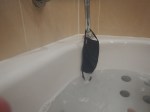
So armed with some Fairy Liquid, the mask joined me for a wash.
Incidentally, I like to have a hot bath every day, as I have very dry eyes, that always get bunged up with sleep. An optician in Vision Express suggested the bath to improve my eyesight and it seems to help.
Will There Be A Sports And Arts Bounceback As There Was After World War II?
This may be optimism, but after World War II, all sports had massive attendances, and I wonder if the same thing will happen, when we get a 100 % reliable vaccine against the covids?
There was even a great desire for fun during the war, as this news item on British Pathe, which is entitled Wartime Derby at Newmarket 1941 shows.
There are several horse racing videos of this period on YouTube.
Perhaps, the proximity of Newmarket to the major fighter base at Duxford, meant that the Luftwaffe didn’t feel safe to attack Newmarket in daylight? Or their intelligent was bad.
Fighting My Way Through The Covids
I owe it to the memory of my great-great-great-grandfather; Robert, who arrived in this country around 1800, from Konigsberg in East Prussia, that I fight my way through the covids.
He had to leave Konigsberg because he was eighteen, male and Jewish! Unless, you were a member of a privileged family, you had to leave. As he had just finished his apprenticeship to be a tailor, he at least had a trade and could carry the tools he needed in a small case.
He became a tailor in Bexley and lived to a good age. I am also sure, that he contributed coeliac disease to the family’s gene pool.
In this post, I will talk about various topics, as I fight my way through to normality.
On the mother’s side of the family, the male line in Huguenot, who probably arrived about 1750.
Did I Fall Because Of A Blood Pressure Problem?
I had a fall in my bedroom, a couple of months ago, as I wrote about in An Accident In My Bedroom.
My GP thinks I might have a blood pressure problem, so I’m now taking my blood pressure sitting down and then standing up for five minutes before taking it again.
These are my readings.
- September 1st – 132/74/182 – 123/102/79
- September 2nd – 145/75/85 – 138/51/82
- September 3rd – 102/77/69 – 123/64/87
- September 3rd – 143/74/75 – 150/64/74
- September 4th – 140/54/64 – 139/64/73
- September 4th – 124/62/92 – 120/51/79
- September 5th – 106/67/51 – 138/52/64
- September 5th – 127/78/67 – 136/62/73
- September 6th – 10:45 – 138/104/76 – 116/53/55
- September 6th – 16:00 – 138/63/54 – 137/88/74
- September 6th – 22:00 – 136/71/59 – 131/77/61
- September 7th – 09:30 – 147/98/76 – 152/82/75
- September 7th – 22:30 – 164/80/74 – 145/61/77
- September 8th – 09:15 – 121/77/66 – 119/71/66
- September 8th – 11:45 – 109/47/70 – 119/48/78
- September 9th – 08:45 – 114/70/73 – 137/51/73 – 129/64/92
- December 9th – 11:00 – 107/146/73 – 143/43/83 – 116/49/87
- September 9th – 20:00 – 131/54/84 – 140/53/78
- September 9th – 21:30 – 131/78/80 – 156/64/81
- September 10th – 10:00 – 148/77/74 – 141/78/63
- September 10th – 13:00 – 106/61/82 – 122/60/81
- September 11th – 09:15 – 137/44/71 – 135/80/66
- September 11th – 10:00 – 126/72/72 – 116/58/70
- September 12th – 10:30 – 119/69/78 – 117/66/70
- September 12th – 20:00 – 111/68/75 – 140/78/69
- September 13th – 10:45 – 112/73/61 – 109/57/69
- September 13th – 15:30 – 106/59/62 – 110/43/65
- September 14th – 09:30 – 116/63/91 – 109/61/85
- September 14th – 17:15 – 117/59/97 – 126/57/79
- September 15th – 08:30 – 134/78/54 – 107/75/76
- September 16th – 06:00 – 113/79/77 – 130/66/80
- September 17th – 09:00 – 117/69/91 – 113/50/63
- September 17th – 22:00 – 118/54/85 – 146/76/86
- September 18th – 09:00 – 147/81/69 – 139/71/67
- September 18th – 21:00 – 124/109/69 – 113/60/83
- September 19th – 10:00 – 143/57/66 – 152/83/75
- September 19th – 19:00 – 118/57/55 – 121/74/81
- September 20th – 09:50 – 143/69/52 – 135/67/66
- September 21st – 09:30 – 158/72/73 – 150/73/66
- September 22nd – 09:15 – 147/49/77 – 149/59/73
- September 22nd – 20:22 – 108/65/82 – 141/66/73
- September 23rd – 08:10 – 140/63/70 – 109/73/60
- September 23rd – 15:00 – 97/65/83 – 109/61/68
- September 24th – 09:00 – 134/52/74 – 143/62/62
- September 25th – 09:00 – 149/70/69 – 130/92/77
- September 25th – 13:00 – 108/75/78 – 135/68/73
- September 26th – 17:30 – 120/62/77 – 124/63/68
- September 27th – 10:00 – 139/64/74 – 132/70/74
- September 28th – 08:00 – 140/73/77 – 140/73/60
Note.
- The first reading is sitting down and the second is after standing up for five minutes.
- My blood pressure meter isn’t the best.
- I didn’t note the times, when I started.
- The third reading is taken about four minutes later.
I don’t know anything about understanding these readings.
Managing My INR
My GP and I have agreed that I should be on 3.5 mg. of Warfarin a day to control my INR.
- So I alternate between 3 and 4 mg.
- I also test my INR every two days.
These are my figures for the last few days, with my Warfarin dose.
- September 1st – 4 mg – N/R
- September 2nd – 3 mg – 2.5
- September 3rd – 4 mg – N/R
- September 4th – 3 mg – 2.7
- September 5th – 4 mg – N/R
- September 6th – 3 mg – 2.8
- September 7th – 3 mg – N/R
- September 8th – 4 mg – 2.4
- September 9th – 3 mg – N/R
- September 10th – 4 mg – 2.3
- September 11th – 3 mg – 2.7
- September 12th – 4 mg – N/R
- September 13th – 3 mg – 2.5
- September 14th – 4 mg – N/R
- September 15th – 4 mg – 2.2
- September 16th – 3 mg – N/R
- September 17th – 5 mg – 2.2
- September 18th – 3 mg – 2.8
- September 19th – 4 mg – N/R
- September 20th – 4 mg. – 2.5
- September 21st – 3 mg – N/R
- September 22nd – 4 mg – 2.2
- September 23rd – 3 mg – 2.3
- September 24th – 4 mg – N/R
- September 25th – 3 mg – 2.4
- September 26th – 4 mg – N/R
- September 27th – 4 mg – 2.1
- September 28th – 3 mg – 2.4
Note.
- If the INR is 2.5 or greater, I take 3 mg that day and 4, the next.
- If it’s less than 2.5, I take 4 mg that day and 3 the next,
- I also check the 30 day average of my Warfarin dose and currently it is 3.6.
One advantage about Warfarin, is the degree of control, you have of your INR.
A couple of years ago, I needed to have a small operation on my mouth.
The surgeon wanted to use an anaesthetist to boost the bill.
- So I said, what INR would be safe and he said 2.1!
- In the end I reduced it, by not taking four mg of the drug.
- After the successful operation, I brought it back up to 2.5, by taking an extra four mg.
- I suspect it cost me a tenner for the extra strips!
Good value and I avoided the lottery of anaesthesia.
I’m Drinking A Lot
In a four-hour period a few days ago, I drank two litres. Is that excessive?
It did include half a unit of alcohol, but was mainly mugs of tea.
And I still felt the need to drink more.
General Health
Like most coeliacs, I know on a gluten-free diet, I’m doing fairly well in the pandemic.
Not one of us has had a severe dose of the covids. But then I’ve never had flu since I went gluten-free and I’ve only had a flu jab since 2005.
Could this be related to the fact, that the gluten-free diet gives us a strong immune system and seems to protect us from cancer, according to research by Joe West at Nottingham University?
Social Distancing In An Empty Train
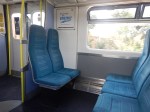
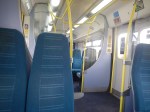
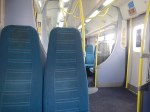
On Sunday morning, I went to Croydon to look at Windmill Bridge, in Croydon, which I wrote about in Croydon Area Remodelling Scheme – Lower Addiscombe Road / Windmill Bridge.
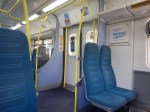
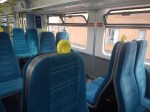
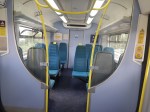
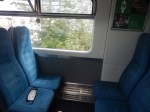
On the way, I found myself in a more or less empty carriage, as these pictures show.

It all got me thinking.
- Generally, the rule in most of the world, is that you should keep a given number of metres apart.
- But supposing, that each public space were to be given a figure for the maximum number of people, who can occupy the space.
- I think, this has already happened in London, where thirty passengers seems to be the maximum number allowed on a double-deck bus.
- Buses and train carriages are public spaces.
But supposing each space was to be assigned a figure for the number of people present, below which the wearing of masks would be optional.
On a bus or train, the customer announcements would change appropriately.
Some might argue, it would be confusing, but it might nudge passenger behaviour in the right way.
- More might travel.
- More might travel at less busy times.
- I suspect that many on a long commute, take their masks off, as they get near home, as te train empties out anyway!
- It should be born in mind, that many modern trains, trams and buses, may know how many passengers are on board, as they can count passengers.
A Design Crime – Pedestrian Chaos At London Bridge
To get home from London Bridge station, I usually get the 141 bus in the station, or if I’m walking along the riverside, I get a 21 or 141 bus from the stop at the Southern side of the bridge.


There is now, no stop on the bridge, so it meant walking nearly to Bank station to get a bus. Not everybody of my age could manage that!
I hope the pea-brained idiot, who designed the current scheme at London Bridge, with no bus stops in either direction has been given his marching orders.
I know that for COVID-19 and wannabe terrorists something must be done, but surely one of the bus-stops in each direction should be working.
I suspect, it was designed by the same idiot, who decided to close the important Waterloo and City Line.
The Mayor won’t care, as he’s a South Londoner.

