Green Hydrogen Project Win
The title of this post, is the same as that of this news item from Nova Innovation.
These are the first two paragraphs.
Nova and consortium partners The University of Strathclyde, Shetland Islands Council and Ricardo Energy, have been awarded funding from the Scottish Government’s Emerging Energy Technologies Fund – Hydrogen Innovation Scheme for their GHOST project.
The GHOST project (Green Hydrogen and Oxygen Supply from Tidal Energy) will look at the potential of producing green hydrogen and oxygen from Nova’s tidal energy projects in Shetland.
They plan to generate hydrogen from tidal energy around the island of Yell. The oxygen, which is often just released into the air, will be used in aquaculture and possibly as rocket fuel at SaxaVord Spaceport.
This map shows Shetland.
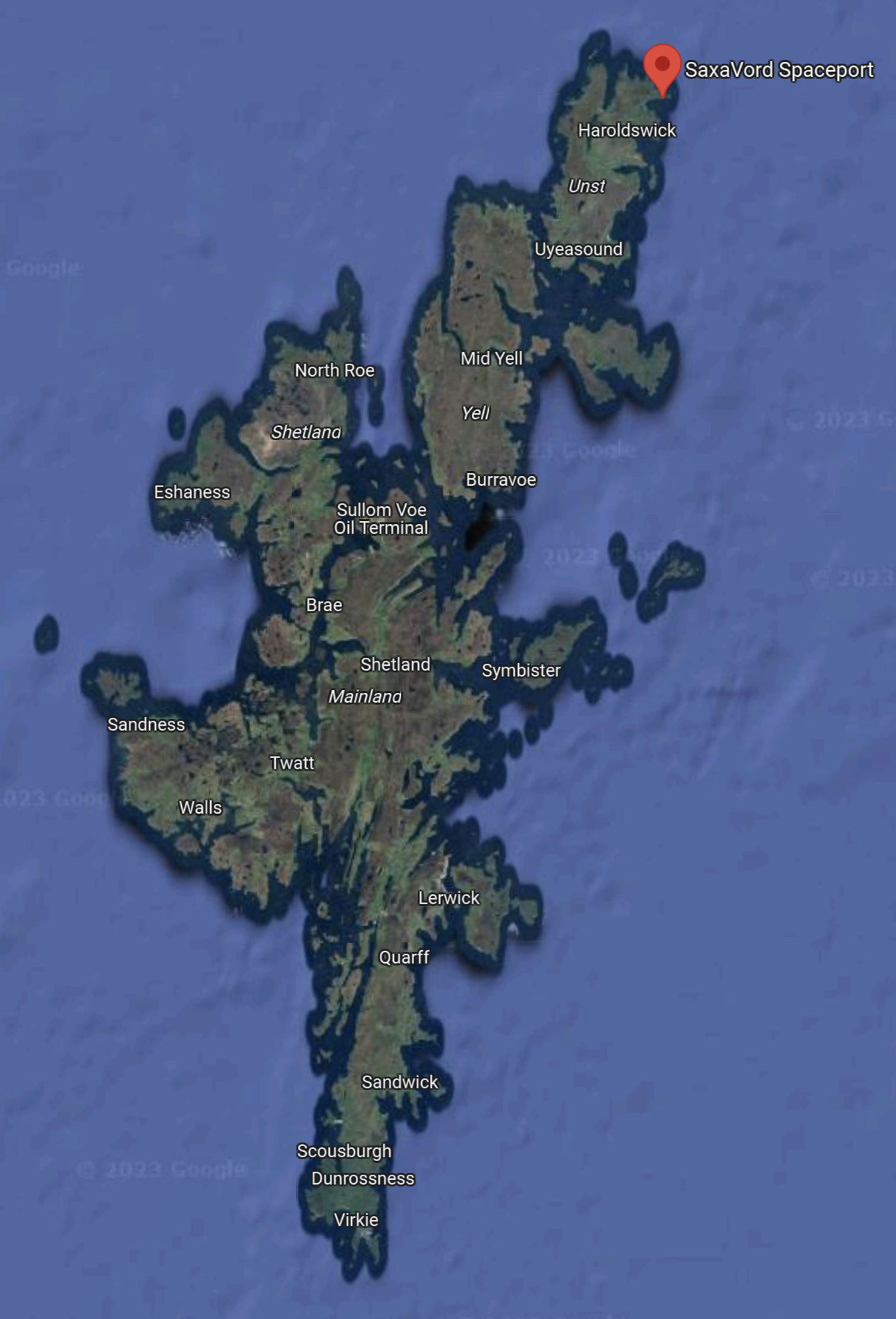
SaxaVord Spaceport is marked by the red arrow at the North end of the archipelago on the island of Unst and Yell is the next island to the South.
If GHOST is successful, it looks like they will have a ready market for their fuel.
Hydrogen Buses Start Running Across Region
The title of this post, is the same as that of this article on the BBC.
These are the main points.
-
A fleet of 20 hydrogen powered buses start running in Merseyside
-
The zero emission buses will improve air quality, Mayor Steve Rotheram said
-
He wants the Liverpool City Region to be net zero carbon by 2040
The buses will operate on the 10A route between St Helens, Knowsley and Liverpool city centre.
I wonder, if they’ll go past my old digs on Huyton Lane.
ESB, Irish Port Team Up To Make Shannon Estuary Go-To Place For Floating Wind
The title of this post, is the same as that of this article on offshoreWIND.biz.
This is the sub-heading.
Irish energy company ESB and Shannon Foynes Port, the company with statutory jurisdiction over all marine activities on the Shannon Estuary, have entered into a collaboration to develop the region into a centre for the deployment of floating offshore wind projects in both Irish and international waters.
This is the introductory paragraph.
Back in 2021, ESB and its then-partner Equinor announced the development of the 1.4 GW Moneypoint floating wind farm in Ireland, with a broader plan under its Green Atlantic @ Moneypoint project to transform the Moneypoint power station in County Clare into a green energy hub and to support wider plans of Shannon Foynes Port to help make the Shannon Estuary a focal point for the offshore wind industry in Europe.
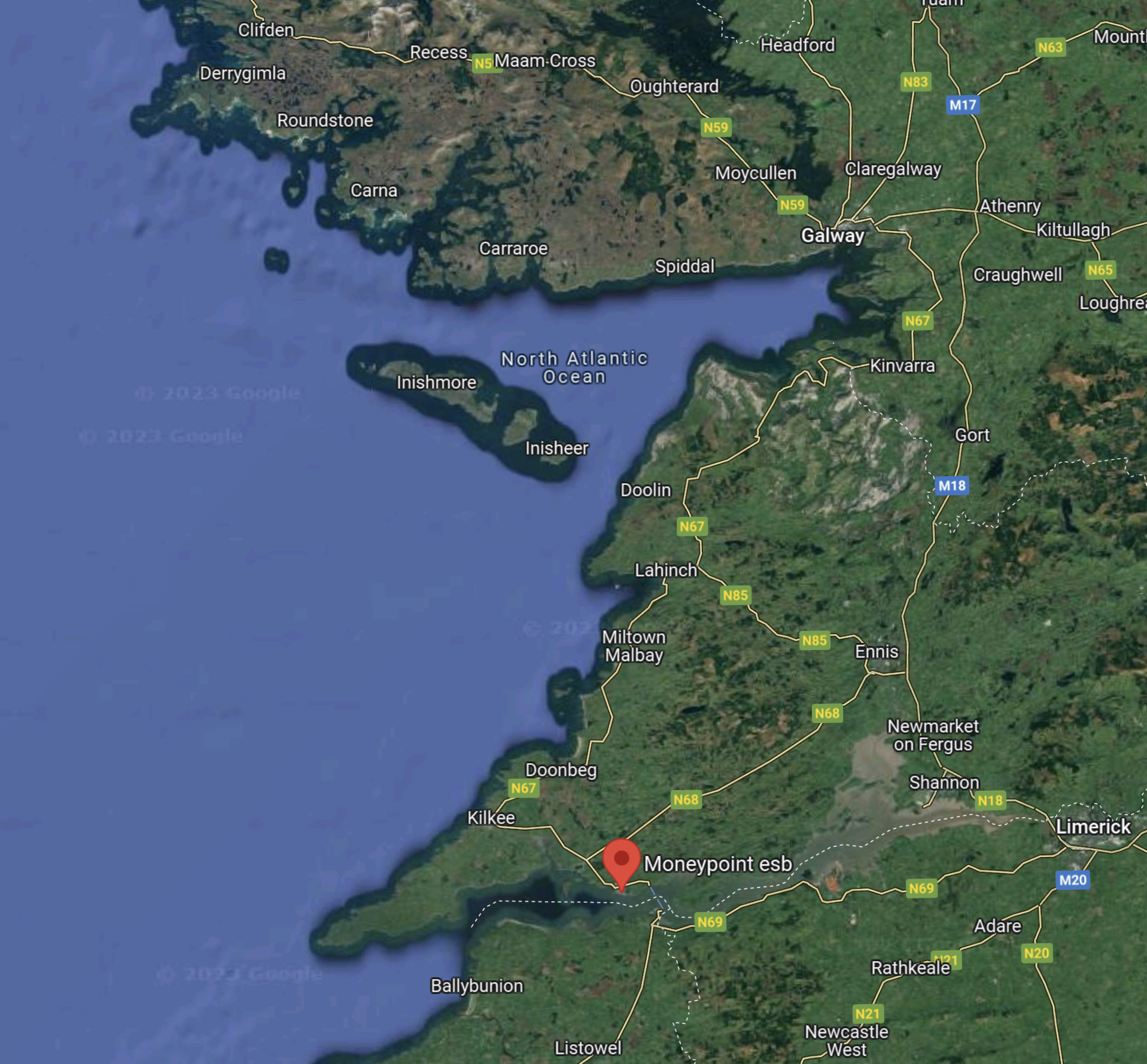
This Google Map shows the location of Moneypoint power station with respect to the Shannon Estuary.
Note.
- Moneypoint power station, which is indicated by the red arrow is on the River Shannon.
- The city pf Limerick is to the East of Moneypoint.
- There’s certainly a lot of water in the West for floating wind turbines.
This second Google Map shows a close-up of the power station.
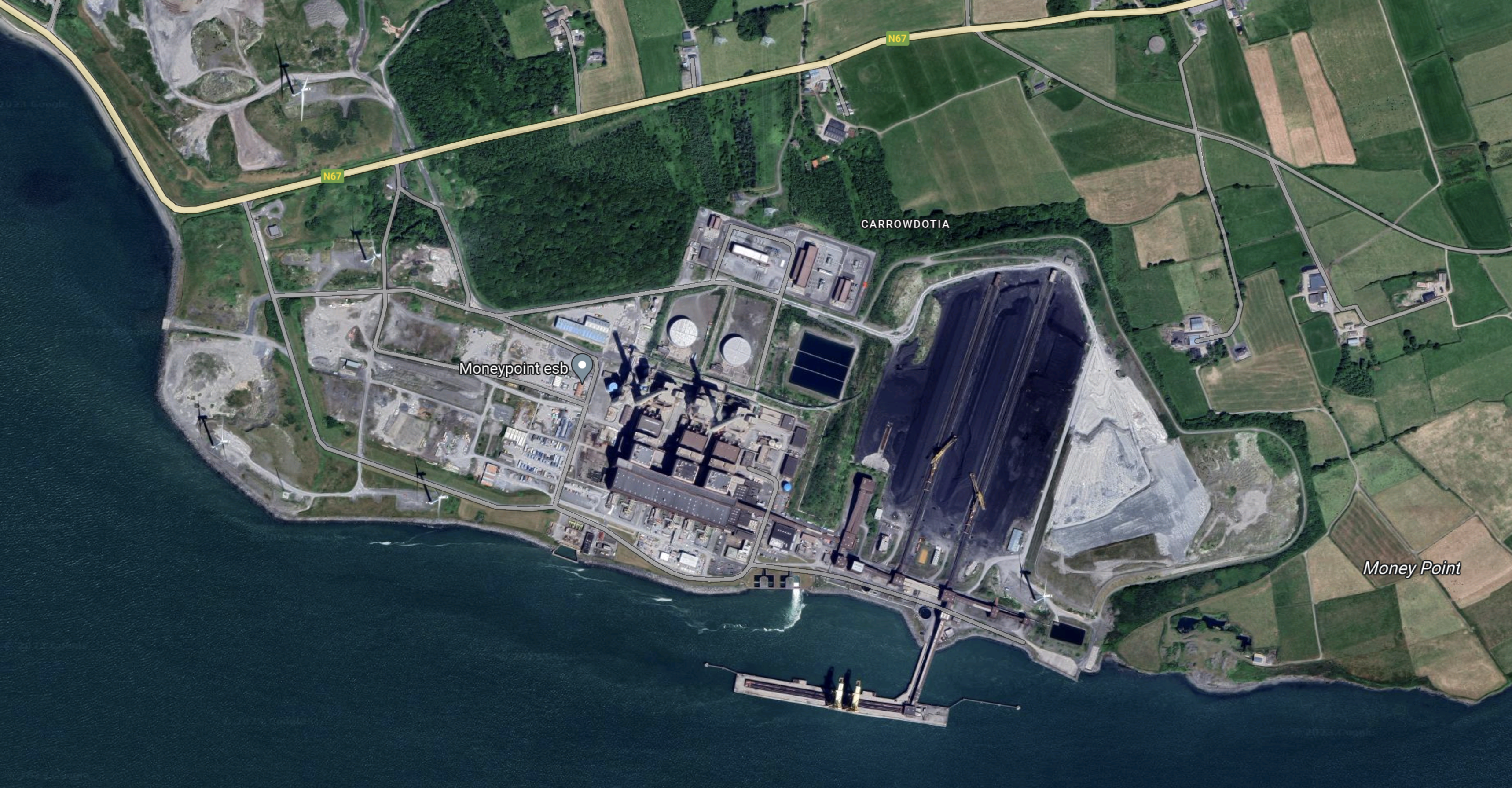
This is a shortened version of the first paragraph of the Wikipedia entry for the power station.
Moneypoint power station is Ireland’s largest electricity generation station (output 915 MW) and only coal-fired power station. Commissioned between 1985 and 1987, it is located on the River Shannon near Kilrush, County Clare. It was constructed at a cost of more than £700m in one of the largest capital projects in the history of the state. The station operates largely on coal, making it both unique in the context of Irish electricity production and the country’s single largest emitter of greenhouse gases. It is capable of meeting around 25% of customer demand across the country. It has two Heavy Fuel Oil (HFO) storage tanks with a capacity of 50,000 tonnes which can be used as a back-up fuel if required.
In some ways, the only good things about this power station are the grid connection that can handle most of a GW and the large site, which could be used for a variety of energy-related purposes, like green hydrogen generation and storage.
In Shannon Estuary Could Support Build-Out of 30 GW Of Floating Wind, House 2 GW of Electrolysis Capacity, I wrote about the potential of this area.
Those figures of 30 GW of floating wind ans 2 GW of electrolysers will certainly mean a lot of investment going into Moneypoint!
I would also feel, that Moneypoint will need a lot of energy storage to support and balance the grid.
Have Your Say About Potential New Hydrogen Facility In Aldbrough
The title of this post, is the same as that of this article on HullLive.
This is the first paragraph.
SSE Thermal is looking for input from the local community regarding its first-of-a-kind low-carbon hydrogen facility.
They are holding meetings in the Hull area as follows to discuss the project with anybody who is interested.
- Tuesday, June 6, 2:30pm – 7pm: Hedon Town Hall, 36 St Augustine’s Gate, Hedon, HU12 8EX
- Wednesday, June 7, 2:30pm – 7pm: East Village Meadows, Northfield Farm, Garton, HU11 4QB
- Thursday, June 8, 2:30pm – 7pm: Aldbrough Village Hall, Garton Rd, Aldbrough, HU11 4QA
I shall be going on the Tuesday. There are buses from Hull station, which take about 35 minutes.
This section is copied from the HullLive article.
What is the Pathfinder Project?
The Aldbrough Hydrogen Pathfinder project is an important building block in the development of a thriving Humber hydrogen economy, underpinning the region’s decarbonisation and supporting economic growth locally and nationally.
The project is proposed to be developed within its existing site at Aldbrough Gas Storage, and all visible infrastructure will be within the site boundary.
The project intends to use one of the current storage caverns and repurpose it to develop a project in the Humber that would unite hydrogen production, storage and power generation in one.
As someone, who feels strongly about the benefits of hydrogen, I feel this is a very worthwhile project.
£77 Million Investment For UK Heavy Duty And Commercial Vehicle Projects
The title of this post is the same as that of this press release from the Advanced Propulsion Centre.
These are the projects.
Ford to design, develop, and build a fleet of 8 hydrogen fuel cell powered Transit vans, with the latest advances in technology
£8 million awarded by government, matched by industry to a total £16.3 million.
This research project will design and develop a hydrogen fuel cell-powered version of the Ford Transit van, with a Ford Dagenham estate facility re-purposed for upfitting of the vehicle. By bringing the manufacturer, vehicle operator and supply chain businesses together, this project aims to establish a business case for the wider rollout of hydrogen Light Commercial Vehicles.
Project partners include: Ocado, BP, Cygnet Texkimp, Cambustion, Viritech.
Note.
- I suspect Ocado will do the road testing.
- BP will probably supply the hydrogen.
- Cygnet Texkimp are a company based in Northwich and is a leading global provider of fibre handling and converting technology. Have they developed a machine for knitting hydrogen fuel tanks?
- Cambustion‘s Engineering Services team provides powertrain development and testing services to a range of global clients from our Cambridge, UK base.
- Viritech’s web site has a mission statement of Rewiring the DNA of Hydrogen Powertrains.
Ford seem to have assembled a team of all the talents.
Wrightbus to develop a new world-leading zero-emission battery and hydrogen fuel-cell electric, multi-axle vehicles
£6.4 million awarded by government, matched by industry to a total £12.7 million.
This project will produce a new, market-leading platform for battery and fuel cell electric driven buses. Whilst demand is growing for zero-emission vehicles, there are currently few options available for heavy, multi-axle vehicles like large buses.
Project partners include: Queens University Belfast, Grayson Thermal Systems, Hutchinson Engineering, Translink.
Note.
- Grayson Thermal Systems are based in Birmingham and specialise in providing HVAC for vehicles and especially zero-carbon ones.
- Hutchinson Engineering are based in Widnes and invest in state-of-the-art machinery and technology to give our customers the most advanced, cost-effective solutions in design, fabrication and manufacturing.
- Translink provides public transport in Northern Ireland.
It looks like Wrightbus have excellent partners.
ULEMCo creating a zero-emission hydrogen fuel cell range extender for prototype ambulance, fire engine and road sweepers
£3.9 million awarded by government, matched by industry to a total £7.9 million.
This project will develop a hydrogen fuel cell range extender for electric vehicles used for special purposes, such as ambulances, fire engines and street sweepers. The zero-emissions range extender will be based on existing, proven technology from the Toyota Mirai, and demonstrate how zero emissions vehicles can be used in a wide range of specialised and challenging settings.
Project partners include: Altair Engineering, Emergency One, Technical Services Ltd, Oxon Fire & Rescue Services
Note.
- ULEMCo are based in the Liverpool City Region and it is very much in Liverpudlian DNA to repurpose something that works. Hence the use of The Toyota technology.
- Altair Engineering is a multinational engineering and technology company.
- Emergency One is a Scottish manufacturer of fire engines and emergency vehicles.
- Technical Services Ltd, who are based in Cleckheaton, supply thermal management systems and solutions.
- Oxon Fire & Rescue Services will obviously be doing the testing.
In Hydrogen-Powered Ambulance Drives Into Glasgow Ahead Of London Trial, I wrote about a prototype hydrogen-powered ambulance, that was built by ULEMCo and industry partners, that was shown at COP26.
Is this project turning the prototype into a system, that can be manufactured in large volumes?
Bramble Energy developing a hydrogen double-deck bus, using innovative, low-cost fuel cell technology
£6.3 million awarded by government, matched by industry to a total £12.7 million.
This project will demonstrate a fuel cell/battery hybrid powertrain on a double-decker bus. This novel product will be cheaper than the equivalents currently available for large vehicles like buses and uses innovative new electronics and energy recovery technologies.
Project partners include: University of Bath, Equipmake, Aeristech
Note.
- Bramble Energy‘s Printed Circuit Board Fuel Cell (PCBFC™) is a patent protected, revolutionary design which leverages existing manufacturing routes from the printed circuit board industry to offer a cost-effective, scalable hydrogen fuel cell solution.
- Equipmake are based at Snetterton in Norfolk.
- In Equipmake Hybrid To Battery Powered LT11, I describe Equipmake’s conversion of a New Routemaster to battery operation.
- Aeristech are based in Crawley and have developed a range of award-winning compressors for Tier-1, OEMs and other customers.
- Is the compressor needed to pump a mixture of hydrogen and air through the fuel cell?
I have a feeling, that this could be a very revolutionary design.
BorgWarner developing hydrogen combustion systems for heavy-duty commercial transport
£4.9 million awarded by government, matched by industry to a total £9.8 million.
This project aims to speed up the rollout of hydrogen-burning internal combustion engines, as an alternative to diesel. Hydrogen is a clean fuel, producing only water when burned. Project Cavendish will develop new fuel and air management systems, so that existing heavy duty diesel technologies can be repurposed to use hydrogen as fuel.
Project partners include: Mahle, Cambustion, Hartridge
Note.
- BorgWarner is a large American automotive supplier.
- Mahle is a large German automotive supplier.
- Cambustion‘s Engineering Services team provides powertrain development and testing services to a range of global clients from our Cambridge, UK base.
- Since the brand formation in 1930 Hartridge, who are based in Buckingham, has become a world leader in diesel fuel injection test equipment.
- Project Cavendish is obviously named after Henry Cavendish, who discovered hydrogen.
In Ricardo Supports Industry Leaders To Develop Innovative Dedicated Hydrogen Engine, I talk about another project involving BorgWarner. Is Project Cavendish a follow-on from the original project or a new one?
Leyland Trucks scaling up the production of electric trucks through innovations in automation and advanced testing
£2.6 million awarded by government, matched by industry to a total £5.1 million.
By better use of automation and advanced testing, Leyland Trucks aim to increase productivity and step up their production of battery electric trucks. A ‘digital twin’ of the Leyland production line will be set up, meaning any changes can be run in simulation before being rolled out physically.
Project partners include: Expert Tooling, HSSMI
Note.
- Leyland Trucks is one of Britain’s leading manufacturing companies. It is PACCAR’s established centre for light and medium duty truck design, development and manufacture. The company is based in Leyland.
- Expert Technologies are specialists in delivering industrial automation solutions. The company is based in Coventry.
- HSSMI is a sustainable manufacturing consultancy.
As I have done a lot of simulation in my time, I’m very much in favour of digital twins.
JLR leading a consortium research project to develop a high-efficiency and highly integrated 800V inverter designed and built in the UK
£6.3 million awarded by government, matched by industry to a total £12.6 million.
This project will explore and develop technology for inverters – a key component in electric vehicles. As well as developing a best-in-class product, this work will support the growth of a UK supply chain in components for electric vehicles.
Project partners include: University of Bristol, Custom Interconnect Ltd, API Capacitors Ltd
Note.
- JLR is Jaguar Land Rover.
- Custom Interconnect is an advanced electronics manufacturing company, which is based in Andover.
- API Capacitors is the UK’s leading designer and manufacturer of high quality power capacitors for power electronic applications. The company is based in Great Yarmouth.
I suspect this invertor will have several applications.
Conclusion
The grants seem to have been widely spread around the UK.
South Korea Targets Over 2,000 Hydrogen Buses By 2026
The title of this post, is the same as that of this news item from Argus Media.
This is the sub-heading.
South Korea plans to convert more than 250 commuter buses intro hydrogen-fuelled buses by this year and more than 2,000 by 2026, in a concerted effort to raise the uptake of hydrogen vehicles.
It appears to be a well-thought plan.
This last paragraph gives South Korea’s long-term objective.
A higher uptake of hydrogen vehicles is in line with the hydrogen roadmap the government released in November 2022, where it envisioned the transportation sector as one of the key drivers of large-scale hydrogen demand. South Korea aims to raise its supply of high-mobility vehicles such as hydrogen buses and trucks, with a goal of producing 30,000 hydrogen commercial vehicles and building 70 liquid hydrogen refuelling stations in the country by 2030.
We need an ambitious plan like this in the United Kingdom.
As the UK population is thirty percent larger than South Korea’s we probably need one with similar but larger ambitions.
Green Hydrogen Production Facility
The title of this post is the same as this project on the Arup web site.
This is the introduction.
Green hydrogen – hydrogen produced using 100% renewable energy – holds promise as a future, low emission energy source. Across the world many players are beginning to explore or invest in its production at scale.
Statkraft are Europe’s largest renewable energy producer and are investing heavily in green hydrogen as an energy source for use in transportation and industry. Statkraft have identified a site in Pembrokeshire for a green hydrogen production facility near to the Haven Waterway Enterprise Zone, an area focusing on developing opportunities within the energy and environment sectors.
This green energy hub will be located on the former Royal Navy Armaments Depot in Trecwn, Pembrokeshire. During development, the site employed over 3,000 people, and it is hoped that this new facility can continue to support highly skilled jobs in the area, while contributing to the Welsh Government’s net zero strategy.
Statkraft have a web page for the Trecwn Green Energy Hub, where this is said about the expected production.
It is estimated that the 15MW hydrogen plant will generate up to 4 tonnes of hydrogen a day, the equivalent of powering a single bus for over 40,000 miles. The hydrogen produced could be used locally for a range of purposes including transport, as a feedstock or heat source for industry and manufacturing, as well as for heating buildings.
This Google Map shows the location of Trecwn in Pembrokeshire.

Note.
- The red arrow indicates Trecwn.
- The port of Fishguard is just to the North of Trecwn.
The site appears to be at RNAD Trecwn, which is a decommissioned Royal Navy Armaments Depot.
This second Google Map shows the remains of some of the site.
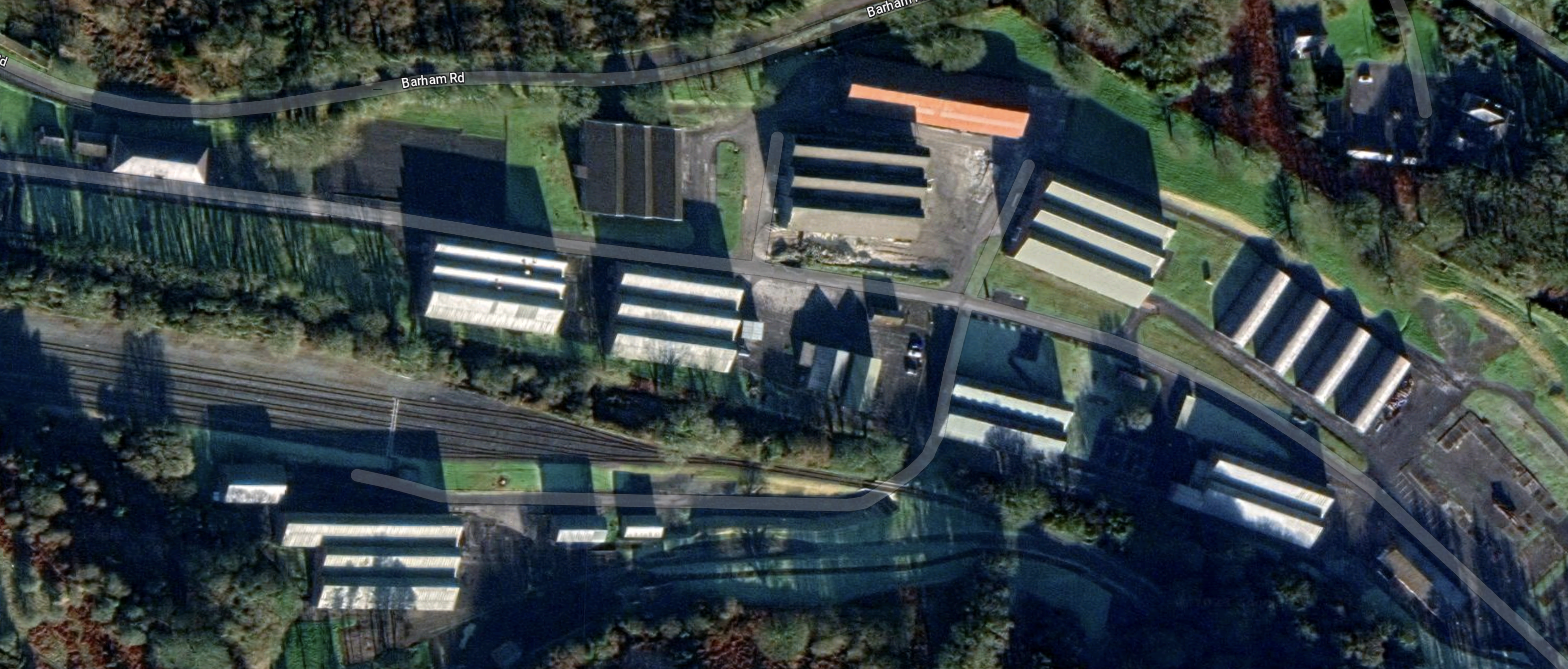
Note the railway line to the site, which is visible in West of the map, which connects to Carmarthen, Fishguard, Milford Haven and Pembroke Dock.
Wikipedia says this about its condition.
Network Rail have not only kept the railway connection operational, but refurbished it to allow the site to develop as an Intermodal freight traffic distribution site from Fishguard.
Note.
This would surely enable local trains, port operations, railway locomotives and ships to be hydrogen-powered.
- Trains and railway locomotives could be filled on the site.
- Buses and trucks could be filled on the site.
- Ports could be supplied by hydrogen trains.
- Strangely, I’ve not seen a design for a short hydrogen delivery train, which would be needed to supply the ports. But I doubt, it would be difficult to design and build.
All the Health and Safety protocols could probably easily be created, given the former use of the site.
Conclusion
Statkraft seem to have chosen an ideal site for the hydrogen electrolyser.
Retired Alaska Airlines Turboprop To Get New life As ‘World’s Largest’ Hydrogen-Powered Plane
The title of this post, is the same as that of this article on KUOW.
It’s increasingly looking like, there will be at least a couple of viable hydrogen conversions of current turboprop aircraft to hydrogen.
Cummins And Accelera Showcase Broadest Portfolio Of Decarbonizing Technologies With An Emphasis On Hydrogen
The title of this post, is the same as that of this press release from Cummins.
This is the first paragraph.
Cummins Inc. and Accelera™ by Cummins, Cummins’ zero-emissions technology brand, will showcase a variety of technologies in their booth at Advanced Clean Transportation Expo (May 2 to 4, Anaheim, California). The line-up emphasizes the role that hydrogen will play as part of Destination Zero, Cummins’ strategy to go further, faster to reduce greenhouse gas (GHG) and air quality impacts of its products and reach zero emissions by 2050. The company will showcase technologies across the hydrogen value chain, including electrolyzers to produce hydrogen that can power both a hydrogen-fueled internal combustion engine (H2-ICE) concept truck and a fuel cell electric powertrain.
The press release says this about their electrolysers for hydrogen production.
The hydrogen ecosystem is underpinned by green hydrogen production. Accelera’s electrolyzer technology is enabling the infrastructure scale-up needed to support hydrogen-powered vehicles.
They also say that they now have a 2.5 MW electrolyser module.
The press release has a section about the X15H Peterbilt Model 579 Concept Truck, which is a conversion of a standard Peterbilt Model 579 truck.
Cummins will reveal a heavy-duty concept truck featuring the X15H hydrogen internal combustion engine (H2-ICE). The proof-of-concept installation with ratings up to 500 horsepower (372 kW) features a 700-bar pressure 80 kg high-capacity hydrogen storage system. The H2-ICE conversion highlights the opportunity for heavy-duty truck applications to operate on zero-carbon hydrogen fuel with an operating range of more than 500 miles. The hydrogen conversion work is not expected to compromise truck performance, cargo capacity or payload. The substitution of the diesel engine with the 15-liter hydrogen engine and integration with the existing driveline highlights the ability of H2-ICE to offer a zero-carbon solution for fleets to deploy quickly with limited investment.
This footnote says a bit more about the X15H hydrogen internal combustion engine.
The X15H hydrogen engine with up to 1900 foot-pounds torque is an all-new engine platform featuring cutting-edge technology to enhance power density, reduce friction losses and improve thermal efficiency. As a result, performance is equivalent to that of a similar displacement diesel engine and compatible with the same transmissions, drivelines and cooling packages. A further benefit of the X15H is significantly quieter running than a diesel.
It looks to me, that Cummins will be going for both the new build and replacement market.
Werner Enterprises Signs Letter Of Intent Planning To Secure 500 X15H Engines From Cummins and Transport Enterprise Leasing To Integrate Cummins X15H Hydrogen Engine Into Heavy Duty Trucks show this sales philosophy at work.
The press release also says this about their hydrogen fuel cell engine.
Hydrogen fuel cell engines turn hydrogen stored onboard a fuel cell electric vehicle (FCEV) into electricity to power the electric powertrain. This creates efficient, zero-emissions power for demanding applications with longer ranges and harder duty cycles. On display at ACT Expo is Accelera’s FCE150 Gen 4 fuel cell engine, powered to go the distance with superior performance and reliability and zero tailpipe emissions. It features increased power density, efficiency and durability with ease of system integration. It is available in 150 kW and 300 kW configurations with the flexibility to decarbonize a range of heavy-duty applications.
This looks to be a formidable beast.
After America, The World
It will be interesting to see what plans Cummins have for the rest of the world.
These posts contain some of my thoughts.
- Air Products, Cummins To Accelerate Hydrogen Integration In Fuel Cells Trucks
- Could London’s New Routemaster Buses Be Converted To Hydrogen Power?
- Cummins Fuel Cell Technology Powers Coradia iLint Fleet In Germany
- Daimler Truck North America And Cummins Collaborate To Drive Hydrogen Fuel Cell Trucks Forward In North America
- Do Cummins And Stadler Have a Cunning Plan?
- Electrolyser System To Linde For Green Hydrogen Production In Niagara Falls, New York
- Ricardo Supports Industry Leaders To Develop Innovative Dedicated Hydrogen Engine
This must be one of the biggest conversions of a major corporation to zero-carbon thinking.
World First As HS2 Trials Dual-Fuel Piling Rig On London Site
The title of this post, is the same as that of this news item on HS2.
This is the piling rig.
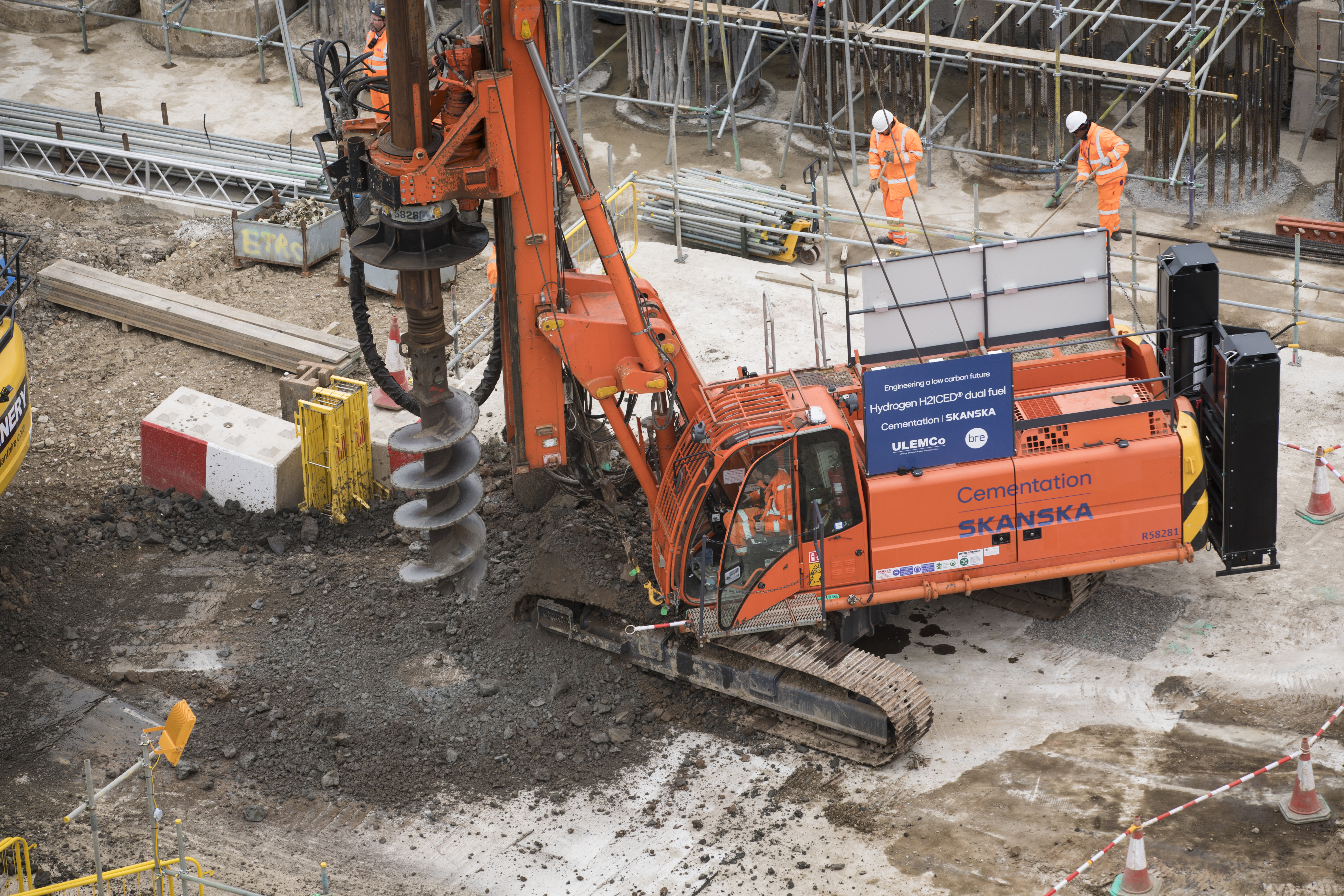
These are the two bullet points.
- Four piles installed using a hydrogen dual-fuel piling rig, cutting the use of traditional fuel by 36%.
- Trial is the first real world use of the technology on a construction site.
These three paragraphs outline the project.
HS2 has taken a further step forward in decarbonising the constructure sector, completing a world first by installing four 30-metre deep piles on a London site using a hydrogen dual-fuel piling rig.
The trial took place as part of work done in partnership by ULEMCo and Cementation Skanska, working with the world-leading Business Research Establishment (BRE), funded through the BEIS Phase 1 Red Diesel Replacement competition.
ULEMCo and Cementation Skanska successfully modified a medium sized CFA piling rig, converting it so that the machine component operated using energy from on-board hydrogen tanks. Using the dual-fuel system, both diesel and biofuels (HVO) can be mixed with hydrogen, displacing the fuel with hydrogen, resulting in a reduction in fuel use and lower CO2 emissions.
Note.
- We’re going to see a lot more large machines converted to dual-fuel and pure hydrogen.
- ULEMCo from Aintree, seem to be one of the leaders in the field of dual-fuel conversions.
You certainly see lots of these machines working around London and other big cities.
 The Anonymous Widower