Meet The Futuristic-Looking Electric Arrival Bus
The title of this post, is the same as that of this article on Microsoft News.
The Arrival Bus is by the same company, who are building electric vans for UPS, that I wrote about in UK Electric Van Maker Arrival Secures £340m Order From UPS.
This is a video of the prototype under test.
This article on CNET is entitled Arrival’s Electric Bus Is Designed For Coronavirus-Era Social Distancing and it contains this paragraph.
The British startup company, which focuses on smart electric vehicles, on Wednesday debuted the Arrival Bus, pitched as just the bus for social distancing. That’s because the interior of the bus is customizable, with removable seats, so you can create additional space between passengers. It’s a pretty novel way to increase or decrease seats to meet reopening guidelines
If it works, knowing Sod’s Law, it will probably be rarely used, as someone will come up with an affordable vaccine, that’s bulletproof!
As we’ve also had an electric bus from Norfolk, that I wrote about in Equipmake Opens New Electric Bus Factory In Snetterton, there will be several players helping to decarbonise the bus industry.
£350m Investment For Britain’s First Mainline Digital Railway
The title of this post, is the same as that of this article on Rail Technology Magazine.
This is the introductory paragraph.
The East Coast Main Line will become Britain’s first mainline digital rail link with £350m of new investment to install state-of-the-art electronic signalling designed to cut journey times and prevent delays.
We’re finally going digital!
The Route Of High Speed Two Into Birmingham
This map clipped from the High Speed Two web site, shows the route of the line to its terminus in Birmingham Curzon Street station.
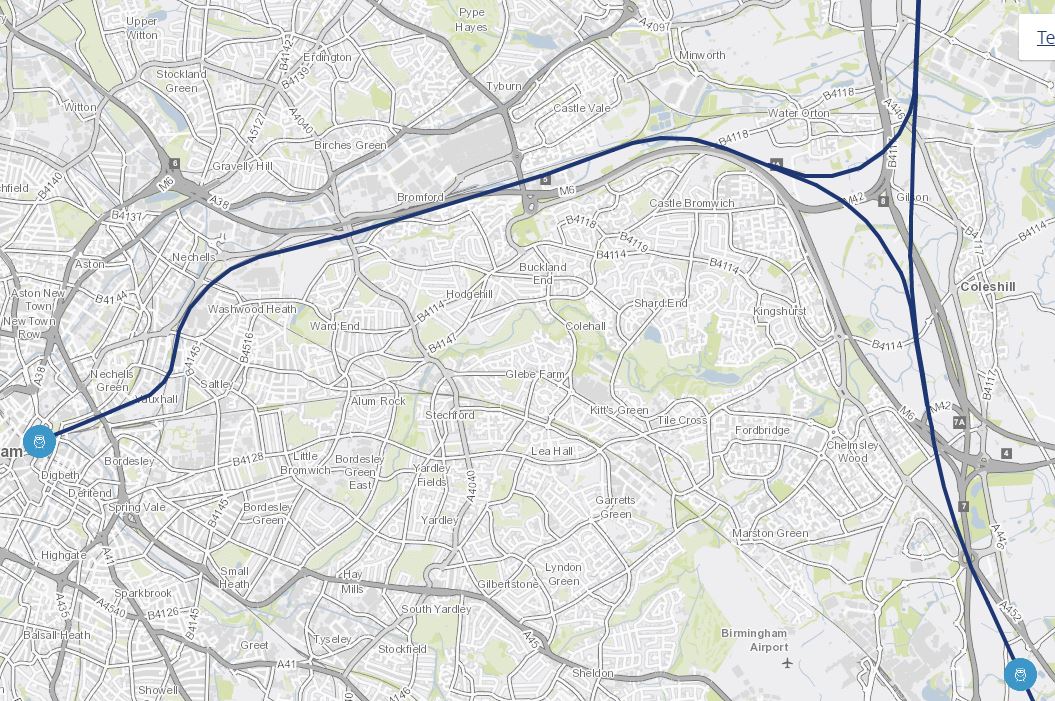
Note.
- Birmingham Curzon Street station is indicated by the blue dot in the West.
- Interchange station is indicated by the blue dot in the South-East corner of the map.
- There is a large triangular junction connecting the spur to Birmingham Curzon Street to the main North-South route of High Speed Two.
This second map is an enlargement of the South-East corner of the map.
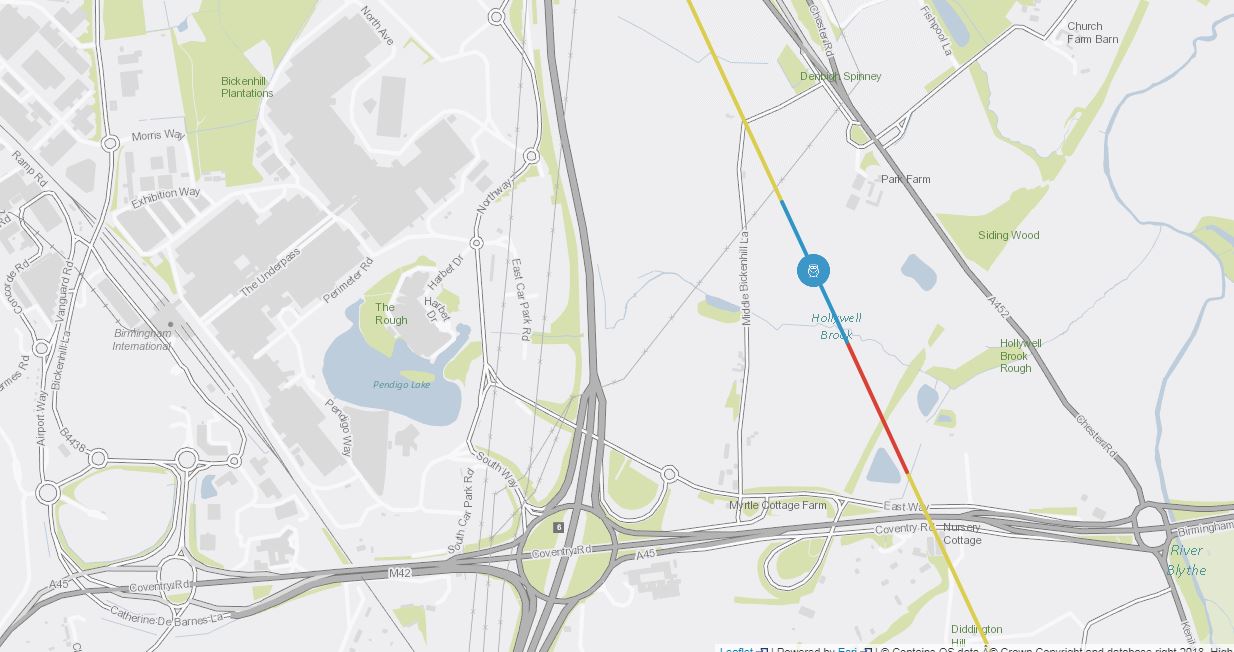
Note.
- The road across the bottom of the map is the A45,
- The large circular roundabout roughly at the halfway [point is where the M42 crosses the A45 at Junction 6.
- The Junction at the Eastern edge of the map is where the A452 crosses the A45.
- High Speed Two goes roughly North-South between the M42 and the A452.
- When shown in red, High Speed Two is on an embankment.
- When shown in yellow, High Speed Two is in a tunnel.
- The large blue dot is the position of the Interchange station.
- The existing Birmingham International station is on the other side of the M42.
- The two stations will be connected by a people mover.
This description of the Interchange station is from this page on the High Speed Two web site.
The Interchange Station itself will be made up of two 415 metre long island platforms, offering 4 platform faces, as well as 2 central high speed through lines for non-stopping services. The station will be linked to the NEC, Birmingham International Station and Birmingham Airport via an automated people mover carrying up to 2,100 passengers per hour in each direction. In addition to the APM, the station will be fully integrated with other local buses, taxis and private vehicle options.
This third map is an enlargement of the triangular junction.
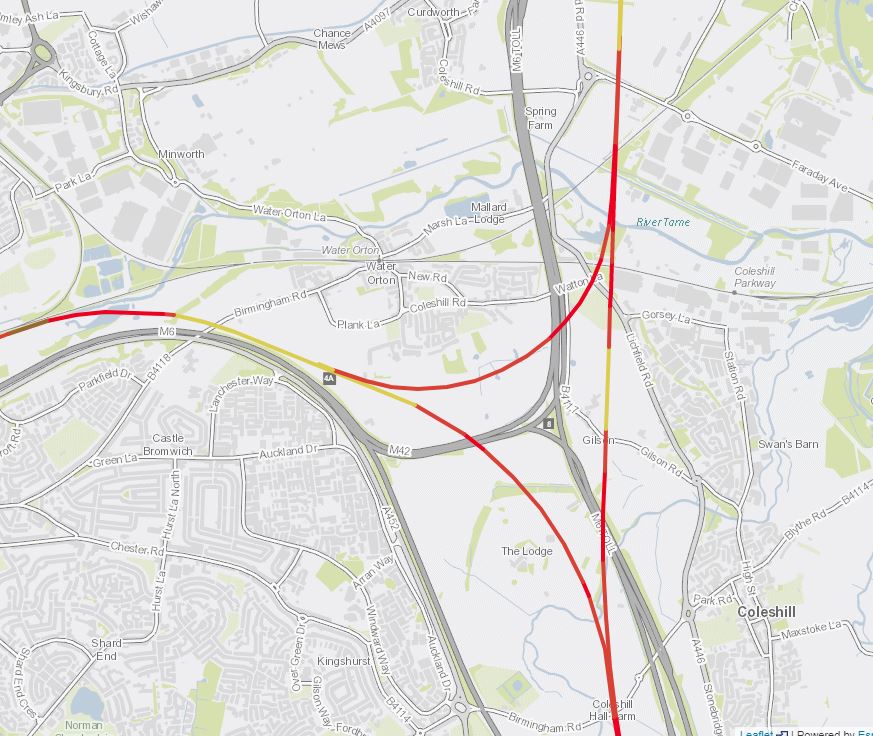
Note.
- The M6 going West to Spaghetti Junction, Birmingham and the North.
- The M42 and the M6 Toll going North-South.
- When shown in red, High Speed Two is on an embankment.
- When shown in yellow, High Speed Two is in a tunnel.
The junction seems to have been fitted around the motorways using a series of embankments and tunnels.
This fourth map shows the approach to the City.
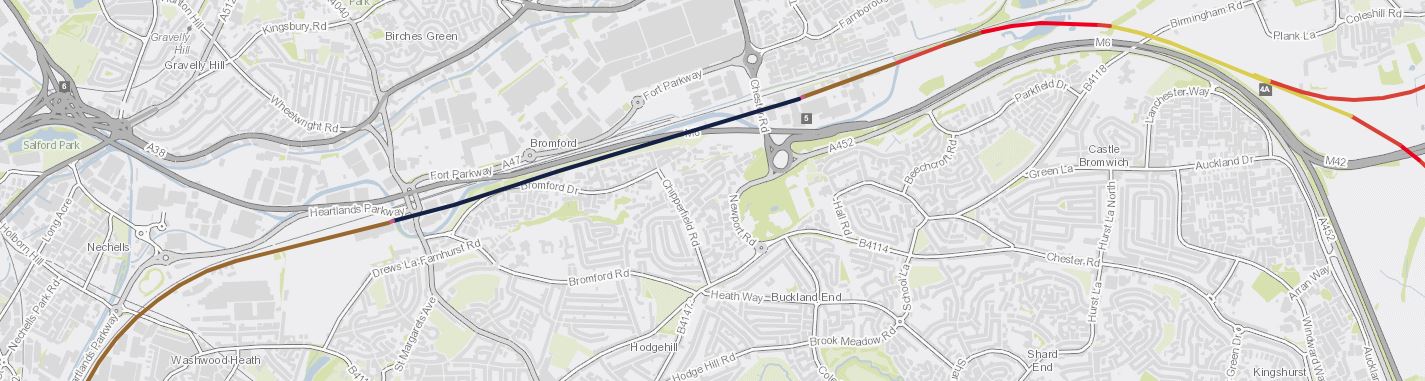
Note.
- The spur appears to run alongside the elevated section of the M6.
- Spaghetti Junction is in the North-West corner of the map.
- The Western junction of the triangular junction is at the Eastern edge of the map.
- When shown in brown, High Speed Two is on the surface.
- When shown in black, High Speed Two is in a cutting.
- Or are black and brown, the other way round, as I can’t find the legend for the map.
The spur seems to have been neatly fitted in alongside the M6.
This fifth map shows the route as it terminates in Birmingham Curzon Street station.

Note.
- The A38 (M) that connects the City Centre to Spaghetti Junction at the top of the map.
- High Speed Two appears to approach the City Centre on a viaduct. But then trains between London and Birmingham New Street and Birmingham Moor Street stations, do the same.
- The three stations are within a reasonable walking distance and there will also be a tram connection.
- The journey time between Birmingham Curzon Street and Interchange stations is planned to be nine minutes.
This page on the High Speed Two web site, gives more details on Birmingham Curzon Street station.
Honeywell Launches Lightweight Cooling System For Electric Aircraft
The title of this post is the same as that of this article on Flight Global.
This is the introductory paragraph.
Honeywell Aerospace has unveiled a lightweight, low-maintenance cooling system for developers of urban air mobility (UAM) and electric aircraft, and has named the Eviation Alice as launch platform for the energy-efficient feature.
I particularly like the comment of Eviation’s founder Omer Bay-Yohay’s comment of “Every ounce counts!”.
But although weight is important in an electric aircraft, like the Eviation Alice, it is also important in other forms of transport from a family runabout to a high-speed train. Especially, if the vehicle is powered by batteries.
It should also be noted, that Honeywell are setting up a specialist business unit to provide equipment for and help the builders of electric aircraft.
Conclusion
Other companies will follow Honeywell’s lead and produce lightweight equipment for the automotive and rail industries.
Green Light For Revived West Midlands Passenger Service
The title of this post, is the same as that of this article on Rail News.
This is the introductory paragraph.
Passenger trains are set to return to the line between Walsall and Wolverhampton, having been withdrawn 12 years ago. Since then, the line has been used for freight.
These points are made about the proposed service.
- Network Rail have agreed the timetable.
- It will be an hourly service between Walsall and Wolverhampton.
- Trains will call at Darlaston and Willenhall, where plans are in place for new stations, as I wrote in Reopening Of Darlaston And Willenhall Train Stations Moves Closer.
- There will also be a second hourly service between Birmingham New Street and Wolverhampton via Tame Bridge, Darlaston and Willenhall.
- Both routes appear to be electrified.
The West Midlands Mayor; Andy Street is quoted as saying he’s pleased with the scheme.
And well might he be!
This to me is a classic reopening scheme.
- There is a fully-electrified freight route, that runs between Walsall and Wolverhampton.
- There used to be three intermediate stations; Darlaston James Bridge, Willenhall Bilston Lane and Portobello.
- The first two intermediate stations closed in 1965 and the last in 1973.
- Network Rail have said, it will be possible to run the extra trains needed.
- The direct Walsall and Wolverhampton service will complete an hourly or better triangular service between Birmingham, Walsall and Wolverhampton.
- This triangular route is also fully-electrified.
- If extra rolling stock is needed, there are quite a few suitable electric multiple units, that are sitting in sidings or will be replaced by new trains in the next couple of years.
Except for the building of the new intermediate stations, nothing would appear to be high cost.
The project must have a high benefit cost ratio.
A Possible Extension From From Walsall To Aldridge
In the Wikipedia entry for Walsall station, this is said.
There are also plans to reopen a terminus single platform at Aldridge for trains to Birmingham New Street via Walsall but not to Sutton Coldfield and Water Orton.
This service would be on part of the freight-only Sutton Park Line between Walsall and Water Orton stations and is regularly used by freight trains avoiding Birmingham New Street station.
This Google Map shows the Sutton Park Line through Aldridge.
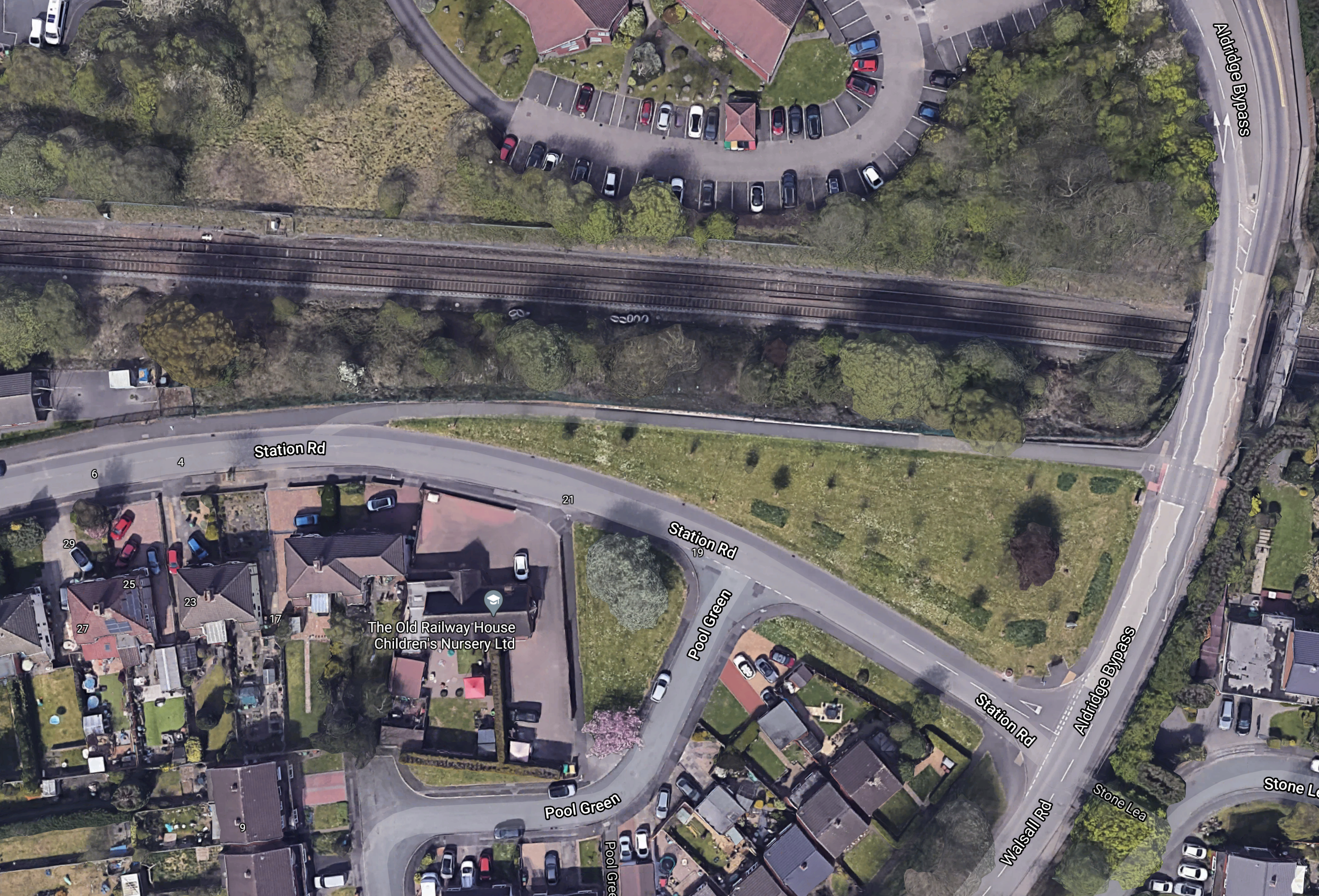
Note.
- The Sutton Park Line is double track and not electrified.
- The road running South of the railway is called Station Road, which is a bit of a giveaway.
- There is a xrossover visible in the image,
There would appear to be space for a reopened station. between the railway and Station Road.
- It could have a single platform.
- There could be adequate car parking.
- There would be no need for an expensive bridge.
- The station could be designed to be converted into a two-platform station if a full service were to be run on the Sutton Park Line at a future date.
As the station would be no more than about five miles from Walsall station and its electrification, the extended service from Walsall could be run by a battery-electric train.
Conclusion
I predict, that if this route is reopened and it is a success, other parts of the UK will want to open more freight lines to passenger traffic.
These similar projects have already been widely mentioned.
- The Leamside Line between Ferryhill and Newcastle stations. See Boris Johnson Backs Station Opening Which Could See Metro Link To County Durham.
- The Ivanhoe Line between Burton-on-Trent and Leicester stations. See Reinstatement Of The Ivanhoe Line.
- Newcastle And Ashington. See Northumberland Unveils £3.5m Rail Project To Bring Back Passenger Services.
- The Camp Hill Line In Birmingham. See First Passenger Train In 80 Years Runs On Camp Hill Line.
- The Barrow Hill Line Between Sheffield and Chesterfield. See Reinstatement Of The Barrow Hill Line Between Sheffield And Chesterfield.
- The Fawley Line Between Totton And Fawley. See Reintroduction Of Passenger Rail Services On The Waterside Line.
Most of these reopening, would just need refurbishment and some new stations.
Hydrogen Freight Trains And Anti-Slip Technology For UK Railways Get Share Of £9.4m Funding
The title of this post is the same as that of this article on Professional Engineering, which is published by the Institute of Mechanical Engineers.
This is the introductory summary.
A zero-emissions machine that removes and replaces rails, a hydrogen-based turbine system for freight trains and ‘cryogenic blasting’ to prevent wheel slip could all be coming to UK railways thanks to a new £9.4m fund.
The article is a good summary of the important projects and it also gives details of what a project in the last round of funding achieved.
I seem increasingly to be reposting articles from professional engineering institutions. Does this mean, that we’re all thinking that good engineering, is one of the ways out of this COVID-19 mess?
I also think, that if I look at the list of twenty-five new projects, that I listed in First Of A Kind Funding Awarded For 25 Rail Innovation Projects, that some will benefit the wider UK population in a world dominated by the remains of the COVID-19 pandemic.
Solar Firm To Develop Novel Electronics For Rail Renewables
The title of this post is the same as that of this article on Engineering and Technology.
This is the introductory paragraph.
Solar energy company Riding Sunbeams has won funding to develop power electronics technology that will enable it to feed renewable electricity directly into railway overhead wires.
Because solar panels and lithium-ion batteries work in DC and overhead electrification works in AC, this sentence describes the main objective of the project.
The Daybreak demonstrator will repurpose existing technology already being used on UK rail networks for other purposes to create a new device that will provide the required power conversion.
Existing technology and equipment will be used to save time and costs and because it is already rail-certified.
The rest of the article fleshes out a few details.
The test system will be installed at Quinton Rail Technology Centre at Long Marston.
This is the closing paragraph.
In particular, Riding Sunbeams hopes its technology will be able to play a part in delivering 70MW of direct-wire renewable generation to help power the soon-to-be-electrified Core Valley Lines in South Wales through a mixture of solar, wind and energy storage.
As electrification in the Core Valley Lines will be discontinuous, it could appear that the technology developed in this project could help connect and reduce costs.
Will Steam Solve The Zero Carbon Freight Locomotive Problem?
Steamology Motion has now been awarded two Department of Transport grants to develop modern steam power for UK railways.
February 2019 – W2W Zero Emissions Power System
In Grants To Support Low-Carbon Technology Demonstrators, I quoted an extract from this article on Railway Gazette to describe their W2W Zero Emissions Power System.
Steamology’s Water 2 Water concept will use compressed hydrogen and oxygen gas in a ‘compact energy-dense steam generator’ to produce high pressure superheated steam to drive a turbine, which will generate electricity to charge the batteries as a ‘range extender’ for a Vivarail Class 230 multiple-unit produced from former London Underground vehicles.
There is not much on the Internet about this project, but I did find this article on the Bournemouth Echo, which is entitled Team Behind Chalres Burnett Steam Car Is Working On Trains.
Note that the typo in the headline is not mine, but one of the worst, I’ve seen in a newspaper, since the heady days of the Liverpool Echo in the 1960s, which gave Fritz Spiegl a second career, with all its spelling mistakes.
In the article, Chief Engineer; Christopher Lack describes the steam power like this.
We take hydrogen and oxygen and we burn them inside the chamber which then creates steam and we use that steam to drive a turbine which then powers the generator.
That all sounds very feasible, despite being a bit like the power system of a Space Shuttle, which carried liquid hydrogen and oxygen in the external tank.
At take-off the Space Shuttle carried 629.3 tonnes of liquid oxygen and 106.3 tonnes of liquid hydrogen. Will hydrogen and oxygen always have a similar 5.92 ratio by weight in any combustion process?
June 2020 – Zero Emission Rail Freight Power
In First Of A Kind Funding Awarded For 25 Rail Innovation Projects, I described this project like this.
Hydrogen-based steam turbine system to provide zero emission power for existing freight locomotives.
This is surely a much bigger challenge, as a Class 66 Locomotive for example, has a power output of nearly 2,500 kW, which might need to be sustained for three or four hours. That could be ten MWh, which explains why battery freight locomotives haven’t been developed.
As hydrogen contains 147 MJ/Kg of energy, does that mean that about 250 Kg of hydrogen and an equivalent amount of oxygen would be needed to power the locomotive for four hours?
The amount of space required for the fuel doesn’t seem to be ridiculously large, so that shouldn’t be a problem.
One of the processes in the chemical industry, that I haven’t modelled is combustion. This is probably because, when I was building mathematical models in the chemical industry, it was for ICI Plastics Division and their processes were all about pressure and/or mixing large amounts of chemicals in huge reaction vessels.
But thinking about it, if you burn hydrogen and oxygen in a combustion chamber, you’ll generate a lot of heat, but not much superheated steam to drive a turbine.
So could Steamology Motion have combined the combustion chamber and the boiler in some way?
Suppose, hydrogen and oxygen are burned in a combustion chamber and controlled amounts of water are injected into the chamber.
- Obviously, not enough to stop the combustion.
- The water would vaporise and surely join the combustion products and come out as turbine-ready superheated steam.
I suspect some researcher somewhere has used this process to see if they can drive a steam turbine from hydrogen and oxygen.
Perhaps, they were experimenting with a hydrogen-based energy storage system.
- An electrolyser powered by surplus renewable energy, would split water into hydrogen and oxygen, which would be stored under pressure.
- To recover the energy, the hydrogen and oxygen would be burned together to create superheated steam to drive a turbine.
The process could work, with an efficient hydrogen and oxygen to superheated steam generator.
But would it be economic, when compared with a hydrogen fuel cell? Fuel cells don’t need to have an oxygen feed and just uses common-or-garden air!
On the other hand, as the US space program has shown, it might work with liquid hydrogen and oxygen, which would possibly need less storage space and could mean a longer range for the locomotive.
Conclusion
It is a very large engineering challenge for Steamology Motion to get their system to work.
But, I do believe, that it’s possible to make the idea work.
I also think that the Government wouldn’t have signed up for a second project, if the first project had been a complete failure.
But, if Steamology Motion can convert a Class 66 locomotive from a polluting, noisy, carbon-spewing dinosaur into an eco-friendly hydrogen-electric locomotive, they will have done the planet an enormous favour, as there are tens of thousands of diesel locomotives, that could be converted.
They will also make billions for themselves!
15 More Fuel Cell Electric Buses For UK Roads
The title of this post, is the same as that of this article on H2 View.
This is the introductory paragraph.
A further 15 fuel cell electric buses (FCEBs) are planned for the UK this year, as the country works towards its goal of deploying 4,000 zero emission buses over the next five years.
These futher points are made.
The fuel cells are 85KW heavy-duty FCveloCity®-HD fuel cell modules from Ballard Power Systems.
This will take Wrightbus’s order book for hydrogen-powered buses to fifty. all of which will be delivered this year.
Twenty buses are for London and fifteen are for Aberdeen.
I have some thoughts on the 85KW heavy-duty FCveloCity®-HD Fuel Cell Module.
This pdf file on the Ballard web site is the data sheet and this is selected data.
- The net power is 85 kW
- The fuel cell weighs 256 Kg.
- It needs a coolant sub-system that weighs 44 Kg.
- It needs an air sub-system that weighs 61 Kg.
- It is a true zero-emission product.
It is worth looking at the power train of a New Routemaster bus, which although very different will probably give clues as to the weight that can be carried and the power and battery size needed for a full-size bus.
- The Cummins ISBe diesel engine develops 138 kW and weighs 499 Kg.
- The engine is mounted half-up the back stairs.
- The Microvast Lithium Titanate battery has a capacity of 18 kWh.
- The battery is placed under the front stairs.
- The braking on the New Routemaster bus is regenerative.
These are some of my observations.
- If you sit at the back of a New Routemaster bus, you can hear the engine, when it is running. On most routes in Central London, it certainly isn’t running all the time.
- The battery doesn’t seem very large at 18 kWh.
- The fuel cell with its sub-systems would appear to be lighter than the diesel engine, but of less power.
- The fuel-cell won’t need the generator of the diesel bus.
I very much feel getting all the components into a standard double-decker bus will be a tight squeeze, but none of the individual components are that large or heavy.
Conclusion
I can’t wait to have my first ride in a hydrogen-powered double-decker bus.
East Midlands Railway Class 170 Trains To Get New Emissions Technology
The title of this post, is the same as that of this article on Rail Advent.
These two paragraphs introduce the article.
Porterbrook has announced that it has received funding for the trial fitment of technology to reduce emissions on its fleet of Class 170 DMU trains.
The £400,000 funding will see the Class 170 ‘Turbostar’ trains, which are in operation with East Midlands Railway, fitted with Eminox SCRT technology.
The trial will be for three months, after which a decision will be made, as whether Porterbrook’s share of the over 120 Class 170 trains will be upgraded.
 The Anonymous Widower