Capacity Crunch At Chester – Mid-Cheshire Line
The Capacity Crunch At Chester article in the July 2017 Edition of Modern Railways has a section about the Mid-Cheshire Line.
The section opens with this paragraph.
Trains on the Mid-Cheshire Line, from Chester to Manchester via Stockport and Altrincham, provide interchange with Manchester Metrolink at Altrincham, but the average speed from Chester to Altrincham is 30 mph, which again is uncompetitive with car journey times.
Despite this and only an hourly service, Knutford station has in a footfall in excess of 500,000.
There are other problems.
- The train timetable is not commuter-friendly to Chester.
- Connections to and from London are bad at Chester.
- Sunday services are two-hourly.
But Network Rail are on the case and are lengthening platforms, so frequencies can be increased.
Manchester Airport Western Link
The Wikipedia entry for the Mid-Cheshire Line talks about a western link to Manchjester Airport, which would start from near Mobberley.
Conclusion
Upgrading the Mid-Cheshire Line and Sandbach To Northwich must have possibilities.
Capacity Crunch At Chester – Sandbach To Northwich
The Capacity Crunch At Chester article in the July 2017 Edition of Modern Railways talks about reopening passenger services between Sandbach and Northwich stations on an existing freight-only line to serve Middlewich.
This is said.
The principal demand would be for travel to Manchester, but campaigners say an additional service from Middlewich to Chester would relieve the A556 of peak traffic congestion and serve tourists, including people who hire canal boats in Middlewich.
The proposal would also involve a new station at Gadbrook Park, a Business Improvement District near Northwich, where increasing numbers of people are employed.
In Looking For Holmes Chapel Road Station, I talked about a proposed Middlewich station.
Three factors will increase the chances of this route being reopened.
- Class 769 trains (formerly Class 319 Flex trains) would be ideal for this route.
- Track and signalling appear to be ready.
- If the Mid-Cheshire Line is improved, this route could join it to Crewe.
- The arrival of HS2 at Crewe in 2027.
This short route has a lot going for it.
Conclusion
I think this will be opened before 2027.
Have Your Say On Our Plans For Kennington Park Head House And Landscaping
Transport for London have asked for comments on their plans for the Kennington Park Head House for the Northern Line Extension.
This picture is from their consultation.
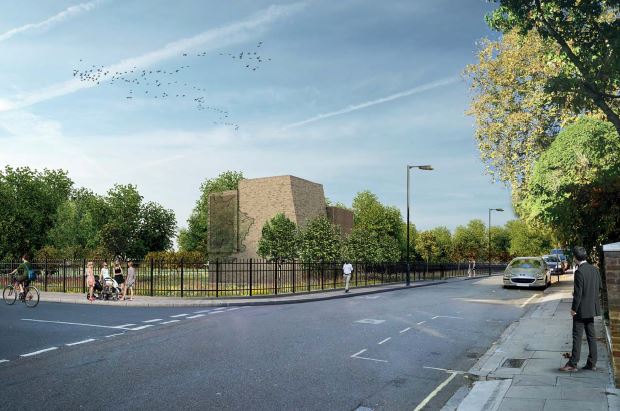
What surprises me is the scale. If you compare this head house for some of those of Crossrail, the Jubilee and the Voctoria Line , they seem larger and more intrusive.
This is a visualisation of Crossrail’s shaft in Mile End Park.
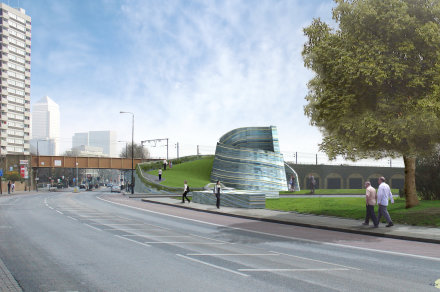
Mile End Park Ventilation Shaft
This is the actual Jubilee Line head house at Durant’s Wharf.
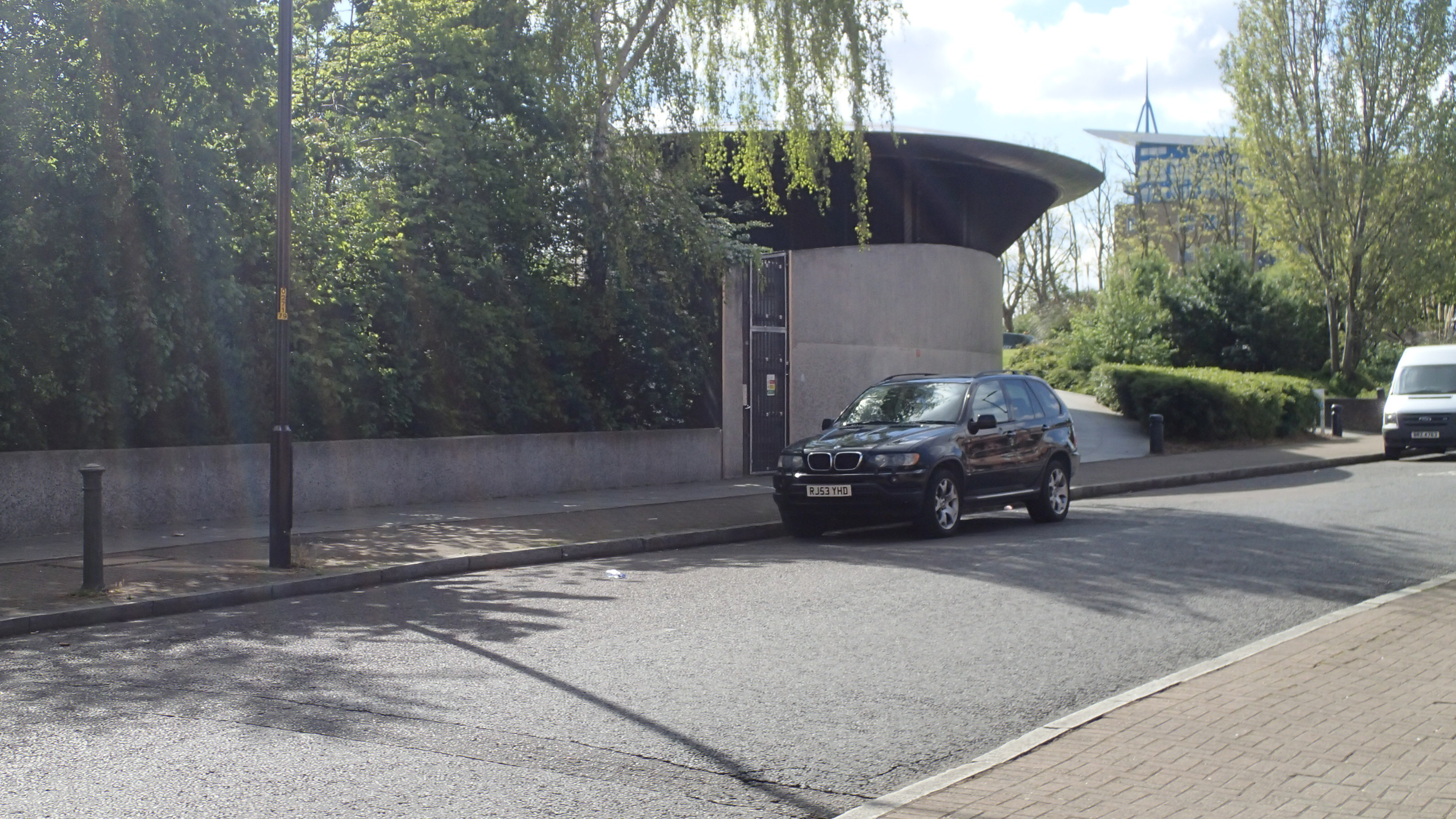
And this is the Victoria Line head house in Gibson Square.
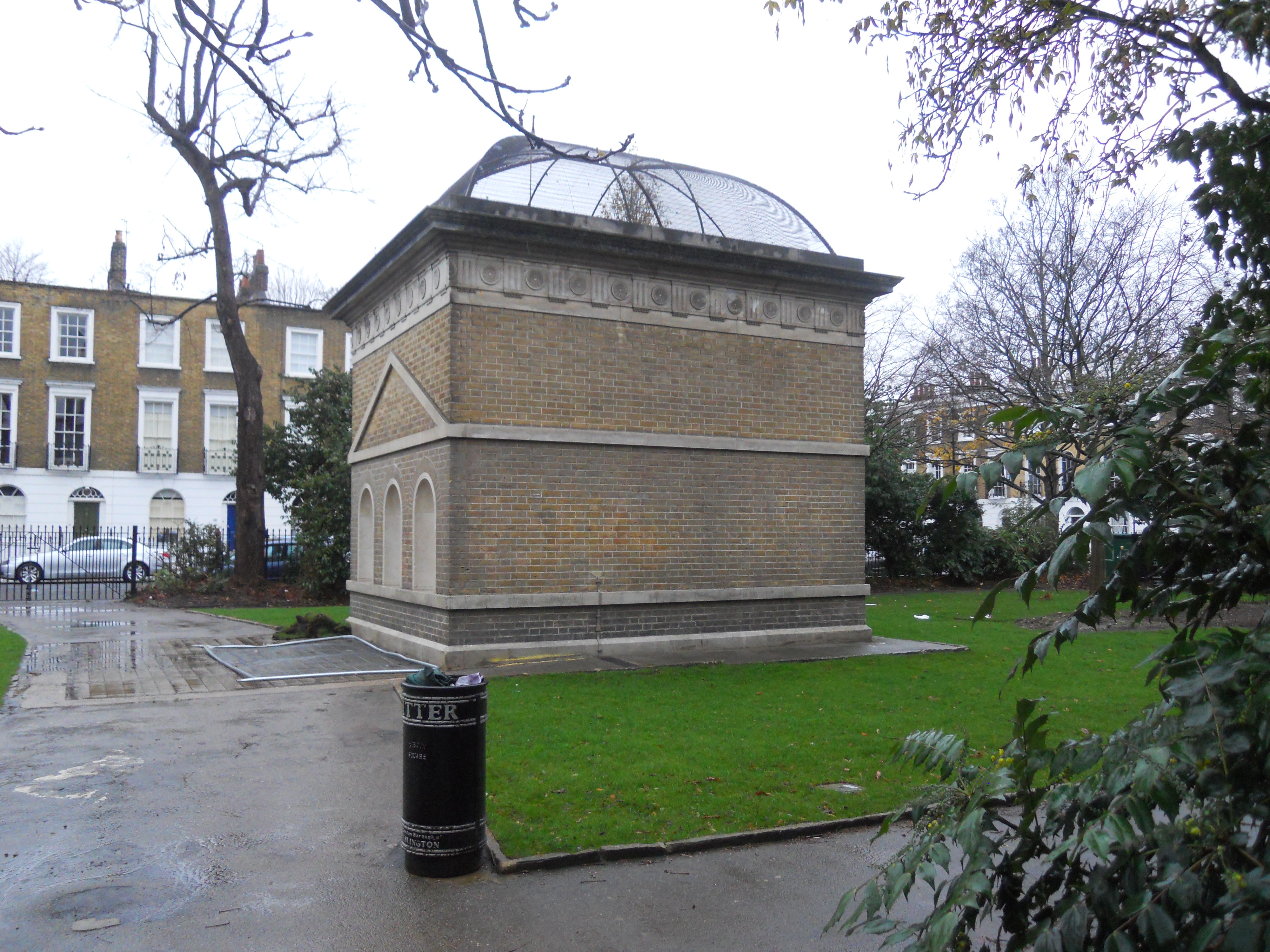
It should be noted that the Durant’s Wharf and Gibson Square structures are for ventilation only.
But even so, I think that a better design for the Kennington Park Head House can be created.
Where are the curves for a start?
The Design Of The New Greater Anglia Class 745 Train
I am writing this article about the new Class 745 trains for Greater Anglia, as I think they fit the evolving pattern of train design.
The Article In The July 2017 Edition Of Modern Railways
In the July 2017 Edition of Modern Railways, there is an article entitled GA Shows Off Stadler Mock-Up, where this is said.
GA’s fleet will all offer air-conditioning, wi-fi, plug and USB points, electronic seat reservations and will have a low floor design to offer improved accessibility.
I would expect no less!
This is also said.
The 12-car EMUs are formed of two six-car sets permanently married together. Each six-car set has one power bogie at each end, with a total of four on a 12-car train.
As the train has a First Class section and the bistro buffet between First and Second Classes, I suspect there could be two different types of six-car set.
- One with the First Class seats, the bistro buffet and perhaps a couple of Second Class cars.
- One with Second Class seats.
Normally, trains will be formed of one of each set.
I would assume, if say two six-car sets were out of service for some reason, the two working sets could be married to create some temporary capacity.
But yet again we see a train and a half-train philosophy.
Bicycle Spaces
As the Norwich trains will have six bicycle spaces, perhaps three will be placed in each set.
The article also says that Stansted Expresses will have eighteen spaces. Perhaps, Class 745 trains have a movable bulkhead at the end opposite to the cab, so that bicycle capacity can be tailored to the expected passengers.
Surely, being able to book your bicycle on the train going to East Anglia for the weekend will not be a feature that is not used.
Capacity To Norwich
Currently, there is two trains per hour (tph) between London and Norwich via Colchester and Ipswich, which are eight-cars long.
The new trains will enable 3 tph, each of twelve-cars, which is more than doubling the number of cars in an hour.
Train Power
The current Class 90 locomotives have a power output of 930 kW to pull the eight coaches.
It could be that each of the four powered bogies are rated at 1000 kW, so if that is right, these new trains are much more powerful than the current ones.
This is an extract from the article.
GA is currently investigating the potential to change from diesel to electric power on the move, and says it will seek to utilise the environmental benefits of electric power wherever possible, even on short stretches out of Norwich and Ipswich stations.
All units are designed for 100 mph operation, but with the potential for upgrading to 110 mph in future.
Does the speed upgrade apply to both the electric and bi-mode units?
Knowing the lines well, I suspect that the extra speed could be useful on the following lines.
- Stowmarket to Norwich
- Cambridge to Norwich
I suspect that if there is more improved double-track introduced, there couple be other places.
Conclusion
So expect Norwich-in-Ninety and Ipswich-in-Sixty!
Crossrail Expands Before It Opens
This is certainly something you don’t hear often about a new rail line.
This article in Global Rail News is entitled TfL To Order More Elizabeth Line Trains.
Four new Class 345 trains are being ordered, which will mean that in the Off Peak the following will happen.
- Trains between Whitechapel and Paddington will increase from 16 trains per hour (tph) to 20.
- Trains between Paddington and Shenfield will increase by two tph
- Trains between Paddington and Abbey Wood will increase by two tph
- Trains between Paddington and Reading will double from two tph to four.
- Trains between Paddington and Maidenhead will increase from four tph to six
- From December 2019, six tph will call at Heathrow Terminal 5.
So have Transport for London miscalculated the capacity of the line?
I suspect not!
It’s just that they wanted to be sure that the trains and the signalling can handle the frequency of twenty tph, before ordering the trains.
That has probably been ascertained by now thorough thorough testing.
This article on the BBC, is entitled Crossrail Stations In West London Delayed Until 2019.
I wonder, if this is within the float of these station builds, so that the whole project is not delayed.
Have Crossrail only announced the actual completion date, when it is certain it can be met?
If it is, these two apparently disconnected stories show Project Management at its best, where a project is delivered on the date agreed before as much as a humble spade had entered the ground.
- If it is late the client and the general public complain.
- It it is early, the construction team have probably spent too much money.
So hopefully, everybody’s happy!
I would love to see Crossrail’s schedule of announcements until December 2019.
Like the ordering of more trains mentioned in the first article, I suspect some will be pleasant surprises.
The first article also has this paragraph.
The increased service frequency will be achieved, in part, by replacing five Great Western Railway services with Elizabeth line trains.
So could we see Greater Anglia and Southeastern losing paths and becoming better integrated with Crossrail?
In Abbey Wood Station in my series of Kent On The Cusp Of Change posts, I said that it looks like the track layout allows trains to run on to Dartford, Gravesend or even Rochester, as other trains on a modern signalled North Kent Line.
At Shenfield station, provision has been made in the track layout for trains to continue from Platform 4 to Southend Victoria station and Greater Anglia trains already do it.at a frequency of three tph.
I don’t think it will happen, as the journey is too long for a train without toilets.
But if Platforms 4 and 5 at Shenfield were bi-directional, this would allow Crossrail trains to venture down the Southend Branch.
CAF Rarely Do The Obvious, But It’s Generally Sound
This article on the BBC is entitled 300 Train Building jobs Created At £30m Newport Centre.
This is the first two paragraphs.
Three hundred “highly-skilled and well paid” engineering jobs will be created when a Spanish train manufacturer opens a production factory in Newport.
Construcciones y Auxiliar de Ferrocarriles (CAF) is expected to open its £30m centre where Llanwern Steelworks once stood in autumn 2018.
Currently CAF are supplying the following trains and trams for the UK.
- Urbos trams for the Midland Metro and the Edinburgh Trams.
- Mark 5 sleeping cars for the Caledonian Sleeper
- Mark 5A coaches for TransPennine Express
- Class 397 trains for TransPennine Express
- Class 195 trains for Northern
- Class 331 trains for Northern
The trains alone add up to nearly five hundred vehicles.
If you look at the geography of the sea routes between the Basque Country and the United Kingdom, taking a cargo ship with a few trains to South Wales is probably not the most difficult or indirect of voyages.
Newport too, is on the South Wales Main Line, which is well connected all over England, by lines that should be electrified and will hopefully be by 2019.
This Google Map shows the Celtic Business Park in relation to Newport and its docks.
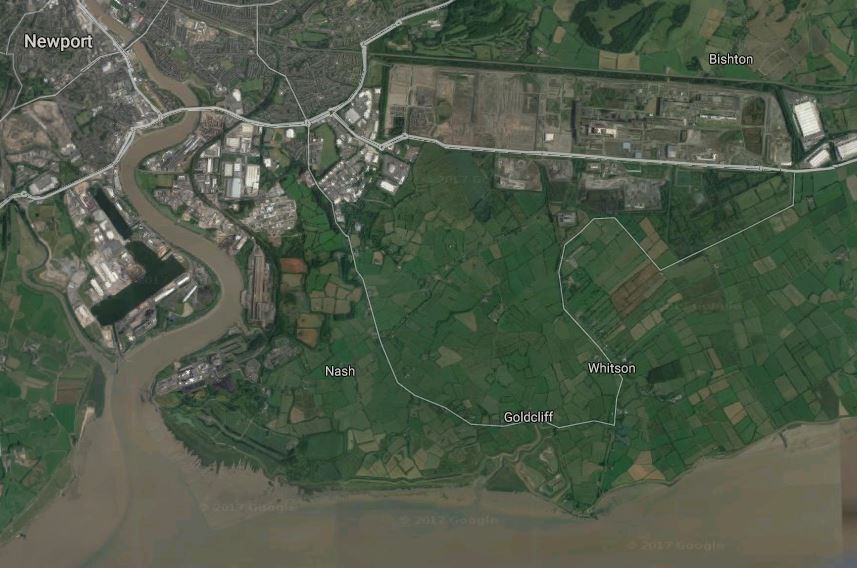
The Celtic Business Park is part of the massive rectangular site to the North East of Newport, that is the Llanwern steelworks, which is being downsized. The South Wales Main Line passes along the North side of the site and the map clearly shows access to Newport Docks.
It raises the question that CAF may bring the trains in on their wheels in a specialist train ferry.
I know nothing about how much preparation needs to be performed on a foreign-built train, before it can run on the UK rail network, but it would be expected that just checking the five hundred vehicles must keep quite a few employees busy. I suppose too, that if certain parts of the train were sourced from the UK, that instead of sending them to Spain, they could be fitted in Newport.
It should also be remembered, that Hitachi build their body-shells in Japan and then ship them to Newton Aycliffe for fitting out.
Although, the Welsh and the Basques are two nations with strong cultural ties; rugby included, I think that Newport was chosen with another very practical reason in mind.
In the May 2016 Edition of Modern Railways, Ian Walmsley, wrote an article called Metroland Of My Fathers, which included these paragraphs.
Back in the November 2013 issue of Modern Railways I raised the possibility of converting the Cardiff network to light rail. I was still working for Porterbrook at the time, which, like other rolling stock companies (ROSCOs), saw the Valleys as a retirement home for its old London commuter trains, so when the proposal met with the response it’s heavy rail and that’s that, I was quite happy.
The local press and BBC Wales showed more interest and now I am delighted to say that Network Rail has the Valley Lines electrification ‘on hold’ pending re-evaluation.
Consider the following.
- Urbos trams come in a variety of shapes and sizes.
- Trams are getting better every year at climbing hills.
- The Urbos family includes the Urbos TT, which is a tram-train.
- Midland Metro’s trams are being fitted with energy storage using supercapacitors
- How much marketing advantage for other places, is gained from having Edinburgh and Cardiff on the customer list?
- Conversion could probably be done on a line-by-line basis.
- Provision must be made for freight trains on some lines.
- Cardiff and the Valley Lines were resignalled in the last few years and everything is controlled from Cardiff ROC
But remember that CAF are a very research and design-oriented company.
So what is the likelihood that the Cardiff Valley Lines will be converted to light rail using a CAF product?
I would say pretty high, especially after reading this article in Global Rail News, which is entitled Engineering Firm BWB Consulting Bought By Spanish Giant CAF.
I could see a design of rail vehicle with these features.
- The ability to work on standard rail track.
- The ability to give level step-free access to standard height rail station platforms.
- The ability to use modern railway signalling.
- The ability to climb steep gradients.
- The ability to work on both 25 KVAC and 750 VDC overhead.
- Automatic pantograph raising and lowering.
- Supercapacitor energy storage.
- Regenerative braking.
I could see an energy-saving vehicle being designed, that made clever use of the gradients.
Would it be a train or a tram-train?
Increasingly, the difference is getting blurred!
Gibb Report – Too Many Off Peak Services
The title of this post is a sub-title in the Gibb Report
The section starts like this.
Generally I do believe there are too many lightly loaded off peak services on the GTR network, and this means the system is unable to recover quickly from any incident. The system should be robust enough to mean that the service can recover fully from any concluded incident before 1400, to run a full and punctual service from 1600 onwards. This is impossible with the current timetable. It is clear to me that the three previously competing operators deliberately filled up every off peak path, to stop the other operators running additional services and receiving a larger income allocation through ORCATS. I can see no sign of any rationalisation of the contractual obligations occurring prior to the letting of the current franchise, so all the competing services were amalgamated into the new franchise obligations.
This is also said.
The timetable is based on the assumption that almost every station on the GTR network must have regular direct trains to London, at all times of the day. In addition to provide 12 car trains on the busiest sections, principally Horsham / Haywards Heath – London Bridge / Victoria, trains from the “country” couple up at places like Horsham, Haywards Heath and Redhill. This is fine in theory, but results in a complex timetable and plan, with multiple potential failure points. I have noted that stakeholders on each route are unwilling to lose any through services to London, irrespective of the benefits to the overall system. There is no easy short term solution.
Chris Gibb makes some suggestions including a “firebreak” in the middle of the day that enables services to recover for the evening peak.
Conclusion
It looks a bit of a mess.
Small Electrification Projects
My visit to Abbey Wood station yestetday proved to me that some small electrification projects don’t actually need wires or third rails.
The reversing siding for Crossrail, which is also a link to the North Kent Line, consists of the following new tracks.
- A set of points at the Eastern end of Abbey Wood Station to connect the two Crossrail platforms 3 and 4 and allow trains to reverse.
- A track to serve as the reversing siding and the link between the two lines. It is probably about 700 metres long.
- A set of points to connect the libk to the Down North Kent Line.
- A cross-over between the two North Kent Lines.
Only about fifty metres of the reversing siding around the first set of points is electrified.
I have been convinced for some time, that the Barking Riversude Extension will be built without wires, as the project details mention electric trains, but don’t mention electrification.
Aventras may also have a remote wake-up capability as detailed in Do Bombardier Aventras Have Remote Wake-Up?, which would allow trains to be parked overnight in sidings without electrification
Kent On The Cusp Of Change – Abbey Wood Station
The Kent On The Cusp Of Change article in the July 2017 Edition of Modern Railways talks about Kent and Crossrail.
This is said.
In December 2018, the Elizabeth Line is due to reach its south-eastern terminus at Abbey Wood, where there will be interchange with the North Kent line.
A wide range of new journey opportunities will open up, which over time will influence many choices over work and home locations. A train every five minutes from Abbey Wood to Canary Wharf and central London is expected to have a dramatic effect in North Kent.
The article goes on to say that a working group called Crossrail Gravesend is pushing to extend the Elizabeth Line to Ebbsfleet International station for High Speed One.
In this post, I will talk about issues at Abbey Wood station.
The Modern Railways article says that Abbey Wood station is a cross-platform interchange, as do other articles.
Track Layout At Abbey Wood Station
This map from carto.metro.free.fr shows the layout of lines at Abbey Wood station.
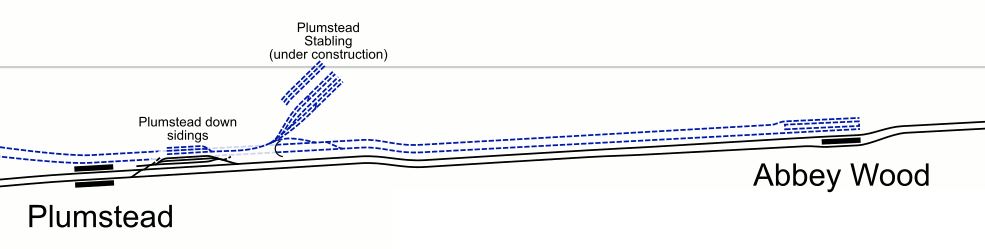
Compare this with this track layout, that I posted in Abbey Wood Station – 29th August 2016.
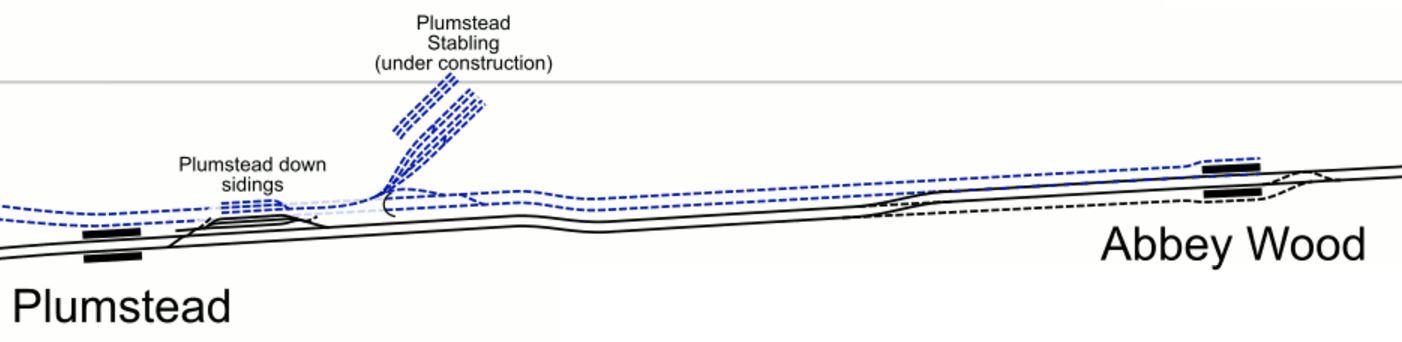
Note the following.
- The older layout shows cross-platform interchange.
- The current one has two pairs of platforms, with Platforms 3 and 4 for Crossrail and Platforms 1 and 2 for other services.
- The current layout probably connects better to the existing lines to Dartford.
These pictures were taken on the 28th June 2017 and show pictures generally taken from the West of the station.


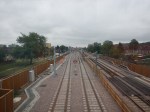


They show a similar layout, of two Northern platforms (3 & 4) for Crossrail and two Southern platforms (1 & 2) for all other services.
Note.
- The two cross-overs to the West of Abbey Wood station to get the Crossrail trains to and from the right platforms.
- The station building and the two footbridges over the lines.
- The solid wooden fence between the two pairs of lines.
- The robust nature of the overhead wiring.
I suspect, that if they had wanted to have Eastbound and Westbound lines each share an island platform, it would have required a flyover, which would have been a large expense.
These pictures were taken on the 10th July 2017 to the East of the station.
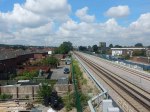
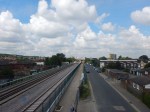

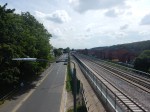
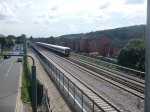
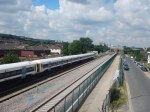


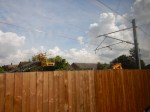

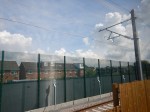


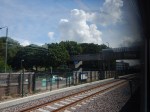

Note that the first seven pictures were taken from a public footbridge that crosses the tracks about five hundred metres to the East of Abbey Wood station and the last few pictures were taken from a train leaving Abbey Wood station for Dartford station.
This recent Google Map shoews from Abbey Wood station, to where the reversing siding ends close to where Aliske Road turns North
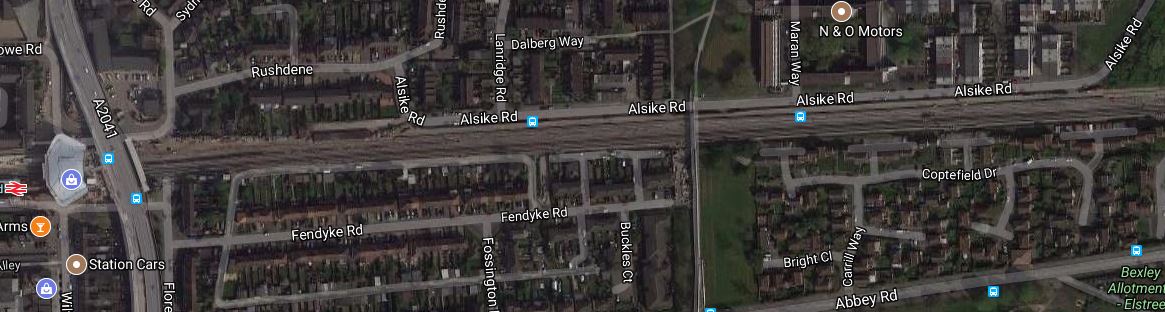
The pictures and the map show the following.
- The two third-rail electrified tracks of the North Kent Line run between Platforms 1 and 2 at Abbey Wood station to Belvedere station.
- The North Kent tracks are fully in use, by services between London and Kent.
- The two Crossrail Platforms 3 and 4 at Abbey Wood station are electrified with overhead wires.
- The two tracks in Platforms 3 and 4 would appear to join together into a single line mainly without electrification, that connects to the North Kent Line about a kilometre to the East of Abbey Wood station.
- There is only a short length of electrification to the East of the station.
It is not what I expected, as it means that there is no cross-platform interchange between services going to North Kent and Crossrail, as various sources including the The Kent On The Cusp Of Change article have said.
Passengers changing between the North Kent Lines and Crossrail will have to go over through the station or use the bridge.
So how will the station handle the various train movements?
Comparison Between Abbey Wood and Shenfield Stations
Abbey Wood will after rebuilding be a station with two North Kent and two Crossrail platforms
Shenfield station has now been converted into a station with six platforms, three of which can be used as Crossrail platforms.
In the Peak, services to the two stations are as follows.
- Shenfield – 10 trains per hour (tph)
- Abbey Wood – 12 tph
In addition 4 tph on the Shenfield Branch turn-back at Gidea Park station.
In the Off Peak, services to the two stations are as follows.
- Shenfield – 8 tph
- Abbey Wood – 8 tph
So it would appear that Abbey Wood is the harder station to operate with more services in the Peak and one less platform.
Train Stabling At Abbey Wood Station
Train stabling needs to be provided on a busy branch line, as it makes it easier to adjust the number of trains running to the demand throughout the day.
At Shenfield, the stabling sidings are beyond the station, which must be easier operationally, than the position of the sidings at Abbey Wood, where they are back down the line at the Plumstead tunnel portal.
If you look at the second set of pictures taken to the East of the station, spaqce would appear to be very limited. So is this why stabling is not ast of Abbey Wood station.
Turning Back Crossrail Trains At Abbey Wood
At Shenfield, train operators have been turning back Class 315 trains at a rate of six tph since 1980, so with the addition of a new platform and modern trains and signalling, the handling of ten tph should be achievable.
But at Abbey Wood in the Peak, there is a need to turn trains round at a rate of twelve tph or a train every five minutes.
The operation could involve each of Platform 3 and 4 handling six tph, using the cross-overs to the West of the station to get the train between each platform and the right Crossrail track, but handling six tph on two platforms feeding a 12 tph double track railway is a tough ask.
From what I have seen, I think that Crossrail will turnback their trains like this.
- All Crossrail trains from London arrive in Platform 4.
- All Crossrail trains to London depart from Platform 3.
- All trains arriving in Platform 4 use the unelectrified single track line as a reversing siding to get to Platform 3
- As the pictures show, the single track line is probably long enough to store a failed train, for later recovery.
But the Class 345 trains have a system called Auto-Reverse.
When the train is ready to leave Platform 4,the driver initiates an Auto-Reverse and the train moves automatically into the reversing siding, whilst the driver starts to walk back through the train to the other cab.
- By the time, the train is in the reversing siding, the driver is ready to drive the train into Platform 3.
- The process will have to be done within five minutes.
- The process could also involve the basic cleaning and removal of rubbish, with cleaners getting on at Platform 4 and getting off at Plstform 3.
Crossrail is not your bog-standard railway.
Trains Leaving Service At Abbey Wood
Suppose a train was leaving service at Abbey Wood.
Normally, it would probably perform the Auto-Reverse and go to the stabling sidings at the Plumstead tunnel portal.
It might even go the wrong way directly out of Platform 4, if the signalling was bi-directiomal.
Remember too, that Class 345 trains could be two independent half-trains, so if one half fails, the other could be designed to get the train to safety and out of the way.
Class 345 trains are not a bog-standard trains.
Running Crossrail Trains To And From Gravesend
From what I have seen, I’m convinced that the track layout at Abbey Wood station, means that Crossrail can be easily extended to and from Dartford, Gravesend, Rochester, Gillingham or Rainham.
Let’s assume the terminal for four tph is Gravesend.
Crossrail trains from London to Gravesend will do the following.
- Stop in Platform 4 at Abbey Wood station.
- Lower the pantograph
- Take the single uon-electrified line alongside the North Kent Line.
- Cross over to the Down North Kent Line.
- Use the third-rail electrification to travel to Gravesend.
Crossrail trains from Gravesend to London will do the following.
- Use the third-rail electrification to travel from Gravesend.
- Cross over to the single non-electrified line alongside the North Kent Line before Abbey Wood station.
- Stop in Platform 3 at Abbey Wood station.
- Raise the pantograph.
The Crossrail trains would be needed to be fitted with third-rail shoes.
Interchange BetweenThe Extended Crossrail And Other Services.
Suppose you are going from Ramsgate to Paddington, you would get a Highspeed service to Gravesend and then wait for a Crossrail train to call at the same platform.
To repeat myself, Crossrail is not a bog-standard railway.
Crossrail’s Trump Card
When the trains turnback at Abbey Wood or extend to and from Gravesend, the Class 345 trains will have to use the non-electrified single track line shown in the pictures.
It may be electrified in the next year! But why bother?
The distances that need to be handled without power are not much more than a kilometre at slow speed.
The Class 345 trains could be fitted with batteries to bridge the gaps in the electrification.
These batteries will also do the following.
- Handle regenerative braking.
- Provide emergency power, in the event of complete tunnel power failure.
Conclusion
To repeat myself again, Crossrail is not a bog-standard railway.
See Also
These are related posts.
- Ashford Spurs
- Crossrail
- Elimination Of Slow Trains
- Fawkham Junction Link
- Highspeed Routes
- High Speed To Hastings
- Historic Routes
- Longfield Station
- Maidstone
- Reading To Tonbridge
- Thameslink
- Thanet Parkway Station
- Track Improvements
- Ultimate Class 395 Train
- Victoria As A Highspeed Terminal
To know more read Kent On The Cusp Of Change in the July 2017 Edition of Modern Railways.
Gibb Report – Some Little Used Stations Have Too Many Services
The title of this post is a sub-title in the Gibb Report
The section starts like this.
The franchise obligations for the GTR franchise are those inherited from the three previous competing franchises.
Some elements of these obligations have not been reviewed properly since privatisation, and service levels are far above current demand. On a system that is so
dependent on every aspect working perfectly, calling at stations with very few passengers is one more thing that causes the system to fail.I have studied the ORR’s station usage, and identified seven stations that appear to have an excessively frequent off peak service.
The stations mentioned as receiving too many services are as follows.
Chris Gibb says the following.
- The stations will stay open.
- Peak services will not be reduced.
- Off peak services may be reduced.
I have looked at the Wikipedia entries for these stations and they are a mixed bunch, typical of what you see all over the country. Bishopstone station is even a Grade II Listed Building on the At Risk Register.
Conclusion
I think there is a case to develop a procedure, whereby the station can be transferred for community use.
Perhaps, a body like English Heritage can come up with some rules.
 The Anonymous Widower