Gibb Report – East Croydon – Milton Keynes Route Should Be Transferred To London Overground
The Gibb Report, says that the East Croydon – Milton Keynes route should be transferred to the London Overground.
By 2020 London will have two high-capacity and two medium-capacity cross-London heavy rail routes, backed up by several cross-London Underground Lines.
- Central Line – 30+ trains per hour (tph)
- District Line – 20+ tph
- Crossrail – 24 tph
- East London Line – 20 tph
- Jubilee Line – 30+ tph
- Metropolitan Line – 20+ tph
- Northern Line – 30+ tph
- North London Line – 16+ tph
- Piccadilly Line – 30+ tph
- Thameslink – 24 tph
- Victoria Line – 30+ tph
One line is missing from this list; the West London Line, which has a rather pathetic four tph between Clapham Junction and Willesden Junction stations.
Until Southern got embroiled in their Driver Only Operation dispute, there used to be a very useful one tph service between East Croydon and Milton Keynes Central stations.
The Gibb Report says this about the service.
I believe there is an option to transfer the East Croydon – Milton Keynes operation to TfL and it’s London Overground concession in 2018.
TfL may decide to change the service, for example by not running it north of Watford Junction, or running it to an alternative southern destination other than East Croydon. They could also develop the combined West London line service to better match available capacity to demand.
They would have a number of crewing and rolling stock options, but should be able to operate the service more efficiently than GTR in the longer term, without the involvement of Selhurst.
Selhurst TMD is the depot in South London, where the current Class 377 trains are based.
I think that this is a good proposal for the following reasons.
- As was seen on the Chingford Branch Line, London Overground have a reputation for making a good fist of taking over services that need improvement.
- As the Gibbs Report says, the combined West London Line service could be developed.
- I have net quite a few people, who use this West London Line route to get to and from events at Wembley stadium.
- The service could call at Old Oak Common station to connect to Crossrail and HS2.
- A variant of London Overground’s new Class 710 trains, could probably work the shortened route, as either four or eight-car trains.
- The Class 710 trains could be based at the convenient Willesden TMD, along with the rest of the fleet.
Being practical, a service of just two tph would give a train every ten minutes on the West London Line.
The Current Service
The current service is supposed to stop at the following stations.
- Bletchley
- Leighton Buzzard
- Tring, Berkhamsted
- Hemel Hempstead
- Watford Junction
- Harrow & Wealdstone
- Wembley Central
- Shepherd’s Bush
- Kensington (Olympia)
- West Brompton
- Imperial Wharf
- Clapham Junction
- Wandsworth Common
- Balham
- Streatham Common
- Norbury
- Thornton Heath
- Selhurst
Note.
- Stations between Watford Junction and Clapham Junction, already have a substantial Overground presence.
- London Overground already run three tph on the Watford DC Line between Euston and Watford Junction stations.
But would this be the ideal route?
The Northern Terminal
The West Coast Main Line is very busy and stations between Watford Junction and Milton Keynes are well-served by London Midland and Virgin Trains.
So would it be sensible to continue a slower local service North of Watford Junction?
It should also be remembered, that Southern introduced the original service to give better access to Gatwick Airport. Surely, this need is now satisfied by services from Clapham Junction and East Croydon.
As Watford Junction station probably has platform capacity, surely Watford Junction should be the Northern terminal
Could The Service Use The Watford DC Line?
If this were possible, this must surely give advantages, especially if Watford Junctio is the Northern terminal.
- Dual-voltage Class 710 trains could work the route.
- The service level on the Watford DC Line would be increased.
- There would be no problem accessing the bay platforms at Watford Junction station.
- There would be no requirement for any paths on the West Coast Main Line.
I think the answer to whether the Watford DC Line could be used at the present time is that trains going from the West London Line to Watford Junction must use the West Coast Main Line.
This map from carto.metro.free.fr shows the lines around Willesden Junction..
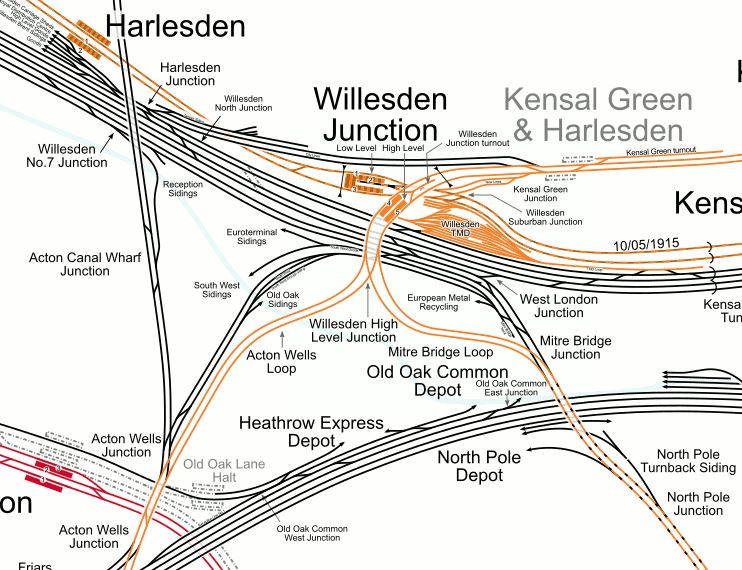
As it is all railway land, I suspect that the connection can be created.
The one problem, is that some of the Watford DC Line is shared with the Bakerloo Line.
But as the Bakerloo Line is being extended to the South and the Northern end will probably be improved, then surely creating an optimal solution to the Watford DC line, the Bakerloo Line and Overground services to Watford, makes a lot of sense.
The Southern Terminal
Various stations have merits and problems to be used as the Southern terminal for the service.
Clapham Junction
Clapham Junction would appear to have a strong case, but London Overground had enough problems squeezing in their current services.
As the station is now substantially step-free and has typically three tph to Gatwick Airport, Clapham Junction offers a good route to the airport.
Balham
Balham has been used as a terminal in the past and connects to the Northern Line. If redeveloped for Crossrail 2, it could be a possibility.
Steatham Common
Streatham Common could be developed as a major interchange and if this happens, then surely is is a possibility.
East Croydon
East Croydon would have a strong case, as it is a busy and well connected station, but there probably isn’t a suitable platform.
I think that any station South of East Croydon is probably too far.
My money would be on the new interchange station at Streatham Common, with Balham as an alternative.
Schedules And Trains
I estimate that a train doing a return journey between Watford Junction and Streatham Common would take under three hours, using the Watford DC Line. This would mean that three trains would be needed for an hourly service and six trains for a half-hourly service.
Conclusion
Transferring the East Croydon – Milton Keynes route to the London Overground looks feasible.
Reading The Gibb Report
The Gibb Report on the problems affecting GTR is entitled Changes To Improve The Performance Of The Southern Network And Train Services, And rRstore Passenger Confidence.
It is a weighty document that is well worth reading.
The document can be downloaded from here.
I shall write each of my comments as single posts, so that those looking for how their station or route will be effected, will only have to read what is relevant.
These are my various posts.
Ashford – Hastings Route Should Be Transferred To The New Southeastern Franchise
East Croydon – Milton Keynes Route Should Be Transferred To London Overground
Gatwick Airport Station Should Be Transferred To Gatwick Airport
Moorgate Services Could Be Transferred To The London Overground
More Station Shelters Should Be Installed
Kent On The Cusp Of Change – Maidstone
The Kent On The Cusp Of Change article in the July 2017 Edition of Modern Railways talks about Kent and not surprisingly, the county town;Maidatone is mentioned several times.
The Medway Valley Line
The Medway Valley Line runs as its name suggests down the Medway Valley, from Strood station in the North to Maidstone West, Paddock Wood, and Tonbridge stations in the South.
I took these pictures on the line.

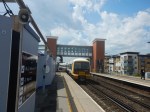
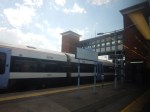





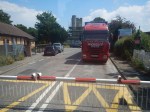

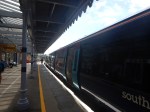
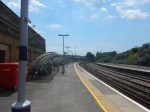

Note.
- Strood station is undergoing a major upgrade, which the hoardings claim will be finished this year.
- The Medway Valley Line has its own termial platform in Strood station.
- The line is double-track all the way.
- The line is run as a community rail service.
- There were several level crossings on the route.
- There were several new housing estates visible from the train.
The line would appear to be well run and I suspect that in the next few yeas, services could be increased.
Currently, the service is a two trains per hout (tph) shuttle with an Peak Hour service between St. Pancras International and Maidstone West.
Plans exist for an all day Highspeed service between St. Pancras International and Maidstone West and this would mean three tph along the Medway Valley Line.
I do feel though that if a way could be found to run four tph on the route, that this would be very beneficial.
Maidstone
I walked between Maidstone West and Maidstone East stations buying lunch on the way in a cafe.
These pictures sum up my walk.















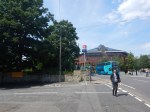
If I do the trip again, which is likely, I’d go to Maidstone East station first, as the walk would be dowbhill. It would also mean, I could pick up my gluten-free lunch in Marks and Spencer and eat it by the River Medway.
Not that the liver, bacon and vegetables was at all bad!
Maidstone East Station
I’ve discussed Maidstone East station before in this post called Maidstone East Station.
The two visits have left me with the impression, thatr the service from Maidstone East station is crap.
It will improve when Thameslink starts its two tph service to Cambridge, which will give the station four tph to and from London.
Two developments would really improve Maidstone East station.
Development of the station is promised, with Wikipedia saying this.
In November 2012, initial plans for the regeneration of Maidstone East Station were submitted to Maidstone Borough Council to determine whether an Environmental Impact Assessment was required. MBC concluded in December 2012 that due to the additional road traffic, an assessment would be appropriate. Plans include a new railway station, new large foodstore, other retail units, bar, cafe, commuter and retail parking (approx 1100 spaces) and associated landscaping. The proposed plan involves the demolition of the existing station ticket office, a disused hotel/bar, retail units opposite County Hall and the adjacent Royal Mail sorting and enquiry office which is due to transfer operations to a new site in Park Wood, Maidstone late 2012
Kent’s county town certainly needs a better station.
The other development would be to get rid of the Class 465 trains.
The one I got home was unreliable and according to fellow passengers, this is not uncommon.
But the speed it was keeping on the line to London was a measily 30 mph at times.
It was definitely, one that could be named a Notworker.
Hopefully the new franchise holder will obtain a new fleet of trains to kick the problem off the White Cliffs.
Conclusion
I learned a lot of the good and bad points about Southeastern today.
See Also
These are related posts.
- Abbey Wood Station
- Ashford Spurs
- Crossrail
- Elimination Of Slow Trains
- Fawkham Junction Link
- Highspeed Routes
- High Speed To Hastings
- Historic Routes
- Longfield Station
- Reading To Tonbridge
- Thameslink
- Thanet Parkway Station
- Track Improvements
- Ultimate Class 395 Train
- Victoria As A Highspeed Terminal
To know more read Kent On The Cusp Of Change in the July 2017 Edition of Modern Railways.
Slow Trains In The North
I was asked a few hours ago, as to why would TransPennine Express want to get rid of their Class 350/4 trains.
These ten 110 mph trains were only delivered in 2013 -2014, so why should TransPennine Express replace them?
They work Manchester Airport to Glasgow and Edinburgh services, but they have two major problems.
No Wi-Fi
It looks like none of the Class 350 trains have wi-fi, so possibly passing them on now3, will give that problem to the new owner.
They Are Only 110 mph Trains
The trains are being replaced with Class 397 trains from Spanish manufacturer; CAF.
I suspect the Class 397 trains have a few advantages over the Class 350 trains.
- The new trains are probably built with wi-fi.
- The interiors are custom-designed for the Scottish and Manchester Airport markets.
- The trains are five-cars as opposed to four.
- The capavity of the new trains is 286 seats as opposed to 229.
But the major difference is that the Class 397 trains are 125 mph trains, like the Class 390 trains used by Virgin.
Looking at times between Glasgow and Preston on the West Coast Main Line, it would appear that the Class 390 trains are up to twelve minutes faster than the current Class 350 trains, so when both companies are running 125 mph trains will we see an improvement in both?
Similar improvements will probably happen on the East Coast Main Line, where the Class 397 trains will be mixing it with Class 800 trains.
Could The Class 397 Trains Handle 140 mph?
This question has to be asked, as at some point in the next few years, when the signalling allows, there may be possibilities for 140 mph. running on both the West and East Coast Main Lines.
I would hope that the Class 397 trains can be uprated to allow 140 mph running.
Will The Class 397 Trains Get In The Way Of HS2 Trains?
HS2 could reach Crewe as early as 2027 and the trains will take to the West Coast Main Line to go North.
I hope that the Class 397 trains are future-proofed to share a line with these new trains.
Other Trains On The West And East |Coast Main Lines
There are other trains that will use the West and East Coast Main Lines, which will not be able to operate at speeds in excess of 125 mph.
- 100 mph Class 185 trains
- 125 mph Class 220 trains
- 125 mph Class 221 trains
- 100 mph Class 319 trains
- 125 mph InterCity 125 trains
I suspect these trains will have to be kept away from the two main lines to Scotland.
Conclusion
The Class 397 trains will have to be capable of being uprated to 140 mph.
I also suspect that any train not capable of holding 140 mph may not be allowed on the West and East Coast Main Lines.
I Like This!
This article in the Guardian is entitled Virgin Trains and six other companies agree to sell advance tickets on the day.
Goodeee!
This is said,
The Rail Delivery Group (RDG), which represents the train operators and Network Rail, said customers of Grand Central, Greater Anglia, Northern, TransPennine Express, Virgin Trains East Coast, Virgin Trains West Coast and those using the Caledonian Sleeper from London to Scotland can now also buy Advance tickets for many trains on the day of travel.
The price of football has just dropped, as I can buy my ticket to Ipswich on Saturday morning and might make a saving.
Where Is London Midland Going?
This excellent article on Rail News is entitled Franchising timetable slips again.
This is the first two paragraphs.
THE Department for Transport’s franchising timetable is slipping again, possibly because of delays introduced by the snap General Election.
The winner of the West Midlands franchise should have been announced in June, ready for the new contract to start in October.
It is now getting very tight for a new West Midlands franchise, currently held by London Midland, to start in October.
The Current Fleet
The current fleet is a mixture of diesel and electric multiple units, most of which are in reasonable condition, although it does need a certain amout of updating and the addition of some new or refurbished trains.
- I don’t think any of the trains have wi-fi, whereas some of their competitors have it installed.
- The several Class 153 trains probably need replacing or augmenting with larger units.
- More 100 mph electric units are probably needed for the West Coast Main Line.
- More Class 350 trains from TransPennine Express must be a possibility.
- I wouldn’t be surprised to see some Class 769 trains going to the new franchise to work partially-electrified routes.
But the train fleet doesn’t look like it will need a massive number of replacement trains.
Planned And Proposed Lines Around Birmingham
The next few sections detail some of the developments either in progress or proposed.
The Chase Line
The Chase Line electrification should be complete by May 2018 and this will need more electric trains.
Although, I do wonder if the new franchise might use the new electrified route to introduce new services.
The Cross City Line
The Cross-City Line electrification to the newly-rebuilt Bromsgrove station should allow a new three trains per hour (tph) electric service to start across Birmingham in May 2018.
Unless of course, the electrification is late.
The Camp Hill Line
The Camp Hill Line is another cross-Birmingham route and effectively acts as a loop for the Cross-City Line.
It is a long term aim of Birmingham to reopen this line to passengers and the new franchise could include this line in their plans.
Wikipedia talks of a £170million pound scheme to reopen the line with the following features.
- Three tph
- Three new stations
- A connection to Moor Street.
But as the line is open to freight and long distance passenger traffic, I do wonder if now that responsibility for this line has been devolved, that something simpler could be done in the short term to increase services across Birmingham.
Kenilworth Station
Kenilworth station should open this year on the Coventry to Leamington Line.
It will probably open with single-car Class 153 trains, which will probably be totally inadequate.
I wonder if the Coventry and Leamington Line could run back-to-back services with the Coventry to Nuneaton Line, thus creating a Leamington to Nuneaton service via Kenilworth, Coventry and Coventry Arena.
The North Warwickshire Line
The North Warwickshire Line links Birmingham with Stratford-on-Avon and has an alternative name of the Shakespeare Line.
Plans exist to extend this line South to Honeybourne station on the Cotswold Line.
Under Possible Future Development in the Wikipedia entry for the Warwickshire Line, this is said.
The Shakespeare Line Promotion Group is promoting a scheme to reopen the 9 miles (14 km) of line south of Stratford to Honeybourne where it would link to the Cotswold Line. Called the “Avon Rail Link”, the scheme (supported as a freight diversionary route by DB Schenker) would make Stratford-upon-Avon station a through station once again with improved connections to the South, and would open up the possibility of direct services to Oxford and Worcester via Evesham. The scheme faces local opposition. However, there is a good business case for Stratford-Cotswolds link.
I think we’ll see something in the new franchise about developing this line, as there is a lot of potential for a train operator.
- Direct services between Stratford-on-Avon and Oxford, where there is a connection to Bicester Village. Tourists would love that!
- Connection of the housing development at Long Marston to Birmingham.
- Could Stratford-on-Avon or Honeybourne become the terminus of a service from Leamington, Coventry and Nuneaton.
It would also give DB Schenker, their freight diversion.
A Bi-Mode Train For The West Midlands
The lines around Birmingham are very much like those around Liverpool and Manchester, with a mix of electrified and non-electrified lines.
More trains are needed and needed very soon to make the most of the following.
- New stations like Bromsgrove and Kenilworth.
- New electrification like the Chase Line to Rugeley and the Cross-City Line to Bromsgrove.
- Reopened lines like the Camp Hill Line.
- Capacity on electrified lines through Birmingham, Coventry and Wolverhampton.
I suspect that an ideal train for the West Midlands would have the following characteristics.
- 100 or even 110 mph on 25 KVAC overhead electrification.
- Perhaps 90 mph on diesel power.
- Possibly a range of perhaps a dozen miles on batteries.
- Four coaches.
- A modern interior.
- Wi-fi
This specification could have been written for one of Porterbrook’s Class 769 trains. Batteries might need to be added, which is something Porterbrook may do if a customer needs the feature.
But it doesn’t have to be a rebuilt train from the 1980s, as I suspect Class 755 trains, which are bi-mode Stadler Flirts as ordered by Greater Anglia would do the job well.
And who’s in the mix to run the new West Midlands franchise? Abellio, who recently won the new Greater Anglia franchise.
So could we see some flirting around Birmingham?
Regional Services
The current franchise runs services to Liverpool, but not Manchester.
Applications in the past have been made to run to Preston and I suspect that the new franchise will seek to improve services to Crewe, Liverpool, Manchester, Manchester Airport and Preston, although some of these routes will be opposed by Virgin.
As Manchester Airport seems to be developing as a rail hub, perhaps we’ll see the new franchise serving the important airport!
Conclusion
It will be interesting to see the plans of the new franchise, when they are announced.
But as this brief analysis and speculation shows, I think that there will be an order for new or refurbished bi-mode trains.
Kent On The Cusp Of Change – Longfield Station
The Kent On The Cusp Of Change article in the July 2017 Edition of Modern Railways has made me ask questions about how services to various stations in Kent will be affected.
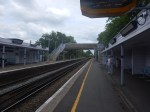
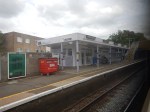
Longfield station is probably best described as a typically busy commuter station with three trains per hour (tph) for most of the day.
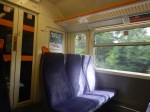
These pictures show the station.




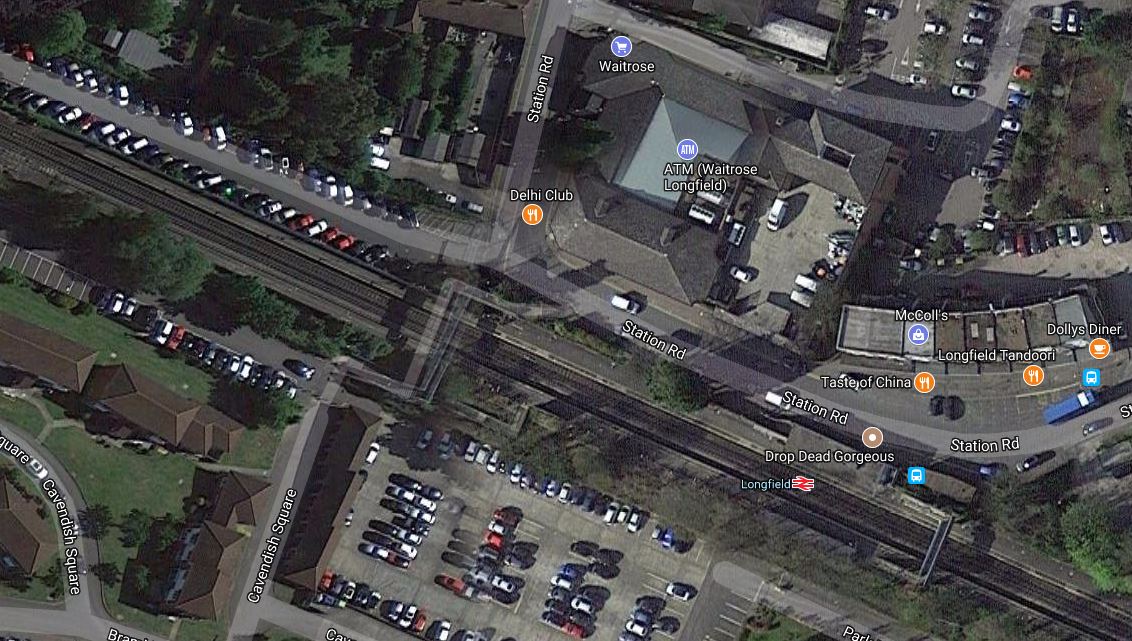
This Google Map shows the layout of the station.
I had lunch with a friend whilst I was there and a problem he flagged up was that parking can be difficult, especially if you want to travel later n the day.
Parking At longfield Station
He said sometimes the only alternative to driving, is to cut across toEbbsfleet International station and put up with the higher prices of the Highspeed sewrvice.
Note how the car parking at Longfield station is all over the place.
The Price Of The High Speed Service
I have heard several complaints about the cost of the service into St. Pancras and I do wonder that if Victoria could be used as a second terminal, as I examined in Victoria As A Highspeed Terminal, that this could have the affect of bringing prices down.
Trains Through Longfield
I travelled out to Longfield in a 100 mph Class 377 train, but I travelled back in a 75 mph Class 466 train.
The former are just about fast enough, but the latter are too slow for a journey between ictoria and Dover or Ramsgate.
As I indicated in Track Improvements, Network Rail believe that the key to faster services is better signalling and faster trains.
The signalling problem is being addressed by the East Kent Re-Signalling Project, but new trains are needed that can operate at a higher speed on the lines in Kent.
Using a version of the Class 395 train is a possibility, but so is an entirely new train from another manufacturer. Having ridden in an Aventra and read the armours that the train can have a 125 mph capability, I’m sure Bombardier can come up with a Kent Coast Express.
Surely, more Class 395 trains must be the most likely, as six-car trains, working on most routes as 12-car units, is something that appears to work well for the current operator.
I think that the most likely scenario in future will be.
- The stopping service currently run by 75 mph Class 466 trains will be run by 100 mph Class 377 trains.
- The two semi-fast services will be run by new faster trains.
- All services would be twelve-car trains.
As each service would be run by a faster train, there would be journey time savings.
Will Longfield Lose Any Of Its Three Trains Per Hour?
I think this is unlikely, as when this is tried, there is usually a bitter row, that train operating companies try to avoid.
Will There Be Any Victoria to Thanet Services via Bromley South And High Speed One?
These services would take the following route from Victoria to Ashford International station.
- Bromley South station
- Fawkham Junction Link
- Ebbsfleet International station
- High Speed One
After Ashford, they could go to Dover, Hastings or Ramsgate.
There are two capacity constraints.
- Between Victoria and Bromley South.
- Between Ebbsfleet International and Ashford International
I wouldn’t be surprised to see a fast service from Victoria to Thanet in the timetable.
It would be ideal, if a train to both Dover and Ramsgate were possible in an hour.
Conclusion
It is my view that Longfield station will not have an inferior service to the present time, when the new franchise is awarded.
But services will be different! And hopefully faster!
See Also
These are related posts.
- Abbey Wood Station
- Ashford Spurs
- Crossrail
- Elimination Of Slow Trains
- Fawkham Junction Link
- Highspeed Routes
- High Speed To Hastings
- Historic Routes
- Maidstone
- Reading To Tonbridge
- Thameslink
- Thanet Parkway Station
- Track Improvements
- Ultimate Class 395 Train
- Victoria As A Highspeed Terminal
To know more read Kent On The Cusp Of Change in the July 2017 Edition of Modern Railways.
Faster Trains For Slower In Scotland
In my analysis of the Kentish routes in Kent On The Cusp Of Change, I wrote a post called Elimination Of Slow Trains.
In the post, I said that the 75 mph Class 465 trains, were slowing services and reducing capacity, based on an article called Kent on the Cusp of Change in the July 2017 Edition of Modern Railways.
I proposed a minimum specification for trains on Kentish routes.
- 100 mph capability
- Designed for a fast station stop with minimum dwell-time
- Regenerative braking
- Efficient traction motors
- Wi-fi in all classes
- The capability to fit boosters for 4G signals.
Southeastern’s Class 465 trains fail on all points.
In Scotland, there is a new batch of Class 385 trains on order to work the new electrified services between Edinburgh and Glasgow.
Under Operation in the Wikipedia entry for the trains, this is said.
The new trains will also operate on the newly electrified Croy, Dunblane and Shotts lines as well as replacing existing stock on the currently electrified Carstairs, North Berwick and Cathcart Circle Lines. This will allow for the replacement of ScotRail’s Class 314 fleet, and allow for the cascading of a number of Class 156, Class 158 and Class 170 units.
The Class 314 trains are even older and less capable than Southeastern’s Class 465 trains.
So what will be effect on services in Scotland, where the Class 385 trains replace the Class 314 trains?
If you look at the North Berwick Line trains between Edinburgh and North Berwick stations take around 33-34 minutes, when run by 100 mph Class 380 trains. Under Rolling Stock in the Wikipedia entry for the North Berwick Line, this is said.
From December 2017, ScotRail services on the North Berwick Line will begin to use new Class 385 units. Services will be formed of six coaches (two 3-car units) following growing passenger numbers (the platform at North Berwick was extended in early 2016 to accommodate these new longer trains). In the short term Class 380/1s (four car) will be removed from the line and two Class 380/0s (three car) used instead until the Summer and back again to four car units until December. Once the new units arrive, The Class 380 units will be cascaded to increase capacity on the Ayrshire and Inverclyde Lines to and from Glasgow making all services on these routes operated by Class 380s.
So could it be that although both Class 380 and 385 trains are 100 mph units, the newer trains have a better station stop performance, which enables the timings on the line to be reduced and possibly allow the doubling of frequency of trains to two trains per hour?
Conclusion
Modern 100 mph trains with the ability to execute fast stops at stations are good for operators and passengers alike.
Could South Western Railway Use Class 395 Trains Instead Of The Proposed Class 442 Trains?
In When Do Mark 3 Coaches Accept The Inevitable?, I mused about why South Western Railway were using refurbished Class 442 trains on the routes betweenLondon and Portsmouth.
The reasons for using these refurbished trains include.
- They could be very powerful trains if they were retractioned.
- The Portsmouth Direct Line is very challenging.
- The trains might become 100 mph plus trains, which could save minutes on journey times and aid timetabling.
|The current Class 444 and Class 450 trains working the route may be 100 mph trains, but could it be that the required performance improvements need a more powerful and/or faster train?
I suspect too, that as the trains are based on legendary Mark 3 coaches, the interiors can be refurbished to a high standard with everything passengers need and want.
In Ultimate Class 395 Train, which is part of my analysis into Kentish routes in Kent On The Cusp Of Change, I proposed upgrades to a new batch of Class 395 trains.
- Batteries To Enable Working To Hastings For The New Southeastern Franchise
- Wi-Fi And 4G Capability
- Up To 125 mph Capability On 750 VDC Third-Rail Electrification
Would these trains be an alternative to the Class 442 trains for the Portsmouth Direct Line even using batteries to handle the topography of the line, regenerative braking and save energy?
If they were working a line like the Portsmouth Direct Line, where acceleration and power is probably more important than outright speed, the trains could be rated accordingly. The operating speed on the line is currently 90 mph, but how much time would be saved with perhaps a 110 mph train and some or all of the line able to handle speeds of 100 mph plus?
The choice of refurbished Class 442 trains, which are claimed to save five minutes on fast services and seven minutes on slow ones, says a lot about what is possible between London and Portsmouth.
But would a Class 395 train, similar to those needed on Kentish routes without the 25 KVAC capability be an off-the-shelf new train that could give the same or even better journey time improvements?
 The Anonymous Widower