Climate change: Offshore Wind Expands At Record Low Price
The title of this post, is the same as that of this article on BBC News.
These are the first paragraphs.
A record amount of new offshore wind power has been announced in the UK – at record low prices.
The new projects will power more than seven million homes for as little as £39.65 per megawatt hour.
Compare this price with the £92.50 per MWh for the nuclear Hinckley Point C.
Note that all prices are in 2012 prices.
I have no argument with the engineering of nuclear power stations, but they do have issues that must be addressed.
- They shouldn’t be built in possible earthquake zones.
- They have a very high cost.
- They can be an eyesore in parts of the UK.
But they do provide a good power zero-carbon baseload, once they are constructed.
Dogger Bank Wind Farm
The Dogger Bank Wind Farm would appear to be the centrepiece of the energy developments South of the Scottish Border.
It will be three separate 1.2 gigawatt wind farms developed on the relatively shallow seas around the Dogger Bank.
- Creyke Beck A
- Creyke Beck B
- Teesside A
Wikipedia says this about the first two wind farms.
They would connect to the existing Creyke Beck substation near Cottingham, in the East Riding of Yorkshire.[6] The two sites lie 131 kilometres (81 mi) from the East Yorkshire coast.
Both have an area of around two hundred square miles.
Teeside A is further North and would be connected to a substation near Redcar.
North Sea Wind Power Hub
The three fields I’ve listed are all in UK waters and according to Wikipedia will or could be joined by more wind farms in the same area.
But just across the maritime border between the United Kingdom and the European Union, Denmark, Germany and The Netherlands have plans to develop the North Sea Wind Power Hub.
Wikipedia introduces the project like this.
North Sea Wind Power Hub is a proposed energy island complex to be built in the middle of the North Sea as part of a European system for sustainable electricity. One or more “Power Link” artificial islands will be created at the northeast end of the Dogger Bank, a relatively shallow area in the North Sea, just outside the continental shelf of the United Kingdom and near the point where the borders between the territorial waters of Netherlands, Germany, and Denmark come together. Dutch, German, and Danish electrical grid operators are cooperating in this project to help develop a cluster of offshore wind parks with a capacity of several gigawatts, with interconnections to the North Sea countries. Undersea cables will make international trade in electricity possible.
These points are also made.
- Six square mile islands will be built surrounded by thousands of wind turbines.
- The Dutch have estimated that 110 gigawatts of wind power could be produced at the Dogger Bank location.
- We are not a member of the consortium, but it is hoped that Norway, Belgium and the UK will join.
- The Dutch have suggested converting some of the electricity produced to hydrogen.
- Completion date is set for 2050.
I am excited by this project.
We may not be part of the North Sea Wind Power Hub consortium and in a month or so, we may or may not be part of the European Union, but today’s announcement of new wind power projects in our section of the Dogger Bank is effectively a substantial marker, that compliments the European plan.
Consider.
- We are putting 3.6 GW of wind turbines on the Dogger Bank.
- We are connecting it to the UK electricity grid. at Creyke Beck.
- It would be easy to create another bi-directional electricity interconnector between the UK’s planned and the EU’s possible wind farms.
This is the sort of project that works, whether Brexit happens or doesn’t!
Six Scottish Wind Farms
.There is also a second article on the BBC, which is entitled Six Scottish Wind Farms Awarded Contracts.
These are the first paragraphs.
Six Scottish wind farm projects are set to go ahead after being awarded UK government contracts to sell the electricity they would produce.
The schemes include Forthwind and SSE Renewables’ Seagreen Phase 1, which are both proposed for the Firth of Forth.
Four onshore wind farms – Muaitheabhal and Druim Leathann in Lewis and Hesta Head and Costa Head in Orkney – have also secured contracts.
All farms are expected to be built by 2025 and provide enough energy for 265,000 homes.
Price Summary For Offshore Wind
This page on Offshore Wind gives the strike prices for the six offshore wind farms.
Creyke Bank A – £39.65 per MWh – 1200 MW
Creyke Bank B – £41.61 per MWh – 1200 MW
Teeside A – £41.61 per MWh – 1200 MW
Teeside B (Sophia) – £41.65 per MWh – 1400 MW
Forthwind – £39.65 per MWh – 12 MW
Seagreen Phase 1 – £41.61 per MWh – 454 MW
The size of each farm is also given.
Conclusion
The lights will stay on and we will need to develop more energy storage.
The Chilling Power Of Drones And Software
This article on the BBC is entitled Saudi Oil Attacks: Images Show Detail Of Damage.
Read this article and then say, that drones can’t be used to create death ad destruction or merely havoc, like flight disruption at a major airport.
Consider.
- Automation is such, that drones can now be launched on a fire-and-forget basis.
- You can’t jam an autonomous drone!
- There is nothing to stop a top quality programmer creating evil software.
- Much of the software, used for evil purposes, is probably also used to write business, research, engineering, scientific, educational and other types of software.
- The genie is well and truly out of the bottle!
14/09/2019 will become a notorious date in history.
United Downs Deep Geothermal Project Confident On Potential Power Generation
The title of this post is the same as that of this article on ThinkGeoenergy.
This is the first paragraph.
With initial tests of the well drilled, the United Downs Deep Geothermal Project (UDDGP) suggests that the project will be able to generate electricity of as much as 3 MW in power generation capacity.
Two holes have been bored to a depth of 5 km.
If the project is successful, up to three MW of heat could be brought to the surface, which can be used to generate electricity or heat buildings.
A Look At Possible Costs
This page on Wikipedia is entitled Cost Of Electricity By Source.
It gives these for the capital cost of power stations for various zero-carbon energy sources.
- onshore wind – $1600/kW
- offshore wind – $6500/kW
- solar PV (fixed) – $1060/kW (utility) $1800/kW
- solar PV (tracking)- $1130/kW (utility) $2000/k
- battery storage power – $2000/kW
- conventional hydropower – $2680/kW
- geothermal – $2800/kW
Geothermal has one big advantage over wind and solar power in that it is a continuous power source like nuclear, hydropower and some fossil fuels, so it doesn’t need to be backed by energy storage.
Bollocks To Brexit
This snippet is in the bottom-right corner of Page 29 in today’s Sunday Times
Is there no escape from politics? The top and bottom rows of the cryptic crossword in Thursday’s Guardian spelt out “Bollocks to Brexit”. Very amusing, but not a message that isn’t available elsewhere in the paper. How much more impressive to have smuggled it into The Daily Telegraph.
There’s certainly no escape from hearing views about Brexit.
What Happens When An Irresistible Force Meets An Immovable Object?
Wikipedia has an entry called Irresistible Force Paradox.
Read it and you won’t find any help with a solution to the Brexit impasse!
As someone, who is very much a European, who voted Remain and believes that we should always follow the first referendum result, Wikipedia didn’t help me either!
The only thing that will sort this stand-off out, is a good old-fashioned British compromise.
We can probably wait for ever for that!
Climbing Stairs Two At A Time
This set of stairs is at Syon Lane station.
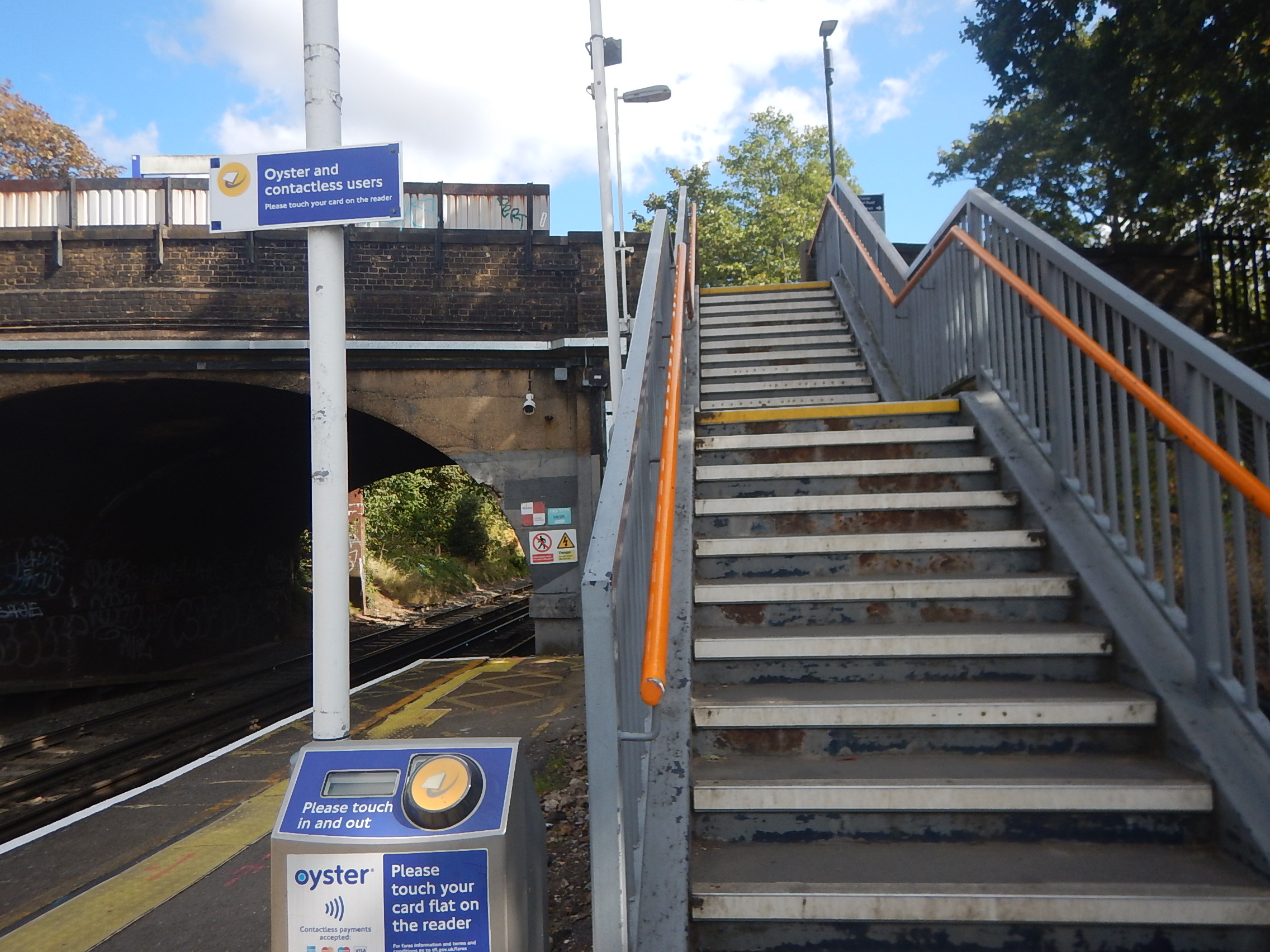
It is typical of many sets of stairs in London and all over the UK.
I have recently found that it is easier and faster for me to climb stairs like these, two steps at a time.
Sometimes, I will climb up the right side of the stairs pulling myself with my good right arm.
I can understand, why when using my good arm, it is easier and faster, as I am pushing with two limbs and pulling with one.
But the surprise is that if I walk up the middle of the stairs, it’s easier too!
Is it down to the fact that most stairs are to the same standard, which was designed to fit the mechanics of the average human.
I suspect too, that practice helps.
Is This A Massive Endorsement For The City Of London?
This Google Map is dominated by the new Goldman Sachs building in the City of London.
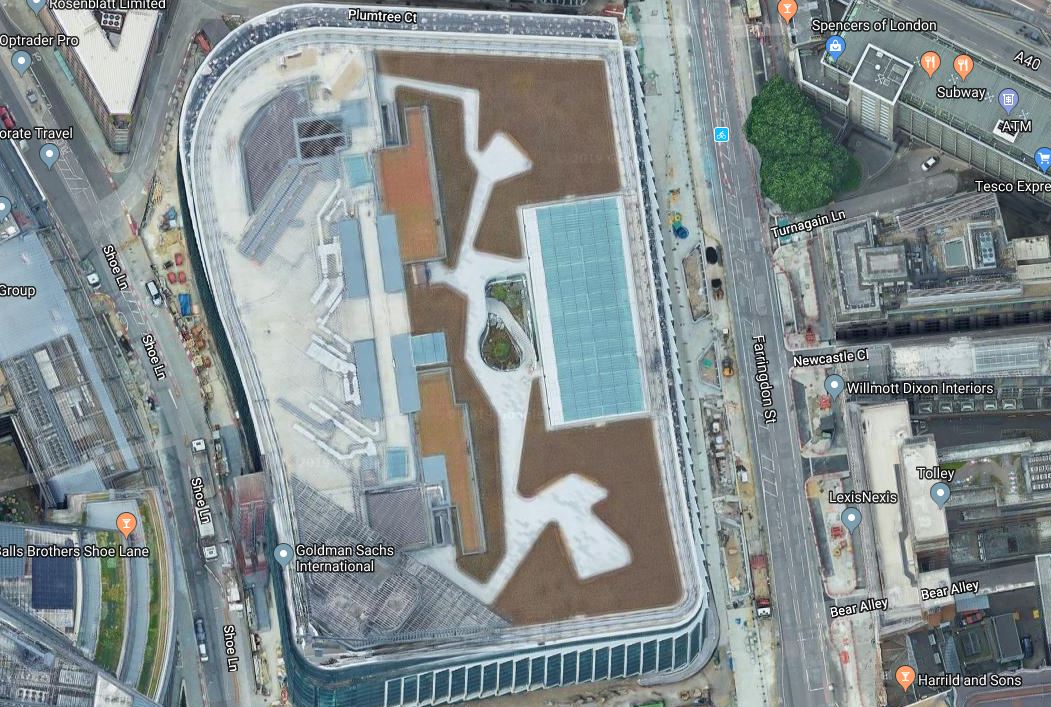
Make what you want of the building and its significance for the City.
But is it an endorsement of a strong future or a monument to a glorious past?
Location, Location, Location
One property developer once said, these were the three most important things about a property.
This Google Map shows the location with respect to Farringdon station.
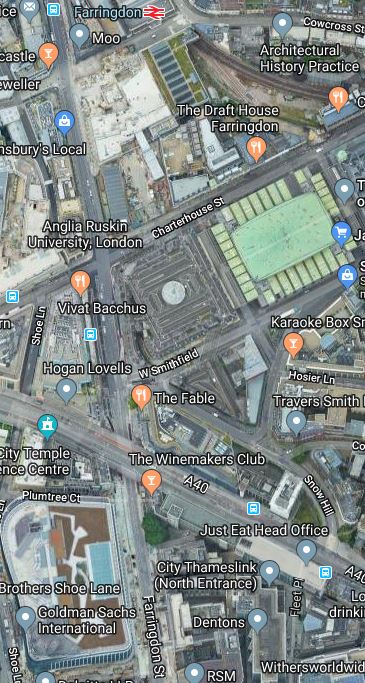
The station, which is at the top of map, will be the best connected in Central London as it will be the crossing of Crossrail and Thameslin. That probably won’t be important to some of the employees of Goldman Sachs, but the building apparently has favoured bicycle spaces over car parking.
Note just to the South of Farringdon station, two of the large buildings of Smithfield Market. These two are very much under-used and plans exist to convert part of them into the new Museum of London.
But a lot of the area between Goldman Sachs and Farringdon is under-developed and will the Goldman Sachs decision, lead to more development of offices, hotels and residences in this part of London at the West of the actual City?
Terminal Six At Heathrow And Terminal Three At Gatwick
I often joke, that this area, will become extra terminals at Heathrow and Gatwick Airports, with an easy link to the trains to Scotland and the Continent just a short taxi ride, bicycle ride or one stop on the Underground up the road at Kings Cross and St. Pancras.
A Walk From Smithfield To The Goldman Sachs Building
These are some pictures I took on the way.
The New Museum Of London Site
















Holborn Viaduct







The Goldman Sachs Building












I’m sure that if I can walk to and from Farringdon station at seventy-two, then a lor of people working in the building will use the railway to get to and from work.
Conclusion
Have Goldman Sachs decided to build their new offices at the Crossroads of the World?
From Green Gin To Sustainable Steel, Government Fires Up £140m Hydrogen Push
The title of this post, is the same as that of this article on Business Green.
The projects are wide ranging.
Green Gin
This is said about gin production by Orkney Distilling Ltd.
The successful projects feature a number of eye-catching initiatives, including the HySpirits project which has been awarded just under £200,000 to explore how the European Marine Energy Centre could work with local gin producer Orkney Distilling Ltd to convert its distillery from using liquid petroleum gas to hydrogen produced using renewable power.
I have been told that making whisky produces carbon dioxide. Does gin?
My source, also said carbon dioxide frpm Scotch whisky production has been used in the growing of soft fruit.
I found this article on The Courier, which is entitled Time To Cut Back On Whisky’s CO2 Emissions and this article on Scottish Capture and Storage, which is entitled Carbon Capture In The Heart Of The City.
Both are worth reading.
This is a paragraph from the second article.
The carbon capture process at this site is relatively simple, because the off gas from fermentation is already very pure in CO2. The process is not about enhancing CO2 concentration, but more about removing impurities. That involves a number of washing stages to remove water and impurities from the gas given off during fermentation, before it is compressed, stored, and eventually transported by road.
The article also says that the distillery produces four tonnes of carbon dioxide per day, which compared to the emissions of Chinese, Indian and United States coal-fired power stations is small beer, but it does show how in some industrial processes capturing the carbon dioxide can be relatively easy in some industrial processes and of a high quality for perhaps using in food and medical products.
But I can’t find a article connecting carbon dioxide from whisky to food production.
The Dolphyn Project
This is said about the Dolphyn Project.
A further £427,000 has been awarded to the Dolphyn project, which plans to mount electrolysers onto floating wind turbine platforms to produce hydrogen. One wind turbine alone has the potential to produce enough low carbon hydrogen to heat around 2,500 homes, fuel over 120-240 buses, or run eight to 12 trains,” the government said
I can’t find much on the Internet about this project, except this extract from this document on the Institution of Engineering and Technology web site, which is called Transitioning To Hydrogen.
The Deepwater Offshore Local Production of Hydrogen
(Dolphyn) project will consider large-scale retrofit
hydrogen production from offshore floating wind
turbines in deep water locations (Figure 19).This is a partnership project led by ERM with Engie,
Tractebel Engie and ODE. The project looks to
utilise the vast UK offshore wind potential to power
electrolysers to produce hydrogen from the water the
turbines float on. Large 10MW turbines consisting of
desalinisation technology and PEM electrolysers will
feed hydrogen at pressure via a single flexible riser to
a sub-sea manifold with other turbines’ lines. The gas
is then exported back to shore via a single trunkline.
A 20-by-20 array array would have a 4GW capacity,
producing sufficient hydrogen to heat more then 1.5
million homes.This project may include the offshore wind supply
of hydrogen supported with hydrogen from steam
methane reformation with carbon capture technology.
This project is well aligned to work the ACORN75
project at St Fergus.
Note that the project is talking about gigawatts of energy and providing enough hydrogen to heat millions of homes.
I think that the Dolphyn Project is badly named, as Google thinks you’re looking for projects about aquatic animals.
Gigastack
This is said about Gigastack.
Meanwhile, a consortium featuring Ørsted, ITM Power, and Element Energy is celebrating after securing just shy of £500,000 to help move forward with its Gigastack feasibility study, a six-month project to investigate the potential for delivering bulk, low-cost, and zero-carbon hydrogen.
There’s more here on this page on the ITM Power web site, where this is the first paragraph.
Project to demonstrate delivery of bulk, low-cost and zero-carbon hydrogen through gigawatt scale PEM electrolysis, manufactured in the UK.
As you’d expect from the name, they are looking at creating gigawatts of hydrogen.
Steel
This is said about steel.
The funding awards came as the government also launched a new call for evidence seeking views on how the government should structure and manage a planned £250m Clean Steel Fund. The government said the proposed fund would help the industry embrace clean technologies and move on to “a pathway that is consistent with the UK Climate Change Act” and its new net zero emission goal.
So what has hydrogen got to do with steel?
Search for hydrogen steelmaking on Google and you get lots of articles including this article from the Stockholm Environmental Institute, which is entitled Hydrogen Steelmaking For A Low-Carbon Economy.
This is a paragraph.
In the spring of 2016, three Swedish companies – LKAB (iron ore mining), SSAB (steel manufacturer) and Vattenfall (power utility) – announced their ambition to develop and implement a novel process for fossil-free steel production in Sweden. This process would use hydrogen (instead of coal) for the direct reduction of iron oxide/ore (H-DR), combined with an electric arc furnace (EAF). It would be almost completely fossil-free when the hydrogen is produced from electrolysis of water by use of renewable electricity. The concept is called Hydrogen Breakthrough Ironmaking Technology, or HYBRIT for short.
My knowledge of process engineering, tells me, that even if the Swedes don’t succeed, someone will and here in the UK, we’re ideally placed to take advantage, as we have the wind power to produce the hydrogen.
Conclusion
The future’s bright, the future’s green hydrogen!
, The North Sea can provide us with more than enough hydrogen, so long as the wind blows and there’s water to electrolyse..
Has Boris Shot The Fox?
Has Boris shown Remoaners and the other parties to be bad losers?
They’ll all running around like headless chickens!
He’ll surely win the next election by a street!!
The only person, who can stop Boris, would be a brilliant orator, with total respect from everybody!
Metrolink Customers Complete 170k Trips Using Contactless System
The title of this post, is the same as that of this article on Rail Technology Magazine.
The high number of journeys is no surprise to me and Manchester should have introduced this system several years ago!
This post from September 2015 is ntitled Transport for London Are Leading The Contactless Revolution.
I’ll repeat the short post here.
This article from Rail Magazine is entitled Contactless Ticketing Booms In London.
It states the following.
- In the first year, 180 million journeys have been made using contactless cards.
- This accounts for a fifth of all pay-as-you-go journeys.
But what isn’t said is the fact that despite the predictions of some left-wing and green politicians, there has been no hint of any problems. If there had been, the various tabloids would have had a field-day.
When are the rest of the large cities of the UK going to copy London, so I don’t need to use that nineteenth century technology of paper tickets?
Manchester’s figure of 170,000 in four weeks is a rate of around two million in the first year.
- Greater Manchester is a lot smaller than Greater London.
- London had been running Oyster successfully since 2003.
- Oyster and contsctless ticketing could be used on the Underground, Overground, trams, trains and buses.
I will be very surprised if Manchester doesn’t expand their system.
This is said in the Wikipedia entry for Oyster card.
Since the launch of contactless payment in 2012, over 500 million journeys have been made, using over 12 million contactless bank cards.
Assuming the rate of use is level, which it isn’t as it’s increasing, this works out at 71.4 million journeys per year.
- Greater London’s population is 8.8 million
- Greater Manchester’s population is 2.8 million
Just doing a simple pro-rata means that Manchester should see 22 million journeys a year or 62,000 journeys a day.
According to Wikipedia, the Manchester Metrolink had 43.7 million riders in 2018/19.
Conclusion
Manchester must do the following as soon as possible.
- Extend contactless ticketing to all buses and trains in the Greater Manchester area.
- Make sure all taxis accept contactless cards.
- Extend the Mabchester Metrolink.
- Put in an order for some more trams, as soon as possible. They will be needed as traffic will grow exponentially.
- Purchase some vandal-proof terminals.
They should also enter into discussions with Cheshire, Lancashire, Leeds, Liverpool, Sheffield and Yorkshire about creating a common and integrated contactless card system for the North!
Contactless ticketing would transform lhe North!
Will Contactless Ticketing Generate Funding For Extensions?
Some extensions to the Manchester Metrolink will be fairly easy and not very costly to build. In Tram-Trains To Hale Station, I talked about a simple extension to Hale station, that could go a lot further to perhaps Northwich, Sandbach and Crewe.
When Transport for Greater Manchester get a decent financial model and data from a year of contactless ticketing, some of the routes for tram-trains might be possible to fund from a large insurance or pension fund.
I have used this tram-train extension as an example, as there is no need to lay a lot of new track, so costs can be less.
London should have been able to fund improvements, but Sadiq Khan brought in a fare freeze and Crossrail turned out to be late.
A Lesson For Brexit
Boris Johnson was Mayor of London, when full contactless ticketing was implemented in London.
- It was the first such system in the world.
- The left and the green were against it and said it would all end in tears.
- All Londoners and visitors have embraced the system and I’ve never found anybody who refuses to use it.
- Attacks on staff have dropped to a very low level, as there’s no money about.
- In my opinion it is one of the main reasons, that London has been so successful in recent years.
I voted Remain and still think, there are reasons we should stay in Europe.
- But the referendum went the other way and everyone must abide by the result.
- Boris probably had little to do with London’s contactless ticketing revolution, but if it had failed he would have got the blame.
- All politicians in London now embrace the technology and would be voted out of office, if they decided contactless bank cards couldn’t be used.
Boris is now in charge of Brexit and just like those of the left and the green who opposed contactless ticketing, those that oppose Brexit will be Yesterday’s Men.
Like contactless ticketing, it has nothing to do with Boris, but all to do with the power of the man and woman on the bus or in the voting booth.
I think it is too late to stop a No-Deal Brexit.
 The Anonymous Widower