Electricity Networks Accelerate Potential Connection Dates Of Over 200 Clean Energy Projects
The title of this post, is the same as that of this press release from National Grid.
This is the sub-heading.
7.8GW of clean energy projects, more than double the output of Hinkley Point C nuclear power station, have had their connection offer dates brought forward by up to 10 years through the Technical Limits programme, which is allowing projects to connect to lower voltage distribution networks prior to reinforcement of the high voltage transmission network.
These are the first two paragraphs.
Networks have so far sent offers to 203 projects totalling 7.8GW with an average connection acceleration of 6.5 years. In total 393 projects are eligible for the programme with the further 190 projects able to receive accelerated offers once they have progressed through the connection offer process. Last month a solar farm near Bridgwater in Somerset became the first project to be energised under this scheme. Horsey Levels solar farm, which will provide clean energy for 10,000 homes annually, connected to National Grid’s electricity distribution network significantly ahead of its original planned connection date. This initial acceleration has been delivered in the first phase of the Technical Limits programme, with further phases and analysis planned.
Technical Limits, a collaborative project from National Grid Electricity Transmission, Energy Networks Association, the Electricity System Operator and the Distribution Network Operators (DNOs) forms part of the ongoing collaborative industry efforts, together with Ofgem and government, to speed up and reform connections to the grid. Scottish Transmission and Distribution network owners have been involved in developing the Technical Limits programme and are in the process of rolling out the programme in their license areas also.
Note.
- National Grid seem to measure large amounts of power, with respect to Hinkley Point C nuclear power station, which will have an output of 3.26 GW.
- The Technical Limits programme seems to be a sensible idea.
- Was the idea thought up by National Grid or is it an idea borrowed from another country?
- If it allows another 7.8 GW of clean electricity projects to be connected an average of 6.5 years earlier, then there can’t be much wrong with the idea.
- Horsey Levels solar farm is to the East of the M5, just to the North of Bridgwater.
I shall be following the roll-out of National Grid’s Technical Limits programme, as more clean power projects are connected to the grid.
National Grid And Innovation
This is another post about innovation at National Grid.
Others include.
- £9.2m Electricity Research Project To Save 39,000 Tonnes Of C02 Gets Go-Ahead, which talks about modifying transmission lines to carry more electricity. This means, that theoretically, we’ll need less and smaller transmission lines.
- £400k For National Grid Innovation Projects As Part Of Ofgem Fund To Help Shape Britain’s Net Zero Transition, which talks about Ofgem grants to fund innovation.
- National Grid Fast-Tracks Overhead Line Upgrade Project To Help Accelerate Connection Dates Of 175 Clean Energy Projects, which describes acceleration of projects.
- National Grid To Accelerate Up To 20GW Of Grid Connections Across Its Transmission And Distribution Networks, which also describes acceleration of projects.
- National Grid Goes Carbon-Free With Hydrogen-Powered Substation Trial, which describes work to use hydrogen as back-up power for substations.
- University Of Manchester And National Grid Team Up To Develop SF6-Free Retrofill Solution For Electricity Network, which describes a project to remove SF6 from the grid. SF6 is a greenhouse gas.
- National Grid Installs LineVision Sensors To Expand The Capacity Of Existing Power Lines, which describes an interesting idea from the United States.
- National Grid ESO And Reactive Technologies Launch Flagship Inertia System To Measure Grid Stability, which describes an innovative Spanish way to measure grid stability.
Note.
- I have included projects, that accelerate connection of new projects to the grid.
- Does National Grid benefit from operating grids in the UK and US, as it gets offered the best technology from both sides of the Pond?
National Grid seem to be big innovators.
Mercia Power Response & RheEnergise Working Together To Build Long Duration Energy Storage Projects In The UK
The title of this post, is the same as that as this news item from Mercia PR.
As it is from the 16th of August last year, I wonder why my Google Alert didn’t pick it up.
This is the sub-heading.
Mercia Power Response, a key provider of flexible power response services to the UK grid, has signed an agreement with RheEnergise to explore the potential deployment of RheEnergise’s new and innovative form of long-duration hydro-energy storage, known as High-Density Hydro® (HD Hydro).
These are the first three paragraphs.
Mercia Power Response, a key provider of flexible power response services to the UK grid, has signed an agreement with RheEnergise to explore the potential deployment of RheEnergise’s new and innovative form of long-duration hydro-energy storage, known as High-Density Hydro® (HD Hydro). Mercia Power Response (“Mercia PR”) and RheEnergise will work together to identify suitable sites for additional HD Hydro storage projects. The two companies’ initial focus will be the feasibility of getting 100MW of HD Hydro in commercial operation by 2030 by utilising Mercia PR’s existing grid connections.
With 40 sites having a combined capacity of 263MW and a number of sites under development and construction over the next 5-10 years, Mercia PR believes that RheEnergise’s HD Hydro storage technology would be a complementary, low carbon solution to its operating portfolio.
Additionally, Mercia PR’s industry partners bring market expertise in energy trading and forecasting, helping RheEnergise to optimise grid-connected energy storage projects.
Note.
- The average size of Mercia PR’s batteries would appear to be 6.5 MW.
- Working on the often-used two-hour duration, that would be a storage capacity of 13 MWh.
- I suspect some of Mercia PR’s sites will be more suitable for lithium-ion batteries and some will be more suitable for RheEnergise’s HD Hydro systems.
- I have witnessed local Nimbys objecting to lithium-ion systems on grounds of the fire risk.
- I am fairly sure, that the National Grid will be able to cope with both lithium-ion batteries and RheEnergise’s HD Hydro systems.
- I suspect Mercia PR’s industry partners, with their market expertise in energy trading and forecasting, could turn a small wind or solar farm into a nice little earner.
This looks to be a good fit between two innovative companies.
Ireland Charts Course For 37 GW Offshore Wind Development
The title of this post, is the same as that of this article on offshoreWIND.biz.
This is the sub-heading.
Irish Minister for the Environment, Climate and Communications, Eamon Ryan, has launched the Future Framework for Offshore Renewable Energy, which provides a roadmap for Ireland to deliver 37 GW of offshore wind by 2050.
This is the introductory paragraph.
The framework sets out the pathway Ireland will take to deliver 20 GW of offshore wind by 2040 and at least 37 GW in total by 2050. Critically, it also provides the evidence base for Ireland’s offshore renewable energy (ORE) targets.
This document from the UK Government, which is called Offshore Wind Net Zero Investment Roadmap, says this.
With the highest deployment in Europe, we have proved that offshore
wind can be delivered at ever increasing scale whilst decreasing the
costs to consumers.
The UK has a world-leading ambition to deploy up to 50GW by 2030,
with up to 5GW coming from floating offshore wind.
Irish ambitions look to be more or less in line with the UK’s.
These are some further thoughts.
Ireland Interconnectors
These are interconnectors connecting Ireland to the UK and Europe.
- Celtic Interconnector – 700 MW – Between the southern coast of Ireland and the north-west coast of France.
- East-West Interconnector – 500 MW – Between Portan in Ireland to Shotton in Wales.
- Green Link – 500 MW – Between County Wexford and Pembrokeshire.
- Moyle Interconnector – 500 MW – Between Scotland and Northern Ireland.
If Ireland is going to install 37 GW of offshore wind, as opposed to about 4.7 GW in total generation now, I suspect Ireland will need more interconnectors or industries, that need a lot of GWs.
RheEnergise To Build First-Of-A-Kind Hydro Storage System
The title of this post, is the same as that of this article on Power Technology.
This is the sub-heading.
A demonstrator of the company’s long-duration hydro-energy storage system will be constructed at Sibelco’s Devon mine.
These are the first two paragraphs.
UK hydro-energy storage company RheEnergise is to build a first-of-a-kind demonstrator of its long-duration hydro-energy storage system at Sibelco’s mining operations at Cornwood, near Plymouth, Devon. The construction of the demonstrator will start soon, with commissioning scheduled in September.
The power generated by RheEnergise’s HD Hydro demonstrator, which has a peak power production of 500kW, will support Sibelco’s mining operations at times of high energy demand and help the company decarbonise its operations. The Cornwood site produces kaolin, mainly for sanitary ware, ceramics, tiles and industrial applications.
I have some thoughts.
A Short Construction Time
If RheEnergise’s timescale is correct and it is the same in RheEnergise’s original press release, then I can draw the following conclusions.
- Five months is a short construction time.
- I would suspect that the system can be built from readily available components.
- RheEnergise’s HD Hydro system, which uses a fluid with a specific gravity of 2.5 can work with standard pipes and turbines.
I wouldn’t be surprised, that the only difference between RheEnergise’s system and a standard water-based hydro system is the fluid and a few settings on the control system.
It might even be possible to check that the system works by using water as the storage fluid.
But that would of course shorten the testing time.
Could An Existing Pumped Storage System Be Uprated With RheEnergise’s Fluid?
Consider
- There are only a few small pumped hydro systems.
- The RheEnergise system needs to be sealed.
- The storage capacity would be raised by 2.5 times.
It is an interesting idea, but could be possible in some cases.
What Will Be The Storage Capacity Of The Sibelco System?
This is not stated, but typically a battery system has a duration of two hours.
So that would give a capacity of 1 MWh.
Could RheEnergise’s HD Hydro System Back Up A Wind Or Solar Farm?
Consider.
- Batteries are always a good addition to a wind or solar farm, as they stabilise the output.
- A lot would depend on the possible size of the RheEnergise system battery.
- The location of the wind farm is probably important.
An onshore wind farm on top of a hill might be an ideal candidate.
Conclusion
RheEnergise could be installed in a lot of sites.
Octopus Energy Invests In Floating Offshore Wind Tech Company
The title of this post, is the same as that of this article on offshoreWIND.biz.
This is the sub-heading.
Octopus Energy’s generation arm has invested in US-headquartered Ocergy to boost the development of floating offshore wind farms globally.
These are the first three paragraphs.
According to Octopus, Ocergy has an innovative approach to designing and manufacturing floating foundations, reducing the time and cost of building them.
Ocergy is pioneering a hyper-local supply chain approach, working with local manufacturers and creating green jobs in the areas where the wind turbines are installed, said the company.
Further efficiencies are unlocked through Ocergy’s lighter and modular designs which make the turbine foundations easy to transport and assemble at their final destination, according to the press release.
This page on the Ocergy web site contains the press release, mentioned in the article.
These are some sentences from the press release.
- Ocergy, which is headquartered in the US and has operations in France, is pioneering a hyper-local supply chain approach, working with local manufacturers and creating green jobs in the areas where the turbines are installed.
- Further efficiencies are unlocked through Ocergy’s lighter and modular designs which make the turbine foundations easy to transport and assemble at their final destination.
- Floating foundations are used in areas with coastlines that are too deep for foundations that are fixed to the seabed. Around 80% of global offshore wind resources are located in deep waters, underscoring this technology’s vast untapped potential.
- It comes as governments across the globe have set ambitious targets for floating offshore wind. The UK alone is targeting 5 GW of floating offshore wind capacity by 2030.
I certainly like their approach.
believe that innovative designs and streamlined manufacturing will play a large part in installing the large amount of floating wind, that is planned by governments worldwide.
I also believe that because of the repetitive nature of the building of these floating structures, innovative project management software and systems will be developed.
I certainly have my own ideas for that!
The Problem Of Waste Plastic And Why Pyrolysis Oil Might Just Contain The Answer
The title of this post, is the same as that of this article on the Chemical Engineer.
These three paragraphs introduce the article.
One of the few technologies that can break down unrecyclable post-consumer waste plastic, pyrolysis is fast becoming a potential recycling route for companies trying to reduce their waste output.
The world produces around 450m t/y of plastic, but only 9% is recycled, with most waste ending up in landfill. Pyrolysis, which involves heating the plastic at extremely high temperatures in the absence of oxygen, breaks down the molecules to produce pyrolysis oil or gas. The oil can then be used to develop new products.
George Huber, a professor of chemical engineering at the University of Wisconsin-Madison, is leading a research team that is investigating the chemistry of pyrolysis oil and its use in polyolefin recycling.
This is a quote from George Huber
Waste plastic should be viewed as a resource we can use to make plastics and other chemicals. We should not be landfilling or burning it, we should be reusing the carbon in waste plastics.
I very much agree with what he said.
These are my thoughts.
Pyrolysis
The Wikipedia entry for pyrolysis starts with this paragraph.
The pyrolysis (or devolatilization) process is the thermal decomposition of materials at elevated temperatures, often in an inert atmosphere.
This paragraph describes the technique’s use in the chemical industry.
The process is used heavily in the chemical industry, for example, to produce ethylene, many forms of carbon, and other chemicals from petroleum, coal, and even wood, or to produce coke from coal. It is used also in the conversion of natural gas (primarily methane) into hydrogen gas and solid carbon char, recently introduced on an industrial scale. Aspirational applications of pyrolysis would convert biomass into syngas and biochar, waste plastics back into usable oil, or waste into safely disposable substances.
I came across pyrolysis in my first job after graduating, when I worked at ICI Runcorn.
ICI were trying to make acetylene in a process plant they had bought from BASF. Ethylene was burned in an atmosphere, that didn’t have much oxygen and then quenched in naphtha. This should have produced acetylene , but all it produced was tonnes of black soot, that it spread all over Runcorn.
I shared an office with a guy, who was using a purpose-built instrument to measure acetylene in the off-gas from the burners.
When he discovered that the gas could be in explosive limits, ICI shut the plant down. The Germans didn’t believe this and said, that anyway it was impossible to do the measurement.
ICI gave up on the process and demolished their plant, but sadly the German plant blew up.
I would assume we have progressed with pyrolysis in the intervening fifty years.
University of Wisconsin-Madison
The University of Wisconsin-Madison is a top-ranked American University and is part of my daily life, as the Warfarin, that stops me having another stroke was developed at the University in the 1940s.
Conclusion
The article is a must-read and I feel that my past experience says, that George Huber and his team could be on to something.
I wish them the best of luck.
National Grid Shares Proposals For Green Electricity Projects In Lincolnshire And West Norfolk, Needed To Boost Home-Grown Energy Supplies And Progress Towards Net Zero
The title of this post, is the same as that of this press release from National Grid.
These four bullet points, act as sub-headings.
- National Grid is inviting communities in East Lindsey, Boston and South Holland in Lincolnshire, and King’s Lynn and West Norfolk, to view proposals for two new primarily offshore electricity infrastructure projects.
- National Grid will consult communities from 23 April – 17 June to introduce the proposed project and ask for local peoples’ opinions.
- Eastern Green Link 3 (EGL 3) and Eastern Green Link 4 (EGL 4) will be able to transport enough clean energy generated in Scotland to power up to four million homes in the Midlands and South of England.
- The projects form part of The Great Grid Upgrade, the largest overhaul of the grid in generations, with new infrastructure across England and Wales helping the UK to meet its net zero ambitions, reduce its reliance on fossil fuels and contribute to lower energy bills over the long-term.
These five paragraphs outline the two projects.
National Grid is inviting communities to comment on early proposals for two green electricity infrastructure projects which will help deliver the UK’s energy security strategy and net zero targets.
The eight-week initial consultation, which begins on 23 April, shares proposals for Eastern Green Link 3 (EGL 3) and Eastern Green Link 4 (EGL 4) projects – two new, primarily subsea high voltage direct current (HVDC) electricity links, with associated infrastructure, between Scotland and England.
National Grid Electricity Transmission (NGET) is jointly developing EGL 3 with SSEN Transmission (SSEN) and EGL 4 with SP Energy Networks (SPEN).
EGL 3 would run from Peterhead, Aberdeenshire, under the North Sea via marine cables to a potential landfall location on the Lincolnshire coastline, either at Theddlethorpe or Anderby Creek. EGL 4 would run from Westfield, Fife, also via marine cables under the North Sea to the same landfall location as EGL 3.
After making landfall, both projects’ cables will run underground for approximately 100km to two proposed converter stations in the Walpole, King’s Lynn and West Norfolk, area. Underground cables would then connect the converter stations to the transmission network via a new proposed substation, also within the Walpole area.
Note.
- These would appear to be early proposals.
- National Grid appear to be planning and consulting on two interconnectors at once.
- There would appear to be a lot of underground cable on land. But then the cables will be dug into good Fenland soil.
- All the electrical gubbins seem to be in the Walpole area.
These paragraphs invite people to comment.
Throughout our initial consultation, we are holding a series of face-to-face events to consult on the electrical infrastructure required in England.
Our consultation events are being held across the project area. Information about our proposals will be on display and copies of maps and technical documents will be available to view. Members of the project team will be available to talk through our proposals and answer any questions.
National Grid have also announced dates of when public information events are being held.
- Tuesday 30 April 2024 – 2pm-7pm – Dunes Complex, Central Promenade, Mablethorpe, LN12 1RG
- Wednesday 1 May 2024 – 2pm-7pm – Anderby Village Hall, Sea Road, Anderby, Skegness, PE24 5YD
- Thursday 9 May 2024 – 12:30pm – 6pm – Alford Corn Exchange, 9 Market Place, Alford, LN13 9EB
- Monday 13 May 2024 – 2pm-7pm – Leverington Village Hall, Gorefield Rd, Leverington, Wisbech, PE13 5AT
- Wednesday 15 May 2024 – 2pm-7pm – Eastville, Midville and New Leake Village Hall, Station Rd, Eastville, PE22 8LS
- Thursday 16 May 2024 – 2pm-7pm – Poachers Country Hotel, Swineshead Road, Kirton Holme, PE20 1SQ
- Monday 20 May 2024 – 2pm-7pm – Walpole Community Centre, Summer Close, Walpole St Andrew, PE14 7JW
- Wednesday 29 May 2024 – 2pm-7pm – The Holbeach Hub, Boston Rd South, Holbeach, PE12 7LR
- Wednesday 5 June 2024 – 2pm-7pm – Burgh le Marsh Village Hall, Jacksons Lane, Burgh le Marsh, Skegness, PE24 5LA
I would have hoped, that some of the venues would have been easier to get to by public transport.
I have some thoughts and observations.
What Will Be The Capacity Of Green Link 3 And Green Link 4?
I can find references to the capacity of Eastern Green Links 1-4 and it appears that all four have a capacity of 2 GW.
A Map Of Green Link 3 And Green Link 4
I have found this map of Green Link 3 and Green Link 4.

National Grid are going to be busy, as they’re also building Green Link 1 and Green Link 2.
Will Green Link 3 And Green Link 4 Share A Route Between The Coast And Walpole?
There is only one green HVDC onshore cable on the map. But surely laying two 2 GW cables in the same trench will cost less, than digging two cable routes.
Looking at the three converter stations would appear to confirm that Green Link 3 and Green Link 4 share a route.
Will Landfall Be At Theddlethorpe Or Anderby Creek?
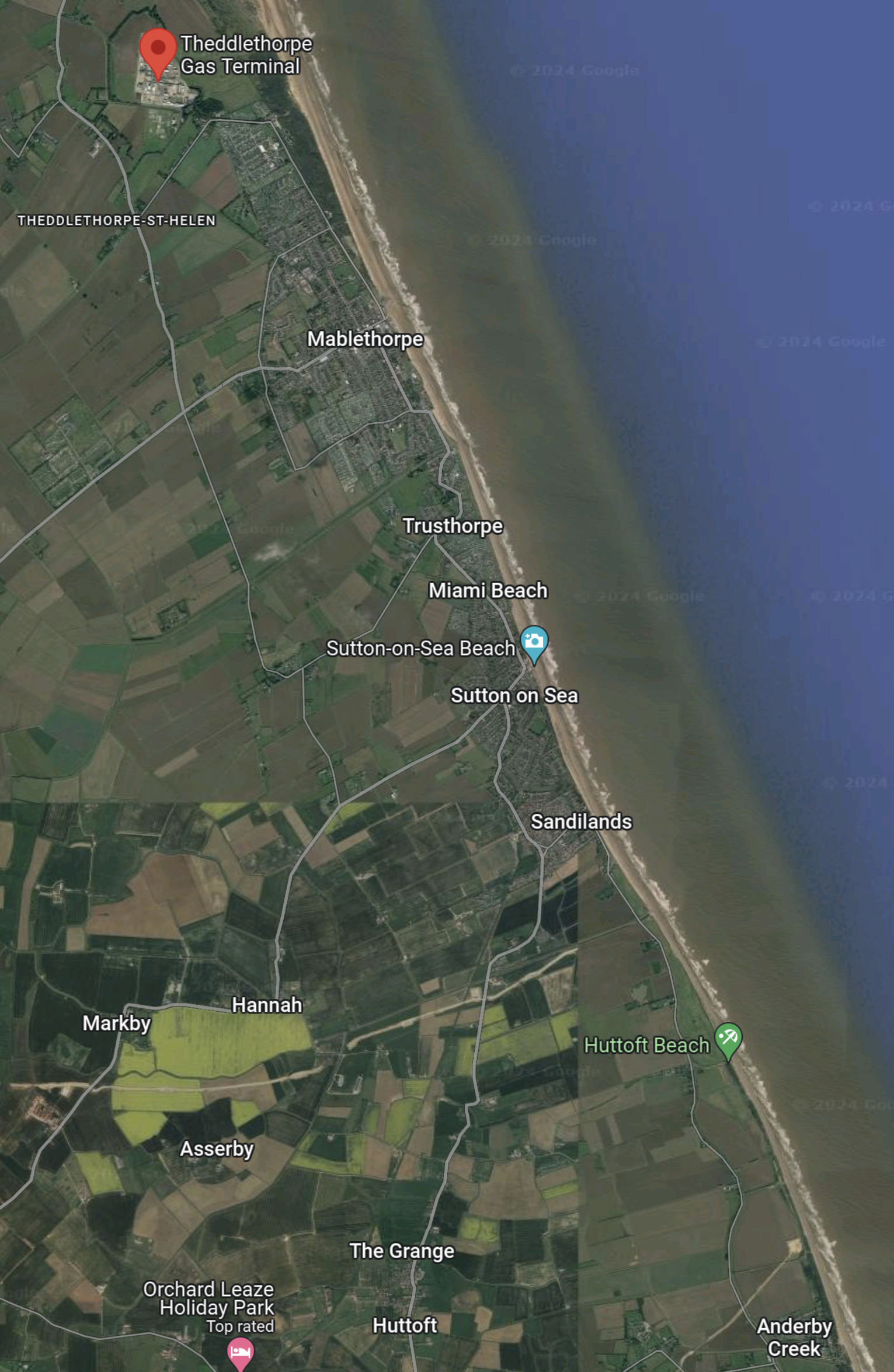
This Google Map shows the coast between Theddlethorpe and Anderby Creek.
Note.
- The decommissioned Theddlethorpe gas terminal is indicated by the red arrow.
- The seaside resort of Mablethorpe lies between the two possible landing sites.
- Anderby Creek is in the South-East corner of the map.
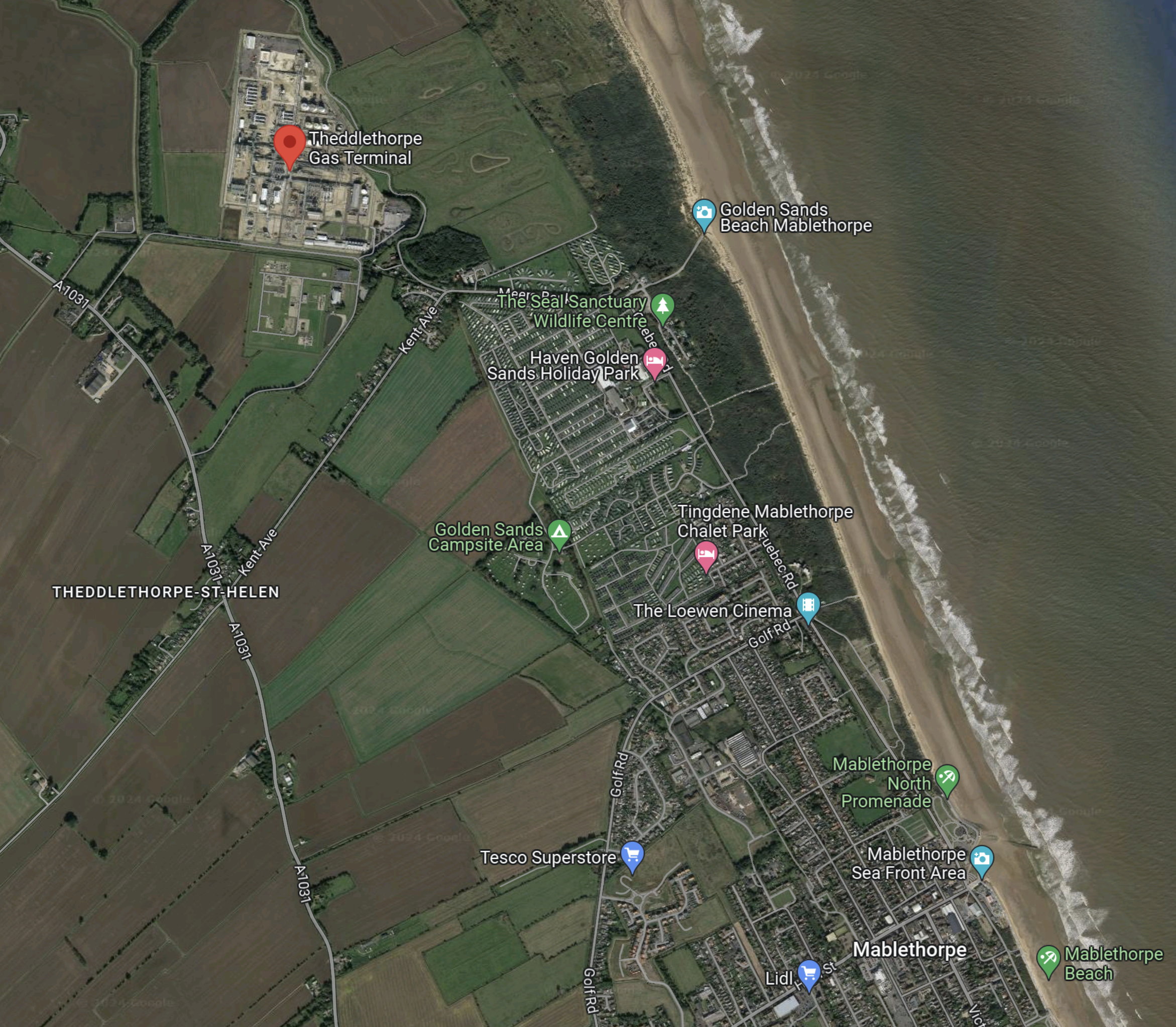
This second Google Map shows the Theddlethorpe Gas Terminal and the North of Mablethorpe.
Note.
- The decommissioned Theddlethorpe gas terminal is indicated by the red arrow.
- Mablethorpe beach appears to be on a high quality.
Both sites would appear to be strong possibilities.
Both sites have plenty of space, but the Theddlethorpe gas terminal is a large brownfield site.
The Anderby Creek site would probably be a shorter underground cable across Lincolnshire.
The Triton Knoll Wind Farm
The Wikipedia entry for the Triton Knoll wind farm starts with these two paragraphs.
Triton Knoll Wind Farm is an 857 MW round 2 offshore wind farm 33 kilometres (21 mi) off the coast of Lincolnshire, in the North Sea, England.
RWE Npower Renewables were awarded the lease to the development area in 2003. The offshore elements of the wind farm of up to 1200MW power gained planning consent in 2013; RWE reduced the scope of the wind farm to 900MW or under in 2014, to reduce cost per MW.
Note.
- The wind farm was commissioned in January 2022.
- The wind farm cables make landfall at Anderby Creek.
- They then travel underground to Bicker Fen substation.
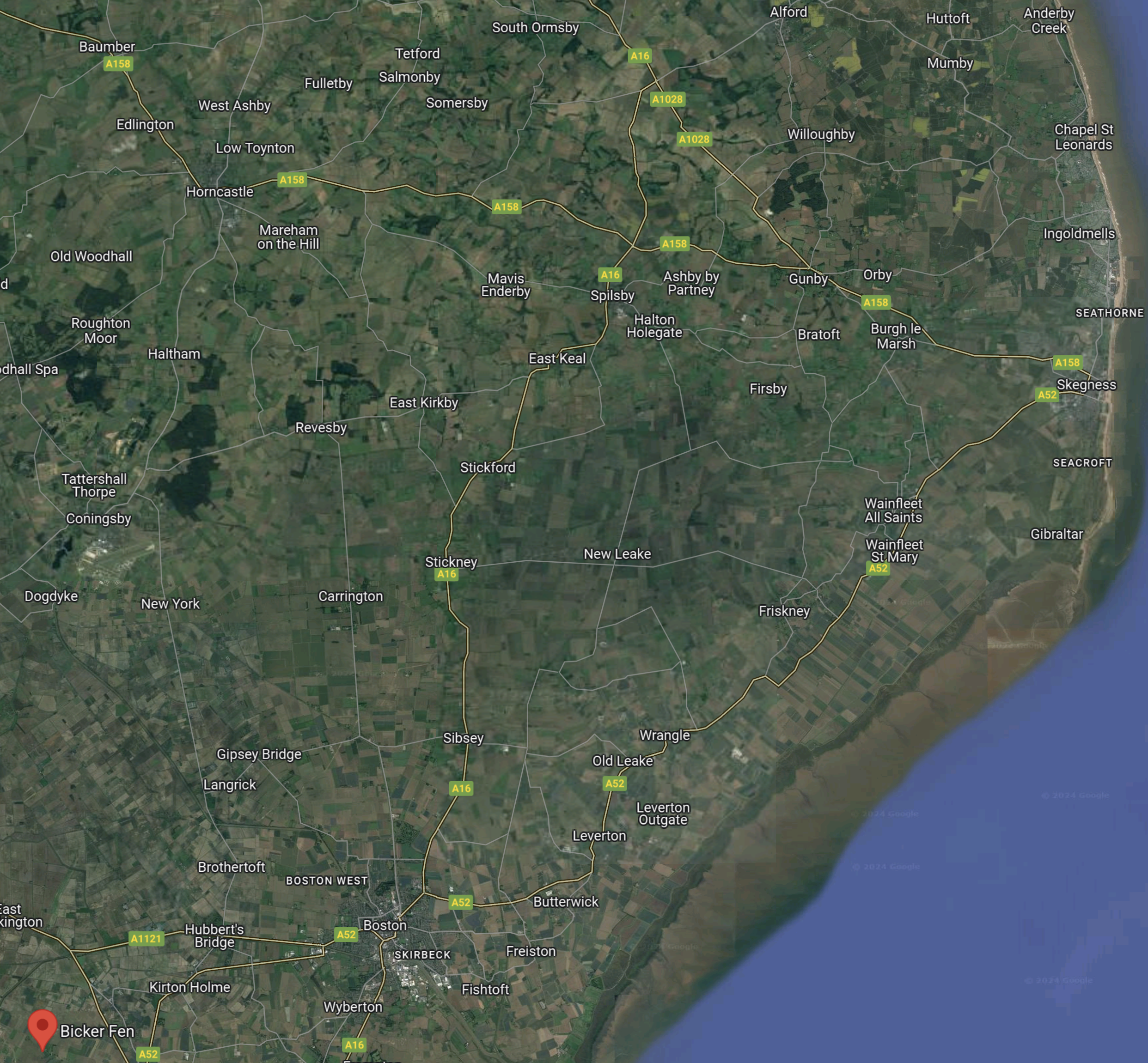
This Google Map shows Bicker Fen and Anderby Creek.
Note.
- Bicker Fen substation is in the South-West corner of the map and is indicated by a red arrow.
- Anderby Creek is in the North-East corner of the map.
- The cable is underground.
- This page on the Murphy Group website, describes the work the company did to install the cables.
- It appears from the Murphy document, that there are six cables between Anderby Creek and Bicker Fen.
This Google Map shows Anderby Creek.
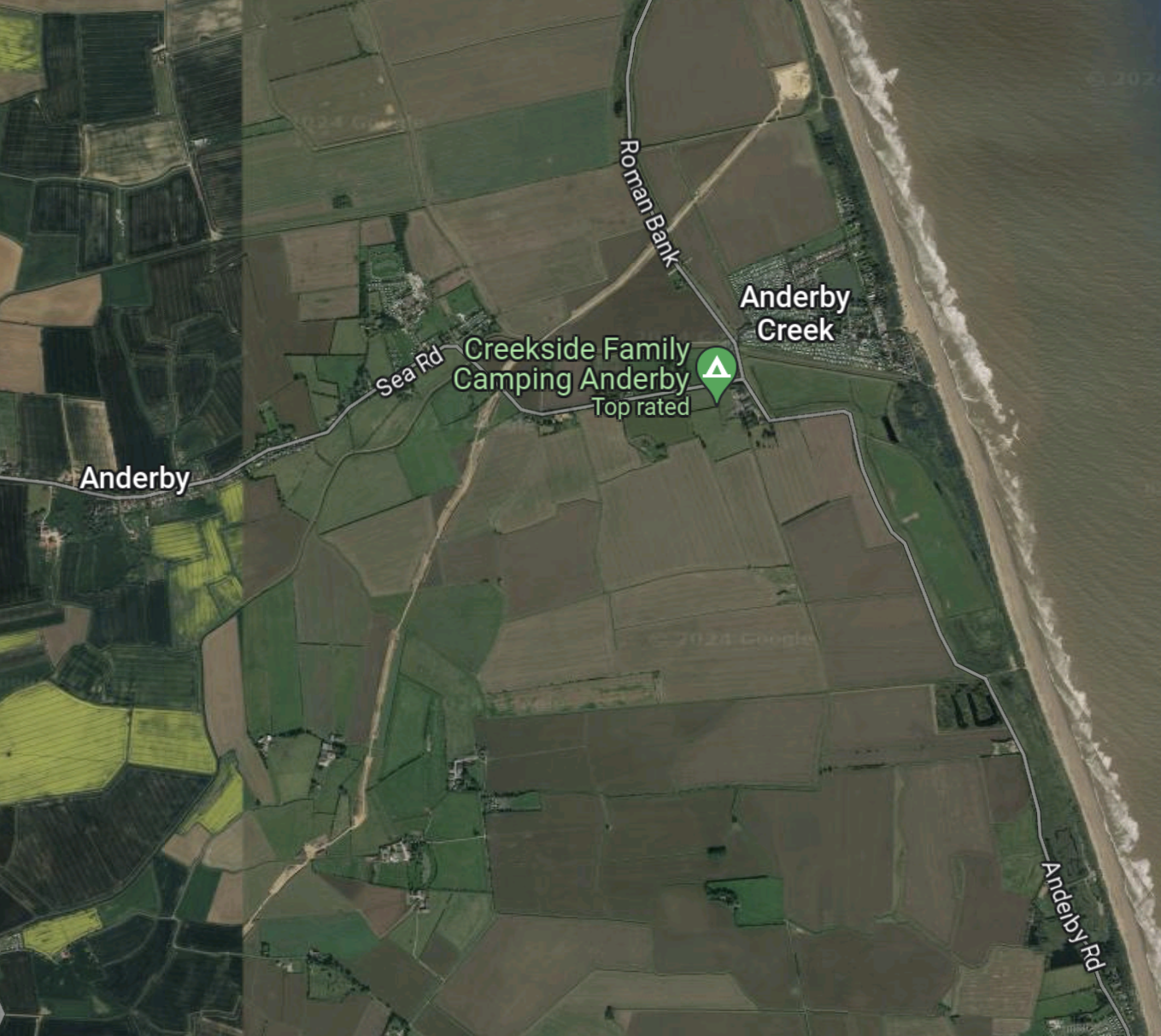
Could the scar across the land to the West of Anderby Creek, be the connection to the offshore Triton Knoll wind farm?
I think it is! And I also think that it can carry more than just the 857 MW Triton Knoll wind farm!
I am suspicious, that one of Baldrick’s ancestors has been at work and the Triton Knoll export cable system could be used to connect Green Link 3 and Green Link 4 to Bicker Fen and Walpole substations.
This would surely allow Scottish wind power to be sold to Denmark and then sold onward to Germany.
The VikingCCS Project
The VikingCCS project is a carbon capture and storage project, that is proposed to be based at the decommissioned Theddlethorpe gas terminal.
The VikingCCS project has a web site.
Would the use of the Theddlethorpe gas terminal mean that it is more likely that Green Link 3 and Green Link 4 will make a Southern landfall at Anderby Creek?
Will There Be A Connection To Viking Link?
The Viking Link is a 1400 MW at 525 KV electricity interconnector between Bicker Fen in Lincolnshire and Revsing in Jutland, Denmark.
This Google Map, shows the location of Bicker Fen, about halfway between Boston and Sleaford.

This second map shows the position of the current Walpole substation with respect to the Wash.
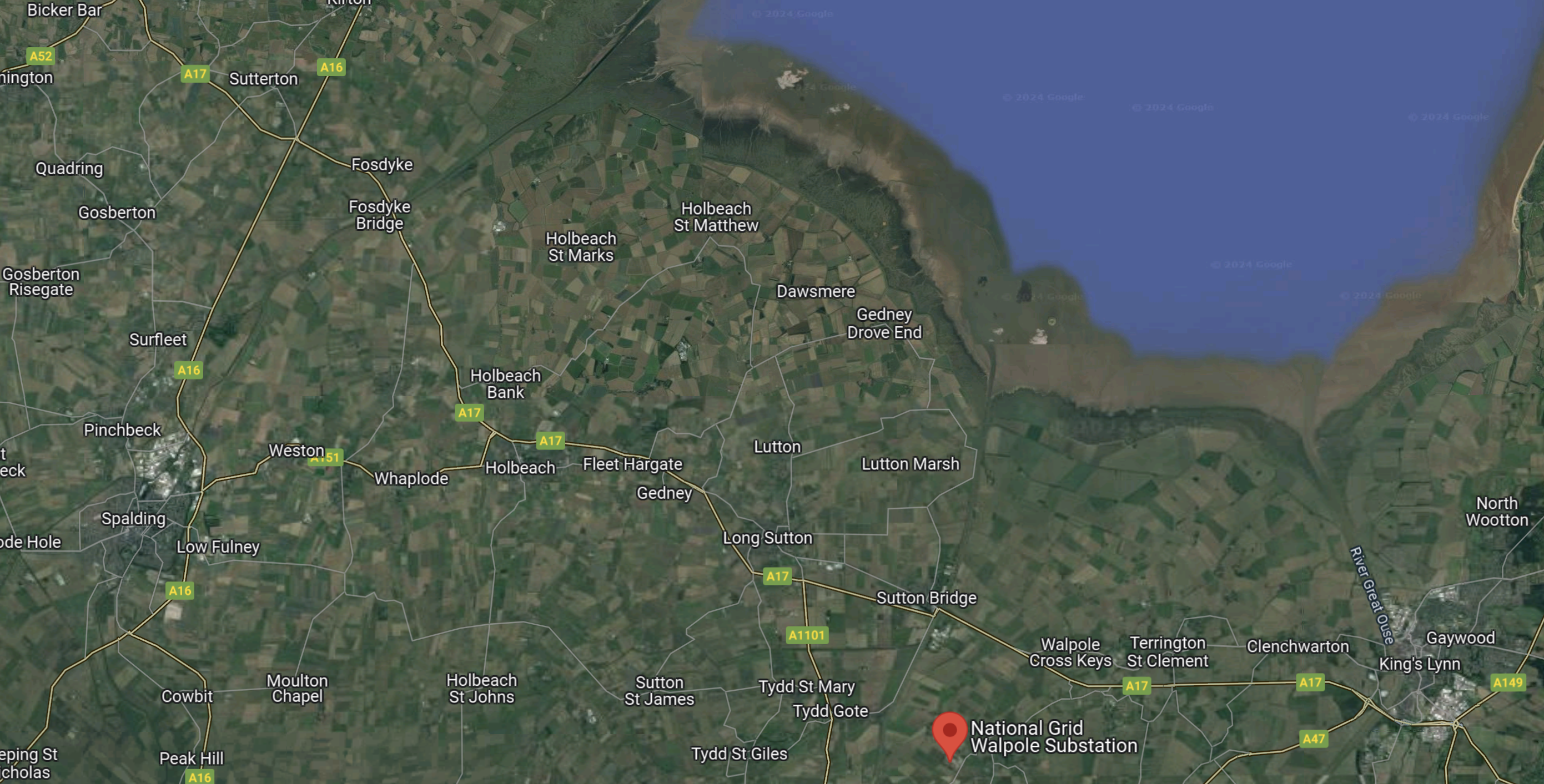
Note.
- Bicker Fen is in the North-West corner of the map.
- The current Walpole substation is marked by the red arrow.
- King’s Lynn is in the South-East corner of the map.
I suspect, if National Grid wanted to connect Green Link 3 and Green Link 4 to the Viking Link, then this would be possible.
If the Viking Link were to be connected to Green Link 3 and Green Link 4, this would allow surplus Scottish renewable energy to be sent to Denmark and on to Germany.
Green Link 3, Green Link 4 And Viking Link Appear To Be Underground In Lincolnshire
I can’t find any trace of overhead cables for the Viking Line in Lincolnshire and the press release says this about Green Link 3 and Green Link 4.
After making landfall, both projects’ cables will run underground for approximately 100km to two proposed converter stations in the Walpole, King’s Lynn and West Norfolk, area.
The connection to the Triton Knoll wuind farm is also underground.
It does appear that National Grid, are going for a Nimby-friendly approach for cables between Walpole and the coast.
Hopefully putting the cables underground will save money in legal arguments and fees.
Could London Drivers Be Charged On A Cost Per Mile Basis?
This article on CarWow is entitled Transport for London Investing £150 million In Technology Capable Of Enforcing Pay-Per-Mile Road Charging.
These reasons are given for the new system.
- Transport for London developing new ANPR technology
- Set to be used for Ulez and congestion charging for now
- Could be expanded in the future to include pay-per-mile road charging
- Estimated project cost of £150 million
In addition, this paragraph gives another reason.
A new platform for existing road user charging schemes, such as Ulez and the Congestion Charge, is being developed by Transport for London to replace the outsourced system currently in place as the contract is due to expire in 2026.
I can understand, that if it is brought in house, that this might create more jobs in London, rather than somewhere far away.
Speeding
If you read the article on CarWow, nothing is said about speeding.
But surely, if a sophisticated computer system knew you were at A and B at certain times, it could calculate your speed.
Coupled with a 20 mph speed limit, it could be a big money earner.
It also gets Sadiq Khan off the hook with pay-per-mile charging. He just introduces fines for people, who break the law by speeding.
Conclusion
I don’t drive, so it doesn’t bother me.
But I would advise anyone, who does, to think long and hard about who they vote for.
Rail Minister Marks Completion Of £150m Hope Valley Railway Upgrade
The title of this post is the same as that of this article on Rail Magazine.
These first two paragraphs summarise the work.
More reliable journeys are promised on the Hope Valley line between Manchester and Sheffield after a £150 million upgrade was completed in early April.
Over the last three years, the existing platform at Dore & Totley station on the south side of Sheffield has been extended to cope with six-coach trains. Meanwhile the second platform has been rebuilt and commissioned (after it was removed in the 1980s), two mechanical signal boxes have been abolished and a new one-kilometre freight loop laid in the Peak District. At Hathersage, a pedestrian crossing has also been removed and replaced with a footbridge.
These are my thoughts.
Dore And Totley Station
The Rail Magazine article says this about the improvements at Dore and Totley station.
Replacing two tracks through Dore & Totley removes a single-track bottleneck that often saw Sheffield to Manchester express services held up by slower stopping services and cement trains destined for Earles Sidings. A nine-day shutdown of the route in March was needed to finish the work.
The new platform sits between the Midland Main Line and the Hope Valley line, so can only be reached via the new footbridge or lifts. As well as the usual ‘blister paving’ slabs marking the edge of the platform, other tactile paving has been laid to help people with visual impairments find their way around the station.
This OpenRailwayMap shows the new layout of tracks at Dore and Totley station.

Note.
- The four tracks at the North of the map go to Sheffield station.
- The Eastern pair of tracks are the Midland Main Line and they go to the South-East corner of the map for Chesterfield and the South.
- The Western pair of tracks are the Hope Valley Line and they go to the South-West corner of the map for Manchester.
- The blue lettering in the middle of the map indicates Dore and Totley station.
- There is a single track curve between the Midland Main Line and the Hope Valley Line, which is mainly used by freight trains.
This secondOpenRailwayMap shows Dore and Totley station in greater detail.

The big improvement is that the Hope Valley Line is now double instead of single track, which must eliminate a lot of delays.
These pictures show the station in July 2020.


















The pictures clearly show the single track and platform at Dore and Totley station.
Dore South Curve
Dore South Curve links the Southbound Midland Main Line with the Westbound Hope Valley Line.
This OpenRailwayMap shows the curve.

There is a crossover in the South-West corner of the map, so with careful signalling, trains can use the Dore South Curve in both directions.
Bamford Loop
This is a freight loop between Bamford and Hathersage stations.
This OpenRailwayMap shows the loop.

Note.
- The Hope Valley Line goes diagonally across the map.
- Manchester is to the North-West.
- Sheffield is to the South-East.
- Bamford station is in the North-West corner of the map.
- Hathersage station is just off the South-East corner of the map.
- The loop is on the Northern side of the Hope Valley Line.
The loop will most likely be used by trains going to Sheffield or Chesterfield.
Hathersage Footbridge
This Google Map shows Hathersage station.

Note.
- Dore Lane and the B 6001 appear to pass under the railway.
- There appears to be what could be foundations just to the West of the platforms at Hathersage station.
- From pictures found by Google the bridge appears to be a simple steel structure.
I shall have to go and take pictures.
Fast Trains Between Manchester And Nottingham
In the Wikipedia entry for the Hope Valley Line, this is said.
Nottinghamshire County Council and the Department for Transport have investigated the possibility of adding another service that does not call at Sheffield in order to improve the journey time between Nottingham and Manchester. Stopping (and changing direction) in Sheffield, the fastest journey is 110 minutes (in 2019), but the council has estimated bypassing Sheffield would cut the time to 85 minutes. Suggested improvements on a 2+1⁄2-mile (4 km) stretch near Stockport may reduce journey times by 2–3 minutes.
Consider.
- According to Google, the driving time between the two cities is 128 minutes and the motorway route is via the M1 and M62.
- If nearly half-an-hour could be saved between Manchester and Nottingham could be a big saving in journey time.
- Manchester Piccadilly is likely to be rebuilt for High Speed Two and a fast route via Nottingham could be a viable alternative.
- Both Manchester and Nottingham have good local tram and train networks.
- As the electrification of the Midland Main Line progresses, the route will be increasingly suitable for 100 mph battery-electric trains.
A Manchester and Nottingham express service looks to be an easy service to implement after the Hope Valley Line has been improved.
Hourly Stopping Trains Between Manchester And Sheffield
The Wikipedia entry for the Hope Valley Line gives these details for the stopping service between Manchester Piccadilly and Sheffield.
- Trains are hourly.
- Trains call at Reddish North, Brinnington, Bredbury, Romiley, Marple, New Mills Central, Chinley, Edale, Hope, Bamford, Hathersage, Grindleford and Dore & Totley.
- But some services do not call at some or all of Edale, Bamford, Hathersage, Grindleford and Dore & Totley giving some 2-hour gaps between services at these stations.
Let’s hope that some of the extra capacity is used to provide a regular service at all stations on the Hope Valley Line.
As in a few years, it will have electrification at both ends, this route could be very suitable for battery-electric trains.
Completion Date
It appears that the first day, when passengers will be able to use the new upgraded tracks and stations will be Thursday, the 2nd of May.
Conclusion
The improvements, certainly seem to allow extra and improved services through on the Hope Valley Line.
I also feel that in a few years, services will be run by battery-electric trains.
ITM Power Seals PEM Electrolyser Deal With Hygen
The title of this post, is the same as that of this article on gasworld.
These three paragraphs give details of the deal.
ITM Power has struck a partnership with Hygen Energy to become the preferred supplier for Proton Exchange Membrane (PEM) electrolysers for major hydrogen projects within the UK and across Europe.
Hygen, a leading developer, producer and asset owner of low-carbon hydrogen production on the continent, focusing on the decarbonisation of mobility, construction and hard-to-electrify industries and power, is targeting 200 Megawatt (MW) of electrolyser projects across the continent.
The two-phase collaboration will see 50 MW of Neptune Plug and Play electrolysers across several projects, many of which will be based on UK government HAR2 or similar funding programmes, followed by 150 MW of larger-scale modular electrolysers. Each project will be subject to a Final Investment Decision (FID).
Note.
- This page on the iTM Power web site gives details of the Neptune electrolyser.
- Neptune appears to be a 2 MW electrolyser, so the first phase could be around 25 electrolysers.
- This news item on the iTM Power web site is entitled iTM Power And Sumitomo Complete Installation Of First If Its Kind Demonstration Electrolyser Un Japan.
Things seem to be looking up for iTM Power.
Conclusion
I can see a time in the not to distant future, where a large number of small-to-medium size electrolysers will be mopping up surplus electricity to create hydrogen.
 The Anonymous Widower