AquaVentus
I suggest, that you read this page on the RWE web site called AquaVentus.
The page starts with this RWE graphic.
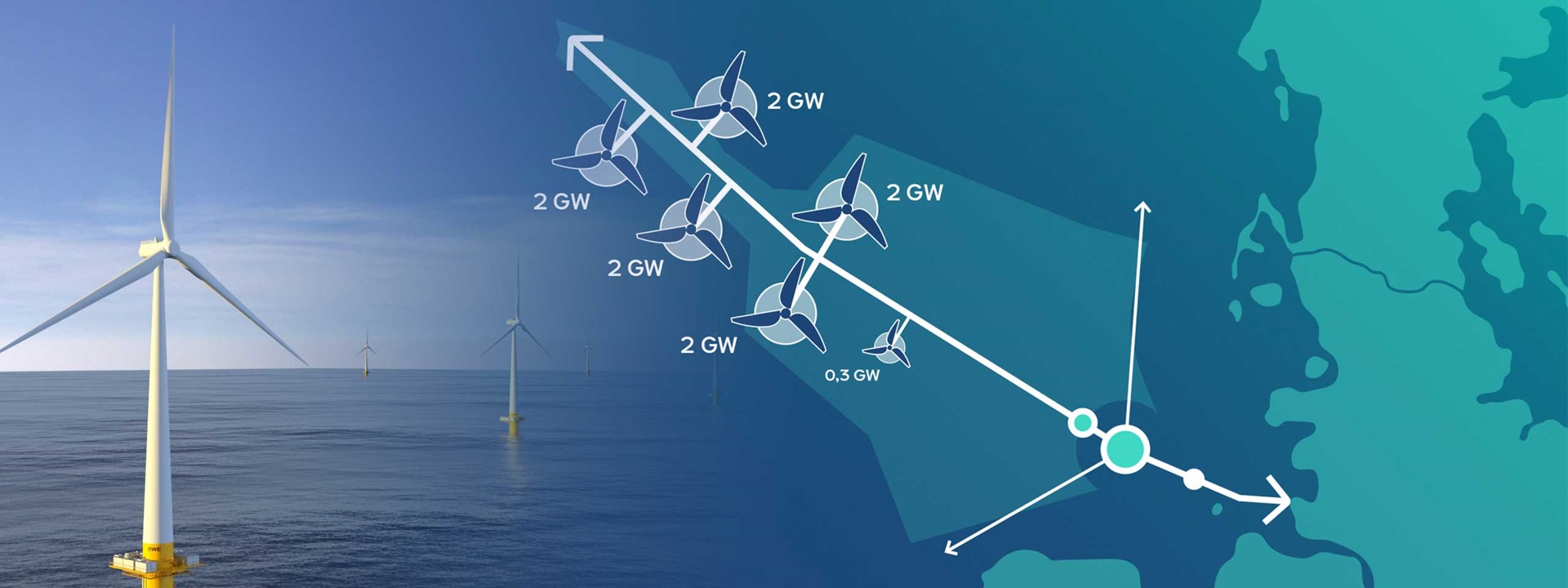
It appears that 10.3 GW of hydrogen will be created by offshore wind farms and piped to North-West Germany.
These two paragraphs outline the AquaVentus initiative .
Hydrogen is considered the great hope of decarbonisation in all sectors that cannot be electrified, e.g. industrial manufacturing, aviation and shipping. Massive investments in the expansion of renewable energy are needed to enable carbon-neutral hydrogen production. After all, wind, solar and hydroelectric power form the basis of climate-friendly hydrogen.
In its quest for climate-friendly hydrogen production, the AquaVentus initiative has set its sights on one renewable energy generation technology: offshore wind. The initiative aims to use electricity from offshore wind farms to operate electrolysers also installed at sea on an industrial scale. Plans envisage setting up electrolysis units in the North Sea with a total capacity of 10 gigawatts, enough to produce 1 million metric tons of green hydrogen.
The page also gives these numbers.
- Total Capacity – 10 GW
- Tonnes Of Green Hydrogen – 1 million
- Members – 100 +
The web site says this about commissioning.
Commissioning is currently scheduled for early/mid 2030s.
The Germans can’t be accused of lacking ambition.
Conclusion
AquaVentus will bring the Germans all the hydrogen they need.
I suspect AquaVentus can be expanded into the waters of other countries surrounding the German territorial waters.
UK Boosts Sixth CfD Auction Budget, Earmarks GBP 1.1 Billion For Offshore Wind
The title of this post, is the same as that of this article on offshoreWIND.biz.
This is the sub-heading.
The UK government has decided to increase the budget for the next Allocation Round 6 (AR6) to GBP 1.5 billion, including GBP 1.1 billion for offshore wind. The funding uplift represents more than a 50 per cent increase on the budget previously set in March this year.
These are the first three paragraphs.
At the beginning of this year, the UK government revealed a budget of GBP 1 billion for this year’s Contracts for Difference (CfD) AR6 with the majority of it, GBP 800 million, earmarked for offshore wind.
However, the new budget, announced on 31 July by the UK’s Secretary of State for Energy Security and Net Zero, Ed Miliband, marks a GBP 500 million increase over the funding set by the previous Conservative government.
The scheme’s design means the central government’s budget will not be impacted, following findings from a Treasury spending audit revealed GBP 22 billion of unfunded pledges inherited from the previous government, according to the press release.
I do find it interesting, that despite blaming some dubious funding from the previous government, that more of the same will be used to develop some more wind farms.
How I Was Imprisoned In A Pizza Restaurant And Driven Home By The Metropolitan Police
At lunchtime today, I received a phone call, saying that my GP’s surgery could see me at 16:30 this afternoon, to discuss my lack of sleep, arthritis and various strains and pains.
My middle son; Henry had expressed a desire to be at such an appointment, so I said, that if he could chauffeur me to the GP, he could come along.
His diary co-operated and he duly arrived outside my house at 16:00.By the time of the GP’s appointment, we had parked conveniently outside the surgery and we had been ushered into the GP’s consulting room.
We had a good meeting and by just after five, we had broken up and agreed a comprehensive plan for the diagnosis of my problems.
Henry had three problems of his own.
- He had legal work to do for the morning.
- He needed to do some bits of shopping.
- He also said, that he was feeling rather hungry.
- I too was hungry and needed to do some shopping.
So I suggested we drive to Southgate Road and see if we could get a pizza in Sweet Thursday.
- They do gluten-free pizzas, so I would have no dietary worries.
- In previous meals, I have found the quality excellent.
- There are shops nearby, where we could shop, if we needed.
As I approached the restaurant, I decided we had made the right decision, as there was a parking space about twenty metres from the restaurant.
We both had similar meals.
- Ham and mushroom pizzas, although mine was gluten-free.
- I drunk a zero-alcohol Lucky Saint, whilst Henry had a Diet-Coke.
- We both finished off, with two scoops of appropriate ice cream.
It was only, when we had paid and tried to leave that we got a very big surprise.
Parked in front of the restaurant with its disabled ramp extended, like some beached airliner was a 141 bus, that was empty of passengers.
- There was broken glass at the front of the bus.
- Was this evidence, that the bus had hit something or somebody?
- The police had strung white tape everywhere.
- There were half-a-dozen police cars and ambulances blocking Southgate Road.
Henry’s car wouldn’t be going anywhere for some time, as it was blocked in by two ambulances and a police car with flashing blue lights.
- So, Henry and I each had a coffee, to pass the time.
- We also made friends with others trapped in the restaurant.
- Henry also obtained information from the police, that no-one would be moving, until it was known that no-one would be moving until the full state of the injuries of the person hit by the bus was known.
So Henry and I just sat there with several others on the hard chairs in front of the restaurant.
In the end, for me, it was over very quickly.
- I live about a kilometre North of the incident.
- Some were walking from the incident to the Balls Pond Road to get a bus.
- I am fairly sure, Henry had told the police, that it was far too far for me to walk with my arthritic hip.
I was put in the back of a police car and ferried home, at about 21:45.
Thanks to the Metropolitan Police.
I have some further thoughts.
Do I Drink Enough?
Since lunchtime, I have drunk the following.
- 4 x 330 ml – Adnams Ghost Ship 0.5 % Beer
- 1 x 330 ml – Lucky Saint 0.5 % Beer
- 300 ml – Assorted water and juices.
- 1 cup – coffee.
Is that enough?
I certainly slept better last night!
Jurgen Maier To Chair Great British Energy
This article in The Times is entitled Pylons Are The Price Of Lower Bills, Keir Starmer Tells Rural Britain.
These are two paragraphs from the article.
Starmer confirmed that Jürgen Maier, the former UK chief executive of the Siemens conglomerate, would chair the energy company.
Maier has advised Labour on rail and transport since December. He was openly critical of the party’s decision to drop a pledge to spend £28 billion a year on green investment, saying the figure was an “absolute minimum” and that scrapping the promise was “not good for climate change or for the growth of our economy”.
Note.
- His Wikipedia entry is impressive.
- He has dual Austrian and British citizenship.
- He went to school in Leeds and is a graduate of Nottingham Trent University.
- He rose to be Chief Executive of Siemens UK and retired in 2019 at 55.
- I have heard him several times on the radio and he seems to talk a lot of sense.
In my view he could be an excellent choice as Chair of Great British Energy.
I also have some further thoughts.
Jürgen Maier And Peter Hendy
Jürgen Maier and Peter Hendy, who is Starmer’s Rail Minister, have remarkably similar backgrounds and I wouldn’t be surprised if they know each other well, through dealings around Siemens’ contract for Transport for London’s new trains for the Piccadilly Line.
When last, were two technological heavyweights, so close to the heart of a UK government?
RWE
German energy company; RWE are the UK’s largest power generator.
- RWE have five gas-fired power stations with a total output of 6.56 GW.
- RWE have two onshore wind farms in operation with a total output of 67 MW.
- RWE have four offshore wind farms in operation with a total output of 1.88 GW.
- RWE have eight offshore wind farms under development with a total output of 9.90 GW.
- RWE also has other electrical gubbins, like an electrolyser in South Wales.
Would Jürgen Maier be an ideal person, to persuade RWE to keep investing in the UK?
When he was with Siemens, he certainly invested heavily in the UK.
The German Problem
Germany’s problem is how they generate electricity.
Sources are as follows for Germany and the UK.
- Coal – 26 % – 1 %
- Natural Gas – 10.5 % – 32 %
- Wind – 32 % – 29.4 %
- Solar 12.2 % – 4.9 %
- Biomass – 9.7 % – 12.3 %
- Nuclear – 1.5 % – 14.2 %
- Hydro – 4.5 % – 1.8 %
- Oil – 0.7 % – 0 %
- Other – 2.9 % – 0 %
- Storage – 0 % – 1 %
- Imports – 0 % – 10.7 %
Note.
- Figures are for 2023.
- Germany is the first percentage.
- UK is the second percentage.
- Germany has pledged to end coal-fired electricity production by 2030.
- Both countries seem to generate similar amounts of electricity from wind, biomass and hydro.
To replace the coal and make up for lack of nuclear, Germany needs to find a new power source.
The German Solution
The Germans are going for hydrogen in a big way.
The title of this page of the RWE web site is Welcome To The Age Of Hydrogen.
The page starts with this paragraph.
RWE is actively involved in the development of innovative hydrogen projects. The H2 molecule is considered to be an important future building block of a successful energy transition. RWE is a partner in over 30 H2 projects and is working on solutions for decarbonising the industry with associations and corporations like Shell, BASF and OGE. Hydrogen projects are comprehensively supported in the separate Hydrogen department of the subsidiary RWE Generation.
I also suggest, that you read this page on the RWE web site called AquaVentus.
The page starts with this RWE graphic.
It appears that 10.3 GW of hydrogen will be created by wind farms and piped to North-West Germany.
These two paragraphs outline the AquaVentus initiative .
Hydrogen is considered the great hope of decarbonisation in all sectors that cannot be electrified, e.g. industrial manufacturing, aviation and shipping. Massive investments in the expansion of renewable energy are needed to enable carbon-neutral hydrogen production. After all, wind, solar and hydroelectric power form the basis of climate-friendly hydrogen.
In its quest for climate-friendly hydrogen production, the AquaVentus initiative has set its sights on one renewable energy generation technology: offshore wind. The initiative aims to use electricity from offshore wind farms to operate electrolysers also installed at sea on an industrial scale. Plans envisage setting up electrolysis units in the North Sea with a total capacity of 10 gigawatts, enough to produce 1 million metric tons of green hydrogen.
The page also gives these numbers.
- Total Capacity – 10 GW
- Tonnes Of Green Hydrogen – 1 million
- Members – 100 +
The web site says this about commissioning.
Commissioning is currently scheduled for early/mid 2030s.
The Germans can’t be accused of lacking ambition.
AquaVentus And The UK
This video shows the structure of AquaVentus.
I clipped this map from the video.

Note.
- There is a link to Denmark.
- There appears to be a undeveloped link to Norway.
- There appears to be a link to Peterhead in Scotland.
- There appears to be a link to just North of the Humber in England.
- Just North of the Humber are the two massive gas storage sites of Aldbrough owned by SSE and Brough owned by Centrica.
- There appear to be small ships sailing up and down the East Coast of the UK. Are these small coastal tankers distributing the hydrogen to where it is needed?
In the last century, the oil industry, built a substantial oil and gas network in the North Sea. It appears now the Germans are leading the building of a substantial hydrogen network.
AquaVentus And Aldbrough And Rough Gas Storage
Consider.
- In The Massive Hydrogen Project, That Appears To Be Under The Radar, I describe the Aldbrough Gas Storage.
- In Wood To Optimise Hydrogen Storage For Centrica’s Rough Field, I describe Centrica’s plans to turn Rough Gas Storage into the world’s largest hydrogen store.
- There is a small amount of hydrogen storage at Wilhelmshaven.
It looks like the East Riding Hydrogen Bank, will be playing a large part in ensuring the continuity and reliability of AquaVentus.
Dogger Bank South And AquaVentus
This Google Map shows the North Sea South of Sunderland and the Danish/German border.
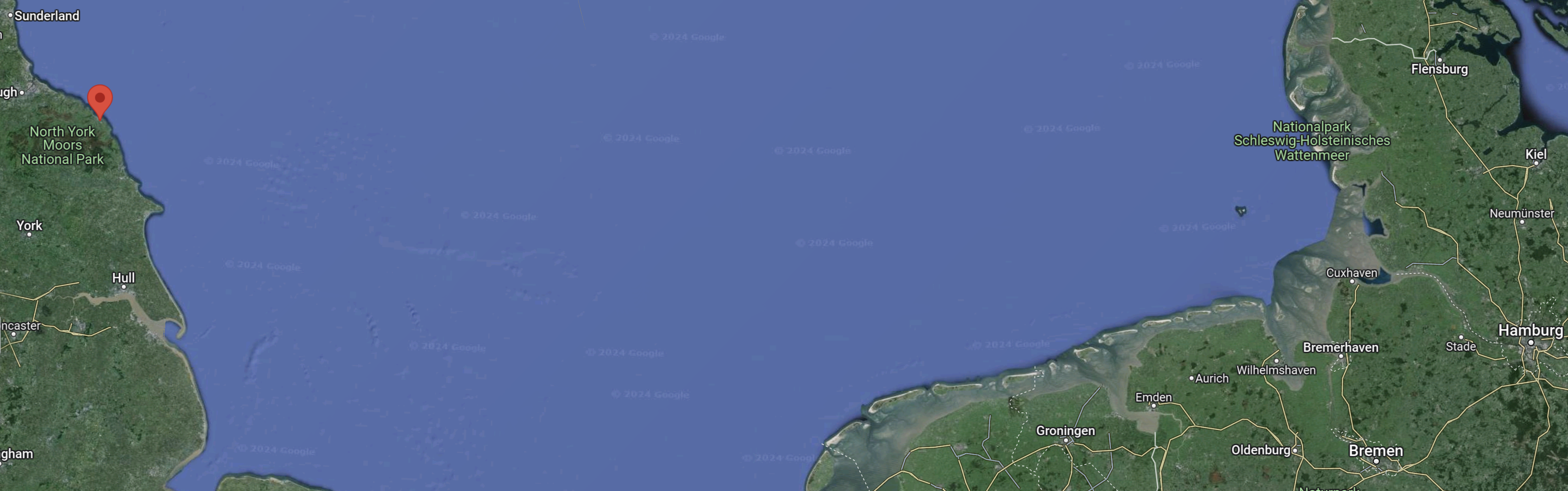
Note.
- Sunderland is in the top-left hand corner of the map.
- A white line in the top-right corner of the map is the Danish/German border.
- Hamburg and Bremen are in the bottom-right hand corner of the map.
If you lay the AquaVentus map over this map, I believe that RWE’s Dogger Bank South wind farm could be one of the three 2 GW wind farms on the South-Western side of the AquaVentus main pipeline.
- Two GW would be converted to hydrogen and fed into the AquaVentus main pipeline.
- Two GW of hydrogen will be a nice little earner for UK plc.
- One GW of electricity would be sent to the UK.
But this is only one of many possibilities.
Conclusion
Could Jürgen Maier, be the man to develop British links to AquaVentus for the benefit of both the UK and Germany?
- The UK’s wind farms could provide a lot of hydrogen for AquaVentus.
- Aldbrough And Rough Gas Storage are conveniently places to add the hydrogen storage, that AquaVentus needs.
- AquaVentus can certainly be expanded to Norway, and possibly Orkney and Shetland.
He certainly has a lot of relevant experience.
Welcoming GB Energy And Its Mission To Make Britain A Clean Energy Superpower
The title of this post, is the same as that of this press release from SSE.
This is the sub-heading.
Making Britain a clean energy superpower by 2030 is one of the new government’s five missions. The UK Government and Crown Estate have announced plans to join forces to create a new publicly owned energy firm. GB Energy will invest in homegrown, clean energy.
These are the first two paragraphs of SSE’s response to the announcement.
We welcome the focus of GB Energy on earlier stage technologies, such as carbon capture and storage (CCS), where the Government can de-risk projects and help accelerate the clean energy transition.
In areas such as offshore wind, where industry is already delivering mission-critical infrastructure, the biggest impact will be on delivering policies that speed up the build out of these essential projects.
It looks like SSE, see Great British Energy as a positive development.
SSE And Gilkes Energy Announce Joint Plans To Progress Loch Fearna Pumped Storage Hydro Project
The title of this post, is the same as that of this press release from SSE Renewables.
These five paragraphs from the press release outline the scheme.
SSE has announced plans to progress a new pumped storage hydropower scheme at Loch Fearna in Scotland’s Great Glen, in a 50:50 development joint venture with a consortium led by Gilkes Energy.
The proposed co-development is located at the western end of Glengarry around 25km west of Invergarry and adjoins SSE Renewables’ existing Loch Quoich reservoir in the Great Glen hydro scheme.
SSE Renewables already operates the largest fleet of hydro-electric power and pumped storage hydro assets in Scotland. It is now progressing development plans for new pumped storage hydropower projects in the Highlands to complement its existing fleet and deliver the large-scale, long-duration electricity storage (LDES) needed as part of Britain’s future energy mix.
The Fearna Pumped Storage Hydro (PSH) project envisages the development of tunnels and a new power station connecting SSE Renewables’ existing reservoir at Loch Quoich with an upper reservoir at Loch Fearna.
Under the terms of the joint venture being announced today, Gilkes Energy will lead the project’s development under a development services agreement with SSE Renewables.
I wrote about the Great Glen hydro scheme in Repurposing The Great Glen Hydro-Electric Scheme, where I included this map, from the SSE Renewables web site shows the layout of the dams and power stations.
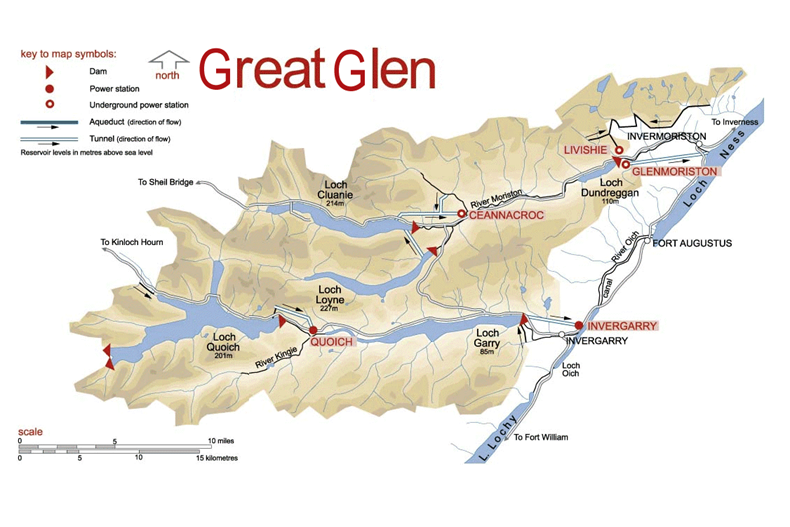
The sizes of the power stations in the scheme are as follows.
- Ceannacroc – 20 MW
- Livishie – 15 MW
- Glenmoriston- 37 MW
- Quoich – 18 MW
- Invergarry – 20 MW
- Mucomir – 1.7 MW
This gives a total power of 112.7 MW.
This five paragraph from the press release details the size of the scheme.
It is envisaged the proposed development would be up to 1.8GW in generating capacity and capable of producing around 37GWh of stored energy capacity. The project has already secured a grid connection offer totalling 1,795MW.
The 1.8 GW/37 GWh Fearna pumped hydro scheme will dwarf the Great Glen hydro scheme.
it is now seventy years since some of these hydro-electric systems were built in Scotland.
As an engineer, I wouldn’t be surprised to a see a fair amount of updating in the Highlands to upgrade Scotland’s hydro-electricity.
How To Protect The UK Population From Future Pandemics
The Times today has an article, which is entitled Flu Jab: Single-Shot Vaccine ‘Within Five Years’ Could Stop Future Pandemic.
This is the introductory paragraph of The Times article.
A single-shot vaccine against flu that would provide a lifetime of protection even against future mutations could be available in “five years or less”, scientists have said after making a breakthrough.
The article is very much a must-read, but I believe if used alongside a simple proven medical test, it could be even more effective.
Since 1997, when I was diagnosed as coeliac and started eating gluten-free food exclusively, I have never had a dose of flu.
I may have had one very mild dose of Covid-19, but I have never had a serious dose.
Research At The University Of Padua
This partial immunity to Covid-19 has been shown in a peer-reviewed scientific paper, by the University of Padua in Italy.
I discuss the Padua research in Risk Of COVID-19 In Celiac Disease Patients.
Mathematical Modelling Of Pandemics
As a control engineer, mathematical modeller and statistician, I believe that our herd immunity to future pandemics could be increased, if all new entries to the UK population, like babies and migrants, were tested for coeliac disease.
These days the coeliac test is just a blood test, that costs just a few pounds and I believe that a high percentage of gluten-free coeliacs in the UK population, because of their low susceptibility to flu pandemics, would slow the spread of the pandemic.
In a nuclear reactor non-radioactive carbon rods are often used to control the speed of the reaction.
I believe that non-susceptible coeliacs on gluten-free diets would perform the same function in the UK population.
Should Diagnosed Coeliacs Be Forced To Be Gluten-Free?
I would not force coeliacs to go gluten-free.
They would have to face up to the consequences, if they didn’t.
My son was an undiagnosed coeliac, who refused to get tested.
He died at 37 of pancreatic cancer, as his immune system was useless.
Coeliac disease and a gluten-free diet is a good wingman, but undiagnosed it can kill you!
Why Should Migrants Be Tested?
I hope they are, as some might have something nasty.
But if everyone was tested for a wide range of health and genetic conditions, could it act as a deterrent to come to the UK?
Oxford And Cambridge Compared On COVID-19
In Oxford And Cambridge Compared On COVID-19, I compared the COVID-19 rates of the two University cities.
- Oxford and Cambridge are very similar-sized cities and both ae surrounded by similar counties and countryside.
- During the pandemic, Oxford had a much higher COVID-19 rate than Cambridge.
From my experiences and observations in Cambridge, I believe that the city has a high level of coeliacs.
Why Does Cambridge Have A High Level Of Coeliacs?
I doubt, it is due to the genetics of the local population, as if it was, my coeliac disease would have been picked up earlier.
The two most likely causes are.
- Someone in the Health Authority decided to have a Whack-a-Coeliac policy.
- Addenbrooke’s Hospital, in conjunction with Cambridge University and the Sanger Centre were testing the accuracy of the newly-develop genetic test for coeliac disease.
Note.
- Both routes would have needed a streamlined endoscopy unit to test all those thought to be coeliac.
- I was tested twice in such a unit to prove that I was coeliac, after the genetic test showed, I probably was.
- Fit, younger patients were pushed to have the endoscopy without a sedative, which cut the number and cost of recovery beds and staff.
- My endoscopies were performed without a sedative, by a doctor working alone.
- I was able to drive home, a few minutes after the procedure.
It was a classic case of applying good old-fashioned time-and-motion to a test that would have to be applied to a large number of patients.
If Cambridge’s army of coeliacs helped the city take the edge of the pandemic, what would a Whack-a-Coeliac policy, do for other cities?
Wrightbus Launches NewPower In Bicester
The title of this post, is the same as that press release from Wrightbus.
This is the sub-heading.
World-leading bus manufacturer Wrightbus today took the wraps off a bold new enterprise designed to replace older diesel engines with new zero-emission electric powertrains.
These three paragraphs from the press release give more details.
NewPower, which has moved into a hi-tech factory in Bicester, Oxfordshire, aims to speed up the decarbonisation process by eradicating diesel powertrains in older fleets at a substantially lower price than a new bus.
Wrightbus becomes the first OEM to offer a re-powering service, utilising the unique skills of its 1,800-strong workforce to swap diesel for electricity. Its master technicians built the original buses and have unrivalled expertise in being able to swap powertrains.
Hailed as affordable decarbonisation, it is hoped that operators with mid-life bus fleets but without the funding for new zero-emission buses can take advantage of the instant sustainability switch.
Note.
- It appears that Wrightbus, have taken over the new factory of failed electric van manufacturer; Arrival.
- Converting a bus takes three weeks and six can be handled at one time.
- This gives the overall capacity to decarbonise five hundred buses per year.
I have some extra information from this article in Sustainable Bus magazine, which is entitled Wrightbus Launches Repowering Programme NewPower In Former Arrival Headquarter.
Which Buses Can Be Converted And How Much Does A Conversion Cost?
This paragraph is from the Sustainable Bus article.
UK trade media Bus & Coach Buyer reports that the new venture “is focused on fitting its tailored electric drivetrain into Streetdeck buses, then tailoring it for Gemini 2, then New Route Master, with plans to then engineer solutions for other common buses, at around £1m per model”.
Note.
- That is certainly a comprehensive conversion programme.
- I would assume the million pound per model is the development cost of an engineering package for a fleet of buses.
- London would get a thousand refurbished zero-carbon New Route Masters.
- A new double-decker bus can cost between £300,000 to £500,000.
It looks like a programme can be developed, that is profitable for all parties.
The Aerosol Tales
When I left Liverpool University in 1968, I was very familiar with the use of products distributed in aerosol cans.
- I had used aerosol shaving cream, although about that time, I acquired my beard.
- I certainly used aerosol deodorant, as did most in the 1960s.
- Aerosol paints were common for covering scuffs and scratches in your car.
- Aerosols were often used to apply sun protection.
- Aerosols containing cream or a non-dairy alternative for culinary use were not unknown.
- Aweosol lubricants were starting to appear.
Although, I went to work for the chemical giant; ICI, at that time, I had no idea how an aerosol and its can worked.
As ICI at the time, ICI were major manufacturers of aerosol propellants, I quickly learned how they worked.
The Wikipedia entry for Aerosol Spray Dispenser gives a lot of history about aerosol cans and their propellants.
The Wikipedia entry for Propellant has this paragraph describing propellants of the last century.
Chlorofluorocarbons (CFCs) were once often used as propellants, but since the Montreal Protocol came into force in 1989, they have been replaced in nearly every country due to the negative effects CFCs have on Earth’s ozone layer. The most common replacements of CFCs are mixtures of volatile hydrocarbons, typically propane, n-butane and isobutane. Dimethyl ether (DME) and methyl ethyl ether are also used. All these have the disadvantage of being flammable. Nitrous oxide and carbon dioxide are also used as propellants to deliver foodstuffs (for example, whipped cream and cooking spray). Medicinal aerosols such as asthma inhalers use hydrofluoroalkanes (HFA): either HFA 134a (1,1,1,2,-tetrafluoroethane) or HFA 227 (1,1,1,2,3,3,3-heptafluoropropane) or combinations of the two. More recently, liquid hydrofluoroolefin (HFO) propellants have become more widely adopted in aerosol systems due to their relatively low vapor pressure, low global warming potential (GWP), and nonflammability.
Note that the whole range of these chemicals, effect the ozone layer.
Rocksavage Works
ICI’s Rocksavage Works, was an integrated chemical plant by the Mersey,.
- It made all types of CFCs for aerosols and other purposes.
- It also made the fire suppressant and extinguisher; Bromochlorodifluoromethane or BCF.
- Alongside BCF, it made the anaesthetic Halothane or as ICI called it Fluothane.
- The plant was a poisonous place with all those bromine, chlorine and fluorine compounds.
- Despite this, the plant had a remarkable safety record.
I had the pleasure of working at the plant and it was where, I had most of my excellent Health and Safety training, from the amazing site foreman; Charlie Akers.
Some of the wisdom he distributed has proved invaluable in aiding my stroke recovery.
I suspect that since the signing of the Montreal Protocol, the plant has changed greatly or has even been closed.
All that appears to be left is the 800 MW gas-fired Rocksavage power station and a Facebook page.
Aerosol Baked Beans
In those days, I worked most of the time in a lab at Runcorn Heath.
One of the labs near to where I generally worked, in the large research complex, was a lab, where new aerosol products were developed and tested.
One of the standard jokes about that lab, was that they were working on aerosol baked beans. They said, they would develop the product, even of they had to eject them from the can one at a time.
Gift Time
One afternoon, the boss of the aerosol development lab came through with a tray of goodies.
On the tray, which was much like a cinema usherette’s ice cream tray of the sixties was a whole host of partly-labeled aerosol cans. Only clues to what the product might be were written on the outside in felt-tip pen.
I grabbed two, one of which was marked something like lubricating oil and the other was just marked hand cream, which I of course gave to my new wife; C.
We were married for nearly forty years and often, when she bought hand cream, she would remark, that it wasn’t of the same standard as the little can I brought home from work.
It appears to me, that one of the world’s top cosmetic companies and ICI were trying to create the world’s best and probably most expensive hand creams.
DMW
Fast-forward nearly twenty years and I was approached by Lloyds Bank about two individuals, who had developed an aerosol valve, that instead of using CFCs or other ozone-depleting chemicals.
- By the exploitation of the nether end of fluid dynamics, the propellant of the aerosol was nothing more harmless than pure nitrogen.
- I formed a company called DMW with the two inventors.
- John Gummer, who at the time was my MP and Environment Minister, knew of the aerosol valve and he took the details to Montreal.
So did a device developed in Suffolk help push through the Montreal Protocol?
Osbourne Reynolds
I also wonder, if we had some supernatural help. At the time, I lived in the family home of Osbourne Reynolds.
- He did a lot of the early work on fluid dynamics.
- He was the first UK Professor of Engineering.
- He was professor of Engineering at Manchester University for nearly forty years.
- The Reynolds number is named after him.
- Remarkably, students are sill taught on the equipment Reynolds designed.
- Reynolds was certainly one of our great Victorian scientists.
This Wikipedia entry gives more details of his remarkable life and work.
After Montreal the aerosol valve was sold to Johnson & Johnson.
DMW continued to develop other products and we had one, who no-one had any idea about how it worked.
So I discussed it with the Reynolds’s expert at Manchester University and he said he had no idea either.
But he was absolutely certain, that Reynolds would have known.
UK Company Unveils Mooring Solution For Floating Offshore Wind
The title of this post, is the same as that of this article on offshoreWIND.biz.
This is the sub-heading.
UK-based Blackfish Engineering has unveiled a mooring system, called C-Dart, which eliminates the direct handling of heavy mooring lines by operational personnel. The system is designed to rapidly connect various floating structures and assets, including wave and tidal energy converters, offshore wind, floating solar platforms, aquaculture, and more, according to the company.
These three paragraphs give a few details.
By utilising the principles of gravity, buoyancy, and rope tension, the C-Dart system facilitates a contact-free, automated connection process that secures equipment securely and swiftly, Blackfish said.
The system’s rapid connect and disconnect capability is said to cut down the time typically required for offshore operations which is vital in reducing the overall operational costs and downtime, particularly in the high-stakes environment of renewable energy projects.
Constructed from high-tensile, corrosion-resistant materials, the C-Dart system could withstand harsh oceanic environments, extending its service life while minimising maintenance requirements.
There is also this excellent video.
These are my thoughts.
The Companies Involved
The companies, organisations involved are listed on the C-Dart product page.
Skua Marine Ltd, Morek Ltd, Flowave, Underwater Trials Centre, Offshore Simulation Centre, National Decommissioning Centre, Bureau Veritas, Queen Mary University, The Waves Group, KML, Alex Alliston, Arnbjorn Joensen
Note.
- Blackfish Engineering are in Bristol.
- Bureau Veritas is a French company specialized in testing, inspection and certification founded in 1828.
- Queen Mary University is in London.
- The Underwater Trials Centre is in Fort William.
- The National Decommissioning Centre is in Aberdeen.
- The Offshore Simulation Centre, is in Norway.
Funding came from the Scottish Government.
Good Design And Improved Safety
It does look in this product that good design and improved safety go together.
Conclusion
This peoduct could be a real winner.

