Will We See More Multi-Country Renewable Energy Deals?
In this blog, I have talked about various deals, where two or more countries and/or companies are getting together to generate electricity in one country and transfer it to another, either as electricity or as hydrogen
Examples include.
- The Asian Renewable Energy Hub, which I first wrote about in Vast Australian Renewable Energy Site Powers BP’s Ambitions.
- The Australia-Asia PowerLink, which I first wrote about in Sun Cable’s Australia-Asia PowerLink.
- Fortescue Future Industries will convert cattle stations in Western Australia into renewable power stations.
- The EuroAfrica Interconnector is a HVDC interconnector and submarine power cable between the Greek, Cypriot, and Egypt power grids, which I first wrote about in The EuroAfrica Interconnector.
- The EuroAsia Interconnector is a proposed HVDC interconnector between the Greek, Cypriot, and Israeli power grids via the world’s longest submarine power cable, which I first wrote about in The EuroAsia Interconnector.
- Icelink is a proposed electricity interconnector between Iceland and Great Britain, which I first wrote about in Is Iceland Part Of The Solution To The Problem Of Russia?
- The Morocco-UK Power Project, which I first wrote about in Moroccan Solar-Plus-Wind To Be Linked To GB In ‘Ground-Breaking’ Xlinks Project.
- Namibian Green Hydrogen, which I first wrote about in Namibia Is Building A Reputation For The Cheapest Green Hydrogen.
There are also all the hydrogen deals done by Fortescue Future Industries.
Where Are There Possibilities Of More Multi-Country Renewable Energy Deals?
These are a few serious possibilities.
Argentina
This is an extract from this page on Wind Energy International, which is entitled Argentina.
Argentina has an estimated technical wind energy potential of 300 GW. In southern Patagonia (Chubut and Santa Cruz provinces), average wind speeds range between 9.0 and 11.2 m/s, whereas in the north (Neuquén and Río Negro provinces), wind speeds range from 7.2 to 8.4 m/s. The general average capacity factor for Argentina is 35% and in the Patagonia region it ranges between as much as 47% and 59%. Especially in Northwest Patagonia, locally known as the Comahue region, hydro and wind may seasonally complement each other and.benefit both technologies. One other promising region for wind power development is the Atlantic sea coast.
As I wrote in Australia’s FFI Plans $8.4 Billion Green Hydrogen Project In Argentina, it appears that Andrew Forrest and FFI are already on the ground.
Australia
There are already three major schemes based on Australia and I am certain they will be more. Especially, as Japan, Korea, Malaysia and Singapore will need the zero-carbon energy.
It would appear that except for the Australia-Asia PowerLink, the energy will be transferred as liquid hydrogen or liquid ammonia.
Bangladesh
Bangladesh wouldn’t be on the lists of many, where ideal countries for renewable energy are being discussed.
But, this report on Energy Tracker Asia is entitled The Renewable Energy Potential of Bangladesh, where this is said.
A report investigating the renewable energy technical capacity of Bangladesh found that the country could deploy up to 156 GW of utility-scale solar on 6,250 km2 of land and 150 GW of wind. Offshore wind power would account for 134 GW of this total capacity.
I wouldn’t be surprised to see Bangladesh, supplying renewable energy to the East, with international companies and organisations developing the renewable infrastructure.
I think it should be noted that international companies flock to countries, where the investment opportunities are good. That has happened in the UK, with offshore wind, where many wind farms have been developed by companies such as Equinor, Iberola, RWE and Wattenfall.
Chile
Chile has started to develop the 100,000 square kilometres of the Atacama Desert for solar power and I wrote about this in The Power Of Solar With A Large Battery.
This sentence in the Wikipedia entry for Energy In Chile, illustrates the potential of solar power in the Atacama Desert.
In 2013, Total S.A. announced the world’s largest unsubsidised solar farm would be installed with assistance from SunPower Corp into Chile’s Atacama desert.
I also wrote Chile Wants To Export Solar Energy To Asia Via 15,000km Submarine Cable, about Chile’s ambitions to supply Asia with energy.
Ethiopia
Andrew Forrest of Fortescue Future Industries is on the case, as I wrote in Fortescue Future Industries Enters Ethiopia to Produce Green Energy.
North Africa
Consider.
- The major North African countries of Morocco, Algeria, Tunisia, Libya and Egypt, all have and depend on to a certain extent on fossil fuels.
- There are gas pipelines to Spain and Italy.
- Morocco will be the Southern end of the Morocco-UK Power Project, if it gets developed.
- All five countries have some nuclear power stations.
- All five countries have lots of sun for solar power.
- Some Saharan countries to the South of Morocco, Algeria and Libya could also provide energy from the sun.
- Egypt has substantial hydro-electric power on the River Nile.
- Egypt will be connected to Greece through the EuroAfrica Interconnector.
I believe that a well-designed and co-ordinated project could generate a lot of electricity and hydrogen for Europe and bring much-needed income and employment to North Africa.
I feel that if the Morocco-UK Power Project can be successfully built, then this could create a flurry of activity all over North Africa.
Saudi Arabia
Saudi Arabia has a problem. As the rest of the world moves away from fossil fuels in the next few decades, they will see the revenues from oil and natural gas come under pressure.
But as a rich country, with 2.15 million km² of land and lots of sun, they must have some potential to generate solar electricity.
In the Wikipedia entry for Solar Power In Saudi Arabia, this is said.
The Saudi agency in charge of developing the nations renewable energy sector, Ka-care, announced in May 2012 that the nation would install 41 gigawatts (GW) of solar capacity by 2032.[2] It was projected to be composed of 25 GW of solar thermal, and 16 GW of photovoltaics. At the time of this announcement, Saudi Arabia had only 0.003 gigawatts of installed solar energy capacity. A total of 24 GW of renewable energy was expected by 2020, and 54 GW by 2032.
Wikipedia also says that Saudi Arabia also has nuclear ambitions.
I can see that Saudi Arabia will replace some of their oil and gas exports with green hydrogen.
Green Hydrogen Namibia
The title of this post, is the same as that of this web site.
This is the mission statement on the home page.
With its abundant, world-class renewable energy resources and increasing demand for green hydrogen worldwide, Namibia is quickly emerging as an early entrant in this new market and has ambitions of becoming the leading exporter of Green Hydrogen in Africa.
Namibia is serious about green hydrogen.
Rolls-Royce Chief Warren East Spies Rebound For Air Travel
The title of this post, is the same as that of this article on The Times.
It is a must-read article.
This is the first paragraph.
Warren East, the outgoing chief executive of Rolls-Royce, has sounded a bullish note on aviation’s recovery from Covid-19, reporting increased demand from the jet-engine maker’s airline customers and expressing his belief that China will gradually open up to international travel.
Certainly, with all the chaos at the Channel this weekend, people are starting to travel again.
Support For The Military
This is a paragraph in the article.
Tom Bell, head of Rolls-Royce Defence, said the company was in talks with the US and UK militaries about supplying “deployable” reactors for military bases.
I’m sure that a reactor would have advantages to a large diesel or gas-turbine generator to power a military base.
- Military bases need a lot of power.
- It would not need refuelling every day.
- It could be connected to an electrolyser, to generate hydrogen for vehicles.
- It would be a lot quieter.
- I wonder, if it could be transported in a large transport aircraft.
But I feel, it might have other applications.
- It could provide power support after a large earthquake or natural disaster.
- It could provide power in remote or difficult locations.
- If the only power station for a remote community had a catastrophic failure, a deployable reactor could be brought in.
- It could provide power for a large construction site, which would help to decarbonise the construction.
- Power would be zero-carbon at point of generation.
The reactors might even be rail-transportable, so they could be moved to where they are needed safely and quickly.
But I don’t think they would necessarily be the same size as the Rolls-Royce SMRs, which are 470 MW.
A Scalable Reactor
This is a paragraph in the article.
Rolls also has a contract with the UK Space Agency to develop a “micro reactor” for space vehicles and satellites, Bell added. “These are really exciting opportunities for us to not only perpetuate our business undersea, at sea, on land, in the air, but also to go to space,” he said. East noted the advantage of nuclear reactors in space: “You can’t have air-breathing engines on the moon.”
Note.
- East is Warren East, who is the outgoing Chief Executive of Rolls-Royce.
- Nuclear power sources have been used in space before, usually by using an isotope, that gives out heat, as it decays.
- How small is micro?
- The US deployed a 1.75 MW nuclear power plant in Antarctica under the Army Nuclear Power Program. That reactor also provided heating and hot water. It is worth reading the Wikipedia entry, especially the section about the MM-1 reactor.
It does seem that Rolls-Royce are designing a reactor that can be scaled in size, to cover a whole spectrum of applications.
Repowering Zero-Emission Buses As An Alternative
The title of this post, is the same as that of this article on Digital Journal.
The article makes the argument for swapping out the diesel engine for a zero-emission powertrain.
I very much feel that this is a worthwhile idea, as do Ricardo.
I wrote about converting London’s New Routemasters to hydrogen in Could London’s New Routemaster Buses Be Converted To Hydrogen Power?.
The Channel Crossing Problem
My company provided the project management computer system; Artemis, that planned how both the tunnel and the rail link to London was built. So I heard numerous stories of inadequate infrastructure on both sides of the Channel.
I also for a time was a business partner of the man, who had been project manager on a previous attempt to build a Channel Tunnel, that was cancelled by Harold Wilson’s government in 1975, who had a lot of interesting input.
I have heard over the years of these inadequacies,
- The Dartford Crossing wouldn’t be able to handle the traffic generated at busy times.
- The Eurotunnel terminal in Folkestone wasn’t built large enough.
- The port of Dover is too small.
- The roads to the Port of Dover were inadequate.
- The rail terminal at St. Pancras doesn’t have the capacity to run services to the places that are better served by train.
The government only has one major improvement in place, which is a new Thames Crossing, but that will only make matters worse, as more traffic will be tempted to cross the Channel to get to Europe.
It is my belief, that we need more innovative services to provide more capacity.
- A German company called CargoBeamer, is developing a system, whereby unaccompanied freight trailers can be moved thousands of miles across Europe by rail. Their plans include services to Birmingham, Cardiff, Manchester and Scotland.
- I would also run a CargoBeamer service from Calais to Holyhead to create a direct freight service between Ireland and Europe.
- Ebbsfleet needs to be developed as a destination for the Elizabeth Line and an extra terminal for both daytime and sleeper trains to Europe.
- High speed freight trains, based on existing 160 mph EMUs could be used.
- Given the position of the new Thames Crossing on the Isle of Grain, perhaps a new ferry port could be built on the island to partially replace Dover.
- Could some Eurotunnel services start from Watford Gap?
We have to be bold.
The Grade II Listed Next-Train Indicators At Earl’s Court Station Are Back
This page on Rail News has a section, which is entitled Heritage Train Indicators Return To Service, where this is said.
Vintage train describers have returned to the platforms of Earl’s Court District Line station, which is Grade II listed. First installed in 1905 when London’s District Railway was electrified, they have been renovated and given replica destination name plates, which are highlighted as required by an illuminated arrow. The indicators had been switched off while they were connected to a new signalling system. Modern information panels showing the destination and the number of minutes before the next train is due from each of the four platforms have also been installed.
I went Earl’s Court station to have a look this morning and took these pictures.

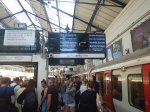






They all seemed to working as they should.
Earl’s Court station is a Grade II listed London Underground station and Wikipedia says this about these indicators.
On each platform is an old-fashioned “next train” indicator board which had various routes shown, of which one is usually highlighted by an arrow to indicate that this is the route of the next train. As of March 2022, these have been temporarily disabled while signalling is upgraded to CBTC signalling, as part of the 4LM improvement works to the subsurface lines, although are expected to return in June the same year. These have not been replaced by modern electronic equivalents as they are Grade II listed.
There can’t be many next train indicators in the world, that are listed or given the local equivalent.
This does take me all back to the 1960s, when for two summers, I worked in the Electronics Laboratory at a company called Enfield Rolling Mills. The Electronics Laboratory developed control systems for the many machines in the factory. At that time, a lot of the work involved replacing relays and electronic valves with then-modern transistors. I learned a lot about industry in those two summers and it wasn’t all about automation and electronics.
Would a fifteen-year-old be allowed to do a job like that, these days?
I suspect that on that Earl’s Court indicator board, there is some interesting electronics connecting it to the CBTC signalling.
Minding The Gap – Barking Style
There are several ways of minding the gap between the train floor and the platform on railway systems.
- There’s the simple get the geometry right method used on the Elizabeth Line, parts of the London Overground and some other routes.
- There’s Stadler’s method where a gap filler comes out from the train.
But I’d never seen, this simplemethod that is used at Barking Riverside station on the London Overground.






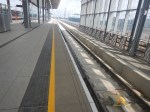

Note the rubber strip, where all the doors on the train are by the platform.
This is a simple device and I’ve never seen it before.
But according to this article on Rail Technology Magazine, it has been in use on Heathrow Express for a year.
The devices are Australian and come from a company called Delkor Rail.
Schoolchildren Get First Glimpse Of Northumberland Line Train Services
The title of this post, is the same as that of this article on the Northumberland Gazette.
The title does say it all, but what a good idea to give the kids a ride first to build up enthusiasm for the new Northumberland Line.
High Speed Two Publish Rural Footbridge Design
High Speed Two have published their rural footbridge design on this page of their web site.
This image from High Speed Two shows an artist’s impression of the bridge.
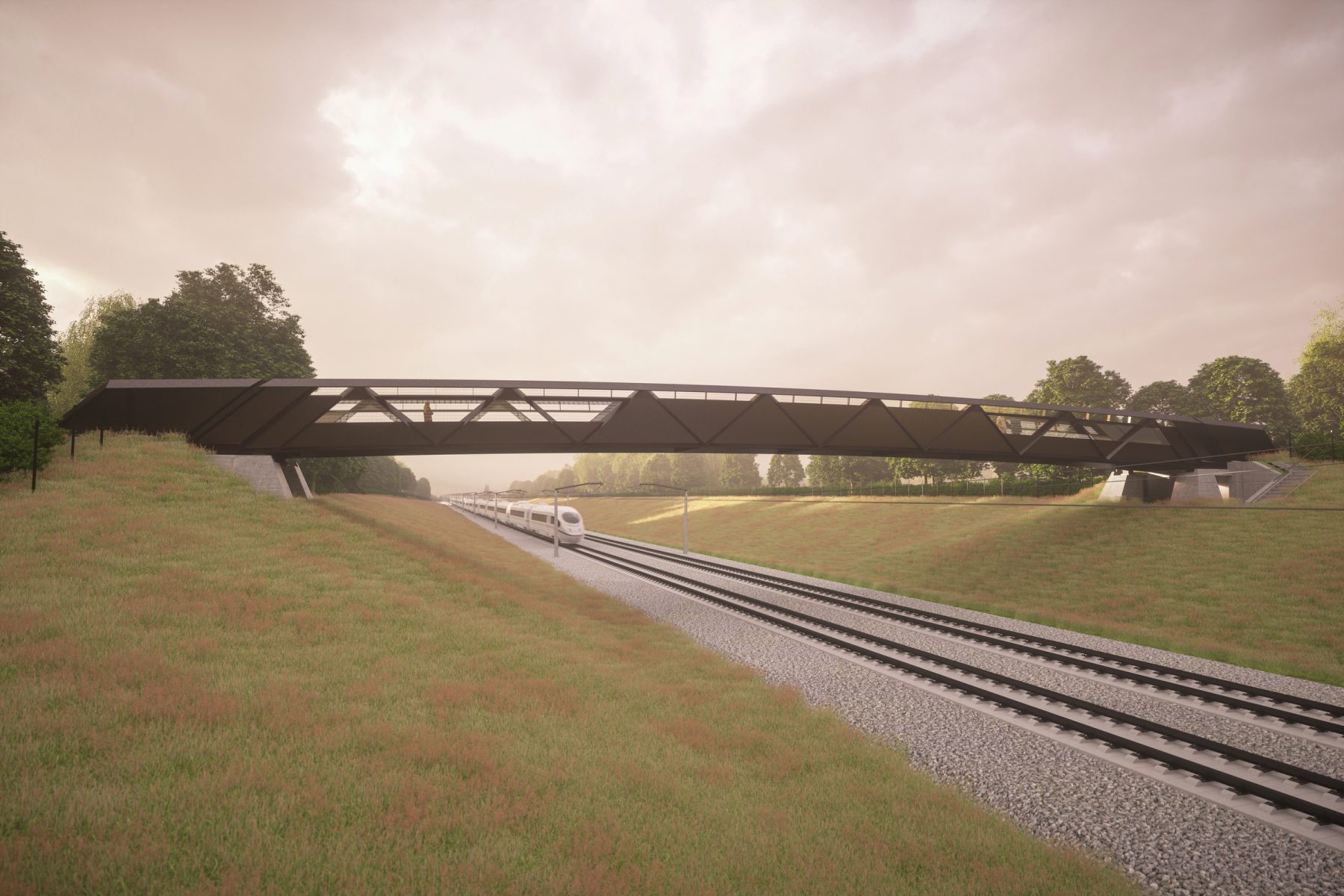
This is High Speed Two’s own thoughts on the design.
Made of weathering steel, the sides of the lightweight bridges will lean outwards to maximise views of the sky and improve the experience of people crossing the railway.
Weathering steel – which ages naturally to a russet brown colour – was chosen to help match the tone of the surrounding countryside, while the plates that form the structure of the bridges will be angled to appear narrower and lighter.
To emphasise the sense of lightness, each span will be slightly higher in the middle so that they appear to leap over the railway. Most of the bridges will consist of just one 42m span, with extra spans added where necessary to create bridges of up to 102m long.
The design of the bridge would appear to be a good compromise between accessibility, cost, ease of construction and installation and practicality.
The article also covers other topics.
Step-Free
This paragraph explains how the bridges will be step-free.
In order to improve efficiency of manufacturing and assembly, all the bridges will have the same basic form, with the approach paths built into the earthworks on either side of the bridge. This also means that all the footbridges will effectively be step-free.
I can see bridges of this type being built at other rural locations.
A Single-Platform Station
These images show James Cook station in Middlesbrough.












High Speed Two’s rural bridge design could be used as part of a design for a step-free station on a rural line.
Bridleways
The footbridge can be used for a bridge on a bridleway.
Designed with guidance from the British Horse Society, the bridges which carry bridleways will follow the same basic pattern, with a recycled, non-slip rubber deck and the structure acting like a baffle to stop horses being distracted by passing trains.
Footbridges will be 2.5m wide, while bridleways will be 3.5m wide to allow two horses to pass comfortably and safely.
It should be remembered, that horses are flight animals and if they are startled they run, so if say a train went under the bridge, when they were on top, they would most likely go forward and cross the bridge quickly.
I would happily have ridden my stallion; Vague Shot over a bridge like this.
I also think, the design of the bridge in the landscape should allow riders to approach to a safe distance from the bridge and perhaps watch a train or two go through.
Other Animals
I can see other animals like badgers, foxes and hares using a bridge like this.
I also think, that on classic railways, bridges like these could be used to allow farmers to move sheep or possibly cattle over a railway, with some simple design changes.
Conclusion
This bridge has more applications, than the initial one, for which it was designed.
UK-German Energy Link Reaches Financial Close
The title of this post, is the same as that of this article on renews.biz.
These are the three introductory paragraphs.
A multibillion-euro 725 km interconnector between the UK and Germany has reached financial close, paving the way for construction works to begin in the coming months.
The £2.4bn (€2.8bn) NeuConnect interconnector will form an “invisible energy highway” with subsea cables allowing up to 1.4GW of electricity to flow in either direction between the UK and Germany and will help deliver a more secure and resilient energy supply, particularly as more renewable generation is added.
Independent analysis shows the project will create over £1.7bn in UK consumer benefits over 25 years.
Other points about NeuConnect include.
- It has been privately funded by a consortium of over twenty national and international banks.
- It will run between the Isle of Grain and a the new Fedderwarden substation in Wilhelmshaven.
- It should be operational in 2028.
Although, it is bi-directional, it appears that one of its major uses will be to provide Germany with UK wind energy to compensate for the loss of Putin’s bloodstained gas.
 The Anonymous Widower