A Big Advantage Of Only Ten Platforms For High Speed Two At Euston Station
Many of us have been involved in the start-up and handover of a new project, even it is just buying a new house to live in from a builder.
All projects have one thing in common. Something will go wrong, even if it is just the lock on the toilet door.
Harold Macmillan expressed it memorably as “Events, Dear Boy! Events!”
This article on Ian Visits is entitled Call For A Rethink Of HS2’s Euston Station Plans.
These two paragraphs describe the current plan for Euston station.
The current plans for the HS2 station at Euston will see it delivered in two phases, with six platforms opened first to carry HS2 trains on the first stage of the railway up to the West Midlands. The second phase of the Euston station would open later, with an additional 5 platforms to manage demand when HS2 is extended to Crewe, Manchester and Leeds.
Phase one was scheduled for completion in 2026, and phase two in 2033.
This paragraph describes the latest idea from the Department for Transport.
However, the Oakervee review from last year called for a redesign of the station scaling back the station and increasing the amount of oversite development to fund it. Earlier this year it was revealed that the Department for Transport has instructed HS2 to refine the development to build it in one phase, but with just 10 platforms instead of 11 platforms.
There are now two camps arguing as to whether the station should be built with ten or eleven platforms.
The eleven platform station project will involve.
- Two-phase construction
- Five platforms by 2026
- Eleven platforms by 2033
On the other hand, the ten platform station project will involve.
- Single-phase construction
- Ten platforms on opening.
- More oversite development.
Note.
- There will be eleven trains per hour (tph) in Phase 1 of High Speed Two from London Euston.
- , Trains will serve Birmingham, Carlisle, Lancaster, Liverpool, Macclesfield, Manchester. Preston, Stafford, Stoke-on-Trent and Scotland.
- Full-size trains will be able to run to Birmingham Curzon Street and Crewe, but not to the two Manchester stations, as the trains don’t fit the infrastructure.
I suspect that Speed Two Classic-Compatible Trains will be running to Manchester.
The Big Advantage Of A Two-Phase Project With Ten Platforms
In the two-phase project with eleven platforms to rebuild Euston station, there will be five platforms, when the station opens, but in the single-phase project with ten platforms, there will be ten platforms.
If there are ten platforms, the station must be easier to operate, especially during the tricky phase of opening the new station.
With ten platforms, there will be more space to sort out those unexpected events!
Building Council Flats In London
I was told this tale by the Head of the Construction Branch of the Greater London Council, who was a big user of the first Project Management System;PERT7, that I wrote in the 1970s.
The GLC were building some council flats alongside the railway.
There were four parallel blocks with five floors and I’ll number them 1 to 4, with 4 alongside the railway and 1 furthest away.
The plan to build them involved the following.
- Deliveries were planned, so that the many residents around the site and British Rail were not inconvenienced.
- Site access was arranged with British Rail along the railway on a track to and from a major road a few hundred yards away.
- The site would be cleared with all the rubble going out in the reverse direction.
- The plan then was to build the blocks 1, 2, 3 and 4 towards the railway.
- This was logical, as when each block was completed it could be occupied and the new tenants wouldn’t be living in a building site, as what needed to be done was towards the railway.
But he was overruled by a vociferous local lobby and some local politicians, who had convinced themselves that building away from the railway in a 4, 3, 2, 1 order would be better.
In the end they were built in the 4, 3, 2, 1 order with budget and time overruns and endless complaints from residents.
If there is a lesson from this fairly insignificant project, it is that in a construction project, there is often one way to build it, that minimises construction time and disturbance to neighbours and maximises the cash flow from the development.
Why Does Birmingham Interchange Station On High Speed Two Need Four Long Platforms?
This page on the High Speed Two web site describes the design and construction at Birmingham Interchange station.
This paragraph talks about the overall design philosophy of the station.
The Interchange Station itself will be made up of two 415 metre long island platforms, offering 4 platform faces, as well as 2 central high speed through lines for non-stopping services. The station will be linked to the NEC, Birmingham International Station and Birmingham Airport via an automated people mover carrying up to 2,100 passengers per hour in each direction. In addition to the APM, the station will be fully integrated with other local buses, taxis and private vehicle options.
Note.
- There would appear to be six tracks through the station.
- The four platforms will accept the longest High Speed Two trains.
- The automated people mover appears to be very comprehensive.
Birmingham Interchange certainly seems to have been designed as a very high capacity station.
This table gives the a list of the trains that will call at Birmingham Interchange station.
- Train 2 – London Euston and Birmingham Curzon Street – 400 metre Full-Size
- Train 3 – London Euston and Birmingham Curzon Street – 400 metre Full-Size
- Train 7 – London Euston and Manchester – 400 metre Full-Size
- Train 11 – London Euston and Edinburgh – Classic Compatible
- Train 11 – London Euston and Glasgow – Classic Compatible
- Train 14 – London Euston and Leeds – 400 metre Full-Size
Note.
- 400 metre Full-Size trains will be a pair of 200 metre trains.
- Train 11 is a pair of 200 metre long Classic-Compatible trains, that split and join at Carlisle.
Only five 400 metre trains call at Birmingham Interchange.
I have some thoughts.
Stations Served From Birmingham Interchange
These destinations are served from Birmingham Interchange.
- Two tph – Birmingham Curzon Street
- One tph – Carlisle
- One tph – East Midlands Hub
- One tph – Edinburgh Haymarket
- One tph – Edinburgh Waverley
- One tph – Glasgow Central
- One tph – Leeds
- Five tph – London Euston
- One tph – Manchester Airport
- One tph – Manchester Piccadilly
- One tph – Motherwell
- One tph – Preston
I suspect as the service develops more services will stop at Birmingham Interchange, to reduce the number of passenger journeys where a change is necessary.
Surely Liverpool needs a service from Birmingham Interchange, as it doesn’t have one from Birmingham Curzon Street.
Perhaps, the Liverpool/Lancaster service should stop at Birmingham Interchange?
Splitting And Joining At Birmingham Interchange
Consider.
- The position of Birmingham Interchange to the South of the junction where the Western and Eastern legs, surely makes it an ideal place for splitting and joining a pair of trains, one of which serves the Western leg and the other serves the Eastern.
- The Liverpool/Lancaster service could split and join at Birmingham Interchange to give better connectivity between the North West and the West Midlands.
Intelligent use of splitting and joining at Birmingham Interchange could make better use of paths to and from Euston.
Splitting And Joining Of Full-Size Trains At Birmingham Interchange
According to the currently proposed timetable Birmingham Curzon Street, Manchester Airport and Manchester Piccadilly will all get three Full-Size tph to and from London Euston, with East Midlands Hub and Leeds getting two Full-Size tph.
This may be a right decision, but if four Full-Size tph is the frequency needed on some routes, then splitting and joining of Full-Size trains can be used at Birmingham Interchange to increase frequencies.
Suppose it was decided that the Leeds and Manchester services needed to be four Full-Size tph.
- The London and Manchester service that stops at Birmingham Interchange would split into two trains at the station, with one train going to Manchester and the other going to Leeds.
- The London and Leeds service that stops at Birmingham Interchange would split into two trains at the station, with one train going to Manchester and the other going to Leeds.
Coming South the two services would join at Birmingham Interchange.
I can almost envisage Full-Size pairs of trains leaving London Euston every ten minutes, which then split and join at Birmingham Interchange to give Leeds and Manchester a core service of six Full-Size tph.
There are a large number of possibilities.
Down One Leg Up T’Other
Birmingham Interchange can be used as an interchange station for journeys where you come South on one leg and then go North on the other.
It might even be possible to arrange some changes with an interchange across one of the island platforms at Birmingham Interchange.
Turning Back Trains
There is a worry about late trains delaying everything.
But because it has four platforms, it could be the station, where trains are turned back, when they are running very late.
It could be better to turnback a train at Birmingham Interchange, rather than let it run all the way to Euston and create havoc.
Perhaps, simulation has shown, that two extra platforms at Birmingham Interchange enable the optimal working of ten platforms t Euston?
Line Blocked Or Blockaded Between Birmingham And Euston
Events happen and there may be reasons why services can’t run through to London.
It could easily be turned into a mini-terminus for services to the North and linked to London by either the West Coast Main Line or a Rail Replacement Bus.
Conclusion
Because of its position in the middle of the country, I suspect there are many reasons for the four long platforms at Birmingham Interchange station.
How Many High Speed Two Trains Will Be Able To Terminate In Euston Station?
This is one of those questions for which you get a different answer depending on what conditions you put on the question.
But there are some physical constraints that have been built into the design.
High Speed Two Tracks And Signalling Are Designed For Eighteen Trains Per Hour
It seems to be an accepted fact, that High Speed Two tracks and signalling will be able to handle 18 trains per hour (tph) or a train every three minutes and twenty seconds.
If this applies to all High Speed Two routes it is certainly a big increase in capacity of the UK rail network.
Seventeen Trains Per Hour In Euston Station
Does it also mean that Euston station must be able to handle 18 tph? Not necessarily, as High Speed Two will only need to handle 17 tph, because they will be keeping one path for recovering the service, after perhaps a train breaks down.
- If the station has eleven platforms, that means each platform must handle 1.5 tph or in practice two tph or a train every thirty minutes.
- If the station has ten platforms, that means each platform must handle 1.7 tph or in practice two tph or a train every thirty minutes.
Ten platforms appear to make little difference in normal operation But when things go wrong, it is more likely, there will be another platform to park a late train.
Turning Trains In Thirty Minutes At Euston Station
One train every thirty minutes means that operating procedures and staff training must be such that trains can be turned within this time.
If trains could be turned faster, then this would enable services to be recovered after a delay.
Twenty-Four Trains Per Hour In Euston Station
If say at some time in the future, signalling improves and 24 tph on High Speed Two is possible with perhaps Automatic Train Operation, this would mean that if there were ten platforms each would have to handle 2.4 tph, or in practice three tph or a train every twenty minutes.
A frequency of 24 tph won’t happen in my lifetime, but I do believe it is possible on High Speed Two with ten platforms at Euston station.
Thirty Trains Per Hour In Euston Station
Thirty tph may be practical on Metros today and could be possible on High Speed Two in the far future, but in practice, that would only be four tph or a train every fifteen minutes.
The Initial Full Timetable Is Seventeen Trains Per Hour
Currently, this is planned to be the case and the trains to and from London Euston are planned to be as follows.
- Train 1 – London Euston and Birmingham Curzon Street – 400 metre Full-Size
- Train 2 – London Euston and Birmingham Curzon Street – 400 metre Full-Size
- Train 3 – London Euston and Birmingham Curzon Street – 400 metre Full-Size
- Train 4 – London Euston and Lancaster – Classic Compatible
- Train 4 – London Euston and Liverpool – Classic Compatible
- Train 5 – London Euston and Liverpool – Classic Compatible
- Train 6 – London Euston and Macclesfield – Classic Compatible
- Train 7 – London Euston and Manchester – 400 metre Full-Size
- Train 8 – London Euston and Manchester – 400 metre Full-Size
- Train 9 – London Euston and Manchester – 400 metre Full-Size
- Train 10 – London Euston and Edinburgh – Classic Compatible
- Train 10 – London Euston and Glasgow – Classic Compatible
- Train 11 – London Euston and Edinburgh – Classic Compatible
- Train 11 – London Euston and Glasgow – Classic Compatible
- Train 12 – London Euston and Sheffield – Classic Compatible
- Train 12 – London Euston and Leeds – Classic Compatible
- Train 13 – London Euston and Leeds – 400 metre Full-Size
- Train 14 – London Euston and Leeds – 400 metre Full-Size
- Train 15 – London Euston and Sheffield – Classic Compatible
- Train 15 – London Euston and York – Classic Compatible
- Train 16 – London Euston and Newcastle – Classic Compatible
- Train 17 – London Euston and Newcastle – Classic Compatible
Note.
- I have assumed 400 metre Full-Size trains will be a pair of 200 metre trains.
- Trains 4, 10, 11, 12 and 15 are pairs of 200 metre long Classic-Compatible trains, that split and join at Crewe. Carlisle, Carlisle and East Midlands Hub respectively.
- Trains 5, 6, 16 and 17 are single 200 metre long Classic-Compatible trains.
This graphic shows the services.
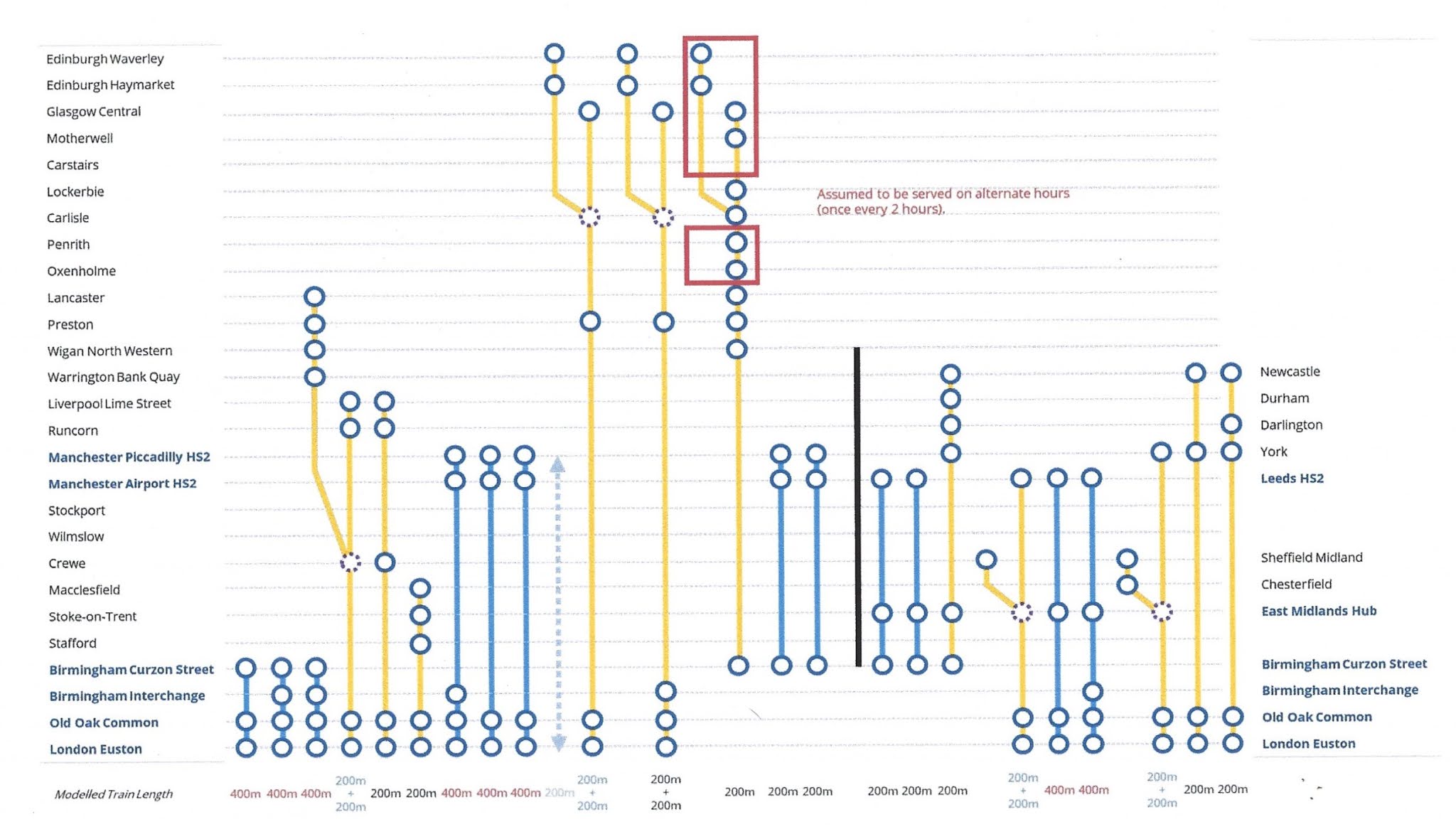
Note.
- Trains to the left of the vertical black line are Phase 1 and those to the right are Phase 2.
- Full-Size trains are shown in blue.
- Classic-Compatible trains are shown in yellow.
- The dotted circles are where trains split and join.
- In the red boxes routes alternate every hour.
In an hour, the following trains will leave London Euston.
- 8 – 400 metre Full-Size trains, each of which consist of a pair of 200 metre trains.
- 5 – Pairs of 200 metre long Classic-Compatible trains.
- 4 – Single 200 metre long Classic-Compatible trains.
Note.
- Adding up the 200 metre trains gives a total of thirty trains.
- If all paths were handling a pair of 200 metre trains, the total would be thirty-four trains.
As I showed in Could High Speed Two Serve Holyhead?, these four trains can be used to serve extra destinations by appropriate splitting and joining.
So in answer to the question in the title of this post, the answer is thirty-four 200 metre trains.
- Each path can carry one pair of 200 metre trains per hour.
- The number of paths is determined by the 18 tph that each leg can handle, reduced by one for a path for recovery.
I am assuming each platform can handle two tph.
But thirty or forty years in the future, this figure with more advanced trains and signalling could be a lot higher.
Does Euston Station Need Ten Or Eleven Platforms?
Mathematically, the following is possible.
- Ten platforms can handle thirty tph, if trains can be turned in fifteen minutes.
- Ten platforms can handle twenty-four tph, if trains can be turned in twenty minutes.
- Ten platforms can handle seventeen tph, if trains can be turned in thirty minutes.
The only need for the eleventh platform, is for when things go seriously wrong.
Should London Euston’s High Speed Two Station Have Ten Or Eleven Platforms?
This article on Ian Visits is entitled Call For A Rethink Of HS2’s Euston Station Plans.
These two paragraphs describe the current plan for Euston station.
The current plans for the HS2 station at Euston will see it delivered in two phases, with six platforms opened first to carry HS2 trains on the first stage of the railway up to the West Midlands. The second phase of the Euston station would open later, with an additional 5 platforms to manage demand when HS2 is extended to Crewe, Manchester and Leeds.
Phase one was scheduled for completion in 2026, and phase two in 2033.
This paragraph describes the latest idea from the Department for Transport.
However, the Oakervee review from last year called for a redesign of the station scaling back the station and increasing the amount of oversite development to fund it. Earlier this year it was revealed that the Department for Transport has instructed HS2 to refine the development to build it in one phase, but with just 10 platforms instead of 11 platforms.
There are now two camps arguing as to whether the station should be built with ten or eleven platforms.
I used to write project management software for four decades.
I have seen and heard of many arguments like these where money, time and resources push the design of a project one way or another.
My feeling is that Oakervee is right to recommend increasing the amount of oversite development to fund the station, as there are a lot of knockers of High Speed Two, who object to the amount of money being spent.
But this might mean that the station should be built in one phase, so that the oversite development can proceed at pace on the whole site, rather than just half at a time. I wasn’t involved in the planning of Canary Wharf, but it did seem to go up faster than other developments. And it was a large site!
So perhaps building the station in one phase will get it finished earlier in a better financial state.
But the downside of that, is the station will have ten platforms instead of eleven. But it will have ten platforms from the day it opens!
I would object to the reduction in the number of platforms, if it made High Speed Two more difficult to operate.But I do tend to believe those who say that High Speed Two can manage with ten platforms, as signalling, train design and operation is improving fast.
As an example, I think the next generation of high speed trains will be able to be turned faster in a terminal station.
The test of this statement will come in a few months, when I take a ride to Edinburgh on the new East Coast Trains service, which seems to be proposing to run to a tight timetable. This says to me, that they have found ways of running more efficiently!
Conclusion
I will let others choose the number of platforms at Euston, but I reserve the right to criticise their decision.
Although, I do believe that it could be better to build the station in one phase to maximise the oversite development and optimise the cash flow to pay for the project, both during the building and in the operation.
I would also hope to see some radical ideas for the uses of the oversite development. But I suspect, it will be more of the same.
Could High Speed Two Serve Holyhead?
Why?
It could be a way to create a zero- or low-carbon route between the islands of Great Britain and Ireland.
Battery-Electric Trains Could Be The Solution
In Will High Speed Two’s Classic-Compatible Trains Have Battery Operation?, I suggested that it might be feasible for High Speed Two’s Classic-Compatible trains to have batteries.
I said this at the start of that post.
I believe it is very likely, that High Speed Two’s new classic-compatible trains will have battery capabilities.
-
- Batteries would handle energy generated by regenerative braking.
- Batteries would give a train recovery capability in case of overhead catenary failure.
- Batteries would be used for depot movements.
- Batteries would probably improve the energy efficiency of the trains.
Effectively, the batteries would power the train and would be topped-up by the electrification and the regenerative braking.
Since I wrote that post in February 2020, Hitachi have launched two battery-electric trains, one of which is the Hitachi Intercity Tri-Mode Battery Train, which is described in this Hitachi infographic.

As diesel (or should I say Stuart) engines are so nineteenth-century. any high speed independently-powered train would probably use batteries, have no diesel engines and be a battery-electric train.
So could Hitachi or any other bidder for the High Speed Two Classic-Compatible trains produce a train, that would be capable of handling the long-distance routes from London, that would be difficult or expensive to electrify, by the use of batteries?
- Batteries will improve dramatically in the next few years.
- Batteries will also become more affordable.
- Engineers will also learn how to package them in better and more innovative ways.
I think it is very likely, that a High Speed Two Classic-Compatible train could be produced with a reliable range of over eighty miles on batteries.
Holyhead And Crewe By Battery-Electric Classic-Compatible High Speed Train
These are the distances between stops on the route between Holyhead and Crewe
- Holyhead and Bangor – 25 miles.
- Bangor and Llandudno Junction – 16 miles
- Llandudno Junction and Colwyn Bay – 4 miles
- Colwyn Bay and Rhyl – 10 miles
- Rhyl and Prestatyn – 4 miles
- Prestatyn and Flint – 14 miles
- Flint and Chester – 13 miles
- Chester and Crewe – 21 miles
Note.
- It is a route of only 105 miles.
- There is no 25 KVAC electrification, except at Crewe.
- It is nearly all double-track.
- The operating speed is 90 mph
- The route is also generally flat and mainly along the coast.
Suppose the following were to be done.
- Erect traditional electrification between Chester and Crewe.
- Hitachi ABB Power Grids build a section of their discontinuous electrification around Llandudno Junction.
- Install a battery charging system at Holyhead.
An alternative might be to put another section of discontinuous electrification through Bangor, if installing the charging station at Holyhead proved to be difficult.
I believe it would be possible to run a High Speed Two Classic-Compatible train equipped with batteries between London Euston and Holyhead.
What Time Would Be Possible?
Consider.
- High Speed Two are predicting 56 minutes between London Euston and Crewe.
- Avanti West Coast are showing journey times of one hour and 57 minutes between Crewe and Holyhead.
- Avanti West Coast are using 125 mph Class 221 trains, but are restricted to a lot less than this speed.
- The HSC Dublin Swift can sail between Dublin and Holyhead in several minutes under two hours.
I believe that a High Speed Two Classic-Compatible train equipped with batteries could go between London Euston and Holyhead in under three hours.
If this were to be linked to the latest hydrogen-powered fast ferry between Holyhead and Dublin, would London Euston and Dublin be fast enough to attract passengers from the airlines?
- The journey time could be under five hours.
- It would be zero-carbon.
- By cutting stops to the West of Chester and track improvements train times could be reduced.
- It would be the sort of adventure, that some families like!
I think that Avanti West Coast and the ferry company could have a rail and ferry service, that would appeal to many travellers.
Would There Be A Path To Euston For Another High Speed Service?
In How Many Trains Are Needed To Run A Full Service On High Speed Two?, I listed the trains that would use the Western leg of High Speed Two.
- Train 1 – London Euston and Birmingham Curzon Street – 400 metre Full-Size
- Train 2 – London Euston and Birmingham Curzon Street – 400 metre Full-Size
- Train 3 – London Euston and Birmingham Curzon Street – 400 metre Full-Size
- Train 4 – London Euston and Lancaster – Classic Compatible
- Train 4 – London Euston and Liverpool – Classic Compatible
- Train 5 – London Euston and Liverpool – Classic Compatible
- Train 6 – London Euston and Macclesfield – Classic Compatible
- Train 7 – London Euston and Manchester – 400 metre Full-Size
- Train 8 – London Euston and Manchester – 400 metre Full-Size
- Train 9 – London Euston and Manchester – 400 metre Full-Size
- Train 10 – London Euston and Edinburgh – Classic Compatible
- Train 10 – London Euston and Glasgow – Classic Compatible
- Train 11 – London Euston and Edinburgh – Classic Compatible
- Train 11 – London Euston and Glasgow – Classic Compatible
- Train 12 – Birmingham Curzon Street and Edinburgh or Glasgow – Classic Compatible
- Train 13 – Birmingham Curzon Street and Manchester – 200 metre Full-Size
- Train 14 – Birmingham Curzon Street and Manchester – 200 metre Full-Size
Note.
- A lot of the paths into London Euston would appear to be allocated.
- Train 4 is a pair of 200 metre long Classic-Compatible trains, that will split and join at Crewe, with one train going to Liverpool and the other going to Lancaster.
- Train 5 is only a single 200 metre long Classic-Compatible train.
I suspect it would be possible to make Train 5 a pair of 200 metre long Classic-Compatible trains, that will split and join at Crewe, with one train going to Liverpool and the other going to Chester and Holyhead.
It does appear that the proposed timetable for High Speed Two has been designed so extra trains can be added if the demand is there.
What Times Would Be Possible Between Holyhead And Crewe?
Consider.
- I have looked at the route from my virtual helicopter and suspect that much of the route can be upgraded to 100 mph running.
- The current average speed between Holyhead and Crewe is 54 mph.
- London Liverpool Street and Norwich is 114.5 miles and is regularly achieved in ninety minutes on a 100 mph line, which is an average speed of 76 mph.
- The number of stops could be reduced.
I can build a table of times for faster average speeds.
- 60 mph – One hour and 45 minutes – Two hours and 41 minutes
- 70 mph – One hour and 30 minutes – Two hours and 26 minutes
- 80 mph – One hour and 19 minutes – Two hours and 15 minutes
- 90 mph – One hour and 10 minutes – Two hours and 6 minutes
- 100 mph – One hour and 3 minutes – One hour and 59 minutes
Note.
- The first time is Holyhead and Crewe.
- The second time is London and Holyhead.
I am fairly certain, that a substantial time improvement is possible.
Why Not Electrify All The Way Between Holyhead And Crewe?
I am seventy-four and can remember several incidents of serious storms and flooding along the North Wales Coast Line.
There was a warning earlier this year according to this article on the BBC.
Perhaps it would be better to spend the money on improving the resilience and operating speed of the track?
Conclusion
London Euston and Holyhead could be a serious proposition.
With some development and a new fast ferry, it could also open up a practical zero-carbon route between Great Britain and Ireland.
Times of four and a half hours between London Euston and Dublin could be possible.
New £157m Chelmsford Railway Station Makes Progress
The title of this post, is the same as that of this article on Rail Technology Magazine.
This is the introductory paragraph.
The submission of an environmental impact assessment application to Chelmsford City Council for the proposed £157m Beaulieu railway station marks the next step in the ambitious project.
It may not be a large step, but it moves things forward to creation of this new Beaulieu station, North of the City of Chelmsford, which should be open around 2025.
Beaulieu Station Will Have Three Platforms
Intriguingly, Wikipedia says that the station will have three platforms.
The stations on the Great Eastern Main Line between Shenfield and Colchester will have the following numbers of platforms.
- Ingatestone – 2
- Chelmsford – 2
- Beaulieu – 3
- Hatfield Peverel – 2
- Witham – 4
- Kelvedon – 2
- Marks Tey – 3
As Witham and Marks Tey have branch lines, Beaulieu will be very much the outsider.
I suspect the extra platform is very much for reasons, similar to those that result in Cambridge North station being built as a three-platform station with two through and one bay platform.
I don’t think we’ll see Crossrail extended to Beaulieu.
- The route between Shenfield and Beaulieu is only double-track.
- All passenger trains currently on the route are 100 mph electric trains.
- Crossrail’s Class 345 trains are only 90 mph trains.
The speed mismatch would slow services to and from stations to the North.
But will we see a new service between London Liverpool Street and Beaulieu, which stops at perhaps, Stratford, Romford, Shenfield, Ingatestone and Chelmsford?
I suspect we will certainly see a new service terminating at Beaulieu, even if it is only in the Peak.
How Will Current Services Call At Beaulieu?
Currently, one fast and four stopping services stop in Chelmsford station every hour.
There are actually two trains per hour (tph) between London Liverpool Street and Norwich, but only one stops at Chelmsford.
So will the second hourly fast service stop at Beaulieu?
I would certainly be logical.
The four stopping services, that stop at Chelmsford every hour are.
- London Liverpool Street and Braintree
- London Liverpool Street and Clacton-on-Sea
- London Liverpool Street and Colchester Town
- London Liverpool Street and Ipswich
As all services stop at most stations, I would expect they would stop at Beaulieu.
- This would give Beaulieu a four tph Turn-Up-And-Go service to and from Chelmsford station, which uniquely for East Anglia is in the centre of the City.
- If the third platform were to be used for a fifth service to London Liverpool Street, this would be a train every twelve minutes between Chelmsford and Beaulieu stations.
- I can see that for some journeys, the fastest and most convenient route may include a change of train at Beaulieu.
I also seem to remember, that Greater Anglia had plans to extend the Ipswich service to Norwich and this will surely be useful to travellers from Beaulieu, who would then have a fast and a stopping service to Norwich.
A Park-And-Ride For Football And Events At Ipswich And Norwich Football Grounds
Both football grounds at Ipswich and Norwich are close to the stations and I can see many attendees driving to Beaulieu to catch a train, as parking in both Ipswich and Norwich can be difficult.
If in the future, there are two tph between Beaulieu and both destinations, it could be the quickest way to the grounds.
Fraunhofer Targets Hydrogen Adoption With Improved Electrolysis System Efficiency
The title of this post, is the same as that of this article on Hydrogen Fuel News.
This is the first paragraph.
The Fraunhofer Heinrich Hertz Institute (HHI) has announced that it is taking part in a new research project meant to accelerate hydrogen adoption. Its main focus is to examine water electrolysis in order to achieve improve efficiency.
The research project is called InnoEly, and this appears to be the project’s aim, as stated on the web site.
Modeling and characterization tools for the development of water electrolysers – from materials to system integration
This could be a project, that brings about a big improvement in the efficiency of electrolysers.
Purfleet Station – 19th August 2021
According to this article on Ian Visits, Purfleet station is going to be transformed and renamed Purfleet-on-Thames station.
- The station will be moved Northwards
- 2850 homes will be built in the local area.
- The current level crossing will be replaced by a bridge.
So I went to the station, took a look and took these pictures.


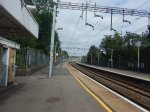


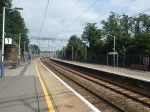
Note.
- The level crossing is at the Southern end of the station.
- Whilst I was there, I didn’t see anybody use the footbridge.
- Everybody used the level crossing.
- The bus stops could be better placed.
But the station building and the platforms weren’t in the worst of conditions.
This Google Map shows Purfleet station.

Note.
- It would appear that the only building in the way of moving the road to the North would be the station ticket office.
- As my pictures show the platforms are long and could probably be extended at the Northern end.
The article on Ian Visits has a good map of the area, showing the development and the new road layout.
It would be good if building bridges to replace level crossings was always as easy as this.
Silicon Roundabout – 18th August 2021
It’s been some time, since I took pictures of the progress of the remodelling of Silicon Roundabout and Old Street station.
I took these pictures this morning.
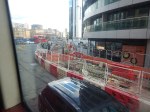
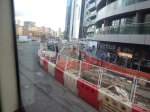
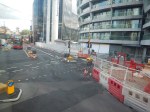

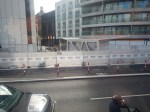



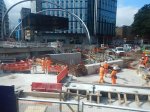
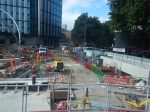
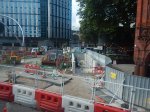
It seems to have moved on since I took the last pictures in Silicon Roundabout – 10th April 2021.
This page on the Transport for London web site, is now saying this about changes to station access.
New and permanent changes to station access at Old Street will be in place from 31 August 2021.
-
- The new entrance at Cowper Street will open and will provide direct access for customers to the station.
- Subway 1 (northeast exit) will be permanently closed. Subway 3 (southwest exit) will remain open.
- The staircase at Subway 4 (northwest exit), will re-open and the ramp at Subway 4 will permanently close. The green line leading to Moorfields Eye Hospital will be reinstated along the stairs.
That sounds like the end of Phase 1 to me!
 The Anonymous Widower