I Only Ran Out Of Deoderant
For about three years, I’ve not bought deodorant or toothpaste in the normal manner, in say a shop in the High Street or locally.
What I’ve tended to do, is just pack my toothbrush and a few other things in my travel bag and buy new travel ones, once I’ve gone through Customs.
Consequently, I’ve only bought small travel roll-on deodorants. I’ve used roll-on ones for many years, as I didn’t like to use aerosols with all their noxious gases.
On Friday my last one ran-out and I needed a new one. The only one I could buy in a local shop, was an aerosol powered by butane. In other words it’s a flame-thrower in all but name! Search the Internet and you’ll find lots of pictures.
I find this very sad, as I funded a development of a totally-safe aerosol, that used compressed nitrogen as the propellant! The development was sold to a US company and I got a return on my money! Obviously, the product wasn’t cheap and nasty enough! But it was good enough though to be discussed at the Montreal Climate Change talks in 2005.
I actually found the butane-powered flame-thrower impossible to use, due to the damage to my left hand.
- Was it the break to my humerus caused by the school bully?
- Was it the stroke?
- Was it the recent damage caused by my fall?
I just needed to find a roll-on deodorant. But had they been discontinued?
This morning, thankfully, I found one at the Angel.
So I will smell better tomorrow!
I won’t leave this post before telling this tale.
I used to work for ICI Mond Division, who used to make the hydro-fluoro-carbon gases, that used to power aerosols in the 1960s and 1970s.
One of the guys in a nearby lab, where I worked at Runcorn Heath, used to formulate the propellants for possible products.
His standard joke was that he’d get baked beans into an aerosol, even if they had to come out one by one.
Every so often, he’d bring round samples that he’d made for various companies and one day I obtained an aerosol hand cream.
What make it was, no-one had a clue, but C always swore, it was the best hand cream, she’d ever used.
Thoughts On Powering Electrification Islands
In The Concept Of Electrification Islands, I didn’t say anything about how electrification islands would be powered. Although, I did link to this post.
The Need For A Substantial Electrical Supply
Electrification can use a lot of electricity.
This was illustrated by the electrification of the Midland Main Line, where a high-capacity feed from the National Grid had to be provided at Market Harborough.
But then the Government cancelled electrification North of Kettering leaving a twelve mile gap to be filled. I wrote about the problem in MML Wires Could Reach Market Harborough. In the end the sensible decision was taken and the electrification will now reach to Market Harborough station.
So places like Cambridge, Darlington, Doncaster, Leeds Norwich and York. which are fully electrified and on a main route probably have enough electrical power to charge passing or terminating battery-electric trains on secondary routes.
In Thoughts On The Actual Battery Size In Class 756 Trains And Class 398 Tram-Trains, I quoted the reply to a Freedom of Information Request sent to Transport for Wales, which said.
A four-car Class 756 train will have a battery capacity of 600 kWh.
A Class 756 train is similar to a Greater Anglia Class 755 train, which in Battery Power Lined Up For ‘755s’, I estimated weighs about 135 tonnes when full of passengers.
Weights for the Hitachi trains are difficult to find with a figure of 41 tonnes per car given for a Class 801 train on Wikipedia. In Kinetic Energy Of A Five-Car Class 801 Train, I estimated a full weight of a five-car Class 801 train at 233.35 tonnes.
Based on the Stadler figure, I would estimate that every train passing an electrification island will need to pick up as much as somewhere between 600-1000 kWh.
An Electrification Island At Sleaford
In The Concept Of Electrification Islands, I proposed an electrification island at Sleaford station.
- Sleaford is a market town of around 18,000 people.
- I doubt the power in the town has much surplus capacity.
- This station is served by four trains per hour (tph), one to each to Lincoln, Nottingham, Peterborough and Skegness.
- So it looks like a feed of three to four MW will be needed to charge passing trains.
Can the electricity supply in a town like Sleaford provide that sort of power for perhaps eighteen hours a day?
The only ways to provide that sort of power is to build a new power station or provide energy storage capable of boosting the supply.
Could Highview Power Provide The Solution?
I have been following Highview Power and their CRYOBatteries for some time.
They have already built a 5 MW pilot plant in Manchester and are currently aiming to build a plant with 250 MWh of energy storage, that can supply up to 50 MW. The company and this plant is discussed in this article on The Chemical Engineer.
One of these CRYOBatteries, would surely be ideal to power an electrification island, like the one at Sleaford.
- It could be scaled to the electricity needs of the town and the railway.
- It would be charged using renewable or excess energy.
- There is a lot of wind power in Lincolnshire and just off the coast, which needs energy storage.
- Similar systems could also be installed at other electrification islands at Cleethorpes, Lincoln, Skegness and other places, where the grid needs strengthening.
I have used Highview Power in this example, but there are other systems, that would probably boost the electricity just as well.
Faulty Masks. Flawed Tests. China’s Quality Control Problem In Leading Global COVID-19 Fight
The title of this post, is the same as that of this article on the Los Angeles Times.
It is a good explanation of some of the problems, those who are trying to obtain Personal Protection Equipment (PPE) are facing.
These are the last two paragraphs.
But the coronavirus has exposed the world’s dependence on China and that country’s problems with quality control.
Whether this experience will lead to further “decoupling” after the pandemic, with more countries seeking to diversify supply chains away from China, will depend in part on how China’s regulators perform.
First the Chinese covered up the outbreak of the virus and then they sent out faulty equipment to fight it.
Government Boost To Reopen Skelmersdale Rail Link To Manchester And Liverpool
The title of this post is the same as that of this article on Lancs Live.
These two paragraphs give the whole story.
Rosie Cooper says the government has given her new assurances that it is committed to creating a Skelmersdale rail link.
Transport minister Chris Heaton-Harris told the West Lancashire Labour MP that an initial £500m funding pot set aside for reopening lines closed under the Beeching Act could be used towards ongoing efforts for Skelmersdale.
To my mind, Skelmersdale illustrates the appalling planning of the 1960s.
These dates are from Wikipedia.
- November 5th, 1956 – Skelmersdale station closed to passenger services.
- January 10th, 1957 – Harold Macmillan becomes Prime Minister
- 1961 – Skelmersdale was designated a new town.
- March 27th, 1963 – Beeching Report
- October 19th, 1963 – Sir Alec Douglas Hume becomes Prime Minister
- November 4th, 1963 – Skelmersdale station closed to all services.
- October 16th, 1964 – Harold Wilson becomes Prime Minister
- 1968-1970 – The M58 opens to connect Skelmersdale to the M6 and the M57 at Switch Island.
- June 19th, 1970 – Edward Heath becomes Prime Minister.
It looks like a rail connection to the new town was removed, but a comprehensive road network was built.
This policy seems to be very different to decisions taken at Billericay, Crawley, Harlow, Hemel Hempstead, Kirkby, Milton Keynes and Stevenage, where rail connections were at least maintained.
The Latest Plan For Skelmersdale Station
This is the latest plan for Skelmersdale station, according to the Wikipedia entry.
It has been proposed a new station at Skelmersdale would act as the terminus for Merseyrail’s Northern Line, with connections available to Wigan and Manchester. Initial estimates suggest that the scheme could cost around £300 million to develop. On page 36 of the Liverpool City Region Combined Authority, Long Term Rail Strategy document of October 2017, it states that Merseytravel is currently working with Lancashire County Council and Network Rail to develop a plan to extend the Merseyrail network from Kirkby through to Skelmersdale, with work completed in 2019. They are considering 3rd rail electrification and other alternatives with a new station at Headbolt Lane to serve the Northwood area of Kirkby. The document on page 37 states two trials of electric 3rd rail/battery trains will be undertaken in 2020, this is one of the “alternatives”
Lancashire County Council approved a plan in May 2019 to commission an outline business case into reopening the station which will be presented to the government.
Note.
- The possible site of Headbolt Lane station and the Concourse Shopping Centre in Skelmersdale are about 8 miles apart.
- Will the trains to Wigan and Manchester be direct or via a change at the new Headbolt Lane station?
- The reference to battery-electric trains, which would be able to handle the sixteen-mile round trip easily.
The site of the station will be at the former Glenburn Sports College, which is a couple of hundred metres to the East of the Concourse Shopping Centre.
This Google Map shows the location.
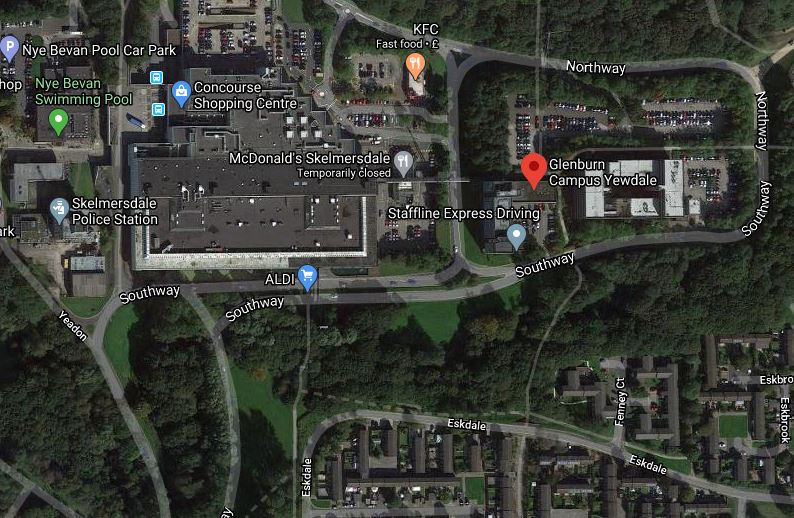
I would feel that this is very convenient.
- The former Glenburn Sports college is marked by the red arrow.
- The Concourse Shopping Centre is to the West of the station.
- The station would be well-connected to the road network.
- The approach track to the station could probably run by the side of Southway and cross it using a bridge or underpass.
This second Google Map shows the station in relation to the Kirkby Branch Line.
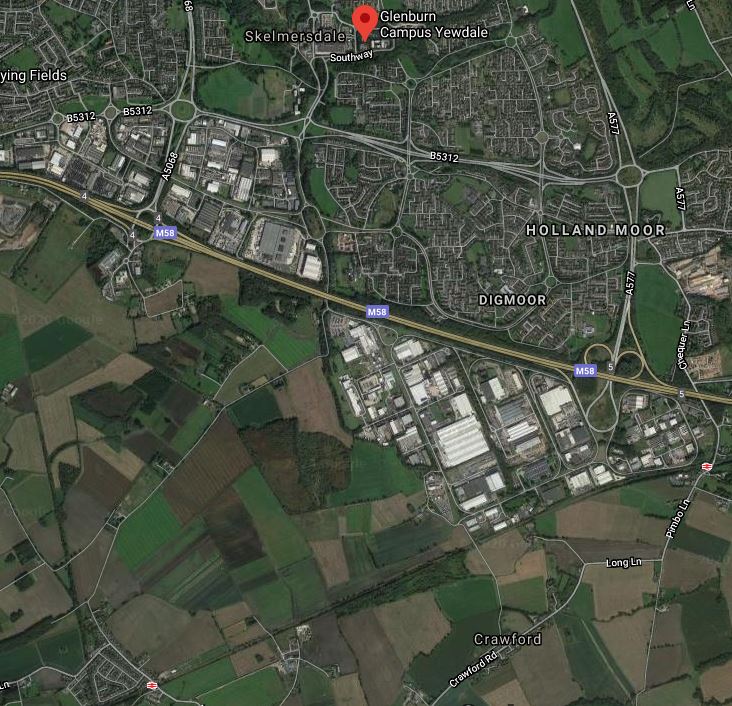
Note.
- The Glenburn Campus is indicated with the red marker at the top of the map.
- The M58 goes across the map.
- Rainford station is in the South-West corner of the map.
- Upholland station is on the Eastern edge of the map below the M58.
The Kirkby Branch Line links the two stations.
- The Kirkby Branch Line continues to the West to the new Headbolt Lane station, Kirkby station and Liverpool city centre.
- The Kirkby Branch Line continues to the East to Wigan Wallgate, Bolton and Manchester Victoria stations.
- The Kirkby Branch Line is double-track to the East of Rainford and single-track to the West.
How will Skelmersdale station be connected to the Kirkby Branch Line?
If you look at the previous map, notice that a network of roads lead down from the Concourse Shopping Centre and then go under the M58. From the Google Map, it looks like the roads go under the M58 where there is a generous bridge.
This Google Map shows the section of the route on both sides of the M58.
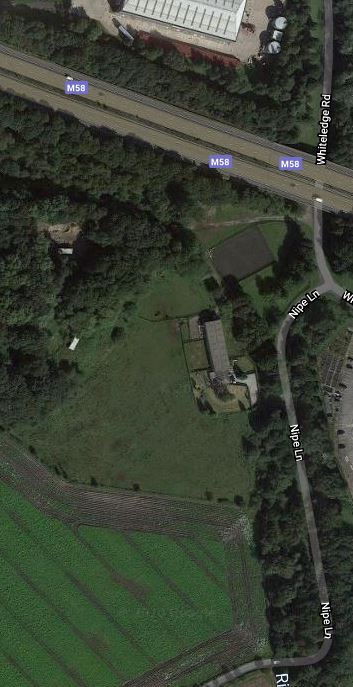
It looks to me that a single-track railway could be run between the new Skelmersdale station and the Kirkby Branch Line.
- Merseyrail’s new Class 777 trains are not large trains and I am certain a single track could be squeezed in alongside the roads.
- The distance is about three miles and a train would take about six minutes or around about fifteen minutes for the round trip.
- Four trains per hour (tph) would be possible, which is the same frequency as the current service between Kirkby station and Liverpool.
Putting this together, I think the following would be possible.
- A single track line without electrification between the Kirkby Branch Line and the new Skelmersdale station to the East of the Concourse Shopping Centre on the Glenburn Sports Campus site.
- Class 777 trains would use battery power to the East of Headbolt Lane station.
- The trains would charge their batteries between Liverpool and Headbolt Lane station.
- The branch would leave the Kirkby Branch Line to the East of Headbolt Lane station.
- Up to four tph between Liverpool Central and Skelmersdale stations, calling at all stations.
- Up to two tph between Headbolt Lane and Manchester Victoria stations via Wigan.
- Passengers between Skelmersdale and Manchester would change at Headbolt Lane station.
Other schemes would be possible, but allowing a direct Manchester and Skelmersdale service might be complicated and add substantially to the cost.
At Least The Second Greatest Driver Of All Time
Sadly,Sir Stirling Moss died today.
Strangely, he is one of the few celebrities, with whom, I have shaken hands. Most of the others were probably jockeys before or after a race.
It was at Olympia, where I went with my family to see the Christmas equestrian event. Sir Stirling was one of the celebrities running round the crowd collecting money for charity in a bucket.
How many of today’s celebrities would do that?
My greatest memory of Sir Stirling was watching on the TV, as he won the 1961 Monaco Grand Prix.
He was driving an underpowered Lotus 18 and throughout the race he fought off three Ferraris to win by a few seconds.
Deep-Sea Divers Move In To Help Hospitals Fight Coronavirus
The unusual title of this post is the same as an article on the Sunday Times.
This is the introductory paragraph.
More than 500 deep-sea divers who have experience of coping with breathing difficulties have been drafted in to help the NHS treat critically ill coronavirus patients.
When you read the article it seems a sensible more.
- The divers are medical technicians.
- They are experts at using masks.
- They normally provide care offshore.
- They are used to working in PPE in uncomfortable positions.
- I suspect, that they are not six stone weaklings.
It is being co-ordinated by a former director-general of the Army Medical Corps.
As a one-time next-door neighbour, who had been a colonel in the British Army once said to me. “In case of war, burn all the rule books!”
Zero Carbon? Not Here! Carbon-Fibre Bogie Frame
When I was at University in the 1960s, the big UK engineering project was the Rolls-Royce RB-211 turbofan engine.
One of the features of the engine was a carbon-fibre fan blade, which saved weight and thus made the engine lighter and more efficient.
However the blades were found to shatter with bird strikes and titanium had to be used instead.
At Liverpool University, we knew something was wrong, as a fellow student on our course was the son of the Manager of Tesco in Derby. What used to happen to Tesco’s out-of-date chickens? They ended up at Rolls-Royce, where they were used to test jet engines for bird-strikes. He told us the story of the failed testing one liquid lunch-time.
That was over fifty years ago and the RB-211 has morphed into the successful Rolls-Royce Trent engine, which first ran in 1990 and is still going strong.
Carbon-fibre has gone its own way and is used in many applications from cars to tennis rackets and golf clubs.
The title of this post is the same as that of this article on Rail Engineer.
The article describes work at Birmingham University to create a carbon-fibre bogie frame.
This paragraph from the article describes the outcome.
A major achievement is that the mass of the frame as built is 350kg, compared to the steel equivalent of 936kg. By the time the metal fittings were installed and paint applied, the mass had increased to 940kg compared with the steel equivalent of 1468kg, a reduction of over half a tonne per bogie.
Lighter bogies mean lower track-access charges.
I will be interesting to see how this project ends, when a prototype has been running in a real train.
The Definitive Hydrogen Train
There is only one hydrogen-powered train in service and that is the Alstom Coradia iLint, which is running in Germany.

I feel it is very much an interim design, as Alstom has taken a diesel-mechanical Lint train and swapped the diesel for a hydrogen-powered electricity generator and an electric motor.
Alstom are converting electric Class 321 trains into a hydrogen-powered version called Breeze.
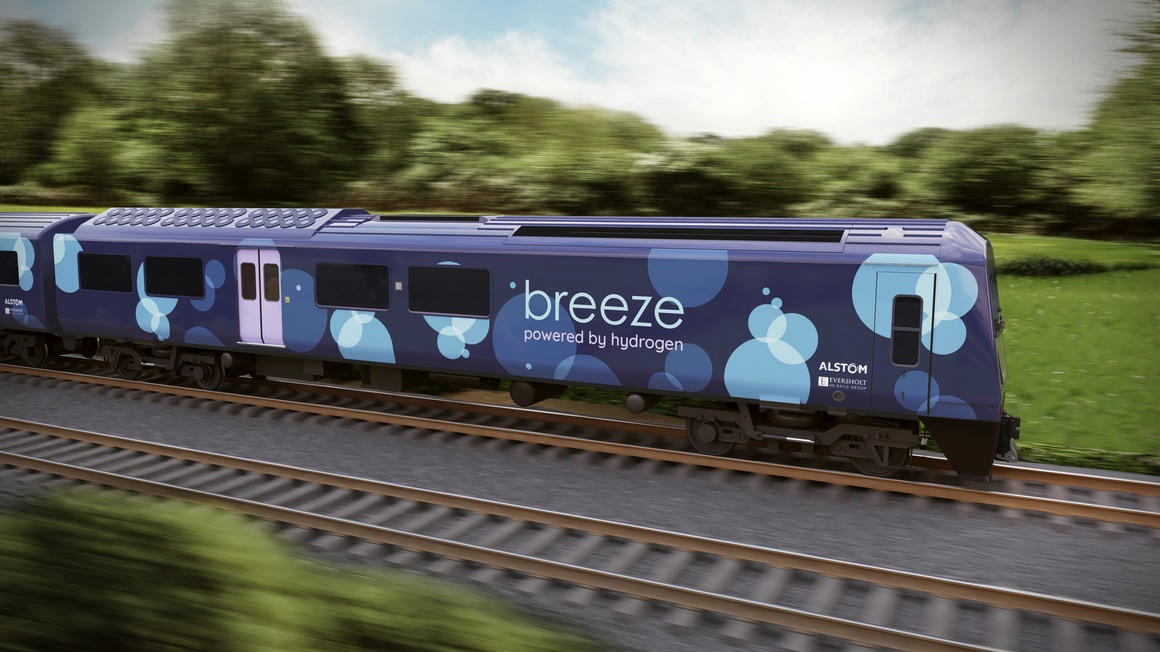
A typical train would be three cars. The visualisation shows one of the two driver cars, that contain a large hydrogen tank behind the cab.
Between the two driver cars would be a trailer car.
Using Electrification
Nothing has been disclosed yet, but it would surely be easy to allow this hydrogen train to keep its pantograph on the trailer car and be able to use electrification if it is installed.
This would increase the range of the train and might allow a version with a smaller hydrogen tank and a greater passenger capacity.
Charging Batteries
In a definitive hydrogen-powered train, which had been designed from scratch to use hydrogen, I could envisage, that the batteries could also be charged, when the train is connected to either electrification or a charging station.
A Smart Computer
The train would have a very smart computer, which would do the following.
- Manage the various power sources.
- Choose the appropriate source for the route, weather, passenger load, fuel and battery levels.
- Raise and lower the pantograph automatically.
- Control the trains systems to minimise electricity use.
This is little different to many trains, built in the last few years.
Conclusion
The definitive hydrogen-powered train will be a battery-electric-hydrogen hybrid train.
Hardly Any Passengers – But Greater Anglia’s Trains Are More Reliable
The title of this post is the same as that of this article on the Great Yarmouth Mercury.
This is the introductory paragraph.
It may be operating fewer trains and carrying a fraction of the passengers it was – but Greater Anglia’s trains are now much more reliable for essential workers, figures show.
Greater Anglia’s most punctual route was Manningtree to Harwich at almost 99 %.
 The Anonymous Widower