ITM Power and Ørsted: Wind Turbine Electrolyser Integration
The title of this post is the same as that of this press release from ITM Power.
This is the introductory paragraph.
ITM Power (AIM: ITM), the energy storage and clean fuel company, is pleased to share details of a short project sponsored by the Department for Business, Energy & Industrial Strategy (BEIS), in late 2019, entitled ‘Hydrogen supply competition’, ITM Power and Ørsted proposed the following: an electrolyser placed at the wind turbine e.g. in the tower or very near it, directly electrically connected to the DC link in the wind turbine, with appropriate power flow control and water supplied to it. This may represent a better design concept for bulk hydrogen production as opposed to, for instance, remotely located electrolysers at a terminal or platform, away from the wind turbine generator, due to reduced costs and energy losses.
Some points from the remainder of the press release.
- Costs can be saved as hydrogen pipes are more affordable than underwater power cables.
- The proposed design reduces the need for AC rectification.
After reading the press release, it sounds like the two companies are performing a serious re-think on how wind turbines and their links to get energy on-shore are designed.
Will they be using redundant gas pipes to bring the hydrogen ashore?
I think, that they could go further than that!
- Imagine a very large wind farm built over a cluster of redundant gas-fields that are suitable for the storage of gas.
- The wind farm will produce hydrogen, which could be either sent to an onshore terminal or stored in one of the redundant fields.
- When hydrogen is needed onshore, it can come from the turbine/electrolysers in the wind-farm or from offshore storage.
- The pipeline to the shore would probably also be reversible and used to take carbon dioxide offshore for storage.
- If more electricity is needed onshore, the hydrogen is used as fuel for a gas-fired power station.
It sounds complicated, but hydrogen gives a lot of flexibility, as it is easily converted to and from electricity.
Controlling this network is a classic problem for Control Engineers and sophisticated computers will make sure, there is both enough electricity and gas.
The other application for combined wind turbines and electrolysers is where there is a need for moderate amounts of gas in the middle of nowhere.
Uses could include.
- Large farms all over places like East Anglia, much of North America, Australia and Serbia, where it would be used for motive power and heating.
- Islands like the Orkneys to decarbonise heating and transport and especially aviation and small ships like tugs and ferries.
- Hydrogen filling stations for trucks and other vehicles in places like the Mid West and large parts of Africa and Asia.
- Large transport depots, that switch from diesel to hydrogen might install their own combined wind turbine and electrolyser.
- Ports of all sizes will switch to hydrogen and smaller ports may well use combined wind turbines and electrolysers.
- Will isolated villages and small towns have their own combined wind turbines and electrolyser to bring a much needed gas supply?
I used to own a farm and I would certainly have looked at the technology to see, if it was worth installing.
It is my view, that combined wind turbines and electrolysers are one of those enabling technologies, that will find lots of different applications.
HyDeploy
I could have called this post; What Do You Do With Surplus Electricity?.
Believe it or not, one thing you can do is inject it into the gas main, by converting it into hydrogen first.
The Project
The concept is being tested in a project called HyDeploy at Keele University.
- The project has its own web site, from where I have obtained much of the information on this post.
- Keele University has its own gas network.
- Keele has a campus population similar to a small town.
- Keele University has a reputation for research excellence.
This paragraph outlines the project.
HyDeploy is a pioneering energy demonstration to establish the potential for blending hydrogen, up to 20%, into the normal gas supply so that we can reduce carbon dioxide (CO2) emissions.
A 10 month live demonstration of blended gas is taking place on part of the Keele gas network and will finish in August 2020.
HyDeploy will help to determine the level of hydrogen which can be used by customers safely and with no changes to their existing domestic appliances.
The HyDeploy project has been split into the following phases.
- Phase One will be live test using the Keele University gas network to learn about injecting hydrogen into a natural gas network.
- Phase Two will move to a larger demonstration on public network in the North East.
- Phase Three will be another large demonstration in the North West.
Once the evidence has been submitted to Government policy makers, we very much expect hydrogen to take its place alongside other forms of zero carbon energy in meeting the needs of the UK population.
The Electrolyser
ITM Power are providing the 0.5 MW electrolyser to turn electricity into hydrogen.
It’s only a small one, but this is about proving the technology.
A New Slide From Today’s COVID-19 Press Conference!
A new slide was shown in today’s COVID-19 press conference at Downing Street today.
It showed the total number of ICU beds available by region.
Would the Government have showed this slide, if they didn’t have enough ICU beds to cater for all possible scenarios?
Hiring More Female Lorry Drivers Would Cut Accidents
The title of this post is the same as that of this article in The Times.
A study by the University of Westminster has shown that women drivers have less accidents.
This is a paragraph from the article.
Academics called for more women to be recruited to driving jobs in light of their better road safety record. They said that greater gender equality in positions that rely on motoring skills such as driving taxis, HGVs and delivery vans was needed to help cut deaths.
The article didn’t give any prediction about what will happen in the future.
So here goes!
We are already seeing taxis and delivery vans going zero carbon and I think within twenty years or even less, a large proportion of taxis, HGVs and delivery vans will be either battery-powered, or more likely, in my view, hydrogen-powered.
Look at the LEVC black taxi and compare it to its diesel forerunner.
- It is more environmentally-friendly.
- It has a lot of driver and passenger-friendly features.
But it is more expensive.
I suspect that the capital cost of a zero-carbon HGV bus or delivery van, will also be more expensive, than the current diesels.
- As to the fuel costs between diesel, battery and hydrogen, this would depend on the application, but fuel costs tend to even themselves out.
- There could be a saving with battery- and hydrogen-powered vehicles in terms of maintenance, just because they are less complicated.
Summing up I could say the following.
- I am fairly sure, that a zero-carbon taxi, HGV bus or delivery van will have an acquisition cost, that is higher than a diesel version.
- I also think that if the vehicle was run on a twenty-four hour basis, that the fuel costs would be comparable per mile, but maintenance costs would be less.
- So I think it likely, that vehicle owners would be more likely to want to run vehicles on a twenty-four hour basis, to get a better return on their capital.
Surely, this would require more drivers.
Consider.
- A lot of black taxis in London are shared between two drivers.
- There have been several instances, where I have read that a couple have both been London Underground drivers, as they can arrange shifts to fit in with child care and domestic duties.
- The partner of a driver, will surely know what the job entails.
- Driving a modern HGV or bus, is a lot less gruelling than it used to be.
Will more family-friendly methods of working emerge, that allows partners of existing drivers to join the profession?
London Underground certainly changed working conditions to get enough driver for the Night Tube.
Conclusion
Would employing more female drivers cut accidents?
It all depends on the quality of the drivers; both male and female.
But, I suspect that improvements in all vehicles in the future, will cut accidents anyway!
Porterbrook: Modified Trains Have A Role To Play
The title of this post is the same as that of this article on Rail Magazine
Poterbrook are talking about reducing carbon dioxide emissions.
The problem is that building a new electric train produces around 146 tonnes of CO2, whilst maintenance produces around 2-3 tonnes of CO2 annually.
- CO2 produced in a 20 year lifetime in construction and maintenance is 196 tonnes or 9.8 tonnes per year.
- CO2 produced in a 40 year lifetime in construction and maintenance is 246 tonnes or 6.15 tonnes per year.
So if you can prolong the useful life of a train by modifying the train at say twenty years, you could save carbon dioxide emissions.
Surely, this calculation must work for cars, earth-moving equipment and food-mixers.
The longer something lasts, the less will be the CO2 emissions per year.
Varamis Plans Electric Freight To Carry Light Goods
The title of this post, is the same as that of an article in Issue 902 of Rail Magazine.
This is the introductory paragraph.
Freight trains using electric multiple units could be operating on the East Coast Main Line by the end of the year, in plans unveiled by Varamis Rail.
This is their promotional video.
From the video and the Rail Magazine article, the following can be ascertained.
The Route
From the video, the basic route is circular and the concept is explained in the article, by Phil Read; the Managing Director of Varamis Rail.
Our vision is to create a circular network around the UK via both the East Coast Main Line and West Coast Main Line, with a stop/go method of service delivery serving major towns and cities en route.
And we could move goods in both directions.
Longer term, there could be extensions to Bristol and South Wales and into East Anglia.
Note.
- From the video is looks like the main loop will start and finish in London.
- Trains on the main loop will call at Doncaster, Newcastle, Edinburgh, Glasgow, Carlisle, Manchester and Birmingham.
- Varamis have said they will stick to electrified lines.
I like the concept of the route.
- It covers a lot of the country.
- It can be easily extended.
- Extra stops could be easily added. Darlington, Leeds, Peterborough, Preston and Reading come to mind.
With dual-voltage trains, it could even be extended South of London.
The Trains And The Organisation
Varamis are certainly looking to keep the operation efficient and low-cost. This is said about the trains.
The plan is to remove all the internal furnishings in the umits we lease utilise them without altering any of the loading or dynamic characteristics that the trains had when formerly used as passenger trains. I’m in discussions with rolling stock leasing companies and the DfT at present to lease the trains.
The DfT owns all 40 Class 365 trains.
In addition, the following is said.
- Maintenance would be outsourced, with one of two likely companies.
- Operations Director will be appointed soon.
- Company headquarters would be in Doncaster.
- Varamis will employ all their own staff, including drivers, fitters and logistics operators.
A small point is that Phil Read has worked for the Rail Operations Group.
Class 365 Trains
Class 365 trains have the following characteristics.
- Four cars
- Up to three trains can be coupled together.
- 100 mph operating speed.
- Two pairs of wide double doors on the side of each car.
- They are not a train with a reputation for unreliability.
This is a picture of a Class 365 train.

Note.
- They could probably be converted to dual-voltage, by adding third-rail gear.
- The trains could probably be made available at short-notice.
The company talks about an end-on cross-transfer system at their hubs, where goods can be moved through the train.
I will be interested to see what this means, but I suspect it will give a quick and easy transfer of pallets of goods between trains and the trucks doing the local delivery.
Green Logistics
Varamis are marketing their services as Green Logistics.
Conclusion
As someone, who needed this sort of system in the early days of Metier to distribute new copies of the Artemis software, I think the service will fulfil a large need.
I said earlier that I like the concept of the route.
But thinking about it more, I suspect it can be very easily extended.
- Brighton, Portsmouth and Southampton could be served by dual-voltage trains.
- Could for instance a hub in Edinburgh, distribute pallets and parcels to and from the North of Scotland?
- Could bi-mode trains serve the towns and cities on the Midland Main Line?
- A connection to Heathrow would be very valuable.
A large proportion of the country could be connected.
If it existed now, would it help in the fight against COVID-19?
Manchester Metrolink Opens Trafford Park Line
The title of this post is the same as that of this article on Railway Gazette.
This is the introductory paragraph.
The 5·5 km Manchester Metrolink light rail extension to the Trafford Centre shopping complex was opened for revenue service on March 22, around seven months ahead of the original target date.
I had hoped to go up to Manchester on the day it opened to take a few pictures, but COVID-19 kyboshed that!
Short-Notice Spaghetti Trains Organised To get Pasta Across The Alps
The title of this post is the same as that of this article on Railway Gazette.
This is the introductory paragraph.
DB Schenker has organised the transport of several hundred tonnes of pasta by rail from Italy to Germany, enabling 650 Aldi supermarkets to replenish supplies which had been depleted by customers stocking up during the coronavirus pandemic.
I can’t help feeling that this story pays homage to Richard Dimbleby‘s classic April Fool story about the spaghetti harvest in Switzerland.
Greater Anglia Completes Directly-Managed Norwich Victoria Sidings Project
The title of this post is the same as that of this article on Railway Gazette.
This is the introductory paragraph.
Greater Anglia has opened four sidings able to stable 12-car trains just outside Norwich station, with its first train using the facility on March 3.
Other information can be found in this and other articles.
- It was Greater Anglia’s biggest infrastructure investment to date.
- The sidings are on the South side of the Trowse Swing Bridge, that crosses the River Wensum.
- The project took nine months to complete.
- The sidings look to be fully electrified.
I would assume that each siding can take one of the following.
- A twelve-car Class 745 train, which are 236.6 metres long.
- A ten-car Class 720 train, which are 240 metres long.
- Two five-car Class 720 trains, which are 122 metres long.
- More than one Class 755 trains, which are 65 metres long (3-car) and 81 metres long (4-car)
They will certainly be able to pack in the trains.
Walking To Liverpool Street Station
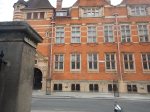
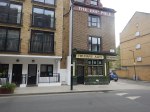
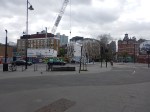
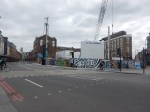
I took these pictures yesterday, as I walked from my home to Liverpool Street station.
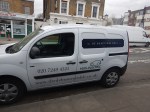




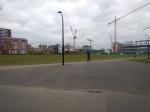

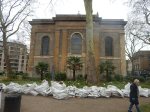

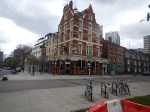

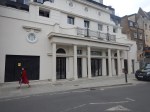
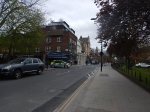
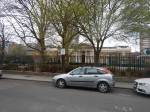
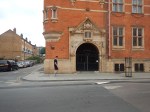


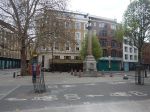
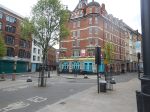

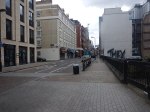
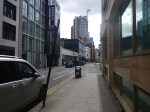

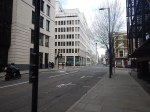

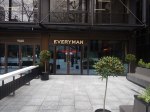

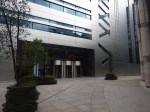



I had intended to buy the latest edition of Modern Railways at W H Smith’s in the station, but it was shut.
 The Anonymous Widower