The Coolest Trains In London
It was hot in London today, so I thought I’d investigate how well the New Class 710 trains on the Gospel Oak to Barking Line.
I did the following journeys.
- A 141 bus from my house to Harringay Green Lanes station.
- A Class 710 train between Harringay Green Lanes and Gospel Oak stations.
- A Class 710 train between Gospel Oak and Blackhorse Road stations.
- A Victoria Line train between Blackhorse Road and Highbury & Islington stations.
- A Class 707 train between Highbury & Islington and Moorgate stations.
- After doing some shopping, I took a 141 bus to my home.
I took these pictures on the route.
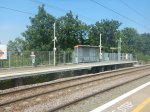
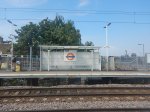
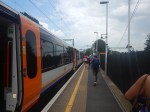
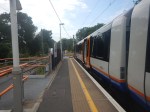

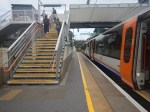
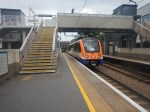
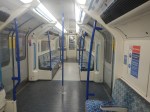
Some observations.
Passengers Towards Gospel Oak Weren’t Numerous
The train going to Gospel Oak station wasn’t very full, wil only about half the seats taken.
The Train From Gospel Oak Was Packed
It was rather different going back, as every seat on the train was taken and there were passengers standing.
The Seats And Air In The Train Were Comfortable
I would certainly recommend a trip in a Class 710 train on a hot day, as a means to cool off.
Let’s hope that all the other classes of Aventras have the same quality of air-conditioning.
The Victoria Line Wasn’t Busy
The air and temperature ion the Victoria Line wasn’t bad, but it wasn’t of the same quality as the Class 710 train.
But the trip made me think that passengers avoid the deep tube in hot weather.
Class 707 Train To Moorgate
I used the cross-platform interchange at Highbury & Islington station to switch to a Class 707 train, running a Great Northern service to Moorgate station.
The air-conditioning was working well and the two other passengers remarked that it was good in this hot weather.
It’s a pity that these trains have ironing-board seats.
Will These Trains Cut Crime?
When I moved to Dalston in 2010, the service along the North London Line was just being launched and wasn’t fully running until May 2011.
Dalston was the haunt of aimless youth and it wasn’t the best place to live.
Nine years on and it has all changed.
The youths have disappeared and the perceived threat of crime seems down. So where have they all gone?
From stories I have heard, public transport has improved so much, that a large proportion of the youths, have discovered something better to do! It’s called work.
- New Class 378 trains
- North London Line trains have gone from four trains per hour (tph) to eight.
- East London Line trains didn’t exist in 2010 and are now sixteen tph.
- There are several fleets of new buses.
- Increases in train frequencies are planned.
Dalston is now a much better place to live.
The new Class 710 trains will soon be running on the following routes.
- Gospel Oak to Barking Line
- Liverpool Street to Cheshunt
- Liverpool Street to Chingford
- Liverpool Street to Enfield Town
And the new Class 707 trains will soon be running on the following routes.
- Moorgate to Hertford East
- Moorgate to Stevenage
- Moorgate to Welwyn Garden City
Most new trains will be in service by the end of this year.
The following will be delivered.
- More capacity
- Increased frequencies
- Better comfort
- Wi-fi and power sockets
- On-train CCTV
A lot of the previous ancient trains will be scrapped.
Will the new trains cut crime and the perception of crime in the areas of North-East London, that they serve.
It is too early to tell, but good public transport has had a remarkable affect on Dalston.
So will the same thing happen in Enfield, Hasringey and Wathamstow?
Conclusion
I wonder how many people with a Freedom Pass like me are cooling off in this weather by using these and other trains.
Steaming Up To Treforest In A Class 143 Train
On my trip to Treforest, I was in a Class 143 train or one of the dreaded Pacers.
It was performing well on the challenging route and I wondered how the power compared with that of the proposed tram-trains, that will be used in a couple of years.
Class 143 Train
- Speed – 75 mph
- Sections – 2
- Weight – 48.5 tonnes
- Length 31 metres
- Power – 336 kW
- Capacity – 122 seats
- Gross Weight (90 Kg per passenger) – 49.6 tonnes
- Kinetic Energy At Operating Speed – 7.7 kWh
- Time to Operating Speed At Full Power – 1.5 minutes
The train I was on was pretty smooth! Or for a Pacer anyway!
Class 399 Tram-Train
- Speed – 62 mph
- Sections – 3
- Weight -66.15 tonnes
- Length – 37.2 metres
- Power – 870 kW
- Capacity – 88 seats and 150 standing.
- Gross Weight (90 Kg per passenger) – 87.6 tonnes
- Kinetic Energy At Operating Speed – 9.3 kWh
- Time to Operating Speed At Full Power – 6 minutes
These figures are taken from details of the tram-trains in Sheffield.
The two trains are very similar in some respects, but the tram-train is heavier with a full load of passengers.
I certainly can see no reason, why the Class 399 tram-train won’t perform as well as the lass 143 train, but with a bigger and heavier load of passengers.
But one important factor should be born in mind.
The German cousins of the Class 399 tram-trains are used in Karlsruhe, where they easily climb out of the city into the surrounding hills.
A trip up the valleys to Aberdate, Merthyr Tydfil or Treherbert could be no more difficult, once the electrification is in place.
Conclusion
I can see other cities and tram networks around the UK, Europe and the wider world developing urban transport networks around these Stadler tram-trains.
UK cities for their deployment must include Manchester and Sheffield.
Nissan Refuses To Improve Qashqai’s Toxic Emissions
The title of this post is the same as that of this article on Tuesday’s copy of The Times.
This is the first paragraph.
Nissan has refused a government request to carry out adjustments to thousands of highly polluting diesel cars to make them less toxic.
The car is called the Nissan Qashqai, which I wouldn’t recognise, unless it reversed into me on the street and I could see the name badge on the boot.
Today, there is this article on the BBC, which is entitled Nissan Workers Braced For Job Cuts.
As they say in Private Eye, could the two stories be related?
Especially, as Nissan seem to have had problems with a CEO recently, who seemed to find enhancing his lifestyle more important, than good stewardship of the company.
Cadoxton Station Is Going Step-Free
This article on Rail Advent is rntitled MP Visits Cadoxton station to see upgrade work.
This is the first paragraph.
Vale of Glamorgan MP, Alun Cairns, met the Network Rail team upgrading Cadoxton station to see first-hand the work being delivered to make the station accessible for all passengers.
So as I was in South Wales, I had to go and have a look at Cadoxton station.
I took these pictures.
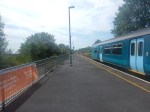

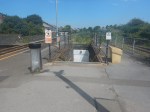

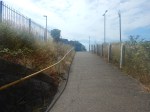
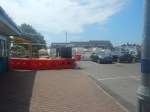
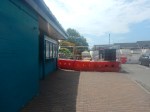
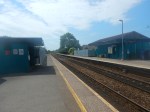
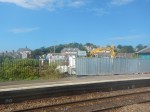
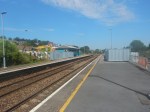
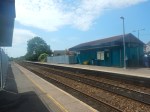
It appears to be a traditional step-free installation and will take about a year to complete.
Super-Efficient Flats Don’t Need Heating Or Air-Con
The title of this post is the same as that of this article on Page 34 of today;s copy of The Times.
These are the first two paragraphs.
In a city of skyscrapers the 26-storey building on a small island next to Manhattan looks unremarkable. Hiding in plain sight, however, is an architectural revolution.
The House, a dormitory for graduate students at Cornell University, is so energy efficient it can eliminate the need for heating and air conditioning. It is the first “passive house” in the US and is providing a stream of data for engineers.
If someone built a passive skyscraper in London, I’d ceretainly go and look.
Barry Station To Go Step-Free
This document on the Government web site is entitled Access for All: 73 Stations Set To Benefit From Additional Funding.
Barry station is on the list.
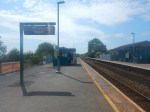
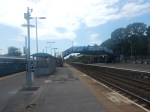
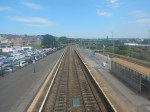
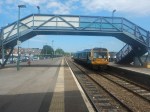
These pictures show the station and the current bridge,




Note.
- The trains were very crowded.
- The bridge is approaching its rust-by date.
- I think it is true to say, that the station buildings need a thorough refurbishment.
I have been sent a map of the proposed works and facilities for the South Wales Metro. This snippet shows the lines around Barry station.
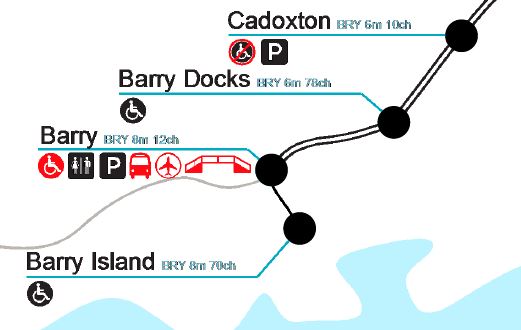
Note.
- The lines are not planned to be electrified.
- Barry station will get a new PRM-compliant bridge with step-free access between street and train.
- There will be an airport connection at the station.
I would assume that the station buildings will get the much-needed refurbishment.
Services To Barry, Barry Island, Bridgend and Penarth
The South Wales Metro services through Barry will be as follows.
- Services will terminate in the South and West at Barry Island, Bridgend and Penarth
- Services will terminate in the North at Coryton and Rhymney.
- There will be increased train frequencies.
Trains will be tri-mode Stadler Flirts with three or four cars, which will be similar to Greater Anglia’s Class 755 trains.
Judging by yesterday this capacity increase will be welcome.
Installing The Step-Free Access
It would appear there is plenty of space for a step-free footbridge with lifts.
In Winner Announced In The Network Rail Footbridge Design Ideas Competition, I wrote how the competition was won by this bridge.
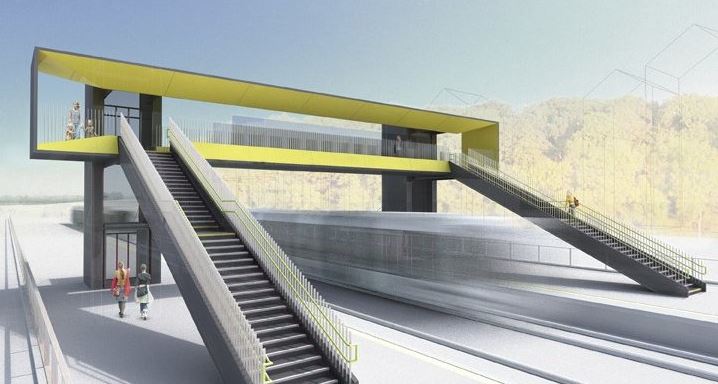
A bridge like this could be built at the other end of the station.
It would also be able to built it, without disrupting the train services or the passengers.
Once complete, the old bridge could be demolished or left as required.
Electrification West Of Cardiff Central Station
These pictures show erected gantries for the electrification to the West of Cardiff Central station.

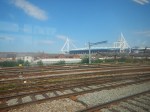
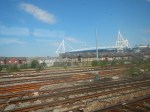
I have been sent a map of the proposed works and facilities for the South Wales Metro. This snippet shows the lines to the West of Cardiff Central station.
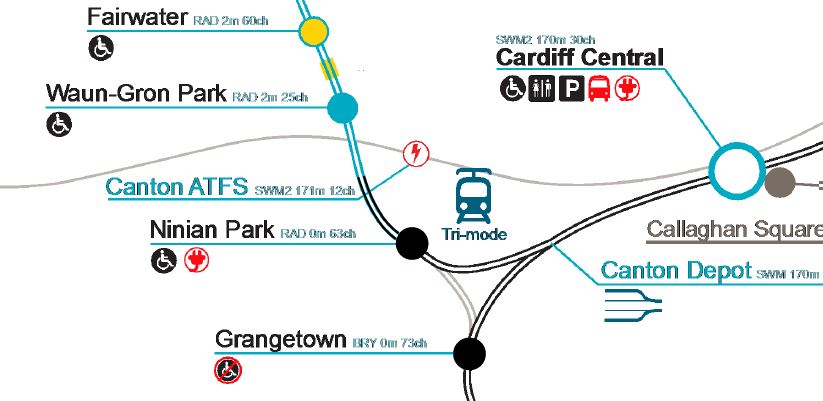
Note.
- Electrified lines are shown in blue and unelectrified ones in black.
- The South Wales Main Line is shown as a feint line going East-West to the North of Ninian Park station.
- Trains for Barry Island, Bridgend, Cardiff Airport, Maesteg and Penarth go via Grangetown station.
- Tram-trains for Radyr will go via Ninian Park station.
It looks like tram-trains emerging out of Canton Depot will have immediate access to 25 KVAC overhead electrification.
Treforest Station To Go Step-Free
This document on the Government web site is entitled Access for All: 73 Stations Set To Benefit From Additional Funding.
Treforest station is on the list.
These pictures show the station and the current bridge,


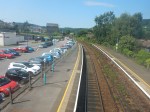

The bridge is not the easiest to cross and I tripped.
I wouldn’t like to cross it in the worst weather the Valleys could through at it!
Installing The Step-Free Access
This Google Map shows the station.
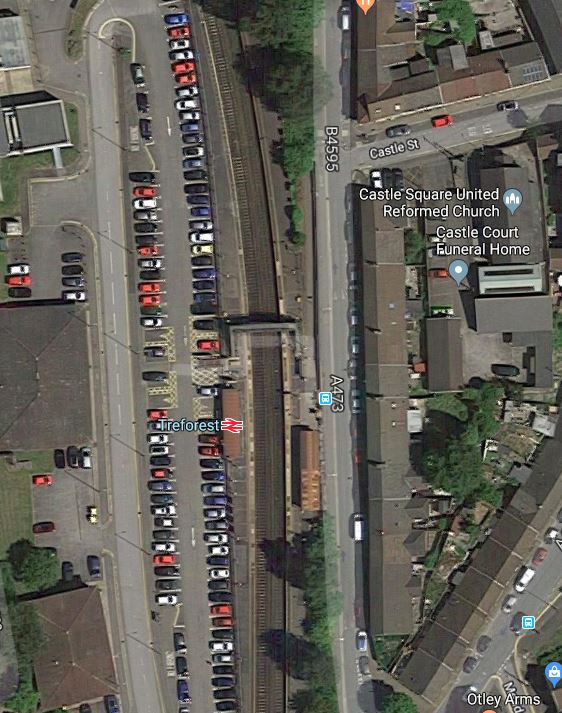
In Winner Announced In The Network Rail Footbridge Design Ideas Competition, I wrote how the competition was won by this bridge.
I believe that one of these bridges could be built at the Northern end of the station.
- The Southbound platform could be widened if necessary.
- The Western end of the bridge might mean a few car-parking spaces would be lost.
- Disabled car-parking spaces could be close to the bridge.
- The bridge could be used to support the electrification in the station.
But most importantly, the bridge could be installed without any disruption to trains and passengers.
I have been sent a map of the proposed works and facilities for the South Wales Metro. This snippet shows Treforest station.
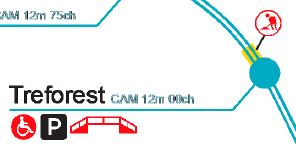
Note.
- Treforest station is shown with a PRM-compliant bridge and step-free access from street to train. The new bridge would deliver this.
- The station is shown electrified.
- A short section of line North of the station is without electrification.
This Google Map shows the area to the North of the station.
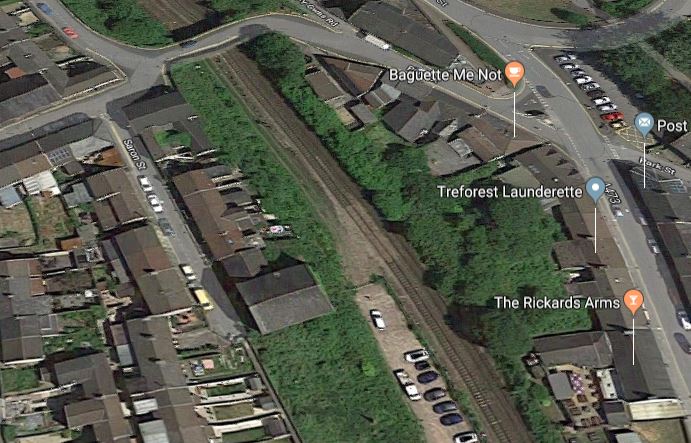
It would appear, that instead of rebuilding the bridge to squeeze the wires underneath, a short earthed section of overhead conductor rail would be used.
Conclusion
Using one of Network Rail’s new bridges at Treforest station, solves all the problems of the station and could even make the electrification easier.
Is Taff’s Well Station Planned To Go Step-Free?
This document on the Government web site is entitled Access for All: 73 Stations Set To Benefit From Additional Funding.
Taff’s Well station is not on the list.
These pictures show the station and the current bridge,

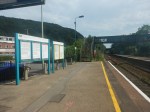
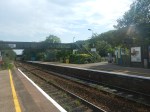
Crossing the tracks on the current bridge, is no easier, than at Cathays and Treforest stations, both of which are going step-free.
This map is a schemastic of the South Wales Metro.

Twelve trains per hour (tph) will go through the station, when the South Wales Metro is fully developed.
Passenger numbers for 2017/2017 South between Pontypridd and Cathays are as follows.
- Pontypridd – 864,000 – Step-free
- Treforest – 752,000 – Going step-free by 2024
- Treforest Estate – 84,000
- Taff’s Well – 364,000
- Radyr – 539,000 – Step-free
- Llandaff – 483,000 – Step-free
- Cathays – 946,000 – Going step-free by 2024
Taff’s Well is the second least-used station.
But a doubling of the train frequency in the next few years, will certainly increase passenger numbers.
One guy, I spoke to said, that the station wasn’t busy.
I have been sent a map of the proposed works and facilities for the South Wales Metro. This snippet shows Taff’s Well station.

Note.
- There’s a lot of work to be done in the area.
- Taff’s Well station is shown with a PRM-compliant bridge and step-free access from street to train. The current bridge is not PRM-compliant.
- The station is shown electrified.
- Short sections of line around the station are without electrification.
I feel that to meet their objectives, the bridge needs to be replaced.
Installing Step-Free Access
In Winner Announced In The Network Rail Footbridge Design Ideas Competition, I wrote how the competition was won by this bridge.
I feel that, when Network Rail fully understand their installation procedures and costs, that a bridge like this could be used to replace the current monstrosity.
It also appears that the wires at Taff’s Well station will not be electrified, so could a bridge be used to hold up the overhead wires, that will guide pantographs through the station?
This Google Map shows Taff’s Well station.
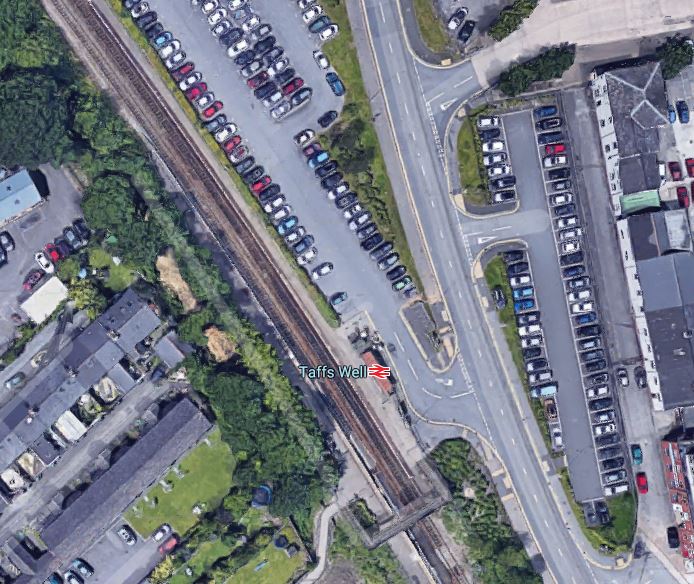
The station has the common problem, of those that use the station as a Park-and-Ride have to negotiate the bridge one way.
Does the possibility of coming back from Cardiff, with lots of shopping, encourage shoppers to drive down the valley?
Taff’s Well station illustrates one of the benefits of the winning bridge design.
It could be built at the Northern end of the station, without disrupting the existing trains or their passengers.
I feel that Taff’s Well station would be ideal for one of the new bridges, even if it is not installed for a few years.
Electrification Through Taff’s Well Station
It is planned that electrification will be continuous through the station., which probably means that a new bridge with all the right clearances is desireable.
South of the station, there are a series of modern road bridges, which should have been built to give sufficient clearance for the 25 KVAC overhead electrification.
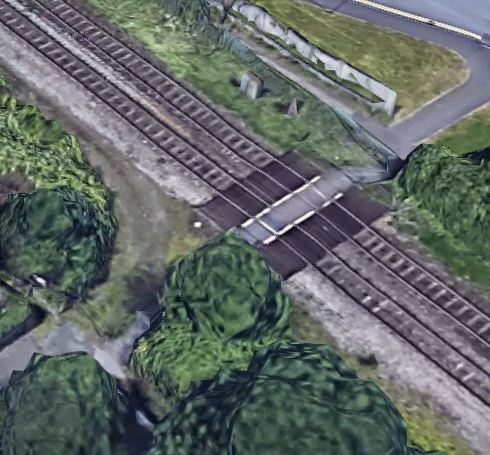
North of the station, there are two modern footbridges.
This is the one nearest the station.
And this is the more Northerly bridge.
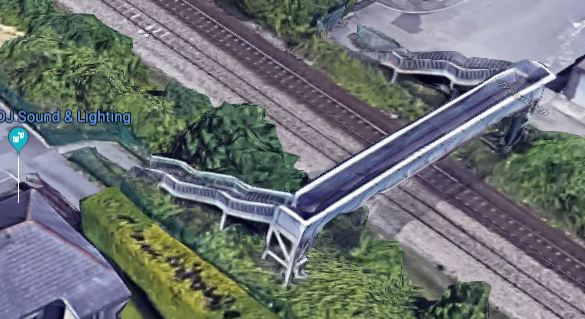
It appears that discontinuous electrification will be used on both bridges to make sure all safety clearances are met.
In an ideal world, the second bridge should surely have lifts!
Conclusion
Obviously, as the plans develop, we’ll know more about what will happen at Taff’s Well station.
 The Anonymous Widower