A Video Of The Alstom Coradia iLint
This video of the Alstom Coradia iLint has been uploaded to YouTube.
I must go and get a ride!
Ballard Receives Order From Porterbrook for Fuel Cell Module to Power UK HydroFLEX Train
The title of this post is the same as this article on Cision.
The article says that the copy has been provided by Ballard.
This is the first paragraph.
VANCOUVER and DERBY, U.K., Dec. 13, 2018 /CNW/ – Ballard Power Systems (NASDAQ: BLDP; TSX: BLDP) today announced that it has received a purchase order from Porterbrook Leasing Company Limited (“Porterbrook”; http://www.porterbrook.co.uk), a leading participant in the rail leasing market, for an FCveloCity®-HD fuel cell module and related support to power a HydroFLEX train in the U.K.
The article says this about the HydroFLEX train.
The HydroFLEX will be the U.K.’s first fully sized hydrogen demonstrator train. It will showcase how hydrogen can be used to power a train that retains the ability to operate across existing electric routes, on either 3rd rail or 25kV overhead power. Testing and demonstration runs are planned for the summer of 2019 at RailLive, which will take place at Long Marston in Warwickshire.
That sounds like it could be a date for my diary.
Strictly A Demonstrator
In this article on Rail Engineer, which is entitled Hydroflex – The Next Iteration Of The Flex Concept,there is a section entitled Strictly A Demonstrator, from which this was taken.
In response to Rail Engineer’s questions, BCRRE said that the demonstrator version focuses on delivering an electric/hydrogen bi-mode to UK gauge.
So the HydroFLEX is more about research., which I believe is a good route.
- My feelings on seeing the Alstom Coradia iLint in Germany, was that they had launched too early!
- Getting a University to run a demonstrator might show up the smaller problems associated with a complex project.
- Birmingham University may also have access to better mathematics and computing.
- The interior of the train can be used for test equipment and hydrogen tanks.
I also suspect that a well-designed demonstrator could help with the repurposing of Porterbrook’s extensive fleet, by doing appropriate research.
The Fuel Cell
The Ballard fuel cell is a HD variant of their FCveloCity family.
This page on the Ballard web site is the data sheet.
- The fuel cells come in three sizes 60, 85 and 100 kW
- The largest fuel cell would appear to be around 1.2 m x 1 m x 0.5 m and weigh around 400 Kg.
- The fuel cell has an associated cooling subsystem, that can provide heat for the train.
It would appear that mounting the fuel cell under the train floor would be a feasible proposition. I would assume that the cell would be placed under one of the driver cars.
If you search the Internet, you’ll find there is a lot of fuel cell companies out there innovating like crazy and fighting for market share.
I don’t think there will be any problem with the fuel cell in the HydroFLEX train.
The Electrical System
The electrical system of the Class 319 train is simple.
- There is a 750 VDC busbar, which connects to all four cars.
- The busbar is fed by the 25 KVAC overhead or 750 VDC third-rail electrification.
- One of the middle cars has the pantograph and the other has four 247.5 kW traction motors, which power the whole train.
- There is no regenerative braking capability.
- The two driver cars are only differentiated, by the seats installe by the operator.
It looks to me that this was a sensible piece of 1980s engineering by British Rail to create a low-cost dual-voltage train.
I do wonder, if the originator of this system is still hale and hearty. I suspect they are, as they certainly know how to design for a long life.
When Porterbrook commissioned the Class 769 train, the two diesel generators under the driver cars were connected into this busbar.
They didn’t add any energy storage to the train, although as I said in Brush Traction Signs Contract With Skeleton Technologies For Modules For Class 769 Trains, they have added SkelStart capacitors to start the diesel generators.
Effectively, the Class 769 train is an electric or diesel train, just like the Class 319 train is an overhead or third-rail electrificsation train.
Will the fuel cell of the HydroFLEX train be connected to the electrical system of the train in the same way?
Or will energy storage, be added to the drive train?
In a more advanced design, batteries or capacitors could be in the motored car.
- They would be charged from the busbar.
- They would power the traction motors.
If the traction motors, were to be changed to modern ones, that could perform regenerative braking, then this energy could be used to recharge the battery.
The Fuel Tank
I suspect as the train is for research, that a standard off-the-shelf hydrogen tank will be used.
This page on the Fuel Cells And Hydrogen Joint Undertaking, is entitled Improved Hydrogen Tanks For Fuel Cell Cars Of The Future.
This is the first paragraph.
The EU funded COPERNIC project, supported by the Fuel Cells and Hydrogen Joint Undertaking (FCH JU), succeeded in improving the quality of materials and design of hydrogen storage tanks for cars. It also made the manufacturing of these tanks more cost efficient, helping to make hydrogen cars a more viable and competitive option.
I think it is highly likely, that a well-designed hydrogen tank, could probably share the space under the driver car with the fuel cell.
If it can’t then as it’s a research project a few seats can be taken out.
Harry Redknapp And Stacey Dooley
With Harry Redknapp winning I’m A Celebrity … Get Me Out Of Here and Stacey Dooley winning Strictly Come Dancing are we seeing a reaction to the gloom that pervades everyday life and especially politics.
I’ve never met either, but both seem likeable characters, to whom not many would object.
The Problem With Britain’s And Probably Other Older Railways
This post on IanVisits is entitled West Hampstead Overground Station’s New Footbridge.
Ian had intended to report on the finish of a station rebuilding project at West Hampstead station.
But like many other projects it is running several months late.
Ian says this.
It’s reported that the delay stems from an unexpected massive slab of concrete that was added to the bridge that runs over the railway tracks, and supports the old station entrance.
Plans to pull the old building back and release more space on the pavement may now need to be revised as that would require the pavement to be reinforced to the same level as the road, in case a heavy lorry were to swerve onto the pavement by accident.
The old Edwardian era station building was due to be turned into a “retail opportunity”, although that may now be in doubt if the pavement issue proves intractable.
How many of us have renovated old buildings to find that what is actually there, has little relation to what the surveyors/architects believed was there?
Years ago, I was rebuilding a Listed house and the Listed Building Inspector from English Heritage was very practical. When she asked the Council Planner, if he thought that the house should be like it was built in the 1840s, he said yes!
To which she replied, “So you think there should be outside toilets?”
Everybody except one laughed!
A couple of months later, she came back to see the work and told me of a very rich man, who was rebuilding a Grade II Listed Building, that was several times over budget. Her advice at the time had been knock it down or move, as she felt preservation was impossible. But the neighbours and the wider area, felt that the building should be saved.
I suspect that, if Transport for London had known what they know now, they would have demolished the inadequate station. I don’t think the station is Listed!
Conclusion
We have a preserve all buildings regardless of the cost attitude in this country and it exists in other countries as well.
Look at my post Stuttgart Hauptbahnhof, which outlines the problems there.
Imagine Crossrail with lots of tunnel construction problems and angry protestors!
Palm Oil Giant Wilmar International To Combat Deforestation Using Satellite Monitoring Of Suppliers
The title of this post is the same as that of an article on The Independent.
This is the first three paragraphs.
The world’s largest trader in palm oil has unveiled plans to use satellite monitoring to prevent further destruction of rainforests.
Wilmar International is backing a project by sustainability consultancy Aidenvironment to draw up a comprehensive mapping database of suppliers in countries such as Indonesia and Malaysia.
It has pledged to immediately suspend groups involved in deforestation or development on peatland, while also working with them to improve their operations.
Both the Independent and The Times, quote Kiki Taufik of Greenpeace, as the announcement being a potential breakthrough.
The Times also says, that Mondelez, who own Cadbury, have backed Wilmar’s palm oil plan.
Vivarail And Hoppecke Announce Long-term Supply Of Batteries For Class 230s
The title of this post is the same as that of a press release from Vivarail.
Some extracts.
A 3-car Class 230 can run for 65 miles between charges which means they are more than able to operate numerous routes throughout the UK, and active conversations are taking place with interested operators. Battery trains enable emission-free rail travel in areas where electrification is either non- or only partially existent. The trains are particularly suited to urban routes where authorities wish to eliminate pollution caused by traditional DMUs as well as scenic lines where the natural environment needs protecting.
A Sixty-five mile range is very respectable and a good start.
Currently Vivarail is building a fleet of diesel/battery hybrids to operate the Wrexham-Bidston line for Transport for Wales, where the diesel gensets will be used to charge the batteries not to power the train. This power variant gives the range of a diesel train, the performance of an EMU (with acceleration of 1m p/s/s up to 40 miles per hour) and combines it with emission-free travel. As well as using the genset to charge the batteries the train also has regenerative braking – as do all the battery trains.
The acceleration is up there with a Class 345 train.
Hoppecke’s Lithium Ion batteries are ideally suited for the Class 230s by providing the rapid charging needed for battery trains. Simulations and performance data show that many non-electrified routes can be operated by the Class 230 battery trains and to make this possible in the short-term Vivarail has designed and patented an automatic charging system and battery bank. This means that costs of both infrastructure upgrades and daily operation are hugely minimised – in some cases by millions of pounds.
The batteries will probably be fairly traditional, but reading about Hoppecke on the web, they seem to be a company that believes in service. They also seem to supply back-up power supplies for critical infrastructure like telecommunications and computing.
Note too, that Vivarail have patented their charging system.
Designs for other types of hybrid trains exist including the use of existing OHL with a pantograph and transformer and 3rd rail with shoegear. Additionally, a new hydrogen variant is being developed which, similarly to the diesel hybrid, will exceed the pure battery train’s range of 65 miles.
Other power sources could be added, when they are invented.
A Serial Hybrid Train
The Class 230 trains for Wales are actually serial hybrids, just like one of London’s Routemaster buses. As the Press Release says, the generator set charges the batteries and these drive the train.
In the Press Release the following methods are mentioned for charging the batteries.
- Diesel generators on the train.
- Static charging systems at stations.
- Regenerative braking.
- 25 KVAC overhead line electrification.
- 750 VDC third rail electrification.
- Hydrogen fuel cells.
I wouldn’t be surprised to find that Vivarail have split the control systems into two-more or-less independent systems; one keeps the batteries charged up in an optimal manner and the other links the batteries to the train’s systems and traction motors.
I also suspect that Bombardier’s proposed 125 mph Aventra With Batteries is a serial hybrid.
Conclusion
Is there anything recycled London Underground trains can’t do?
I have read somewhere, that Vivarail have talked about on-board self-service coffee machines!
Oyster Card Scheme Extension Agreed
The title of this post is the same as that of this article on the BBC,
This paragraph describes the extensions.
Its extension, due in early 2019, will include Hertford North, Welwyn Garden City, Luton Airport Parkway and Epsom.
As the Oyster Card extension will also include intermediate stations, the following stations will be included on the four routes.
- Hertford North – Crews Hill, Cuffley and Bayford.
- Luton Airport Parkway – Radlett, St. Albans City and Harpenden
- Welwyn Garden City – Potters Bar, Brookmans Park,Welham Green and Hatfield
All intermediate stations to Epsom are already in the Oyster Card Scheme.
Fourteen new stations will be added.
These are a few random thoughts.
Contactless And Oyster
Oyster card and most contactless payment methods with a card or mobile device can be used on Oyster Card reader, so in this post, I will use contactless to cover all methods.
I believe that in a few years, Oyster could be phased out, as cards and mobile devices will take over the ticketing.
Luton Airport Parkway
Adding Luton Airport Parkway station to the network, brings Luton Airport in line with Gatwick and Heathrow Airports.
This is very much a logical extension.
Airport Services
This is a list of the current times for airport services from London.
- Gatwick – Express – 29 minutes – Thameslink – 39-60 minutes
- Heathrow – Express – 15 minutes – Crossrail – 28 minutes
- Luton – East Midlands Trains – 21 minutes – Thameslink 30-47 minutes
- Southend – 52-53 minutes
- Stansted – 49-52 minutes
If you look at the passenger statistics for Gatwick Airport station, they have been rising at around a million passengers a year for the past few years. How much of the recent rises have been due to the station going contactless in January 2016?
Certainly, if you’re late for a plane, contactless ticketing might save a couple of minutes.
I always remember an incident at Southend Airport station.
My plane was late and arrived very close to the departure time of the last train to London. There had recently been a lot of arrivals and the queues for tickets were long.
So a Greater Anglia employee took the decision to tell everybody to get on the train and we all went to London without tickets.
If ticketing had been contactless, Greater Anglia might have collected some fares.
But contactless at an airport is not solely about making money, but getting the passengers away from the airport quickly.
Hertford East And Hertford North Stations
Hertford East station accepts contactless cards.
Adding the facility to Hertford North station may open up some journey possibilities and ease ticketing.
The National Rail web site recommends that to go between Ware and Bayford stations on either side of Hertford, that you walk between the East and North stations.
An anytime ticket will cost you £19.50.
But buy two separate tickets between Ware and Hertford East stations and Hertford North and Bayford stations and it’ll cost £6!
Using contactless ticketing and touching in at all stations will save £13.50! Will this cost difference encourage more journeys with a walk in the middle?
When I visited the Hertford East Branch recently in mid-morning, I thought that it was surprisingly busy. Does lower-hassle contactless ticketing encourage more passengers?
Analysis of contactless touches will provide the answers to my two questions.
St. Albans City And St. Albans Abbey Stations
The Abbey Line between Watford Junction and St. Albans Abbey stations is not contactless, although Watford Junction station is so enabled and St. Albans City station will be.
There is surely a case for adding contactless ticketing to this short line of five intermediate stations.
Welwyn Garden City Station
Enabling Oyster on the route to Welwyn Garden City station, will mean that all stations on the Great Northern Route from Moorgate station will be enabled except for Watton-at-Stone and Stevenage.
This would surely be less confusing for passengers, than the current arrangement, where Oyster tickeing is stopped at Hadley Wood and Gordon Hill stations.
Hopefully a suitable announcement would wake-up accidental fare avoiders at Hertford North station.
Epsom Station
The two routes to London from Epsom station are both fully Oyster-enabled, so surely adding one station to the routes shouldn’t be a difficult problem technically.
Further Routes For Oyster
Distances of the new Oyster-enabled stations, with a few existing ones, by rail from Central London are as follows.
- Epsom – 16 miles from Victoria.
- Gatwick Airport – 26 miles from Victoria
- Hertford North – 20 miles from Moorgate
- Luton Airport Parkway – 29 miles from St. Pancras
- Shenfield – 20 miles from Liverpool Street
- Welwyn Garden City – 20 miles from Kings Cross
So what other stations could be added?
Southend And Stansted Airports
Airports seem to like Oyster and as I said earlier, it can help to sort out ticketing problems at certain times.
- Southend Airport station is 39 miles from Liverpool Street and there are five other stations between Southend Airport and Shenfield stations.
- Stansted Airport station is 36 miles from Liverpool Street and there are six other stations between Southend Airport and Broxbourne stations.
This story on ITV is entitled Rail Minister Urged To Roll Out Oyster Card Payments To Stansted, Luton And Southend Airports.
Luton Airport will soon be Oyster-enabled, so hopefully Stansted and Southend Airports will be enabled soon.
Thirty Miles From London
There are a lot of places within thirty miles of London on commuter routes, that I’m sure eventually will be Oyster-enabled.
- High Wycombe and Aylesbury – Chiltern have ambitions for this.
- Rochester – 30 miles from London and on Thameslink.
- Windsor
There will be other suggestions.
Extending Freedom Pass
I’d like to be able to just touch-in and touch-out to go to any station in the Oyster card area.
My Freedom Pass would be connected to a bank or credit card and I would be charged beyond the Freedom Pass area.
If Oyster cards can be linked to a bank or credit card, surely London’s control computer can be programmed to do something very powerful for Freedom Passes.
It could be a nice little earner for cash-strapped Transport for London.
Conclusion
Oyster is extending its reach and after this flurry of extensions in the next few months, lot of places will be wanting to be Oyster-enabled.
I suspect the only objector to this roll-out, will be the RMT, who have made the Luddites look like pussycats!
I Have Just Been Microsofted!
I run Office 365 and today it updated itself.
Now nothing in the suite works.
I don’t like automatic updates, as they have this power to drop you deep in it.
I usually only upate software, when there is a problem!
Could London Overground Extend To Hertford East Station?
London Overground’s Future Plans
This table summarises London Overground’s improvements and future plans
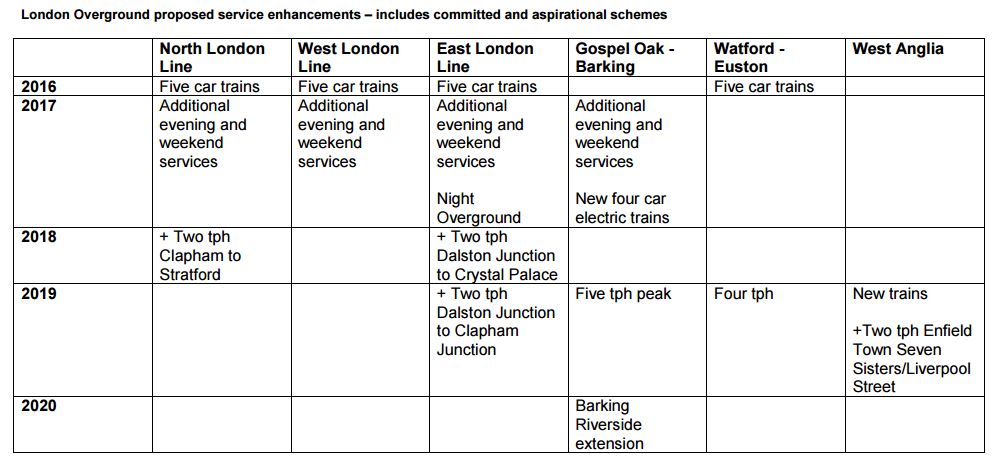
Note that in 2019, it is proposed that two extra trains per hour (tph) are added to services between Liverpool Street and Enfield Town stations.
I was also told at the weekend, a strong rumour, that in 2020, London Overground will be taking over the following services.
- Northern City Line services between Moorgate and Gordon Hill, Hertford North, Stevenage and Welwyn Garden City.
- Services to Hertford East station.
The first has been mooted for some time, but is supposedly stalled because of differences between Chris Grayling and Sadiq Khan. The second was rather a surprise.
So what will be the result of the Hertford East services being the responsibility of the London Overground?
Greater Anglia’s Services
Greater Anglia‘s current services along the West Anglia Main Line (WAML) are as follows.
- Two tph between Liverpool Street and Hertford East stations.
- Two tph between Stratford and Bishops Stortford stations.
- Two tph between Liverpool Street and Cambridge/ambridge North stations.
- Four tph between Liverpool Street and Stansted Airport.
In the past Greater Anglia have run Stansted services to and from Stratford and have said they may do so again.
This means that Greater Anglia run ten tph along the WAML between Tottenham Hale and Broxbourne stations.
Compare this with the measly two tph, that run between Edmonton Green and Cheshunt stations using the alternative Southbury Loop. The only other movements on this line appear to be a few empty stock movements and freight trains. But not many!
Judging by some of the empty stock movements, I suspect that Greater Anglia have problems positioning their extra trains before and after the Peak.
Rolling Stock To Hertford East
Currently, Greater Anglia run eight-car Class 317 trains to Hertford East station. These are 160 metres long and seat nearly 600 passengers in two classes.
Their new Class 720 trains come in two sizes.
- Five cars – 122 metres long, seating 540
- Ten cars – 243 metres long, seating 1100
Could it be that the five-car trains are too small and the ten-car trains are too long for the platforms on the Hertford East Branch?
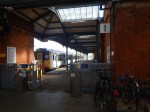
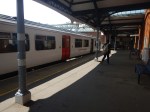
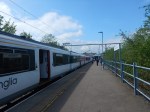
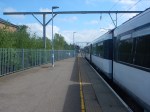
These pictures show that the platforms at Hertford East station are just long enough for two four-car Class 317 trains working as an eight-car formation. I doubt that a ten-car Class 720 train will fit these platforms and it appears that lengthening the platforms could be difficult.
On the other hand, London Overground’s four-car Class 710 trains are the same length as Class 317 trains.
So could it be that Greater Anglia would prefer that they didn’t have a service to Hertford East station?
Liverpool Street Or Stratford?
Crossrail will have one big effect on the planning of services on the WAML and the Lea Valley Lines, in that the new line will call at both Liverpool Street and Stratford stations, when it eventually opens.
Connectivity
It will be a two-stop journey between the two stations, which in addition are both well-connected to the Underground.
There is very little difference in connectivity between the two stations.
Capacity
Liverpool Street is getting to be full and given more services will be run along the Great Eastern Main Line, it could do with some capacity enhancement.
Stratford though has only two platforms connected to the WAML.
But there is the little-used High Meads Loop under the Eastfield Shopping Centre, which has been used in the past to turn Stansted Express trains, when they served Stratford.
Loops like this can easily handle at least 12 tph, as they do in Liverpool with the Wirral Line.
The High Meads Loop was well-designed to accept a lot of trains.
- It is double-track.
- Both tracks have a platform at Stratford capable of accepting a twelve-car Class 745 or Class 720 train.
- Both platforms are wide and step-free with lifts.
- The driver doesn’t have to change ends, when using the loop, so the loop will be efficient.
- An extra stop could be added at Stratford International station.
It is London’s forgotten terminal station.
Operators Would Get Extra Capacity
The two train operators; London Overground and Greater Anglia would gain extra capacity in London.
Travellers Would Choose
If travellers were able to have a choice of London terminals, I suspect that most would choose the one they liked best, but because of Crossrail, it wouldn’t matter if they ended up at the wrong terminal.
Sorting Out West Anglia Main Line And Lea Valley Lines Local Services
I know there needs to be a bit of a sort-out on the WAML to run four tph between Stratford and Meridian Water stations, but could something more radical be on the cards.
Reasonable objectives based on London Overground’s principles would see the following stopping services.
- Four tph between Seven Sisters and Cheshunt stations via Edmonton Green station.
- Four tph between Seven Sisters and Enfield Town stations
- Four tph between Tottenham Hale and Cheshunt stations via Waltham Cross station
- Four tph between Cheshunt and Hertford East stations.
At the Northern end of the route, there would be three terminal platforms controlled by London Overground, one at Cheshunt and two at Hertford East.
The Aventra Effect
The high-performance Aventras, used by London Overground and Greater Anglia, are ready for digital signalling and designed around fast station stops.
The trains should be able to stop at all stations and maintain the current timetable on the route.
So the timetable could become more passenger friendly, with everything station getting four tph in both directions!
Broxbourne Station Could Be Key
The key at the Northern end could be Greater Anglia’s Broxburne station.
- It has four platforms.
- There would be space for an extra platform and/or a turnback for trains from the South.
- Overground services to and from Hertford East station will call.
- It is planned to be the terminal of Crossrail 2.
Services between Liverpool Street and Stratford stations and Bishops Stortford, Cambridge and Stansted Airport generally stop at Broxbourne.
So could we see cross-platform interchanges between London Overground’s local services calling at all stations to London and Greater Anglia’s fast services?
The Hertford East Difficulty!
At present one difficulty, is that the Hertford East Branch can only handle three tph, which it does in the Peak, so running the required four tph might need dualling the single-track section through Ware station.
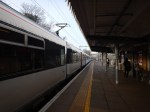
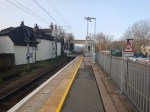
These pictures show Ware station and the level crossing.



Note.
- The platform can accept a twelve-car train.
- There would be space to install a second platform.
- To the East the single track becomes double after the bridge at the end of the platform and is double all the way to the WAML.
- To the West the single track becomes double after the level crossing at the end of the platform and is double all of the way to Hertford East station.
Laying a second track and adding a second platform at Ware station, is probably the ultimate solution, to provide four tph all day between London and Hertford East.
But I also feel that with precision driving, the nimble Aventras will be able to do four tph, with a procedure something like this.
- The level crossing closes to road traffic.
- A Westbound train arrives in the station and an Eastbound train stops at a signal at the end of the Eastbound track from Hertford East station.
- When the Westbound train has unloaded and loaded the passengers, it leaves the station and takes the Westbound track to Hertford East station.
- When the Westbound train has safely passed the stationary Eastbound train, the points are changed and the Eastbound train moves into the station.
- The level crossing opens to road traffic.
There would be four level crossing closures per hour, which is the same as now, but they could be slightly longer.
I suspect there is a better absolutely safe operating procedure than my naive example.
Eight Tph At Cheshunt Station
As eight tph will be going South from Cheshunt station; four each via Edmonton Green and Waltham Cross, Broxbourne station could turn any that couldn’t be handled at Cheshunt and Hertford East stations.
So we might see the following Northern terminals, if the four tph can run to Hertford East station.
- Four tph at Hertford East; two via Edmonton Green and two via Waltham Cross.
- Two tph at Cheshunt via Edmonton Green
- Two tph at Broxbourne; via Waltham Cross.
All stations between London and Hertford East will get four tph.
Cheshunt station needs a certain amount of rebuilding to make it step-free and possibly remove the level crossing.
A step-free station is essential.
- The station is not a sleepy rural halt.
- Changes between trains from the North to London Overground services mean crossing the footbridge.
- It would give pedestrians, wheelchair users, buggy pushes and others an easy way across the railway, when the level crossing in closed.
Southbound trains from Cheshunt could be.
- Two tph from Cheshunt via Edmonton Green
- Two tph from Hertford East via Edmonton Green
- Two tph from Broxbourne via Waltham Cross
- Two tph from Hertford East via Waltham Cross
Northbound trains from Cheshunt could be.
- Four tph to Hertford East.
- Two tph to Broxbourne.
Judicious timing of Northbound trains could mean that passengers arriving via Edmonton Green at Cheshunt could change to a Hertford East train by walking across the platform.
There are a lot of possibilities to get the best connectivity at the Northern end.
The Southern End
At the Southern End, there will be the following services.
- , Tottenham Hale station will receive four tph from Cheshunt.
- Seven Sisters station will receive four tph from Cheshunt and four tph from Enfield Town.
Both stations will be able to send trains to either Stratford or Liverpool Street.
Seven Sisters Services
Seven Sisters station is easier to sort.
- Half of each group of trains go in each direction.
- Four tph go direct to Liverpool Street stopping at all stations en route.
- Four tph go to Stratford via South Tottenham and Lea Bridge stations.
,Trains to Stratford should turn in the High Meads Loop under Eastfield.
South Tottenham Interchange
This map from carto.metro.free.fr shows the lines at South Tottenham station.
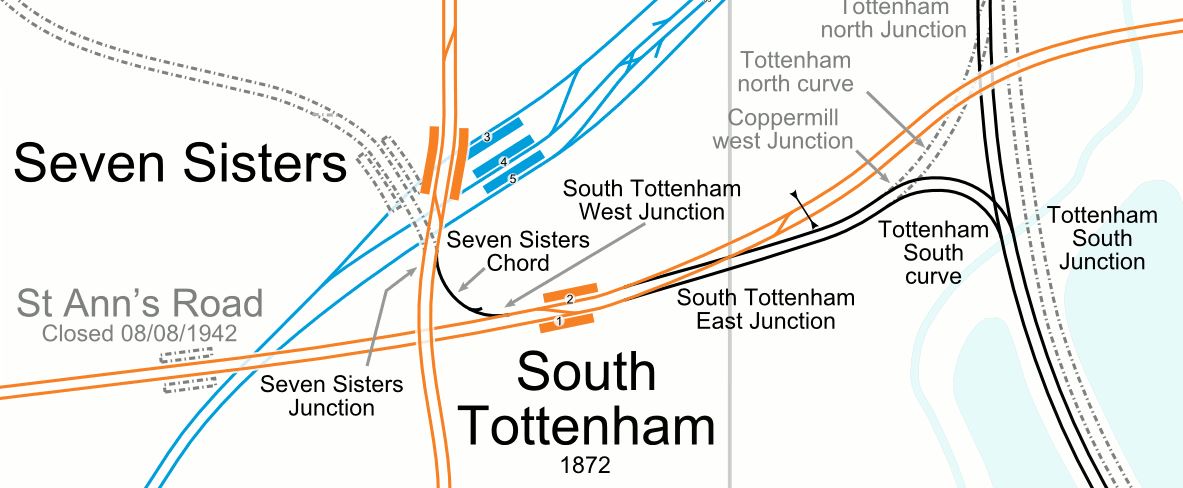
Note.
- The orange line going across the from left to right is the Gospel Oak to Barking Line
- The blue line is the Victoria Line.
- The orange line going down the map is the Lea Valley Line, between Liverpool Street in the South and Cheshunt and Enfield Town stations in the North.
- The single-track; Seven Sisters Chord, which connects the two Overground lines.
- The black line going down the map on the right is the WAML, between Stratford and Lea Bridge stations in the South and Tottenham Hal station in the North.
What is not shown on the map is the massive double-ended Crossrail 2 station, that will link South Tottenham and Seven Sisters stations, which are about five hundred metres apart.
This Google Map shows the area of the two stations.
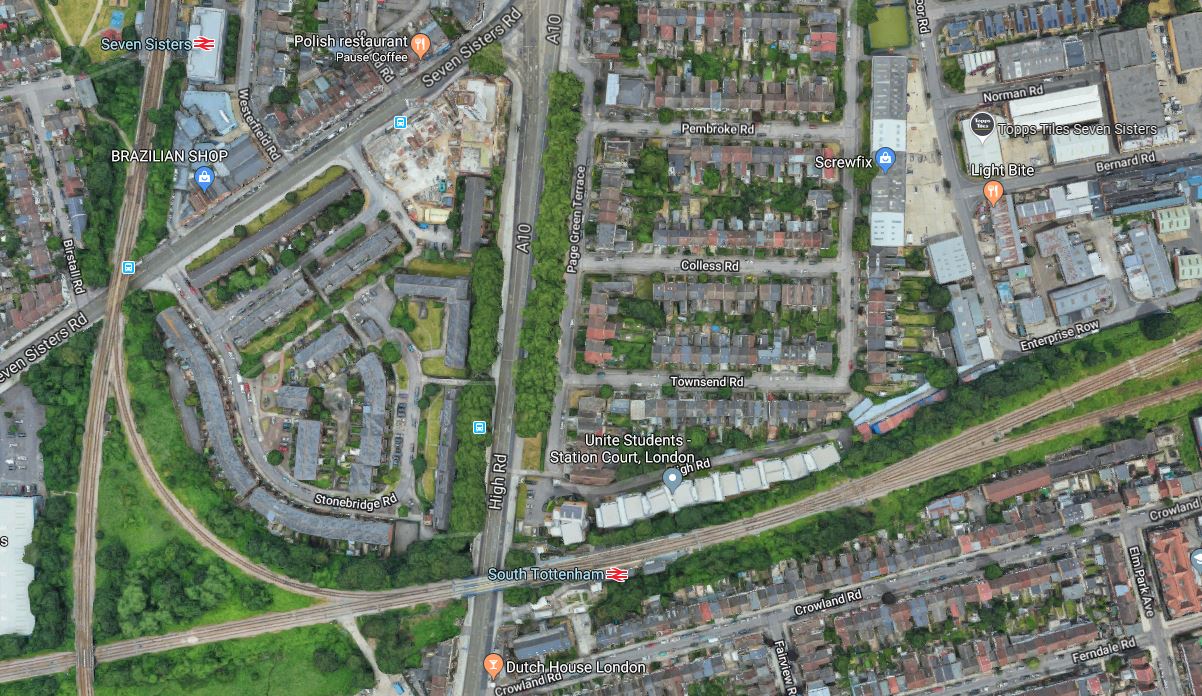
Note how much green space there is alongside the tracks.
If four tph went via South Tottenham and Lea Bridge stations, this would mean that South Tottenham station has the following services.
- Four tph to Barking
- Four tph to Gospel Oak
- Four tph to Stratford
- Two tph to Enfield Town
- Two tph to Broxbourne, Cheshunt or Hertford East.
Timings could be arranged to give a user-friendly interchange at South Tottenham station, which is a step-free station.
Note that it is probably likely, that the Seven Sisters Chord shown in the first map, would need to be improved.
But there is certainly enough space to do it properly!
Tottenham Hale Services
These are trickier, but I believe they could be sorted if the new third track from Meridian Water station was used exclusively for Southbound services going to Stratford.
This would mean that platform usage at Tottenham Hale station would be as follows.
- Existing Platform 1 – Services to Liverpool Street station.
- Existing Platform 2 – Services to Cheshunt, Broxbourne, Stansted Airport and Cambridge.
- New Platform 3 – Services to Stratford station.
Platforms 1 and 3 would be a cross-platform interchange to allow passengers to change terminal.
Splitting Of Stratford And Liverpool Street Services
Stratford and Liverpool Street services would split somewhere North of the new Meridian Water station.
Services to Liverpool Street would include.
- London Overground – Two tph from Cheshunt, Broxbourne or Hertford East.
- Greater Anglia – Two tph from Cambridge/Cambridge North
- Greater Anglia – Four tph from Stansted Airport.
This is much the same as the current timetable, with a change of operator on the Hertford East service.
Services to Stratford would include.
- London Overground – Two tph from Cheshunt, Broxbourne or Hertford East.
- Greater Anglia – Two tph from Bishops Stortford.
If all these services stopped at Meridian Water, Northumberland Park, Tottenham Hale and Lea Bridge stations, the STAR service has been implemented.
These Stratford services would be turned in the High Meads Loop.
As there would be four tph coming to Stratford from Seven Sisters station, this would mean that eight tph were being turned in the loop.
I can see two problems with this arrangement.
- The merging of Northbound trains South of Tottenham Hale station could be tricky.
- The Cambridge and Stansted expresses use the same route to Liverpool Street as London Overground’s Chingford services, as they do now!
Both problems could be lessened by perhaps running half of the Cambridge and Stansted services to Stratford.
This would mean the following.
- Five tph that served the WAML would use Liverpool Street station.
- Seven tph that served the WAML would use Stratford station.
- Eleven tph would need to be turned in the High Meads Loop.
Trains on the High Mead Loop would be as follows.
- London Overground – Two tph to Enfield Town
- London Overground – Two tph to Broxbourne, Cheshunt or Hertford East via Edmonton Green
- London Overground – Two tph to Broxbourne, Cheshunt or Hertford East via Waltham Cross
- Greater Anglia – Two tph to Bishops Stortford
- Greater Anglia – One tph to Cambridge/Cambridge North
- Greater Anglia – Two tph to Stansted Airport
It could be that the expresses could use one track of the High Meads Loop, with the local services using the other.
I also think, that there is sufficient capacity in the High Meads Loop to terminate all services on the WAML at Stratford.
But would that be a step too far?
Possibly for some passengers, but I suspect it would be liked by train operators.
Services Between Tottenham Hale And Broxbourne
Currently, the following services run between Tottenham Hale and Broxbourne stations on the WAML.
- Two tph between Liverpool Street and Hertford East stations.
- Two tph between Stratford and Bishops Stortford stations.
- Two tph between Liverpool Street and Cambridge/Cambridge North stations.
- Four tph between Liverpool Street and Stansted Airport.
This gives a total of ten tph in both directions.
If you go to my first scenario of providing four tph to Cheshunt/Broxbourne/Hertford East, this gives the following services between Tottenham Hale and Broxbourne stations.
- Two tph between Liverpool Street and Hertford East stations.
- Two tph between Stratford and Bishops Stortford stations.
- Two tph between Liverpool Street and Cambridge/Cambridge North stations.
- Four tph between Liverpool Street and Stansted Airport.
- Two tph between Stratford and Broxbourne stations.
The extra service between Stratford and Broxbourne is to ensure that all stations on the route get four stopping services, of which two tph go to either Liverpool Street or Stratford at the Southern end.
This gives a total of twelve tph in both directions.
By adding just two tph, there is a vastly improved stopping service along the WAML, with all stations getting at least a four tph service.
Could The West Anglia Main Line Handle Twelve Tph?
In 2020, Greater Anglia will be running Class 745 and Class 720 trains on this route.
- They will both be 100 mph trains.
- They will have fast station dwell times.
- They may even have level access between platform and train, which will help speed boarding.
- They will have a quality Driver Assist System.
- Electronic in-cab digital signalling is a possibility.
- The WAML may allow some 100 mph running.
- Removing the remaining level crossings would surely speed up services.
The Greater Anglia trains will be limited stop and most will only stop at Tottenham Hale, Cheshunt and Broxborne.
London Overground will also be running Class 710 trains, which will be faster than current trains, with very good dwell times.
So I expect that with new trains, some improvement to the infrastructure, the following will be possible.
- Four tph, which stop at all stations between Tottenham Hale and Broxbourne.
- Six tph, which are limited stop expresses, only stopping at Tottenham Hale and Broxbourne and a couple of other occasional stations.
- Time saving for all services.
- I suspect that the current Stratford to Bishops Stortford service will become limited stop North of Meridian Water station.
It would hopefully be a timetable, that appealed to both passengers and train companies.
Services At Meridian Water
Meridian Water station has been promised four tph to Stratford, that call at Northumberland Park, Tottenham Hale and Lea Bridge stations.
So what services will call at Meridian Water station, in the scenario I have outlined, that follows from four tph between London and Hertford East being transferred from Greater Anglia to London Overground.
It could be something like this.
- Two tph to Hertford East, calling at all stations.
- Two tph to Bishops Stortford, calling at selected stations.
- Two tph to Cheshunt or Broxbourne, calling at all stations.
- Four tph to Stratford, calling at all stations.
- Two tph to Liverpool Street, calling at all stations.
It’s certainly better and more comprehensive than promised.
As Meridian Water will be such an important station, could some of the Cambridge and Stansted services call?
Four-Tracking Of The West Anglia Main Line
This project is needed to both increase capacity to Cambridge and Stansted Airport and in the future for Crossrail 2, which will reach as far as Broxbourne station.
But it will be a very disruptive project, not just for rail users, but for road users, when they close several level crossings.
The Underused Southbury Loop
The limited triple-tracking around Tottenham Hale station has been moderately disruptive at weekends and services have run using the Southbury Loop.
The Southbury Loop is underused and I believe that if services were increased permanently on the diversion route, that it would have the beneficial effects on the WAML.
Extra services could be added to the existing double-track route.
Between Cheshunt and Broxbourne
There is one section that could be easier than most to four-track and that is the section between Cheshunt and Broxbourne stations.
This Google Map shows the line North of Cheshunt station.
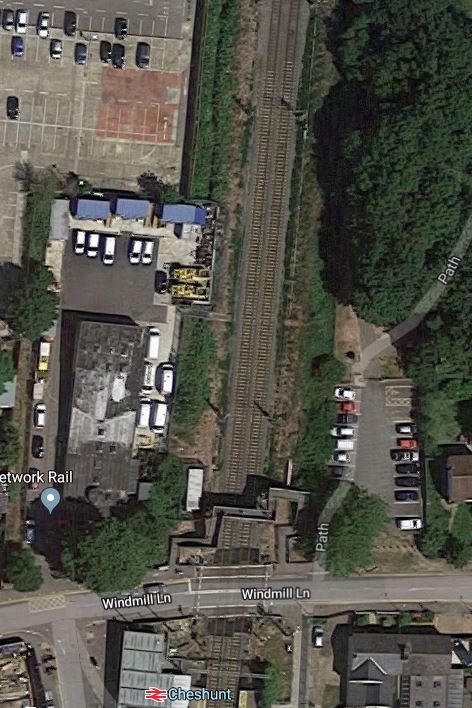
I have flown my helicopter along this route and just as in the map, the two-tracks sit on a wide site, with space for extra tracks.
I am fairly certain,that four-tracking this section would not be difficult.
South Of Cheshunt
If the Southbury Loop were to be used to handle some trains, I think the four-tracking could be done in a more relaxed series of small projects over a longer period of time.
There are various problems.
- Waltham Cross station
- Enfield Lock station and level crossing.
- Brimsdown station and level crossing.
But South from Ponders End station should be a lot easier,
- There are no buildings in the way.
- There will already be a third-track between Tottenham Hale and Meridian Water stations.
- Northumberland Park and Meridian Water stations will be fourth-track ready.
I very much feel, that the four-tracking can be done piecemeal without too much disruption to rail pr road traffic.
Other Issues
Over the years, other issues have been raised with the WAML and Crossrail 2.
A Turnback At Enfield Lock Station
I’ve read in a couple of places, that there could be a bay platform at Enfield Lock station, which could turnback trains to the South..
Under the current plans for the STAR service, this will terminate at Meridian Water station and I’ve heard station staff, say it will be a bi-directional shuttle between Tottenham Hale and Meridian Water stations.
The bi-directional shuttle would.
- Not be using the new infrastructure in a worthwhile manner.
- Bring more passengers to the overloaded Victoria Line.
- Not take passengers to the transport hub at Stratford with Crossrail.
- Not be an efficient use of a train and crew.
I also think, it would struggle for passengers until the building of housing at Meidian Water gets under way.
But supposing, two tracks were built North from Meridian Water to Enfield Lock station, where there would be a bay platform.
- A fourth track would need to be added alongside the third-track between Lea Bridge and Meridian Water stations.
- Another platform would be needed at Tottenham Hale station.
- There is a lot of space on the Eastern side of the WAML, between Meridian Water and Ponders End station.
- Two extra tracks through Brimsdown station, should be possible with the purhase of some low-grade commercial property.
Note that currently a train from Enfield Lock to Stratford takes twenty-four minutes, if it stops at the little-used Angel Road station.
If a train turned in the High Meads Loop at Stratford, it could be back at Enfield Lock within the hour.
- Four tph would be possible.
- This would provide a much needed service for all those who do and will live, work and enjoy themselves allow the Lea Valley.
- Four trains would be needed for a four tph service.
I can understand, why Enfield Lock station has been talked about as a place for a possible bay platform.
There would also be the possibility of extending to Enfield Lock, without closing the level crossing at the station, if a step-free bridge were to be provided.
The station could become a valuable interchange between Greater Anglia’s Bishop’s Stortford services and the four tph to Stratford, stopping at all stations.
Eventually, though, the level crossing will be removed and four tracks will be extended Northwards.
Hackney Downs Issues
If as I proposed the following trains run through Seven Sisters station.
- Two tph between Liverpool Street and Cheshunt/Broxbourne or Hertford East.
- Two tph between Stratford and Cheshunt/Broxbourne or Hertford East.
- Two tph between Liverpool Street and Enfield Town.
- Two tph between Stratford and Enfield Town.
This means that Hackney Downs would have the following services.
- Two tph between Liverpool Street and Cheshunt/Broxbourne or Hertford East.
- Two tph between Liverpool Street and Enfield Town.
- Four tph between Liverpool Street and Chingford.
Would it not be more efficient, if all of these services used the slow tracks into Liverpool Street?
This would give the expresses exclusive use of the fast lines into Liverpool Street.
An Alternative Strategy
Suppose Greater Anglia were to acquire some eight-car trains, then they could carry on as normal.
They wouldn’t actually change the order, but shuffle some of the stock to create eight-car trains.
As the Class 720 trains are cut-and-paste, they can put any number of trailer and motor cars between the two driver cars, a motor car and a pantograph car.
As Greater Anglia could need perhaps ten eight-car trains, this would be
- Driver cars – 20
- Pantograph cars – 10
- Motor cars – 10
- Intermediate cars – 40
The right number of cars can be found in six ten-car trains and four five-car trains..
Have Greater Anglia purchased a set of ten- and five-car trains, that can also be run as a sub-fleet of eight-car trains?
Conclusion
This post has been speculation on a rumour.
But I now believe that Hertford East services can be run under two different methods.
Transfer To The London Overground
The service could transfer to the London Overground.
- London Overground have trains suitable for the service and Greater Anglia doen’t!
- Greater Anglia services may be simpler to operate.
- Ware station needs to be rebuilt to enable a decent service and Funding the work might be easier for London Overground in partnership with Hertfordshire County Council, than for Greater Anglia.
- Large numbers of stations in the London Borough of Enfield get a four tph service.
- By using the Southbury Loop, extra services can be run, without adding to traffic on the West Anglia Main Line.
In a few years time operation of the West Anglia Main Line would be very different.
The Class 710 Trains Can Be Shuffled Into An Eight-Car Sub-Fleet
This is the carry-on as before solution and is possible by just shuffling the required number of trains.
Christmas Card Messages
I received a card with a stylised dove of peace on the front. Underneath were the words.
All is Calm
Inside the sender had added.
The makers of this card clearly hadn’t heard about Brexit!
You wouldn’t want to send it to a friend or relative in France either!
There are some very inappropriate cards in shops.
 The Anonymous Widower