Extra Intermediate Stations On Crossrail
Various groups and councils regularly ask if there could be an extra station on Crossrail, that would be convenient for their needs.
Can Extra Stations Be Accommodated In The Timetable?
There is not much point in building an extra station, if it means that a realistic timetable can’t be achieved.
Every station stop will introduce a delay intro the timetable. The train may only be stationary for thirty seconds or so, but there is extra time in the braking and acceleration either side of the stop.
But the Class 345 trains have been designed so that the times to execute a station stop are minimised.
Rapid Acceleration And Deceleration
The trains have been designed with eight motored cars out of a total of nine.
- This high-proportion of powered axles gives the trains acceleration and deceleration, which is fast, but well within the levels for passenger safety and comfort.
- The trains also have regenerative braking, which is powerful and smooth.
- At times on the current service between Liverpool Street and Shenfield, I have noticed the trains waiting at stations for a couple of minutes, to allow the timetable to catch up.
These trains have the performance to execute a station stop in the smallest time possible.
Wide Doors And Spacious Lobbies
The trains have been designed with wide double doors and spacious lobbies.
This enables fast unloading and loading of passengers at each station.
Level Access Between Train And Platform
Trains and platforms could be arranged, so that all passengers can embark and disembark as fast as possible.
Precision Driving And Automatic Train Control
As much of the route uses modern digital signalling and the trains have a comprehensive driver assistance system, the trains should be driven to a high degree of precision.
Conclusion
All of these factors will make it possible to execute station stops very quickly.
Thus, if it is desired to add a new station stop, the stop might only add a few minutes to the timetable.
You wouldn’t want to add half a dozen stops between Stratford and Shenfield, but the odd stop here and there shouldn’t be a problem!
Could Extra Stations Be Added In The Tunnels?
I would hope that Crossrail’s design process wouldn’t have left out an important station in the Underground sections of the line.
In my lifetime only one station has been added to a line after it opened, except on an extension. That station was Pimlico on the Victoria Line, but that was a late addition to the project and opened within fourteen months of the opening of the rest of the line.
I think, that I can safely say that from the history of London’s extensive network of underground railways, that it would be extremely unlikely to add a new underground station to Crossrail.
But I think though the following could happen.
New Entrances To Existing Stations
Even these will be extremely unlikely, if Crossrail have done their planning thoroughly.
But then there are massive property developments, sprouting up all over Central London.
One of London’s latest signature office developments, the Norman Foster-designed Bloomberg London will incorporate an entrance to Bank Underground station.
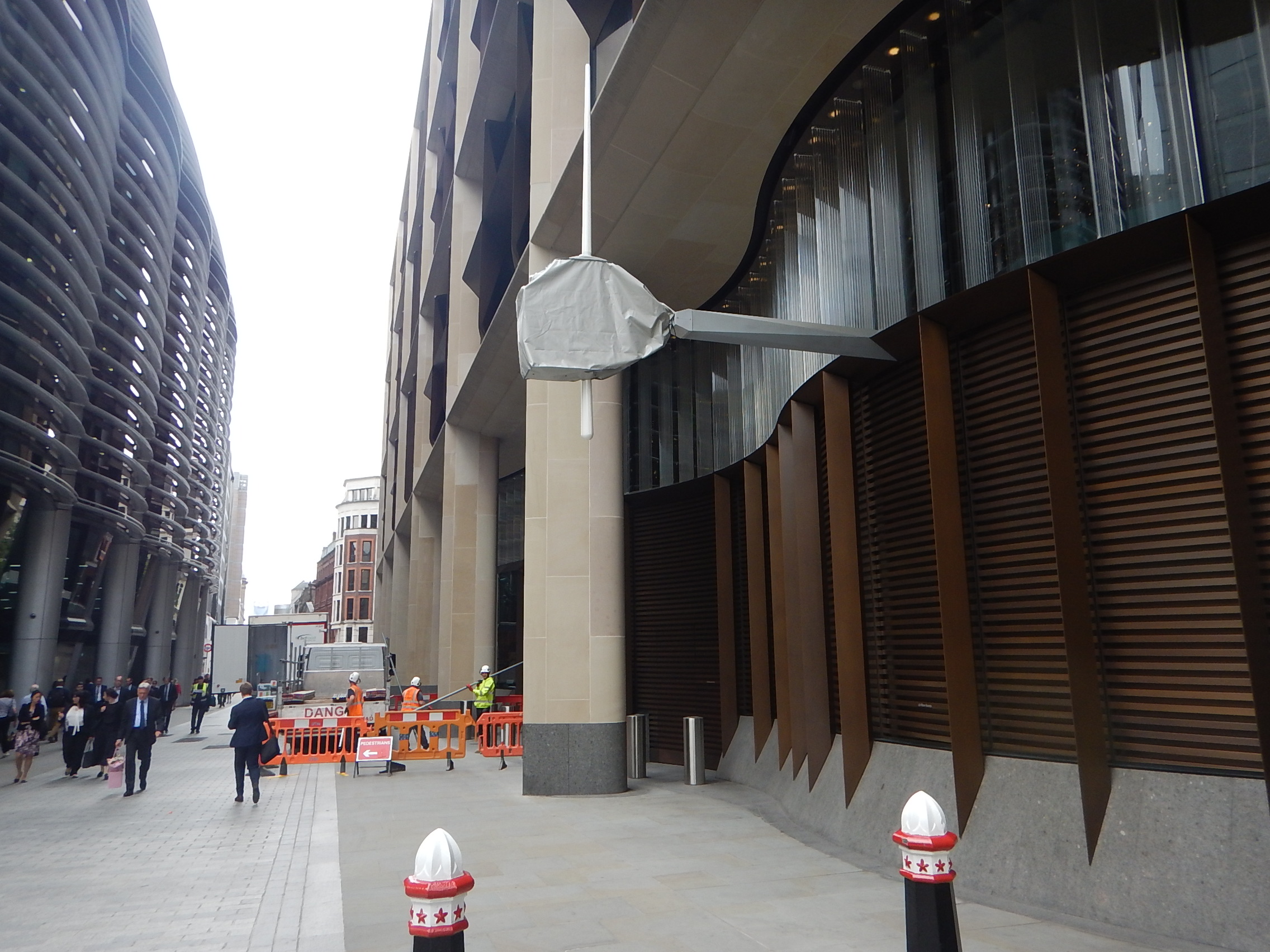
Hopefully, the entrance will open soon.
Bank station’s new step-free entrance will also incorporate a massive office development on the top.
If a property developer is spending around a billion pounds on a development, and it can be connected to a station, they will seriously look at doing it.
I can’t believe that no new developments will want to have an entrance to a Crossrail station.
The New Museum Of London
The current site of the Museum of London is too small and difficult to find. The Museum is planning to move to Smithfield and will be very close to Farringdon station.
There is a massive over-site development on top of the station, that I wrote about in TfL Gives Go Ahead To Build Above Farringdon Station.
This Google Map shows the relationship between the station and the new site of the museum.
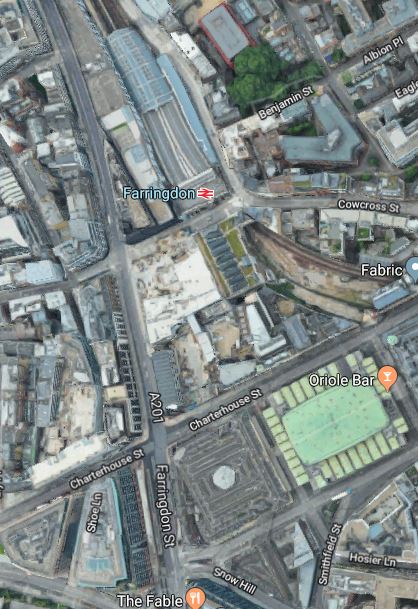
Note.
- The building with the light-green roof is the Poultry Market.
- Thameslink runs under the Poultry Market.
The basement of this Poultry Market together with the site to its West and the triangular site to the South, will be transformed into the new Museum of London.
Much of the space between the Poultry Market and Farringdon station is a Crossrail work-site and whole area is ripe for development, which must surely incorporate some form of connection between the Museum and Farringdon station.
Farringdon, which for many years was just a meat market surrounded by a lot of low grade buildings, should evolve into a visitor attraction in its own right.
For a better look at the current state of the area, visit A Detailed Look At The Space Between Farringdon Station And The New Museum Of London Site.
As a Friend of the Museum of London, I am looking forward to what will happen!
The Liverpool Street-Moorgate Mega -Station
I don’t think many, who use Liverpool Street and Moorgate stations understand what will happen when Crossrail opens.
This visualisation shows the below-ground elements of the Crossrail station, that will connect the two current stations.
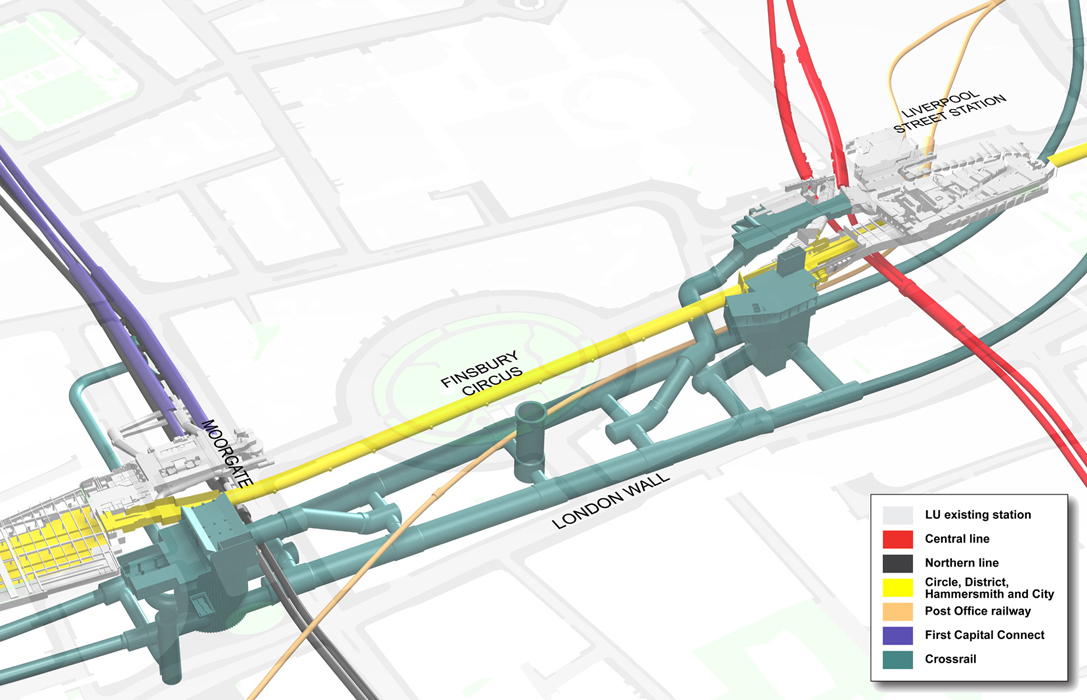
Note.
- On the right is the Central Line, which is shown in red and continues South to Bank station under Bishopsgate.
- On the left is the Northern Line, which is shown in black and continues South to Bank station.
- The Circle, Hammersmith and City and Metropolitan Lines, which are shown in yellow.
- Crossrail is in blue.
- The ventilation and evacuation shaft for Crossrail in Finsbury Circus.
This Google Map shows the area of the stations.
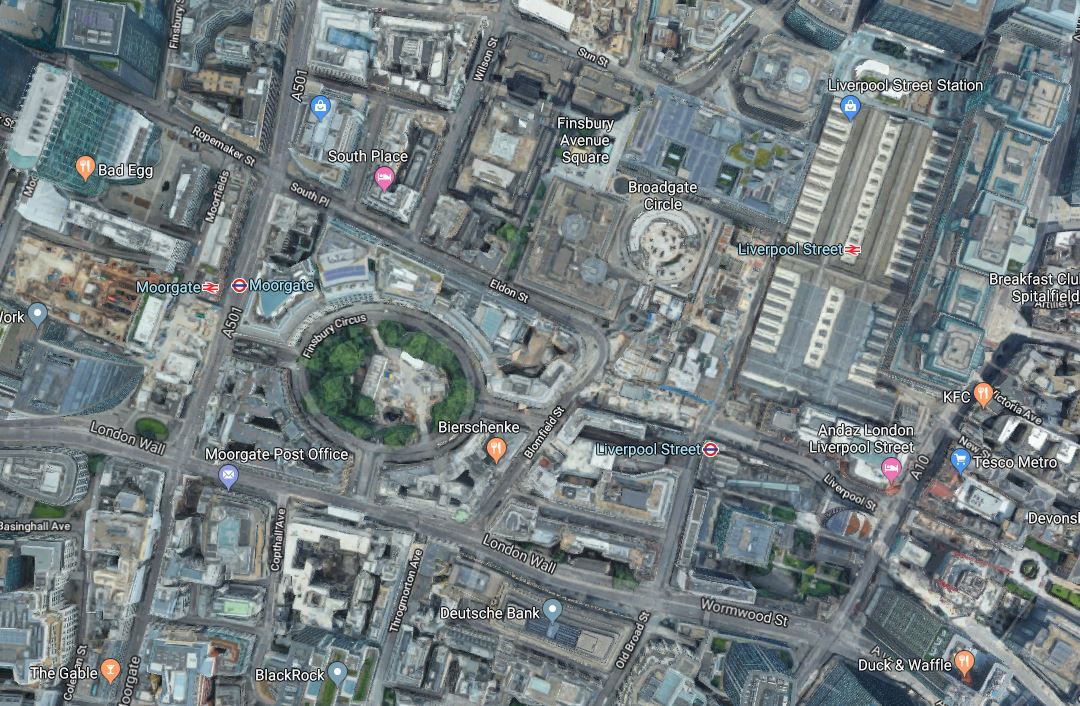
Note Finsbury Circus in the middle.
I would not be surprised if some redevelopment has access into this mega-station complex, that stretches either side of Finsbury Circus.
This access needn’t be below ground, as I strongly believe that the City of London will become virtually traffic-free in the next ten years.
Missing Interchanges
One of the omissions in the design of Crossrail, is the lack of a link to both the Piccadilly and Victoria Lines.
Consider.
By 2024, these two lines will be running at least thirty-six trains per hour (tph) in both directions.
The capacity of Crossrail in each direction could be thirty tph each carrying 1500 passengers or 45,000.
Dear Old Vicky’s current trains hold 876 passengers, so if she achieves the magic forty tph, which I believe she will, then this equates to just over 35,000.
Siemens will surely ensure, that the capacity of the Piccadilly Line will at least be as high, as that of the Victoria Line.
It is just amazing to think what might be squeezed out of twentieth-century infrastructure, some of which is over a hundred years old.
Oxford Circus Station And The Hanover Square Entrance To Bond Street Crossrail Station
This is the easy interchange between Crossrail and the Victoria Line.
- Oxford Circus station is full-to-bursting and will be rebuilt in the next few years, with wider platforms, more escalators and full step-free access.
- I also think, that provision of an easy walking route to the Hanover Square entrance of Bond Street station will be provided, either by pedestrianising much of the area or perhaps building a pedestrian tunnel with travelators.
- It is probably less than two hundred metres to walk on the surface.
Coupled with some property development along the route, there must be possibilities for an innovative scheme, that would ease passengers on routes between Paddington and Heathrow and North and East London.
I took these pictures, as I walked between Oxford Circus Tube station and Hanover Square.
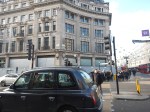
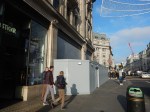

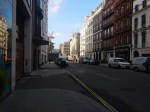

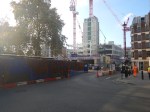
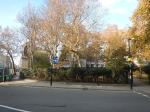
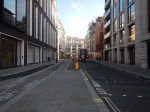
This Google Map shows the route from Oxford Circus station to Hanover Square.
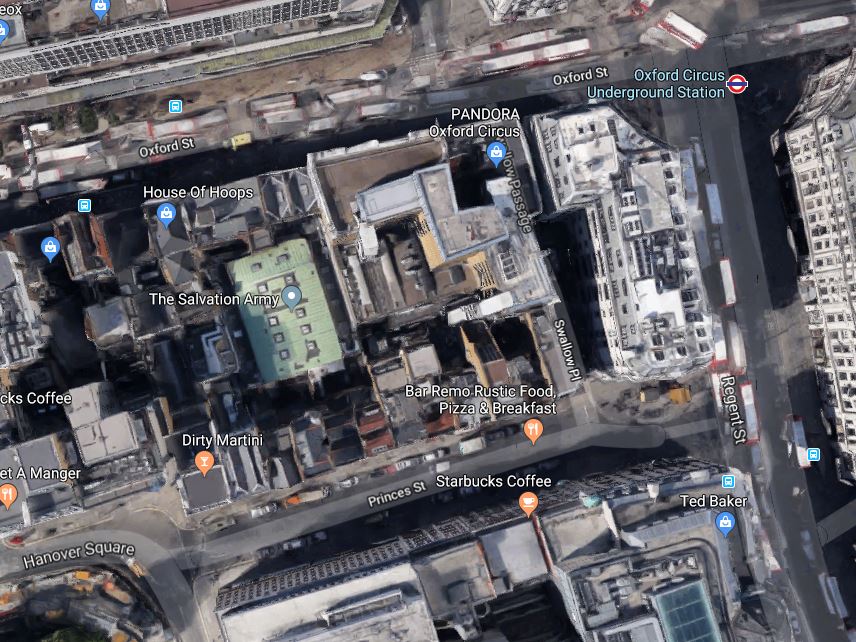
In the simplest scheme, part-pedestrianisation of Hanover Square and Princes Street might just do it!
- A new entrance to Oxford Circus station could also be constructed in the middle of a large pedestrian area, at the shut off junction of Princes Street and Regent Street.
- A short tunnel would connect the new entrance, to the rebuilt.Oxford Circus station.
- Walking wouldn’t be long, with the possibility of a wait in the gardens in the centre of Hanover Square.
- Appropriate retail outlets could be placed along Princes Street.
- Crossings with lights would enable pedestrians to cross into and out of the gardens.
Was this always Transport for London’s plan to link Crossrail to the Victoria Line?
It’s certainly feasible and works with little or no construction.
The Importance Of Finsbury Park Station
Finsbury Park station has two direct routes to Crossrail; Thameslink to Farringdon and the Northern City Line to Moorgate and could have a third if the Victoria Line has a better connection at Oxford Circus/Bond Street.
Passengers needing to use Crossrail from the Northern reaches of the Piccadilly Line could walk across the platform to the Victoria Line and then use the Oxford Circus/Bond Street connection.
It is not a perfect route, but if Finsbury Park were to be upgraded to a passenger-friendly interchange, it would be a lot better.
So it looks like, it will be Vicky to the rescue again.
Never in the field of urban transport was so much owed by so many to a single railway built on the cheap.
Interchange Between Crossrail And The Piccadilly Line At Holborn Station
Consider.
- Holborn station is due to be rebuilt with a second entrance in the next few years.
- Crossrail passes under Holborn station.
- After rebuilding, Holborn station will probably offer the best interchange to an East-West route from the Piccadilly Line.
- To add extra platforms on Crossrail, would probably mean long closures on the line.
It is one of those projects, that can be done, but not without immense disruption.
But at some point in the future, it is a link that could be added, so I wouldn’t be surprised to see the expanded Holborn station will have provision for a link to Crossrail.
New Surface Stations On Crossrail
Usually, when you look at old maps of railway lines there are a number of places, where stations used to be.
However, between Reading and Shenfield stations, there is no station that has been closed. There is a site for Crowlands station that was planned near Romford, in the early twentieth century, but was never built. No-one is suggesting it should be opened now.
So where are stations planned or proposed?
Old Oak Common Station
In fifteen years or so, Old Oak Common station could be one of the most important non-terminal on Crossrail.
Current plans say that the following lines will call at the station.
- Crossrail
- Great Western Railway
- High Speed Two
In addition the following lines may call.
- London Overground
- West London Orbital Railway
- Chiltern Main Line
It could become a very comprehensive interchange station.
This Google Map shows the vast Old Oak Common site.
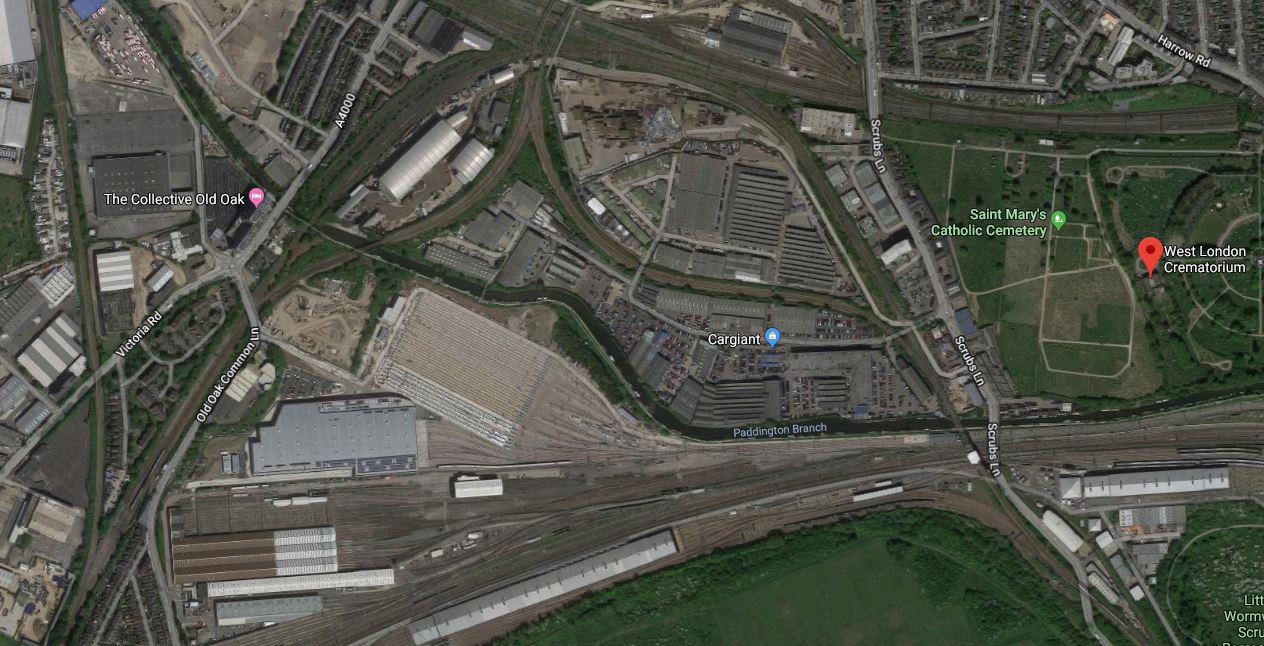
Note.
- The Grand Union bisecting the site in an East-West direction.
- The inverted-Y of the Overground, with North London Line to Richond going South-West and the West London Line to Shepherds Bush going South-East.
- The Great Western Main Line going East-West across the bottom of the map.
- The West Coast Main Line going East-West across the top of the map.
- The Dudding Hill Line going North-South at the Western side of the map.
Between the Grand Union Canal and the Great Western Main Line, there are currently four rail depots. From South to North, they are.
- Hitachi’s North Pole depot, where they service the Class 800 trains for Great Western Railway.
- The Heathrow Express depot.
- The Great Western Railway depot.
- Crossrail’s main depot.
The Heathrow Express depot is due to be demolished to make way for the new Old Oak Common station.
Wikipedia says this about the station.
The High Speed 2 line will be below ground level at the Old Oak Common site, with the parallel Great Western Main Line and Crossrail tracks on the surface to the south.
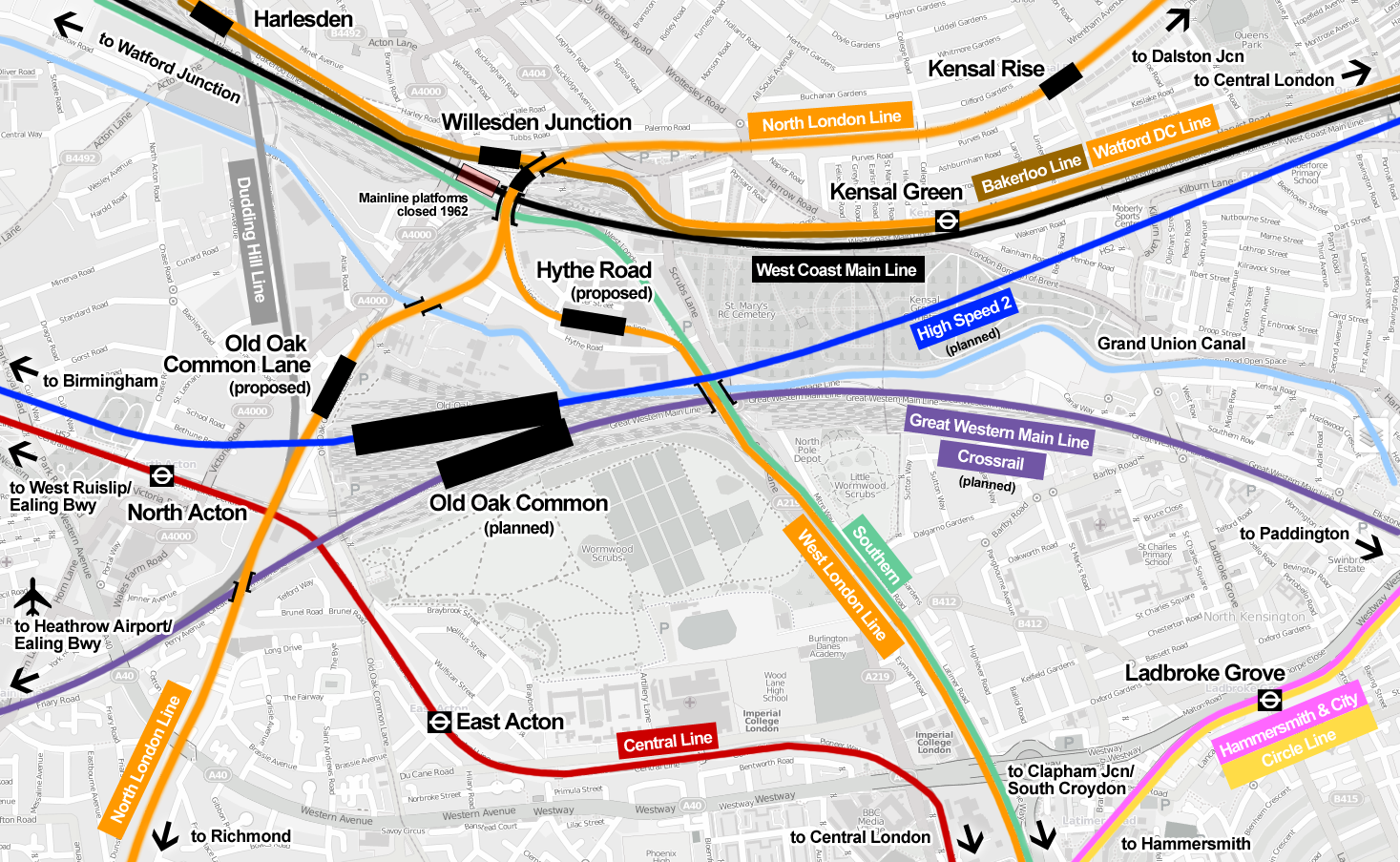
This map from Wikipedia, shows how the lines connect.
A few points.
- Considering that the High Speed Two tracks are below the surface and the Crossrail and Great Western tracks will be on the surface, I am fairly sure that a simple clean interchange will be created.
- The different levels will also mean that if say there were to be a Crossrail branch to Watford or High Wycombe, then the High Speed Two tracks are well out of the way.
- The High Speed Two platforms will be almost four hundred metres long, with the Crossrail and Great Western platforms probably about half as long. This should give lots of scope to create good connections to the other lines through the station.
- The new Old Oak Common Lane station will be on the North London Line between Stratford and Richmond stations, will be the way I access High Speed Two from Dalston and it will be 350 metres West of the main station.
- The West London Orbital Railway could have a station on the Dudding Hill Line, which runs to the West of, but close to Old Oak Common Lane station.
- The new Hythe Road station will be on the West London Line between Stratford and Clapham Junction stations and will be 1100 metres from the main station.
- Hythe Road station will incorporate a turnback platform for services from Clapham Junction. It would be ideal for a service between Gatwick Airport and High Speed Two.
- It should not be forgotten that there is going to be a large number of houses built around Old Oak Common.
It looks to me that if I took the wrong train from Dalston Kingsland station to get a High Speed Two train to Birmingham or the North, I might end up at the wrong end of my double-length High Speed Two train, with a walk of up to 1100+400+350 = 1850 metres to get to the required place on my train.
I would hope that the High Speed Two station would have some form of high-tech people mover, that stretched across the station site. It could be like a cable car without the cable.
Hopefully, the designers of Old Oak Common station will create what needs to be one of the best stations in the world.
London City Airport Station
Wikipedia says this about adding a station for London City Airport.
Although the Crossrail route passes very close to London City Airport, there will not be a station serving the airport directly. London City Airport has proposed the re-opening of Silvertown railway station, in order to create an interchange between the rail line and the airport. The self-funded £50m station plan is supported ‘in principle’ by the London Borough of Newham. Provisions for re-opening of the station were made in 2012 by Crossrail. However, it is alleged by the airport that Transport for London is hostile to the idea of a station on the site, a claim disputed by TfL.
In 2018, the airport’s chief development officer described the lack of a Crossrail station as a “missed opportunity”, but did not rule out a future station for the airport. The CEO stated in an interview that a station is not essential to the airport’s success
This Google Map shows the Western end of the terminal at London City Airport and the Docklands Light Railway running to the station at the Airport.
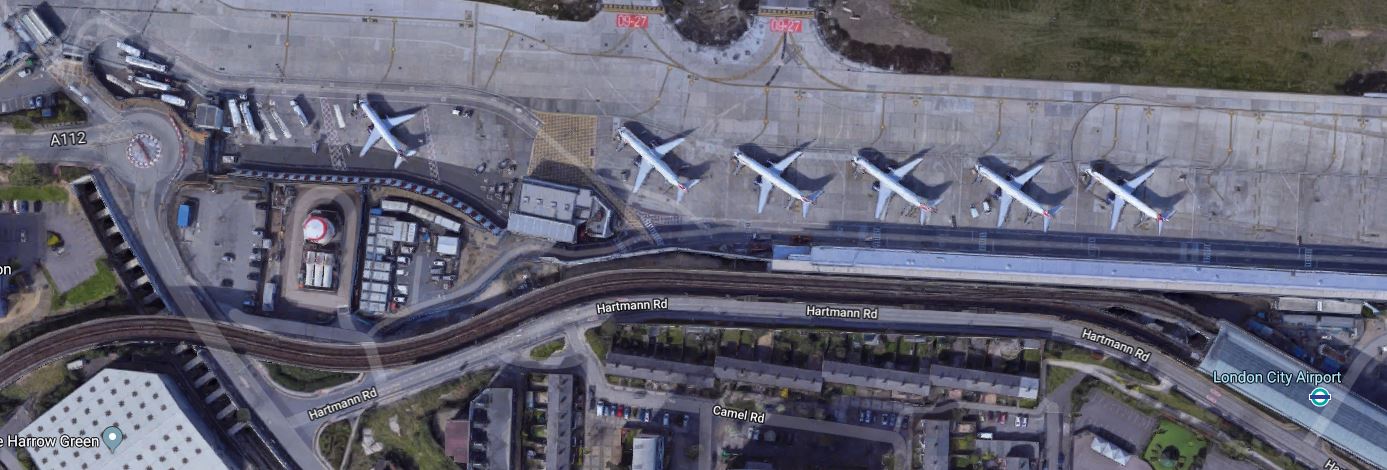
The Southern portal of Crossrail’s Connaught Tunnel can be seen under the DLR at the left end of this map, due to the concrete buttresses across the cutting rebuilt for Crossrail.
Surely, it would not be the most difficult of designs to build a station, somewhere in this area, where the former Silvertown station once stood.
I said more about this station in August 2017 in Action Stations On Crossrail Howler.
I will be very surprised if this station isn’t built.
Ladbroke Grove Station
If Ladbroke Grove station is built, it will because of property development. Wikipedia says this about current plans.
At a site just to the east of the Old Oak Common site, Kensington and Chelsea Council has been pushing for a station at North Kensington / Kensal off Ladbroke Grove and Canal Way, as a turn-back facility will have to be built in the area anyway. Siting it at Kensal Rise, rather than next to Paddington itself, would provide a new station to regenerate the area. Amongst the general public there is a huge amount of support for the project and then-mayor of London Boris Johnson stated that a station would be added if it did not increase Crossrail’s overall cost; in response, Kensington and Chelsea Council agreed to underwrite the projected £33 million cost of a Crossrail station, which was received very well by the residents of the Borough. Transport for London (TfL) is conducting a feasibility study on the station and the project is backed by National Grid, retailers Sainsbury’s and Cath Kidston, and Jenny Jones (Green Party member of the London Assembly).
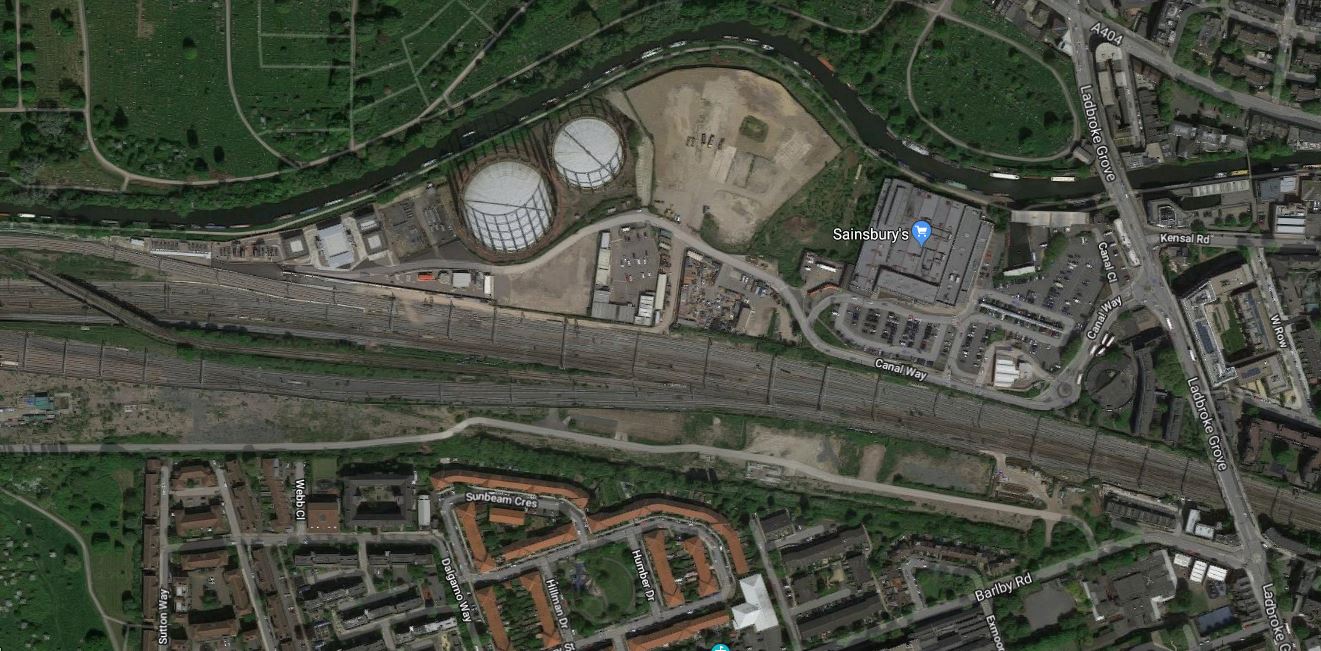
This Google Map shows the wider area.
Note.
- Ladbroke Grove is the road running North-South at the right side of the map.
- Canal Way is the twisting road running North of the railway.
- Sainsbury’s supermarket is North of Canal Way.
- The cleared site of the old Kensal gasworks is earmarked for housing.
The Crossrail tracks are on the North side of the railway, so access from a station to the housing could be very easy.
Conclusion
Crossrail is not even open yet and it looks like when it does, it will start a large number of projects to expand its scope.
Some will be about extending the system, some about better transport links and other about property development.
Crossrail will be an unlimited opportunity for London and the South East.
My Ruined Saturday Mornings!
Since, I moved to Dalston in 2010, my Saturday morning routine has been something like this.
- Take a 30 Bus to St. Mary’s Church.
- Visit the Carluccio’s and have a gluten-free breakfast, like a full English or an eggs benedict.
- Visit Waitrose for half my shopping.
- Visit Marks and Spencer for my gluten-free shopping.
But things have changed.
Egyptian Buses On Route 30
A few weeks ago, new buses started on route 30.
I don’t use them, except as a last resort.
They were built in Egypt. Now, I’ve nothing against Egyptians or their country, but we make very good buses in this country and we should have British buses for British bottoms!
The new company running the route seems to not provide the same frequency anyway, so catching a 30 bus, would often involve a longer wait.
Carluccio’s Has Closed
But the need to take a 30 bus decreased, a few weeks ago, when Carluccio’s in Islington closed.
As there is no other place in Islington to get a quick gluten-free breakfast, that put a big hole in my Saturday mornings. I could go to Bill’s or Cote, but they take a lot longer and are much more expensive.
Waitrose
Waitrose too, are annoying me.
They have redone their self-service tills and they are useless for my way of shopping.
I have a large reusable M & S bag, that folds into my man-bag and although it was fine for their original tills, it’s too big for their new tills.
So to shop in Waitrose, I put the bag in the trolley, load my purchases onto the till without a bag and then after payment move them into my shopping bag. How inefficient is that?
I now limit my purchases at Waitrose by using the much-more customer friendly Sainsburys next door.
Anyway, Sainsburys have a much better gluten-free selection, than the terrible range in Waitrose, where no care is taken to make ranges of foods like sausages and burgers gluten-free.
In fact, I wouldn’t trust Waitrose on their allergen philosophy. The labelling might be correct, but it’s all about how different product types and ranges are handled.
You wouldn’t shop in Waitrose if you were a family with one member who was coeliac or gluten-free!
Marks And Spencer
Marks and Spencer at the Angel carry on as normal, as they have done since my paternal grandmother shopped there ibefore the First World War and, when C and I used to shop there in the 1970s.
But they have competition in that I am ringed by others of their stores in Dalston, Finsbury Pavement, Kings Cross, Liverpool Street and London Bridge.
Yesterday, I ate breakfast in Leon at Kings Cross and then roamed the shops before doing my Saturday shopping in their Finsbury Pavement store. That one is now opening on Saturdays and I can get two buses directly from the store to the zebra crossing by my house.
Conclusion
All of these factors are combining to make me use Islington less.
What the Angel needs is a Leon, so I can have a fast gluten-free breakfast on the go.
One of the great things about breakfast in Leon, is that there is often time and space to layout your tabloid-sized newspaper and eat a leisurely breakfast.
Steam Engine Hits Car At Sheringham Level Crossing
The title of this post is the same as that of this article on the BBC.
As it appears that no-one was hurt, I think that I can quote the article, which includes a less than serious quote from Norfolk Police.
General manager Andrew Munden said the Sweet Briar Lane crossing’s lights and sirens were sounding at the time.
“We are all so relieved that this was a low speed collision and that no-one was injured,” he said.
Services resumed by the afternoon after the Rail Accident Investigation Branch had given permission to clear the site, Mr Munden said.
PC Jon Parker, of Norfolk Police tweeted: “Currently on scene at a train vs car incident. Unsurprisingly, the train emerged the victor.”
I wonder when a steam engine was last involved in a level crossing accident in the UK.
Looking at this section on Wikipedia, there has only been one accident between a road vehicle and a steam engine and that was a horse and cart in 1832.
There must be others! But we all know that Wikipedia always gets its facts right!
That accident is described in detail in the Wikipedia entry for the Leicester and Swannington Railway.
Up For Grabs: Rene’s Fallen Madonna With The Big…
The title of this post, is the same as that of a short humorous article in today’s Times.
It’s the prop for that running gag in ‘Allo ‘Allo!
The picture, has turned up for auction in Bristol.
Who was it who said, he who laughs last, laughs loudest?
Will we be expecting a repeat on BBC2?
Huge Solar Farm Plan
The title of this post is the same as that of a small article in today’s copy of The Times.
This is said.
Plans for Britain’s largest solar farm have been submitted to the government. Cleeve Hill Solar Park between Whitstable and Faversham in Kent would be five times bigger than the present largest solar farm, in Wiltshire, and provide enough clean energy to power more than 91,000 homes. A ruling is expected by the end of 202.
According to this page on the OVO Energy web site, the average household in the UK used 3,940 kWh in 2014.
This is 0.45 kWh per hour.
On this figure, the 91,000 houses would use 358.4 GWH
Compare this output with the 240 MW of the world’s first nuclear power station at Calder Hall, which opened in 1956, which in a year would generate 2104 GWH
Cleeve Hill Solar Park has a web site, which together with other sites gives more details of the project.
- The project has an area of 360 hectares.
- The project will be connected to the grid using an existing sub-station, that is used to connect the London Array wind farm in the Thames Estuary to the grid.
- The solar panels are laid close together to create the maximum amount of electricity.
On this information it looks like a solar farm in the UK, which is the size of 360 football pitches, can generate a sixth of the power of the world’s first and admitted small nuclear power station.
The web site also includes this informative schematic of a typical solar farm.
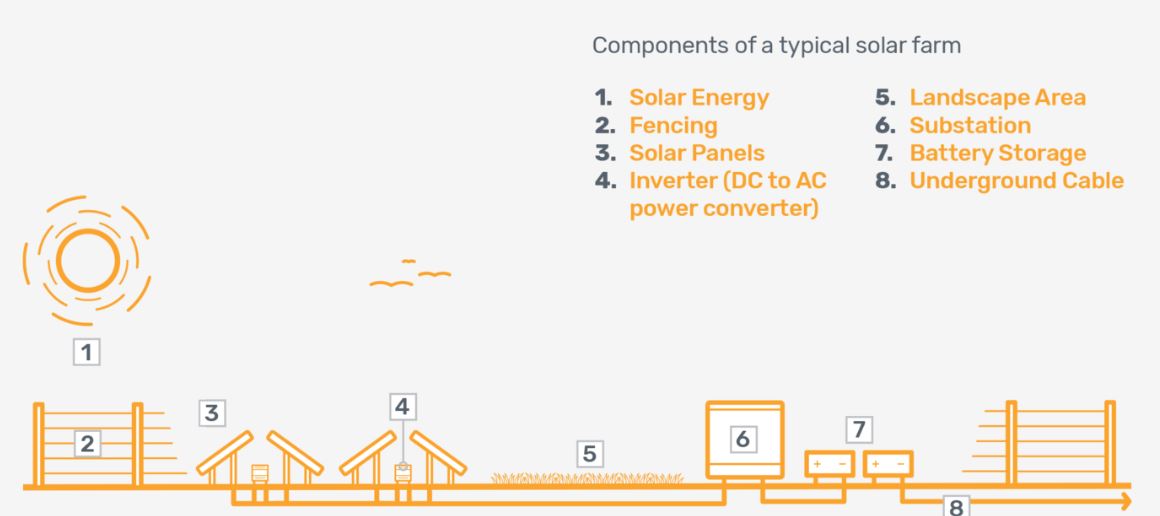
Note that battery storage is included, which I find significant.
- Battery or some other form of energy storage would be used to smooth the peaks and troughs of generation and use.
- Is it significant that it shares a sub-station that is used to connect wind turbines to the grid?
- So will the solar panels charge the batteries and then this energy will be sent to the grid, when the wind isn’t blowing?
The battery would be sized accordingly and calculating the size required is a the sort of problem that needs some comprehensive mathematical modelling.
- Using past sun and wind data, it would be possible to predict likely weather on a day-to-day basis.
- This data would be fed into a mathematical model of the wind and solar farms, with different sizes of batteries.
- A battery size would be chosen, that didn’t allow 91,000 houses in Kent to be without power.
But don’t worry, if you live in Kent, as there are other power stations nearby that could step in.
Having run mathematical models for complicated systems since the late 1960s, I know that this problem is within the capabilities of today’s mathematicians and computers.
The Potential Power Of The Cleeve Hill Solar Farm
The Internet entry for Solar Power In The UK has a section called Solar Potential, where this is said.
London receives 0.52 and 4.74 kWh/m² per day in December and July, respectively. While the sunniest parts of the UK receive much less solar radiation than the sunniest parts of Europe, the country’s insolation in the south is comparable with that of central European countries, including Germany, which generates about 7% of its electricity from solar power. Additionally, the UK’s higher wind speeds cool PV modules, leading to higher efficiencies than could be expected at these levels of insolation.
I’ll start by looking at December.
The solar array at Cleeve Hill will be 360 hectares, which need to be converted to square metres. A hectare is roughly the size of a football pitch like Wembley or 100 metres x 100 metres.
So I can say the following.
- The area of the Cleeve Hill solar farm is 3,600,000 square metres.
- If I assume that Cleeve Hill gets the same amount of sunlight as London, I can say that on each day in December the solar farm will receive an average of 0.52 * 3,600,000 kWh or 1872 MWh of solar energy.
- I have found web sites that say that the best solar panels are twenty percent efficient, which means that on an average December day 374.4 MWh will be generated.
- This is 4.11 kWh for each of the 91,000 households.
Looking at July, I can say the following.
- If I assume that Cleeve Hill gets the same amount of sunlight as London, I can say that on each day in July the solar farm will receive an average of 4.74 * 3,600,000 kWh or 17064 MWh of solar energy.
- Using the same twenty percent efficiency, which means that on an average July day 3412.8 MWh will be generated.
- This is 37.5 kWh for each of the 91,000 households.
I have created an Excel Workbook, that shows the energy generation for a 360 hectare solar farm, through a year.
- I obtained the insolation rates from this page on the Contemporary Energy web site.
- Other data came from Cleeve Hill Solar Farm.
- All parameters can be changed are and at the first part of the workbook.
- It is in Word 97 format
Click this link to download.
A Detailed Look At The Space Between Farringdon Station And The New Museum Of London Site
I took these pictures as I walked up Charterhouse Street beside the new site of the Museum of London.


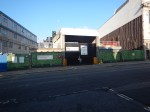
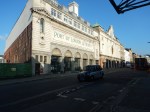
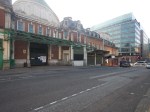
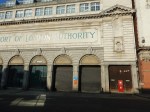


Note.
- The buildings to be used for the museum need a lot of work.
- The two buildings which could both be cold stores on the railway side of Charterhouse Street wouldn’t appear to have much architectural merit.
- Once Crossrail works are finished, there will be two big gaps leading to the railway lines and Farringdon station.
This picture from Crossrail says it is the Chaterhouse Street ticket hall.
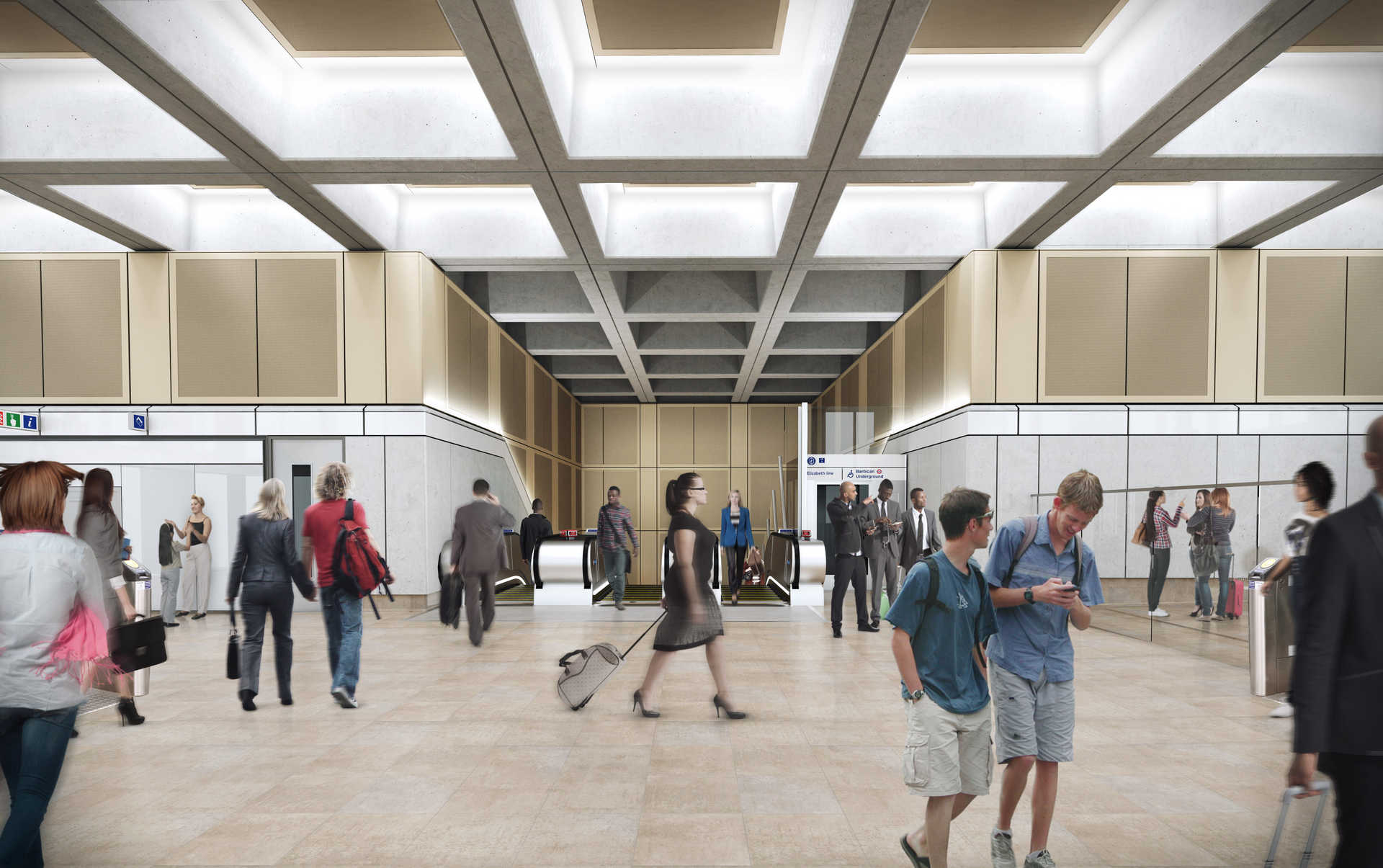
So it looks like that box in the third picture is an entrance to the station and it’s bang opposite the museum.
This Google Map shows the space on the railway side of Charterhouse Street.
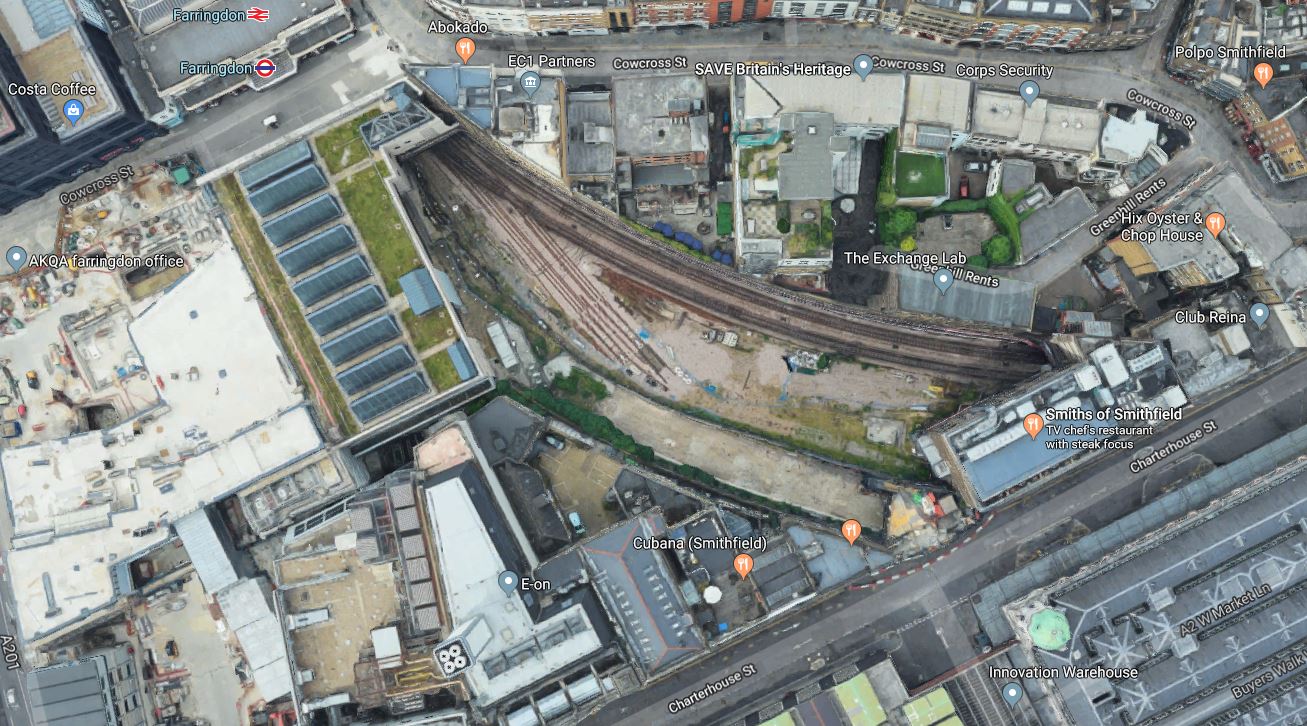
Note.
- Farringdon station at the top of the map towards the left.
- To the left of the station is the site I talked about in TfL Gives Go Ahead To Build Above Farringdon Station.
- Below that site, is another site on the corner of Charterhouse Street and Farringdon Road, that could either be developed in conjunction with the site above it or on its own.
- The Circle, Hammersmith & City and Metropolitan Lines curving between Farringdon and Barbican stations.
- What appear to be a couple of sidings are the remains of the Widened Lines, which used to lead to Moorgate.
- There is also a large curved space, which used to be which was used by services between Bedford and Moorgate, before Thameslink was created.
There’s a lot of space in the area to create a building or series of buildings that provide.
- A worthwhile amount of office space.
- A landmark hotel on one of the best-connected sites in London.
- The right amount of retail space, bars, cafes and restaurants.
But above all a short and pleasant walking route between Farringdon station and the new Museum of London could be designed.
An Encounter In A Lift
I don’t use lifts on the trains very often, except when I am lumbered with heavy shopping, or to use a lift is substantially quicker.
This morning my Northern Line train arrived at Kings Cross, so that I alighted right by the lift, in time to see two ladies with babies in buggies, leave the lift and get on the platform.
Now this was a time-saving that was too good to be true, as this lift drops you just by the ticket gates.
I waited to press the button, in case someone else needed the lift.
My only companion turned out to be an attractive tall lady about thirty, who was strikingly dressed, with a very short leather skirt and shoes with the some of the highest heels, I’ve ever seen on the street.
If I do travel in a lift, I like to not be youngest person in the lift, as one has to keep up standards and fight hard against anno domini.
So I said to the lady. “Thanks for coming in the lift, as I make it a rule not to use a lift, unless there’s someone younger than myself on-board!”
She smiled and replied. “I can’t climb the stairs in these f**king shoes!”
Trying to be sympathetic, I said. “Couldn’t you have worn something more comfortable?”
“No!” She replied! “I’m a backing singer going to an audition. One has to impress!”
I hope all her efforts were rewarded!
Most Zopa Plus Investors Earn “At Or Above” Target Rate
The title of this post is the same as that on this article on Peer2Peer Finance News.
I have not complained and I’ve been an investor for ten years.
Building New City-Centre Lines Instead Of Using Existing Network Inflates HS2 Cost By 15%
The title of this post, is the same as that of this article on Rail Technology Magazine.
This is the first paragraph.
HS2’s second phase will cost more compared to similar overseas schemes because it relies on new dedicated high-speed lines into city-centre terminal stations at Manchester and Leeds rather than using the existing conventional railway.
As the review of the costs of HS2, that showed this, was done by PwC, I suspect the figures can be believed.
Over the last few years, we’ve redeveloped or extended several busy stations like Derby, Kings Cross, Liverpool Lime |Street, London Bridge, Manchester Victoria, Nottingham, Reading and St. Pancras.
I like Reading and London Bridge the best, as the large concourse crossing either over or under the tracks with lots of escalators and lifts, seems to work well Liverpool Lime Street with a wide concourse at one end, seems to work well for a terminal station.
But St. Pancras is a mess for passengers and staff alike with effectively four stations in one one Victorian building.
It would have been better, if the station had been flattered and a new one built.
This approach is being taken at that 1960s monstrosity; Euston, which is being extended for HS2.
The four Northern stations in Phase 2 of HS2 are being treated differently.
- Leeds is getting a dedicated approach to new platforms at right angles to the existing ones.
- Liverpool Lime Street uses the existing approach and platforms have been extended for the new HS2 trains.
- Manchester Piccadilly is getting a dedicated approach to new platforms alongside the existing ones.
- Sheffield uses the existing approach and platforms will be extended for the new HS2 trains.
Liverpool Lime Street is already HS2-ready and can handle at least two normal expresses and one HS2 train in an hour.
The works were completed in a six-month blockade in the Summer of 2018.
I suspect Sheffield will be made HS2-ready, in a similar way.
Conclusion
Obviously, every station is different.
But Liverpool Lime Street has shown how it is possible to find an affordable, less disruptive approach to some stations.
 The Anonymous Widower