What Is The Kinetic Energy Of A Class 710 Train?
I finally got a good look at a Class 710 train at Gospel Oak station this morning.
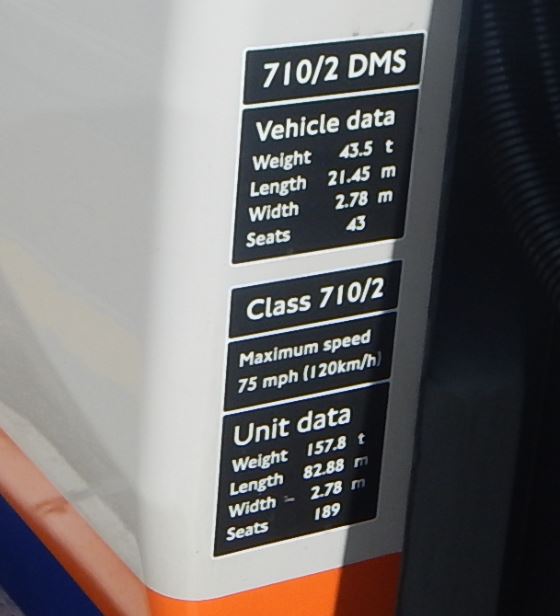
The picture shows the plate on the end of a DMS car.
- The weight of the train is 157.8 tonnes. Note that the four-car Class 378 trains weigh 172.1 tonnes.
- 700 passengers at 90 Kg each with baggage, bikes and buggies would be 63 tonnes.
- That would be a total weight of 220.8 tonnes.
- The operating speed is shown as 75 mph., which is the same as the Class 315 train, that many Class 710 trains will replace.
Using the Omni Kinetic Energy Calculator gives a kinetic energy of 34.5 kWh.
For completeness these are the figures for different speeds.
- 50 mph – 15.3 kWh
- 60 mph – 22.1 kWh
- 90 mph – 49.4 kWh – Operating speed of a Crossrail Class 345 train.
- 100 mph – 61.3 kWh – Operating speed of many electric multiple units.
Note that the amount of energy is proportional to the square of the speed.
What Do The Kinetic Energy Figures Show?
These are a few of my thoughts.
What Is Regenerative Braking?
A full Class 710 is travelling along at 75 mph, ihas 34.5 kWh of kinetic energy. Whenit needs to stop at a station, this energy has to be dissipated.
With normal friction brakes, the energy will be converted into heat and wasted.
But with regenerative braking, the traction motors are used in reverse to generate electricity.
This electricity is generally handled in one of three ways.
- It is passed through resistors on the roof of the train and turned into heat and wasted.
- It is fed back into the electrification and used by nearby trains. This needs special transformers feeding the electrification.
- It is stored in a battery or other energy storage device on the train.
The last method is the most efficient, as the stored energy can be used to help restart the train and regain line speed.
Can The Lea Valley Lines Electrification Handle Regenerative Braking?
This question must be asked, as if the lines can’t then running trains with batteries could be the best way to handle regenerative braking and improve efficiency and reduce the electricity bill.
It should be noted, that the Chingford and Enfield Town routes are not shared with any other trains, so running Class 710 trains on these routes may have advatages in the maintenance of the electrification, if the trains handle the regenerative braking.
On the Cheshunt route, there are also some Greater Anglia services, but these will generally be run by Class 720 trains, which are also Aventras.
On the other hand, the electrification on the Gospel Oak to Barking Line has probably been installed to handle the reverse currents.
Do Class 710 Trains Have Regenerative Braking?
Search the Internet for “Class 710 train regenerative braking” and you find little in addition to my ramblings.
But other Aventras, like Crossrail’s Class 345 trains have been stated to have regenerative braking.
I also repeated my views in an article in Rail Magazine, which I described in I’ve Been Published In Rail Magazine.
No-one has told me that they disagree with my views and I was talking rubbish!
So I will assume that Class 710 trains do have regenerative braking!
The Aventra’s Electrical Systems
In this article in Global Rail News from 2011, which is entitled Bombardier’s AVENTRA – A new era in train performance, gives some details of the Aventra’s electrical systems. This is said.
AVENTRA can run on both 25kV AC and 750V DC power – the high-efficiency transformers being another area where a heavier component was chosen because, in the long term, it’s cheaper to run. Pairs of cars will run off a common power bus with a converter on one car powering both. The other car can be fitted with power storage devices such as super-capacitors or Lithium-ion batteries if required.
This was published eight years ago, so I suspect Bombardier have refined the concept.
But even in 2011, Bombardier were thinking about energy storage on the train.
How Much Storage Would A Class 710 Train Need?
As I said earlier, I train would need sufficient energy storage to store the kinetic energy of a train.
As my calculations show that a full train travelling at the maximum speed of 75 mph, then the energy storage for this version of a Class 710 train must be able to store at least 34.5 kWh, at all times.
The size of the on board energy storage could be around 40-50 kWh, which is readily available in a lithium ion battery, that has been designed for transport use.
Where Would The Energy Storage Be Placed?
The extract above says that two cars hold the electrical systems.
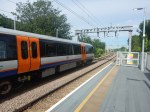
These pictures show the pantograph car and driver car next to it.
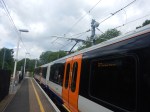
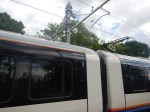

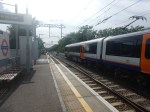
Note that underneath the pantograph car is a transformer.
So are these, the pair of cars, the extract describes? They certainly could be!
This is a selection of pictures of the underneath of the driver car.
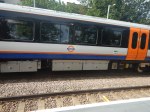
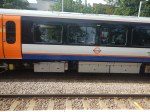

Note.
- There are two large boxes with latches under both driver cars.
- Next to these boxes is a smaller box. At the pantograph end of the train, it is open and looks like a cooling system for the two boxes
- At the other end of the train, the smaller box appears to have a blanking plate, so perhaps the boxes are empty.
The only sensible use I can think of for the boxesis to store the batteries or capacitors.
I
I would estimate that each of the four large boxes.
- Is about a metre wide.
- Is about 0.3 metres high.
- Is sized to fit within the 2.7 metre width of the train. Perhaps 2.5 metres.
These give a column of 0.75 cubic metres.
Bombardier used to manufacture a Primove 50 kWh battery, which was built to power trams and trains, that had the following characteristics.
- A weight of under a tonne.
- Dimensions of under two x one x half metres.
Were these boxes under the floor of the driver cabs of the Class 710 train designed to hold a Primove 50 kWh or similar battery?
Four batteries could give the train as much as 200 kWh of energy storage.
But surely for trundling along the Gospel Oak to Barking Line. a smaller battery capacity would be sufficient. I suspect that you fill the boxes with how many batteries you need and the computer does the rest.
Perhaps, just one 50 kWh battery would be enough! This could explain, why the cooling system appears to be blanked off at one end of the train.
Could The Batteries Be Used To Power The Class 710 Train?
In an article in the October 2017 Edition of Modern Railways, which is entitled Celling England By The Pound, Ian Walmsley says this in relation to trains running on the Uckfield Branch, which is not very challenging.
A modern EMU needs between 3 and 5 kWh per vehicle mile for this sort of service.
So a 50 kWh bsttery would give the following ranges with these consumption rates for a four-car Class 710 trains.
- 3 kWh – 4.2 miles
- 4 kWh – 3.1 miles
- 5 kWh – 2.5 miles
It looks to me, that battery power would be possible over the extension to Barking Riverside station, which is about a mile long.
Battery power would also other uses.
- Moving the train to a safe place for passenger evacuation, when the overhead electrification fails.
- Moving the train in a depot or sidings, without overhead power.
- Running innovative on-board services for maintenance and train preparation, when the train is parked overnight.
Reliable battery power has a lot of uses on a train.
West London Orbital Railway
The West London Orbital Railway would have less than ten miles of lines without electrification, with several electrified miles on either side.
I believe that Class 710 trains with the right amount of batteries could bridge the gap and make a massive difference to rail transport in North and West London.
I think that jumping a gap of a few miles on battery power, may well be easier than doing an Out-and-Back service..
A Flexible System
As it appears, each Class 710 train has got four battery boxes, I suspect that batteries can be installed as to the needs of the route.
- Standard operation on Gospel Oak to Barking, Watford DC Lines and Lea Valley Lines could be one or two batteries to handle regenerative braking.
- Out-and-Back to Barking Riverside station ,might need two batteries.
- West London Orbital services might need three or four batteries.
These battery boxes also could be designed to allow an easy and quick change of battery, as batteries on buses have given Transport for London trouble in the past.
Conclusion
Bombardier’s design of the Aventra has been designed with battery operation in mind, which opens up lots of possibilities!
Why Do Some Train Operators Still Buy Half-Trains?
This picture shows the unloved-by-SWR Class 707 trains.

South Western Railway‘s predecessor; South West Trains bought thirty of these trains and SWR is replacing them with Class 701 trains.
Sixty of these new trains will be ten-cars in length and thirty will be five-car.
Why?
Consider.
- Most Class 707 trains, always seem to run as ten-car units, formed of two trains.
- There are four cabs, rather than two.
- A ten-car Class 701 train has twenty more seats than two five-car trains.
- Including standing passengers, a ten-car Class 701 train has eight percent more capacity, than two five-car units.
- Staff have to get out of the train and back in, to go between the front and back of the train.
- I’ve even seen trains delayed because the conductor was helping a disabled passenger in the other train.
Running two half-trains as a full-size train must surely be more stressful for the staff and more uneconomic for train operators.
The only place for five-car trains, is surely on routes with short platforms.
The Cut-And-Paste Aventra
It should also be noted that Bombardier’s new Aventras and other recently-designed trains, can be cut and pasted to adjust the trains that an operator needs.
At the present time, services on the Gospel Oak to Barking Line, which can only accept four-car trains are being run by four-car Class 378 trains, which have been shortened from their normal five-car length by removing a car.
So for instance if on a route, South Western Railway needed to run eight-car trains due to a temporary length restriction, they could shuffle a ten-car and a five-car train to get an eight-car and a seven-car,
In a list of Aventra variants, the following are detailed.
Tfl Rail
Class 345 trains will be nine-car, but currently they are running as seven-cars.
London Overground
Class 710 trains will be used in three ways.
- As pairs of eight-cars on the Lea Valley Lines.
- As four-cars on the Gospel Oak to Barking Line and the Watford DC Line.
- As five-cars on the North London Line.
It has puzzled me, why the Lea Valley sets are not to be built as eight-car trains and I discuss this in Latest On The New London Overground Class 710 Trains.
Greater Anglia
Class 720 trains will be `22 ten-car and 89 five-car trains.
I think that Greater Anglia have some routes, that cannot accept ten-car trains.
As I showed for Hertford East station in Could London Overground Extend To Hertford East Station?
So will we be seeing some creative shuffling to get a tailored fleet, with perhaps some eight-car trains for routes like those to Hertford East?
I think that six ten-car trains and four five-car trains can be converted into ten eight-car trains.
South Western Railway
Class 701 trains will be 60 ten-car trains and 30 five-car trains.
Do South Western Railway need a sub-fleet of eight-car trains?
They can easily create one, by shuffling the trains.
West Midlands Trains
Class 730 trains will be 36 three-car trains and 45 five-car trains.
These are like-for-like replacements of the current fleet.
c2c
Class 711 trains will be six ten-car trains.
They will be replacing Class 387 trains on a short-term lease.
Conclusion
It appears to me, that for the train operator to have maximum flexibility, that you need to start with a long train and a short train and be able to shuffle cars around to get the train fleet you need.
Certainly a fleet of both ten-car and five-car Aventras gives you the possibility of creating a sub-fleet of eight-car trains.
Interestingly, the Hitachi Class 800 trains appear to have a similar ability.
737 MAX, Airbus And Aventra
I think that there are parallels between these plains and trains.
The 737 MAX is a conventional fifty-year-old design of aircraft, that has been updated with modern technology through the years.
When Airbus designed their fly-by-wire systems about thirty years ago, they were duplicated with two independent systems, programmed by separate teams. I think that the plane could fly on one system, if the other failed. Ittook time to develop, but no-one questions its reliability today.
The design and some of the things it gets up to, like moving fuel around to balance the aircraft help to increase the efficiency of the aircraft.
Efficiency and low pilot workloads help to sell aircraft.
Boeing is now trying desperately to catch up, but doing this in an ageing design appears to be difficult.
One thing I wonder is that is misloading of cargo a problem in the two 737 MAX crashes.
Supposing there was an imbalance of cargo on an Airbus! Would the plane’s computer realise this and move fuel to conpensate? Boeing must rely on a conventional approach using the flying controls.
Boeing are obviously worried as they have installed a special anti-stall conputer system called MCAS.
So what has this got to do with Bombardier’s Aventra train, that is suffering from software problems causing delays.
The Aventra is a radical design, that rewrites the rules, just like Airbus did. It relies heavily on a sophisticated computer system to control everything and bring a higher level of efficiency.
It will take time to get right, but just as Airbus did all those years ago, I believe they will.
The Aventra will change train design by as much as Airbus have changed airliner design.
Dwell Times And End Doors
Chris Stokes finishes his column in the January 2019 Edition of Modern Railways, with this paragraph.
Dwell times remain critical too. The new TransPennine units provide more seats, but have single end doors. For an operation with high numbers joining and alighting at many stops, dwell times are going to increase significantly at stations such as Manchester Victoria, Huddersfield, Leeds, Boltonand Preston, chewing up any savings in running times, and exacerbating the problems at platforms 13 and 14 at Manchester Piccadilly.
I haven’t seen a TransPennine Mark 5A coach in the flesh yet, but I’ve seen several pictures, which show each coach has single end doors.
This picture of the 100 mph Class 755 train shows the door layout is totally different.
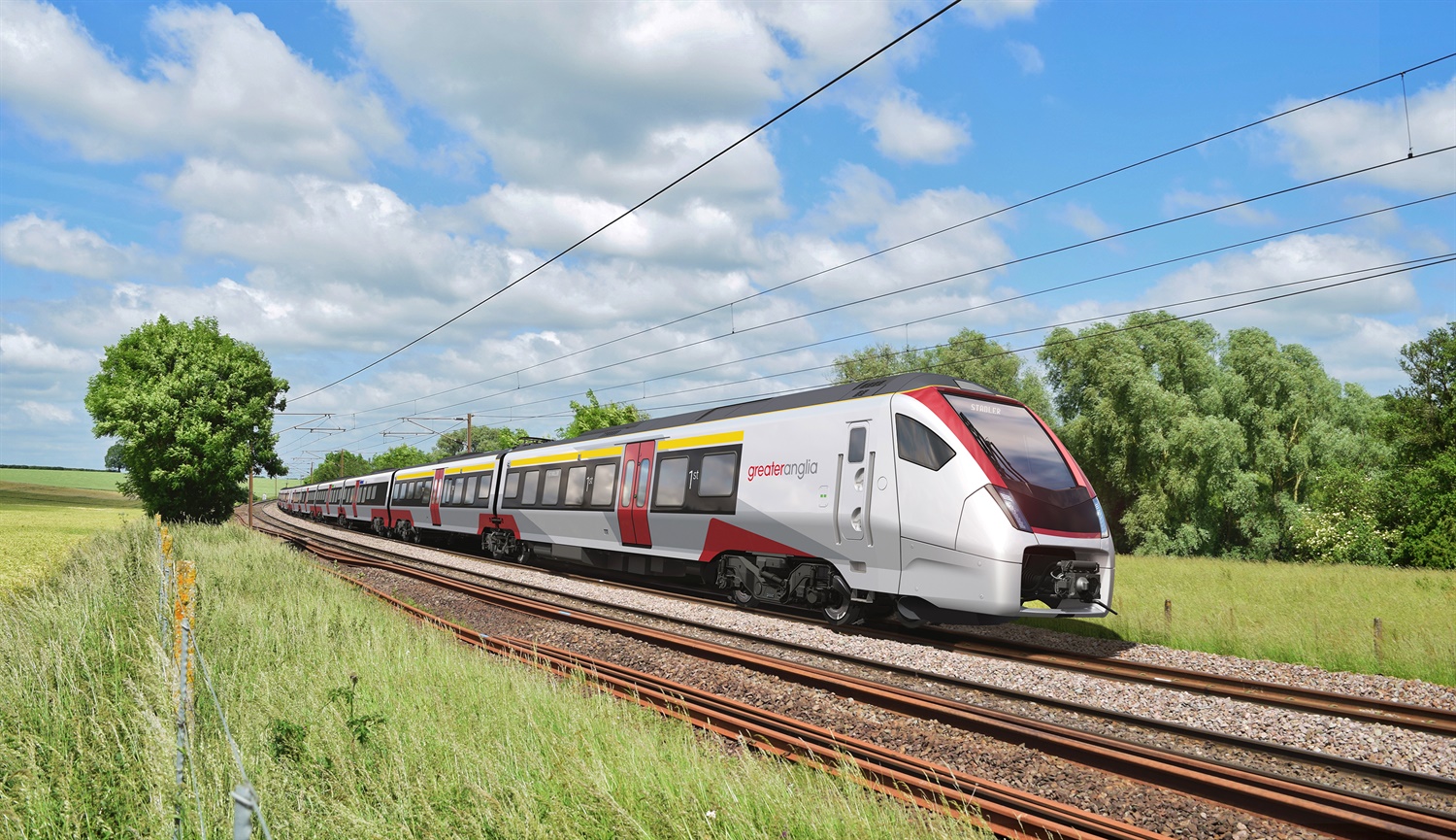
It looks like it has a single double door on each coach.
It appears that the electric Class 745 trains have more doors.
If you look at a typical Bombardier Aventra or Electrostar, Stadler Flirt or Siemens Desiro City, there are generally no end doors.
Have CAF commited a design crime of the highest order?
Or is it TransPennine’s fault?
Do Aventras Use Supercapacitors?
In this article in Global Rail News from 2011, which is entitled Bombardier’s AVENTRA – A new era in train performance, gives some details of the Aventra’s electrical systems. This is said.
AVENTRA can run on both 25kV AC and 750V DC power – the high-efficiency transformers being another area where a heavier component was chosen because, in the long term, it’s cheaper to run. Pairs of cars will run off a common power bus with a converter on one car powering both. The other car can be fitted with power storage devices such as super-capacitors or Lithium-ion batteries if required. The intention is that every car will be powered although trailer cars will be available.
Unlike today’s commuter trains, AVENTRA will also shut down fully at night. It will be ‘woken up’ by remote control before the driver arrives for the first shift
This was published over seven years ago, so I suspect Bombardier have refined the concept.
The extract makes three interesting points.
All Or Most Cars Will Be Powered
In A Detailed Layout Drawing For A Class 345 Train, I give the formation of a Crossrail Class 345 train.
DMS+PMS+MS1+MS3+TS(W)+MS3+MS2+PMS+DMS
Note.
- M signifies a motored car.
- Eight cars have motors and only one doesn’t.
- The train is composed of two identical half-trains, which are separated by the TS(W) car.
- There are four wheelchair spaces in the TS(W) car.
Are the MS!, MS2 and MS3 cars identical?
In addition, I have been told, that all cars in Class 720 trains are motored.
It does seem that Bombardier have fulfilled their statement from 2011.
Remote Wake-Up
This is mentioned in the extract, but there are few other references to it. I quoted a report from the Derby Telegraph, which has since been deleted, in Do Bombardier Aventras Have Remote Wake-Up?.
Supercapacitors And Lithium-Ion Batteries
According to the extract, the trains have been designed to accept supercapacitors or lithium-ion batteries if required.
As the other two statements in the extract appear to be likely, I will continue to believe that all Aventras can have some form of energy storage.
Crossrail
I’ll look first at Crossrail’s Class 345 train.
In How Much Energy Does A Crossrail Class 345 Train Use?, using the train’s data sheet, I came to the conclusion, that electricity usage of the trains is 2.67 KWh per car per kiometre or 3.29 KWh per car per mile.
In the linked post, I also calculate the kinetic energy of a fully-loaded nine-car Crossrail train.
I’ll repeat it.
- If I take a nine-car Class 345 train, this has a mass of less than 350 tonnes and a maximum speed of 145 kph.
- 1500 passengers at 80 kg each works out at another 120 tonnes.
- So for this crude estimate I’ll use 450 tonnes for the mass of a loaded train.
This gives the train a kinetic energy of 101 KWh.
As the Class 345 trains are effectively two half trains, with two PMS cars with pantographs, it is likely that they have at least two cars that are ready for supercapacitors or lithium-ion batteries.
The Design Of Crossrail
Crossrail could best be described as the Victoria Line on steroids.
- Both lines were designed to run in excess of twenty-four trains per hour (tph) across London.
- The Victoria Line was built to deep-level Underground standards, with one of the most advanced-for-its-time and successful train operating systems of all times.
- Crossrail is a modern rail line being built to National Rail standards, with world-leading advanced technology, that takes full account of modern environmental standards and aspirations.
Costs were saved on the Victoria Line by leaving out important parts of the original design..
- The route was cut back to Walthamstow Central, from the proposed terminus at Walthamstow Wood Street or possibly South Woodford or Woodford.
- Some stations like Highbury & Islington were built to a totally inadequate low-cost design.
- Third escalators at stations were changed into stairs.
- Step-free access was non-existent at the opening, but has been added to some stations since.
- Cross platform interchange with the Chingford Branch Line was left out at Walthamstow Central station.
Costs were saved on Crossrail, by using high-quality design.
- Crossrail and the Great Western Main Line electrification share a sub-station to connect to the National Grid.
- The number of ventilation and access shafts was reduced significantly, with one in a new office block; Moor House.
- Electrification uses a simple overhead rail, which is only fed with power at the ends.
I also believe that the Class 345 trains, which were designed specifically for the route, were designed to save energy and increase safety in the tunnels.
Regenerative braking normally saves energy by returning braking energy through the electrification, so it can be used to power other nearby trains.
Batteries For Regenerative Braking
However, in recent years, there has been increasing interest in diverting the braking energy to onboard energy storage devices on the train, so that it can be used when the train accelerates or to power systems on the train.
The system has these advantages.
- Less energy is needed to power the trains.
- Simpler and less costly transformers can be used for the electrification.
- The onboard energy storage can be used to power the train after an electrification failure.
- In tunnels, there is less heat-producing electricity flowing in all the cables.
Obviously, keeping the heat down in the tunnels is a good thing.
A Station Stop On Crossrail Using Regenerative Braking And Energy Storage
Imagine a fully-loaded train approaching a station, at the maximum speed on 145 kph.
- The train will have a kinetic energy of 101 kWh.
- As it approaches the station, the brakes will be applied and the regenerative brakes will turn the train’s energy into electricity.
- This energy will be stored in the onboard energy storage.
- As the train accelerates away from the station, the electricity in the onboard energy storage can be used.
The only problem, is that regenerative braking is unlikely to recover all of the train’s kinetic energy. But this is not a big problem, as the train draws any extra power needed from the electrification.
To make the system as efficient as possible, the following must be fitted.
- The most efficient traction motor.
- Onboard energy storage capable of handling the maximum kinetic energy of the train.
- Onboard energy storage with a fast response time.
The train will probably be controlled by a sophisticated computer system.
What Size Of Onboard Energy Storage Should Be Fitted?
Obviously, this is only speculation and a best guess, but the following conditions must be met.
- The onboard energy storage must be able to capture the maximum amount of energy generated by braking.
- The physical size of the energy storage system must be practical and easily fitted under or on the train.
- The energy storage system should be able to store enough energy to be able to move a stalled train to safety in the event of complete power failure.
Note that an energy storage system with a 100 kWh capacity would probably take the train somewhere around four to five kilometres.
Obviously, a series of computer simulations based on the route, passengers and various other conditions, would indicate the capacity, but I feel a capacity of around 120 kWh might be the place to start.
Where Would The Energy Storage Be Placed?
With nine cars, and with eight of them motored, there are a several choices.
- One energy storage unit in all motored cars.
- One energy storage unit in the three MS cars.
- One energy storage unit in each half train.
I’ve always liked the concept of an energy storage unit in each powered car, as it creates a nice tight unit, with energy stored near to where it is generated and used.
But there is another big advantage in splitting up the energy storage – the individual units are smaller.
Could this mean that supercapacitors could be used?
- The main need for onboard energy storage is to handle regenerative braking.
- The secondary need for onboard energy storage is for emergency power.
- There is no needon Crossrail as yet,to run the trains for long distances on stored power.
- Supercapacitors are smaller.
- Supercapacitors can handle more operating cycles.
- Supercapacitors run cooler.
- Supercapacitors have a fast response.
If running for longer distances were to be required in the future, which might require lithium-ion or some other form of batteries, I’m sure there will be space for them, under all those cars.
I wouldn’t be surprised to find out that Crossrail’s Class 345 trains are fitted with supercapacitors.
Note, that a Bombardier driver-trainer, talked of an emergency power supply, when I asked what happens if the Russians hacked the electrification.
Class 710 Trains
London Overground’s Class 710 trains are a bit of a mystery at the moment as except for a capacity of seven hundred passengers disclosed in this article on the International Railway Journal little has been published.
Here are my best guesses.
Formation
Based on the formation of the Class 345 trains, I think it will be.
DMS+PMS+MS+DMS
Effectively, this is a half-train of a seven-car Class 345 train, with a DMS car on the other end.
Dimensions
I have a Bombardier press release, which says that the car length is twenty metres, which is the same as Class 315, Class 317 and Class 378 trains and a whole load of other trains, as twenty metre cars, were a British Rail standard.
I doubt there will be much platform lengthening for these trains in the next few years.
Weight
The Wikipedia entry for Aventra gives car weight at between thirty and thirty-five tonnes, so the train weight can be anything between 120-140 tonnes.
Passenger Capacity
I wrote about this in The Capacity Of London Overground’s New Class 710 Trains.
This was my conclusion.
It appears that seven hundred is the only published figure and if it is, these new Class 710 trains are going to substantially increase public transport capacity across North London.
They are certainly future-proofed for an outbreak of London Overground Syndrome, where passenger numbers greatly exceed forecasts.
As some of the trains are being delivered as five-car units, there is always the option of adding an extra car. Especially, as the platforms on the line, seem to have been built for five or even six car trains.
London Overground have not made the platform length miscalculations of the North and East London Lines.
For the near future they’ll hold around 700 passengers at 80 Kg. each, which means a passenger weight of fifty-six tonnes.
Full Train Weight
For various train weights, the fully-loaded trains will be.
- 120 tonnes – 176 tonnes
- 130 tonnes – 186 tonnes
- 140 tonnes – 196 tonnes
Until I get a better weight for the train, I think I’ll use 130 tonnes or 186 tonnes, when fully-loaded.
Speed
I wrote about this in What Is The Operating Speed Of Class 710 Trains?.
This was my conclusion.
But what will be the operating speed of the Class 710 trains?
I said it will be somewhere between 145 kph (90 mph) and 160 kph (100 mph)
Consider.
- I think that 145 kph, will be able to handle the two planned increased frequencies of four tph.
- 145 kph is identical to the Crossrail trains.
- 160 kph is identical to the Greater Anglia trains.
- 160 kph seems to be the speed of suburban Aventras.
It’s a difficult one to call!
I do think though, that trundling around the Overground, they’ll be running at the same 121 kph of all the other trains.
Kinetic Energy
The kinetic energy of a 186 tonnes train at 121 kph is 29 kWh.
Could Supercapacitors Handle This Amount Of Energy?
I’m pretty certain they could.
Conclusion
Supercapacitors are a possibility for both trains!
I’ll review these calculations, as more information is published.
 The Anonymous Widower