The Pressure For More Rail Electrification
Over the last few days, there have been several articles on the media pushing for more electrification.
This article in Rail Technology Magazine, which is entitled TfGM To Fight Corner For Full TransPennine Electrification.
This article in the Carlisle Times and Star, which is entitled Campaigners Urge Backtrack On Axed Electric Rail Projects.
This article in the Times, which is entitled New Oxford-Cambridge Rail Route Must Rely On Diesel Trains.
This article in the Nottingham Post, which is entitled Strong Condemnation Of Government Plan To Abandon Rail Electrification.
I feel that electric trains are the future, but like members of the current Government, I feel that we need an alternative approach to creating a modern railway network in the UK.
What Do Passengers Want?
Passengers in general want a comprehensive rail service, that is affordable, reliable, fast and frequent and gives them good comfort and service on trains and at their terminal stations.
What Do Train Operating Companies Want?
Train companies need and want to make profits.
Judging by the latest franchise awards to Northern, TransPennine Express, Greater Anglia, South Western Railway and West Midlands Trains, part of their philosophy to achieve this is to buy fleets of new trains to replace old ones, with the following characteristics.
- More carriages and increased capacity.
- Higher speed and performance.
- Power and USB points, wi-fi and 4G connectivity.
- Easier entrance and exit.
- Better facilities for persons of reduced mobility.
- Shorter dwell times at stations.
- Better driver assistance systems.
The best way to pay for these trains and make a profit is to fill them with happy passengers.
So Where Does Electrification Give Advantages?
In summarising what passengers and train companies want, I didn’t mention electrification, although electric trains do give advantages to both groups.
- It must be easy to fit electrical equipment into an electric train.
- Electric trains accelerate faster.
- Electric trains can be fitted with regenerative braking to save energy
Electrification is not needed in all cases as electricity for the train can be provided by diesel or hydrogen-powered generators or some form of onboard energy storage can be used.
Why Are So Many Elecification Schemes In The UK Over Budget And Late?
With my experience of writing Project Management software and talking about it with numerous Project Managers all over the world, I suspect the following about electrifying an existing railway in the UK.
- The drawings and documentation for some of the existing lines which go back well over a hundred years is questionable.
- Politicians put undue pressure to keep costs down and corners are cut.
- The scope of the project changes as it progresses.
- Those against the electrification have lots of routes to delay the project.
- We don’t have enough engineers or qualified personnel to do the work.
- Often work is on constricted sites and the locals get annoyed.
I’m coming to the conclusion, that electrification is one of the most difficult of projects.
I do feel though there is hope for the future judged on what happened at Waterloo during August.
The Future Of Road Transport
We are seeing more and more electric and hybrid vehicles on the roads and this article in the Guardian, says that Britain will ban the sale of all diesel and petrol cars by 2040.
For this to happen, there needs to be a vast improvement in the efficiency and size of energy storage systems.
A few years ago, if you’d fitted solar panels to your house, your neighbours would have laughed at you. Now they don’t as technology has improved the performance of solar panels, just like it will improve energy storage in the next few years.
What Will Improved Energy Storage Mean For Trains?
The first trains with onboard energy storage are starting to appear on the UK’s railways.
Class 800 trains – Intercity Express Programme
This document on the Hitachi Rail web site, which is entitled Development of Class 800/801 High-speed Rolling Stock for UK Intercity Express Programme.
The document provides this schematic of the traction system of a Class 800 train.

Note BC which is described as battery charger.
This is said in the text.
The system can select the appropriate power source from either the main transformer or the GUs. Also, the size and weight of the system were minimized by designing the power supply converter to be able to work with both power sources. To ensure that the Class 800 and 801 are able to adapt to future changes in operating practices, they both have the same traction system and the rolling stock can be operated as either class by simply adding or removing GUs. On the Class 800, which is intended to run on both electrified and non-electrified track, each traction system has its own GU. On the other hand, the Class 801 is designed only for electrified lines and has one or two GUs depending on the length of the trainset (one GU for trainsets of five to nine cars, two GUs for trainsets of 10 to 12 cars). These GUs supply emergency traction power and auxiliary power in the event of a power outage on the catenary, and as an auxiliary power supply on non-electrified lines where the Class 801 is in service and pulled by a locomotive. This allows the Class 801 to operate on lines it would otherwise not be able to use and provides a backup in the event of a catenary power outage or other problem on the ground systems as well as non-electrified routes in loco-hauled mode.
Note that GU refers to Generator Unit, which in these trains are diesel-powered.
This is all very comprehensive, but if you look at how the braking system of the trains work and if it uses regenerative braking, you won’t find anything on the web.
But note how the four traction motors in the diagram are connected to the system. When they are in braking mode, what happens to the electricity?
- It is returned to the overhead wires. Difficult when using GUs on lines without electrification.
- It is passed to resistors on the roof of the train and burnt off as heat.
- It is stored in some form of onboard energy storage, so it can be reused later.
I feel that Hitachi are using Option 3, as it would work in both modes of the train and would save a lot of energy.
Note that in the above extract from the Hitachi document, the company states that the electric Class 801 trains have at least one GU to provide auxiliary and traction power in the event of catenary failure.
It looks like the only difference between the Class 800 and Class 801 trains, is that the Class 800 trains have more GUs.
Could this explain why Hitachi seem to be doing all their testing with Class 800 trains, as the differences between the two trains are minimal?
If the Class 800 works, then the Class 801 will!
Hitachi are also testing the Class 802 trains, but then these are built in Italy, have more powerful engines and bigger fuel tanks.
Bombardier Aventras
Bombardier have been developing battery technology for some years and as I described in Is The Battery Electric Multiple Unit (BEMU) A Big Innovation In Train Design?, I rode in the prototype converted from a Class 379 train in February 2015.
I believe that the Class 345 trains are fitted with onboard energy storage for the following reasons.
- Onboard energy storage is the logical way to handle regenerative braking in tunnels.
- Onboard energy storage means that each train reuses its own braking energy and draws less current from the electrification.
- Onboard energy storage is the only way to move a train to a safe place, when the Russians or North Koreans hack the power suppky.
- Some of the features announced for Aventras, like remote wakeup as I discussed in Do Bombardier Aventras Have Remote Wake-Up?, need onboard energy storage.
- Bombardier have won awards for the technology.
Until Bombardier say otherwise, I’ll assume that Aventras like the Class 345 trains have onboard energy storage.
Overhead Power In Long Tunnels
It should also be noted that the overhead power supply in the Crossrail tunnels is a rail fed with power at both ends, as incidentally is the Severn Tunnel.
Could it be that money could have been saved on the electrification of these tunnels as all electric trains using them; IEPs and Aventras, can handle their own regenerative braking energy?
The Effect Of Large Onboard Energy Storage On Trains and Trams
There is a big difference between adding weight to a pneumatic-tyred vehicle like a car or truck, and adding weight to that of a steel-wheel-on-steel-rail vehicle like a train or tram.
With the former, the rolling resistance is increased, which means more power is needed to move the vehicle, but with the latter, surprisingly, the reverse is true.
This allows locomotives to pull iron ore, coal and stone trains carrying hundreds of tonnes.
So adding a heavy energy storage device under a train may not be as detrimental to performance as you may think.
I suspect Bombardier, Hitachi and others have determined the optimal size of storage device for their trains.
I believe the following, if an appropriately-sized online storage device is fitted to a train.
- It will be able to handle all the regenerative braking energy.
- It will give the train a range of up to fifty kilometres on stored energy.
Without doubt, all trains driven by electricity and having regenerative braking will use onboard energy storage.
This applies even if their main power source is not electricity, but perhaps diesel, hydrogen or extra-strong knicker elastic!
Discontinuous Electrification
Modern trains like Aventras and Hitachi Class 80x trains have another ability.
They can raise and lower their pantographs under GPS control, so that they only connect with the electrification, when it is there.
They can also do it at line speed.
This raises the possibility of discontinuous electrification, where the easy-to-electrify sections have wires and the difficult bits are run using either diesel, hydrogen or onboard storage power.
An example would be between Batley and Morley stations on the Huddersfield Line, between which is the Morley Tunnel.
- The tunnel is four kilometres long and hopefully could be electrified using a conductor rail in the tunnel roof.
- Morley station is hard by the Northern portal of the tunnel.
- The line from Morley to the electrification at Leeds doesn’t appear to have any serious bridges to replace and the double-track line has wide margins.
- Batley, Morley and Cottingley stations are all stations with platforms either side of the track and could probably have the gantries on the platform.
Would it be possible to electrify short sections of line like this and let the trains and the driver decide to use onboard or overhead power?
The TransPennine Route
I will look at the TransPennine route in detail.
Mainly Electrically-Driven Trains
Looking at the various trains on TransPennine routes, we see the following ways of driving the trains and locomotives.
- Class 156 trains – hydraulic
- Class 158 trains – hydraulic
- Class 170 trains – hydraulic
- Class 185 trains – hydraulic
- Class 195 trains – mechanical – six-speed epicyclic
- Class 220 trains – electric
- Class 221 trains – electric
- Class 802 trains – electric – bi-mode
- Class 66 locomotives – electric
- Class 68 locomotives – electric
- Class 88 locomotives – electric – bi-mode version of a Class 68 locomotive.
The last three trains and all the locomotives in this list are electrically driven, where on-board diesel engines generate electricity to power the train.
In addition the Class 802 trains and the Class 88 locomotives are bi-mode and can use electrification to power the trains directly, if it is available.
So a Liverpool to Newcastle service using Class 802 trains or Class 88 locomotives and Mark 5 carriages could use the overhead electrification on the following sections of track.
- From Liverpool to Stalybridge via Manchester Victoria
- Through Leeds
- On the East Coast Main Line
Electrifying between Leeds and the East Coast Main Line would seem to be a lot easier than that between Leeds and Manchester, so I suspect that there is some seriously difficulty that has prevented it being done already, as it would allow Kings Cross to Edinburgh services to stop at Leeds, if that was desired.
Improving The Current Service
Currently Liverpool Lime Street to Newcastle takes three hours and three minutes, with the following sectional times.
- Liverpool to Manchester Victoria – 39 minutes
- Manchester Victoria to Huddersfield – 30 minutes
- Huddersfield to Leeds – 22 minutes
- Leeds to York – 25 minutes
- York to Newcastle – 67 minutes
Some places to save times are apparent.
- Liverpool to Manchester Victoria could be speeded up by a couple of minutes, after the addition of the fourth track at Huyton.
- According to the time table, most dwell times are reasonable, but nine minutes is allowed at Manchester Victoria.
- Manchester Victoria to Stalybridge is being electrified.
- Virgin’s fastest trains take 56 minutes between York and Newcastle, so I would assume that a TransPennine Class 802 train could match this.
- If Leeds to York were to be electrified, I would think that the same percentage decrease in journey time could be expected, which would give a Leeds to York time of 21 minutes.
Could we see the following times on the route?
- Liverpool to Manchester Victoria – 30 minutes
- Manchester Victoria to Huddersfield – 28 minutes
- Huddersfield to Leeds – 22 minutes
- Leeds to York – 21 minutes
- York to Newcastle – 56 minutes
This gives a timing of 157 minutes, which is a saving of twenty-three minutes.
Is The Track Up To It?
Under Timings And Line Speeds in the Wikipedia entry for Liverpool and Manchester Lines, this is said.
As of 2016, the fastest journey times are around half an hour, which is little better than over a century earlier. The fastest recorded run was from Manchester Exchange to Liverpool Lime St in 30 minutes 46 seconds by a 1936 built Jubilee 5707 with 7 coaches. An 1882-built compound steam locomotive was timed on the same route in 38 minutes 18 seconds. Until 1968 trains from Liverpool to Manchester by all 3 routes were scheduled to take 40 minutes and often took less. The southern route via Warrington is now restricted to 85 mph and the northern route via Earlestown to 90 mph, with 75 mph over Chat Moss.
Work is under way to four-track the line between Huyton and Roby which is scheduled for completion in December 2017.
Surely, Twenty-First Century engineering can sort out Stephenson‘s problems of nearly two centuries ago!
If it’s like this between Liverpool and Manchester on a fully-electrified line, what’s it like between Manchester and Leeds?
I believe that modern engineering should be able to create a 100 mph route between Liverpool and Leeds.
Are The Other Trains Slowing The Expresses?
Northern run an assortment of trains between Liverpool and Leeds via Manchester Victoria.
Between Liverpool and Manchester Victoria are all the services timed for and run by 100 mph Class 319 trains, or do some of the assortment of 75 mph trains share the route? If it’s the latter then they will delay the expresses.
Between Manchester Victoria and Hudderfield, I’m sure that slower trains are on the route.
Help is at hand as Northern have ordered fifty-five Class 195 trains, which have a 100 mph capability.
Should Stalybridge To Leeds Be Electrified?
Only when slow trains have been eliminated and the track has been improved to allow 100 mph running between Liverpool and Leeds should we answer this question!
Using rough estimates, I feel we might see the following timings with a Class 802 train.
- Liverpool to Manchester Victoria – 26 minutes
- Manchester Victoria to Huddersfield – 21 minutes
- Huddersfield to Leeds – 16 minutes
- Leeds to York – 21 minutes
- York to Newcastle – 56 minutes
This gives a timing of 140 minutes, which is a saving of forty-three minutes on the current times.
Improving Leeds To Newcastle
The Class 802 trains are stated in Wikipedia as being capable of running at 140 mph with minor modifications.
How many minutes would this take off the journey, if this were to be possible?
Conclusion
There are a lot of things to do before the decision to electrify Stalybridge to Leeds is taken.
- Sort the track for at least 100 mph running.
- Remove all passenger trains not capable of 100 mph from the line.
- Perhaps add some passing loops.
- Electrify Leeds to Colton Junction.
- Remove all level crossings.
- Raise all bridges and other structures, so that electrification is possible.
- Get the planning permission for electrifying the sensitive areas.
Hopefully these actions in themselves would deliver a time of under forty minutes between Manchester and Leeds.
That would be a spoonful of sugar for the passengers and the train operating companies.
Any attempt to electrify without doing all of these actions before the decision to electrify is taken, will result in the sort of mess seen in some of the electrification schemes of the last few years.
The East West Rail Link
I will look at the East West Rail Link in detail.
Linking To Electrified Lines
The East West Rail Link joins or crosses the following electrified lines.
- The Great Western Main Line at Didcot
- The West Coast Main Line at Bletchley
- The Midland Main Line at Bedford
- The East Coast Main Line at Sandy
- The West Anglia Main Line at Cambridge
As connecting the National Grid to electrification is a major cost, if the line were to be electrified, then there are several places to connect at a cheaper cost.
Building For Electrification
The instructions from the Department for Transport seem to have stated the following.
- The line will be double track.
- The line will have an operating speed of at least 100 mph or possibly 125 mph.
- All bridges and structures, will be built to accommodate overhead electrification.
I wonder if the specification suggests preparing the margins of the route, so putting up overhead gantries wouldn’t be a case of digging and hitting important cables or pipes.
Electrification of new lines like the East London Line, Crossrail and the Hitchin Flyover seem to have proceeded much smoother than schemes like the Gospel Oak to Barking Line.
Trains For The East-West Rail Link
The proposed services include.
- Oxford to Bedford
- Bletchley to Bedford
- Oxford to Milton Keynes Central
- Aylesbury to Milton Keynes Central.
I have also seen suggestions that the trains terminate at Reading.
The trains will need the following.
- A 100 mph capability to make good use of the route.
- Ability to use overhead electrification to get to Bedford, Milton Keynes Central and Reading.
- Ability to use diesel to use the Chiltern routes to Aylesbury and Marylebone.
To meet all these requirements, it would appear bi-mode trains like a Class 800 train are needed.
Should The East-West Rail Link Be Electrified?
Consider.
- The trains chosen for the route will be bi-mode and so the line doesn’t need to be electrified.
- Freight trains using the route would be hauled by a diesel locomotive or possibly a bi-mode locomotive like a Class 88 locomotive.
However, if at a future date, all or part of the electrification were to be deemed needed, if the line had been built with electrification in mind, putting up the wires would be a lot easier than on the TransPennine route.
Conclusions
I have come to these conclusions from these two examples.
- The bi-mode route allows a lot of flexibility and means that electrification with all its problems can be done when it is really necessary.
- The bi-mode route, also means that passengers get the benefits of modern, faster and more frequent trains at an earlier date.
- Electrification of a new line is easier than electrifying an old Victorian one.
- All new or reopened lines should be built to allow electrification at a future date.
Don’t underestimate the ingenuity of railway engineers to make a more comprehensive railway powered by electricity possible.
The Automatic Splitting And Joining Of Trains
Hitachi And Automatic Splitting And Joining Of Trains
The Hitachi Class 395 train was the first train in the UK to be able to automatically split and join in service.
In The Impressive Coupling And Uncoupling Of Class 395 Trains, I linked to this video.
Impressive isn’t it?
In Do Class 800/801/802 Trains Use Batteries For Regenerative Braking?, I quoted this comment from a public on-line Hitachi document.
Because the coupling or uncoupling of cars in a trainset occurs during commercial service at an intermediate station, the automatic coupling device is able to perform this operation in less than 2 minutes.
This is definitely in line with Class 395 train performance.
This document from the Hitachi web site talks about the design of Hitachi’s Class 385 trains for Scotland. This is said.
The lead and rear railcars have an automatic coupler at the front and walk-through gangway hoods. When train sets are coupled together, the hoods fit together as part of the automatic coupling operation to provide access between train sets, meaning that passengers and staff are able to move freely from one train set to another.
Obviously, Hitachi have got automatic splitting and joining of trains spot on!
Current Split/Join Services
There are several places in the UK network, where splitting and joining of trains is used.
- Southeastern Highspeed do it at Ashford.
- Great Northern Kings Lynn do it at Cambridge.
- Southern do it at Haywards Heath.
- Virgin Trains do it at Crewe.
- South West Trains do it at Southampton.
But currently only the Class 395 trains can do it automatically.
The in-service entry of the Class 800 trains will change everything, as it will make a lot more new routes possible.
Virgin Trains East Coast
Currently, Virgin Trains East Coast (VTEC) run two trains per hour (tph) between Kings Cross and Leeds. In the Peak, some services are extended to Bradford Forster Square, Skipton and Harrogate, where the last route is not electrified.
Will some services to Leeds be run by two five-car Class 800/801 trains working together as a ten-car train?
- Class 800 trains are electro-diesel which could work to Harrogate under diesel power.
- Class 801 trains are all-electric, which could work all electrified routes from Leeds.
At Leeds the two trains could separate, with each train going to a different destination. Reading Hitachi’s published documents, the split would take under two minutes at Leeds and I don’t think there would be a restriction of a Class 800 and a Class 801 working together between Kings Cross and Leeds using the overhead electrification.
VTEC gets advantages by using this split and join approach.
- Frequencies and train length to the eventual destinations can be adjusted to what the market will sustain.
- Extra expensive train paths between the split/join station and London are not needed.
- Between the split/join station and London, the train can usually run using electrification.
- Costs are probably saved, if only a half-train is run to some destinations, as track access charges are based on weight.
- A five-car electro-diesel could probably access more routes than a nine-car train.
This is the fleet that VTEC have ordered.
- Class 800 – 10 x five-car
- Class 800 – 13 x nine-car
- Class 801 – 12 x five-car
- Class 801 – 30 x nine-car
These Class 800 and Class 801 trains give VTEC all sorts of of possibilities.
The backbone of the service which is a half-hourly service to Edinburgh probably needs about 35 nine-car trains, some of which would be electro-diesels to work North of the electrification to Aberdeen and Inverness.
But that still leaves quite a few five-car trains available for other services.
Great Western Railway
Great Western Railway (GWR) will probably use their Class 800/801802 trains in a similar manner.
This is the fleet that GWR have ordered.
- Class 800 – 36 x five-car
- Class 800 – 21 x nine-car
- Class 802 – 22 x five-car
- Class 802 – 14 x nine-car
Note that the electro-diesel Class 802 train is similar to the Class 800, but with the engines tuned for more power and larger fuel tanks, so it can handle Devon and Cornwall routes easier.
I think that given the number of five-car trains on order and the lack of promised electrification, I think that GWR will be using splitting and joining in some surprising places, to make sure that as many routes as possible get the new trains.
The Stadler Flirt
This article on Railway Technology describes the Stadler Flirts built for Swiss Federal Railways. This is said.
The train consists of articulated train sets, which contains light rail cars attached semi-permanently sharing a common bogie. The trains are available in two to six car combinations with two to six motorised axles. The automatic couplers, installed at both the ends of the trains, permit connection and disconnection of up to four train cars easily and quickly.
Does this mean that two trains can split and join like the Hitachi trains?
The Bombardier Aventra
The Aventra is a train that has been designed to have everything that customers might need. This is the description of the train in Wikipedia.
The train has been designed to be lighter and more efficient, with increased reliability. It will have lightweight all-welded bodies, wide gangways and doors to shorten boarding times in stations, and ERTMS. The design incorporates FlexxEco bogies which have been used in service on Voyagers and newer Turbostars. The gangway is designed to allow maximum use of the interior space and ease of movement throughout the train.
As Hitachi have published a lot of their thinking on Class 800/801 trains on the Internet, I would find it astounding that Bombardier and the other train building companies haven’t read it.
There have been four orders for the Aventras so far, which total over two thousand carriages.
Two of these orders are for mixed fleets of five-car and ten-car trains.
Are these trains and half-trains just like with the Hitachi trains?
If the answer is in the affirmative, I think it is very likely that Aventras will have the capability of splitting and joining automatically.
Greater Anglia
Greater Anglia has a complex route structure that fans out from a very busy electrified core into Liverpool Street on both their main lines.
They have ordered 89 x five-car and 22 x ten-car of Class 720 trains.
Many of their outer-suburban routes currently run twelve-car services and as their two main lines are only double-track, I can see a lot of five car trains working in pairs.
In Harlow Council Leader Jon Clempner Hopes Crossrail 2 Will Extend To Town, I suggested that Greater Anglia might use splitting and joining on the West Anglia Main Line to get four tph on the Hertford East Branch.
It may not be practical in that case, but Greater Anglia have several electrified branches.
South Western Railway
South Western Railway have a similar route structure to Greater Anglia, with a very busy electrified core into Waterloo.
They have ordered 30 x five-car and 60 x ten-car of Aventra trains.
In Waterloo Upgrade August 2017 – Virginia Water Station, I talked about used splitting and joining to provide a better service on the Waterloo to Reading Line and the Chertsey Branch.
However, I think that most services will be run by ten-car trains given the make-up of the fleet.
The five-cars could generally run on routes where the capacity only needs five-car trains or the infrastructure wouldn’t allow anything longer.
They could then split and join to maximise the capacity and use only one path from the split/join station to Waterloo.
TransPennine Electrification And Piccadilly Upgrade Now Also In Doubt
The title of this post is the same as this article in Rail Technology Magazine.
A Digression About The Next Generation Of Trains
After digging through the various pages on Hitachi’s web site, I wrote Do Class 800/801/802 Trains Use Batteries For Regenerative Braking?.
My conclusion was this.
I will be very surprised if Class 800/801/802 trains don’t have batteries.
Will the Class 385 trains for ScotRail have similar traction system?
But having thought about it more, I’m now convinced that by 2030, the average long distance train will have the following characteristics.
- Ability to work from 25 KVAC overhead wires.
- Ability if required to work from 750 VDC third rail.
- Ability to raise and lower pantograph and switch beween modes at line speed.
- Batteries to handle regenerative braking.
- A generator unit to power the train.
- A sophisticated control system to choose the appropriate power source and drive the train according to terrain, passenger load, weather and traffic.
The more I read about Hitachi’s Class 800, Class 801 and Class 802 trains, the more I’m convinced that the features I have listed, is their ultimate goal. I suspect too, that the suburban Class 385 train has the capability of meeting the same objectives.
I would be very surprised if Alstom, Bombardier, CAF, Siemens, Stadler and others are not thinking along the same lines, as this document from Hitachi entitled Development of Class 800/801 High-speed Rolling Stock for UK Intercity Express Programme has been freely available since 2014.
It contains this diagram of the traction system of a Class 800 train.
Note the generator unit and the battery charger.
I’ve ridden the new Class 345 trains for Crossrail, a few times and after a trip yesterday in the gold-standard train;a 1970s British Rail Mark 3 coach, I can honestly say that the ride, noise and vibration in ombardier’s new train, is the best I’ve ridden.
So are Bombardier using a new traction system to achieve this smoothness? I suspect they are.
I also can’t find anything to say how a train will be removed from the tunnel under London, in the event of a complete power failure. No sane engineer would allow a rescue involving diesel or hydrogen in an emergency. However, batteries on the train with the capability of getting passengers to a safe disembarking point would be an obvious solution..
TransPennine Electrification
The major rail route across the Pennines between Leeds and Manchester is the Huddersfield Line.
The following stations are open on the route.
- Leeds *
- Cottingley
- Morley
- Batley
- Dewsbury
- Ravensthorpe
- Mirfield
- Deighton
- Huddersfield
- Slaithwaite
- Marsden
- Greenfield
- Mossley
- Stalybridge *
- Ashton-under-Lyne *
- Manchester Victoria *
The stations marked with asterisks (*) have electrification or will do soon.
Note the following about the route.
- Stalybridge to Leeds is under forty miles by road, so it could be even shorter by rail.
- Huddersfield station is one of a select group of Grade I Listed railway stations..
- Greater Manchester is developing a suburban electric network.
- Greenfield is the last station in Greater Manchester towards Leeds.
- Leeds is developing a suburban electric network.
- Cottingley is the last station in Leeds towards Manchester.
- Currently, trains from Manchester Piccadilly to Leeds can take a diferent route to Stalybridge, that is electrified as far as Guide Bridge station.
- I counted four tunnels, including Standedge tunnel, and over twenty bridges between Stalybridge and Huddersfield.
- Electrification of this section, would probably mean closure for at least a year.
- Between Huddersfield and Leeds the electrification would be a lot easier with about fifteen bridges and Morley tunnel.
My philosophy for this route would be as follows.
- Electrification would not go anywhere near Huddersfield, as the heritage lobby and their lawyers would have a field day.
- Standedge and Morley tunnels are over 2,000 metres long, double track and Standedge is level. If they needed refurbishment in the future, perhaps they could be electrified with an overhead rail, so that bi-modes could have a couple of miles of electricity.
- Electrification might be extended at the Manchester and Leeds ends of the line, so that the two cities could improve their local suburban electric networks.
- An alternative would be that the Leeds and Manchester suburban electric networks were provided with a few Class 769 trains or even some brand new four-car bi-modes.
- Services between Leeds and Manchester would be run by fast bi-modes.
TransPennine Express are already planning to run Class 802 trains between Liverpool and Newcastle via Manchester and Leeds. It looks to me, that whoever plans their train policy, saw this electrification crisis coming.
The money saved on the electrification would be spent on improving track and stations.
Currently the fastest journeys between Manchester and Leeds take just under fifty minutes.
What time could a Class 802 train achieve if the following were done.
- Manchester to Stalybridge is fully electrified.
- Some extra electrification was installed at Leeds.
- The track is improved.
My money would be on thirty-five minutes.
Manchester Piccadilly Upgrade
I hate using the isolated island Platforms 13 and 14 at Manchester Piccadilly station.
They are just too crowded and the steps and escalators down to the platform aren’t well-designed.
The Frequency Of Trains Through Platforms 13/14
The two platforms can be considered equivalent to these busy two-platform stations.
- Canada Water on the East London Line.- 20 trains per hour (tph) from 2020
- St. Pancras on Thameslink – 24 tph from 2018
- West Ham on Essex Thameside – 8 tph
All of these stations handle more trains than Plstforms 13./14 at Manchester Piccadilly.
Provided the signalling can handle it, it should be possible to schedule more trains through these two platforms.
One piece of information I viewed seemed to show that some services terminate in these two platforms. Surely, that is a way to reduce capacity.
Ordsall Chord And Class 769 Train Implications
The Ordsall Chord should change the pattern of trains, when it opens later this year.
The main implication will be that cross-city services can be developed.
The new Class 769 trains will help too, in that current diesel and electric services can be run using one type of train across the city.
A simple example would be Buxton to Blackburn.
These services release platform space in Manchester Piccadilly and other stations, which can be used for new services.
Access To Platforms 13/14
I’ve felt for some time, that if the access to the platform was better designed that a lot of the problems could be reduced.
I sometimes wonder, if when people see that their train is leaving from Platform 13 or 14, that they go there immediately and instead of waiting upstairs in the lounge, they descend to the platform.
When the Ordsall Chord is opened, because of the pattern of services passengers will sometimes change at one of the string of stations on the line.
Perhaps Oxford Road or Deansgate should be designated the preferred interchange station and fixed up with wider platforms, various kiosks and a waiting room to encourage passengers to change away from Piccadilly.
This Google Map shows Oxford Road station.
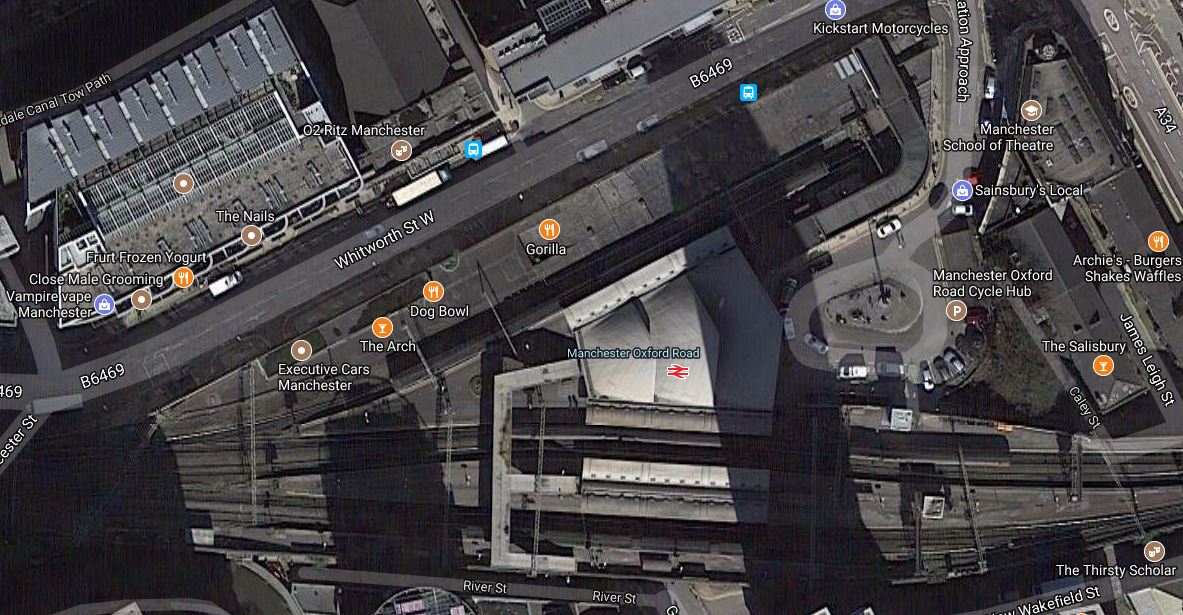
Oxford Road certainly seems to have space for passengers to use it as an exchange, when crossing the city.
But does Oxford Road have a stop on the Metrolink?
This Google Map shows Deansgate station.
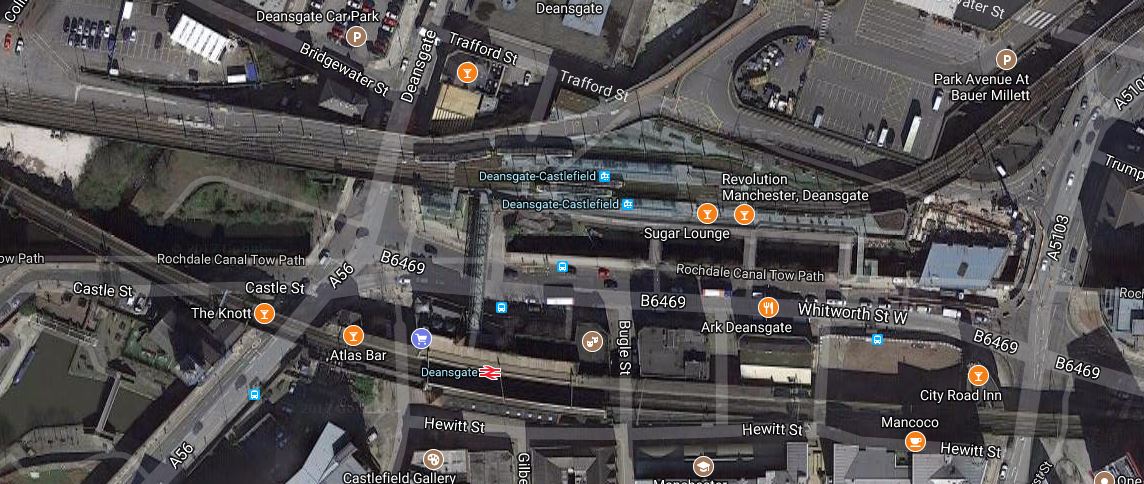
Deansgate doesn’t seem to have the space of Oxford Road. But it does have a good connection to the Metrolink.
The Forgotten Salford Stations
The other stations that could help are the two forgotten Salford stations; Salford Crescent and Salford Central.
This Google Map shows Salford Crescent station.
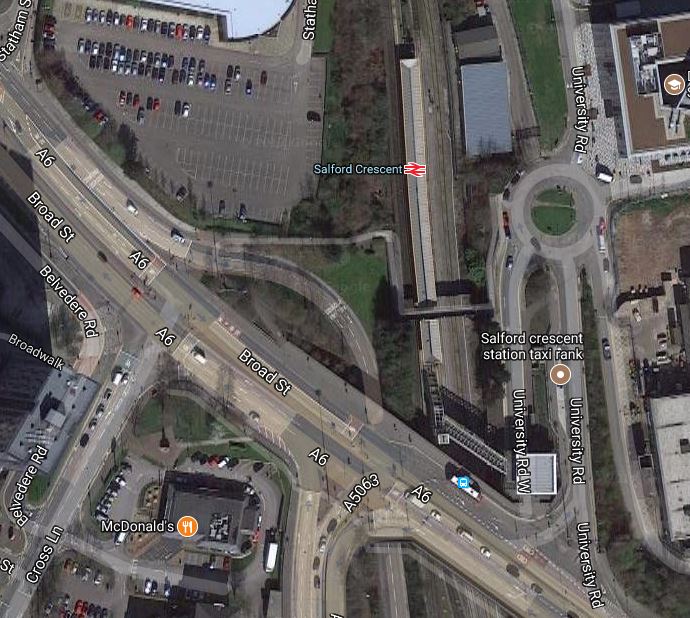
I believe that this station is going to get more platforms. Could it become a sort of triage station, where passengers from the North of Greater Manchester changed for.
- Trains for Manchester Victoria station.
- Trains for Manchester Piccadilly station.
- Metrolink to the city centre.
Surely, space could be found to run trams along Broad Street.
It would also look to be a station, where there is considerable scope to put housing or commercial developments above the station.
This Google Map shows Salford Central station.
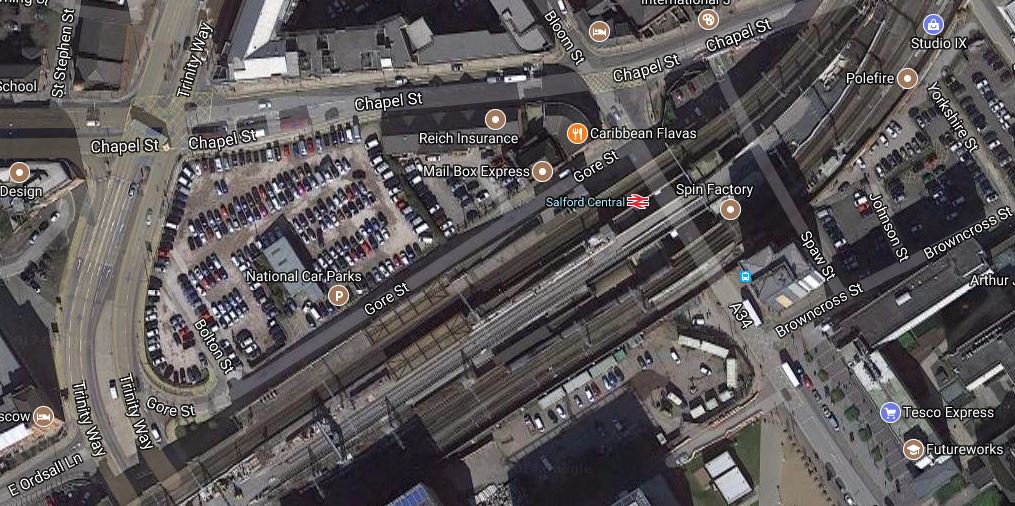
With a bit of thinking Salford Central must have interchange possibilities.
But as with Salford Crescent, this station doesn’t have a Metrolink connection.
The Wikipedia entry for Salford Central has a section called Future Development. This is said.
A Network Rail report suggests building platforms on the line to Liverpool (via Newton-le-Willows), the lines of which run through the station but are not provided with platforms. This scheme has since been adopted by Transport for Greater Manchester and included in their Capital Works Programme for 2015–16 to 2020–21. This will see three additional platforms built, at a cost of £20.5 million and will allow Liverpool, Chester & Manchester Airport-bound trains (using the Ordsall Chord) to call here.
I’ll believe it when I see it.
Conclusion About Manchester Piccadilly Upgrade
I am inevitably drawn to the following conclusions about the upgrade to Manchester Piccadilly.
The Ordsall Chord and the new electric services offered by the bi-mode trains will create a duckers-and-divers network across Manchester City Centre.
The following should be done.
- Access to Platforms 13/14 at Manchester Piccadilly should be greatly improved.
- Deansgate, Oxford Road, Salford Central and Salford Crescent should be improved with extra platforms, same- and cross-platform interchange.
- The Metrolink should be extended to both Salford stations.
- Greater Manchester should adopt a ticketing system based on bank cards to encourage use of the transport network.
Perhaps Mancunians need to be taught to duck-and-dive.
Trains Along The South Coast
I had lunch today with an old friend who lives near Bosham station in West Sussex.
They indicated that the train service along the South Coast to Brighton wasn’t the best.
So I thought, I’d have a bit of an explore on Wikipedia.
The route between Ashford International and Weymouth stations can be divided into four sections.
Weymouth To Southampton – The South Western Main Line
The South Western Main Line runs between Weymouth and Southampton Central stations.
- There are twenty stations.
- The operating speed is 100 mph.
- The line is fully electrified.
- The line is double-track, except for between Dorchester South and Moreton stations.
- There would only appear to be one level crossing at Brockenhurst station.
it is a high quality electrified line, where a well-driven train can keep up a good time.
The fastest trains take an hour and twenty minutes between Weymouth and Southampton with nine stops.
Southampton To Brighton – The West Coastway Line
The West Coastway Line runs between Southampton Central and Brighton stations.
- There are thirty-nine stations.
- The operating speed is 75 mph with up to 85 mph in places.
- The line is fully electrified.
- The line is double-track.
- There are twenty level crossings, including at Portslade, Shoreham-by-Sea, Lancing, Worthing, West Worthing, Goring-by-Sea, Angmering, Ford, Chichester(2), Fishbourne, Bosham, Warblington, Bedhampton and Cosham stations.
Following the line on Google Maps, the line could probably have an increased speed limit, but the problem is obvious in the number of level crossings.
Timings on the line are as follows.
- Southampton Central to Brighton takes one hour forty-five minutes.
- Portsmouth to Brighton takes one hour twenty minutes.
- Portsmouth to Southampton takes forty minutes.
These times are for faster journeys without changes.
Brighton To Hastings – The East Coastway Line
The East Coastway Line runs between Brighton and Hastings stations
- There are seventeen stations.
- The operating speed is 90 mph.
- The line is double-track.
- The line is fully electrified.
- There are seven level crossings, including at Berwick, Polegate, Hampden Park, Westham and Pevensey, Pevensey Bay, Normans Bay stations.
Fastest journeys between Brighton and Hastings take an hour.
Hastings To Ashford International – The Marshlink Line
The Marshlink Line runs between Hastings and Ashford International stations.
- There are nine stations.
- The operating speed is 60 mph.
- The line is double-track with sections of single-track.
- The line is not electrified.
- There are several level crossings.
Fastest journeys between Ashford Internsational and Hastings take forty minutes.
The May 2017 Edition of Modern Railways has an article entitled Kent Capacity Constraints Highlighted.
One sub-section is entitled High Speed To Hastings and it lists options as to how high-speed services could be run to Hastings via Ashford International station and the Marshlink Line.
- Electrify Ashford To Hastings At 25 KVAC
- Electrify Ashford To Hastings At 750 VDC
- Use Class 802 Electro-Diesel Trains
- Use Class 395 Or Class 801 Trains With Batteries
I examined the options in full detail in Options For High Speed To Hastings.
Class 313 Trains
When I travel to the area I inevitably find that I’m travelling in a Class 313 train.
- The trains entered service in 1976.
- The trains are the oldest electric multiple units in service on the British mainland.
- The trains are only three cars.
- The trains have no toilets.
- The trains have a maximum speed of 75 mph.
Their biggest problem, is that because the trains have such a poor performance, all routes on which they are likely to run have to be geared to a train running at 75 mph, that is not the quickest at executing a stop at a station.
It should be remembered that the time a train takes to stop at a station, unload and load passengers and then restart and accelerate to linespeed, is a major factor in determining the schedule on a route with a lot of stations.
Train manufacturers and operators have been doing a lot of work to reduce this time and a modern train could be almost a minute or even more quicker than a Class 313 train, at each stop.
Wikipedia says this about the introduction of the Class 313 trains, which replaced more modern and faster Class 377 trains.
The 313s commenced operations with Southern on 23 May 2010, providing a two-trains-per-hour service between Brighton and Seaford, and some trains between Brighton and Lewes, Hove, West Worthing and Littlehampton.[12] From 13 December 2010, their operation expanded to stopping services from Brighton to Portsmouth Harbour and the Littlehampton to Bognor Regis shuttle.
The decision to use 313s on the Coastway lines has been controversial, as they are much older than the 377s and have fewer on-board passenger facilities.
The rail union RMT criticised the move and many publications including the BBC have questioned the introduction of 35-year-old trains with no lavatories in place of much newer units. These trains are deployed on services that operate predominantly over short distances, such as Brighton to Hove and Brighton to Seaford, and some longer (but stopping) services that provide predominantly local links that run alongside 377s on faster services.
The introduction of 313s on the Coastway routes facilitated the delivery of additional capacity on high-demand suburban routes in South London, where 10-car trains services are to be introduced combined with platform lengthening.
This report on the BBC gives more details.
The Major Problems Along The South Coast
Summarising the previous sections, the major problems on the route can be summarised.
- The Class 313 trains with their poor performance are not fit for purpose.
- The numerous level crossings significantly reduce the operating speed of the route.
- The lack of electrification on the Marshlink Line is a serious obstacle to better London-Hsstings services via HS1.
I would also question, if there is sufficient capacity along the line, especially as there are now three Premier League clubs along its route.
In the following section, I shall detail what is proposed and a few extra actions, that I feel should be taken.
Improve The Marshlink Line
The May 2017 Edition of Modern Railways has an article entitled Kent Capacity Constraints Highlighted.
One sub-section is entitled High Speed To Hastings and it lists options as to how Southeastern High-Speed services could be run to Hastings via Ashford International station and the Marshlink Line.
- Electrify Ashford To Hastings At 25 KVAC
- Electrify Ashford To Hastings At 750 VDC
- Use Class 802 electro-diesel trains
- Use Class 395 Or Class 801 trains With Batteries.
As to which option is chosen, Modern Railways says this.
The option to use a ‘hybrid’ electric/self-powered (diesel or battery) train is suggested as being a ‘more cost-effective way forward’, with linespeed improvements then delivered in an incremental way.
I examined the options in full detail in Options For High Speed To Hastings.
If the improvement was comprehensive, it would give the following advantages.
- High-Speed services from St. Pancras to Hastings.
- Journeys from Ashford International to Portsmouth, Southampton, Bournemouth and Weymouth would be all electric and if desired could be without a change of train.
- Better connectivity along the South Coast to Continental services at Ashford International station.
- A secondary route from London to Brighton in case of closure of the Brighton Main Line.
If an off-the-shelf solution like Class 802 trains were to be used, the improvements could be delivered in a timely manner.
Remove As Many Level Crossings As Possible
Removal of level crossings is a sensitive issue, but from Southampton to Ashford International, they are a serious limit on the operating speed of the trains.
But it is not just the trains that suffer, but road traffic as well.
Consider Hampden Park station, where Wikipedia says this about the level crossing.
The level crossing at Hampden Park is thought to be one of the busiest in the country, with an average fourteen train movements an hour off-peak, and this can lead to significant traffic congestion on adjacent roads.
As some services actually cross it twice to call at Eastbourne station, this level crossing certainly needs to be eliminated.
Improved Stations
Several of the stations have been upgraded, but I believe that step-free access and longer platforms are needed at quite a few stations.
Brighton and Hove Albion are now one of three Premier League football teams along the South Coast and Falmer station needs to be improved, so that higher-capacity trains can serve the ground on match days.
The Plans Of South Western Railway
The May 2017 Edition of Modern Railways also gives details of the plans of the new South Western Railway franchise from December 2018.
This is said.
A direct service will link Portsmouth, Southampton and Weymouth, while there will be a second hourly semi-fast service between Portsmouth and Southampton offering a total of 29 additional services between the cities on Mondays to Saturdays.
Wikipedia also says that there will be another thirty five Monday to Saturday services between London and Portsmouth, with more on Sundays.
Services Between London And Portsmouth
Currently, on a typical day there are sixty-nine down services and seventy-one up services. So as thirty-five extra services are going to be provided, then that means there will be a twenty-five percent increase in services between London and Portsmouth.
So would this mean that London to Portsmouth has a frequency of five trains per hour (tph), as against three tph for Southampton?
As South Western Railway will be introducing additional Portsmouth to Weymouth services, will this mean that there will be two fast routes to London from Weymouth?
- A direct train.
- One with a change at Havant on to Portsmouth Direct Line services.
South Western Railway have certainly thought long and hard.
The Class 313 Trains Will Go To The Scrapyard
With all the fast 100 mph trains rushing between Ashford International and Brighton and Portsmouth and Weymouth, the Class 313 trains will be worse than inadequate and the best place for them will be the scrapyard.
I just wonder though if South Western Railway’s unwanted but new Class 707 trains could replace the Class 313 trains along parts of the South Coast.
- They are 100 mph trains, probably with a good stopping performance, which could save a minute at every stop.
- They are five-car units.
- They have toilets.
As an illustration of the difference the new trains could make, the current Portsmouth to Brighton service takes around one hour twenty minutes with twenty stops.
A rough estimate indicates that Portsmouth to Brighton could be under an hour with new 100 mph trains.
The only problems would be that they couldn’t work a Marshlink Line without electrification and services along the South Coast are provided by three different companies.
Conclusion
A lot of improvement is possible in services along the South Coast.
Adjusting current timings for new trains with a better stopping performance could give the following sectional timings.
- Ashford International to Hastings – 35 minutes
- Hastings to Brighton – 60 minutes
- Brighton to Portsmouth – 60 minutes
- Portsmouth to Southampton – 35 minutes
I believe that an Ashford International to Southampton time of three hours is possible.
This is a similar time as going via London and using HS1.
How Will Virgin Trains East Coast Use Class 800/801 Trains?
The following two sections give Virgin Trains East Coast (VTEC) current and future fleets.
Current Fleet
VTEC have a current fleet comprising the following locomotives and coaches.
- 32 – Class 43 locomotives
- 117 – Mark 3 coaches
- 31 – Class 91 locomotives
- 302 – Mark 4 coaches
- 31 – Driving van trailers
The Class 43 locomotives and the Mark 3 coaches are formed into InterCity 125 trains.
- Two locomotives and nine coaches per set.
- 125 mph capability
- Diesel-powered
Which gives thirteen diesel trains.
The Class 91 locomotives and Mark 4 coaches are formed into InterCity 225 trains.
- One locomotive, one driving van trailer and nine coaches per set.
- 140 mph capability
- Electric-powered.
- Ability to run London to Edinburgh in under four hours.
Which gives thirty-one electric trains.
Adding the two figures together gives a total of forty-four nine-car trains.
Future Fleet
VTEC’s future fleet will include.
- 10 – Five-car Class 800 electro-diesel trains.
- 13 – Nine-car Class 800 electro-diesel trains.
- 12 – Five-car Class 801 electric trains.
- 30 – Nine-car Class 801 electric trains.
Adding these together counting the five-car trains as half gives fifty-four nine-car trains.
Or ten more nine-car trains!
In addition six to eight InterCity225 trains could be retained in service to run limited stop trains between London and Edinburgh.
This increase in capacity can only me good for passengers, with more services and destinations.
Questions About Class 800/801 Trains
What is the capacity of a nine-car Class 800/801 train?
I can’t find this on the Internet and I suspect it hasn’t been decided.
Wikipedia gives the capacity of an InterCity 225 train as 406 Standard and 129 First Class seats.
It should also be noted that the car length in a Class 800/801 is twenty-six metres, as opposed to the twenty-three metres of the InterCity 225.
I would hope good design can make excellent use of this space.
Will two Class 800/801 trains be able to work as a pair?
I suspect the answer to this is yes, as the closely-related Class 395 trains regularly do this.
The most common use would be to run two five-car trains as a ten-car set.
This would be a 260 metre long train, which is perhaps fifteen metres longer than an InterCity 225 train.
Some lengthening of platforms may be necessary, but it probably isn’t a major problem.
Will coupling and uncoupling of a pair of Class 800/801 trains be automatic?
In The Impressive Coupling And Uncoupling Of Class 395 Trains, I linked to videos of the closely-related Class 395 trains, doing just this in under a minute.
I would be very surprised if two Class 800/801 trains couldn’t do the same.
Will a Class 800 train and a Class 801 train be able to work as a pair?
There may be circumstances, where this is needed on electrified lines, so I would be very surprised if this is not possible.
At what station will a Class 800/801 train be able to call?
The nine-car trains are 234 metres long and a pair of five car trains will be 260 metres long, so platform length will mean they can’t call at a lot of smaller stations.
But a five-car train will be only 130 metres long, which will be shorter than a pair of four-car multiple-units working together, which are regularly seen on the UK’s rail network.
So the five-car trains will probably be able to serve a surprising number of stations.
Will Class 800/801 trains have a faster turn-round time?
If you look at the times of trains between London and Leeds, this things happen.
- A few minutes after a train leaves the platform at Leeds and Kings Cross, the next incoming service arrives.
- It then waits in the station for nearly half-an-hour before going back.
Effectively, an hour must be added to each Out and Back journey between London and Leeds.
This time will enable.
- Passengers to unload and load.
- Train to be prepared.
- Crew to be changed if required.
Any delay of a few minutes can hopefully be recovered.
Train preparation time will probably be better with the Class 800/801 trains, as hopefully automation and better design will speed the process.
But cutting this thirty minutes substantially would probably require passengers to be marched around like the Brigade of Guards, which is of course not possible.
Hopefully, the new trains will be designed, so that ingress and egress for all passengers will be easier and faster but at some stations like Leeds, the station layout is more of a bottleneck than the train.
A few minutes reduction in turn-round time might be possible, but nothing that would mean a train doesn’t occupy a platform for half-an-hour.
How long will A Class 801 train take between London and Edinburgh?
Currently the fastest journey time using an InterCity 225 is around four hours and twenty minutes, but they have done it in under four hours in test runs.
For marketing reasons, I suspect that VTEC would like to dip under four hours with the fastest trains.
As the Class 800/801 trains have a similar 140 mph performance to the InterCity 225, I suspect that four hours will also be possible.
But the big difference will be that the Class 800/801 trains will probably have faster stop times at any intermediate stations.
So I suspect that the average journey time between London and Edinburgh will drop.
How Will VTEC Use Class 800/801 Trains?
Returning to my original question, I’ll now attempt to answer it in the next few sections.
London-Edinburgh Services
I think we can assume the following.
- There will be at least two trains per hour (tph)
- Trains will usually be nine-car trains.
- Class 800 trains will not normally use diesel power on the route.
- Some trains could be two five-car trains running as a pair.
- A proportion of trains will do the trip in under four hours.
- Intermediate stops as now will be optimised to the passenger traffic.
- Intermediate stops will be faster.
I also think, that the InterCity 225 sets will be improved, so they can match the times of the Class 800/801 trains.
I think that once improved signalling on the East Coast Main Line is working and allowing running faster than 125 mph, we could be seeing trains being able to go from London to Edinburgh and back in under nine hours, assuming a thirty minute turn-round at both ends of the route.
This would mean that a dedicated London to Edinburgh fleet of just eighteen trains would be required to run a two tph service. Three tph would need another nine trains.
Speed up the trains so, that a round trip can be done in eight hours and sixteen trains are needed for the two tph service, with eight more trains needed to up the service to three tph.
Under Future in the Wikipedia entry for Virgin Trains East Coast, this is said.
If VTEC’s application to operate extra limited stops services to Edinburgh is successful, it is proposing to operate these by retaining six to eight InterCity 225 sets.
Interesting! So will some or all hours see a third train between London and Edinburgh.
Are the thirty-year-old InterCity 225 trains, showing the same survival instincts of their ten-year-older predecessors; the InterCity 125s?
London-Aberdeen And London-Inverness Services
Currently times on these routes from London are as follows.
- London-Aberdeen – seven hours and four minutes – three trains per day
- London-Inverness- eight hours and four minutes – one train per day
So what times could a Class 800 achieve on these routes?
Times North of Edinburgh with an InterCity 125 are as follows.
- Edinburgh to Aberdeen takes two hours and thirty-six minutes – Fastest ScotRail takes two hours sixteen minutes.
- Edinburgh to Inverness takes three hours and thirty-one minutes – Fastest ScotRail takes three hours nineteen minutes.
I suspect that a Class 800 train running on diesel power could match the InterCity 125 times and approach the ScotRail times.
But as they would be running on electric power to and from London in four hours, times could be as follows.
- London-Aberdeen – six hours and sixteen minutes
- London-Inverness – seven hours and nineteen minutes
So over half-an-hour could be saved on both routes.
Currently trains leave London at these times.
- 10:00 – Aberdeen
- 12:00 – Inverness
- 14:00 – Aberdeen
- 16:00 – Aberdeen
Note that there is probably no 18:00 train, as that would arrive in Aberdeen at 0110.
That is probably too late, but a well-driven Class 800 train, might get to Aberdeen around 00:30, which could be acceptable.
There is also the possibility of running a pair of five-car Class 800 trains to |Edinburgh, where they split with one train going to Aberdeen and the other to Inverness.
If the 16:00 train were to split, the Inverness portion would finish its journey before midnight.
A schedule like this from London could be possible.
- 10:00 – Aberdeen and Inverness
- 12:00 – Inverness
- 14:00 – Aberdeen and Inverness
- 16:00 – Aberdeen and Inverness
- 18:00 – Aberdeen
Both Northern cities would get four trains per day from London, because of two factors.
- The ability to run on electric power between London and Edinburgh, which knocks time off that section of the route.
- The ability to split and join trains at Edinburgh, which saves paths on the East Coast Main Line.
It should be noted that any electrification North from Edinburgh will help.
Stirling to Edinburgh and Glasgow could be electrified by 2019 or 2020.
- Trains would run to the South of Stirling on electric power.
- Any splitting going North and joining going South would take place at Stirling.
- Trains would still stop at Edinburgh to load and unload passengers.
- Crew change currently takes place at Edinburgh, but that could happen at Stirling.
With a well-executed stop at Stirling, electric power between Stirling and Edinburgh and a few other improvements could we see the following?
- London-Aberdeen – six hours
- London-Inverness – seven hours
It would certainly please VTEC’s Marketing Department.
Services To St. Andrews
The Open Championship was last held at St. Andrews in 2015, so by the next time it is held at the Home of Golf, it is likely that a station will have been built for the town.
This new station must be able to accept Class 800/801 trains, which during a major event might need to run to the area.
This reasoning must apply to lots of places either on or within fifty miles of the East Coast Main Line.
London-Leeds Services
Leeds is generally served by 2 tph from London in around two hours ten minutes.
These are usually nine-car InterCity 225 trains, with a couple of InterCity 125 trains, that go to places like Harrogate, which are not electrified.
As the speed limits on the East Coast Main Line are increased as trains are fitted with in-can signalling, I suspect that VTEC’s Marketing Department will be pushing for times between London and Leeds to be under two hours.
I can’t believe that VTEC will not extend services from Leeds by making use of five-car trains running to Leeds as a pair, where they would divide and join.
I am assuming that Class 800/801 trains can join as well as the closely-related Class 395 trains, which do so it in under a minute.
Places that could be served include.
- Bradford
- Harrogate
- Horsforth
- Huddersfield
- Ilkley
- Keighley
- Shipley
- Skipton
Note.
- Some stations like Harrogate and Horsforth are not electrified, so would need Class 800 electro-diesel trains.
- Five-car trains could serve a lot of stations on the Leeds-Bradford Metro network, thus opening up the possibility of services to places like Headingley for the cricket and rugby and Saltaire for the culture.
- Could a five-car Class 800 electro-diesel train run over the Settle and Carlisle Line to Carlisle and Scotland?
- Extending some services from Leeds may mean that platform space is released at the station.
I think that the possibilities to extend services from Leeds using the five-car Class 800/801 trains are large.
London-Edinburgh Via Leeds
On the West Coast Main Line, some Scottish services from London, go via Birmingham and Wolverhampton.
So if there was a fully electrified route from Leeds to York, then some Scottish trains could go via Leeds.
At present, I don’t think this is possible with an electric train, as part of the route from Leeds to York is not electrified.
The electrification should be well underway by now, but there is no sign of it.
Other Extended Services
What can be done at Leeds can surely be done at other places.
If the two trains can couple and uncouple within a minute, that means that a pair of trains can arrive in a station and go through the following sequence.
- 00:00 -A joined pair of Class 800/801 trains arrive in the station and load and unload passengers.
- 00:03 – Close the train doors
- 00:04 – Start the automatic decoupling process.
- 00:05 – The first train leaves the platform.
- 00:08 – After three minutes the second train leaves the platform.
I believe that the stop could be under ten minutes and the trains would be a safe three minutes apart, as they left the station.
So where could trains be split?
- Newark or Peterborough for Lincoln and Nottingham
- Doncaster for Hull and Sheffield
- York for Scarborough and Harrogate
- York for Middlesbrough and Sunderland
- Newcastle for Ashington and Sunderland
Note.
- Trains could go in a loop to serve several stations.
- Sunderland could be on such a loop.
- As trains would only be five cars, they could stop at most stations in need of a service.
- Stations like Peterborough, Doncaster, York and Newcastle with more than one through platform in each direction would probably be preferred stations for split and join.
- No electrification is needed away from the East Coast Main Line.
Obviously, passenger needs and traffic patterns will decide, where the trains split and join.
Conclusions
The big conclusion will be that more places will receive long distance services to London and the places in between.
But these trains will really put the squeeze on smaller operators like Hull Trains and Grand Central Trains, as VTEC will be serving their station.
The Four-Car Bi-Mode Train
The Class 319 Flex train is an affordable four-car bi-mode or electro-diesel train, promoted by Porterbrook and to be used by Northern.
- The train is affordable, as it is based on a refurbished Class 319 train, which was built thirty years ago.
- The train is a dual-voltage unit and can be powered by either 25 KVAC overhead or 750 VDC third-rail electrification.
- Each unit also has two rail-proven MAN diesel engines, for powering the train on lines without electrification.
If there is a drawback, it is that with their interiors so far, Northern have opted for a no-frills interior with no wi-fi.
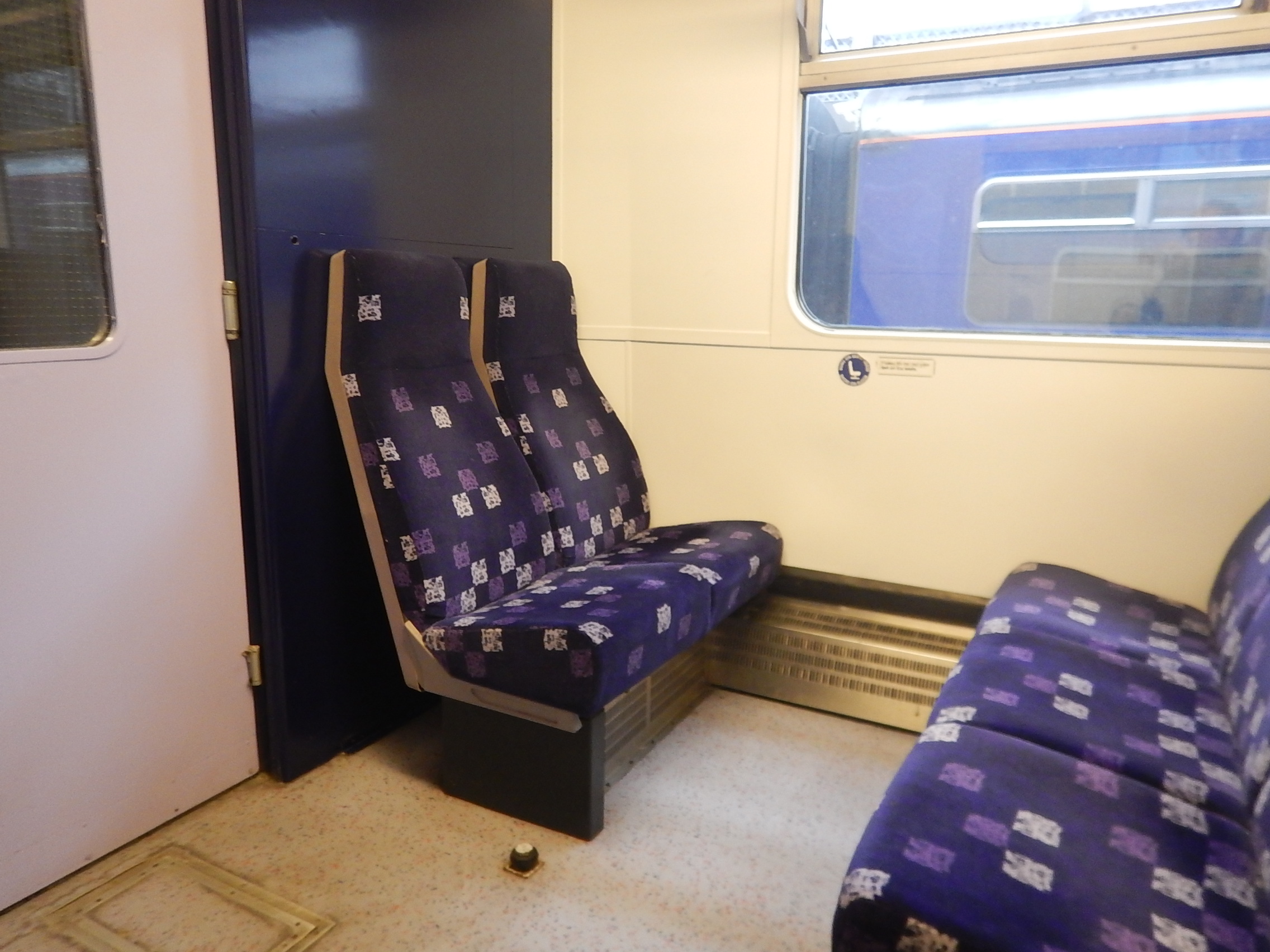
Compare this with the interior of a Class 455 train.
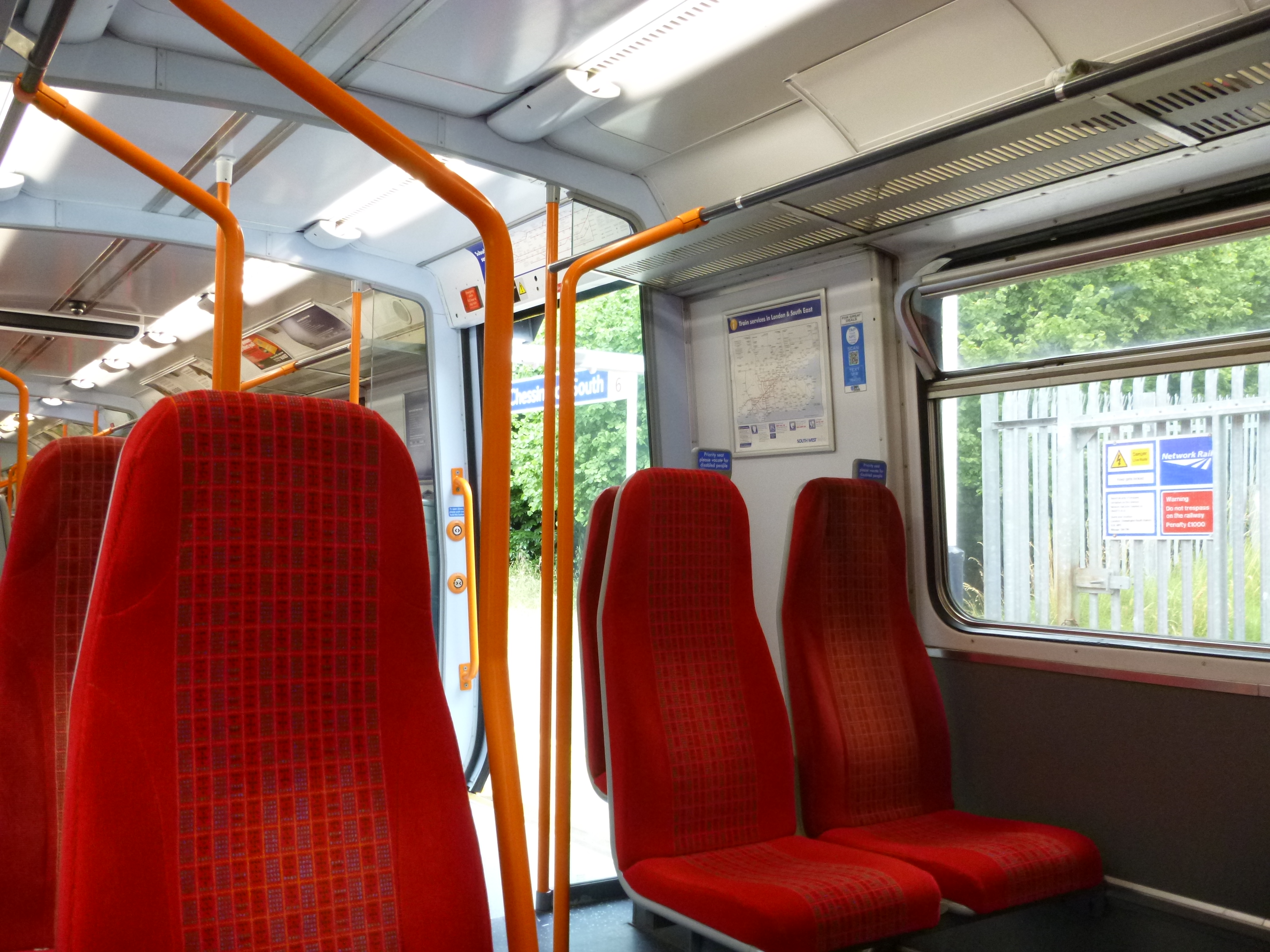
The trains were originally built within a couple of years, but the updated interior specified by South West Trains is much more impressive and passenger-friendly than that used by Northern.
Both trains are four-car units and are based on the Mark 3 coach, so underneath the skin, they probably have a lot in common.
There are a large number of four-car trains on UK railways so it must be a train length that is convenient for operators.
But strangely until now there has not been a four-car bi-mode train.
But then bi-mode trains are not that common, with the only UK train of that type; the Class 800 train, yet to enter service.
But the Class 800 train is for the long distance market and is a five-car or nine-car 125 mph train.
I do wonder, if the reason we have no four-car bi-mode trains, is that no-one has bothered to design one so no-one has wanted one.
But Porterbrook own 86 of these Class 319 trains, which are reliable 100 mph trains, that drivers tell me they like, because of their performance and excellent brakes.
Because of their age, they’re probably not worth a great deal more than scrap value, but because of the depth of knowledge of what can be done with Mark 3 coaches, they can be turned into a useful train by quality engineering.
Porterbrook have seen a gap in the market with Northern for a train specifically designed to be able to handle their toughest route, which is Manchester Piccadilly to Buxtonup the very steep Buxton Line. But the train is no one-trick pony and can run on virtually any of Northern’s routes, whether they are electrified or not.
So Northern can use the train for a variety of purposes.
- Running services on routes, that are not fully electrified.
- New route development.
- Extension of existing electrified routes.
- Replacement of a failed unit, which could be electric or diesel
Northern will have two versions of the Class 319 train; electric and bi-mode, just like other train operating companies will have electric and bi-mode versions of the Class 800 train.
I suspect that to passengers and all train staff except the driver, there will not be many obvious differences between the two versions.
Some routes will probably be able to be served by both versions.
The Bombardier Aventra
I feel very much that the Aventra will have one or more independently-powered versions.
The Aventra has a slightly unusual and innovative electrical layout.
This article in Global Rail News from 2011, which is entitled Bombardier’s AVENTRA – A new era in train performance, gives some details of the Aventra’s electrical systems. This is said.
AVENTRA can run on both 25kV AC and 750V DC power – the high-efficiency transformers being another area where a heavier component was chosen because, in the long term, it’s cheaper to run. Pairs of cars will run off a common power bus with a converter on one car powering both. The other car can be fitted with power storage devices such as super-capacitors or Lithium-Iron batteries if required.
This was published six years ago, so I suspect Bombardier have improved the concept.
Perhaps instead of a power storage device, they could squeeze in a small diesel engine and an alternator.
I’ve believed for a long time, that the Class 710 train being built by Bombardier for the London Overground, has onboard energy storage and that I wouldn’t be surprised if it used the storage to capture energy from regenerative braking, just as a lot of hybrid vehicles, like a London Routemaster and a Toyota Prius.
It won’t be a high-power bi-mode like the Class 319 Flex train, but it could have a useful range on the stored energy.
But it will be an all-electric train and probably more energy-efficient.
Other Four-Car Bi-Modes
I can’t believe that other train manufacturers are not looking at various forms of bi-mode trains.
Hitachi make the Class 800 trains at Newton Aycliffe, where they also make the four-car Class 385 train for ScotRail.
And what about Alstom, CAF, Siemens and Stadler?
What About Five Cars?
Four-car trains mean that operators can run eight and twelve car trains, when they are convenient. But other companies prefer five-car and ten-car trains.
We have the Class 800 trains, which are a 125 mph bi-mode, but we don’t have a five-car bi-mode suburban trundler. A few would surely be useful for Southern to handle Uckfield and the Marshlink Line.
I also believe that Greater Anglia’s five-car Aventras could have the limited independent capacity given by onboard energy storage.
I suspect that what the train operators need, the train operators will get!
Conclusion
We will see a complete spectrum of bi-mode four-car trains. And a few fuve-cars too!
, o
Bi-Mode Ate My Electrification
The title of this post, is the headline on an article by Roger Ford in the January 2017 Edition of Modern Railways.
The article describes how electrification of the rail line between Selby and Hull has been dropped and quotes Chris Grayling as implying that it’s all because the train companies have bought Class 802 trains, which are bi-mode, and won’t need electrification between Selby and Hull.
Both train companies; Hull Trains and TransPennine Express need to run high-class services with modern fast trains to Hull.
I will look at Hull Trains need in more detail.
Much of the route used by Hull Trains is along the electrified East Coast Main Line, so a 140 mph capability could be needed in the next few years, as speeds increase on that line.
If the Selby-Hull line were to be electrified, Hull Trains could run electric trains like Class 801 trains, InterCity 225s, or perhaps a version of the Stadler Flirt, that Greater Anglia will be running.
Hull Trains obviously need to increase quality and capacity on the route and it appears that the only train available is the bi-mode Class 802 train.
The only certain way Hull Trains could get new trains in a reasonable time, given that electrification is continually being kicked into the long grass, is the bi-mode route.
Purists might not like the bi-mode train, but at least it will enable Hull to have a quality high-speed train service.
The Problems With Electrification
Electrification is needed, so that trains can run fast and efficiently, without the noise, pollution and carbon-emissions of diesel power.
But.
- Electrification in the UK, is like trying to make a Victorian house fit for a modern lifestyle and it is even more expensive.
- Electrification gantries and wires, ruin landscapes.
- Much of our railway infrastructure,like stations, bridges and viaducts are beautiful structures in their own right and perhaps electrification will not be for some of them.
As we get further into the future, I think that there will be more reasons why existing lines will not be electrified.
We’re All In It Together
Several countries have a substantial proportion of lines without electrification, of which Germany, India and, the UK and the US are the most notable examples.
So ideas will be developed in these and other countries, that could be replicated in other countries with a pressing need for electrification.
The Problem Is An Opportunity For The Train Builders
Consider.
- Hitachi have developed their Class 800 family of trains to include bi-modes.
- Bombardier are developing trains with onboard electric storage and have a philosophy for all markets that I wrote iabout in Parallel Thinking From Bombardier.
- Stadler have a Pandora’s box for of ideas and technologies.
- CAF are supplying trams with onboard energy storage.
I can’t believe that Alstom, Siemens and other fFar Eastern manufacturers are not looking at using self-powered trains to cut down on electrification.
It is also worth noting that others are developing technologies, that will assist train builders in providing the trains that train companies and their passengers desire.
- Tessla and other companies are developing batteries with a higher storage density.
- Automatic pantograph up and down is being developed, so trains can use overhead power, where it exists.
- Automatic coupling and uncoupling will be developed.
- Trains will be driven automatically, so minimum power is used.
The train of the future will be powered and braked by electricity, and highly automated. It could be driven automatically, but I suspect like the Victoria Line or your average commercial airliner, the driver will be in overall control and monitoring everything.
Why Trains Need An Energy Storage Capability?
If an electric train has an onboard energy storage capability, it has various advantages.
- It can store the energy generated from regenerative braking and release it to help get the train back up to speed.
- On board energy storage can be used with both electric and diesel-electric trains.
- Depots can be designed with less electrification for safety and to save money.
- Trains can be given a remote wake-up capability as I discussed in Do Bombardier Aventras Have Remote Wake-Up?, so a train parked in a siding can be warmed up ready for the driver at the start of the day.
- Trains can recover to the next station using stored power, if electrification power fails.
- Trains can take diversions without electrification if needed.
- Depending on the size of the storage, trains could provide a service over a limited distance on stored power alone.
Hybrid cars and buses, which have onboard energy storage, might suggest even more reasons.
Energy Storage Can Only Get Better
Over the last few decades the energy capable of being stored in a device of a fixed physical size and weight has increased dramatically.
This process can only increase, so onboard energy storage will become more and more viable.
What Is The Kinetic Energy Of A Train?
I ask this question to show the energy values involved.
If I take a nine-car Class 345 train, which will be used on Crossrail, this has a mass of less than 350 tonnes and a maximum speed of 145 kph.
1500 passengers at 80 kg each works out at another 120 tonnes.
So for this crude estimate I’ll use 450 tonnes for the mass of a loaded train.
This gives the train an energy of 365 megajoules or 101 kilowatt-hours.
This amount of energy is only a couple of kWh larger than the largest battery size of a Tessla Model S car.
Can Regenerative Braking Be Handled By Onboard Energy Storage On A Train?
As an example, look at the Stadler Flirts and Bombardier Aventras, that will be running between London Liverpool Street and Cambridge, Colchester, Ipswich, Norwich, Southend and Stansted Airport.
- These are fully-electrified lines.
- The ability to stop and restart quickly is needed as these are very busy lines, with another 110 mph train along in a couple of minutes.
- All the passenger trains on the lines will have regenerative braking.
The electricity generated by braking can either be returned to the overhead wires using an inverter to get the voltages right or stored on the train in an onboard energy storage device.
Both methods are possible with good electrical engineering and there is probably no weight or installation advantage with either technology.
I don’t know what Stadler are doing, but this article in Global Rail News from 2011, which is entitled Bombardier’s AVENTRA – A new era in train performance, gives some details of the Aventra’s electrical systems. This is said.
AVENTRA can run on both 25kV AC and 750V DC power – the high-efficiency transformers being another area where a heavier component was chosen because, in the long term, it’s cheaper to run. Pairs of cars will run off a common power bus with a converter on one car powering both. The other car can be fitted with power storage devices such as super-capacitors or Lithium-Iron batteries if required.
As this was published five years ago, I can’t believe that an innovative company like Stadler have not been thinking about onboard electrical storage.
As I showed in the previous section, the kinetic energy of a Crossrail Class 345 train is around 101 kiowatt-hours.
So it is not beyond the bounds of possibility that a couple of Tessla batteries could handle the regenerative braking for a fully-loaded Crossrail train!
The same would apply to all of the trains in East Anglia, which would probably have a bit more kinetic energy.
It can obviously be done on an Aventra, so I feel that the Flirts will do it as well.
If all the trains on the routes handled their own regenerative braking, this could mean that there would be no need for the power supply to the overhead wires to be able to handle it. Whether that would save money, I don’t know!
Can the same technology be applied to a locomotive-hauled train, like a Class 68 locomotive pulling a rake of five Mark 3 coaches at 160 kph?
The kinetic energy is slightly less than that of the Crossrail train, so it might be feasible to put onboard energy storage in the diesel-electric locomotive to reuse braking energy.
Onboard energy storage for regenerative braking will become universal on all electric or diesel-electric trains.
In March 2016, I wrote Will London Overground Fit On-board Energy Storage To Class 378 Trains?, which was based on this article in Rail Technology Magazine entitled Bombardier enters key analysis phase of IPEMU. In the article, Marc Phillips of Bombardier is quoted as saying this.
All Electrostars to some degree can be retrofitted with batteries. We are talking the newer generation EMU as well as the older generation. So, the 387s and 378s are the ones where we have re-gen braking where we can top-up the batteries and use the braking energy to charge the batteries. That gives us the best cost-benefit over operational life.
So it would seem that the Class 378 trains of the London Overground are candidates for fitting with batteries. This would give the following advantages.
- Electricity savings.
- Recovery to the next station if the electricity supply fails.
- Simplified depot layouts with less electrification.
As nearly all lines are electrified in London, the ability to travel on short routes without electrification wouldn’t be needed.
On the other hand, new services might need a new branch line or a chord between two electrified lines, which if worked with trains with onboard energy storage, would not need to be electrified.
In Don’t Mention Electrification!, I noted that in all the documents for the extension of the Gospel Oak to Barking Line to Barking Riverside, there is no mention of electrification, although electric trains are stated to be working the route.
So could this be the first newly-built line in the UK to be worked by electric trains powered by onboard energy storage?
How Far Will Trains Go On Onboard Energy Storage?
This is very much a case of answering these and other questions.
- How much range do you want?
- Does the route have lots of stops?
- Is the route hilly?
- How much space there is on the train?
In the end, the most important question is can you afford it?
Could We See A Tri-Mode Train?
A tri-mode train would be one that could use the following power sources.
- Electric power from either 25 KVAC overhead or 750 VDC third-rail.
- Diesel power.
- Onboard energy storage.
It could even pick up 750 VDC from a tramway, if it was running as a train-tram.
Consider.
- If you look at an Hitachi Class 800 train, I suspect that the engineers could find space somewhere for onboard energy storage.
- The Aventra double-power-car concept, has probably been designed with a diesel version in mind.
- A hydrogen fuel-cell would be an alternative to diesel.
- The power control system would just switch between power sources automatically.
It’s all down to good engineering design and innovation.
I suspect, that a tri-mode train will be launched in the next few years.
Conclusions
I believe there is a lot of scope to cut the amount of electrification that is done, by using alternative technologies.
The bi-mode is in pole position, but with the advance of battery and other technologies, the current lead will not last long.
What Next For Class 385 Trains?
Scotrail have ordered a fleet of Class 385 trains, which will be built by Hitachi at Newton Aycliffe in the North-East of England.
If you look at Scotrail’s network, there are a lot of lines, where new trains will be needed in the next decade.
Most of these lines are not electrified, so will the Class 385 train, be available in a version say, that would handle lines like the Borders Railway?
Electrifying all lines will be costly and the Heritage Taliban, may object to overhead gantries marching all over Scotland.
Class 800 And Class 801 Trains
The Class 800 trains are electro-diesel trains with a range depending on the size of the fuel tanks, whereas the Class 801 trains are the pure electric version.
Like the Class 385 trains, they are members of Hitachi’s A-Train family, so I suspect that if asked to supply a bi-mode Class 385 train, that Hitachi know the route to create such a train.
Trains With Batteries
I have written two posts about the Japanese using batteries in electric trains.
- Japanese Trains With Batteries describes how some Tokyo Metro trains have batteries to get them to the next station, in an emergency situation.
- Battery Trains In Japan describes how battery trains are to be used on the OGA Line.
The Japanese technology, doesn’t seem as comprehensive as that I wrote about in Bombardier’s Plug-and-Play Train, but I’m sure that Hitachi must be thinking about trains with batteries,
Conclusion
I am inevitably drawn to the conclusion, that Hitachi will come up with a train, that can run say between Edinburgh and Aberdeen, substantially under its own power, aided by overhead electrification where it exists.
Seamless Interchangeability
At several places on the UK rail network, two trains running as a pair will split, with one train going to one destination and another going to another.
I wrote about trains splitting and joining in Trains Uncoupling and Coupling at Cambridge.
In the past, UK railways used to use the concept of slip coaches, so that coaches could be dropped from an express without stopping. But the last time it was used in the UK was in September 1960 at Bicester North station.
I have just read this article on the Rail Engineer web site, which is entitled Seamless Interchangeability.
The article talks about a concept of dynamic coupling, where trains are automatically coupled and uncoupled at line speed.
It also talks about the issues this would raise.
As a Control Engineer, I’m fairly certain, that it would be very easy to create a system, where say an eight-car Kings Lynn train could split just before Cambridge station, with the front four-car train going to Kings Lynn and the other four-car train stopping in Cambridge station.
It could either be done using two drivers or by driver-less trains. Although the unions would have a lot to say about the latter.
I also believe that if the trains could uncouple, then coupling at line speed would also be possible.
So what is the point?
An Example From The Brighton Main Line
To make full use of the capacity available, Southern serve Littlehampton and Ore, with a train that divides at Haywards Heath. It is a well-proven technique that has been used for decades.
Automatically splitting the two trains at line-speed, can give journey time advantages.
Take the 19:47 from Victoria, which arrives at Haywards Heath at 20:30 as an example.
The following is taken from the timetable.
- The front portion to Ore leaves at 20:34.
- The rear portion to Littlehampton leaves at 20:36.
- Stops at East Croydon and Gatwick Airport take about a minute.
This leads to the following, if the two trains split immediately after stopping at Haywards Heath and before the trains take different directions after Keymer Junction where the East Coastway Line divides from the Brighton Main Line, a few miles South.
- The Ore train performs a one-minute stop instead of one of four minutes, thus saving three minutes.
- The Littlehampton train performs a one-minute stop instead of one of six minutes, thus saving five minutes.
- The platform at Haywards Heath is only occupied for a minute, as opposed to six.
- The Littlehampton and Ore portions must be capable of providing enough capacity for their route.
For those worried about driver-less trains, the driver of the second train for Littlehampton, would probably step up at the previous stop at Gatwick Airport or at Haywards Heath.
But the outcome would be a small increase in capacity on the line, due to the platform at Haywards Heath being occupied for five minutes less.
Coming North, take the 09:47 from Littlehampton as an example.
The following is taken from the timetable.
- The first train arrives at Haywards Heath at 10:35 and leaves at 10:45.
- The second train arrives at Haywards Heath at 10:41.
The pattern of the trains would be different.
- Whatever was the front portion of the train would go through Keymer Junction first
- The train forming the rear portion would be the next train through the junction.
- The rear portion could catch the front portion and the two trains would be automatically coupled together before Haywards Heath.
- The joined train would stop at Haywards Heath for a minute.
- The driver of the second train could step-down at Gatwick Airport or Haywards Heath.
In some ways the mathematics involved in the coupling, are not unlike those for a fighter jet connecting with a tanker aircraft. Except that speeds are a lot lower and there is no need to control direction only closing speed.
Haywards Heath station would be occupied for up to nine minutes less, thus creating capacity.
This simplistic analysis, shows how automatically coupling and uncoupling trains at line speed can create capacity and decrease journey times.
- Journey time from Victoria to Ore would be reduced by three minutes.
- Journey time from Victoria to Littlehampton would be reduced by five minutes.
- In the Down direction the platform at Haywards Heath station would be occupied for just one minute instead of six.
- Journey time from Littlehampton to Victoria would be reduced by nine minutes.
- Journey time from Ore to Victoria would be reduced by three minutes.
- In the Up direction the platform at Haywards Heath station would be occupied for just one minute instead of ten.
Obviously strategies would have to be developed for various eventualities including.
- Unsuccessful coupling or uncoupling.
- Late trains.
- Signalling and train failures.
- Leaves on the line.
- Extreme weather.
But as during all coupling and uncoupling operations, both trains would have a driver in the cab, keeping an expert eye over the procedure and each train could be driven independently, I think all safety issues could be overcome, to the satisfaction of all parties.
If you read the full article, you’ll see that there are some much more exciting possibilities, than the simple ones I have outlined here.
But I do believe that line speed uncoupling and coupling of trains with a driver in the cab of both trains involved, can be a very powerful tool in creating capacity on the UK’s railways.
The Great Eastern Main Line
I know the Great Eastern Main Line well and several trains are coupled and uncoupled regularly on this line.
As Greater Anglia has ordered new five-car Aventra trains and nearly all platforms can take 12 -car trains, running these trains in pairs and coupling and uncoupling appropriately, is probably in their plans for the line.
As on the Brighton Main Line, could coupling and uncoupling at line speed, unlock capacity on the line?
A few weeks ago, I caught a train from Chelmsford to Manningtree, that divided at Colchester, with the front four-car train going to Clacton and the rear four-car train going to Harwich.
The 16:44 from Liverpool street is a train that divides at Colchester, when it arrives at 17:40. These timinings are from the timetable.
- The Clacton portion of the train leaves at 16:44.
- The Harwich portion of the train leaves at 16:47.
As the Sunshine Coast Line for Clacton leaves the Great Eastern Main Line immediately after Colchester station, it would appear that the two trains must uncouple during the stop at Colchester.
Surely, an improved and well-designed automatic uncoupling system could separate the trains faster, saving minutes on both services.
Towards London, two trains leave Harwich and Clacton at 07:16. The timetable shows.
- The Harwich train arrives at Colchester at 07:47 and leaves at 07:54.
- The Clacton train arrives at Colchester at 07:50 and leaves at 07:54.
Surely, an improved coupling system, could join the trains faster, saving minutes on both services.
The time savings will not be as great as those at Haywards Heath, but automatic coupling and uncoupling must be a worthwhile feature of the new trains.
|As Bombardier are adding automation to the Aventra, could they be adding the ability to automatically couple and uncouple trains, both in the station and at line speed?
The West Coast Main Line
I have seen Class 221 Trains, join at Crewe, but I don’t think this is done any more.
However, with the need for direct services from London to places like Blackpool, Burnley and Huddersfield, the ability to be to couple and uncouple trains quickly must be something that would be useful to make optimal use of the valuable train paths on the line.
The East Coast Main Line, Midland Main Line, Great Western Main Line And South West Main Line
If the West Coast Main Line could benefit, then surely these lines could as well.
Class 800/801 Trains
The Class 395 train is very much related to the Class 800 and Class 801 trains, that are being built by Hitachi for the East Coast Main Line, Great Western Railway and other routes.
In The Impressive Coupling And Uncoupling Of Class 395 Trains, I talked about the design of the coupling system for the Class 395 trains.
I would be very surprised if this feature was not incorporated in the Class 800 and Class 801 trains.
So will we be seeing two five-car Class 800/801 trains dividing and joining at a convenient station and then running as a ten-car train to and from London?
Class 385 Trains
What about the Class 385 trains for Scotland?
- These are another version of Hitachi’s A-Train, like 395s, 800s and 801s.
- These will come in two lengths; three-car and four-car.
- Edinburgh-Glasgow services will need at least two units to be coupled together.
- The trains are being introduced from Autumn next year.
It seems to me, that Scotrail are acquiring a very flexible fleet that can run in various lengths.
Will they have the ability of the 395s to couple and uncouple in under a minute?
And if they do, will Scotrail use this ability to adjust train formation to the traffic?
Aventras
There are three definite orders for Bombardier’s new Aventra train at the present time.
- Class 345 trains for Crossrail.
- Class 710 trains for London Overground.
- Five and ten car units for Greater Anglia.
All trains are fixed formations in a mixture of lengths.
Will Aventras have similar coupling and uncoupling performance to Hitachi’s Class 395 trains?
I suspect normally, the Crossrail trains will never be coupled together, as where are platforms for a four-hundred metre long train?
But suppose a train fails in the central tunnel, will the quickest way to remove it, be to attach it to another train and drag it out?
The routes where the London Overground trains will run, are currently served by a mixture of four-car and eight-car trains. So will London Overground, adjust train length to the known traffic patterns?
Greater Anglia do couple and uncouple trains at present to serve Harwich. So I suspect, we’ll see use of an automatic and fast coupling and uncoupling feature to create a more efficient timetable.
Cross City Lines
There are several cross-city lines in the UK.
- Cross-City Line – Birmingham
- Crossrail
- North Berwick Line – Edinburgh
- Northern Line – Merseyrail
- Snow Hill Lines – Birmingham
- Thameslink
One of the characteristics of cross-city lines, is they are busiest in the centre of the city, where passengers tend to use the trains for short hops , as well as longer distances. Then in the suburbs, outside of Peak hours the trains could run almost empty.
Crossrail’s trains are designed so that hopefully they could cope with the variable traffic, but would it be possible to have half trains, which join and split at outer stations.
Thameslink
I think that Thameslink could be the line that might benefit most, as it would probably want to serve more places.
In All Change On Thameslink, I detailed the current proposed schedule of trains.
- 4 trains per hour (tph) – Sutton to St. Albans (2 tph via Wimbledon, 2tph via Mitcham)
- 2tph – Brighton to Bedford
- 2 tph – Three Bridges/Gatwick Airport to Bedford
- 2 tph – Brighton to Cambridge North
- 2 tph – Horsham to Peterborough
- 2 tph – Maidstone East to Cambridge
- 2 tph – Sevenoaks to Blackfriars
- 2 tph -Orpington to Kentish Town/West Hampstead
- 2 tph – Rainham to Luton (via Dartford and Greenwich)
- 2 tph – East Grinstead to Bedford
- 2 tph – Littlehampton to Bedford
This makes a total of twenty-four tph, which is the design limit for the central tunnel.
In this schedule 4 tph go to Cambridge and 2 tph go to Peterborough. Suppose, it was decided that Peterborough needed 4 tph.
The path limit of 24 tph through the central tunnel makes this impossible, but if Peterborough and Cambridge services joined and split at perhaps Stevenage, then both Cambridge and Peterborough would get 6 tph through the core tunnel.
It would need new six-car trains, that could couple and uncouple quickly.
Conclusion
I believe that improving the coupling and uncoupling of all modern trains to the standard of that of the Class 395 trains could be very beneficial, to train operators, staff and customers.
If coupling and uncoupling could be done at line speed, this might bring extra benefits.
Is It Bi-Modes And Battery Trains To The Rescue?
This article in Rail Technology Magazine is entitled Further delays to GWML electrification as schemes deferred indefinitely.
The delayed schemes include.
- Bristol Parkway to Bristol Temple Meads
- Bath Spa to Bristol Temple Meads
- Oxford to Didcot Parkway
- Henley Branch
- Windsor Branch
There is no mention of the Marlow Branch or the Greenford Branch.
The article also quotes the Rail Minister; Paul Maynard, as saying.
Introducing newer trains with more capacity in these areas could be done without costly and disruptive electrification,
Is this a meaningless platitude or is there substance behind it?
A mix of Class 801 electric trains and Class 800 bi-mode electro-diesel trains were originally ordered for GWR.
But this is said in the Wikipedia entry for the Class 800 train.
In July 2016, it was announced that GWR’s intended fleet of Class 801s were to be converted from pure EMUs to bi-mode units. Subsequently these were reclassified as Class 800s.
So will we see bi-mode trains working the Bristol Temple Meads routes, which are numbered 1 and 2 above?
That would certainly allow the Minister to bathe in the glory of a run to Bristol via Bath and back via Bristol Parkway.
Five-car Class 800 trains could also work route 3, thus giving Oxford trains, that would increase capacity and run on electric power between Didcot and Paddington.
But what about the four branch lines; Greenford, Henley, Marlow and Windsor?
Note.
- The Minister used the word newer not new.
- He also said capacity would be greater.
- When I passed the Marlow branch a few weeks ago, it appeared electrification had started.
- All branches are short, with the Marlow Branch the longest at 7.25 miles.
- The Henley Branch has a 50 mph speed limit.
It should also be noted that the Mayflower Line, where the battery train trial was conducted in 2015 is just over eleven miles long.
So would it be possible to fit batteries to the Class 387 trains to fulfil the Minister’s statement?
- The Class 387 trains are very similar to the Class 379 trains used in the trial on the Mayflower Line.
- They are newer with greater capacity, than the current trains on the branch lines.
The answer could be yes! I reported on Rumours Of Battery-Powered Trains in August 2015. At that time Network Rail were calling the trains Independently Powered Electric Multiple Units or IPEMUs.
The possibility also exists that Class 387 trains with batteries could also work the lines between Didcot Parkway and Oxford, Reading and Basingstoke and Reading and Bedwyn.
Network Rail needs to convert a serious loss of face into at least a score-draw!
If the Great Western does use this approach, they’ll only be taking a similar route to the Germans, as I wrote about in German Trains With Batteries.
 The Anonymous Widower