‘Mobilising EUR 1 Trillion in Investments’ | North Sea Countries, Industry, TSOs to Ink Offshore Wind Pact
The title of this post, is the same as that of this article on offshoreWIND.biz.
This is the sub-heading.
Government officials from Belgium, Denmark, France, Germany, Ireland, Luxembourg, the Netherlands, Norway and the UK are set to sign a declaration confirming the ambition to build 300 GW of offshore wind in the North Seas by 2050, and an investment pact with the offshore wind industry and transmission system operators (TSOs) that is said to mobilise EUR 1 trillion in economic activity.
These three paragraphs add a lot of powerful detail.
Under the Offshore Wind Investment Pact for the North Seas, to be signed today (26 January) at the North Sea Summit in Hamburg, governments of the nine North Sea countries will commit to building 15 GW of offshore wind per year from 2031 to 2040.
The heads of state and energy ministers will also vow to de-risk offshore wind investments through a commitment to provide two-sided Contracts for Difference (CfDs) as the standard for offshore wind auction design. The pact also commits governments to remove any regulatory obstacles to power purchase agreements (PPAs), according to WindEurope, which will sign the pact on behalf of the industry.
On the industry’s side, the commitment is to drive down the costs of offshore wind by 30 per cent towards 2040, mobilise EUR 1 trillion of economic activity for Europe, create 91,000 additional jobs and invest EUR 9.5 billion in manufacturing, port infrastructure and vessels.
These two paragraphs say something about cost reductions.
The cost reduction of offshore wind is planned to be achieved through scale effects, lower costs of capital and further industrialisation supported by clarity and visibility on the project pipeline.
The transmission system operators (TSOs) will identify cost-effective cooperation projects in the North Sea, including 20 GW of promising cross-border projects by 2027 for deployment in the 2030s.
I hope there is a project management system, that can step into this frenzy, just as Artemis did in the 1970s with North Sea Oil and Gas.
The BBC has reported the story under a title of UK To Join Major Wind Farm Project With Nine European Countries.
this is the sub-title.
The UK is set to back a vast new fleet of offshore wind projects in the North Sea alongside nine other European countries including Norway, Germany and the Netherlands.
These six paragraphs add more detail.
The government says the deal will strengthen energy security by offering an escape from what it calls the “fossil fuel rollercoaster”.
For the first time, some of the new wind farms will be linked to multiple countries through undersea cables known as interconnectors, which supporters say should lower prices across the region.
But it could prove controversial as wind farm operators would be able to shop around between countries to sell power to the highest bidder – potentially driving up electricity prices when supply is tight.
Energy Secretary Ed Miliband will sign a declaration on Monday at a meeting on the future of the North Sea in the German city of Hamburg, committing to complete the scheme by 2050.
Jane Cooper, deputy CEO of industry body RenewableUK, said the deal would “drive down costs for billpayers” as well as increasing “the energy security of the UK and the whole of the North Sea region significantly”.
But Claire Countinho, shadow energy secretary, warned “we cannot escape the fact that the rush to build wind farms at breakneck speed is pushing up everybody’s energy bills.”
Claire Coutinho, as an outsider at present and a member of a party out of Government had to say something negative, but her negotiations when she was UK Energy Minister with her German opposite number, which I wrote about in UK And Germany Boost Offshore Renewables Ties, seem very much a precursor to today’s agreement.
Amazon Books Over Half Of Moray West Offshore Wind Capacity To Power UK Operations
The title of this post, is the same as that of this article on offshoreWIND.biz.
This is the sub-heading.
Amazon has signed a corporate power purchase agreement (CPPA) for a total of 473 MW of Moray West offshore wind farm’s generation capacity to help power its operations when the project becomes operational later this year.
These are the first two paragraphs.
The technology giant signed the CPPA with ENGIE, which owns the Moray West project through Ocean Winds, the 50-50 joint venture between ENGIE and EDP Renewables.
The 473 MW Amazon secured through the agreement is enough to power the equivalent of more than 650,000 UK homes annually and is more than half of the total installed capacity of the 882 MW Moray West offshore wind farm.
Note.
- In Google Buys Scottish Offshore Wind Power, I talked about how Google had signed a Corporate Power Purchase Agreement to buy 100 MW from the Moray West offshore wind farm.
- This would mean that there’s still 305 MW of capacity to allocate.
- I would assume you wouldn’t sell hundred percent of capacity to give yourself leeway.
But what do you do, if your wind farm isn’t producing the 573 MW you need to satisfy the CPPAs you’ve sold? I suspect you have to buy it on the market.
If And When Do Amazon Think About Batteries?
My twenty-five-year-old self could have developed methods to calculate the answer to that question, as it would have been a simple calculation for the analogue computer, that I was using at the time; a PACE-231-R.

They really were magnificent machines.
Google Starts Building £790m Site In Hertfordshire
The title of this post, is the same as that of this article on the BBC.
This is the sub-heading.
Google has invested $1bn (£790m) to build its first UK data centre
These are the first four paragraphs.
The tech giant said construction had started at a 33-acre site in Waltham Cross, Hertfordshire, and hoped it would be completed by 2025.
Google stressed it was too early to say how many jobs would be created but it would need engineers, project managers, data centre technicians, electricians, catering and security personnel.
The prime minister said it showed the UK had “huge potential for growth”.
The project marked the latest investment by a major US tech firm in Britain, after Microsoft announced it would invest £2.5bn to expand data centres for artificial intelligence (AI) across the UK.
Note.
- By “completed by 2025” do they mean completed before 2025 or completed by the end of 2025. Judging by the time they took to build their London HQ, its the latter.
- Rishi is right about the UK having a huge potential for growth! Especially, if the nihilists of the United States vote in the Big Orange!
- Judging by the total spend of £2.5 billion on data centres and the £790 million for this one, this looks to be the first of three.
But where is this data centre going to be built?
This article on EssexLive is entitled Google To Move Into Waltham Cross With £788m Data Centre To Support ‘AI Innovation’, where this is said.
The new data centre will go on land at Maxwell’s Farm, next to the A10 Great Cambridge Road and around one mile from the M25 junction 25. Debbie Weinstein, Google vice president and managing director in the UK and Ireland, set out the decision in a blog post on Thursday, January 18 – the fourth day of the World Economic Forum’s Davos 2024 in Switzerland.
This is a Goggle Map of that area, when I searched for Maxwell’s Farm.
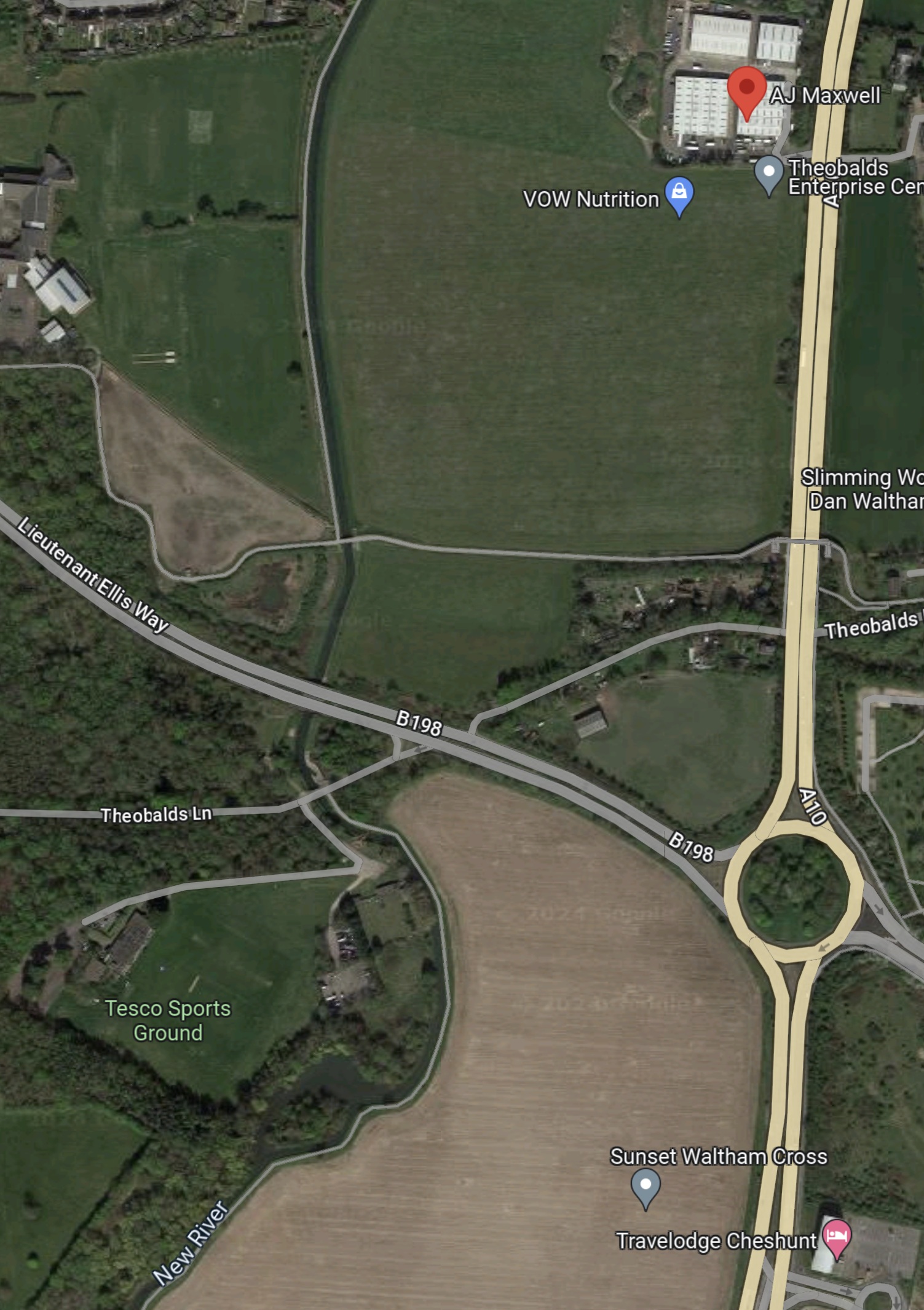
Note.
- The red arrow indicates the result of my search, which Google interpreted as A.J. Maxwell.
- The dual-carriageway road running down the East side of the map is the A10 between London and Cambridge.
- The A10 road joins the M25 at Junction 25.
- The arrow to the South-West of the roundabout indicates the new studios; Sunset Waltham Cross, which is being built.
- At the other side of the studio site, there is a label saying New River and this important piece of London’s water infrastructure can be traced to the top of the map.
- The other dual-carriageway road is the B198 or Lieutenant Ellis Way.
- A quick calculation shows that 33 acres is roughly a 365 metre square.
I would suspect that the data centre will lie somewhere between the A10, the B198 and the New River.
This Google Map shows the South-East corner of the site.
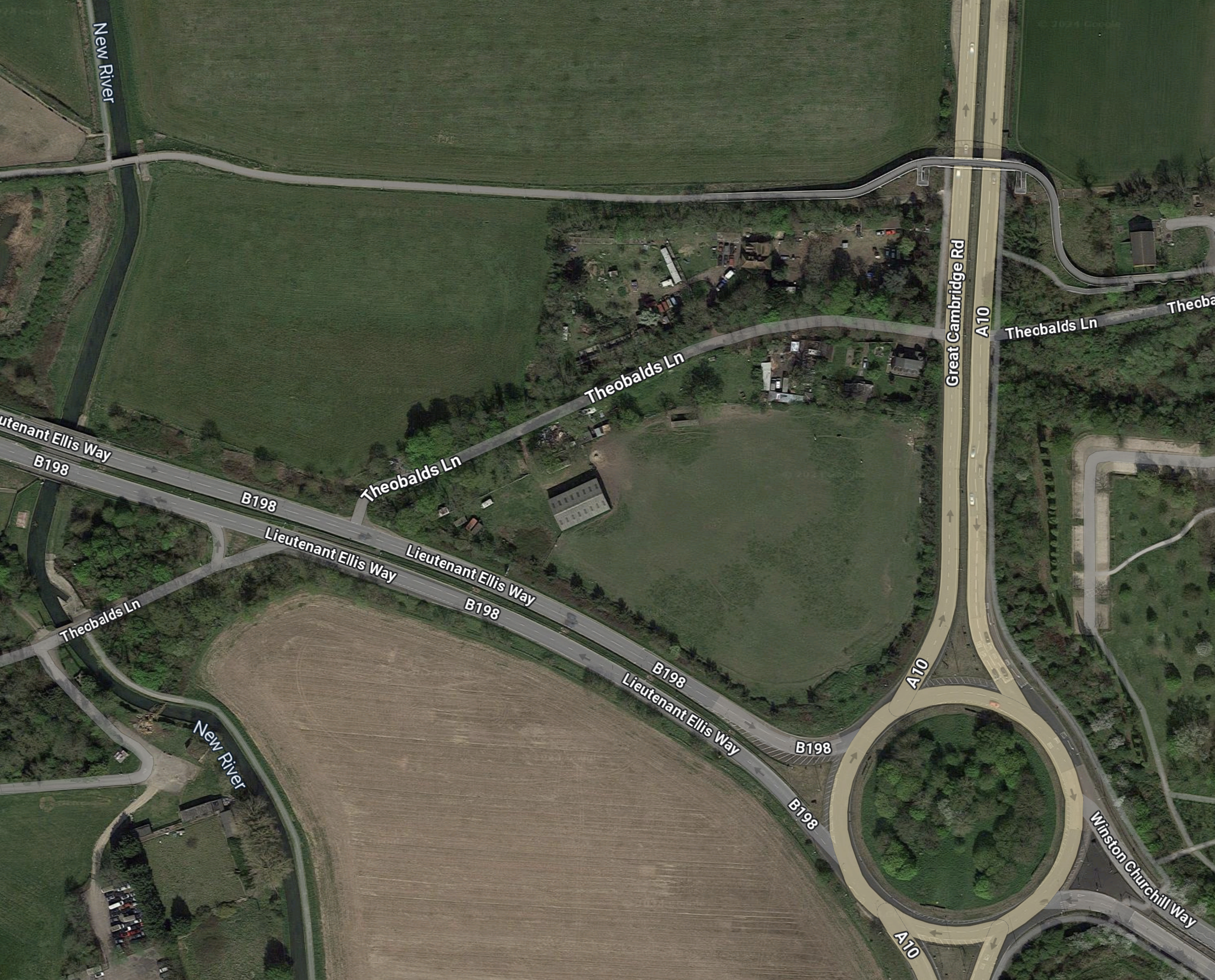
Note.
- There appears to be a lane running East-West, that crosses over both the A10 and the New River.
- Theobalds Lane appears to have some housing and possibly a farm.
- The smaller field by the roundabout appears to have some animals using it as grazing.
- The field between the East-West lane and Theobalds Lane appears to have a good crop of cereal.
The East-West lane would appear to be a possible Southern border of the site.
This Google Map shows where the East-West lane goes.
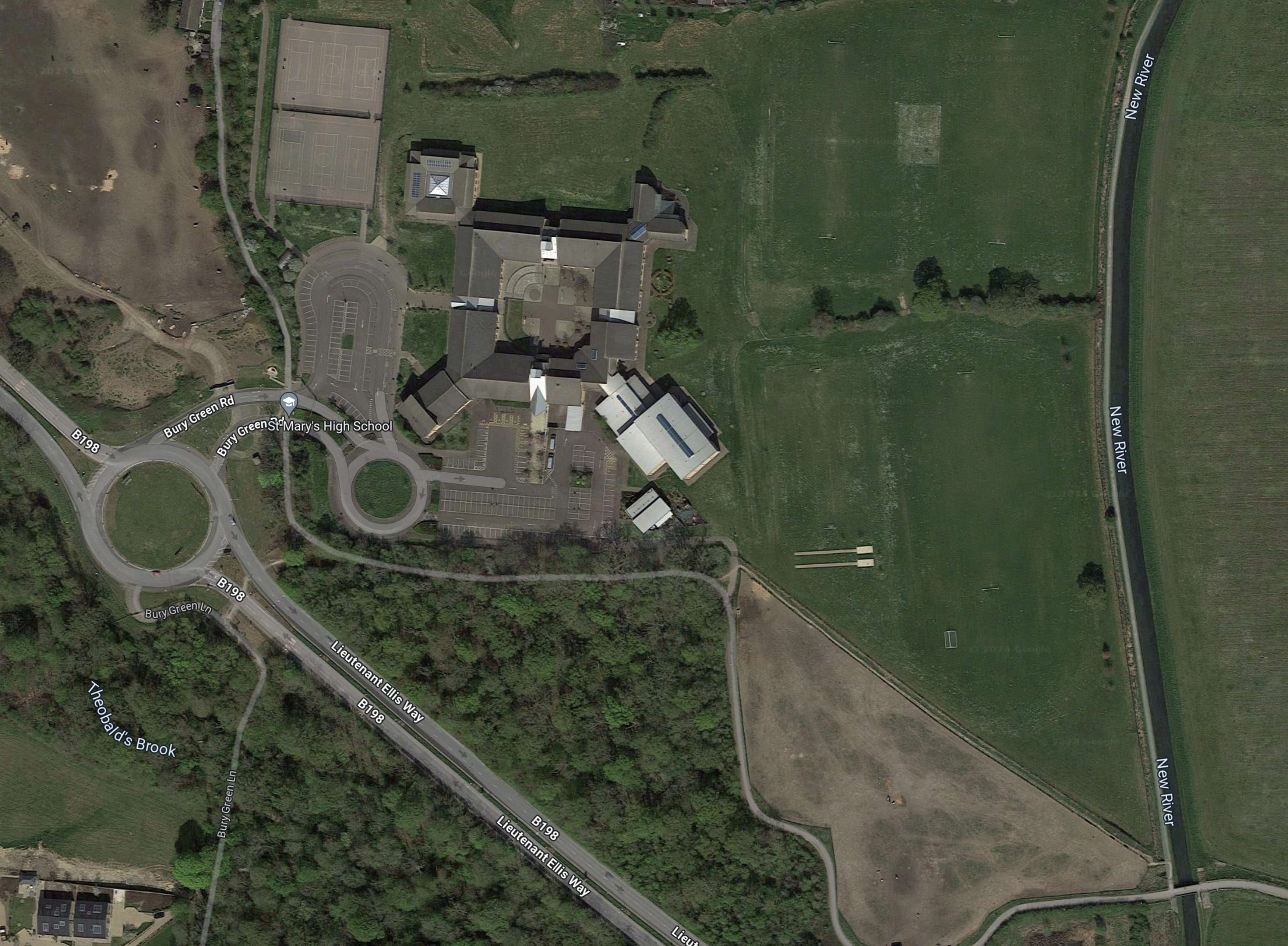
Note.
- The lane leads to Queen Mary’s High School.
- The school also has access from Lieutenant Ellis Way.
- The New River appears to form, the Eastern boundary of the school site.
- There are sports pitches between the New River and the school.
The New River looks to be the Western boundary of the Google site.
This Google Map shows around the red arrow from the Google search that led me to this area.
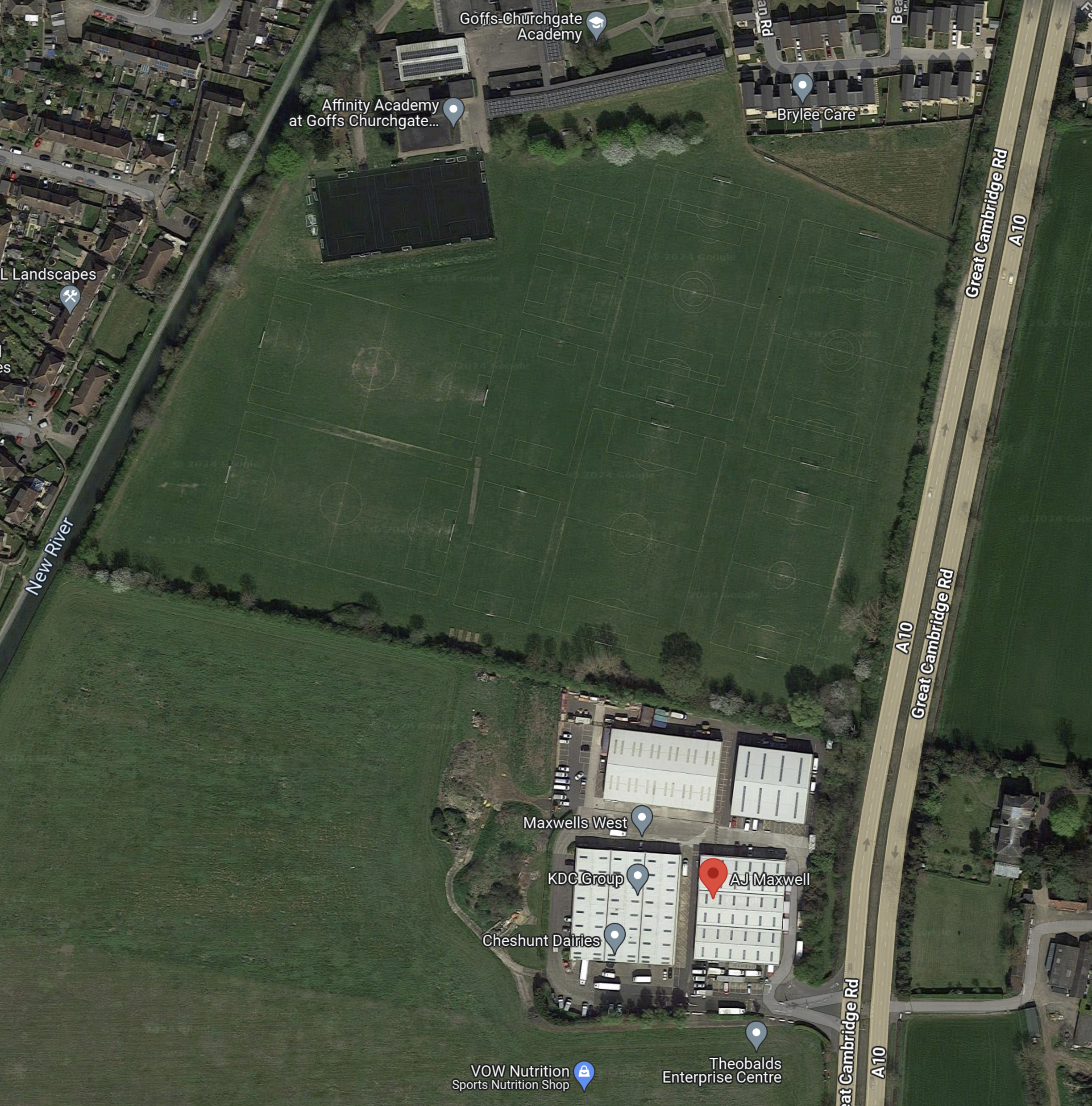
Note.
- A.J. Maxwell is identified by the red arrow in the Theobalds Enterprise Centre.
- The New River can be seen at the West of the map.
- A hedge runs roughly East-West to the North of the Enterprise Centre.
- North of the hedge are a number of football pitches, which appear to belong to the Affinity Academy at Goffs Churchgate.
The hedge could be the Northern boundary of the Google site.
This Google Map shows the area between the South of the Enterprise Centre and the East-West lane I picked out earlier.
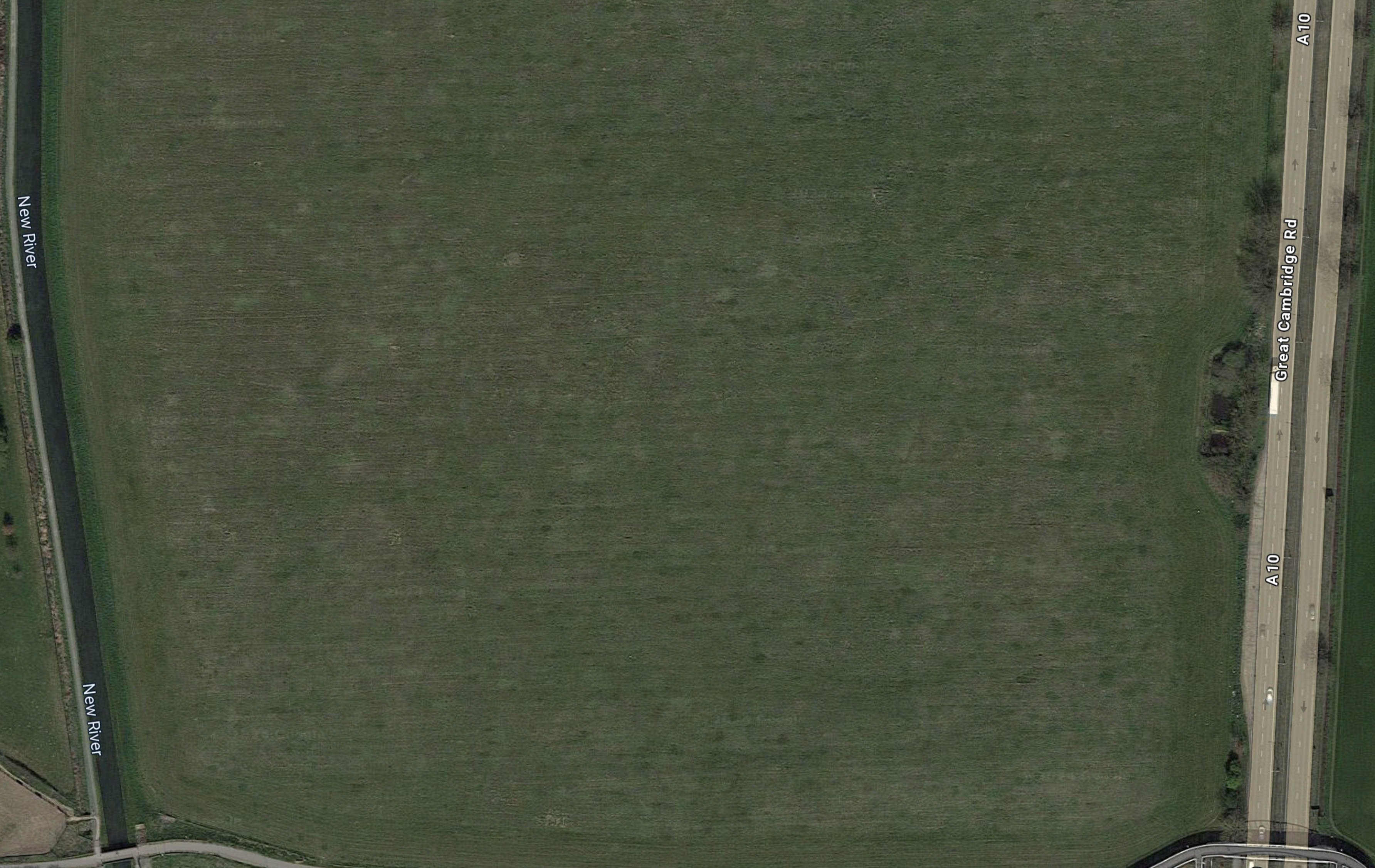
A crude measurement indicates it could be around 33 acres or slightly more.
This picture is used in nearly all the news reports about the Data Centre.

Note.
- Could that be the gentle curve of the New River on the left?
- With the high fence, the New River forms an almost-mediaeval defence against trespassers.
- There looks to be a dual-carriageway road running down the other side of the site, which would be the A10.
- Between the A10 and the site, there appears to be loots of dark areas, which I take to be car parks.
- Are the car-parking spaces in the front of the picture marked for those, who are disabled? There certainly appear to be chargers on some spaces.
I have a few thoughts.
The Relative Locations Of Google’s Data Centre And Sunset Studios?
This Google Map shows the two sites to the West of the A10.

Note.
- St. Mary’s High School is in the North-West corner of the map.
- Cheshunt Football Club is in the North-East corner of the map.
- The dual-carriageway A10 runs North-South on the map.
- I believe that Google’s Waltham Cross Data Centre will be located in the field to the West of the A10, at the top of the map.
- The A10 connects to the M25 at Junction 25, which is in the centre at the bottom of the map.
- In The Location Of Sunset Studios In Broxbourne, Sunset Studios are placed to the North West of the Junction 25 roundabout.
- Just as the A10 forms the Eastern boundary of both sites, the New River forms the Western boundary.
The two sites are close together between the A10 and the New River, separated by the dual-carriageway Lieutenant Ellis Way.
Will Google’s Data Centre Be Storing Data For Sunset Studios?
I’ve never worked in the production of films, but these days with digital electronic cameras, CGI, motion capture and other techniques, producing a film must need huge amounts of data storage.
- So have Sunset Studios outsourced their data storage needs to Google?
- Perhaps too, Sunset Studios found the local authority welcoming and this attitude was recommended to Google.
- Both sites will need local services like electricity, gas, sewage and water.
I suspect that there would be cost savings in construction and operation, if the two sites shared the utilities.
Providing Electricity And Heat For Both Sites
Consider.
- I estimate from information given in the Wikipedia entry for Google Data Centres, that a data centre needs between 10 and 12 MW.
- There is no obvious power source like offshore wind or a nuclear power station nearby.
- There is the 715 MW Rye House gas-fired power station, which is a few miles away.
- In Google Buys Scottish Offshore Wind Power, I talked about how Google had signed a Corporate Power Purchase Agreement to buy 100 MW from the Moray West offshore wind farm.
Google and Sunset Studios would also want an electrical and heat supply that is at least 100 % reliable.
Liverpool University had the same problem on their hundred acre campus in the centre of Liverpool.
- The University decided to build their own 4 MW Combined Heat and Power Unit (CHP), which is described in this data sheet.
- It is fired by natural gas.
- On their web site, Liverpool University state that their CHP can be adapted to different fuel blends. I take this includes zero-carbon fuels like hydrogen and carbon-neutral fuels like biomethane.
But given their location in Waltham Cross close to the Lea Valley, CHP units may have a use for their carbon dioxide.
This Google Map shows between Junction 15 of the M25 and Tomworld.

Note.
- Junction 25 of the M25, where it joins the A10 is in the South-West corner of the map.
- The sites of Google’s Data Centre and Sunset Studios can be picked out with reference to the previous map.
- Tomworld is in the North-East corner of the map.
- So why should Tomworld need a lot of carbon-dioxide?
This Google Map shows Tomworld.
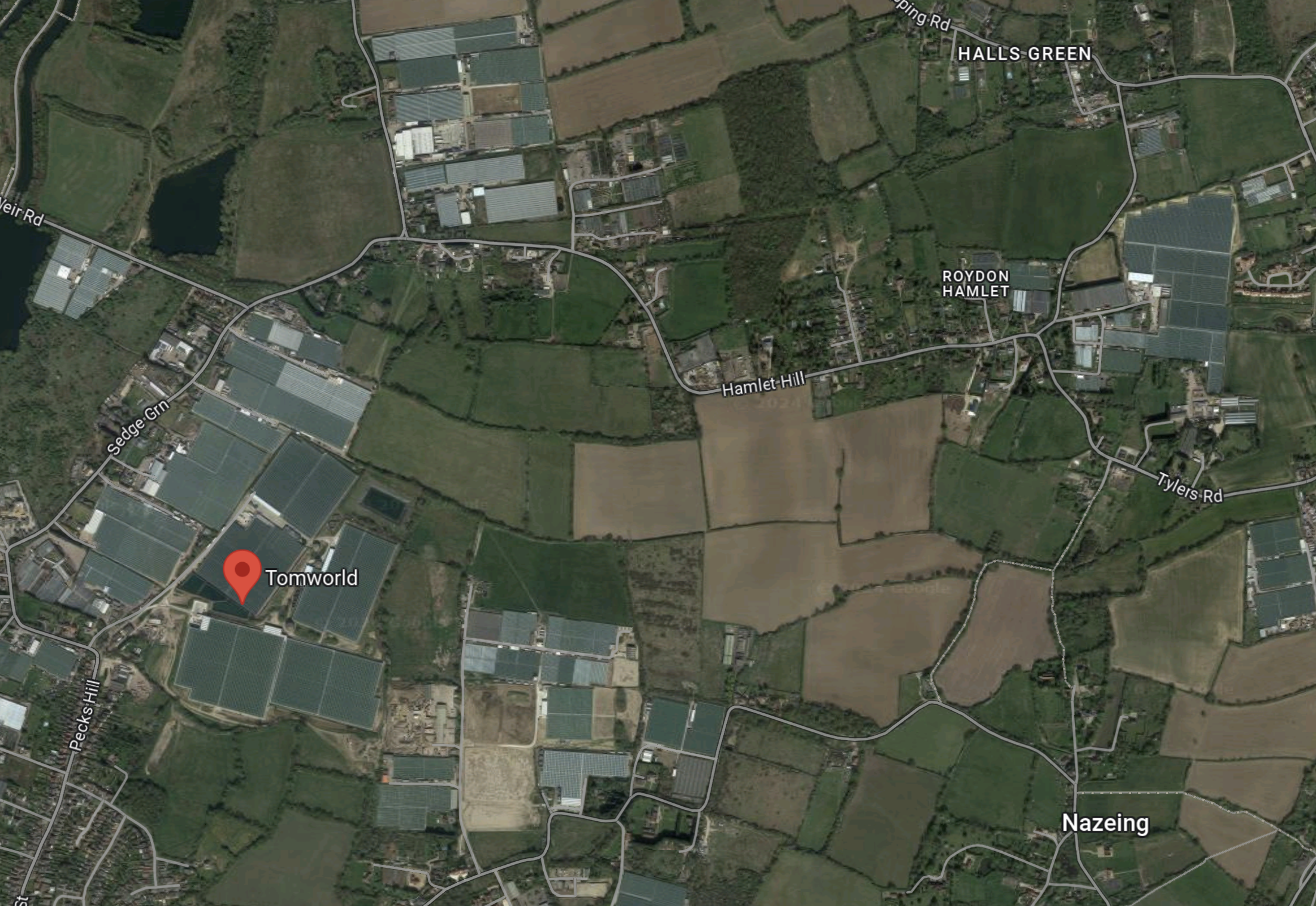
Note.
- This web page indicates what Tomworld do.
- They have 44 acres of glass growing tomatoes, about five miles to the North-East of Google’s Data Centre.
- The map has lots of other greenhouses.
I know of a guy, who has a large greenhouse, that grows tomatoes for the supermarkets.
- He heats the greenhouse with a gas-fired Combined Heat and Power Unit (CHP).
- The electricity produced runs his business.
- Any surplus electricity is fed into the grid.
- The carbon dioxide is fed to the plants in the greenhouse, which helps them grow quality tomatoes.
I just wonder, if carbon dioxide from CHP units at Google’s Data Centre and Sunset Studios could be used by the multitude of greenhouses in the Lea Valley.
Could A Carbon Dioxide Pipeline Be Built Along The M25?
This Google Map shows the Northern section of the M25, South of Waltham Cross.
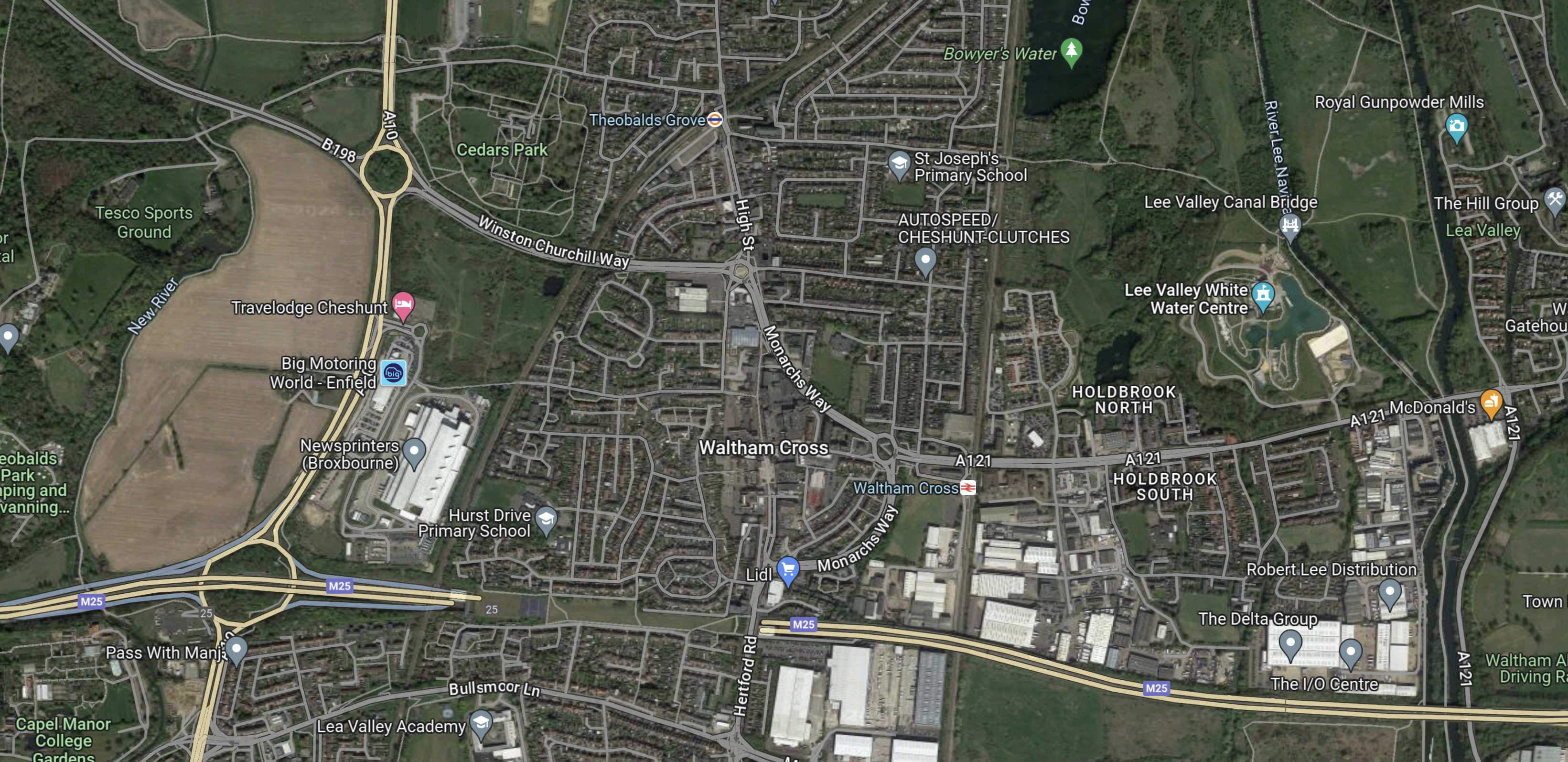
Note.
- The M25 running East-West across the bottom of the map.
- Junction 25 of the M25 in the South-West corner of the map.
- The A10 running North-South at the West of the map.
- Google’s data centre and Sunset Studio are to the West of the A10.
- The River Lee, which has numerous water courses is at the East of the map.
I wonder, if a carbon dioxide pipeline could be built along the M25 to connect the producers to those who could use it?
- It would not be a dangerous pipeline as carbon dioxide is a fire extinguisher.
- It wouldn’t be a huge pipe.
I think it would be possible.
Google’s Commitment To Being Zero-Carbon
This blog post on the Google web site is entitled Our $1 Billion Investment In A New UK Data Centre, has a section, which has a sub-title of 24/7 Carbon-Free Energy By 2030, where this is a paragraph.
Additionally, we’re also exploring new and innovative ways to use the heat generated by data centres, and this new facility will also have provisions for off-site heat recovery. Off-site heat recovery presents an opportunity for energy conservation that benefits the local community, as it allows us to capture the heat generated by the data centre so that it can be used by nearby homes and businesses. The data centre is also set to deploy an air-based cooling system.
If they are using off-site heat recovery, it would be logical to use waste carbon dioxide from CHPs to provide carbon dioxide for the local horticultural businesses.
Will Google Be Building A Vertical Farm Nearby?
In Schneider Electric: Vertical Farming – The Next Yield In Data Centre Sustainability, I noted that some data centres are paired with vertical farms to increase their sustainability.
Could Google be doing that in Waltham Cross?
- They will have a lot of waste heat.
- They will have a fair bit of carbon dioxide, which could be used to help plants grow.
- The local workforce probably contains a lot of experience of market gardening.
I like the idea of pairing a data centre and a vertical farm.
Public Transport Access
Consider.
- Increasingly, the cost of electric vehicles, medical problems and the UK economic situation are causing people to adopt a car-free lifestyle.
- After my stroke, my eyesight deteriorated such, that I am no longer allowed to drive.
- Others may live in one-car families and it may not be their’s to use every day.
- Or your car may just break down on the way to work.
For these and probably lots of other reasons, any large site employing a lot of employees, must have a valid way of getting there by public transport.
The nearest rail station to Google’s Data Centre and Sunset Studios is Theobalds Grove station.
This Google Map shows the roads between the sites and the station.
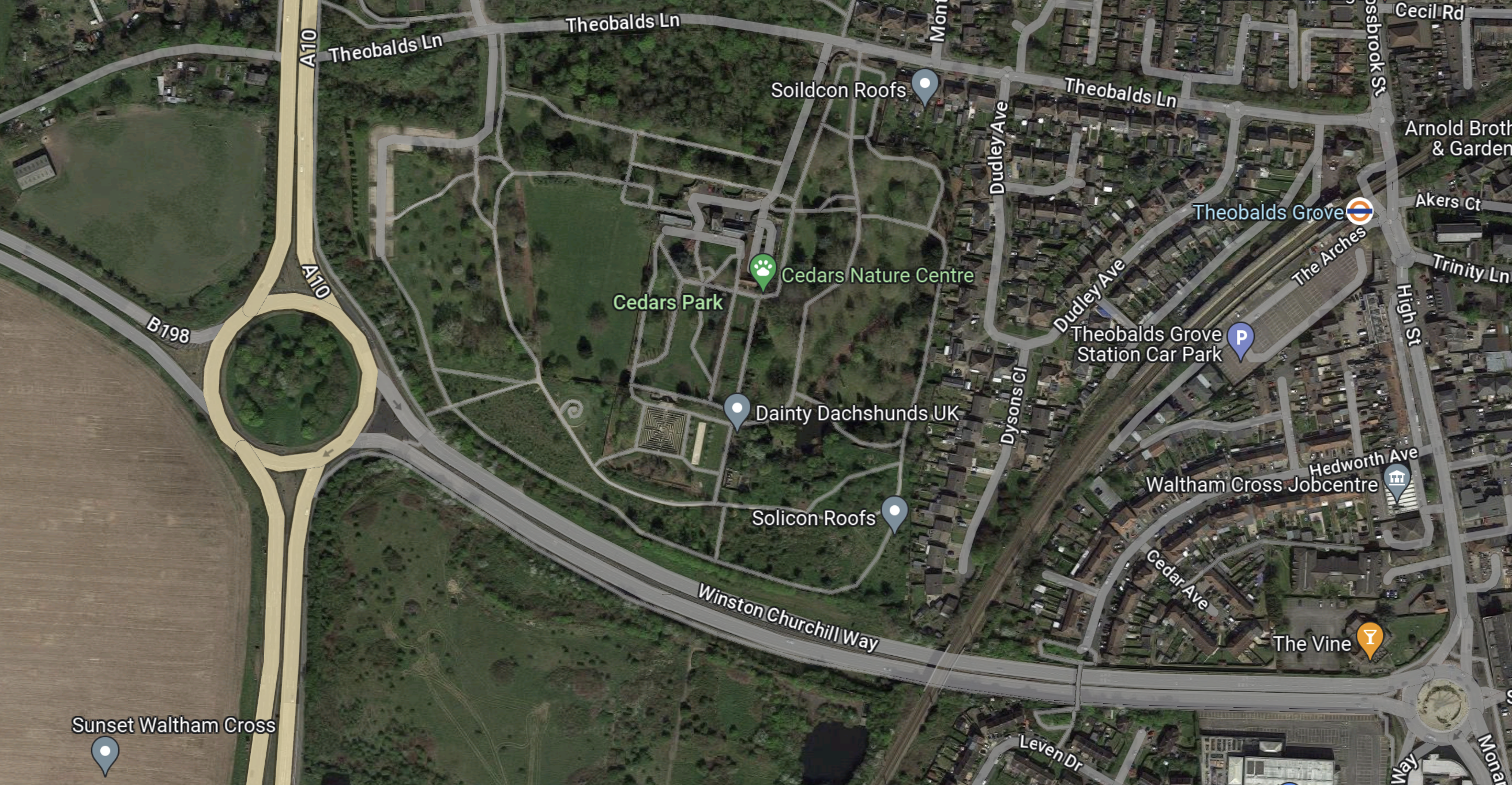
Note.
- The Sunset Waltham Cross label in the South West corner.
- Google’s Data Centre will be just off the map to the West of the A10.
- Theobalds Grove station is marked by the TfL roundel in the North-East corner of the map.
- There would appear to be no bus stops on Winston Churchill Way or the A10.
I walked South from the station to Winston Churchill Way, where I took these pictures.
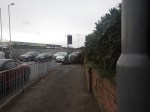




Note.
- At that point, I gave up because of the cold and pollution.
- It was also a Saturday morning about midday.
The route I took is certainly not an alternative route to get to Google’s Data Centre or Sunset Studios.
A Possible Station At Park Plaza North
This article on the BBC is entitled Broxbourne: Two New Stations Planned.
This is the sub-heading.
Two new train stations could be built in Hertfordshire if plans to tighten planning policies are adopted.
This is the first paragraph.
Broxbourne Borough Council said stops at Park Plaza North – between Turkey Street and Theobalds Grove London Overground stations – and Turnford on the London to Bishop’s Stortford route would be subject to a consultation.
Later the BBC say that Park Plaza North station will be South of the A121 Winston Churchill Way near Waltham Cross
This Google Map shows the area South-East of the roundabout, where Winston Churchill Way meets the A10.
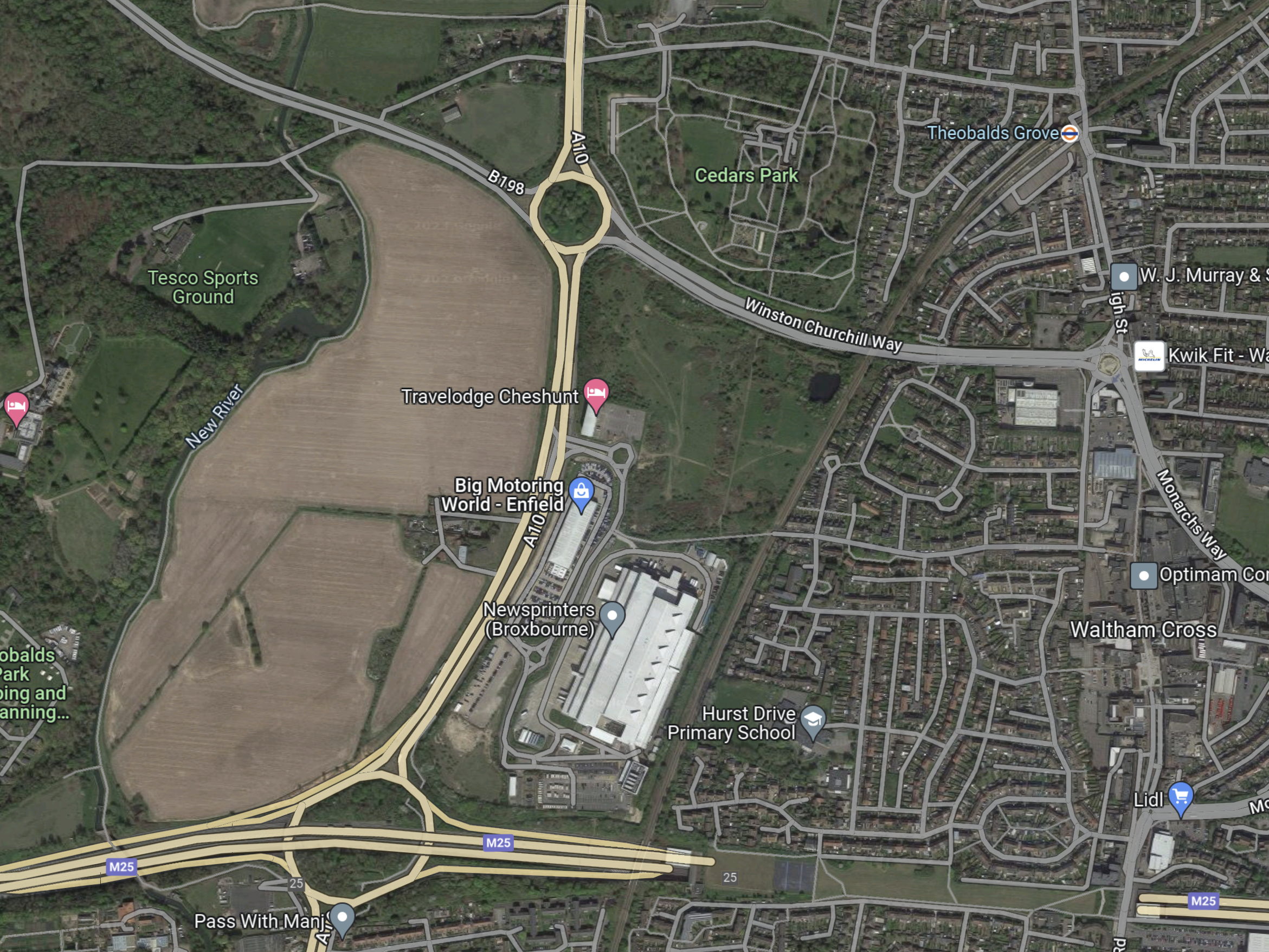
Note.
- The green patch of land to the South-East of the roundabout where Winston Churchill Way meets the A10 appears to be ripe for development.
- Looking at the green patch with a higher resolution, the land is little more than high class scrub beloved of newts.
- The London Overground line to Cheshunt runs down the East side of the site.
- To the North, the London Overground crosses Winston Churchill Way to get to Theobalds Grove station.
- To the South, the London Overground crosses the M25 to get to Turkey Street station.
- There is a lane running East-West along the South edge of the site, which crosses the railway in a level crossing.
This picture clipped from Google StreetView shows the level crossing.
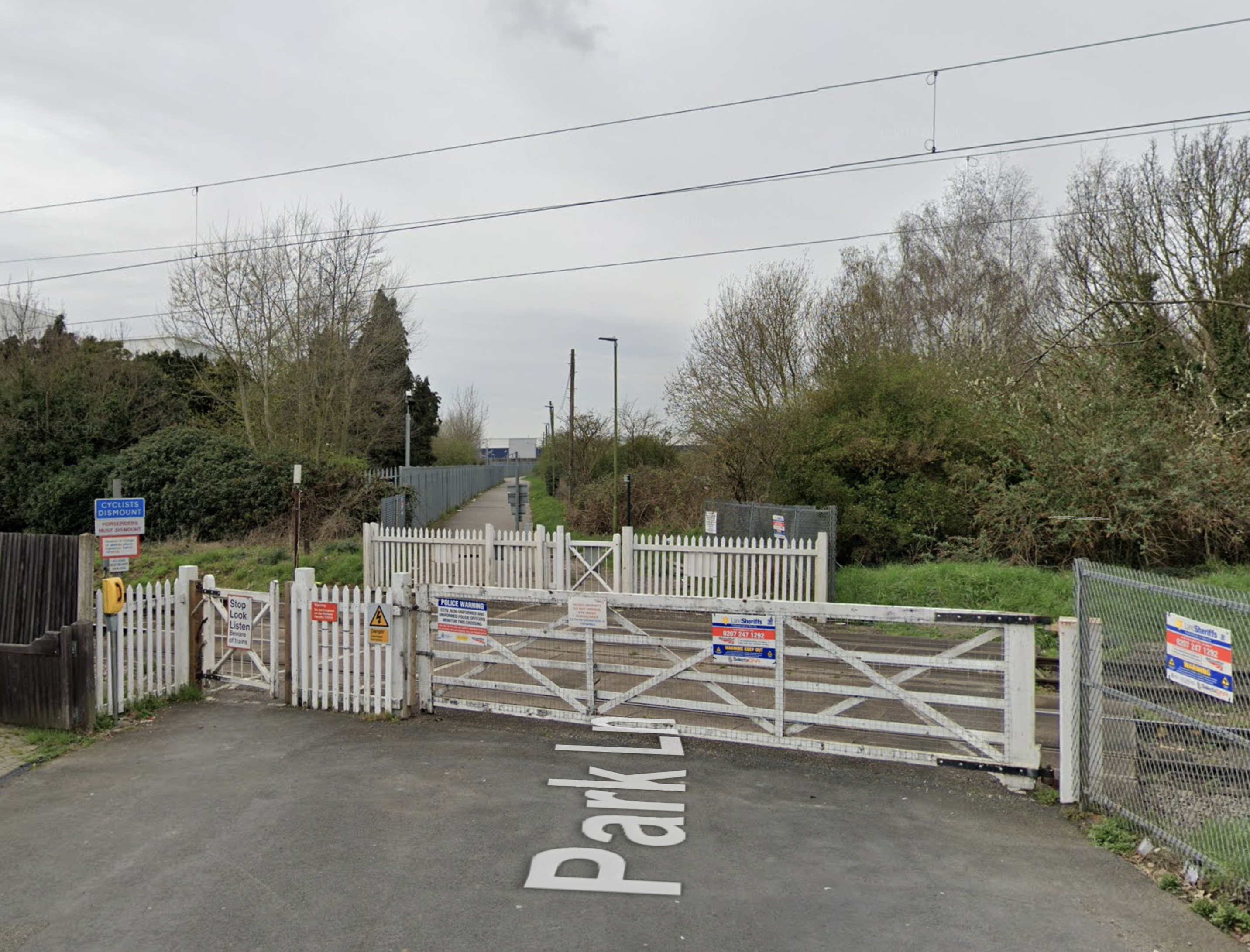
This is certainly one, that drivers dread.
This GoogleMap shows the level crossing and a stretch of the London Overground.
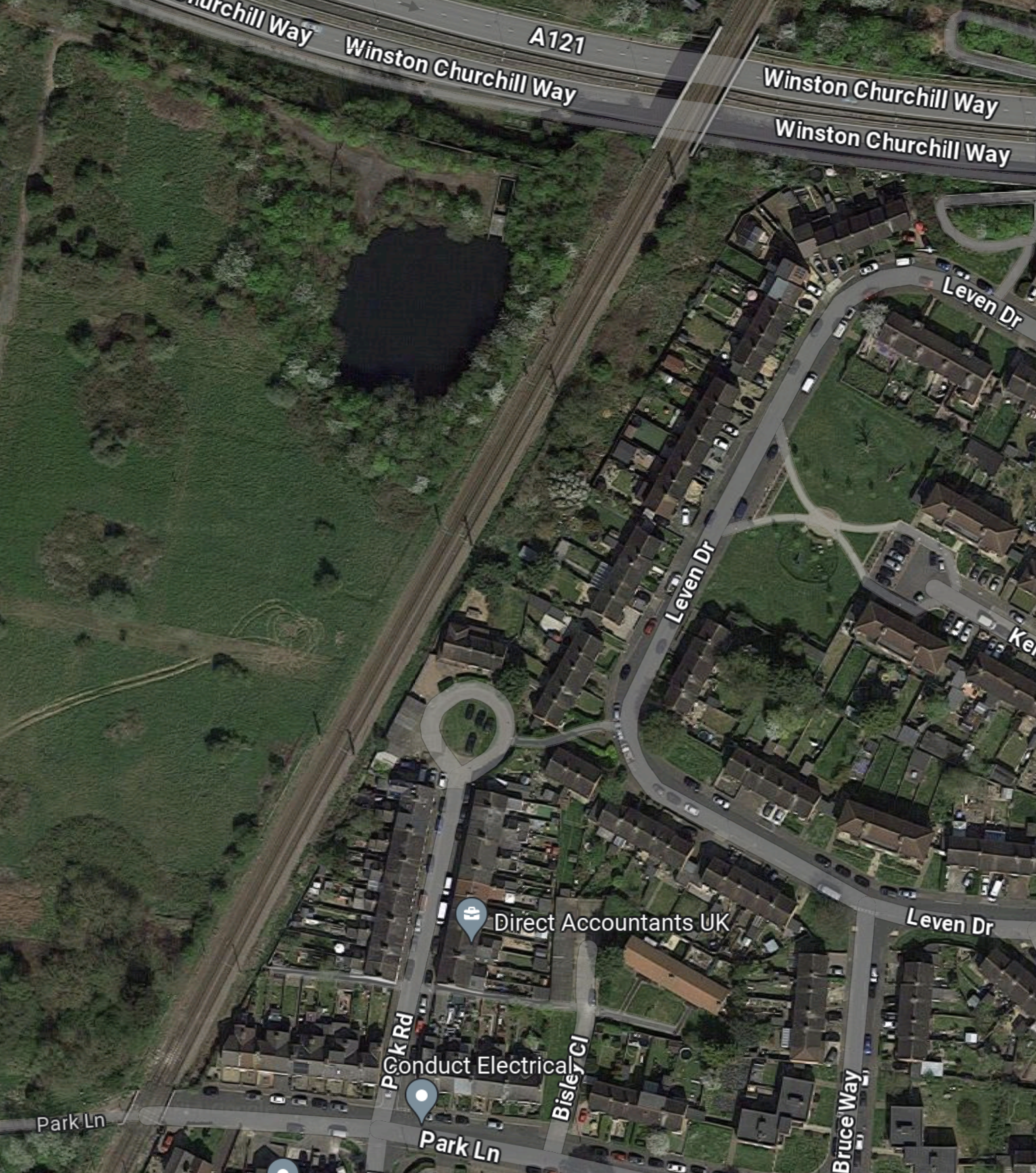
Note.
- The level crossing is in the South-East corner of the map.
- There isn’t much space to put a London-bound platform on the East side of the tracks, South of the Park Road circle.
- There is plenty of space to put a Cheshunt-bound platform on the West side of the tracks.
- North of the Park Road circle, there would appear to be space for two platforms.
It will need a lot of ingenuity to provide a safe and efficient solution to the problems of the level crossing and fitting a station in this limited space.
The first thing I’d do, would be to dig an underpass for pedestrians and cyclists to connect the two halves of Park Lane.
Bristol-Based Manufacturer And Centrica Agree Solar Power Purchase Agreement
The title of this post, is the same as that of this article on BusinessLive.
These three paragraphs outline the story.
A Bristol-based architectural aluminium manufacturer has agreed a power purchase agreement and long term lease of 7,000 solar panels on the roof of its UK headquarters.
Smart Architectural Aluminium (Smart) agreed the deal with Centrica Business Solutions, which will see the 2.94MW installation provide Smart with green energy for the next 25 years whilst servicing 20% of the sites current energy needs.
Centrica Business Solutions has started construction on the 7,000 solar panel array, across the roofs of three buildings at the manufacturing site in Yatton, near Bristol. The 2.94MW installation is the result of a long -term lease agreement between Smart and Centrica Business Solutions, which will see Centrica lease the roof space, finance the project and agree a power purchase agreement with Smart.
Some cynics will look at this deal and think that someone is getting ripped off.
- But the project starts with a non-productive asset; three roofs, which Centrica cover with solar panels.
- Most of the electricity generated will go to Smart and be paid for, as they would do, if they get it from the grid.
- Smart gets paid for the lease of the roofs.
- Centrica gets paid for any electricity that is fed into the grid.
- The leasing company gets paid by Centrica.
Centrica would appear to be the company taking the risk and if they do their sums correctly, they should make a profit.
Shine On – Centrica Opens Its First UK Solar Farm
The title of this post is the same as that of this press release from Centrica.
These are the bullet points.
- 18MW Codford Solar Farm in Wiltshire is Centrica’s first major solar asset
- Part of plans to build a material portfolio of low carbon assets
- Vodafone supports development with long term Power Purchase Agreement for 50% of the output over 10 years
- Additional renewable power supports the UK government’s ‘green grid’ ambitions
I have some thoughts.
Centrica’s First Major Solar Asset
These two paragraphs from the press release outline the project and indicate where it fits in Centrica’s overall philosophy.
Construction began at the site in Wiltshire in April 2022, after the consent was acquired by Centrica Business Solutions in 2021. Made up of 33,000 panels, the project has a total capacity of 18MW and should produce 19GWh of green electricity every year, enough to power some 4,850 homes.
The deal not only brings additional renewable power provision to the UK grid but supports the UK government’s ambition to focus on home-grown renewable energy to boost long-term energy independence and security.
My only reservation is at 18 MW it isn’t that large and the sun doesn’t always shine in the UK.
Centrica’s Portfolio Of Low Carbon Assets
This paragraph from the press release talks about the portfolio.
In late 2021, Centrica announced ambitions to deliver 900MW of low carbon assets by 2026. The company is currently building battery storage projects at former gas peaking plants at Brigg, Lincolnshire, Knapton, North Yorkshire, and Ostend in Belgium, and has developed a multi GW pipeline of projects.
Note that former gas power plants, usually have a very handy connection to the electricity grid.
900 MW would also rate at around the output of two typical gas-fired power stations.
Vodafone’s Power Purchase Agreement
Big companies like Vodafone seem to be increasingly signing Power Purchase Agreements for their renewable electricity. These must give advantages all round.
- The developer can take the purchaser’s deal to a bank and use it to raise capital for the project.
- The purchaser, in this case Vodafone can say that they use at least some zero-carbon electricity, which must help marketing.
- The bank knows that so long as the sun shines, there will be money flowing to the developer.
- The developer doesn’t have to deal with thousands of customers.
These three paragraphs from the press release outline Vodafone’s deal.
Vodafone will purchase half of the electricity output from the solar farm, helping to support its development and bringing additional renewable power provision to the UK Grid. Combined with agreements already in place, around 47% of the company’s annual energy requirement will come from UK-based renewable power sources by 2025.
The long-term Power Purchase Agreement (PPA) will see approximately 9GWh of green electricity dedicated to Vodafone UK. The remainder will be sold into the national grid through Centrica’s Energy Marketing & Trading business.
The deal is the third PPA signed by Vodafone and Centrica Energy Marketing & Trading over the last year. In May 2022, Vodafone and Centrica announced a long-term PPA with MYTILINEOS S.A for the output from three solar farms in the UK. And, in February 2023, Vodafone committed to take a significant proportion of the output from a further five solar farms in one of the largest corporate solar PPAs to date.
It looks like, when Vodafone’s other solar farms are connected, they will be able to advertise as a zero-carbon company running on renewable electricity.
That sort of green advertising hasn’t hurt Lumo’s trains between London and Edinburgh.
Connecting Codford Solar Farm To The National Grid
This Google Map shows the location of the Codford Solar Farm.
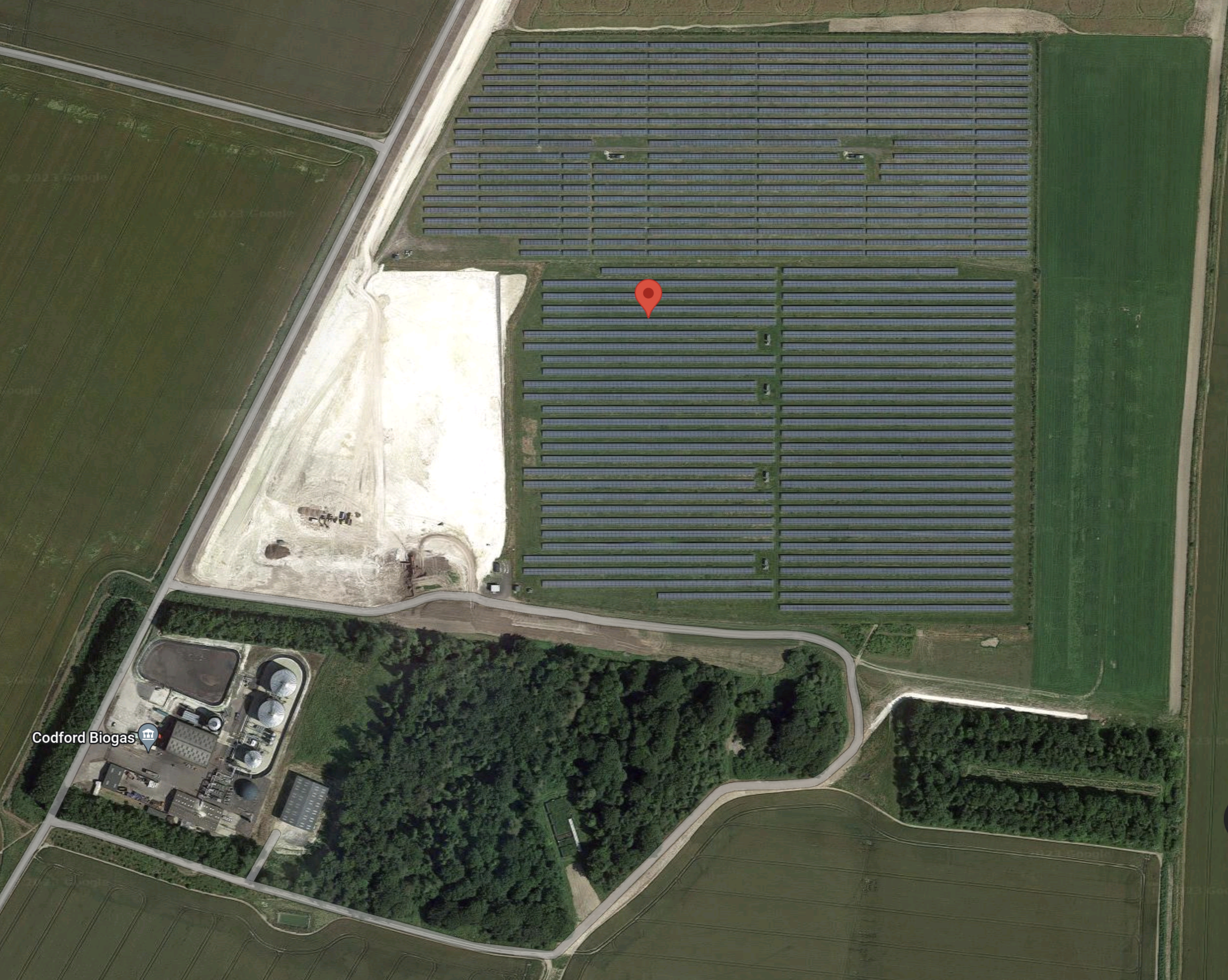
Note.
- The solar panels marked with the red arrow.
- Codford Biogas in the South-West corner of the map.
- The site is surrounded with the fields of a large arable farm, that grows wheat, barley and oilseed rape.
- The site is also shielded by trees.
This second Google Map shows Codford Biogas.
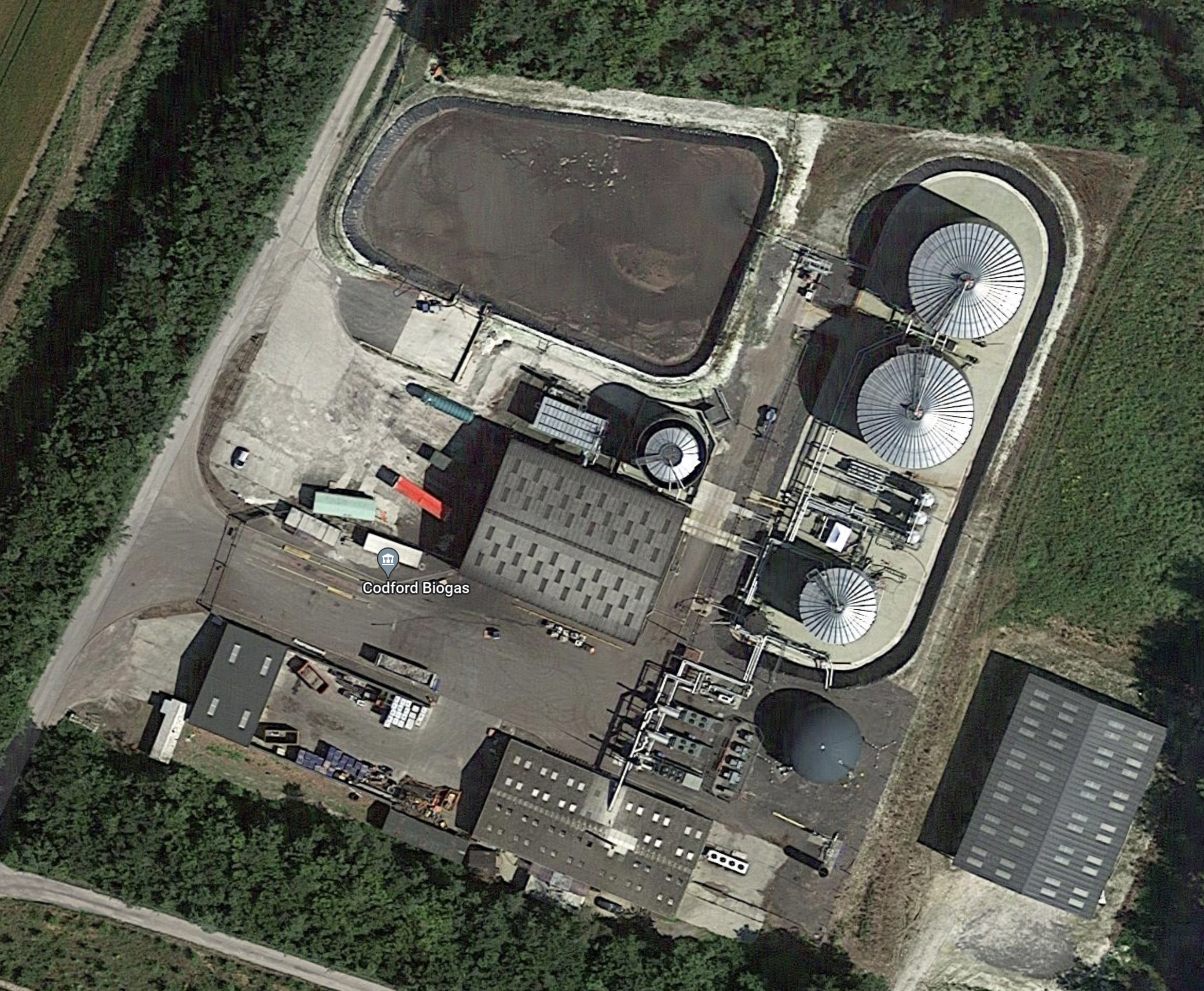
According to their web site, Codford Biogas accept the widest range of food waste in southern England.
The home page describes waste collection, secure disposal and carbon reduction.
Their method of disposal uses anaerobic digestion, which is a complex biological process involving the breakdown of organic matter in the absence of air in large, sealed and insulated vessels with controlled heating and mixing.
The Wikipedia entry for anaerobic digestion describes the process in detail.
On their web site, there is a page, which is entitled What Is AD?, which has an interactive graphic describing the process at Codford.
Main products from the site include.
- 3.6 MW of electricity, which can be fed to the grid.
- Fertiliser, which can be spread directly on the surrounding arable land.
- Waste heat, which will be developed for businesses that need it.
Obviously, the electricity export will need a grid connection, which I suspect will also be used by the new solar farm.
Conclusion
It looks like Centrica have piggy-backed their solar farm on to an existing grid connection.
But it does look like connecting your solar farm to the grid through a power station that can operate continuously, helps to give a more continuous output.
I think we’ll see more of this!
Google Buys Scottish Offshore Wind Power
The title of this post, is the same as that of this article on offshoreWIND.biz.
This is the sub-heading and the first paragraph.
ENGIE and Google have entered into a 12-year, 100 MW corporate power purchase agreement (CPPA) supporting the Moray West offshore wind development in Scotland.
ENGIE will provide Google with more than 5 TWh of green power from the Moray West project, a nearly 900 MW offshore wind farm set to begin generating power from 2025.
Increasingly, it seems that large energy users are committing themselves to long-term energy deals.
One of Google’s senior people is quoted as saying.
People across the UK and Europe are increasingly worried about climate change and energy security. We share that concern and believe technology is an important part of the solution – both by reducing our own emissions, and by helping others to reduce their own.
I have a few thoughts.
How Much Of Moray West’s Output Is 5 TWh?
Consider.
- Moray West has an maximum output of 882 MW.
- This converts to 7.73 TWh.
If Google are buying all the electricity produced by the wind farm, that would mean that the capacity factor is around 64.7 %, which is quite reasonable, if a bit high for a fixed foundation wind farm.
If we are, it does surely reflect a desire for stability and security in a fast-changing world.
Are We Seeing More Corporate Power Purchase Agreements (CPPAs)?
 The Anonymous Widower