Inside A Class 99 – The UK’s Most Powerful Locomotive
The title of this post, is the same as the title of this YouTube video.
This locomotive and its siblings, which can run on both electrification and diesel is the future of rail freight in the UK and GB Railfreight have ordered thirty of them.
Hopefully, by the end of the year, I’ll see one of these locomotives running along the North London Line, through Highbury & Islington and Dalston Kingsland stations.
At the present time, there are 480 Class 66 diesel freight locomotives in the UK. A substantial amount of carbon emissions would be saved, if as many as possible of Class 66 locomotives as possible were replaced by Class 99 locomotives.
These Class 99 locomotives will literally turn the rail freight business upside down.
Can These Locomotives Be Converted from Diesel To Hydrogen Power?
Stadler or Cummins have not said, but Cummins are decarbonising the company.
Already, large American trucks fitted with the latest Cummins engines can be converted to hydrogen. I write about this in Cummins Debuts Integrated HELM Drivetrain At IAA.
Cummins are also supplying Wrightbus with engines for the next generation of low-emission bus, as I wrote about in Wrightbus StreetDeck Ultroliner Next-Gen To Get Cummins Power.
Did Stadler fit a Cummins diesel engine in a Class 99 locomotive, as they know that every Class 99 locomotive or similar locomotives for other markets can be converted to hydrogen?
It is strange but very heartening, that when we have an American President, who thinks that climate change is fake news, one of the United States, largest and most iconic companies is leading the charge to decarbonisation.
Could Manchester Airport Be Accessed From The West By A Tunnel Under The M56?
This OpenRailwayMap shows the railways of East London between Dalston Junction and Stratford International stations.

Note.
- Dalston Kingsland station is marked with an arrow in the West of the map.
- Stratford International station is marked by the blue lettering in the East of the map.
- The orange line between them is the North London Line.
- There are also two pink lines, which indicate High Speed One, which is dug several metres below the North London Line.
It can’t be much different to dig a high speed railway underneath a motorway. Has anybody done this?
This OpenRailwayMap shows the railways leading to Manchester Airport.
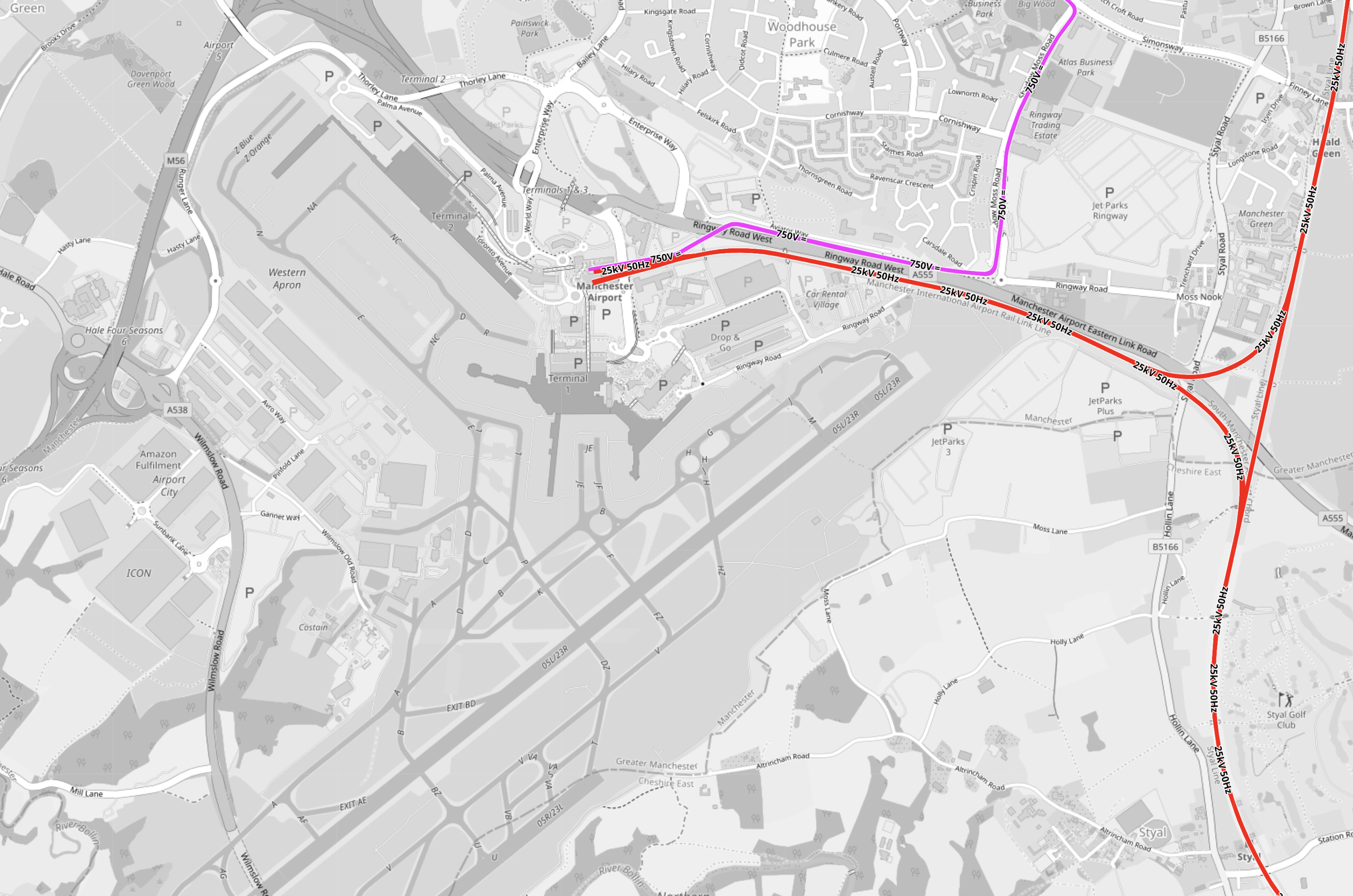
Note.
- Junctions 5 and 6 of the M56 motorway are on the Western edge of the Airport.
- The red tracks are the Styal Line.
- The mauve tracks are the Metrolink.
- It should be noted that railway lines pass under Heathrow Airport’s runways.
Point 4 makes me sure, that Manchester Airport can have a station connected to the West by a railway under the M56.
This OpenRailwayMap shows the railways around Weaver Junction on the West Coast Main Line, where the trains branch off to Liverpool.

Note.
- The West Coast Main Line goes down the Eastern side of the map.
- Warrington Bank Quay is the next station to the North.
- The Liverpool Branch goes off to the West.
- The M56 tuns diagonally across the map from the North-East corner crossing both both branches of the West Coast Main Line.
This Google Map shows where the M56 crosses over the West Coast Main Line to Warrington Bank Quay.
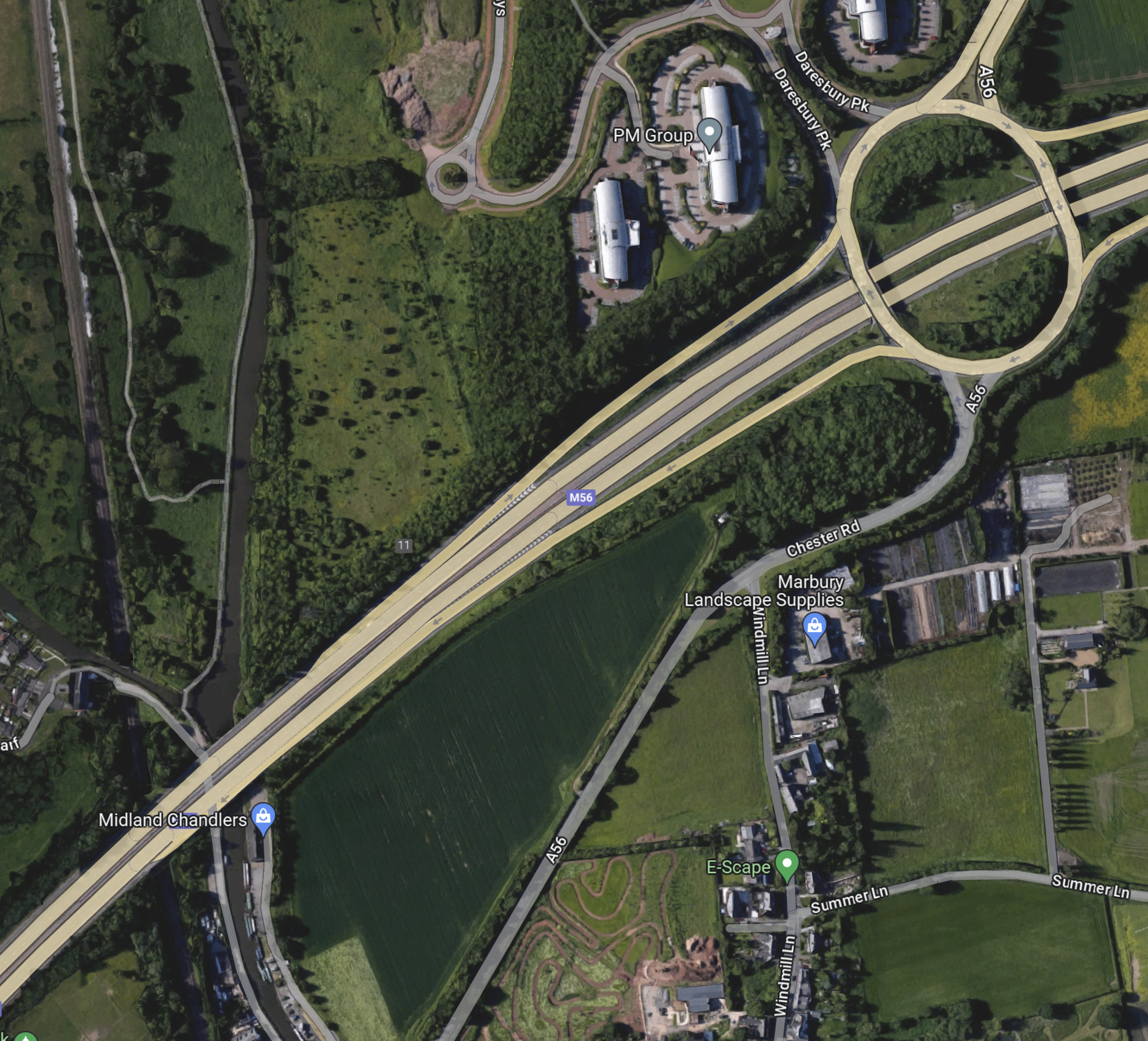
Note.
- The M56 motorway is obvious.
- The Eastbound motorway goes to Manchester Airport and Manchester.
- The junction is numbered 11.
- The railway runs down the Western side of the map.
I believe that it would be possible to connect a railway running East under the motorway to the West Coast Main Line.
This Google Map shows where the M56 crosses over the Liverpool branch of the West Coast Main Line.
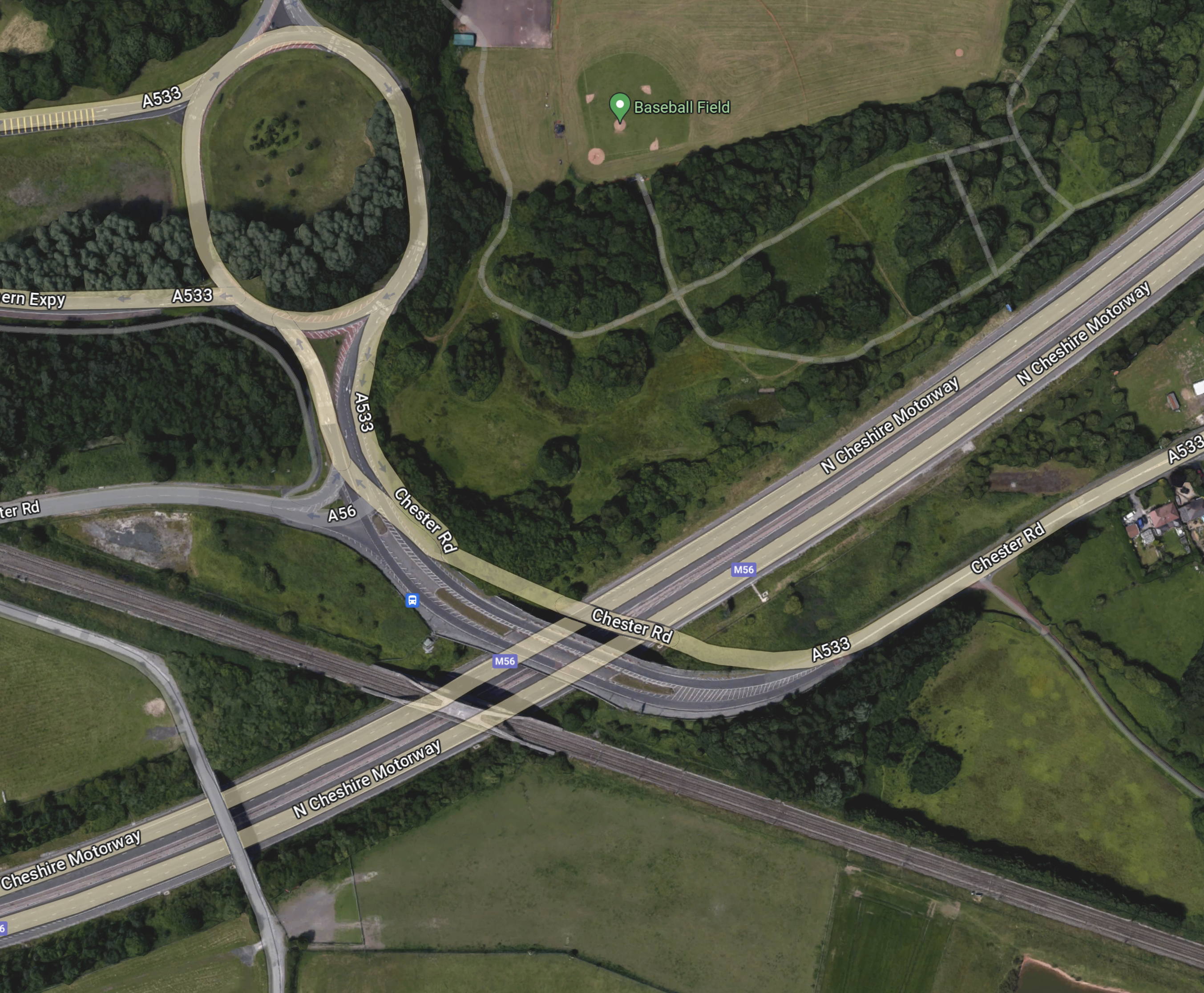
Note.
- There is no motorway junction here.
- The North-East bound motorway goes to Manchester Airport and Manchester.
- The railway runs slightly diagonally across the bottom of the map.
- The Westbound railway goes to Runcorn and Liverpool.
- The Eastbound railway goes to Weaver Junction, Crewe and the South.
There would only need to be a connection between Liverpool and the railway under the motorway going to and from Manchester Airport.
I have some further thoughts and questions.
This Is Just My First Thought
I am happier about the connection to the Liverpool branch than the Northern connection.
But then I feel there are several routes at both junctions, some of which will take a wider route.
How Long Will The Tunnels Be?
Between Junctions 11 and 6 on the M56 is 16 miles.
At What Speed Would The Trains Run?
I suspect that once on the straight section between Junctions 11 and 6, speeds of up to 90 or 100 mph should be possible, but speeds would probably be lower at the junctions to the West Coast Main Line.
How Would It Connect To Manchester Piccadilly?
The tunnel would continue the other side of the Airport and it’s a further 9.4 miles to under Manchester Piccadilly.
In The Rival Plans For Piccadilly Station, That Architects Say Will ‘Save Millions’, I wrote about Weston Williamson’s plan for Manchester Piccadilly station.
This was their visualisation.

Note.
- In the visualisation, you are observing the station from the East.
- The existing railway lines into Piccadilly station are shown in red.
- Stockport and Manchester Airport are to the left, which is to the South.
- Note the dreaded Castlefield Corridor in red going off into the distance to Oxford Road and Deansgate stations.
- The new high speed lines are shown in blue.
- To the left they go to Manchester Airport and then on to London, Birmingham and the South, Warrington and Liverpool and Wigan, Preston, Blackpool, Barrow-in-Furness, the North and Scotland.
- To the right, they go to Huddersfield, Bradford, Leeds, Hull and the North East, and Sheffield, Doncaster and the East.
- Between it looks like a low-level High Speed station with at least four tracks and six platforms.
- The high speed lines could be oriented so they ran East-West, rather than North-South in this visualisation.
- The Manchester Metrolink is shown in yellow.
The potential for over-site development is immense. If the Station Square Tower was residential, the penthouses would be some of the most desirable places to live in the North.
Onward From Manchester Piccadilly
I would hope that a connection could be made to the Huddersfield Line to the East of Manchester Piccadilly station, so that trains could use the TransPennine Upgrade all the way to Leeds.
Could Highbury & Islington And Canada Water Stations Be Connected By A Twelve Trains Per Hour Service?
This article on IanVisits, is entitled More Frequent Trains And A New Station For The London Overground.
This is said.
In a statement, the government agreed to requests for £80.8 million from the GLA to support transport upgrades so that 14,000 homes can be built along the East London Line.
Upgrades include
- New Bermondsey station, which was originally to be called Surrey Canal Road, will be built.
- A second entrance will be built at Surrey Quays station.
- Frequency between Dalston Junction and Clapham Junction stations will be increased from four trains per hour (tph) to six tph.
- Frequency between Highbury & Islington and Crystal Palace stations will be increased from four tph to six tph.
The frequency upgrades will mean twenty tph between Dalston Junction and Surrey Quays stations, or a tyrain every three minutes as opposed to the current three minutes and forty-five seconds.
Consider the section of the East London Line that I use most between Highbury & Islington and Canada Water stations via Whitechapel station.
- Highbury & Islington station has good connections to the Victoria Line, the Northern City Line and the North London Line.
- Highbury & Islington station is the thirteenth busiest station in the UK.
- Whitechapel station has good connections to the District and Hammersmith & City Lines, which have recently been increased in Frequency.
- Whitechapel station will be on Crossrail, when it opens.
- Canada Water station has a good step-free connection to the Jubilee Line.
- Canada Water station is the seventeenth busiest station in the UK.
- Currently, the frequency between Highbury & Islington and Canada Water station is eight tph and after the improvements it will be ten tph.
The frequency increase is to be welcomed but I wonder if it could be better.
Would it be possible that in addition to the proposed changes, the West Croydon and Clapham Junction services should swap Northern terminals, as they do on Sundays.
This would not affect any services South of Dalston Junction, but it would increase the number of services between Dalston Junction and Highbury & Islington via Canonbury to twelve tph.
This would give several benefits.
- Passengers changing from the North London Line to go South, would have an easier change at the less-crowded Canonbury station, rather than Highbury & Islington. Canonbury has only one Southbound platform, simpler passenger flows, is fully step-free and as the trains on the East London Line, will be at a higher frequency, the waiting time would be less and a maximum of just five minutes.
- Passengers could avoid the cramped Dalston Kingsland, which is not step-free, on many journeys.
- Half the trains going North through Dalston Junction would have a cross-platform interchange with the Westbound North London Line at Highbury & Islington.
- Passengers going South from Dalston Junction wouldn’t dither about at the bottom of the stairs, trying to ascertain, which train is going first. As there would be sixteen trains per hour leaving on the left island Platform 3/4, only passengers going to New Cross would go right.
- Dalston Kingsland and Highbury & Islington is one of the busiest Peak Hour services in the UK. Twelve trains per hour on the alternative route might ease the congestion.
- The increased frequency might help, when Arsenal are playing at home.
- In some ways, maximising the service between Dalston Junction and Highbury & Islington, compensates for the annoying cut-back of the 277 bus service.
I do feel that swapping the two services so that both six train per hour services terminate at Highbury & Islington could be beneficial.
Hopefully, TfL have got there first! Unless of course, there’s an operational reason, why the swap can’t be done!
House Prices And Stations
I clipped this from the Evening Standard.
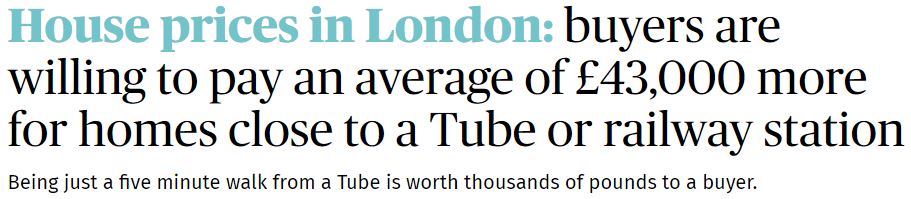
Enough said!
I purposely chose my house to be within ten minutes walk from the two Dalston Overground stations, that would open a couple of years after I moved in.
- It is also within walking distance of twelve major bus routes. All the routes can carry wheel-chairs, if I should ever need one!
- Five routes have stops, within a hundred metres, serving Bank, British Museum, Euston, Harley Street, Kings Cross, London Bridge, Manor House, Moorgate, Piccadilly Circus, Shaftesbury Avenue, St. Pauls, University College Hospital and Victoria.
- I’m only fifty metres from a major cycling route between the City and White Hart Lane.
- I even have a garage, that opens onto the street! But no car!
- My road is wide and there is usually plenty of parking space for visitors or on-line deliveries.
- A taxi ride from Euston, Liverpool Street or Kings Cross is usually under fifteen pounds at all times.
It will get even better!
- When Crossrail opens, I will have 10-12 buses per hour to the Moorgate/Liverpool Street station.
- Dalston Junction station will get a frequency of twenty trains per hour to and from Canada Water, Shoreditch and Whitechapel, that fan out to a selection of places in South London like Crystal Palace, Clapham Junction, Peckham and Penge.
- Dalston Kingsland station will get a frequency of twelve trains per hour to Stratford in the East and Camden, Clapham Junction, Hampstead and High Speed Two in the West.
- I will probably get a series of electric car charging points in the parking spaces in the road, where I live.
- I could put a personal electric car charging point in my garage.
I’m told the value of my house has risen well in the almost ten years, I’ve owned it.
Did somebody once say, that the location of a property, were the three most important things about it?
Conclusion
Make sure your next property has good access to public transport.
The Dalston Kingsland Station Problem
One of my local stations on the North London Line is Dalston Kingsland station.
Unlike Hampstead Heath station and the three neighbouring stations of Canonbury, Dalston Junction and Hackney Central, there are no lifts at Dalston Kingsland station and the stairs are narrower without a central rail.
Looking at the passenger traffic at the stations I have mentioned, gives the following numbers for 2017-18 in millions.
- Canonbury – 3.0
- Dalston Junction – 5.7
- Dalston Kingsland – 5.5
- Hackney Central – 4.3
- Hampstead Heath – 3.3
Dalston Kingsland serves almost as many passengers as does the nearby Dalston Junction, but it is a very inferior station.
- Recently, a high capacity wide gate-line has been installed.
- When trains call at the station, it is difficult to get to the platforms, unless you wait until arriving passengers have come up the stairs.
- There are no lifts.
- More housing is being built around Dalston Kingsland station.
- In December 2018, the train frequency through Dalston Kingsland was raised to eight from six trains per hour (tph).
Is Dalston Kingsland station an accident waiting to happen?
Various plans and other improvements will effect the passenger traffic through Dalston Kingsland station.
More Trains Through Dalston Kingsland Station
In Gospel Oak-Barking Fleet Plan Remains Unclear, I calculated that running the current combined eight tph service between Stratford and Clapham Junction/Richmond needs twenty trains.
- Increasing this service from four tph to five trains per hour to both Western termini, would increase the frequency between Stratford and Willesden Junction to ten tph.
- It would also require twenty-five trains to run the service.
- London Overground has six five-car Class 710 trains on order, that will be used to improve the service on the North and West London Lines.
This would leave a spare train to cover failures and maintenance.
So it would appear that Dalston Kingsland station could get a train every six minutes in both directions.
Passengers would appreciate this, but what about the freight operators, that use the line?
Will a twenty-five percent increase in train capacity result in a similar increase in passengers using the stairs at the station?
The Effect Of London Overground Syndrome
In London Overground Syndrome, I described the syndrome like this.
This benign disease, which is probably a modern version of the Victorian railway mania, was first identified in East London in 2011, when it was found that the newly-refurbished East London Line and North London Line were inadequate due to high passenger satisfaction and much increased usage. It has now spread across other parts of the capital, despite various eradication programs.
The North London Line through Dalston Kingsland station seems to have a particularly strong form.of the syndrome.
In December 2018, the frequency through the station was increased by thirty-three percent, but overcrowding in the Peak seems not to have reduced.
Could it be that because the line offers a more pleasant and easier connection between Stratford, Highbury & Islington, Camden, Hampstead, Willesden, Clapham Junction, Acton and Richmond, that any increase in capacity is welcomed and passengers transfer from a more crowded Underground?
There will be more Ducking and Diving!
Crossrail Effects
I suspect only educated guesses can be made, as to what effects Crossrail will have on Dalston Kingsland station.
Judging by the number of passengers, who get on and off Overground trains at Highbury & Islington station, a lot of passengers use the North London and Victoria Lines for commuting and other journeys.
Crossrail, with its connection to the North London Line at Stratford and eventually at Old Oak Common will take passengers from the North London Line and the various connections between the two lines, will further even out passenger traffic.
If it does, it will be Londoners Ducking-and Diving again!
Avoiding Dalston Kingsland Station
I think that some groups of passengers will avoid Dalston Kingsland station.
- Like me, some travellers have a choice of station.
- Passengers walking between the two Dalston stations, may choose to use the shorter step-free interchange at Canonbury.
- As the frequencies on the Overground increases, passengers may find that a less obvious route is better for them.
- I suspect some savvy passengers take a train from West Croydon at Dalston Junction station and then cross the platform at Highbury & Islington station.
It’s classic animal behaviour to avoid problems and go by a better way.
Northern City Line Effects
The Northerrn City Line between Highbury & Islington and Moorgate stations could have an effect on passenger numbers at Dalston Kingsland station.
In a couple of years, the line will be much improved.
- Services will be running seven days a week.
- Elderly Class 313 traiins will have been replaced by new Class 717 trains.
- There will be a step-free connection to Crossrail at Moorgate station.
- Frequencies will be significantly increased.
Overall, there will be a new high-capacity line running North-South within walking distance or a couple of bus stops of the two Dalston stations.
I have already started to use the line more, by catching a bus to Essex Road station for a train to Moorgate station. It’s quicker in the morning Peak.
HS2 Effects
I remember using the North London Line in the 1970s, between Broad Street and Willesden stations. It was terrible. But now, when High Speed Two opens in 2026, London’s Mucky Duck which has grown into a swan, will speed you to Old Oak Common station for your journey to the North.
Because many of these travellers will have heavy bags with them, all stations on the North London Line must be made step-free.
Highbury & Islington Station Improvements
Highbury & Islington station was rebuilt for the Victoria Line in the 1960s, when costs were much more important than passenger convenience.
The area outside the station is being sorted, but the plans are starting to be developed to create better and step-free access to the deep level platforms.
A much improved Highbury & Islington station would create a lot of easier routes from both Dalston stations.
Essex Road Station Improvements
Essex Road station has lifts, but is not step-free as the lifts go to well below the platforms, to which the final connection is a long set of steps.
The station sits on what must be a valuable site in Islington, which would be ripe for redevelopment.
Redevelopment of this station will happen and it will make things a lot better for me, as it is within my walking range or a short bus ride.
Bus Improvements
When I moved to Dalston in 2010, there was a good bus service to Highbury & Islington station along the Balls Pond Road.
But now, a South London Mayor has cut this, because I suspect we can use the Overground.
But this assumes that Dalston Kingsland station is has quality access. Which of course it doesn’t!
The buses must be improved along the Balls Pond Road.
Six-Car Trains Through Dalston Kingsland Station
I’ve deliberately left this to last, as it is the biggest and most difficult.
There are two routes through Dalston Kingland station.
- Four tph on that use the West London Line to go to Clapham Junction station.
- Four tph on that use the North London Line to go to Richmond station.
One or both of these routes might be possible to be run by six-car trains using selective door opening on the short platforms.
Lengthening the new Class 710 trains will not be a problem, as a few extra coaches would be ordered.
On the other hand lengthening the existing Class 378 trains may be more problematical, as they are out of production. I suppose that two five-car trains could be converted into a six-car and a four-car.
Six-car operation would surely add twenty percent to the passengers going through the station.
The Future Of Dalston Kingsland Station
The extra trains and capacity through Dalston Kingsland station will increase the pressure on the inadequate access at the station.
But some of the other improvements will divert passengers from the station and take the pressure off.
I suspect that Transport for London are hoping this will be sufficient action to keep the station functioning at a comfortable level, until it is rebuilt for Crossrail 2.
But that is a tough ask and could contain a lot of wishful thinking.
Conclusion
Dalston Kingsland station needs lift and wider and safer stairs in the near future.
Stairs And A Lift At Cannon Street Station
These pictures show stairs and a lift at Cannon Street station, that provide access between the National Rail and Underground stations.
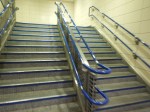
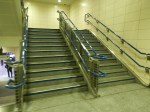
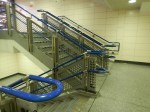
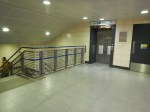
In my view this is one of the best installations, that I’ve seen.
- There is a lift for those who need one.
- The stairs are wide with an additional central hand-rail.
- The hand-rails are double and covered in comfy blue plastic.
This may be impressive, but as yet, there is only a full step-free connection to the Eastbound platform.Underground.
Obviously, all railway stations should be step-free, but to do all stations in the UK in a short time would be expensive and probably disruptive too!
But one thing that can be done at many stations, is to improve the hand-rails.
One of the worst stations near me, is Dalston Kingsland station, which was rebuilt a few years ago with a narrow staircase to each platform.
There has already been an incident at the busy station, where four people were hurt, as reported in this article on City AM.
Were the narrow stairs partly to blame?
Dalston Goes French
I know that De Beauvoir Town, where I live, is next to Dalston’s Kingsland Road, which is the local High Street, but surely for the local Marks and Spencer to sell sandwiches labelled in French is going a bit far.

What would the Rees-Moggies say of this?
Marks And Spencer Returns To Dalston
Marks and Spencer used to have a shop in Dalston, but it is now long gone. In those days before and during the Second World War, the shop would have been close to where my mother worked at Reeves.
Yesterday, I went to the littleWaitrose at Highbury and Islington, only to find it was being rebuilt, so I decided to take the Overground to Dalston Kingsland station and get the tin of cannellini beans, needed from the big Sainsburys opposite.
On turning right out of the station, I saw a new store had been opened under a new residential block.
Imagine my surprise, when I saw it was a new M & S Foothall.
But Marks and Spencer don’t sell cannellini beans, do they? Oh! Yes they do!
- This new stop may only have a short frontage on the street, but it is deep.
- It is much more Kings Road, than Dalston Kingsland High Street.
- The gluten-free section is massive.
- I was even able to get the Southwold 0.5% low-alcohol beer.
These pictures show the store on Dalston Kingsland High Street.
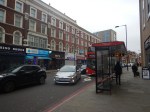
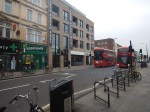
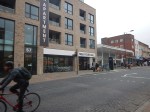

I suspect this store will be a roaraway success.
- It is a high-quality store.
- The world-famous Ridley Road Market is opposite.
- The only major store in the area, is a medium-sized, but rather tired Sainsburys.
- Passengers changing between the two alston stations will have to pass the front door.
- It is up there with new stores I’ve seem in Camden Town, Muswell Hill and West Hampstead.
If Crossrail 2 is built, it will sit right on top of the Dalston mega-station.
The Dalston Eastern Curve
In several posts like Improving The East London Line, An Opportunity For Dalston, Platforms 11 And 12 At Stratford and Missing Links On The Overground, I mention the Dalston Eastern Curve. Currently, the land is occupied by a community garden called unsurprisingly the Dalston Eastern Curve Garden.
The Google Map shows the area.
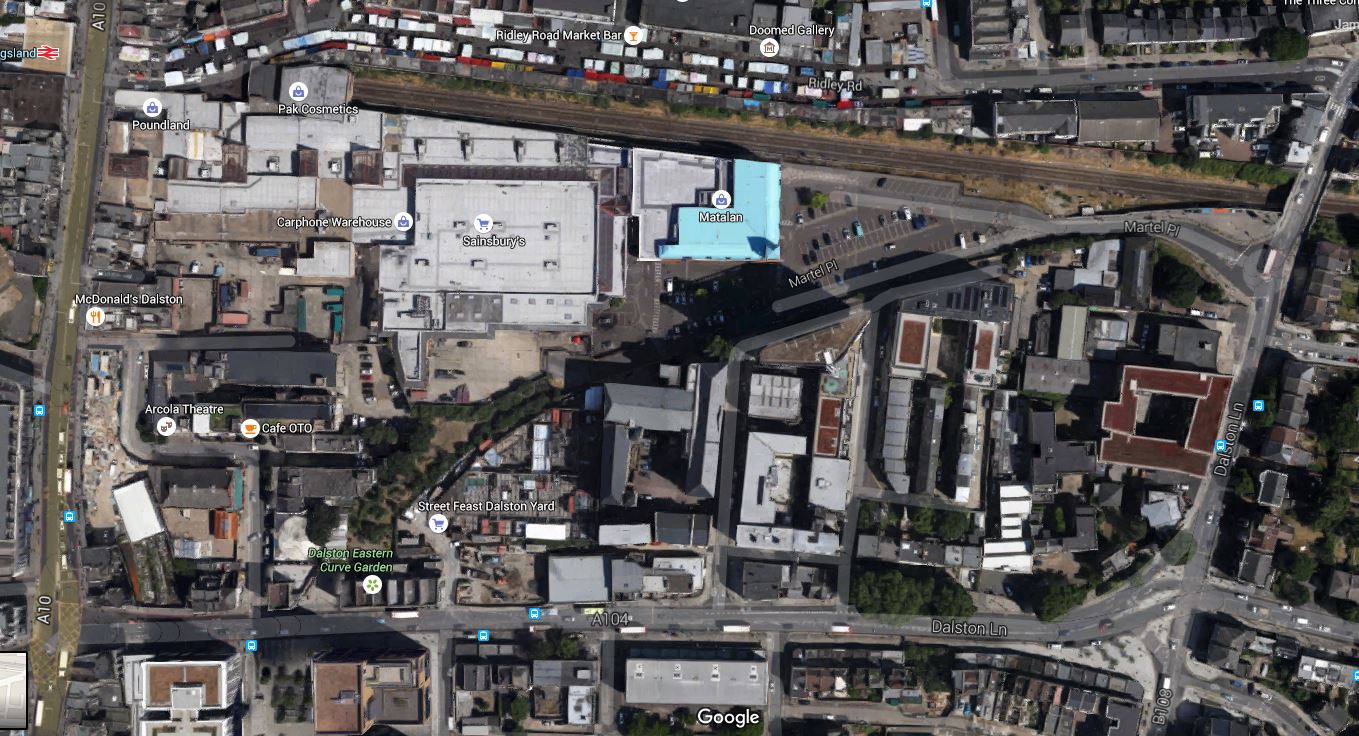
Dalston Eastern Curve
The line of the Dalston Eastern Curve is clearly shown, as it leaves the North London Line that goes across the map, and curves its way down to Dalston Junction station on Dalston Lane. The garden occupies the Southernmost section and has an entrance on the Lane.
These pictures show the area of the Curve.
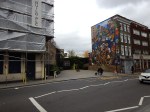
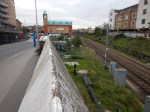
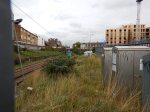
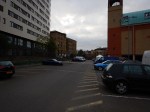
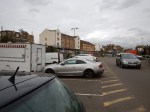
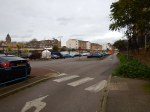
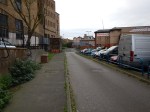
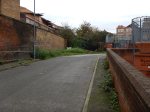
If it were to be reinstated the big losers would be the car park of the Shopping Centre and the Garden.
A new reinstated Dalston Eastern rail curve would probably be covered, as is much of the Western Curve. After all, railway lines in tunnels or covered over can be used as building land for houses, offices, shopping centres or gardens.
The rebuilding plans for Dalston Shopping Centre,shown many months ago, showed an open-aired concept, rather than the dated layout it has today. It also appears that the landlord of the Dalston Eastern Curve Garden is the owner of the Shopping Centre.
So I suppose that what Transport for London and the Shopping Centre agree is needed, will be implemented.
Other trends and facts must also be taken into account.
- The walking route between the two Dalston stations is terrible.
- Car parking is increasingly non-profitable for Shopping Centres to provide.
- More people will use bicycles and public transport to get to Dalston.
- Four extra trains an hour, are already planned on the East London Line.
- The East London Line has a capacity of twenty-four trains an hour. TfL has stated these could be six cars after some platform extensions.
- The East London Line will be given better connectivity to South East London, possibly by extending from New Cross or creating interchanges at Brockley and Penge.
- The North London Line could have more passenger trains. Especially, if freight trains on the line can be reduced.
- Waltham Forest Council has ambitions to have trains from Walthamstow Central and Chingford to Stratford by a reinstated Hall Farm Curve.
- Crossrail 2 or not, there will be massive developments up the Lea Valley, including housing and the Walthamstow Wetlands.
- Crossrail will connect to the East London Line at Whitechapel. What effects will this have on Dalston?
- Joining services back-to-back is always a good idea, as Thameslink showed years ago. It reduces the number of trains, staff and platforms needed to provide the service.
And then there is Crossrail 2, which once it is defined and started, will change everybody’s plans for Central Dalston.
I believe that the Dalston Eastern Curve will eventually be reinstated.
The main reason will be the need to have more Northern destinations for all of those trains going up and down the East London Line. A reinstated curve will allow services to go to and from Stratford and possibly if the Hall Farm curve was also to be reinstated as far as Walthamstow and Chingford.
So a series of short routes are converted into one long one, from Stratford or Chingford to say West Croydon, Orpington, Ebbsfleet or wherever!
It should be noted that at present Chingford/Walthamstow to South London is a difficult crowded journey on the Victoria Line to get a train going south from either St. Pancras or Victoria. A reinstated Hall Farm Curve would make things better by giving access at Stratford to the Jubilee Line and Crossrail in 2019.
Savvy passengers going from Stratford to South London destinations, change at Canonbury. But they would probably prefer a direct train via the Dalston Eastern Curve.
One thing that will happen, is that when the Shopping Centre is rebuilt, then space will be left to reinstate the Dalston Eastern Curve.
 The Anonymous Widower