National Grid Shares Proposals For Green Electricity Projects In Lincolnshire And West Norfolk, Needed To Boost Home-Grown Energy Supplies And Progress Towards Net Zero
The title of this post, is the same as that of this press release from National Grid.
These four bullet points, act as sub-headings.
- National Grid is inviting communities in East Lindsey, Boston and South Holland in Lincolnshire, and King’s Lynn and West Norfolk, to view proposals for two new primarily offshore electricity infrastructure projects.
- National Grid will consult communities from 23 April – 17 June to introduce the proposed project and ask for local peoples’ opinions.
- Eastern Green Link 3 (EGL 3) and Eastern Green Link 4 (EGL 4) will be able to transport enough clean energy generated in Scotland to power up to four million homes in the Midlands and South of England.
- The projects form part of The Great Grid Upgrade, the largest overhaul of the grid in generations, with new infrastructure across England and Wales helping the UK to meet its net zero ambitions, reduce its reliance on fossil fuels and contribute to lower energy bills over the long-term.
These five paragraphs outline the two projects.
National Grid is inviting communities to comment on early proposals for two green electricity infrastructure projects which will help deliver the UK’s energy security strategy and net zero targets.
The eight-week initial consultation, which begins on 23 April, shares proposals for Eastern Green Link 3 (EGL 3) and Eastern Green Link 4 (EGL 4) projects – two new, primarily subsea high voltage direct current (HVDC) electricity links, with associated infrastructure, between Scotland and England.
National Grid Electricity Transmission (NGET) is jointly developing EGL 3 with SSEN Transmission (SSEN) and EGL 4 with SP Energy Networks (SPEN).
EGL 3 would run from Peterhead, Aberdeenshire, under the North Sea via marine cables to a potential landfall location on the Lincolnshire coastline, either at Theddlethorpe or Anderby Creek. EGL 4 would run from Westfield, Fife, also via marine cables under the North Sea to the same landfall location as EGL 3.
After making landfall, both projects’ cables will run underground for approximately 100km to two proposed converter stations in the Walpole, King’s Lynn and West Norfolk, area. Underground cables would then connect the converter stations to the transmission network via a new proposed substation, also within the Walpole area.
Note.
- These would appear to be early proposals.
- National Grid appear to be planning and consulting on two interconnectors at once.
- There would appear to be a lot of underground cable on land. But then the cables will be dug into good Fenland soil.
- All the electrical gubbins seem to be in the Walpole area.
These paragraphs invite people to comment.
Throughout our initial consultation, we are holding a series of face-to-face events to consult on the electrical infrastructure required in England.
Our consultation events are being held across the project area. Information about our proposals will be on display and copies of maps and technical documents will be available to view. Members of the project team will be available to talk through our proposals and answer any questions.
National Grid have also announced dates of when public information events are being held.
- Tuesday 30 April 2024 – 2pm-7pm – Dunes Complex, Central Promenade, Mablethorpe, LN12 1RG
- Wednesday 1 May 2024 – 2pm-7pm – Anderby Village Hall, Sea Road, Anderby, Skegness, PE24 5YD
- Thursday 9 May 2024 – 12:30pm – 6pm – Alford Corn Exchange, 9 Market Place, Alford, LN13 9EB
- Monday 13 May 2024 – 2pm-7pm – Leverington Village Hall, Gorefield Rd, Leverington, Wisbech, PE13 5AT
- Wednesday 15 May 2024 – 2pm-7pm – Eastville, Midville and New Leake Village Hall, Station Rd, Eastville, PE22 8LS
- Thursday 16 May 2024 – 2pm-7pm – Poachers Country Hotel, Swineshead Road, Kirton Holme, PE20 1SQ
- Monday 20 May 2024 – 2pm-7pm – Walpole Community Centre, Summer Close, Walpole St Andrew, PE14 7JW
- Wednesday 29 May 2024 – 2pm-7pm – The Holbeach Hub, Boston Rd South, Holbeach, PE12 7LR
- Wednesday 5 June 2024 – 2pm-7pm – Burgh le Marsh Village Hall, Jacksons Lane, Burgh le Marsh, Skegness, PE24 5LA
I would have hoped, that some of the venues would have been easier to get to by public transport.
I have some thoughts and observations.
What Will Be The Capacity Of Green Link 3 And Green Link 4?
I can find references to the capacity of Eastern Green Links 1-4 and it appears that all four have a capacity of 2 GW.
A Map Of Green Link 3 And Green Link 4
I have found this map of Green Link 3 and Green Link 4.

National Grid are going to be busy, as they’re also building Green Link 1 and Green Link 2.
Will Green Link 3 And Green Link 4 Share A Route Between The Coast And Walpole?
There is only one green HVDC onshore cable on the map. But surely laying two 2 GW cables in the same trench will cost less, than digging two cable routes.
Looking at the three converter stations would appear to confirm that Green Link 3 and Green Link 4 share a route.
Will Landfall Be At Theddlethorpe Or Anderby Creek?
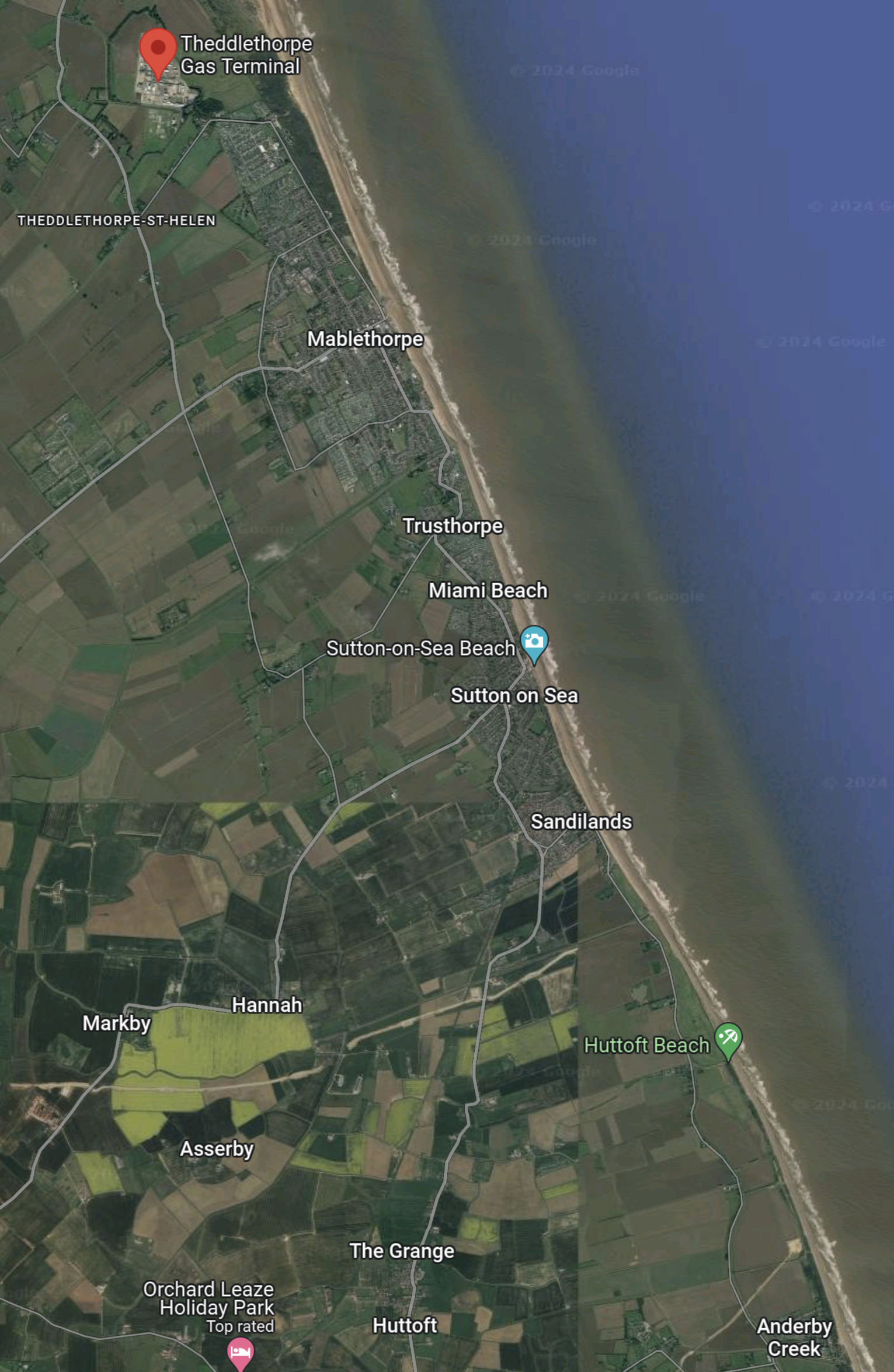
This Google Map shows the coast between Theddlethorpe and Anderby Creek.
Note.
- The decommissioned Theddlethorpe gas terminal is indicated by the red arrow.
- The seaside resort of Mablethorpe lies between the two possible landing sites.
- Anderby Creek is in the South-East corner of the map.
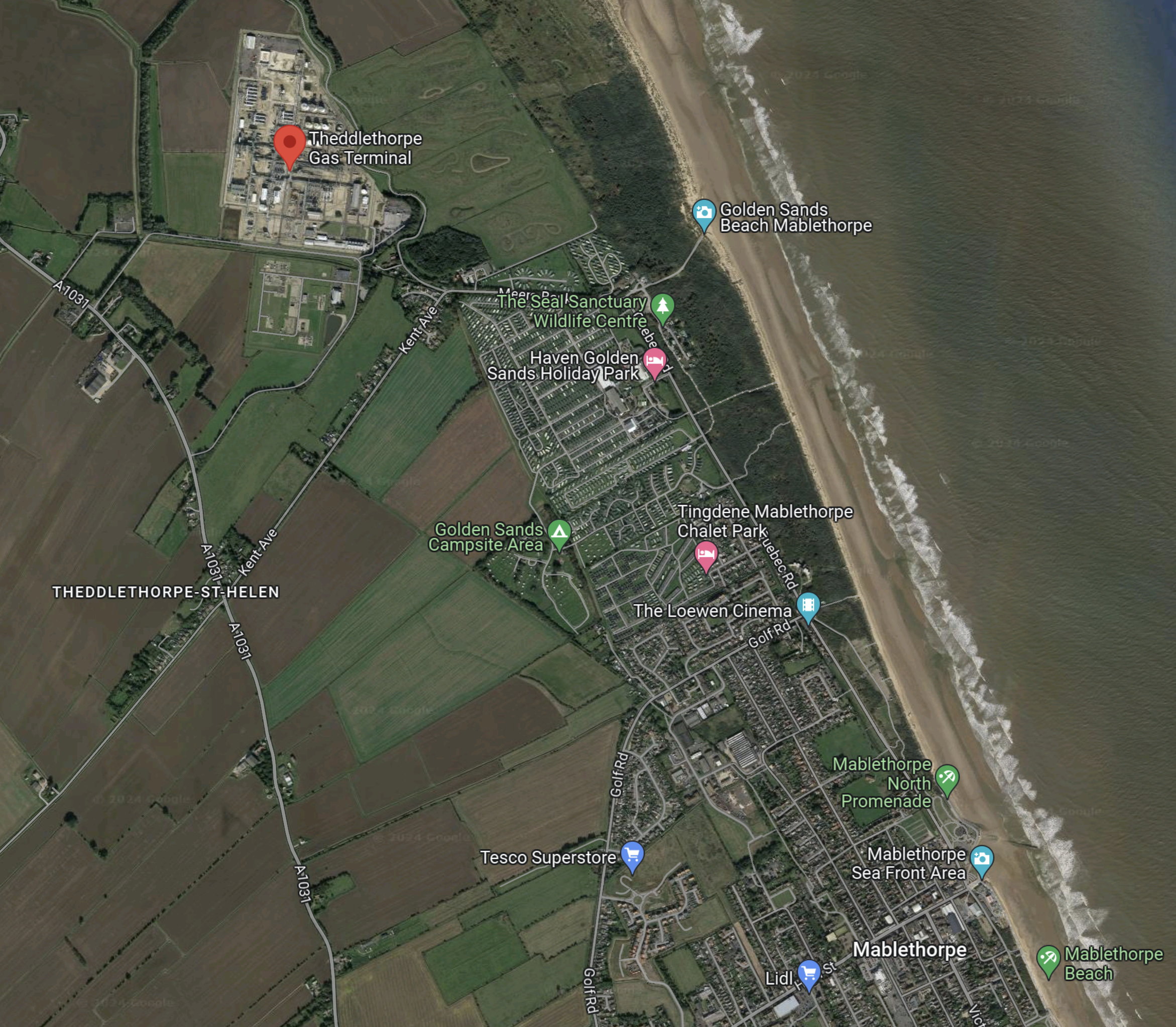
This second Google Map shows the Theddlethorpe Gas Terminal and the North of Mablethorpe.
Note.
- The decommissioned Theddlethorpe gas terminal is indicated by the red arrow.
- Mablethorpe beach appears to be on a high quality.
Both sites would appear to be strong possibilities.
Both sites have plenty of space, but the Theddlethorpe gas terminal is a large brownfield site.
The Anderby Creek site would probably be a shorter underground cable across Lincolnshire.
The Triton Knoll Wind Farm
The Wikipedia entry for the Triton Knoll wind farm starts with these two paragraphs.
Triton Knoll Wind Farm is an 857 MW round 2 offshore wind farm 33 kilometres (21 mi) off the coast of Lincolnshire, in the North Sea, England.
RWE Npower Renewables were awarded the lease to the development area in 2003. The offshore elements of the wind farm of up to 1200MW power gained planning consent in 2013; RWE reduced the scope of the wind farm to 900MW or under in 2014, to reduce cost per MW.
Note.
- The wind farm was commissioned in January 2022.
- The wind farm cables make landfall at Anderby Creek.
- They then travel underground to Bicker Fen substation.
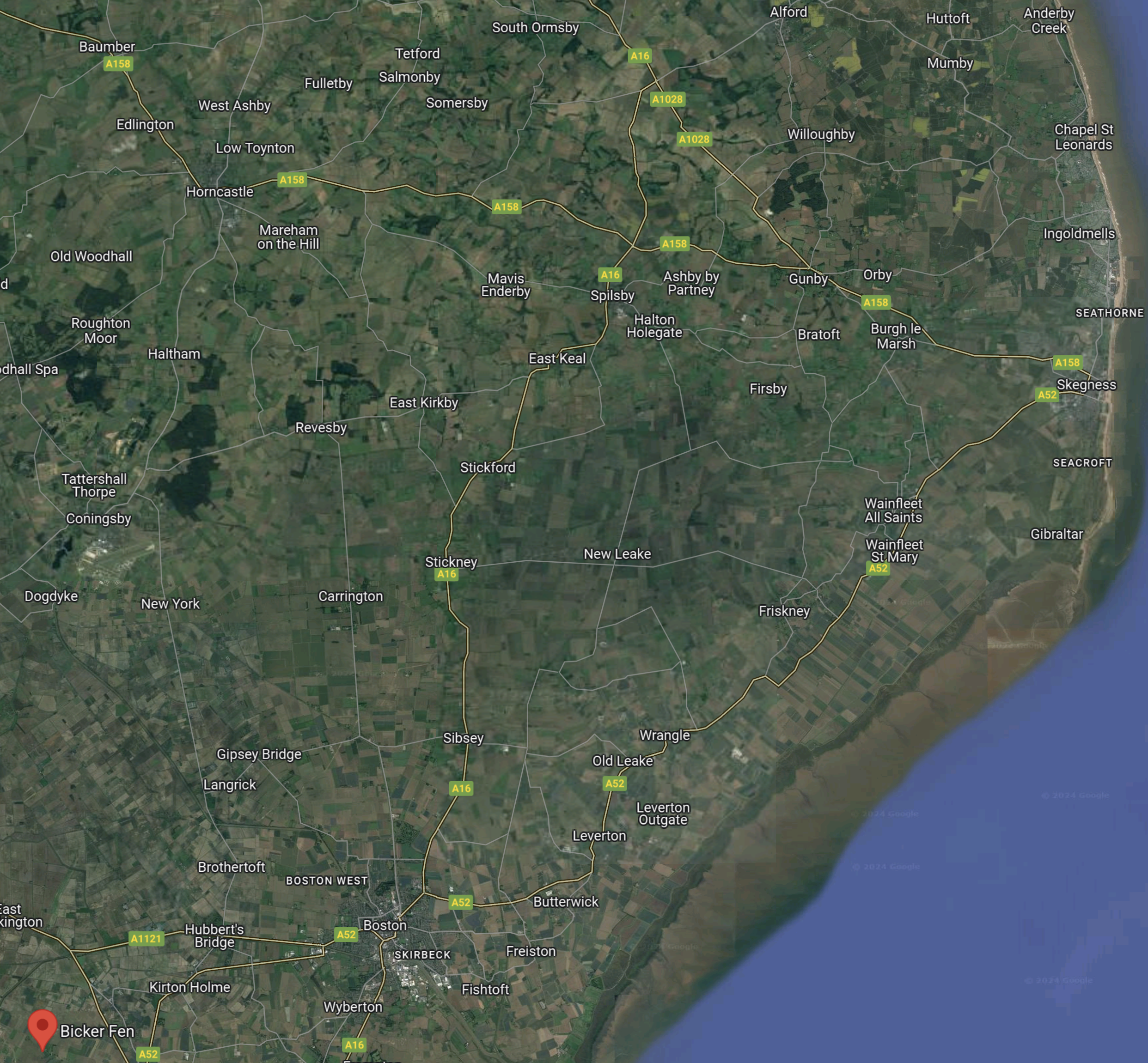
This Google Map shows Bicker Fen and Anderby Creek.
Note.
- Bicker Fen substation is in the South-West corner of the map and is indicated by a red arrow.
- Anderby Creek is in the North-East corner of the map.
- The cable is underground.
- This page on the Murphy Group website, describes the work the company did to install the cables.
- It appears from the Murphy document, that there are six cables between Anderby Creek and Bicker Fen.
This Google Map shows Anderby Creek.
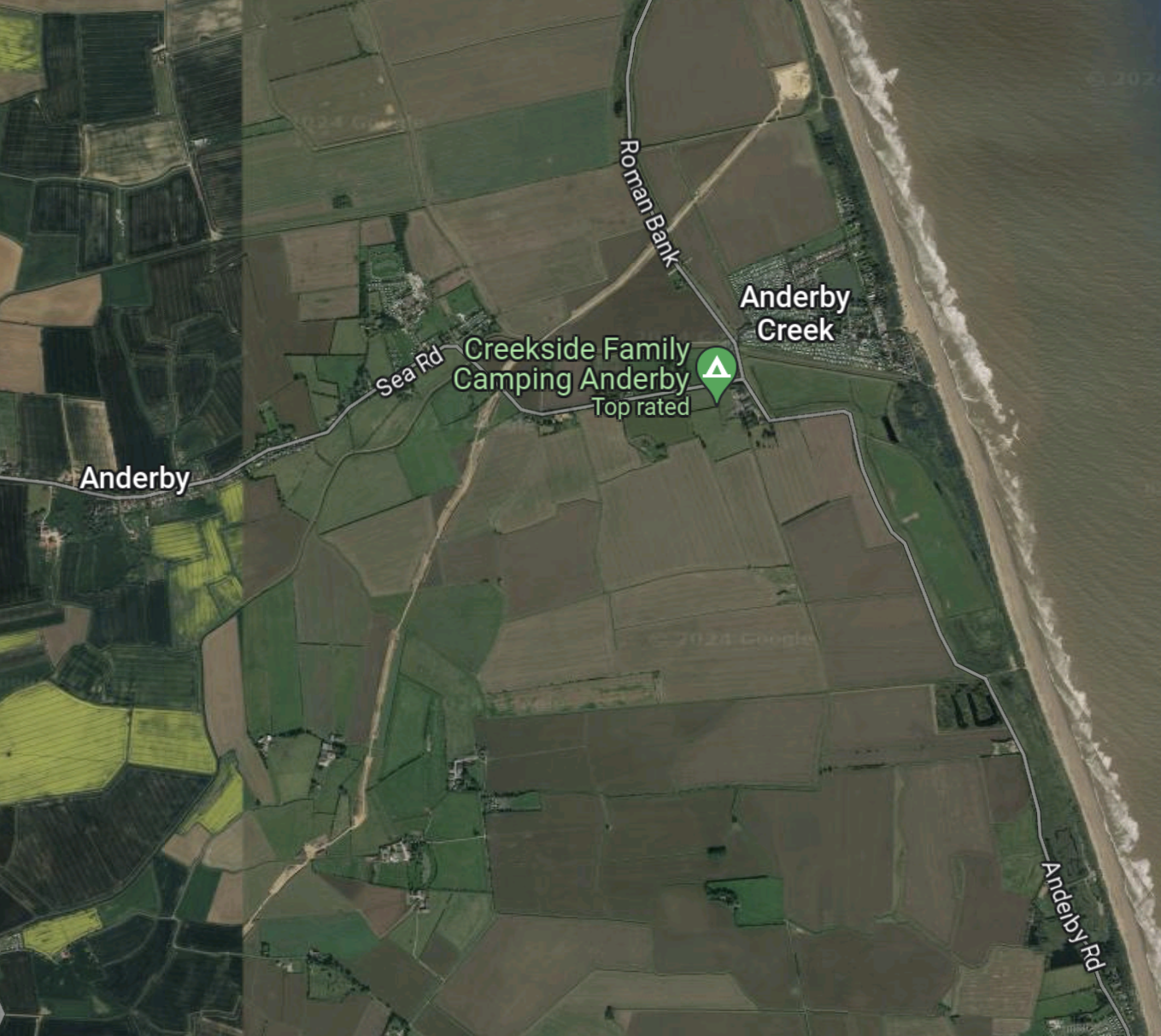
Could the scar across the land to the West of Anderby Creek, be the connection to the offshore Triton Knoll wind farm?
I think it is! And I also think that it can carry more than just the 857 MW Triton Knoll wind farm!
I am suspicious, that one of Baldrick’s ancestors has been at work and the Triton Knoll export cable system could be used to connect Green Link 3 and Green Link 4 to Bicker Fen and Walpole substations.
This would surely allow Scottish wind power to be sold to Denmark and then sold onward to Germany.
The VikingCCS Project
The VikingCCS project is a carbon capture and storage project, that is proposed to be based at the decommissioned Theddlethorpe gas terminal.
The VikingCCS project has a web site.
Would the use of the Theddlethorpe gas terminal mean that it is more likely that Green Link 3 and Green Link 4 will make a Southern landfall at Anderby Creek?
Will There Be A Connection To Viking Link?
The Viking Link is a 1400 MW at 525 KV electricity interconnector between Bicker Fen in Lincolnshire and Revsing in Jutland, Denmark.
This Google Map, shows the location of Bicker Fen, about halfway between Boston and Sleaford.

This second map shows the position of the current Walpole substation with respect to the Wash.
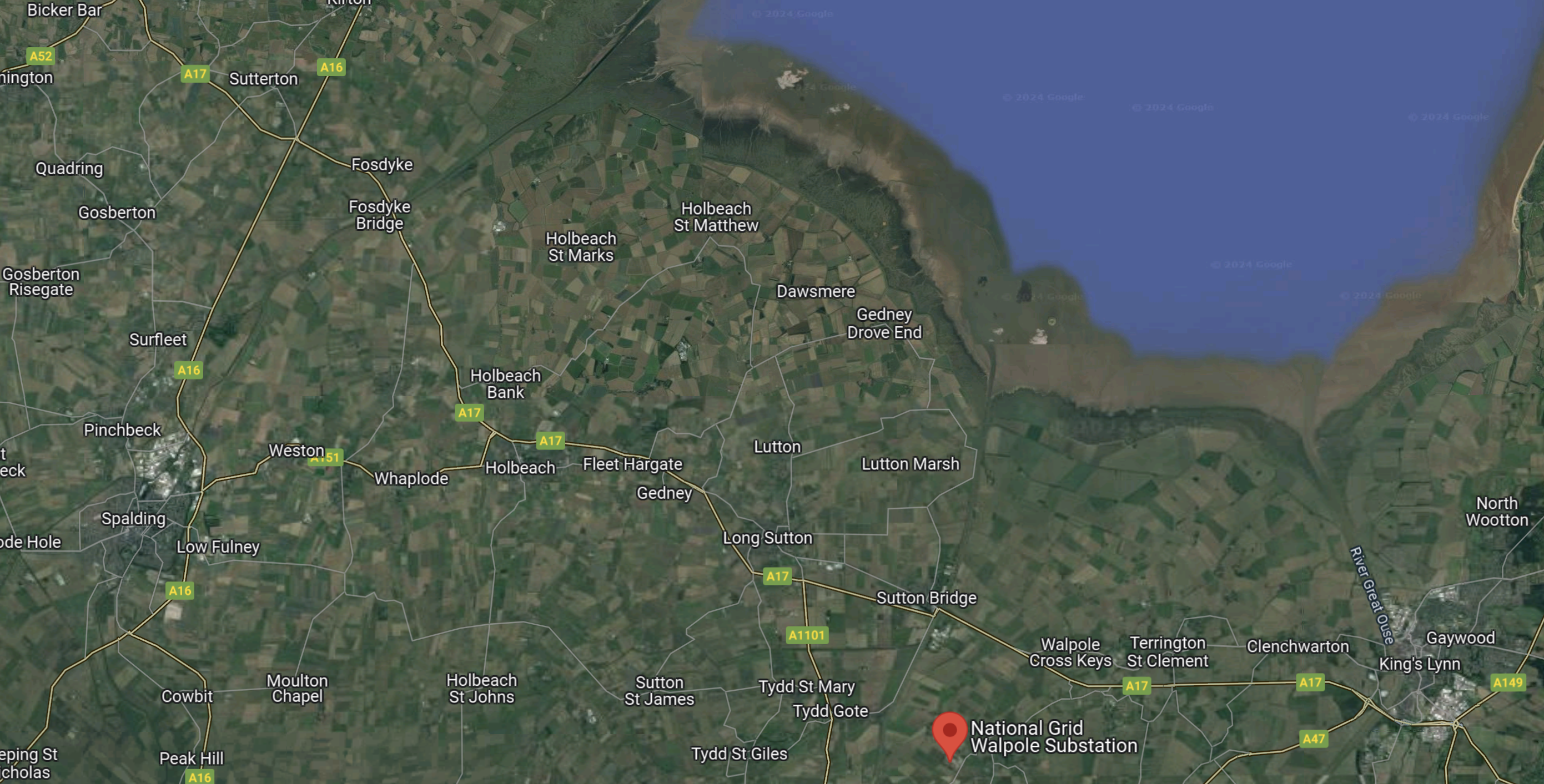
Note.
- Bicker Fen is in the North-West corner of the map.
- The current Walpole substation is marked by the red arrow.
- King’s Lynn is in the South-East corner of the map.
I suspect, if National Grid wanted to connect Green Link 3 and Green Link 4 to the Viking Link, then this would be possible.
If the Viking Link were to be connected to Green Link 3 and Green Link 4, this would allow surplus Scottish renewable energy to be sent to Denmark and on to Germany.
Green Link 3, Green Link 4 And Viking Link Appear To Be Underground In Lincolnshire
I can’t find any trace of overhead cables for the Viking Line in Lincolnshire and the press release says this about Green Link 3 and Green Link 4.
After making landfall, both projects’ cables will run underground for approximately 100km to two proposed converter stations in the Walpole, King’s Lynn and West Norfolk, area.
The connection to the Triton Knoll wuind farm is also underground.
It does appear that National Grid, are going for a Nimby-friendly approach for cables between Walpole and the coast.
Hopefully putting the cables underground will save money in legal arguments and fees.
A Video Description Of Princess Elisabeth Island
This web site is the web site of Belgium’s Princess Elisabeth energy island.
This YouTube video describes the Princess Elisabeth island.
From the video the following can be determined.
- The Princess Elisabeth island is 45 km. from the Belgian coast.
- An interconnector to the UK could come ashore at the site of the decommissioned Bradwell nuclear power station.
- An interconnector to Denmark could come ashore in Southern Jutland, just North of where the Viking Link connects to Denmark.
This map clipped from the video shows the location of Princess Elisabeth island.

Note.
- Belgium is shown in red.
- Istend is in the middle of the straight Belgian coast.
- The red dot between Belgium and the UK is Princess Elisabeth island.
- The interconnector to the UK could feasibly go to Bradwell.
- The interconnector to Denmark could go via a wind farm, which would explain the kink.
- Could the kink point be at the Dogger Bank, where there could be 20 GW of wind farms?
Has Belgium made a bid to dominate European energy distribution?
This Google Map shows the Belgian and English coast lines.
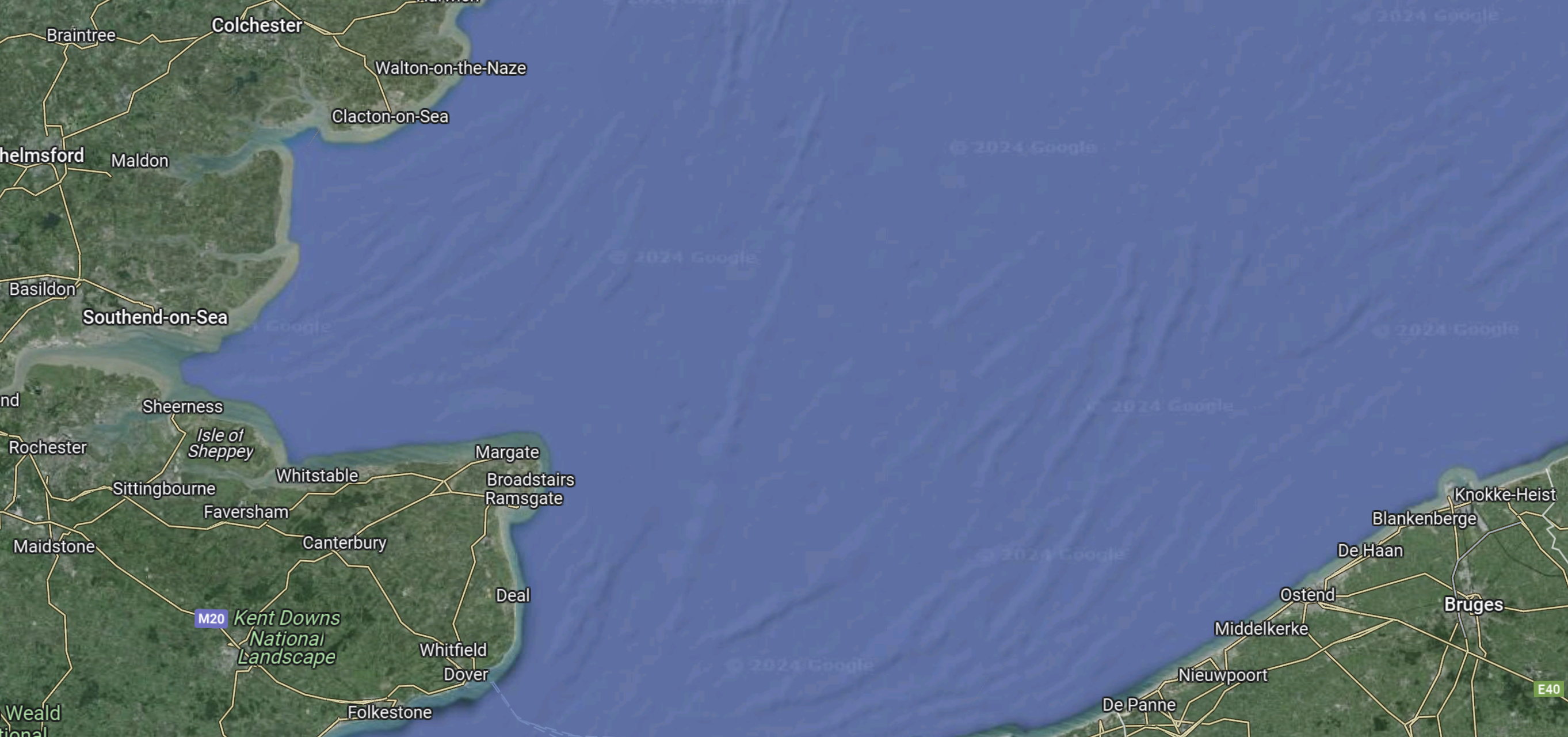
Note.
- Bradwell is on the coast to the North-East of Southend-on-Sea.
- As it used to be a nuclear power station site it still has an electricity connection to the grid.
- The Princess Elisabeth island is 45 km. from the Belgian coast at Ostend.
I estimate that a Bradwell and Princess Elisabeth island interconnector would be about 150 miles.
Denmark Launches Massive Offshore Wind Auction
The title of this post, is the same as that of this article on offshoreWIND.biz.
This is the sub-heading.
Denmark has opened a new offshore wind tender, the country’s largest ever, offering a minimum of 6 GW of new capacity spread over six wind farms, with the overplanting option allowing for 10 GW or more of new capacity to be added.
These are two paragraphs from the article.
The offshore wind farms must deliver at least 6 GW, and as a new element, there will be freedom to establish as much offshore wind as possible on the tendered areas, with the exemption of Hesselø with a maximum capacity of 1.2 GW.
If the market utilizes this freedom to optimize the usage of the areas, it could result in the construction of 10 GW offshore wind or more, the agency said.
Recently, some wind farms in the UK have been increased in size after the auction.
In Crown Estate Mulls Adding 4 GW Of Capacity From Existing Offshore Wind Projects, I note how 4 GW of overplanting could be employed to raise the total capacity from 4.6 GW to 8.6 GW.
So have the Danes decided to build expansion into the tender?
One of the wind farms in the auction is called Nordsøen I.
- It will be about 50 km. from the West Coast of Denmark.
- It appears it will have a capacity of at least 1 GW.
- It could connect to the shore, not far from where the Viking Link between Lincolnshire and Denmark connects to the Danish grid.
- There is a 700 MW interconnector between the area and Eemshaven in The Netherlands.
- There is 1.5 GW of overland transmission lines to Germany.
All these connections, increase energy security for Denmark, Germany, the Netherlands and the UK.
Could the Danes be building the Nordsøen I, so it could work with the all the connections in Southern Jutland and improve energy security?
National Grid Launches Viking Link, The Next Step Towards A North Sea Super-Grid
The title of this post, is the same as that of this press release from National Grid.
These four bullet points act as sub-headings.
- The £1.8bn project connecting the UK with Denmark was launched today.
- With a capacity of 1.4GW, Viking Link will be able to power up to 2.5 million UK homes and is the longest land and subsea cable in the world.
- Viking Link will deliver £5.2bn in benefits to UK consumers.
- As the UK’s first connection with renewable energy-rich Denmark, Viking Link will be instrumental in both countries achieving net zero carbon emissions.
The press release then gives all the details of the latest of National Grid’s sixth interconnector.
As a Control Engineer, I like this interconnector.
- Denmark and the UK are both importers of electricity.
- The UK has 30 GW of wind power and Denmark has 7 GW.
- The UK has almost 15 GW of solar power and Denmark has 3.5 GW.
- The UK has 6 GW of nuclear and Denmark banned nuclear in 1985.
- Both the UK and Denmark use large amounts of biomass to generate electricity.
- As the sun goes East to West, Denmark will produce its daily peak solar before the UK.
- If the prevailing winds go West to East, the UK will produce its daily peak wind before Denmark.
It looks to me that a UK-Denmark interconnector could perform a valuable job, by balancing the UK’s electricity peaks and troughs with those of Denmark.
The system could be improved in two ways.
- If Southern England has a sunny, windy day, there may be need for substantial energy storage.
- The route between the UK and Denmark could be via a large offshore wind farm in the North Sea.
Vind∅ is a proposed Danish energy island in the North Sea.
There’s more about the Viking Link on its web site.
This is the introduction on the home page.
Viking Link is a 1400 MW high voltage direct current (DC) electricity link between the British and Danish transmission systems connecting at Bicker Fen substation in Lincolnshire and Revsing substation in southern Jutland, Denmark.
The project involves the construction of converter sites and installation of onshore and offshore cable in each country. These are then connected to the substations.
Viking Link is approximately 765 km long and allows electricity to be exchanged between Great Britain and Denmark.
The interconnector enables the more effective use of renewable energy, access to sustainable electricity generation and improved security of electricity supplies. It also benefits the socio economy of both countries.
This is going to be a very valuable interconnector for the UK, Denmark and those that own it.
UK Energy Grid Needs £60bn Upgrade To Hit Green Target, Plan Says
The title of this post, is the same as that of this article on the BBC.
This is the sub-heading.
The UK’s electricity network needs almost a further £60bn of upgrades to hit government decarbonisation targets by 2035, according to a new plan.
These five paragraphs explain the plan.
About 4,000 miles of undersea cables and 1,000 miles of onshore power lines are needed, said the National Grid’s Electricity Systems Operator (ESO).
The investment would add between £20 to £30 a year to customer bills, it said.
The government said the ESO’s plans were preliminary and yet to pass a “robust planning process”.
The plans were written up by the ESO, the organisation which runs the electricity network and would run the updated system it is calling for too. It is currently owned by National Grid but will transfer into government ownership later this year.
Its latest £58bn estimate is for work needed between 2030 and 2035 and comes on top of a previous £54bn estimate for work taking place between now and 2030.
These are my thoughts.
The Amount Of Undersea Cable
Edinburgh and London are roughly 400 miles apart as the train runs, so it looks like there could be the equivalent of ten underwater cables between the North of Scotland and England.
In Contracts Signed For Eastern Green Link 2 Cable And Converter Stations, I talked about the proposed 2 GW link between Peterhead in Scotland and Drax in England, which will be a double cable. So there’s the first two of these long cables.
It looks to me, that National Grid are proposing to use underwater cables wherever they can, so they avoid large expensive planning rows stirred up by Nimbies.
Monitoring The Undersea Cables
Last week Ofgem gave National Grid a £400,000 grant to develop new innovative technologies, which I wrote about in £400k For National Grid Innovation Projects As Part Of Ofgem Fund To Help Shape Britain’s Net Zero Transition.
One of the project is called HIRE – Hybrid-Network Improvement & Reliability Enhancement and will be used to check all these cables are performing as they should.
My electrical engineering experience tells me, that there must be some cunning way, that will detect that something is happening to the cable. The involvement of a technology company called Monitra in the project is a bit of a giveaway.
How Much Will It Cost Me?
Currently, UK consumers pay about £30 per year to have electricity delivered, so this will rise to between £50 and £60 per year.
That is just over a pound a week. I would pay about the same for a resident’s parking permit outside my house for an electric car and probably three times more for a petrol or diesel car.
Do We Have Enough Cable?
Two undersea cable factories are under development in Scotland and I suspect the 4,000 miles of undersea cables will be delivered on schedule and covered in saltires.
What About T-Pylons?
The latest onshore electricity transmission line between Hinckley Point C and Bristol, doesn’t use traditional pylons.
It uses T-pylons like these to connect the 3.26 GW nuclear power station.
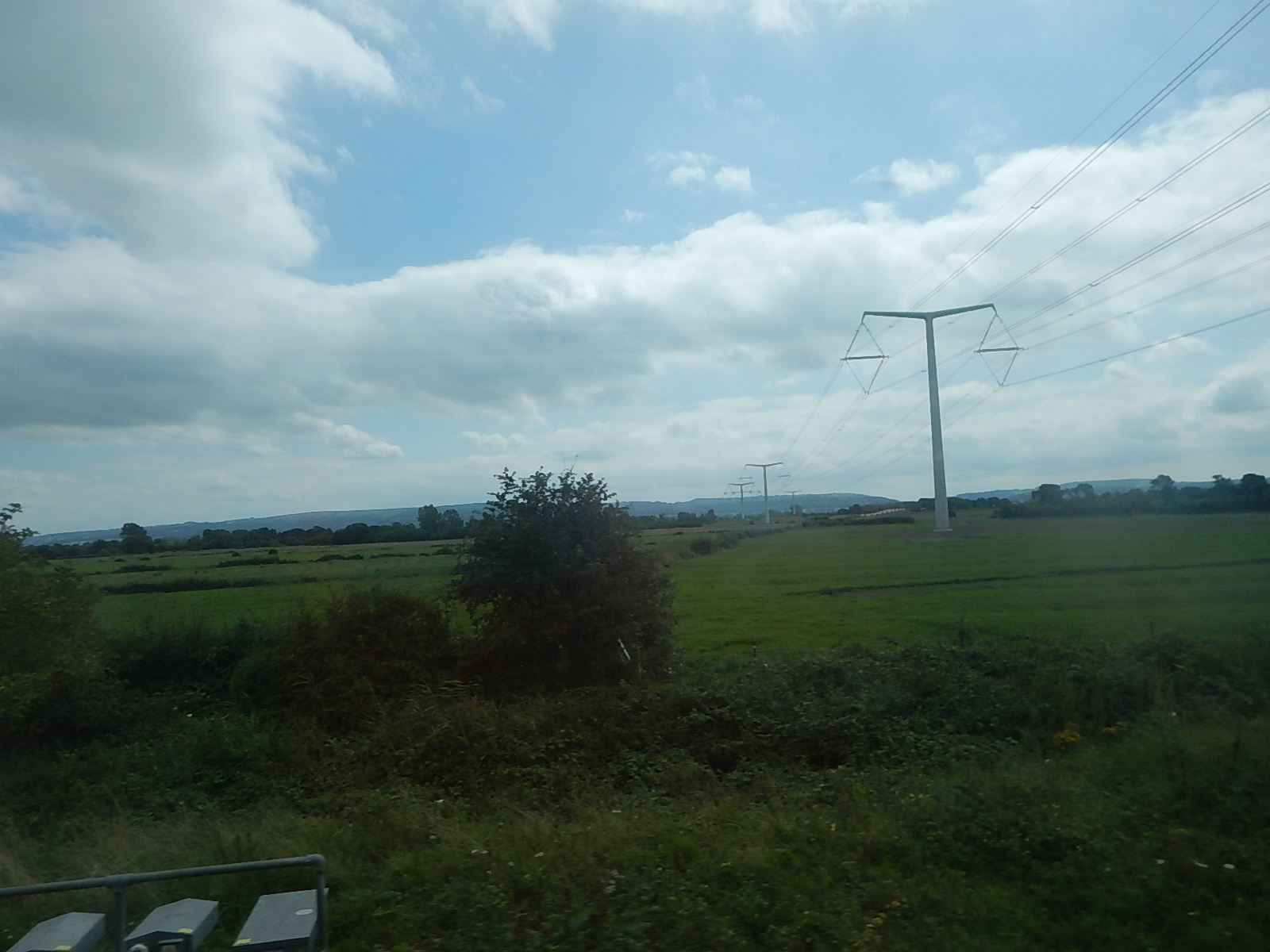
Note that they are shorter, designed to be less intrusive, have a smaller footprint and are made from only ten parts.
I suspect they will cost less to install and maintain.
There is more on T-pylons in National Grid Energise World’s First T-Pylons.
I wouldn’t be surprised that some of the oldest traditional pylons will be replaced by T-pylons.
I am surprised that T-pylons are not mentioned in the BBC article.
I like T-pylons. How do you feel about them?
Eastern Green Link 2
This press release from National Grid, describes Eastern Green Link 2 like this.
Eastern Green Link 2 (EGL2) is a 525kV, 2GW high voltage direct current (HVDC) subsea transmission cable from Peterhead in Scotland to Drax in England delivered as a joint venture by National Grid and SSEN Transmission.
This map from National Grid, shows the route of the Eastern Green Link 2.

The Northern landfall is at Sandford Bay and the Southern landfall is at Wilsthorpe Beach.
This Google Map shows Sandford Bay and Peterhead power station.
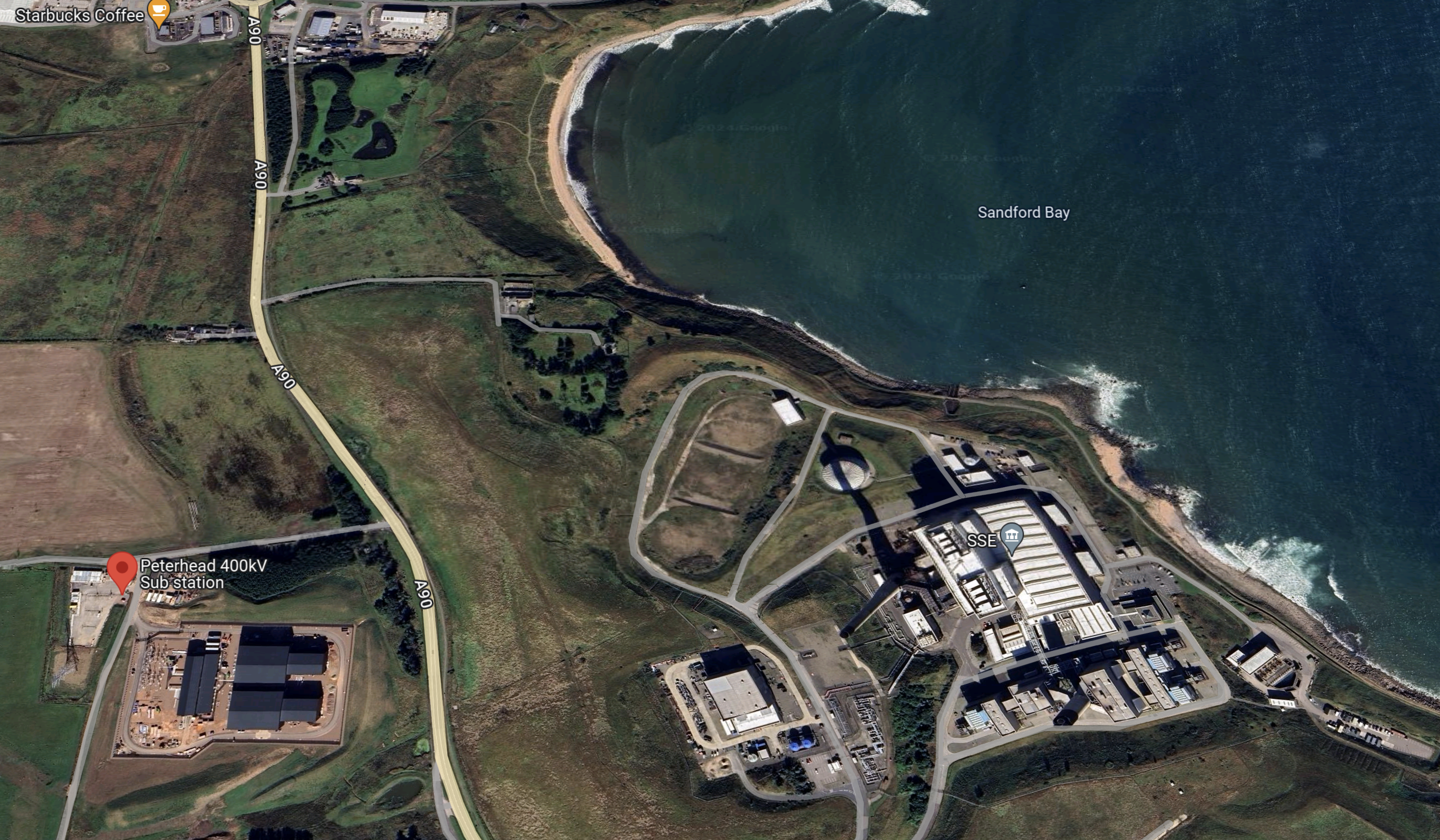
Note.
- Sandford Bay occupies the North-East corner of the map.
- The red arrow indicates the main 400kV sub-station at Peterhead.
- The 2177 MW gas-fired Peterhead power station is to the East of the sub-station marked as SSE.
This second Google Map shows the onshore route of the cable from Wilsthorpe to Drax.

Note.
- Flamborough Head is in the North-East corner of the map.
- Wilsthorpe Beach is at Bridlington a couple of miles South of Flamborough Head.
- The red arrow indicates Drax Power station.
- An onshore underground cable will be installed from landfall in Wilsthorpe to a new onshore converter station built in Drax.
The EGL2 HVDC cable connection from Scotland to England consists of 436km of submarine cable and 69km of onshore cable.
Both converter stations will be on existing power station sites and the major onshore works will be the underground cable between Wilsthorpe and Drax.
Where Does Drax Go From Here?
Currently, Drax power station is a 2595 MW biomass-fired power station.
There are now other large power sources that could replace some or all of the output of Drax power station.
- 2GW of Scottish wind power coming to Drax on Eastern Green Link 2.
- 6 GW of offshore wind is being developed at the Hornsea wind farms.
- 8 GW of offshore wind is being developed at the Dogger Bank wind farms.
- 2.5 GW from the three gas-fired power stations at Keadby, two of which are likely to be fitted with carbon capture.
- 1.8 GW from the proposed hydrogen-fired Keadby Hydrogen power station.
Given the bad feelings many have about Drax burning biomass, with 20.3 GW of electricity, you might think that shutting down Drax would be a simple solution.
But, according to Drax’s Wikipedia entry, it has a unique property.
Despite this intent for baseload operation, it was designed with a reasonable ability for load-following, being able to ramp up or down by 5% of full power per minute within the range of 50–100% of full power.
So Drax could be very useful in balancing the grid, by ramping up and down to fill the gap between production and need.
In addition, there is good biomass. This is from the Wikipedia entry.
A 100,000 tonne pa capacity straw pelletization facility was constructed at Capitol Park, Goole in 2008.
Drax are also promoting BECCS or Bioenergy carbon-capture and storage.
There is a Wikipedia entry for Bioenergy With Carbon Capture And Storage, of which this is the first couple of sentences.
Bioenergy with carbon capture and storage (BECCS) is the process of extracting bioenergy from biomass and capturing and storing the carbon, thereby removing it from the atmosphere. BECCS can theoretically be a “negative emissions technology” (NET).
I do feel that carbon capture and storage is a bit like sweeping the dust under the carpet, when you sweep the floor around it.
But carbon capture and use could be another matter.
This Google Map shows the Drax site.

Note how it is surrounded by agricultural land.
Could the power station be the source of pure carbon dioxide to be fed in greenhouses to flowers, herbs, salad vegetables, tomatoes and other plants?
I suspect there’s productive life left in Drax power station yet!
LionLink
LionLink, that is being developed by National Grid is a new type of interconnector, called a multi-purpose interconnector, that will connect Suffolk and The Netherlands via any convenient wind farms on the way. This means that the electricity generated can go where it is needed most.
I wrote about LionLink in World’s Largest-Of-Its-Kind Power Line To Deliver Clean Power To 1.8m UK Homes And Boost Energy Security.
Other Multi-Purpose Interconnectors
I can see other multi-purpose interconnectors like LionLink being built around the UK.
- There could be one across the Dogger Bank to link out 8 GW of Dogger Bank wind farms with those of the Dutch, Danes and Germans on their section of the bank.
- NorthConnect could be built between Scotland and Norway via some of the wind farms being developed to the North-East of Scotland.
- Could wind farms to the North of Ireland use a multi-purpose interconnector between Scotland and Northern Ireland.
- I can also see one or possibly two, being built across the Celtic Sea to link Devon, South Wales and Southern Ireland via the wind farms being developed in the area.
- Will we also see a Channel multi-purpose interconnector to transfer electricity along the South Coast of England?
Some of these multi-purpose interconnectors could be key to creating a revenue stream, by exporting electricity, to countries in Europe, that have a pressing need for it.
Conclusion
National Grid’s excellent plan will lead to the end of the practice of shutting down wind turbines. The spare electricity will be exported to Europe, which will surely create a good cash-flow for the UK. This in turn will encourage developers to create more wind farms in the seas around the UK’s coasts.
German Company To Build XXL Monopile Factory in Denmark
The title of this post, is the same as that of this article on offshoreWIND.biz.
This is the sub-heading.
German-based Baltic Structures Company (BSC) has revealed that it will build an XXL monopile production factory in Esbjerg, Denmark
These are the first three paragraphs that outline the project.
BSC will build “Europe’s biggest” foundation fabrication site in the Esbjerg Port where it will be able to offer various foundations structures with a more than 100,000-square-metre production area under the roof and an output of up to 200 XXL monopiles per year.
The German company said that the focus of the plant is on structures with dimensions of up to 15 metres in diameter, up to 130 metres in length, and single unit weights of up to 4,000 tonnes.
In addition to monopiles, transition pieces, pin piles, and components for jackets, floating foundations will also be offered, said BSC.
These last three paragraphs sum up, where we are at the moment with European wind turbine foundation manufacture.
In September 2022, Esbjerg Port (Denmark), Oostende Port (Belgium), Groningen Seaports/Eemshaven (the Netherlands), Niedersachsen Port/Cuxhaven (Germany), Nantes-Saint Nazaire Port (France), and Humber (the UK) signed a partnership agreement with an aim to minimise capacity issues.
At the beginning of this year, the six largest European wind ports also signed a mutual declaration to collaborate on an operational and practical level to help bring the new offshore wind capacities across Europe as smoothly as possible.
In January, the Port of Esbjerg, together with US-based Moffatt & Nichol, deployed digital twin technology which could triple the port’s offshore wind capacity.
I also wrote UK And South Korea Help Secure Millions For World’s Largest Monopile Factory, this morning about a new monopole factory on Teesside.
- The Teesside factory is described as the world’s largest.
- On the other hand the Esbjerg Port facility is described as Europe’s biggest foundation fabrication site.
I suspect the Germans and the Koreans are using different engineering dictionaries.
European Offshore Wind Power Targets
Out of curiosity, I looked up the offshore wind capacity, the UK and neighbouring countries are planning before 2030.
- UK – 50 GW
- Germany – 30 GW
- Norway – 30 GW
- The Netherlands – 21 GW
- France – 18 GW
- Denmark – 13 GW
- Italy – 10 GW
- Portugal – 10 GW
- Belgium – 5.4-5.8 GW
- Republic of Ireland – 5 GW
- Spain – 3 GW
Note.
- Norway’s figure relates to 2040.
- Northern Ireland have a target of 1 GW, which I assume is included in the UK total.
- The total is between 195.4 and 195.8 GW.
Given that we could be producing over a quarter of Western Europe’s offshore wind power, the Gods of the Winds must have been British.
Denmark Exploring Multiple Platforms As Alternative To Building Artificial Island
The title of this post, is the same as that of this article on offshoreWIND.biz.
This is the sub-heading.
After concluding that the current concept of its North Sea Energy Island would be too expensive for the State, the Danish government, the transmission system operator (TSO) Energinet, and other relevant agencies are now looking into the concept for the island to be established on several large platforms.
I feel this could be a sensible decision, as it would fit well with a modular approach to the building of offshore wind farms.
Suppose, the floating turbines used by a company like Ørsted were all similar. This would surely simplify management of their portfolio of wind farms.
If it works for floating wind turbines, surely, it would work for substations, electrolysers and other offshore hardware.
Conclusion
Artificial energy islands may seem an impressive way to go, but I suspect that the modular approach using standard components, that either sit on the sea bed or float may be a more affordable and faster way to build offshore wind farms.
British Five-Year-Olds Up To 7cm Shorter Than Western Peers
The title of this post, is the same as that of this article in The Times.
This is the sub-heading.
Poor diet and health service cuts blamed for ‘pretty startling’ trend
These are the first two paragraphs.
Five-year-olds in Britain are on average up to seven centimetres shorter than their peers in other wealthy nations, in a trend described as “pretty startling”.
A poor national diet has been highlighted as a major culprit in Britain’s fall down international rankings of child height.
I am coeliac and am only 170 cm.
During the pandemic, I did some statistical research on coeliac disease and the covids for my own interest.
I found a peer-reviewed Indian medical paper entitled Coeliac Disease: Can We Avert The Impending Epidemic In India? The author felt that modern high-gluten wheats, were increasing the rate of the disease.
The author also said this about introduction gluten to babies in Sweden.
The time of first exposure to wheat influences the development of celiac disease. In countries such as Finland, Estonia, and Denmark, characterized by low gluten consumption in infancy, celiac disease prevalence is much lower than in Sweden where gluten consumption is high in infancy. A natural experiment occurred in Sweden about two decades ago when national recommendations were made to introduce wheat into the diet after cessation of breast feeding at six months. This change was coupled with increased wheat gluten consumption through infant feeds. Together these measures resulted in a two-fold increase in incidence of celiac disease in Sweden, which was attributed to introduction of wheat into the diet after cessation of breast feeding. In 1996 this recommendation was changed to introduce gluten in gradually increasing amounts while the infant was still being breast fed. This led to a dramatic decrease in celiac disease incidence.
It is interesting to look at heights of five-year-olds given in the Times article for the four countries.
- Denmark – 117.4 – 118.1
- Estonia – 116.9 – 115.7
- Finland – 116.3 – 114.5
- Sweden – 115.1 – 115.1
Note that all heights are in centimetres, with boys first.
As according to the graphs in the article the UK and the US have shown the biggest declines in height, is gluten-rich junk food, the major cause of this decline?
More research needs to be done!
Denmark And Germany Sign Bornholm Energy Island Agreement, First Legally Binding Cooperation On Joint Offshore Renewable Energy Project In EU
The title of this post, is the same as that of this article on offshoreWIND.biz.
This is the sub-heading.
German Federal Minister for Economic Affairs and Climate Action, Robert Habeck, and Danish Minister for Climate, Energy and Utilities, Lars Aagaard, have signed an agreement for the Bornholm Energy Island in the Baltic Sea. This is the first legally binding cooperation agreement in Europe on a joint offshore energy project under the EU Renewable Energy Directive.
Bornholm is a Danish island between Denmark, Germany and Sweden, as this map shows.

Note.
- Malmo is in Sweden.
- Copenhagen is in Denmark.
- Germany is in the South-West corner of the map.
Bornholm is the island in the North-East corner of the map.
This paragraph gives the bare details of the generation and transmission capacities.
Bornholm Energy Island, located in the Danish sector of the Baltic Sea, will facilitate connecting at least 3 GW of offshore wind generation capacity to the grid by the early 2030s. The electricity will then be transported via new grid connections to Germany (2 GW ) and to the Danish mainland (1.2 GW).
The great advantage of an energy island, is that the electricity can be sent both ways according to where it is needed.
Some of the energy islands that have been proposed also include energy storage and/or hydrogen production.
This web site gives more details of the Bornholm Energy Island.
Under a heading of Why Build Energy Islands?, these reasons are given.
- Environment and climate
- Energy security in Europe
- Inspiration for the world
Under a heading of What is an Energy Island?, this is said.
An energy island makes it possible to establish large wind farms at sea far from the coast. The energy produced by the wind turbines is sent via cables to the energy island, from where it is sent out to consumers. On Bornholm, a high-voltage facility must therefore be established on the island which can receive and distribute the electricity. After that, green power can be sent from Bornholm to millions of consumers in Denmark and Germany. Bornholm’s Regional Municipality is working hard to seize the energy island’s potential for job creation and local business growth, and in turning Bornholm into the green business beacon and transport hub for green fuels in the Baltic Sea.
I suppose it could be argued that in the UK, Orkney and Shetland are already energy islands and will become more so in years to come.
Energy islands, whether real or man paid certainly seems to be a concept that is growing in populatity, with several being developed.
Vattenfall: Dolphins Unfazed By Offshore Wind Construction Work
The title of this post, is the same as that of this article on offshoreWIND.biz.
This is the sub-heading.
Concerns have been raised that the installation of the monopiles of the Vesterhav North wind farm offshore Denmark could cause a small pod of dolphins to leave the area. The dolphins have, however, neither left the area nor have they changed their behaviour, Vattenfall, the owner and developer of the wind farm, said.
These are the first two paragraphs.
In 2020, wildlife and underwater photographer Lars Mikkelsen discovered a pod of seven Common Bottlenose dolphins during a sailing trip in the canal between the North Sea and the Limfjord at the Danish coastal town of Thyborøn. Since then, Mikkelsen has been closely following the dolphins that are rare guests in the seas around Denmark.
The small pod of dolphins has for the past three years established residence in the area of the Danish part of the North Sea where Vattenfall is constructing its Vesterhav offshore wind farms.
This Google Map shows the Limfjord, which stretches between the North Sea and the Kattegat.
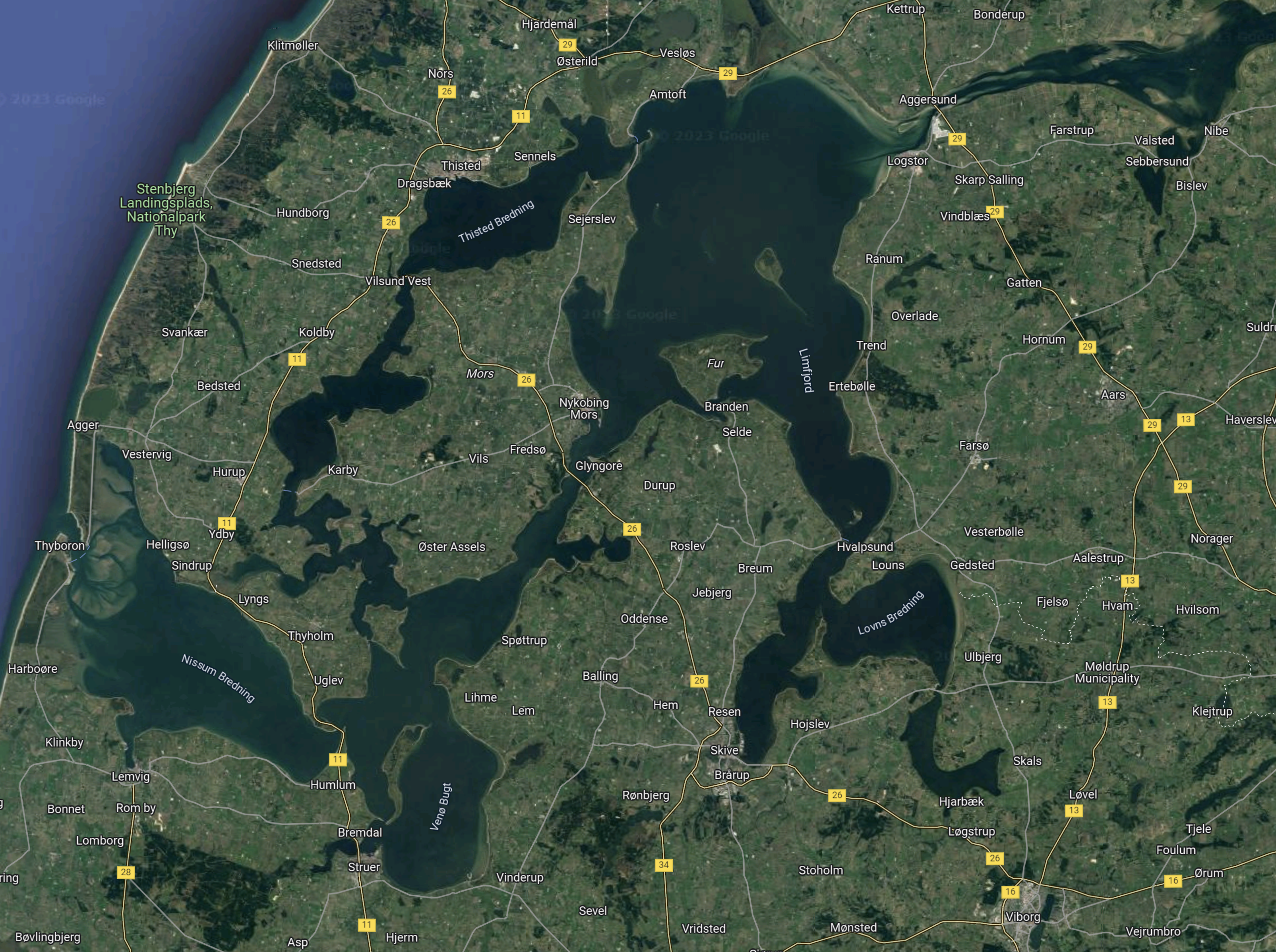
Thyborøn, is at the Western entrance to the Limfjord, which leads into the large area of water in the South-West of the map.
From its Wikipedia entry, the Limfjord seems to be an ecologically-interesting place.
This paragraph sums up how the construction affected the dolphins.
So, when concerns were raised that the installation of the wind farm’s monopiles could cause the dolphins to leave the area, Vattenfall initiated a collaborative monitoring effort. Fortunately, it showed that the dolphins were still present and have not changed behaviour after completion of the monopile installation.
Note.
- Vattenfall did adopt measures to mitigate the noise, as is detailed in the article.
- A university also took a series of measurements.
But the exercise does show it is possible to install offshore wind farms without disturbing the inhabitants.
 The Anonymous Widower