25-Year-Old Danish Offshore Wind Farm Gets Approval To Operate For 25 More Years
The title of this post, is the same as that of this article on offshoreWIND.biz.
This is the sub-heading.
After approving the production permit extension for the Samsø offshore wind farm earlier this month, the Danish Energy Agency (DEA) has now granted extended permits to two more of Denmark’s oldest offshore wind farms, Middelgrunden and Nysted.
These first two paragraphs add more details.
To support its decisions, the DEA has requested that the applicants for the production permit extensions deliver an impartial analysis of the remaining lifetime. After receiving the extensions, the owners are now obliged to carry out comprehensive annual service inspections.
The Middelgrunden offshore wind farm was built in 2000 and received its electricity production permit the same year, before full commissioning in March 2001. The DEA has now approved Middelgrunden to operate for 25 more years.
This must be a very good thing, if with a good well-planned maintenance regime, engineers can get a productive life of fifty years out of an offshore wind farm.
With nuclear power stations, engineers seem to be able to predict their life expectancy fairly well, so if we can do the same with wind farms, it must make the planning of future power capacity a lot easier.
I asked Google for an answer to how long do nuclear power stations last and got this AI Overview.
Nuclear power plants are typically designed to operate for 40 to 60 years, but some can be extended to 80 years or even longer with upgrades and maintenance. Early plants were often designed for 30 years, but many have been refurbished to extend their operational life, according to the World Nuclear Association. The actual lifespan can also depend on factors like financial viability, operating costs, and the need for decommissioning, according to the National Grid Group.
As I suspect that solar farms could remain productive for fifty or sixty years, a mix of nuclear, solar and wind should serve us well in the future. Especially, as every next generation of nuclear, solar and wind power should be better than the last.
As a very experienced mathematical modeller, I like it.
Ørsted Pulls Plug On 2.4 GW Hornsea 4 Offshore Wind Project In UK
The title of this post, is the same as that of this article on offshoreWIND.biz.
This is the sub-heading.
Ørsted has discontinued the development of the UK’s Hornsea 4 offshore wind farm in its current form. The developer said the 2.4 GW project has faced rising supply chain costs, higher interest rates, and increased construction and delivery risks since the Contract for Difference (CfD) award in Allocation Round 6 (AR6) in September 2024.
This introductory paragraph adds more detail.
In combination, these developments have increased the execution risk and deteriorated the value creation of the project, which led to Ørsted stopping further spending on the project at this time and terminating the project’s supply chain contracts, according to the Danish company. This means that the firm will not deliver Hornsea 4 under the CfD awarded in AR6.
Consider.
- Hornsea 4 will be connected to the grid at a new Wanless Beck substation, which will also include a battery and solar farm, which will be South West of the current Creyke Beck substation. Are Ørsted frightened of opposition from the Nimbies to their plans?
- I also wonder if political uncertainty in the UK, and the possibility of a Reform UK government, led by Nigel Farage is worrying companies like Ørsted.
So will factors like these prompt companies like Ørsted to move investment to countries, where they welcome wind turbines like Denmark, Germany and The Netherlands.
Could Ørsted Be Looking At An Alternative?
This is a map of wind farms in the North Sea in the Dogger Bank and Hornsea wind farms, that I clipped from Wikipedia..
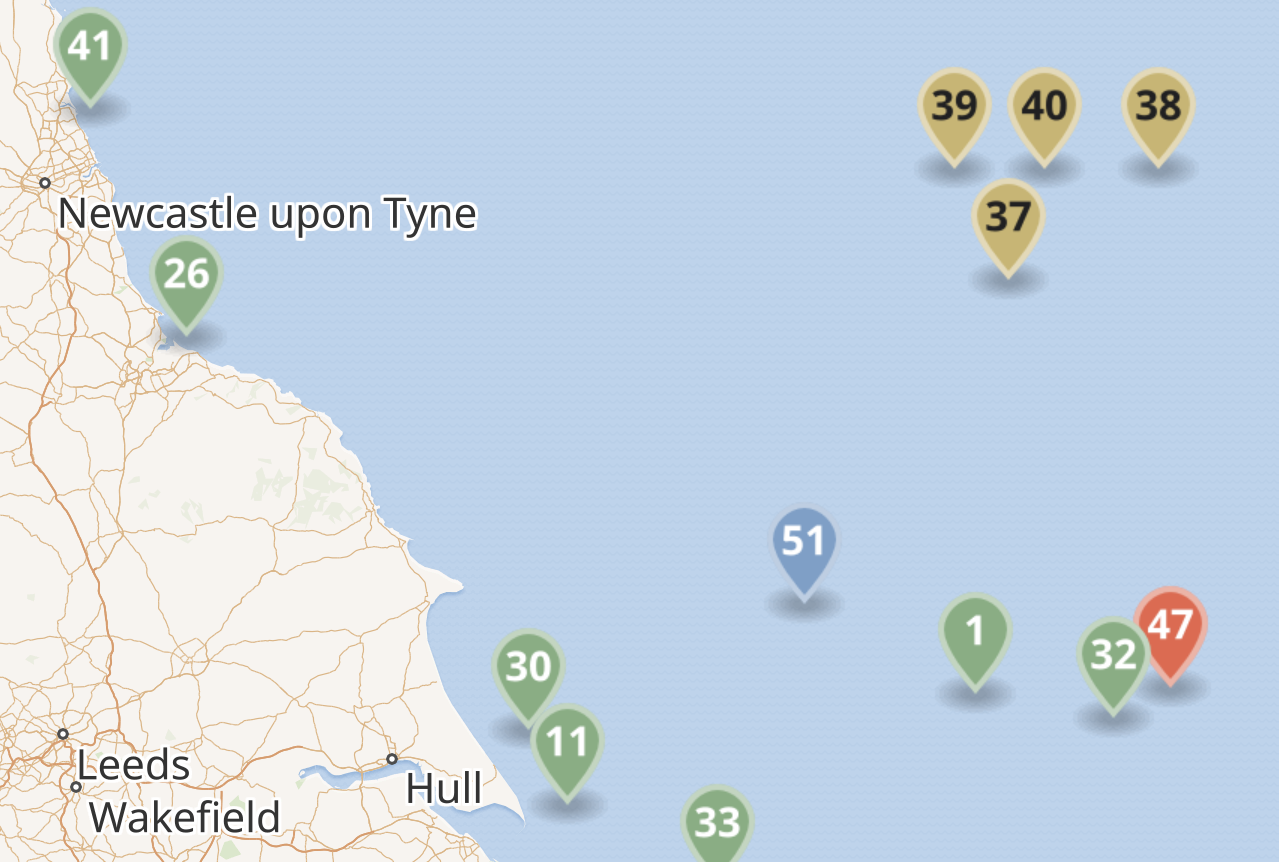
These are the Dogger Bank and Hornsea wind farms and their developers and size
- 37 – Dogger Bank A – SSE Renewables/Equinor – 1,235 MW
- 39 – Dogger Bank B – SSE Renewables/Equinor – 1,235 MW
- 38 – Dogger Bank C – SSE Renewables/Equinor – 1,218 MW
- 40 – Sofia – RWE – 1,400 MW
- 1 – Hornsea 1 – Ørsted/Global Infrstructure Partners – 1,218 MW
- 32 – Hornsea 2 – Ørsted/Global Infrstructure Partners – 1,386 MW
- 47 – Hornsea 3 – Ørsted – 2,852 MW
- 51 – Hornsea 4 – Ørsted – 2,400 MW
Note.
- That is a total of 12, 944 MW, which is probably enough electricity to power all of England and a large part of Wales.
- Wikipedia’s List of offshore wind farms in the United Kingdom, also lists a 3,000 MW wind farm, that is being developed by German company ; RWE called Dogger Bank South,
- The Dogger Bank South wind farm is not shown on the map, but would surely be South of wind farms 37 to 40 and East of 51.
- The Dogger Bank South wind farm will raise the total of electricity in the Dogger Bank and Hornsea wind farms to just short of 16 GW.
Connecting 16 GW of new electricity into the grid, carrying it away to where it is needed and backing it up, so that power is provided, when the wind doesn’t blow, will not be a nightmare, it will be impossible.
An alternative plan is needed!
AquaVentus To The Rescue!
AquaVentus is a German plan to bring 10 GW of green hydrogen to the German mainland from the North Sea, so they can decarbonise German industry and retire their coal-fired power stations.
- I introduce AquaVentus in AquaVentus, which I suggest you read.
- AquaVentus is being developed by RWE.
- AquaVentus connects to a German hydrogen network called H2ercules to actually distribute the hydrogen.
This video shows the structure of AquaVentus.
I clipped this map from the video.

Note.
- The thick white line running North-West/South-East is the spine of AquaVentus, that will deliver hydrogen to Germany.
- There is a link to Esbjerg in Denmark, that is marked DK.
- There appears to be an undeveloped link to Norway, which goes North,
- There appears to be an undeveloped link to Peterhead in Scotland, that is marked UK.
- There appears to be a link to just North of the Humber in England, that is marked UK.
- Just North of the Humber are the two massive gas storage sites of Aldbrough owned by SSE and Brough owned by Centrica.
- Aldbrough and Rough gas storage sites are being converted into two of the largest hydrogen storage sites in the world!
- There appear to be small ships sailing up and down the East Coast of the UK. Are these small coastal tankers, that are distributing the hydrogen to where it is needed?
When it is completed, AquaVentus will be a very comprehensive hydrogen network.
I believe that offshore electrolysers could be built in the area of the Hornsea 4 and Dogger Bank South wind farms and the hydrogen generated would be taken by AquaVentus to either Germany or the UK.
- Both countries get the hydrogen they need.
- Excess hydrogen would be stored in Aldbrough and Rough.
- British Steel gets decarbonised.
- A 1.8 GW hydrogen-fired powerstation at Keadby gets the hydrogen it needs to backup the wind farms.
Germany and the UK get security in the supply of hydrogen.
These may be my best guesses, but they are based on published plans.
Danish Shoppers Boycott Coca-Cola Over Trump
The title of this post, is the same as that of this article in the Telegraph.
This is the sub-heading.
Sales slump in Scandinavian nation following US president’s threats to annex Greenland
These are the first two paragraphs.
Shoppers are boycotting Coca-Cola amid a backlash over Donald Trump’s erratic foreign policy, Carlsberg has said.
The Danish brewer, which bottles the fizzy drink in its home country, said sales were “slightly down” as consumers protested against the US president.
Trump obviously doesn’t realise that every action has an equal and opposite reaction.
New York Governor: ‘I Will Not Allow This Federal Overreach To Stand’
The title of this post, is the same as that of this article on offshoreWIND.biz.
This is the sub-heading.
Following the order of the US Department of the Interior (DOI) to halt all construction activities on the Empire Wind 1 offshore wind project, New York Governor Kathy Hochul said she would fight the federal decision.
This fight could get very nasty.
In the green corner, we have the New York governor; Kathy Hochul, Østed, Denmark and probably a lot of workers who thought they’d retrained for a new growing industry.
And in the orange corner, we have Donald Trump, Vladimir Putin and all the other useful idiots.
Interestingly, I may have met one of referees to this spat.
In The Lady On The Train, I describe a meeting with one of the most powerful justices in the United States.
As she either sat on the US Supreme Court or the New York State Supreme Court, it will be interesting how she would judge this case, given the liberal scientifically-correct conversation we had a few years ago.
The fight in the Courts would be very hard against a whole bench of formidable adversaries like this lady.
Trump’s Eyeing Greenland – But Other Arctic Investment Is Frozen
The title of this post, is the same as that of this article on the BBC.
The BBC Article is a good introduction to Trump’s ideas for Greenland.
This is my one thought.
Do we side with Trump and the United States or our Danish friends?
Siemens Gamesa To Soon Install 21 MW Offshore Wind Turbine Prototype At Danish Test Site — Reports
The title of this post, is the same as that of this article on offshoreWIND.biz.
This is the sub-heading.
Siemens Gamesa is transporting a nacelle from its facility in Brande, Denmark, to the Østerild wind turbine test centre, a company spokesperson confirmed to offshoreWIND.biz. The spokesperson declined to reveal any specifics about the wind turbine but Danish media writes that it is the new prototype which Bloomberg reported earlier this year to have a capacity of 21 MW.
These first two paragraphs give a few more details.
DR (Danish Broadcasting Corporation) reported on 6 December that lamp-posts and traffic signs were being dismantled, and roundabouts widened last week to make room for an 11×11-metre nacelle to pass through on its way to Hvide Sande, starting last Friday. From there, the nacelle will be shipped to Hanstholm and then transported to Østerild, where it will be mounted on an already installed 170-metre tower, according to DR.
In June, Bloomberg reported sources familiar with the matter said that Siemens Energy had told customers it planned to build the largest wind turbine in the world by the end of the decade and the new offshore model would have an output of 21 MW, 40 per cent more than the company’s current largest turbine, the 14 MW platform that can reach up to 15 MW with the company’s feature called Power Boost.
I have a few thoughts.
Will Bigger Be Better?
Going back to the days of North Sea Oil and Gas, I can remember project managers saying that platform installation took off dramatically, as larger platforms, barges, cranes and equipment became available.
I can particularly remember one project manager extolling the virtues of giant 3000 tonne cranes.
Do We Need A Test Centre For Giant Turbines In The UK?
The question has to be asked, as we certainly have large open spaces of sea to put a 40 MW or larger turbine.
Centrica And European Energy Sign Agreement On Måde Green Hydrogen Facility
The title of this post, is the same as that of this press release from Centrica.
This is the sub-heading.
Centrica Energy and European Energy have signed a balancing and optimisation agreement for the Måde green hydrogen facility located at Port Esbjerg. Under the agreement, Centrica Energy will manage power production from co-located wind turbines, designating excess power production to green hydrogen production.
These two introductory paragraphs give more details.
Powering the 12MW green hydrogen facility are two wind turbines, part of the Måde Wind Turbine Test Center, developed by European Energy with a total installed capacity of 16MW. The turbines will provide renewable electricity, which is used to produce green hydrogen through electrolysis with demineralised water.
Expected to produce approximately 1,500 tonnes of green hydrogen every year, European Energy has secured an agreement with Port Esbjerg and a world-class industrial gases company for the offtake from the facility. As the production of hydrogen is a heat-intensive process, the excess heat from production will be fed into the local district heating network, demonstrating sector coupling across the electricity, fuel, and heating domains.
These are my thoughts,
Hydrogen Production
The hydrogen production uses a standard electrolysis method, but excess heat will be fed into the local district heating network.
AquaVentus And Denmark
I introduced AquaVentus in this post called AquaVentus.
This video shows the structure of AquaVentus.
I clipped this map from the video.
Note.
- The thick white line running North-West/South-East is the spine of AquaVentus, that delivers hydrogen to Germany.
- There is a link to Esbjerg in Denmark.
- There appears to be an undeveloped link to Norway.
- There appears to be an undeveloped link to Peterhead in Scotland.
- There appears to be a link to just North of the Humber in England.
- Just North of the Humber are the two massive gas storage sites of Aldbrough owned by SSE and Brough owned by Centrica.
- There appear to be small ships sailing up and down the East Coast of the UK. Are these small coastal tankers, that are distributing the hydrogen to where it is needed?
In the last century, the oil industry, built a substantial oil and gas network in the North Sea.
It appears now the Germans are leading the building of a substantial hydrogen network in the North Sea, that will bring the hydrogen they need to their country.
I also suspect that any spare hydrogen produced in Esbjerg can be added to the AquaVentus network.
- Hydrogen could be sent to Brough and Aldbrough in the UK for storage.
- Hydrogen could be sent to any country in the network that needs it.
Countries will pay for the hydrogen they use.
Optimising AquaVentus
AquaVentus is a complex network.
- Hydrogen could be produced offshore in British, Danish, Dutch, English, German, Norwegian, Orcadian, Scottish and Shetland waters.
- Hydrogen could be sent to Brough and Aldbrough in the UK for storage.
- Hydrogen can be sent to Belgium, Denmark, Germany, Norway, The Netherlands and the UK.
A company like Centrica has the expertise and the software to control the various hydrogen flows to the best advantage of hydrogen producers and users.
Equinor Acquires Minority Stake In Ørsted, Becomes Second-Largest Shareholder
The title of this post, is the same as that of this article on offshoreWIND.biz.
This is the sub-heading.
Norway-headquartered Equinor has acquired a 9.8 per cent minority stake in Denmark’s Ørsted, making it the second-largest shareholder behind the Danish state, which holds a controlling stake in the company.
These are the first two paragraphs.
According to Equinor, the company is supportive of Ørsted’s strategy and management and is not seeking board representation.
“Equinor has a long-term perspective and will be a supportive owner in Ørsted. This is a counter-cyclical investment in a leading developer, and a premium portfolio of operating offshore wind assets”, said Anders Opedal, CEO of Equinor.
Could it also be two Scandinavian companies getting together to put up a stronger front to outside interests?
Are they frightened of the actions that might be taken by Great British Energy and by the Germans with their massive thirst for hydrogen?
3 GW Dogger Bank South Offshore Wind Farms Reach New Development Stage
The title of this post, is the same as that of this article on offshoreWIND.biz.
This is the sub-heading.
The UK Planning Inspectorate has accepted into the examination phase the Development Consent Order (DCO) application for the Dogger Bank South (DBS) Offshore Wind Farms developed by RWE and Masdar.
The first two paragraphs give a brief description of the wind Farm.
The DBS East and DBS West offshore wind farms, which could provide electricity for up to three million typical UK homes, are located in shallow waters on the Dogger Bank over 100 kilometres off the northeast coast of England. The acceptance of the DCO application moves the projects into the pre-examination phase, which will become subject to a public examination later in 2024.
Together, the projects will have up to 200 turbines with a combined estimated capacity of 3 GW. Investment by RWE and Masdar during development and construction is predicted to deliver an economic contribution (Gross Value Added) to the UK of almost GBP 1 billion, including GBP 400 million in the Humber region.
There is a detailed map in the article on offshoreWIND.biz.
The Next Steps
These are given in the article.
The next steps for the projects, following a successful Development Consent Order, would be to secure Contracts for Difference (CfD), followed by financing and construction, the developers said.
It certainly looks like the 3 GW Dogger South Bank Wind Farm is on its way.
These are my thoughts about the project.
The Turbines To Be Used
The article says this about the turbines.
Together, the projects will have up to 200 turbines with a combined estimated capacity of 3 GW.
This means that the turbines will be 15 MW.
In RWE Orders 15 MW Nordseecluster Offshore Wind Turbines At Vestas, I said this.
Does this mean that the Vestas V236-15.0 MW offshore wind turbine, is now RWE’s standard offshore turbine?
This would surely have manufacturing, installation, operation and maintenance advantages.
There would surely be advantages for all parties to use a standard turbine.
It’s A Long Way Between Yorkshire And The Dogger Bank
The article says it’s a hundred kilometres between the wind farm and the coast of Yorkshire.
Welcome To The Age Of Hydrogen
This is the title of this page of the RWE web site.
The page starts with this paragraph.
RWE is actively involved in the development of innovative hydrogen projects. The H2 molecule is considered to be an important future building block of a successful energy transition. RWE is a partner in over 30 H2 projects and is working on solutions for decarbonising the industry with associations and corporations like Shell, BASF and OGE. Hydrogen projects are comprehensively supported in the separate Hydrogen department of the subsidiary RWE Generation.
AquaVentus
I also suggest, that you read this page on the RWE web site called AquaVentus.
The page starts with this RWE graphic.
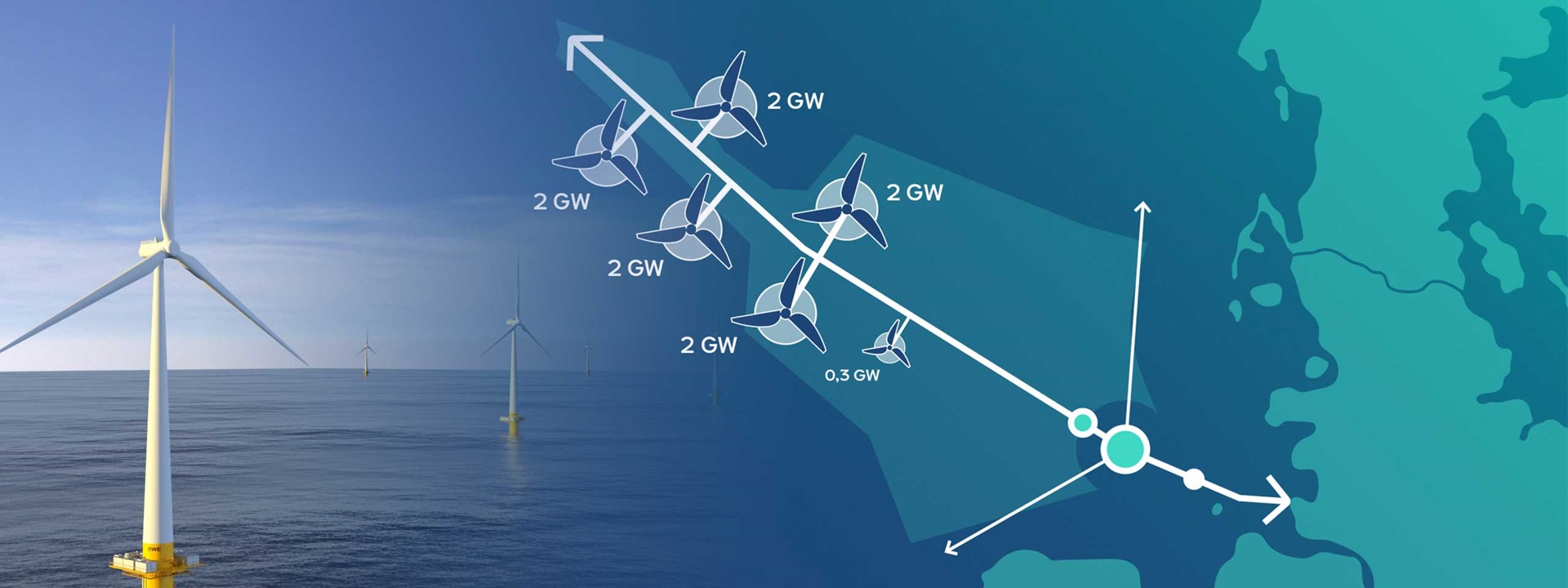
It appears that 10.3 GW of hydrogen will be created by wind farms and piped to North-West Germany.
These two paragraphs outline the AquaVentus initiative .
Hydrogen is considered the great hope of decarbonisation in all sectors that cannot be electrified, e.g. industrial manufacturing, aviation and shipping. Massive investments in the expansion of renewable energy are needed to enable carbon-neutral hydrogen production. After all, wind, solar and hydroelectric power form the basis of climate-friendly hydrogen.
In its quest for climate-friendly hydrogen production, the AquaVentus initiative has set its sights on one renewable energy generation technology: offshore wind. The initiative aims to use electricity from offshore wind farms to operate electrolysers also installed at sea on an industrial scale. Plans envisage setting up electrolysis units in the North Sea with a total capacity of 10 gigawatts, enough to produce 1 million metric tons of green hydrogen.
The page also gives these numbers.
- Total Capacity – 10 GW
- Tonnes Of Green Hydrogen – 1 million
- Members – 100 +
The web site says this about commissioning.
Commissioning is currently scheduled for early/mid 2030s.
The Germans can’t be accused of lacking ambition.
AquaVentus And The UK
This video shows the structure of AquaVentus.
I clipped this map from the video.
Note.
- There is a link to Denmark.
- There appears to be a undeveloped link to Norway.
- There appears to be a link to Peterhead in Scotland.
- There appears to be a link to just North of the Humber in England.
- Just North of the Humber are the two massive gas storage sites of Aldbrough owned by SSE and Brough owned by Centrica.
- There appear to be small ships sailing up and down the East Coast of the UK. Are these small coastal tankers distributing the hydrogen to where it is needed?
In the last century, the oil industry, built a substantial oil and gas network in the North Sea. It appears now the Germans are leading the building of a substantial hydrogen network.
AquaVentus And Aldbrough And Rough Gas Storage
Consider.
- In The Massive Hydrogen Project, That Appears To Be Under The Radar, I describe the Aldbrough Gas Storage.
- In Wood To Optimise Hydrogen Storage For Centrica’s Rough Field, I describe Centrica’s plans to turn Rough Gas Storage into the world’s largest hydrogen store.
- There is a small amount of hydrogen storage at Wilhelmshaven.
It looks like the East Riding Hydrogen Bank, will be playing a large part in ensuring the continuity and reliability of AquaVentus.
Dogger Bank South And AquaVentus
This Google Map shows the North Sea South of Sunderland and the Danish/German border.
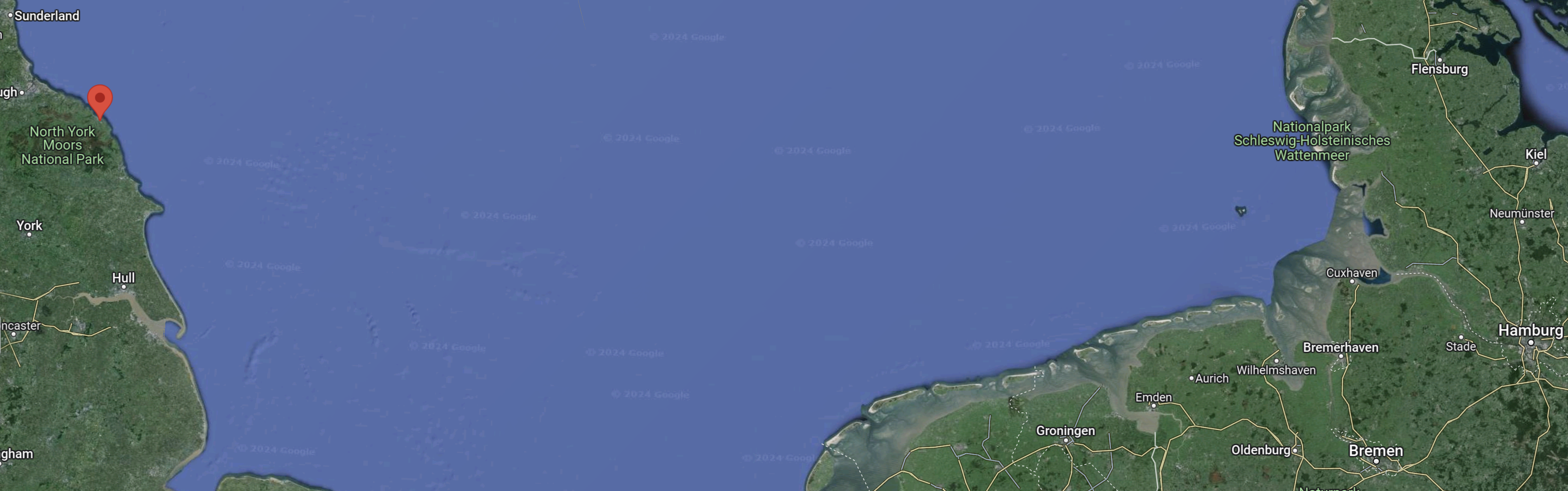
Note.
- Sunderland is in the top-left hand corner of the map.
- A white line in the top-right corner of the map is the Danish/German border.
- Hamburg and Bremen are in the bottom-right hand corner of the map.
If you lay the AquaVentus map over this map, I believe that Dogger Bank South wind farm could be one of the three 2 GW wind farms on the South-Western side of the AquaVentus main pipeline.
- Two GW would be converted to hydrogen and fed into the AquaVentus main pipeline.
- One GW of electricity would be sent to the UK.
But this is only one of many possibilities.
Hopefully, everything will be a bit clearer, when RWE publish more details.
Conclusion
I believe, that some or all of the Dogger Bank South electricity, will be converted to hydrogen and fed into the AquaVentus main pipeline.
I also believe, that the hydrogen stores in the East Riding of Yorkshire, will form an important part of AquaVentus.
Norway’s Sovereign Wealth Fund Acquires Stake In 573 MW Race Bank Offshore Wind Farm
The title of this post, is the same as that of this article on offshoreWIND.biz.
This is the sub-heading.
A consortium made up of investment funds belonging to Australia-headquartered Macquarie Asset Management and Spring Infrastructure Capital has reached an agreement to divest a 37.5 per cent stake in the 573 MW Race Bank offshore wind farm in the UK to Norges Bank Investment Management.
These four paragraphs give more details of the deal.
The stake was sold to the Norwegian sovereign wealth fund for approximately GBP 330 million (about EUR 390.6 million).
According to Norges Bank Investment Management, the fund acquired Macquarie European Infrastructure Fund 5’s 25 per cent stake and Spring Infrastructure 1 Investment Limited Partnership’s 12.5 per cent interest in the Race Bank offshore wind farm.
A Macquarie Capital and Macquarie European Infrastructure Fund 5 consortium acquired a 50 per cent stake in Race Bank during the construction phase in 2016. Macquarie Capital divested its 25 per cent stake in the wind farm in 2017.
With the deal, Arjun Infrastructure Partners will remain co-investor for 12.5 per cent of the wind farm and Ørsted will remain a 50 per cent owner and operator of Race Bank.
These are my thoughts.
The Location of Race Bank Wind Farm
This map from the Outer Dowsing Web Site, shows Race Bank and all the other wind farms off the South Yorkshire, Lincolnshire and Norfolk coasts.
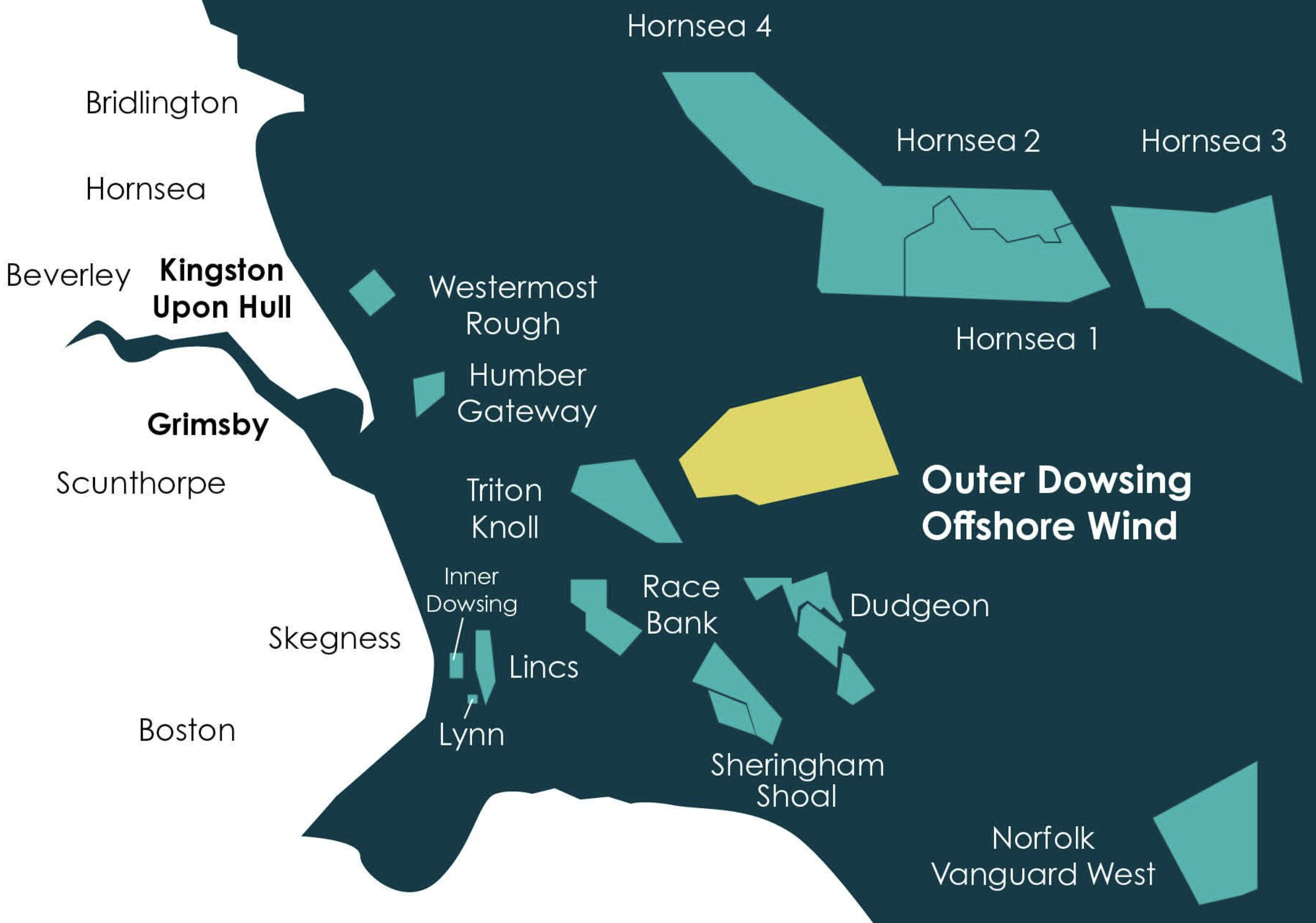
From North to South, wind farm sizes and owners are as follows.
- Hornsea 1 – 1218 MW – Ørsted, Global Infrastructure Partners
- Hornsea 2 – 1386 MW – Ørsted,Global Infrastructure Partners
- Hornsea 3 – 2852 MW – Ørsted
- Hornsea 4 – 2600 MW – Ørsted
- Westernmost Rough – 210 MW – Ørsted and Partners
- Humber Gateway – 219 MW – E.ON
- Triton Knoll – 857 MW – RWE
- Outer Dowsing – 1500 MW – Corio Generation, TotalEnergies
- Race Bank – 573 MW – Ørsted,
- Dudgeon – 402 MW – Equinor, Statkraft
- Lincs – 270 MW – Centrica, Siemens, Ørsted
- Lynn and Inner Dowsing – 194 MW – Centrica, TCW
- Sheringham Shoal – 317 MW – Equinor, Statkraft
- Norfolk Vanguard West – 1380 MW – RWE
Note.
- There is certainly a large amount of wind power on the map.
- Hornsea 1, 2 and 3 supply Humberside.
- Hornsea 4 will supply Norwich and North Norfolk.
- Norfolk Vanguard West would probably act with the other two wind farms in RWE’ Norfolk cluster.
- Ignoring Hornsea and Norfolk Vanguard West gives a total around 4.5 GW.
- There are also two 2 GW interconnectors to Scotland (Eastern Green Link 3 and Eastern Green Link 4) and the 1.4 GW Viking Link to Denmark.
I wouldn’t be surprised to see a large offshore electrolyser being built in the East Lincolnshire/West Norfolk area.
The primary purpose would be to mop up any spare wind electricity to avoid curtailing the wind turbines.
The hydrogen would have these uses.
- Provide hydrogen for small, backup and peaker power stations.
- Provide hydrogen for local industry, transport and agriculture,
- Provide hydrogen for off-gas-grid heating.
- Provide methanol for coastal shipping.
Any spare hydrogen would be exported by coastal tanker to Germany to feed H2ercules.
Do We Need Wind-Driven Hydrogen Electrolysers About Every Fifty Miles Or so Along The Coast?
I can certainly see a string along the East Coast between Humberside and Kent.
- Humberside – Being planned by SSE
- East Lincolnshire/West Norfolk – See above
- North-East Norfolk – See RWE Goes For An Additional 10 GW Of Offshore Wind In UK Waters In 2030.
- Dogger Bank – See RWE Goes For An Additional 10 GW Of Offshore Wind In UK Waters In 2030.
- Sizewell – See Sizewell C And Hydrogen.
- Herne Bay – Under construction
I can see others at possibly Freeport East and London Gateway.

