Shell Joins VindØ Energy Island Consortium
The title of this post, is the same as that of this article on offshoreWIND.biz.
This is the sub-heading.
Global energy major Shell is joining the VindØ consortium which is aiming to take a leading role in developing and building Denmark’s first energy island.
This paragraph outlines the project.
The island will be able to connect 10 GW of offshore wind to Denmark and other neighboring countries, plus host an innovation zone with potential for large-scale Power-to-X production and energy storage. It would include accommodation and operation and maintenance services from onsite harbour facilities.
It looks spectacular in the visualisation.
Thor Offshore Wind Farm To Feature Siemens Gamesa’s Newly Launched GreenerTowers
The title of this post, is the same as that of this article on offshoreWIND.biz.
This is the sub-heading.
Siemens Gamesa has revealed its GreenerTower, a wind turbine tower made of more sustainable steel. The company already closed its first order with RWE to feature 36 of the GreenerTower units at the 1 GW Thor offshore wind project in Denmark.
This is the first paragraph.
Today, tower production accounts for more than one-third of all wind-turbine-related CO2 emissions, according to Siemens Gamesa.
Siemens Gamesa’s new GreenerTower will ensure a CO2 reduction of at least 63 per cent in the tower steel plates compared to conventional steel.
Siemens Gamesa also claim this.
If all towers installed by the company in one year were exchanged with GreenerTowers, it would be the same as removing more than 466,000 cars from the roads in Europe for a year.
The first supplier to be qualified is Salzgitter AG.
- I wrote about Salzgitter’s green steelmaking in WindH2 Hydrogen Project Commissioned In Germany.
- Only a maximum of 0.7 tonnes of CO2-equivalent emissions are permitted per tonne of steel while maintaining the same steel properties and quality.
- Salzgitter’s electric furnaces will be fed with green electricity produced by renewable energy sources.
- Salzgitter AG have recently signed a Power Purchase Agreement (PPA) with Iberdrola.
- It looks like Salzgitter AG are going both the electric and hydrogen route to green steel.
I suspect over the next few years, we’ll be seeing more steel products made with green steel.
In this case, I suspect that Siemens Gamesa could use the same production process with very little modification, which is a great advantage.
World’s Largest-Of-Its-Kind Power Line To Deliver Clean Power To 1.8m UK Homes And Boost Energy Security
The title of this post, is the same as that as this press release from the UK Government.
These are the three bullet points of the press release.
- LionLink power line between UK and Netherlands will deliver enough electricity to power more homes than Manchester and Birmingham combined.
- Agreement made as Grant Shapps leads delegation of leading businesses to key North Sea Summit.
- Part of renewed Government drive to work with business to help grow the economy.
These three paragraphs outline the project.
The world’s largest multi-use electricity power line will be built under the North Sea, boosting UK energy supplies with enough to power 1.8 million homes – more than Birmingham and Manchester combined.
The new LionLink will connect the UK and the Netherlands with offshore wind farms, providing clean affordable and secure energy to Britain which will help cut household bills and drive Putin’s Russia further out of the energy market.
The cross-border electricity line will be only the second of its kind in the world, with the first having been built by Germany and Denmark. However, it will be able to carry more than four times the amount of electricity as its predecessor – making it the largest of its kind in terms of capacity anywhere in the world.
Note.
- I suspect the LionLink will go via the Dogger Bank, where Danish, Dutch, German and UK territorial waters meet an we are already building 8 GW of fixed foundation offshore wind. The other countries are also active in the area.
- The press release doesn’t mention, where the LionLink will make landfall in the UK.
- Much of the connection will probably use the cables being laid for the Dogger Bank wind farms.
- There is also no mention of the North Sea Wind Power Hub, which could be an artificial island on the Dogger Bank.
There is also a press release on the National Grid web site, which is entitled National Grid And TenneT Collaborate On Proposed First-Of-A-Kind Anglo-Dutch Electricity Link, which gives more details.
- The capacity is stated to be 2 GW.
- Like the current BritNed interconnector, the project will be a cooperation between National Grid And TenneT.
- TenneT is a limited liability company owned by the Dutch government, that is a transmission system operator in the Netherlands and in a large part of Germany.
There is also a diagram, showing how the LionLink will work, which includes these components.
- On the Dutch side, there is an offshore AC>DC Converter Station, which is connected to the Dutch electricity grid and one or more offshore wind farms.
- Across the border between the Dutch and UK Exclusive Economic Zones, there will be a HVDC cable.
- The HVDC cable will terminate in an onshore DC>AC Converter Station in the UK, which will be connected to the UK electricity grid.
No details of the two landfalls have been given.
More information is given in this article on offshoreWIND.biz, which is entitled UK And Netherlands Unveil Multi-Purpose Interconnector Plans.
- This shows a map of the North Sea with an interconnector running in a straight line between possibly Rotterdam and Bacton in Norfolk.
- A wind farm is shown connected to this interconnector.
This paragraph describes the windfarm and the interconnector.
LionLink, a multi-purpose interconnector that was announced today at the North Sea summit, could connect a Dutch offshore wind farm with a capacity of 2 GW to both countries via subsea interconnectors.
If the wind farm has a capacity of 2 GW, I would assume it can supply up to 2 GW to the UK and The Netherlands.
This is a classic system, that can be optimised by the application of sound principles.
All electricity generated by the wind farm must be used, stored or converted into green hydrogen.
Electricity will be distributed as to need.
Energy storage or electrolysers could be sited at either end or even in the wind farm.
I would suspect that more wind farms could be connected to the interconnector.
The team, that write the control system for the grid will have a lot of fun!
BritNed
I have a feeling that National Grid and TenneT have taken a long hard commercial look at the electrical and financial performance of BritNed over the last year and decided, that a second connection would be to the mutual benefit of both companies, their customers and the UK and The Netherlands in general.
It would also be twice as difficult for terrorists sponsored by Putin to cut two cables.
Conclusion
This is a great leap forward for wind power in the North Sea and Europe.
Denmark Launches World’s First Power-to-X Tender
The title of this post, is the same as that of this article on offshoreWIND.biz.
This is the sub-heading.
The Danish Energy Agency (DEA) has invited bids to build and operate Power-to-X projects with a deadline for applications set to 1 September. Through the tender – the first of this kind in both Denmark and the world – the country has made available DKK 1.25 billion (approximately EUR 167.7 million) in state support for the production of Power-to-X in the form of green hydrogen.
This paragraph outlines the deal.
The tender is being held to procure hydrogen produced by using renewable energy sources and is part of Denmark’s goal to reach between 4 and 6 GW of electrolysis capacity by 2030 and its Power-to-X strategy, released in 2021, according to which the country’s offshore wind resources provide good conditions for the production of green hydrogen, which requires large amounts of green electricity.
These are the conditions.
- Only hydrogen that is produced from renewable energy sources and meets the EU’s documentation requirements for green PtX fuels is eligible for support.
- The winning bidder(s) must have the project(s) built to full capacity and start green hydrogen production within four years of signing the contract with the Danish Energy Agency.
The tender has been approved for state aid by the European Commission.
I can see all the large electrolyser builders getting their bids ready for what will be tough competition.
Vestas 15 MW Prototype Now At Full Throttle
The title of this post, is the same as that of this article on offshoreWIND.biz.
This is the sub-heading.
Last week, three months after it was installed at the National Test Center for large wind turbines in Østerild, Denmark, Vestas’s V236-15.0 MW prototype wind turbine reached its nominal power rating of 15 MW.
On the 30th December 2022, I wrote Vestas 15 MW Prototype Turbine Produces First Power.
It appears to me, that going from startup to full power in a few days over three months indicates that testing has gone well.
I suspect too, that this apparently successful first test indicates that 15 MW will quickly become a standard size for wind turbines.
Full certification is expected from the third quarter of this year.
Green Hydrogen to Flow From Denmark To Germany From 2028
The title of this post, is the same as that of this article on Hydrogen Central.
These are the two introductory paragraphs.
Green hydrogen to flow from Denmark to Germany from 2028.
The climate minister, Lars Aagaard, and the German economy and climate minister, Vice Chancellor Robert Habeck, signed an agreement in Copenhagen to build a land-based hydrogen pipeline from Denmark to Germany, which will commence operations in 2028.
The article also says this about the hydrogen infrastructure to Germany.
An underground hydrogen pipeline from western Jutland will probably be used to transfer the hydrogen to northern Germany. The capacity of the new pipeline was not confirmed.
I can see the UK having the means to export hydrogen to Europe.
Floating Offshore Substation Project Secures EUDP Funding
The title of this post, is the same as that of this article on offshoreWIND.biz.
This is the sub-heading.
Semco Maritime, ISC Consulting Engineers, Aalborg University, Energy Cluster Denmark, and Norway and Sweden-based Inocean have secured funding to further develop a floating offshore substation (FOSS) concept.
This is the first paragraph.
The parties announced their collaboration in 2022 and are now set to further accelerate floating offshore substation development through funding from the Energy Technology and Demonstration Program (EUDP).
These three paragraphs talk about the design.
The substation layout has been developed to fit the shape of a three-column stabilised substructure, according to the partners.
The floating offshore substation is a crucial component in the offshore wind farm industry as deeper ocean sites further from the coastline are to be utilised, the partners said.
Between 60-80 per cent of the world’s offshore wind energy potential is in areas with depths greater than 60+ metres, which presents a need for an alternative solution to bring the power to shore, such as a floating offshore substation, according to the developers.
That all seems sensible.
The Netherlands Chooses Site For World’s Largest Offshore Wind-to-Hydrogen Project
The title of this post, is the same as that of this article on offshoreWIND.biz.
This is the sub-heading.
The Dutch government has designated an area for what will become the world’s largest offshore hydrogen production project. That area is Ten noorden van de Waddeneilanden (the North of the Wadden Islands), identified earlier for offshore wind development and deemed most suitable for providing 500 MW of electrolysis capacity and for the transport of hydrogen to land.
This Google Map shows the Wadden Islands.
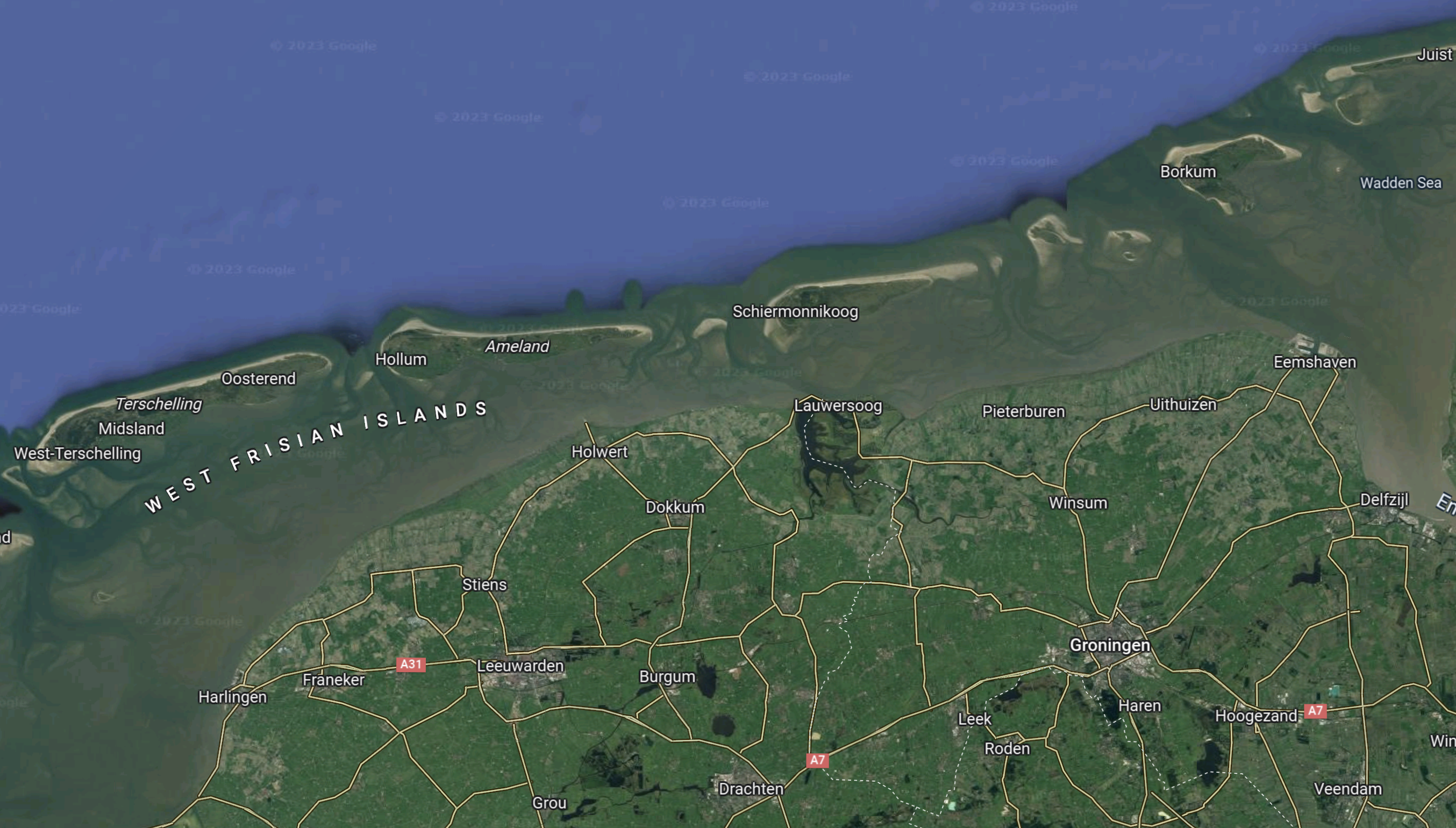
Note.
- Groningen is in the South-East corner of the map.
- I wrote about Eemshaven, which is to the North-East of Groningen in The Train Station At The Northern End Of The Netherlands.
- The Wadden or Frisian Islands are along the coast.
The Wadden Islands of the Netherlands, Germany and Denmark are a World Heritage Site.
In Can The UK Have A Capacity To Create Five GW Of Green Hydrogen?, I said the following.
Ryze Hydrogen are building the Herne Bay electrolyser.
- It will consume 23 MW of solar and wind power.
- It will produce ten tonnes of hydrogen per day.
The electrolyser will consume 552 MWh to produce ten tonnes of hydrogen, so creating one tonne of hydrogen needs 55.2 MWh of electricity.
If the Dutch build a 500 MW electrolyser it will produce 217 tonnes of hydrogen per day.
The Dutch Plan For Hydrogen
This 500 MW electrolyser fits well with the The Dutch Plan For Hydrogen.
Project Launches To Pair Offshore Wind With Sustainable Food Production
Note that it’s a little over a fortnight to April Fool’s Day!
The title of this post, is the same as that of this article on offshoreWIND.biz.
This is the sub-heading.
Win@Sea, a new collaboration between Vattenfall and Danish universities and companies, will investigate how to produce offshore wind power and sustainable food – all while improving the marine environment and biodiversity in the same marine area.
This is the first paragraph.
The partners will look into whether an offshore wind farm could simultaneously produce fossil-free electricity and sustainable food while also contributing positively to biodiversity in the same area.
But this report is not alone, in using the sea as a farm.
- Amazon Finances First-Ever Commercial-Scale Seaweed Farm Located Between Offshore Wind Turbines
- Brown Seaweed Could Remove 550 Million Tons Of Carbon
- The Plans For Giant Seaweed Farms In European Waters
- Oysters Get New Home At Eneco Luchterduinen Offshore Wind Farm
It sounds to me like a case of great minds thinking alike.
European Company To Make All Wind Turbine Blades 100 % Recyclable, Plans To Build Six Recycling Factories
The title of this post, is the same as that, of this article on offshoreWIND.biz.
This sub-heading outlines what the company plans to do.
A Denmark-based company Continuum plans to make all wind turbine blades fully recyclable and stop landfilling and their emissions-intensive processing into cement with six industrial-scale recycling factories across Europe, backed by investment from the Danish venture capital firm Climentum Capital and a grant from the UK’s Offshore Wind Growth Partnership (OWGP).
Other points in the article include.
- Continuum plan six factories.
- The first factory will open at Esbjerg in Denmark in 2024 and will be able to accept end-of-life blades this year.
- The second factory will be in the UK and it will be followed by others in France, Germany, Spain, and Turkey.
- Each factory will have the capacity to recycle a minimum of 36,000 tonnes of end-of-life turbine blades per year.
This paragraph describes, what will happen to the recycled turbine blades.
The company will recycle wind turbine blades into composite panels for the construction industry and the manufacture of day-to-day products such as facades, industrial doors, and kitchen countertops.
Looking at their description of their mechanical separation process, I suspect that they could recycle other products and manufacture lots of others.
 The Anonymous Widower