TransPennine Electrification And Piccadilly Upgrade Now Also In Doubt
The title of this post is the same as this article in Rail Technology Magazine.
A Digression About The Next Generation Of Trains
After digging through the various pages on Hitachi’s web site, I wrote Do Class 800/801/802 Trains Use Batteries For Regenerative Braking?.
My conclusion was this.
I will be very surprised if Class 800/801/802 trains don’t have batteries.
Will the Class 385 trains for ScotRail have similar traction system?
But having thought about it more, I’m now convinced that by 2030, the average long distance train will have the following characteristics.
- Ability to work from 25 KVAC overhead wires.
- Ability if required to work from 750 VDC third rail.
- Ability to raise and lower pantograph and switch beween modes at line speed.
- Batteries to handle regenerative braking.
- A generator unit to power the train.
- A sophisticated control system to choose the appropriate power source and drive the train according to terrain, passenger load, weather and traffic.
The more I read about Hitachi’s Class 800, Class 801 and Class 802 trains, the more I’m convinced that the features I have listed, is their ultimate goal. I suspect too, that the suburban Class 385 train has the capability of meeting the same objectives.
I would be very surprised if Alstom, Bombardier, CAF, Siemens, Stadler and others are not thinking along the same lines, as this document from Hitachi entitled Development of Class 800/801 High-speed Rolling Stock for UK Intercity Express Programme has been freely available since 2014.
It contains this diagram of the traction system of a Class 800 train.

Note the generator unit and the battery charger.
I’ve ridden the new Class 345 trains for Crossrail, a few times and after a trip yesterday in the gold-standard train;a 1970s British Rail Mark 3 coach, I can honestly say that the ride, noise and vibration in ombardier’s new train, is the best I’ve ridden.
So are Bombardier using a new traction system to achieve this smoothness? I suspect they are.
I also can’t find anything to say how a train will be removed from the tunnel under London, in the event of a complete power failure. No sane engineer would allow a rescue involving diesel or hydrogen in an emergency. However, batteries on the train with the capability of getting passengers to a safe disembarking point would be an obvious solution..
TransPennine Electrification
The major rail route across the Pennines between Leeds and Manchester is the Huddersfield Line.
The following stations are open on the route.
- Leeds *
- Cottingley
- Morley
- Batley
- Dewsbury
- Ravensthorpe
- Mirfield
- Deighton
- Huddersfield
- Slaithwaite
- Marsden
- Greenfield
- Mossley
- Stalybridge *
- Ashton-under-Lyne *
- Manchester Victoria *
The stations marked with asterisks (*) have electrification or will do soon.
Note the following about the route.
- Stalybridge to Leeds is under forty miles by road, so it could be even shorter by rail.
- Huddersfield station is one of a select group of Grade I Listed railway stations..
- Greater Manchester is developing a suburban electric network.
- Greenfield is the last station in Greater Manchester towards Leeds.
- Leeds is developing a suburban electric network.
- Cottingley is the last station in Leeds towards Manchester.
- Currently, trains from Manchester Piccadilly to Leeds can take a diferent route to Stalybridge, that is electrified as far as Guide Bridge station.
- I counted four tunnels, including Standedge tunnel, and over twenty bridges between Stalybridge and Huddersfield.
- Electrification of this section, would probably mean closure for at least a year.
- Between Huddersfield and Leeds the electrification would be a lot easier with about fifteen bridges and Morley tunnel.
My philosophy for this route would be as follows.
- Electrification would not go anywhere near Huddersfield, as the heritage lobby and their lawyers would have a field day.
- Standedge and Morley tunnels are over 2,000 metres long, double track and Standedge is level. If they needed refurbishment in the future, perhaps they could be electrified with an overhead rail, so that bi-modes could have a couple of miles of electricity.
- Electrification might be extended at the Manchester and Leeds ends of the line, so that the two cities could improve their local suburban electric networks.
- An alternative would be that the Leeds and Manchester suburban electric networks were provided with a few Class 769 trains or even some brand new four-car bi-modes.
- Services between Leeds and Manchester would be run by fast bi-modes.
TransPennine Express are already planning to run Class 802 trains between Liverpool and Newcastle via Manchester and Leeds. It looks to me, that whoever plans their train policy, saw this electrification crisis coming.
The money saved on the electrification would be spent on improving track and stations.
Currently the fastest journeys between Manchester and Leeds take just under fifty minutes.
What time could a Class 802 train achieve if the following were done.
- Manchester to Stalybridge is fully electrified.
- Some extra electrification was installed at Leeds.
- The track is improved.
My money would be on thirty-five minutes.
Manchester Piccadilly Upgrade
I hate using the isolated island Platforms 13 and 14 at Manchester Piccadilly station.
They are just too crowded and the steps and escalators down to the platform aren’t well-designed.
The Frequency Of Trains Through Platforms 13/14
The two platforms can be considered equivalent to these busy two-platform stations.
- Canada Water on the East London Line.- 20 trains per hour (tph) from 2020
- St. Pancras on Thameslink – 24 tph from 2018
- West Ham on Essex Thameside – 8 tph
All of these stations handle more trains than Plstforms 13./14 at Manchester Piccadilly.
Provided the signalling can handle it, it should be possible to schedule more trains through these two platforms.
One piece of information I viewed seemed to show that some services terminate in these two platforms. Surely, that is a way to reduce capacity.
Ordsall Chord And Class 769 Train Implications
The Ordsall Chord should change the pattern of trains, when it opens later this year.
The main implication will be that cross-city services can be developed.
The new Class 769 trains will help too, in that current diesel and electric services can be run using one type of train across the city.
A simple example would be Buxton to Blackburn.
These services release platform space in Manchester Piccadilly and other stations, which can be used for new services.
Access To Platforms 13/14
I’ve felt for some time, that if the access to the platform was better designed that a lot of the problems could be reduced.
I sometimes wonder, if when people see that their train is leaving from Platform 13 or 14, that they go there immediately and instead of waiting upstairs in the lounge, they descend to the platform.
When the Ordsall Chord is opened, because of the pattern of services passengers will sometimes change at one of the string of stations on the line.
Perhaps Oxford Road or Deansgate should be designated the preferred interchange station and fixed up with wider platforms, various kiosks and a waiting room to encourage passengers to change away from Piccadilly.
This Google Map shows Oxford Road station.
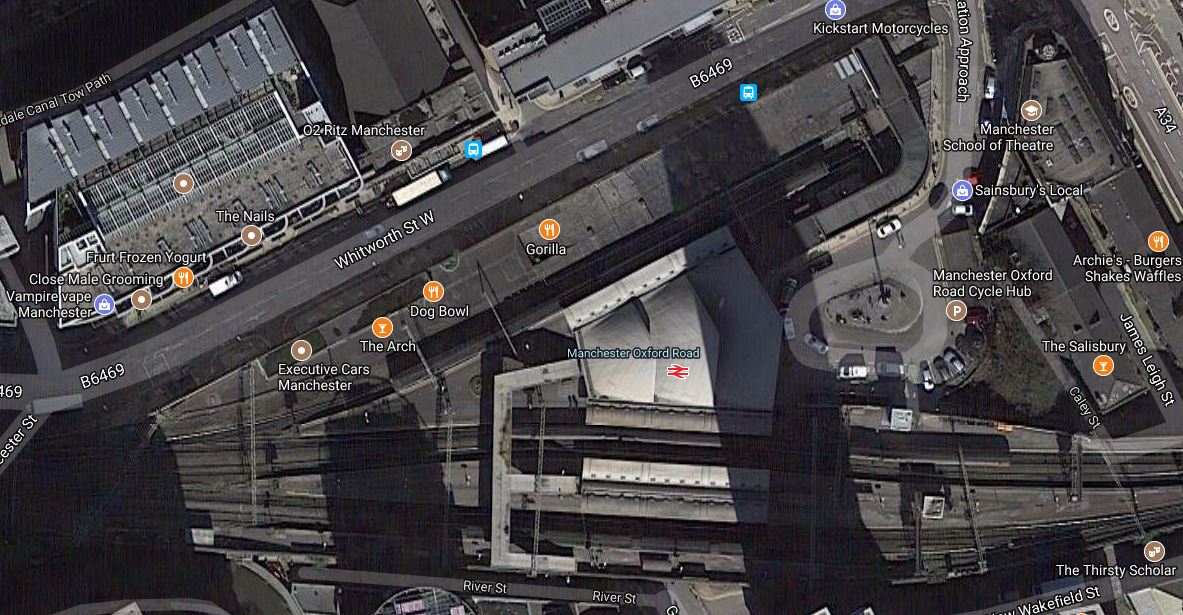
Oxford Road certainly seems to have space for passengers to use it as an exchange, when crossing the city.
But does Oxford Road have a stop on the Metrolink?
This Google Map shows Deansgate station.
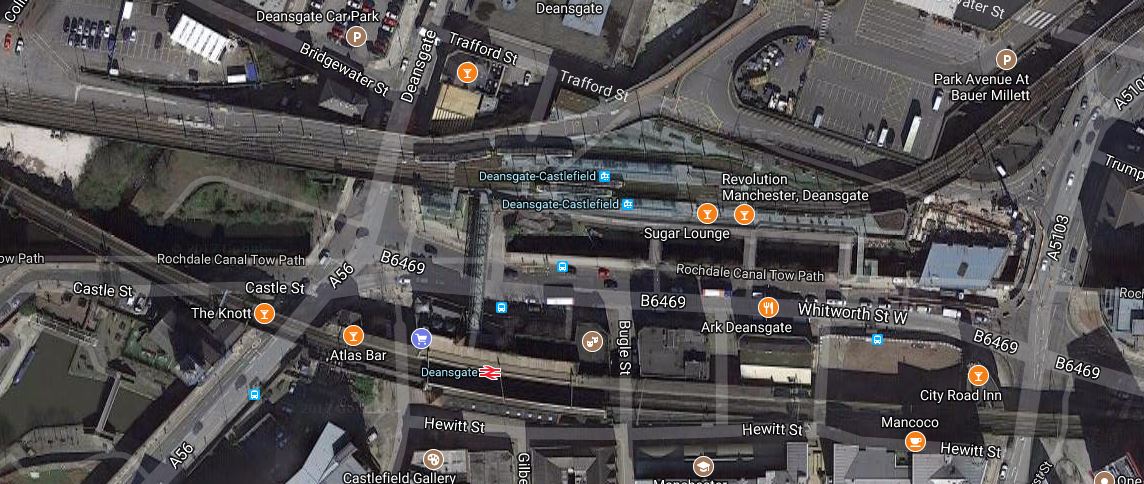
Deansgate doesn’t seem to have the space of Oxford Road. But it does have a good connection to the Metrolink.
The Forgotten Salford Stations
The other stations that could help are the two forgotten Salford stations; Salford Crescent and Salford Central.
This Google Map shows Salford Crescent station.
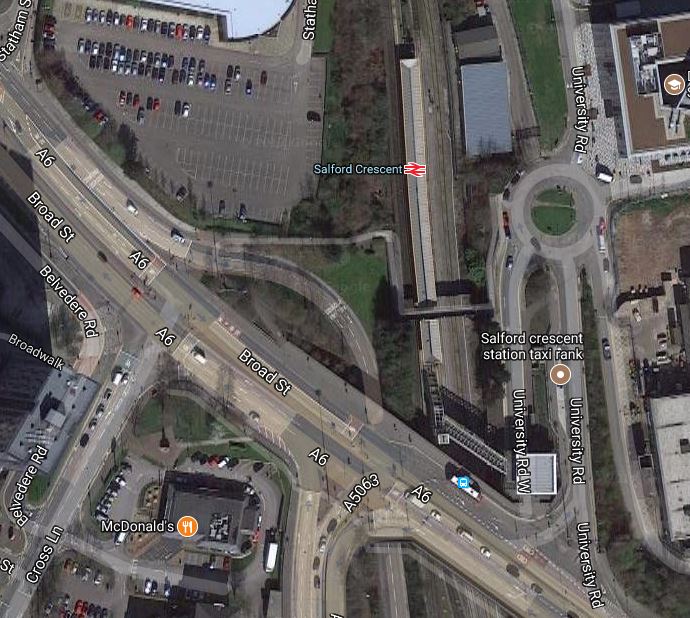
I believe that this station is going to get more platforms. Could it become a sort of triage station, where passengers from the North of Greater Manchester changed for.
- Trains for Manchester Victoria station.
- Trains for Manchester Piccadilly station.
- Metrolink to the city centre.
Surely, space could be found to run trams along Broad Street.
It would also look to be a station, where there is considerable scope to put housing or commercial developments above the station.
This Google Map shows Salford Central station.
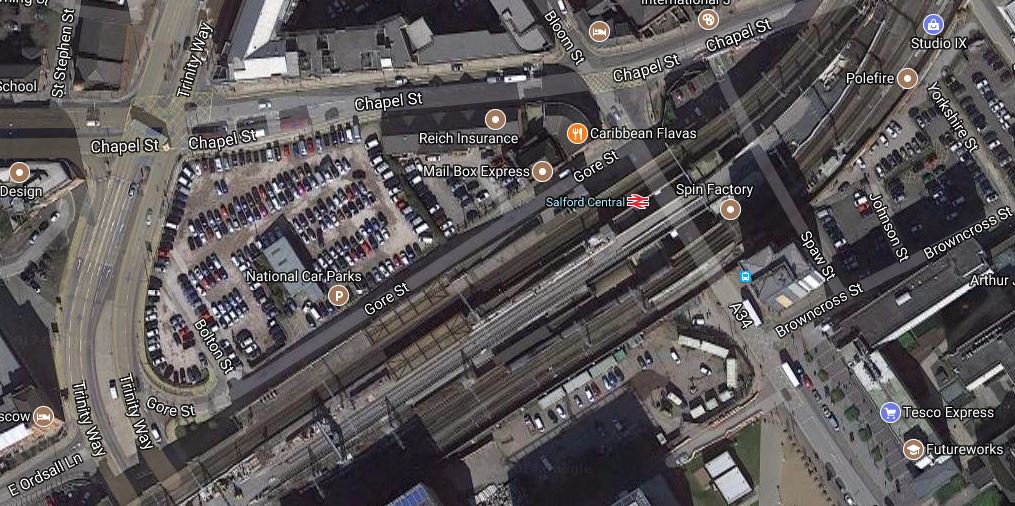
With a bit of thinking Salford Central must have interchange possibilities.
But as with Salford Crescent, this station doesn’t have a Metrolink connection.
The Wikipedia entry for Salford Central has a section called Future Development. This is said.
A Network Rail report suggests building platforms on the line to Liverpool (via Newton-le-Willows), the lines of which run through the station but are not provided with platforms. This scheme has since been adopted by Transport for Greater Manchester and included in their Capital Works Programme for 2015–16 to 2020–21. This will see three additional platforms built, at a cost of £20.5 million and will allow Liverpool, Chester & Manchester Airport-bound trains (using the Ordsall Chord) to call here.
I’ll believe it when I see it.
Conclusion About Manchester Piccadilly Upgrade
I am inevitably drawn to the following conclusions about the upgrade to Manchester Piccadilly.
The Ordsall Chord and the new electric services offered by the bi-mode trains will create a duckers-and-divers network across Manchester City Centre.
The following should be done.
- Access to Platforms 13/14 at Manchester Piccadilly should be greatly improved.
- Deansgate, Oxford Road, Salford Central and Salford Crescent should be improved with extra platforms, same- and cross-platform interchange.
- The Metrolink should be extended to both Salford stations.
- Greater Manchester should adopt a ticketing system based on bank cards to encourage use of the transport network.
Perhaps Mancunians need to be taught to duck-and-dive.
Electrifying Tunnels For Bi-Mode Trains
In TransPennine Electrification And Piccadilly Upgrade Now Also In Doubt, I came across two long tunnels, that would need to be wired, if the Huddersfield Line were to be electrified.
So here’s a list of long railway tunnels that aren’t electrified.
- Totley Tunnel – 5,700 metres
- Standedge Tunnel – 4,883 metres
- Chipping Sodbury Tunnel – 4,064 metres
- Disley Tunnel – 3,535 metres
- Bramhope Tunnel – 3,439 metres
- Cowburn Tunnel – 3,385 metres
- Morley Tunnel – 3,081 metres
- Summit Tunnel – 2,638 metres
- Blea Moor Tunnel – 2,404 metres
Note.
- Standedge and Morley are both on the Huddersfield Line.
- Totley, Disley and Cowburn are all on the Hope Valley Line.
Over the last few years, we have electrified or designed the electrification for several long tunnels including those for Crossrail and the Severn and Box Tunnels.
Consider.
- Crossrail and the Severn Tunnel use a rail attached to the roof of the tunnel.
- Overhead rail is becoming an increasingly common way to electrify a tunnel with 25 KVAC overhead.
- Crossrail developed a specialist machine to install the brackets for the overhead rails.
- Bi-mode trains like the Class 800, Class 755 and Class 769 train, have sophisticated GPS-controlled pantographs, that can go up and down automatically.
- Bi-mode trains will increasingly have energy storage.
- A train travelling at 160 kph (100 mph) will take forty-five seconds to pass through a 2,000 metres tunnel.
- No-one is going to object to the visual intrusion of electrification in a tunnel.
As some of these long tunnels will need refurbishment in the next few years, would it be worthwhile to fit them with at least the mountings for an overhead rail during the refurbishment.
I wouldn’t think it would be unreasonable to have a four-car bi-mode train with energy storage that gave a range of perhaps fifteen miles.
I don’t think it is unreasonable to suspect that both Hitachi and Bombardier have such a train in the Design Office.
Suppose one was shuttling between Manchester Piccadilly and Sheffield along the Hope Valley Line.
- The route is electrified from Piccadilly to Guide Bridge
- The two tunnels; Totley and Cowburn are a total of 5.6 miles long.
- Both tunnels are on a gradient, so electrification might speed up services.
- If Totley were electrified, it would fully charge the train, as it passed through.
I am pretty certain, that if the tunnels were electrified, Manchester to Sheffield would have a fully electric route.
Crossrail 2: City Mayors Criticise Government Backing
This is the headline on an article on the BBC.
This is the first three paragraphs.
Two city mayors have criticised the government’s decision to back Crossrail 2, days after it scrapped rail electrification plans in Wales, the Midlands and the north of England.
Greater Manchester mayor Andy Burnham said there would be “widespread anger” at the decision to back the railway line, which will run through London.
Liverpool City Region’s mayor said there needed to be “balanced spending”.
I can understand the anger, especially in Manchester, where the electrification is running a couple of years late.
The Picc-Vic Tunnel
Manchester was unlucky, in that of the three Northern tunnel projects of the seventies; Liverpool, Manchester and Newcastle, the Picc-Vic tunnel was the one that was cancelled by Harold Wilson. Birmingham and London both got cross-city rail tunnels with the same name; Snow Hill.
Perhaps, Manchester should have renamed Piccadilly Gardens!
Liverpool’s tunnel of the same period has recently been rebuilt and Merseyrail have just ordered a new fleet of Stadler trains to improve and expand their commuter network.
Newcastle’s tunnel helped to create the Tyne and Wear Metro, which is in the process of ordering new trains and expanding.
What would have happened to Manchester, if British Rail’s plans had been allowed to proceed?
All Manchester got was the Metrolink, which compared to tram systems in Birmingham, Blackpool, Croydon, Edinburgh and Nottingham is rather second-rate, despite being the largest.
The Ordsall Chord
Let’s hope that the Ordsall Chord works as it says on the tin. Wikipedia says this about the chord’s operation.
The Ordsall Chord will provide a direct link between Piccadilly and Victoria stations, allowing trains from Manchester Victoria and the east to continue to Piccadilly. Following completion of the chord, four trains per hour will travel between Manchester Airport/Manchester Piccadilly and Manchester Victoria in each direction, and associated reorganisation of train paths and retimetabling will provide eight trains per hour from Manchester Victoria towards the west via Chat Moss, and six trains per hour from Manchester Piccadilly towards either Chat Moss or Bolton and Preston (trains from both Victoria and Piccadilly stations to the west and north west (Chat Moss, Liverpool, Bolton, Preston, etc.) do not actually pass over the Ordsall Chord, both ends of which lead eastwards, but travel over pre-existing track).
But as British Rail said in the 1970s, surely a properly designed tunnel under Manchester with up to three stations in the City Centre would have been better, than the Ordsall Chord.
But what’s done is done and anyway, if the Picc-Vic tunnel had been started in 2016, as was the Ordsall Chord, it probably wouldn’t have been finished until 2026.
Where Are The Trains?
Northern and TransPennine Express are renewing their train fleets, but Manchester’s new electrified lines will need new trains from the end of this year.
The elderly Class 319 trains have stepped up to the plate, like the troopers they have always been. They would have arrived earlier, had the new Class 700 trains arrived on time.
Where Is The Electrification?
The UK and not just the North, has a particular problem and that is, that a lot of our railway lines run through quality countryside, some of which is spectacular.
So imagine trying to electrify the following lines with overhead wires.
- Manchester to Buxton
- Ipswich to Lowestoft
- Ashford to Hastings
- Settle to Carlisle
- Preston to Leeds via Hebden Bridge
The Heritage lobby and their lawyers would tie nNetwork Rail in knots for decades.
On a practical level, from the stories I’ve heard about the electrification of the Gospel Oak to Barking Line near where I live, there are myriad problems with installing electrification in this country.
A lot seems to be down to the fact that British Rail and their predecessors weren’t good at keeping records.
The Class 319 Flex Train
I was once told by an engineer who worked on the InterCity 125, of a mythical pub in Derby, where Rolls-Royce and British Rail engineers met to talk about their problems. Could it be that Derby-based Porterbrook and Northern have tapped this network and came up with the bi-mode Class 769 train, which is a modification to a Class 319 train and must surely be the ultimate manifestation of British Rail’s legendary Mark 3 coach.
But the Class 769 train has been well received, as other orders have been forthcoming.
Surely, the planners could see the demand for this one coming, so where is the four-car suburban bi-mode?
Northern have ordered eight of these bi-mode and it will be interesting to see how they are used.
If nothing else, the Class 769 train has already proved that there is a need for a quality four-car bi-mode train.
Bi-Mode Trains And Bottlenecks
I would assume that the Ordsall Chord has a modern signalling system and that the number of trains that could use the chord could be as high as sixteen trains per hour, which is the current capacity of the Thames Tunnel on the East London Line.
The chord may be able to handle all the trains, which would allow services on both sides of Manchester to be run Crossrail-style as back-to-back services.
As a simple example perhaps Manchester to Buxton and Manchester to Clitheroe could be combined into a Buxton to Clitheroe service run by Class 319 Flex trains, which uses electricity from Hazel Grove to Bolton and diesel engines to climb to the two end stations.
Routes like this will surely release much-needed platform space in Manchester Piccadilly station.
But the two island platforms at Manchester Piccadilly will be a bottleneck.
I can see this happening across the Pennines at other stations.
Bi-mode trains will provide the train capacity, but are the stations up to it?
The Long Term Solution
Class 769 trains are not a long term solution. In my view they are a superb development solution.
If we assume that electrification is ruled out for the near future, this will inevitably lead to more bi-mode trains.
Purists will say no, as they will want electrification and nothing less.
But then we have no experience of a modern bi-mode train.
The first bi-mode to come into service will probably be a Class 800 train built by Hitachi.
In Do Class 800/801/802 Trains Use Batteries For Regenerative Braking?, I answered the question I posed and I now believe that these trains can store energy.
So will the bi-mode of the future not be an electric train with an onboard diesel engine, but a sophisticated design, that can obtain its motive power from multiple sources, thus reducing noise, vibration and carbon footprint?
There are at least two other companies who will join this fight.
- CAF have lots of orders with both Northern and TransPennine Express and they will not want to lose them. So I think it is reasonable to expect something radical from the Spanish company with a proven record in innovation.
- Bombardier have designed the Aventra to have onboard energy storage and I would be very surprised if they haven’t thought about how to squeeze in a small diesel generator.
Will Alstom, Stadler and Siemens sit idly by, whilst other companies carve up the UK market? I doubt it.
The new bi-mode trains will provide the capacity, but other things must be done.
- Stations must be improved to cater for the extra passengers.
- Track and signalling must be improved to allow higher speeds.
- As electrification was done on the cheap in the past, there are some lengths of electrification, that must be done.
- HS2 must go on at full speed.
- Ticketing must be made as easy as London and the South East.
- Planning of a High Speed line across the North should be seriously started.
It will be interesting to see what develops.
Conclusion
I would spend the money on new trains, better stations and improving the passenger experience.
Electrification would come later, when there is a proven need.
But I wouldn’t rule out the train-makers creating a wholly different game.
Do Class 800/801/802 Trains Use Batteries For Regenerative Braking?
I ask this question, because I think that it could be key to the announcements about electrification yesterday, as reported in this article in Global Rail News, which is entitled UK Ditches Electrification Plans In Wales, The Midlands And The North.
If you look at all these Wikipedia entries for Hitachi trains being built for the UK.
You will find no reference to regenerative braking.
If you type “Class 800 regenerative braking” into Google, you will find this document on the Hitachi Rail web site, which is entitled Development of Class 800/801 High-speed Rolling Stock for UK Intercity Express Programme.
The only mention of the R-word is in this paragraph.
An RGS-compliant integrated on-train data recorder (OTDR) and juridical recording unit (JRU), and an EN-compliant energy
meter to record energy consumption and regeneration are fitted to the train.
If you search for brake in the document, you find this paragraph.
In addition to the GU, other components installed under the floor of drive cars include the traction converter, fuel tank, fire protection system, and brake system.
Note that GU stands for generator unit.
Traction System
I will start by having a detailed look at the traction system as described in the document.
The document provides this schematic of the traction system.
Note BC which is described as battery charger.
This is said in the text.
The system can select the appropriate power source from either the main transformer or the GUs. Also, the size and weight of the system were minimized by designing the power supply converter to be able to work with both power sources. To ensure that the Class 800 and 801 are able to adapt to future changes in operating practices, they both have the same traction system and the rolling stock can be operated as either class by simply adding or removing GUs. On the Class 800, which is intended to run on both electrified and non-electrified track, each traction system has its own GU. On the other hand, the Class 801 is designed only for electrified lines and has one or two GUs depending on the length of the trainset (one GU for trainsets of five to nine cars, two GUs for trainsets of 10 to 12 cars). These GUs supply emergency traction power and auxiliary power in the event of a power outage on the catenary, and as an auxiliary power supply on non-electrified lines where the Class 801 is in service and pulled by a locomotive. This allows the Class 801 to operate on lines it would otherwise not be able to use and provides a backup in the event of a catenary power outage or other problem on the ground systems as well as non-electrified routes in loco-hauled mode.
This is all very comprehensive.
But nothing is said about how regenerative brake currents from the traction motors are handled.
Any trained Control Engineer, of which I’m a life-expired example, can see all sorts of questions to ask.
- Could it be that all regenerative brake currents are fed into the Auxiliary Power Supply and then used for hotel power and to charge the battery?
- Is the generator unit switched on and off by a sophisticated control system, that uses GPS, train velocity, train weight, battery level etc.?
- Can battery power be used to move the train?
- How big is that mysterious battery?
In 2010, I wrote Edinburgh to Inverness in the Cab of an HST, after taking a memorable trip.
One memory of that trip is of the skill of the driver as he adjusted the twin throttles of the power cars and used the brakes, as the train travelled up hill and down dale.
This line will be Class 800 territory and I suspect that it will be worked by two five car units working as a ten-car train.
As I think that each five-car unit will have three generator units, does this mean that the driver will have six throttles?
Control Engineering has moved on in the forty years since the InterCity 125 entered service and I suspect that like an Airline Pilot, the driver of a Class 800 train, will have little control about how power is delivered. Except probably in a supervisory role.
So on routes like the Highland Main Line, the Class 800 will come into its own, using the generator units and stored energy as appropriate.
Obviously, the less the generator unit is used the better, as this minimises noise and vibration, and cuts carbon emissions.
Other features in the train design have been disclosed.
All Class 801 Trains Have At Least One Generator Unit
All Class 801 trains have at least one GU (generator unit), so it can obviously provide hotel power and probably enough power to limp to the next station, in case of overhead line failure.
Third Rail Class 800/801 Trains Are Possible
The layout of the traction system surely makes a third rail or even a dual-voltage version of the trains possible.
After all, their first cousin; the Class 395 train is a dual voltage train.
Locomotive Haulage Is Possible
As I said, the specification is comprehensive.
The document is also forthcoming in other areas.
Train Configuration
This is said.
Trains have a unit configuration of up to 12 cars, including the ability to add or remove standardised intermediate cars and the generator units (GUs)
(generators with diesel engines) needed to operate commercial services on non-electrified lines.
So if say GWR wanted an eleven-car train, it would be possible.
Automatic Coupling And Uncoupling
This is said.
Because the coupling or uncoupling of cars in a trainset occurs during commercial service at an intermediate station, the automatic coupling device is able to perform this operation in less than 2 minutes.
This is definitely in line with Class 395 train performance.
Automatic Train Identification Function
This is said.
To simplify the rearrangement and management of train configurations, functions are provided for identifying the train (Class 800/801), for automatically determining the cars in the trainset and its total length, and for coupling and uncoupling up to 12 cars in
normal and 24 cars in rescue or emergency mode.
I suspect most modern trains can do this.
One Twelve-Car Train Can Rescue Another
See the previous extract.
Flexible Interior Layout
This is said.
The rolling stock is designed to facilitate changes to the interior layout to accommodate changes to services or to the number of cars in the train.
I suspect that was expected.
An Interim Conclusion
In answer to the question, I posed with this post, I suspect that the answer is in the affirmative.
Extra Evidence
I also found this article on the Hitachi Rail web site, which is entitled Hybrid Propulsion with a sub-title of Energy-saving hybrid propulsion system using storage–battery technology.
This is the introductory paragraph.
As a step toward producing environmentally friendly propulsion systems, Hitachi has supplied a hybrid propulsion system that combines an engine generator, motor, and storage batteries. This system provides regenerative braking which has not been previously possible on conventional diesel-powered trains, and enables increased energy savings via regenerated energy.
They list the advantages as.
- 10% improvement of fuel consumption
- 60% reduction of the hazardous substances in engine exhaust
- 30db reduction of noise in stopping at the station
They also give various links that are worth reading.
All of these pages seem to have been published in 2013.
Conclusion
I will be very surprised if Class 800/801/802 trains don’t have batteries.
Looking at the schematic of the electrical system, the energy captured will at least be used for hotel power on the train.
Will the Class 385 trains for ScotRail have similar traction system?
UK Ditches Electrification Plans In Wales, The Midlands And The North
The title of this post is the same as that of an article in Global Rail News. This is the first two paragraphs.
The UK government has abandoned plans to electrify the railway between Cardiff and Swansea, the Midland Main Line north of Kettering and the line between Windermere and Oxenholme in favour of bi-mode, or ‘alternative-fuel’, trains.
An announcement from the Department for Transport (DfT) this morning said electrification of the lines was no longer needed and that cancelling the work would result in less disruption for passengers.
So do I agree with the Government’s decision?
Before I answer that question, I will put a few facts into this post!
All Trains Should Be Powered By Electricity
Most trains in the UK are actually powered by electricity.

If you take the noisy and smelly Class 66 locomotive, the wheels are actually turned by electricity, although that electricity is generated by a 2,460 kW diesel engine and an alternator, which is then fed to the traction motors.
The great advantage of electricity is that when you need to deliver precise power to move the train, it is very easy to control.
As an example of precise electric control, think of a variable-speed drill or food mixer.
What makes some trains more efficient than others, is the way they handle the electricity and get it to the traction motors.
Electrification; Overhead Or Third Rail
Ptobably the most efficient way to get electrical power to a train is from an electrification system, which in the UK can be 25 KVAC overhead wire or 750 VDC third rail.
25 KVAC overhead electrification has the following problems.
- Bridges and tunnels must be raised or enlarged to give sufficient clearance for the wires.
- Stations must be designed so that passengers can’t get near the wires.
- Overhead wires are liable to damage.
- Overhead gantries can be unsightly and subject to objection by local interest groups.
- Erecting overhead gantries on an existing railway seems subject to various problems.
I could add that in the UK, we seem to be particularly bad at overhead electrification, but then most other countries electrified their lines decades ago.
750 VDC third rail electrification has one main problem, which is one of Health and Safety.
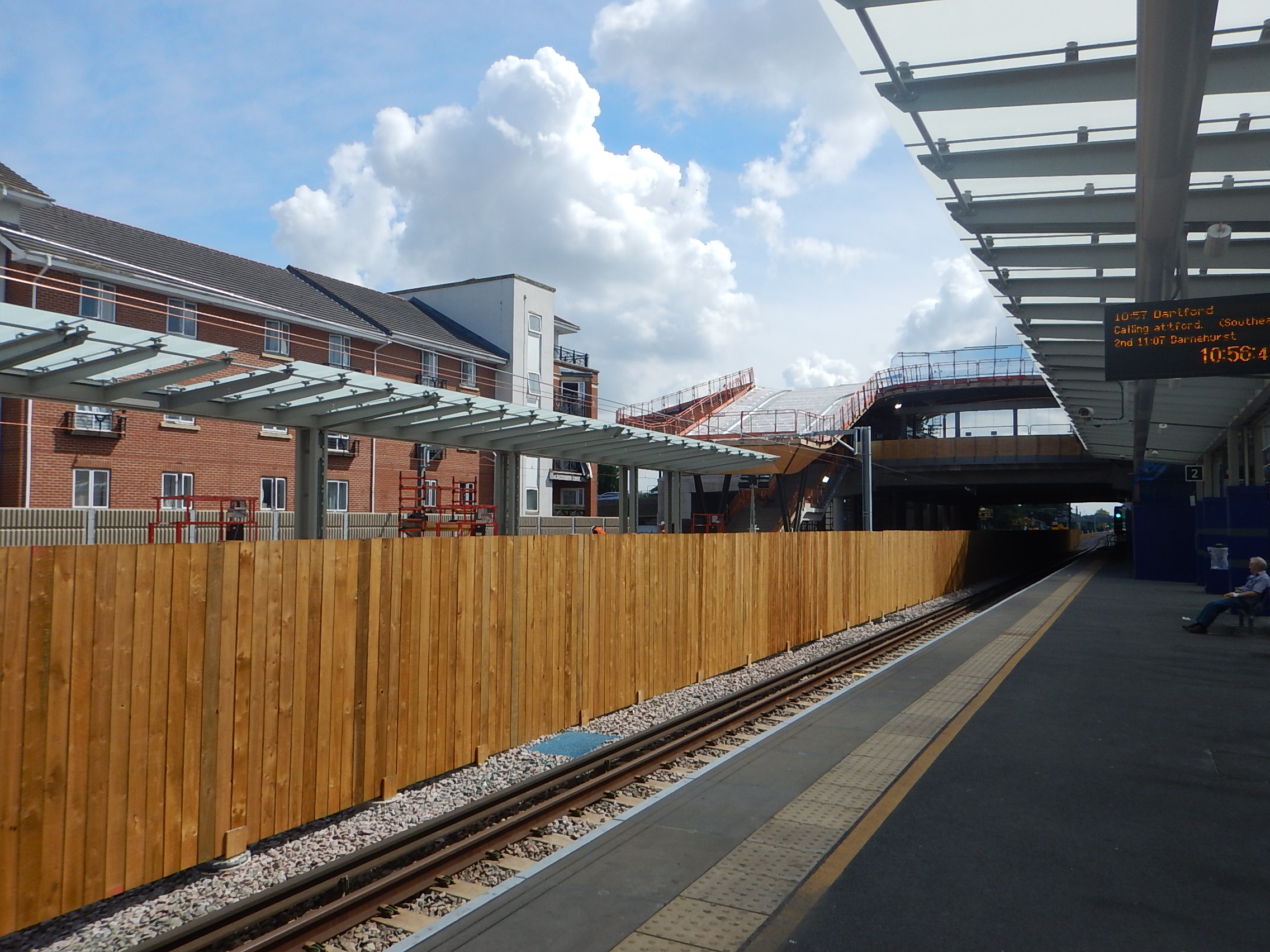
What is the purpose of this palisade fence at Abbey Wood station?
It certainly doesn’t protect passengers on the North Kent Line platform from where I took the photo from the 750 VDC third rail electrification in front of the fence.
The Crossrail tracks behind the fence are electrified with 25 KVAC, which is several metres in the air.
So is the fence to protect passengers on the platform behind the fence from running across the electrified track?
I think it probably is!
Electrification of both types has problems in certain track layouts.
- Switches and crossings sometimes need very complicated layout of the power system.
- Level crossings can present difficult Health and Safety problems.
- Depots can be dangerous places, even without live rails and overhead wires.
Engineers are constantly coming up with ideas to make electrification safer and more efficient.
Diesel Power
Putting an appropriate diesel engine on a train coupled to an alternator is a common way to generate electricity to power the train.
But.
- There is the noise and the smell.
- Diesel engines are very heavy.
- Diesel fuel has to be carried.
- Diesel trains have to be regularly refuelled.
To cap it all, diesel trains are not very green.
Gas Turbine Power
One version of he Advanced Passenger Train of the 1970s was intended to be powered by gas turbines and this shows how engineers tried all sorts of power for trains.
Gas turbine power, although very successful in aircraft is probably not suitable for trains.
Hydrogen Power
The Alstom Coradio iLint is a train powered by a hydrogen fuel cell. This is said in the Wikipedia entry.
Announced at InnoTrans 2016, the new model will be the world’s first production hydrogen-powered trainset. The Coradia iLint will be able to reach 140 kilometres per hour (87 mph) and travel 600–800 kilometres (370–500 mi) on a full tank of hydrogen. The first Coradia iLint is expected to enter service in December 2017 on the Buxtehude-Bremervörde-Bremerhaven-Cuxhaven line in Lower Saxony, Germany. It will be assembled at Alstom’s Salzgitter plant. It began rolling tests at 80km/h in March 2017.
As we have successful hydrogen-powered buses in London, I suspect we might see trains powered by hydrogen fuel cells.
Battery Power
Powering a heavy train for more than a couple of miles, by means of batteries seems very much of a fantasy.
I was sceptical until I rode inn Bombardier’s Class 379 train, that took part in the BEMU trial.

I believe strongly, that the place for a battery in a train is not normally as a primary power source, but as an intermediate electricity store in much the way the battery is used in a hybrid bus or car.
The battery would be charged, when running on electrified track or by using an onboard diesel engine or hydrogen fuel cell.
It could then power the train on a length of track without electrification.
Regenerative Braking
Regenerative braking can save as much of twenty percent of the electricity use of a train.
Every time the train brakes, the traction motors turn into generators and transform the train’s kinetic energy into electricity.
On some systems like the London Underground, the electricity is returned to the network and used to power nearby trains.
But on some trains, it is passed through resistors on the train roof and just turned into heat.
Hybrid vehicles have shown how it is possible to use batteries to store and reuse the energy and I believe that this technique is now starting to be used on trains.
In Thoughts On Batteries, I said this.
A typical four-car electric multiple unit like a new Class 710 train, weighs about 130 tonnes or 138 tonnes with passengers. Going at a line speed of 100 kph, it has a kinetic energy of 15 KwH. So this amount of kinetic energy would be well within the scope of a 75 KwH battery from a Routemaster bus.
I think that the typical four-car electric multiple unit can easily be fitted with a battery to handle the braking for the train.
The physics of steel-wheel-on-steel-rail are also very efficient, as Robert Stephenson, if not his father, would have known.
So it would appear that combining regenerative braking with batteries of a practical size can improve the efficiency of a train.
One of the great advantages of handling the regenerative braking on the train with batteries, is that expensive transformers to handle the return currents are not needed at trackside.
Putting It All Together
I very much feel that the ultimate train should have the following characteristics.
- The ability to work on 25 KVAC overhead and/or 750 VDC third rail electrification.
- A suitable independent power source, which today would probably be diesel.
- Regenerative braking.
- A battery of sufficient size.
- The ability to switch modes automatically.
As a Control Engineer, I feel sure that some form of Automatic Power Management would be welcomed by the driver.
The Class 800 Train
The Class 800 trains, have the following maximum speeds.
- 125 mph on 25 KVAC overhead wires
- 140 mph on 25 KVAC overhead wires with ETCS in-cab signalling.
- 100 mph on diesel.
I think it is true to say, that on 125 mph lines, they may be capable of going faster.
But whatever they can do is probably well known now as Hitachi have over two years of experience of running the trains on British tracks.
In Do Class 800/801/802 Trains Use Batteries For Regenerative Braking?, I analyse the posed question.
After spending several hours searching the Internet, I found this very helpful document on the Hitachi web site.
Reading every word several times, I came to the conclusion, that it is more likely than not, that all variants of Class 80x trains have batteries, that are used for the following.
- Handling regenerative braking
- Providing hotel power for the train in case of complete power failure.
- Providing emergency train recovery in case of complete power failure.
I also discovered the following.
- The all-electric Class 801 train, has at least one onboard diesel engine for emergency situations.
- All Class 80x trains could be modified to use third rail electrification.
- All Class 80x trains can couple and uncouple in under two minutes.
- Class 80x trains can rescue another.
- Class 80x trains can be locomotive-hauled.
Hitachi have worked hard to produce a seriously comprehensive train.
This specification will lead to some interesting operational strategies.
More Destinations
Great Western Railway currently has services between London Paddington and the following destinations in South Wales
- Bridgend
- Carmarthen
- Cardiff
- Llanelli
- Neath
- Newport
- Pembroke Dock
- Port Talbot
- Swansea
But how many other stations in South Wales could benefit from a direct service?
The intriguing thing is that a Class 800 train is narrower at 2.7 metres, than the following trains.
A five-car Class 800 train is also considerably shorter and a lot quieter than an InterCity 125.
So it raises the possibility of direct services between London and the following stations.
- Smaller stations in West Wales like Fishguard Harbour and Milford Haven
- Important stations in the Cardiff Valley Lines.
Could a five-car Class 800 train reach Aberdare, Ebbw Vale and Merthyr Tydfil, with some platform and track modifications?
Or if not a five-car, what about a four- or three-car train, which due to the flexible nature of the trains, I feel is very much possible!
Joining And Splitting Of Trains
In Wales, smaller separate trains could join into a train of up to twelve-cars at say Cardiff or Newport stations and then run to London as a single train.
Similar processes could apply in West Wales, with trains joining at perhaps Port Talbot Parkway station.
Returning from London, the trains would split at an appropriate station.
The big advantage of this approach, is that two or even three services share one path and driver between the join/split station and London, which means an increased number of separate services and total seats between Wales and London.
Similar processes will be possible on the following sets of routes, which will or could be run by Class 80x trains.
- London Paddington to Cheltenham, Gloucester, Hereford, Oxford and Worcester.
- London Paddington to Devon and Cornwall.
- Midland Main Line services.
- East Coast Main Line services.
How many stations on these lines will receive a new direct service to and from London?
Network Rail’s Secret Weapon
I have been suspicious for some time, that Network Rail have a very sophisticated simulation of the UK rail network. In fact, I’d be very surprised if they didn’t have one.
But that’s because I’ve done extensive dynamic simulation and scheduling in my working life and know the power and capabilities of such a system.
It’s just that some of the new franchises have developed some quite radical train patterns.
So I would suspect, a lot of the thinking behind the dropping of electrification has been thoroughly tested on the computer.
So how will the three lines quoted in the article be handled?
Oxenholme To Windermere
The Windermere Branch Line is just ten miles long with four stations.
This article in the Railway Gazette, says this.
‘We have listened to concerns about electrification gantries spoiling protected landscapes’, Grayling said when confirming the cancellation of plans to electrify the Windermere branch in the Lake District, adding that Northern would begin work to trial an ‘alternative-fuelled’ train on the route by 2021. Grayling mentioned the ongoing development of battery and hydrogen power in his statement, but Northern said it had only just begun to explore possible options following the cancellation of the electrification, and so any decision on the technology to be used was still some way off.
From May 2018 Northern plans to operate services to Windermere using Class 769 Flex electro-diesel units to be formed by fitting diesel powerpacks to Class 319 EMUs. New CAF DMUs would then be introduced to the route from December 2019.
It is both a short-term and a long-term solution, that is probably to the benefit of all stakeholders.
Given that the Class 769 train has been designed to serve Manchester to Buxton, you can’t accuse Porterbrook and Northern of hiding their creation under a bushel.
Cardiff To Swansea
The South Wales Main Line between Cardiff Central and Swansea stations is a forty-five mile double-track with the following operating speeds.
- 90 mph from Cardiff Central to East of Bridgend station
- 75 mph from Bridgend to Swansea Loop North Junction
- 40 mph from Swansea Loop North Junction to Swansea
But there is a short section at 100 mph through Pyle station.
This is said in the article in Global Rail News.
Referring to the Cardiff-Swansea route, the statement said, “Rapid delivery of passenger benefits, minimising disruption and engineering work should always be our priority and as technology changes we must reconsider our approach to modernising the railways.”
The argument is based on the planned introduction of bi-mode Class 800 trains later this year.
I have flown my virtual helicopter along the tracks and it doesn’t seem a badly designed route.
- It appears to be fairly straight with flowing curves.
- There are only eleven stations to pass through.
- Looking at the current timetables, it would appear that the fastest trains take about 51-53 minutes to go between Cardiff and Swansea.
- Wikipedia says this about the South Wales Main Line, “resignalling and line speed improvements in South Wales, most of which would be delivered in 2010–2014”.
So have Network Rail found a way to increase the operating speed nearer to the 100 mph of the Class 800 trains, when running on diesel?
I obviously don’t know for sure, but given the improvements to the South Wales Main Line and the performance of the new trains, I wonder if Network Rail’s simulations have shown that there is very little to be gained by full electrification.
As I indicated earlier, by joining and splitting services, the number of trains and the total number of seats can be increased to West Wales without needing more train paths between London and Cardiff.
Midland Main Line
There has been discussions in Modern Railways recently about the problems of devising a timetable for the Midland Main Line.
The article in the Railway Gazette says this.
Hitachi is supplying bi-mode trainsets for Great Western services under the Department for Transport’s Intercity Express Programme, while the operator of the next East Midlands franchise will be required to introduce bi-mode trainsets from 2022. DfT said the use of electro-diesel trainsets instead of electrification would mean passengers would ‘benefit sooner’, because ‘disruptive’ work to install ‘intrusive wires and masts’ would ‘no longer be needed’.
It looks to me that simulation has shown, as in South Wales, there is little to be gained from full electrification.
But there could be a lot to gain from the following.
- Creative joining and splitting of trains.
- Improved track layouts.
- Improving the electrification South of Bedford.
- Adding new stations.
With these intelligent bi-mode trains, electrification can be added selectively, if it is shown to be worthwhile.Control systems linked to GPS, can raise and lower the pantograph appropruiately.
Conclusion
I think that someone asked the heretical question.
What would happen if instead of electrification, we used bi-mode trains?
Both the South Wales Main Line and the Midland Main Line have similar characteristics.
- Operating speed upwards of 90 mph.
- Sections where the operating speed could be raised.
- Partial electrification at the London end.
- All London suburban trains sharing the routes are 100 mph trains.
- Modern signalling
Couple this with the Class 800 trains and a very good simulation, and I suspect that Network Rail have found ways to improve the service.
I very much feel that similar techniques are being used to increase the capacity of the electrified Great Eastern Main Line to achieve Norwich-in-Ninety.
I can’t of course prove my feelings, but then I started writing computer simulations in the mid-1960s and like to think, I know when I see others have done some good numerical analysis.
Where Else Could Bi-Mode Trains Be Used In This Way?
This is very much speculation on my part.
Basingstoke To Exeter Via Salisbury
Consider.
- There have been ambitions to electrify this route for decades.
- The new operator of the route; South Western Railway and Great Western Railway, who will operate Class 800 trains, are partially in the same ownership.
- Third rail or dual voltage Class 800 trains are possible.
- The trains are 100 mph units on diesel against the current 90 mph Class 158 trains.
- The trains would save four minutes between London Waterloo and Basingstoke.
- The trains could take advantage of speed improvement South of Basingstoke.
- If Basingstoke to Exeter was a 100 mph line, then up to fifteen minutes could be saved.
- The trains could join and split to serve multiple destinations.
But perhaps the biggest advantage would be that all trains between London Waterloo and Basingstoke would be 100 mph trains, which must mean that more trains could use the line.
Cardiff to Brighton via Southampton, Portsmouth Harbour and Bristol
Consider.
- This route has significant overcrowding according to Wikipedia.
- Cardiff to Bristol should eventually be electrified with 25 KVAC overhead wires.
- Brighton to Southampton is electrified with 750 VDC third rail.
- Great Western Railway run this route and have Class 800 trains.
- Dual voltage Class 800 trains are possible.
To run this route efficiently, Great Western Railway would need an appropriate number of five-car dual voltage Class 800 trains.
Norwich To Stansted Airport via Ely and Cambridge
The Breckland Line between Norwich and Cambridge has the following characteristics.
- Double-track throughout its just over fofty miles.
- Sections of electrification at Norwich and South of Ely.
- A variable operating speed of up to 90 mph.
The line has recently been upgraded with improved track, removal of level crossings and modern signalling.
As part of their new franchise proposal, Greater Anglia decided to run services from Norwich to Stansred Airport using new Stadler Class 755 trains, with the following characteristics.
- Three- or four-car
- Bi-mode power.
- 100 mph capability.
- Running on 25 KVAC, where available.
I think this is a good plan and is an example of the sort of use of bi-mode trains that will be seen increasingly.
Consider.
- Norwich gets a much better connection to Cambriodge and Stansted Airport.
- Some services on the route are still run by 90 mph Class 158 trains.
- Speed improvements will come because of the nearly fifty miles of electrification between Ely and Stansted Airoport.
- There may be further track improvements possible.
There is also the big possibility of being able to run a direct service between Norwich and London via Cambridge. I estimate that this could be done in about two and a half hours.
This is obviously not as fast as the route via Ipswich, where the current timing is around one hour fifty minutes and plans are in progress to reduce it by twenty minutes, but as an engineering work diversion, it is faster than a bus replacement service.
Peterborough To Colchester via Bury. St. Edmunds and Ipswich
This is an extension of the current Peterborough to Ipswich service that will be run by a bi-mode Class 755 train, under the new franchise agreement.
Consider.
- The route is not electrified, except for Peterborough to Stowmarket.
- Colchester gets a new hourly direct link to Peterborough, which has many services to the North.
- A two train per hour service across Suffolk between Ipswich and Bury St. Edmunds is created.
- Colchester to Peterborough may be reduced by twenty minutes or more.
- Ipswich to Peterborough may be reduced by a few minutes.
If it was decided to electrify from Stowmarket to Peterborough, timings would benefit substantially.
Ipswich To Cambridge via Bury. St. Edmunds and Newmarket
This is an existing service that will be run by a bi-mode Class 755 train, under the new franchise agreement.
Leeds To Glasgow Via Settle
Why not?
If you look at timings for Leeds to Glasgow, they are typically as follows.
- 3 hours 58 minutes with an 11 minute change at Haymarket.
- 4 hours 12 minutes with a 30 minute change at Carlisle
- 4 hours 4 minutes on a direct train via Edinburgh.
The Settle-Carlisle Line has been stoutly repaired after the 2015-2016 Temporary Closures and is probably in its best state for years, if not ever.
- Leeds to Skipton is electrified.
- Carlisle to Glasgow is electrified.
- Virgin Trains East Coast run to Skipton, using InterCity 225s.
I estimate that a Class 800 train could reduce the journey time to around three-and-a-half hours.
Would that be a successful service considering driving between Leeds and Glasgow probably takes almost four hours?
Small Electrification Projects
My visit to Abbey Wood station yestetday proved to me that some small electrification projects don’t actually need wires or third rails.
The reversing siding for Crossrail, which is also a link to the North Kent Line, consists of the following new tracks.
- A set of points at the Eastern end of Abbey Wood Station to connect the two Crossrail platforms 3 and 4 and allow trains to reverse.
- A track to serve as the reversing siding and the link between the two lines. It is probably about 700 metres long.
- A set of points to connect the libk to the Down North Kent Line.
- A cross-over between the two North Kent Lines.
Only about fifty metres of the reversing siding around the first set of points is electrified.
I have been convinced for some time, that the Barking Riversude Extension will be built without wires, as the project details mention electric trains, but don’t mention electrification.
Aventras may also have a remote wake-up capability as detailed in Do Bombardier Aventras Have Remote Wake-Up?, which would allow trains to be parked overnight in sidings without electrification
Kent On The Cusp Of Change – Track Improvements
The Kent On The Cusp Of Change article in the July 2017 Edition of Modern Railways talks mentions a few track improvements.
Ashford Spurs
This enables more Continental trains to call at Ashford International station. I discussed it in Ashford Spurs.
The Link Between High Speed One And The Marshlink Line
This is needed to get the Highspeed trains from St. Pancras to Hastings, I I discussed in Highspeed to Hastings.
The Modern Railways article says this about the creation of the link.
It will be an uphill struggle to fund necessary layout changes at Ashford International during Control Period 6 (2019-2024). A realignment of the track would be needed to join the track serving the London end of platform 2 (which is accessible from the Marshlink route) to the Ashford spurs that link through to High Speed 1.
This diagram from Wikipedia shows the lines through Ashford International station.

Note how the two main tracks of High Speed One use a flyover to get out of the way of Ashford International station. The Ashford Spurs connect the lines through the two platforms to High Speed One.
This Google Map shows the London end of Ashford International stations.
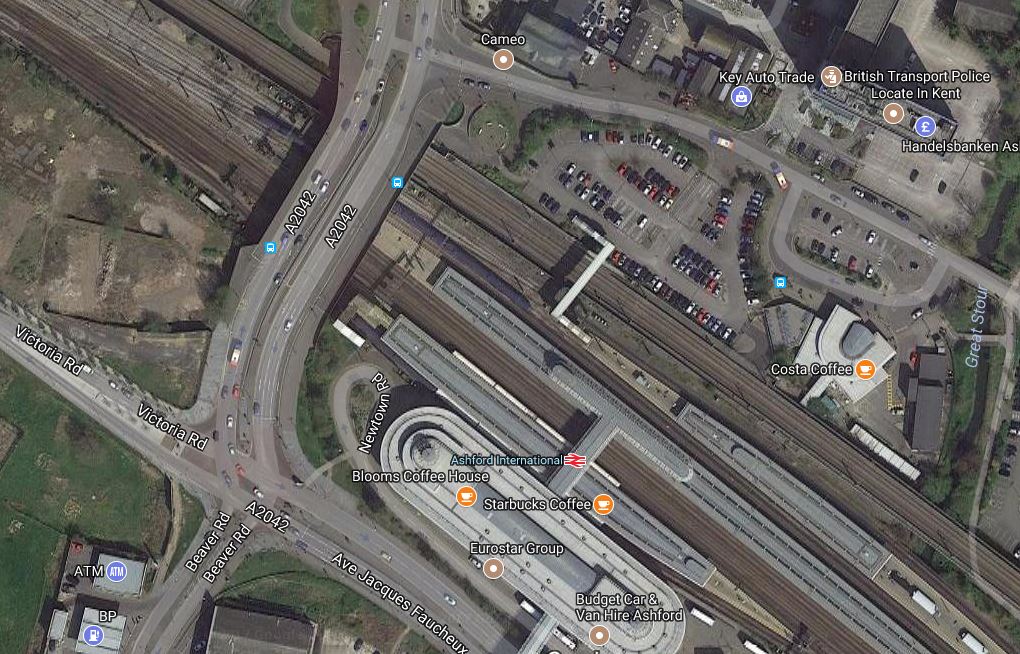
There are three island platforms, which are as follows from the bottom.
- Platform 1 and 2 for third-rail domestic services and the Marshlink Line
- Platform 3 and 4 for Continental services
- Platform 5 asnd 6 for Highspeed domestic services.
The two lines visible beyond platforms 5 and 6 are High Speed One on the flyover.
At the London end of the station, there is already the following links to High Speed One from the station.
- Platform 3 to London for Continental services
- Platform 4 from London for Continental services
- Platform 5 to London for Highspeed services
- Platform 6 from London for Highspeed services
It could be quite complicated connecting even one of Platform 1 and 2 to High Speed One.
But at least as these pictures show, there is plenty of space.
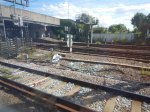
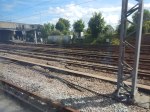
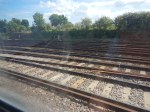
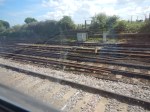

Note.
- The pictures were taken from a Highspeed train leaving Platform 5 for London.
- The first picture was taken just to the London side of the bridge shown in the Google Map.
- The domestic Platforms 1 and 2 are on the far side, in this first picture.
- The
I do feel that after some of the engineering on Crossrail and Thameslink, that an affordable solution is possible.
In addition to the space, I don’t think any trains thunder through here at high speed, as they use the flyover for that.
I also feel that Hitachi might be the key here.
As I said in Highspeed to Hastings, I believe that batteries not diesel will be used to power the trains on the Marshlink Line.
So if necessary, battery power could be used to power the trains between High Speed One and Platforms 1 and 2.
Hitachi could probably do the change between power sources under the wires of High Speed One, so this would mean that there would be no extra overhead electrification at Ashford International station.
As most of the train frequencies between High Speed One and Ashford International station are not by any means high, I wonder if there is a simple solution in there somewhere.
The most difficult connection would be to get trains from London across three tracks.
- The Highspeed line from Platform 5 to London
- The Continental line from London to Platform 4.
- The Continental line from Platform 3 to London
A single track unelectrified dive-under or even a flat junction might be possible to connect High Speed One to Platforms 1 and/or 2.
Connecting Platforms 1 and/or 2 to High Speed One to London is much easier, as no other lines need to be crossed.
I also wonder if the funding problem and probable subsequent delay of building a link could lead to an interim solution to give Hasting the service it needs.
Network Rail’s Options For The Link Between High Speed One And The Marshlink Line
This document from Network Rail gives their options for the link.
- High Speed One To Platform 2
- High Speed One To Marshlink via Platform 3
As the second option would leave Continental services with just one bi-directional platform, I think it is unlikely to be used, as what happens if a train fails in the platform?
This diagram from the Network Rail document shows the traqck layout for the first option.
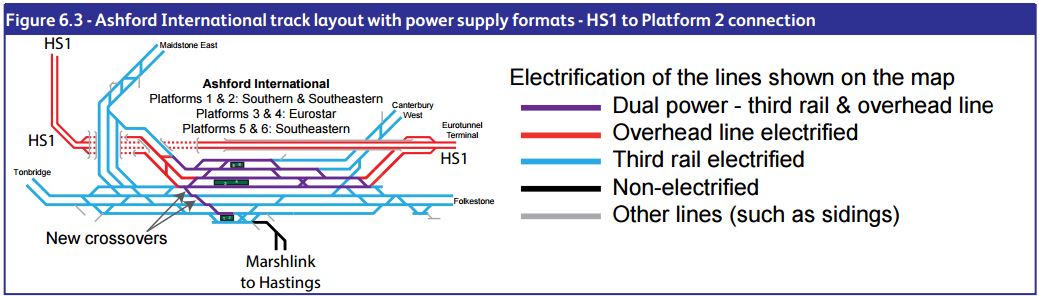
Note the only track work would appear to be two or three new cross-overs, which are shown as being electrified with both third-rail and overhead line.
Note the following.
- The trains that will be working the Marshlink Line and High Speed One will have either diesel or battery power for the Marshlink Line.
- Modern trains like Hitachi’s Class 800 trains can change from one mode to the other at linespeed, raising and lowering the pantograph as necessary.
- Automation can aid the driver in selecting the best power source.
So could we see the cross-overs built without electrification to save money and probably time as well?
I suspect this could be possible, although there may be operational reasons to add third-rail electrification.
Network Rail say this about their scheme with dual-power cross-overs.
Although this seems a fairly simple proposal, the technicalities of installing the crossovers, power supplies and signalling enhancements add significantly to the challenges of the scheme, which would cost in the region of £15-35M.
Surely, as the trains will have a dual-power capability for the Marshlink Line, this would reduce the challenges and cost of the scheme.
, The Fawkham Junction Link
The Fawkham Junction link will enable Highspeed services to use another terminal in London, which will probably be Victoria.
I discussed this link in Fawkham Junction Link.
General Track Improvements
This document from Network Rail is the Route Specification for the South East and it details two projects, that will improve times on the lines between Victoria and shford International station.
- Journey Time Improvement – Reduce impact of Permanent Speed Restrictions
- Maidstone signalling interlocking renewal – Renewal of interlocking and external equipment
The document indicates they could be completed in 2019.
The document also uses this phrase in several places.
Increase speed to rolling stock and signalling capability
As the East Kent Re-Signalling Project seems to be improving the signalling, it does appear that one of the keys to better services in Kent may well be faster trains.
It should be noted, Network Rail have been particularly successful in upgrading the speed of the Midland Main Line in recent years, so with a faster third-rail train available, they might be able to speed up services on the East Kent Lines.
An Interim Solution For A Highspeed Service To Hastings
As I said earlier connecting the Marshlink Line to High Speed One might be delayed because of funding.
Network Rail’s planned improvements will deliver journey time improvements between Victoria and Ashford International stations and along the lines in East Kent, provided some faster trains are procured.
There is not much point in having tracks with a capability in excess of 110 mph, if the trains can’t make use of it.
But these trains, be they Ultimate Class 395 trains or a product from another manufacturer, will be needed to bridge the electrification gap of the marshlink line.
Once the modifications at Ashford are complete, these trains will be able to use High Speed One.
Conclusion
Track improvements are a key to making the new Southeastern franchise a lot better.
See Also
These are related posts.
- Abbey Wood Station
- Ashford Spurs
- Crossrail
- Elimination Of Slow Trains
- Fawkham Junction Link
- Highspeed Routes
- High Speed To Hastings
- Historic Routes
- Longfield Station
- Maidstone
- Reading To Tonbridge
- Thameslink
- Thanet Parkway Station
- Ultimate Class 395 Train
- Victoria As A Highspeed Terminal
To know more read Kent On The Cusp Of Change in the July 2017 Edition of Modern Railways.
A Branch To Penicuik From The Borders Railway
I started this post as part of Extending The Borders Railway To Carlisle, but as I research it more and talk to my correspondent in the Borders, I feel it needs to be a separate post.
There is an article in the Scotsman from 2013, which is entitled Borders rail link: £150m plan for Penicuik spur. This is the first paragraph.
A vital £150 million rail line connecting Penicuik to central Edinburgh could be reopened for the first time in half a century.
The article then gives a lot of favourable comments about the possibility of the link. My correspondent, grew up in the town and feels that a rail link is needed, especially, as when he was a boy, the town had three rail lines.
In the Wikipedia entry for the Borders Railway, this is a paragraph about a future branch to Penicuik.
In May 2013, it was reported that Heriot-Watt University had been asked by Midlothian Council to carry out a feasibility study on a 10-mile (16 km) rail link connecting Penicuik with the Borders Railway. At least 6 miles (9.7 km) of the new line would follow the Edinburgh, Loanhead and Roslin Railway, the alignment of which is generally intact between Millerhill and Straiton.
This proposal is not mentioned in the recent CBR report, which is entitled A Summary Case For A New Cross-Border Rail Link, that can be downloaded in PDF form from this location.
Newcraighall Station And Park-And-Ride
Newcraighall station will be North of where the proposed branch to Penicuik joins the Borders Railway.
This Google Map shows the station and the surrounding area.
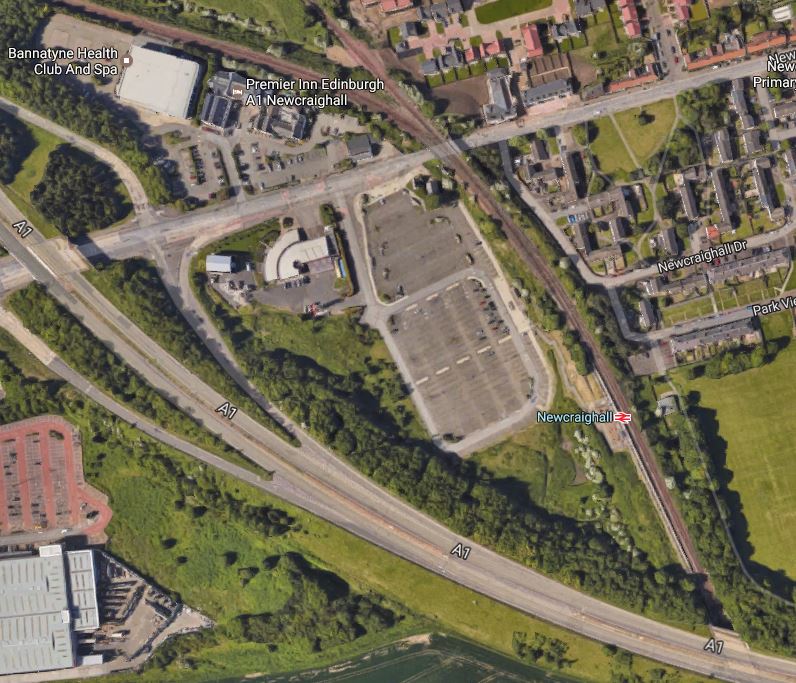
Note the A1 and the convenient Park-and-Ride.
Wikipedia says this about Services from Newcraighall station.
Monday to Saturday daytimes there is a half-hourly service to Edinburgh and to Tweedbank, and an hourly evening and Sunday service. Four weekday morning peak services run beyond Edinburgh to Glenrothes with Thornton via Kirkcaldy and a similar number run in the opposite direction in the evening. When the station was a terminus, many services ran through to/from the Fife Circle Line but this practice ended prior to the reopening of the full route to Tweedbank.
I believe that a Park-and-Ride of this size, location and probable importance needs at least four trains per hour (tph) all day.
Currently, two tph between Edinburgh and Tweedbank call at Newcraighall. As it takes two hours for a train to do the round trip, this means that four trains are needed to provide a two tph service.
Four tph all the way to Tweedbank would need eight trains, but due to limitations in the design of the Borders Railway would probably be very difficult to operate.
Terminating them at Newcraighall and perhaps running beyond Edinburgh to Fife is obviously a possibility, but Newcraighall station only has one bi-directional platform.
Two Trains Per Hour To Penicuik
Opening a branch to Penicuik and running two tph would give Newcraighall station and the Park-and-Ride the four tph train service it needs, when combined with the two tph along the Borders Railway.
The Edinburgh, Loanhead and Roslin Railway
Wikipedia says the route would probably follow the route of the Edinburgh, Loanhead and Roslin Railway.
- Much of the route is visible on Google Maps.
- The original line closed in the 1960s.
- There were stations at Gilmerton, Loanhead, Roslin and Glencourse.
- The major engineering feature of the line was a visduct over Bilston Glen.
Penicuik was served by a freight-only line.
Shawfair Station
It would appear that the Northbound and Southbound trains on the Borders Railway seem to call at Shawfair station around the same time.
This must make operation of the line much simpler and it probably meant that Newcraighall station only needed one platform.
This Google Map shows the Borders Railway passing through Shawfair station.
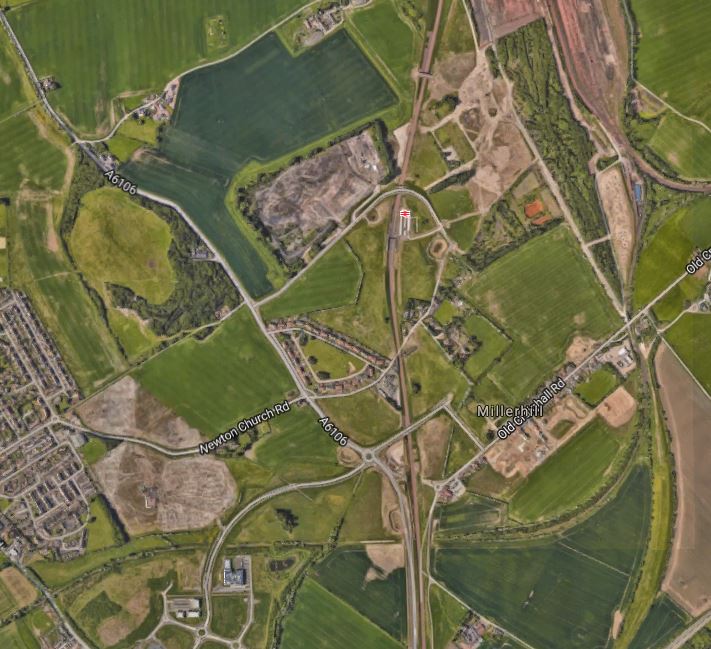
Note the disused track of the Edinburgh, Loanhead and Roslin Railway crossing the Borders Railway at right-angles and then curving Northwards to the freight yard at Millerhill.
Trains could go via Millerhill, to join the Borders Railway South of Newcraighall station, but surely, it would be better if the branch to Penicuik, joined the Borders Railway South of Shawfair station.
This would allow trains to and from Penicuik to pass at Shawfair station.
As trains to and from Tweedbank station seem to call between
- XX:08 to XX:10
- and XX 38 to XX:40
So Penicuik trains could use times of perhaps .
- XX:23 to XX:25
- and XX 53 to XX:55
Which would mean a train would have thirty minutes to go from Shawfair to and from Penicuik.
The way Shawfair station is used also means the following for the Borders Railway.
- A convenient spacing is imposed for trains to call at the single platform at Newcraighall station, as that is just four minutes towards Edinburgh.
- Effectively, the Borders Railway to Tweedbank station runs a two tph service with two widely-seperated trains South of Shawfair station at any one time.
- Two widely-separated trains, South of Shawfair station enables the use of single-platform stations at all stations except Stow and Tweedbank.
- Shawfair station is the only station with an expensive footbridge.
I also suspect that four tph is possible, with trains passing at Shawfair and Stow stations, perhaps with faster trains and improvements to the signalling.
By clever design and selective use of two-platform stations and double-track, it would appear that the engineers have designed an efficient affordable railway, that is mainly single track and has only one footbridge.
The Junction Of The Borders Railway And The Penicuik Branch
This Google Map shows where the track-bed of the Edinburgh, Loanhead and Roslin Railway passes under the Borders Railway to the South of Shawfair station.
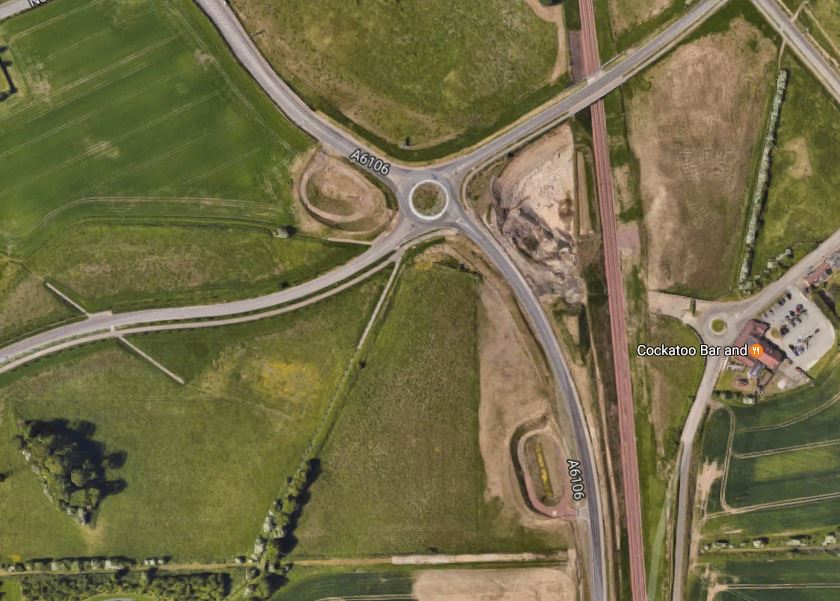
Note the old track-bed of the Edinburgh, Loanhead and Roslin Railway running East-West across the bottom of the map.
The roads in the area don’t appear to have been built with a suitable space for a chord to connect.
But even so, I suspect it would be a practical proposition for a single-track chord to be built between the Borders Railway and the Edinburgh, Loanhead and Roslin Railway.
The only difficult construction would be crossing the A6106 road to the South-East of the roundabout.
A cross-over would be needed South of Shawfair station to allow Southbound trains to access the branch to Penicuik. But as there would only be no more than four tph South of Shawfair station, this wouldn’t be a large operational problem.
Single-Track To Penicuik
Wikipedia says that the proposed Penicuik branch is ten miles in length.
Surely, if it were a single-track branch, trains could go from Shawfair to Penicuik station and return within thirty minutes.
Consider.
- It would take five minutes for the driver to change ends at Penicuik
- Two stops each way with a modern train could take a total of just five minutes.
- The train would be the only one on the branch.
- A well-designed line could have an operating speed of at least 75 mph and possibly 90 mph.
All this would mean that there would be ten minutes for each leg of the journey between Shawfair and Penicuik.
Should A Future Penicuik Branch Be Electrified?
Electrification of a future Penicuik Branch would not be difficult.
- Electrification would need to be extended from Newcraighall station.
- Electrification would be easier, if the branch were single-track with single-platform stations.
- Electrification of a new railway must be easier than electrifying an existing line.
Electrifying between Newcraighall and Penicuik may give advantages.
- There will be a fairly plentiful supply of cascaded electric trains, that could be suitable for the route.
- Electrifying may allow electric trains to access the Millerhill TMD.
- Electrifying would help in running bi-mode trains on the Borders Railway, if that were thought necessary.
- Electrifying may save a few minutes between Shawfair and Penicuik.
Obviously, electrification would allow politicians to boast about their green credentials.
The only disadvantage of electrification is that some bridges may need to be raised.
Surely, if the ten-mile branch was well-designed as mostly single-track, perhaps with electrification, and run by modern trains, two tph would be possible, even with one or more intermediate stops.
Could A Future Penicuik Branch Be Worked By Bi-Mode Trains?
A bi-mode train like a Class 319 Flex train could certainly work the route and as they have lots of power, they could probably achieve the Shawfair to Penicuik and return time of thirty minutes.
Could A Future Penicuik Branch Be Worked By Battery Trains?
As it is only ten miles between Shawfair and Penicuik, I suspect that in the future,, trains with onboard energy storage will be able to work the branch.
Single-Platform Stations
If the future Penicuik Branch could be a single-track railway, where only one train was on the branch at any one time, all stations could be built with a single-platform and no expensive footbridge, as most stations were built on the existing Borders Railway.
As five-cars seems to be becoming the new standard train length, I would build all platforms to accept five-car trains.,
A North-South Service Across Edinbugh
Peak Hour services link Tweedbank and Newcraighall beyond Edinburgh to Glenrothes with Thornton via Kirkcaldy.
There is obviously a need for a service in the Peak, but if there was a second Southern terminus at Penicuik would it be sensible that if a total of four tph were running from Newcraighall to Edinburgh, that a proportion cross the Forth.
Note that Cross-Forth services.
- Call at both Edinburgh and Haymarket stations in the City Centre.
- Have an easy interchange with the Edinburgh trams at Haymarket and Edinburgh Gatway station.
- Probably have an easier route to Edinburgh Airport.
There are certainly lots of possibilities.
Could A Future Penicuik Branch Be Worked By Tram-Trains?
The Germans would probably use tram-trains in a city the size of Edinburgh.
Compared to the tram networks in Nottingham and Birmingham, Edinburgh trams always strike me that it was a network designed without ambition and that doesn’t provide the maximum benefit to the largest number of residents and visitors.
If you look at Edinburgh Gateway station, it could have been modified to allow tram-trains like the Class 399 tram-train to come from the Airport and then go straight onto the Fife Circle Line to South Gyle, Haymarket and Edinburgh stations.
At present this line is not electrified, but doing that is probably in Scotrail’s wish-list.
Once at Edinburgh station, the tram-trains could take any of the electrified routes to North Berwick, Dunbar or perhaps Penicuik.
Passengers would finally get a proper interchange between trains on the East Coast Main Line and the Edinburgh tram.
I also think that the Germans would run tram-trains on the Fife Circle Line and its proposed extension to Leven.
Currently, the frequency of trains on the Fife Circle Line is low and tram-trains could probably give a four tph service to all stations, if electrification was put in place.
Conclusion
I believe that it would be possible to open a single-track branch to Penicuik with single-platform stations and these objectives.
- Provide a two tph service between Penicuik and Edinburgh.
- Boost the service between the Park-and-Ride at Newcraighall and Edinburgh to four tph.
- Provide an alternative Southern terminal for a North-South service across Edinburgh.
Electrification of the line might give operational advantages to Millerhill TMD, the Borders Railway and the branch itself.
The Class 319 Flex Units To Be Class 769
This is the title of a short article in the June 2017 Edition of Modern Railways.
Giving the Class 319 Flex train, its own unique class number of 769, must say that Porterbrook, Northern, Network Rail and the Department of Transport, think that the bi-mode conversion of a Class 319 train is a viable project.
The article gives some new details about the trains.
- Northern have ordered eight units, which will be delivered before the end of May 2018.
- The first unit is at Wabtec’s Brush Traction facility in Louthborough.
- Completion of the design and the first load testing is plasnned before the end of May.
- The first unit is due to be completed with driver training underway, by the end of the year.
- Northern will get a total of thirty-two Class 319 trains, which probably include the eight Class 769 trains.
- Tri-mode functionality and dynamic mode changeover on the move are being considered.
- Full production rate is a Class 769 train every two weeks.
The Class 319 Flex train has definitely moved from concept to a real train.
The article finishes by saying that Porterbrook expects further orders soon, while it is also considering transferring the concept to other roiling stock, such as the Class 455 train.
Why Convert Class 455 Trains?
The Class 319 and Class 455 trains are very similar electrical multiple units based on Mark 3 coaches.
But there are a few differences.
- The Class 455 is third-rail only, whereas the Class 319 is dual-voltage.
- The Class 455 is a 75 mph train, whereas the Class 319 is a 100 mph train.
- South West Trains’ Class 455 trains have had an extensive refurbishment and are fitted with 2+2 seating.
- South West Trains planned to upgrade the traction package of the Class 455 trains, which would include new AC traction motors and regenerative braking. This article in Rail Magazine has full details.
A Class 455 Flex train could have the following specification.
- The updated 2 x 2 seating.
- The new traction package with AC traction motors and regenerative braking.
- 75 mph operating speed on both electric and diesel.
It could be a better financial proposition for both the leasing company and the train operator.
In The Class 319 Flex Train And Third Rail Routes, I looked at various third-rail routes that could be served with a Class 319 Flex train.
Some of these routes could be served by a Class 455 Flex train, instead of the Class 319 Flex train.
The article states that Porterbrook are expecting further orders and could it be, that the company have assessed the number of bi-mode trains required and found that a large proportion of the available Class 319 trains might need to be converted.
So creating a Class 455 Flex train for use in areas with third rail electrification, might be a prudent action.
South Western Railway, will have around ninety well-maintained Class 455 trains with the refurbished interiors going spare, so there is certainly no shortage of trains to convert.
South Western Railway And Class 455 Flex Trains
South Western Railway, themselves could have some uses for the trains.
I doubt that the trains would be acceptable running long distance services from say Waterloo to Salisbury, due to being designed as short distance commuter trains and the lack of a toilet and tables.
They would be ideal for the following local services.
- Running the hourly circular service from Salisbury to Chandlers Ford via Southampton, which has sections of electrified line.
- Existing lines like the Lymington Branch.
- Reopened lines like the Fawley Branch and the Ludgershall Branch.
- Perhaps running services on the Swanage Railway.
- New services like Portsmouth Harbour to Salisbury via Southampton and Romsey.
- Services on the Heart of Wessex Line.
In some places like the Lymington Branch, they would release Class 158/159 trains to boost services on the West of England Main Line.
Merseyrail And The Class 455 Flex Trains
In the June 2017 Edition of Modern Railways, Chris Stokes talks about the problems of running services between Bidston and Wrexham Central stations on the Borderlands Line. He concludes with the following.
So the operation of the route is very tight, but it appears to work quite well.
There has been talk of using battery trains on this route in place of an expensive full electrification, which would allow Merseyrail’s new Stadler trains to run the route in the following manner.
- At least two trains per hour (tph).
- Longer trains.
- Calls at proposed new stations on the route.
In an ideal world, the service would terminate at the Northern end of the line by going round the third-rail electrified Loop Line under Liverpool City Centre.
The Class 455 train appears on a brief look to be the same size as Merseyrail’s current Class 508 trains, so it should be possible to use the Liverpool Loop.
Chris Stokes has told me two things.
- The Class 455 trains, used redundant trailer cars from Class 508 trains, that were shortened for Merseyrail, so there can’t be much difference in the size of the Class 455 and Class 507/508 trains.
- The Wrexham service used to terminate at Birkenhead North station.
So it seems a better Northern terminus could be possible.
Ideally, the Loop Line would be used, but look at this Google Map of Birkenhead North station.
The Wikipedia entry for the station, has a section entitled Wrexham Diesel Service. This is said.
From 4 January 1971 until 2 October 1978, the diesel service on the Bidston to Wrexham line, which had previously operated from New Brighton, was diverted to Birkenhead North. These trains terminated on the centre platform which had previously been used for Liverpool-bound services, and when one of the diesel trains was present (which in that timetable was much of the time), Liverpool-bound electric services used the outer north side of the island platform instead. The diesel service was cut back to Bidston from 2 October 1978. Regular use of the outer platform at Birkenhead North thereafter ceased.
Note that the service used to be Wrexham to New Brighton, which with the replacement of a short chord and some work at New Brighton station might be another alternative, although the service wasn’t very busy.
So could a Class 455 Flex train work the route in the following manner?
- Use diesel power between Wrexham Central and Bidston stations.
- Use electric power from Bidston to Liverpool.
- Join the other Wirral Line trains and terminate in the Liverpool Loop, stopping at the four stations in Central Liverpool.
As to frequency, you could run as many trains as you want, as the Borderlands Line is double-track, with the exception of a short single track section between the two Wrexham stations.
A round trip would take nearly three hours based on current timings, which would mean the following numbers of trains would be needed.
- One tph – three trains.
- Two tph – six trains.
- Four tph – twelve trains.
As Merseyrail like to run four tph on the various branches, why not use this frequency on the Borderlands Line?
It would be a Turn-Up-And-Go service, that would benefit a large number of people.
Does the service have to terminate at Wrexham?
- Shrewsbury is only thirty-one miles from Wrexham on the Chester to Shrewsbury Line.
- Rhyl is only twenty-seven miles from Shotton on the North Wales Coast Line.
It certainly wouldn’t require any electrification or challenging engineering to open up these and other possible routes.
The Class 455 Flex train may have other uses in Liverpool.
Northern’s services in the area will probably use a few Class 319 Flex trains alongside their Class 319 trains, that already serve Liverpool Lime Street.
So where services are being extended from Merseyrail’s third-rail network, why not use some Class 319 Flex trains, as these trains have a third-rail capability from their days South of the Thames?
- There may be an engineering or operational problem with a dual-voltage Class 319 Flex train.
- The pantograph of a Class 319 Flex train might make the train too large for parts of Merseyrail’s third-rail network.
- A third-rail only Class 455 Flex train may be a better financial proposition for leasing companies and train operators.
Or it could be that Porterbrook’s response to the Class 319 Flex train has been so positive, that the alternative offered by the Class 455 Flex train is welcomed.
Merseyrail’s prime route for a bi-mode Flex train would be the Canada Dock branch.
- There is a long term aspiration to run a passenger service.
- The branch is not electrified but it could connect to Liverpool’s third-rail network at both ends and also to 25 KVAC at the Southern end.
- Numerous freight trains use the route.
- Perhaps four stations at about ten million pounds a time would need to be rebuilt.
- Liverpool Football Ground would get a station.
Class 455 Flex trains could run a Southport, Ormskirk or Kirkby to Liverpool South Parkway service tomorrow.
A Four-Car Diesel Multiple Unit
In Who Would Want An Electric Train Powered Only By Diesel?, I discussed the fact that according to the Porterbrook brochure,
A diesel-only version of Class 319 Flex is now being delivered for one operator.
Could it be, that the updated interior of the Class 455 train, is exactly what the operator wants in a diesel train?
A Class 455 Flex train would have the following characteristics, if the third-rail equipment was removed.
- Four cars.
- Diesel power only.
- 75 mph operating speed.
- A quality 2 x 2 interior.
- A train that meets all the present and future access and disabled regulations.
That sounds to me like a high-quality replacement train for which Direct Rail Services will provide you with two Class 68 locomotives and some elderly coaches, which probably don’t meet the latest regulations.
But also, the UK suburban diesel multiple unit fleet has quite a lot of two and three car trains, but very few four-car ones and you see lots of four-car trains made by coupling two two-car units together. So perhaps, some train operators, see these trains as an easy and affordable way to increase the number of four-car trains on their routes without any form of electrification.
As South Western Railway take over the South West Trains franchise on the 20th August 2017, perhaps some Class 455 trains would be available soon after, as they could replace them with new Class 707 trains.
I suspect that a Class 455 Flex train could be available early in 2018.
Conclusions
The Class 319 Flex train or more properly the Class 769 train looks to be a successful concept.
I’m also convinced that Porterbrook have decided the market is larger than they originally thought, so they are seriously looking at converting Class 455 trains, to make sure they have enough trains.
Conservative Manifesto On The Railways
The Conservative Manifesto says this on railways.
We will focus on creating extra capacity on the railways, which will ease overcrowding, bring new lines and stations, and improve existing routes – including for freight. We will increase services on our main lines and commuter routes, and launch new services to places which are poorly served or host major new housing projects.
This would seem a sensible policy and it is probably very little different to what has been done over the last fifteen years.
- Quite a few new trains have been procured.
- New rail and tram lines like the London Overground, the Borders Railway, the Manchester Metrolink, the Midland Metro and others have been opened.
- Around seventy new stations have been opened.
- Some lines have been electrified.
- Some lines have been improved and resignalled.
- Mechanisms have been developed , so that developers can help to provide stations for their new developments.
But there is one big difference.
A lot of quality trains are now being replaced by new or much better trains in the next few years.
- Virgin Trains East Coast‘s and First Great Western‘s InterCity 125s are being replaced by new Class 800 trains.
- Thameslink’s Class 319 trains are being replaced by new Class 700 trains.
- Greater Anglia‘s Class 90 locomotives and Mark 3 coaches are being replaced by new Stadler FLIRTs.
- Greater Anglia’s Class 379 trains are being replaced by new Stadler FLIRTs.
- Greater Anglia’s Class 156 trains are being replaced by new Stadler FLIRTs
- Greater Anglia’s Class 170 trains are being replaced by Stadler FLIRTs.
- Greater Anglia’s Class 321 trains are being replaced by new Class 720 trains.
- Greater Anglia’s Class 317 trains are being replaced vt new Class 720 trains.
- Greater Anglia’s Class 360 trains are being replaced by new Class 720 trains.
- London Overground‘s Class 172 trains are being replaced by new Class 710 trains.
- Various operators have Class 317 trains, which will be replaced by new trains.
- Heathrow Connect’s Class 360 trains are being replaced by new Class 345 trains.
- TransPennine Express wil be returning twenty-two Class 185 trains to the leasing company.
- TrnsPennine Express’s Class 350 trains will be replaced by new Class 397 trains.
Some of these were built this century and will have plenty of takers, whilst others despite being a lot older have already been earmarked for substantial refurbishment.
Remember that, just as our architects and builders are good at taking ruins and creating high quality dwellings, offices or commercial buildings, our engineers, designers and train building and refurbishment companies are good at taking trains of an advanced age and creating high quality trains and locomotives, as comfortable, reliable, safe and passenger, crew and operator-friendly, as new ones straight from the factory.
In What Train Is This?, I show a refurbished Great Western Railway Class 150 train. This picture shows the quality that can be achieved, by refurbishing a thirty-year-old Mark 3-based train.
Who would complain about this superb refurbishment, which I suspect was done by Great Western Railway’s depot at Laira in Plymouth?
This table summarises what has been planned and what trains are worth saving.
- Forty of the hundred InterCity 125 sets are being converted into quality four and five carriage trains for ScotRail and Great Western Railway – Equivalent to forty four-car diesel trains.
- Some InterCity 125 sets might end up as high-speed parcel trains. Although if Scotrail and Great Western Railway prove the Pocket Rocket four-car HST to be viable, other companies may copy the concept.
- Will the 137 Class 150 trains be refurbished to the standard shown in the picture?
- The 114 Class 156 trains can be refurbished to a high standard for local routes. – Perhaps half will go to new operators.
- The twelve Class 170 trains were built in 1999 and will go to another oiperator – Probably equivalent to another six four-car diesel trains,
- The 72 Class 317 trains are in surprisingly good condition for thirty-year-old trains. They are also 100 mph units and Mark 3-based. If Network Rail were good at electrification, they would find a home. They are seventy-two four-car electric trains.
- The 86 Class 319 trains will find homes, with some converted into Class 319 Flex bi-mode trains. – Probably equivalent to another thirty four-car trains, of which some would be electric and some bi-mode.
- The Class 90 locomotives will go to freight operators.
- The 130 Mark 3 carriages will find a use, as they always do. Chiltern probably need some more.
- The 100 Class 321 trains could be refurbished and go to another operator. They are 100 four-car electric trains .Some could even be converted to bi-modes.
- The 10 Class 350 trains were built in 2013 and will go to another operator. They are 10 four-car electric trains.
- The 26 Class 360 trains were built in 2002 and will go to another operator. They are twenty-one four-car and five five-car electric trains.
- The 30 Class 379 trains were built in 2010 and will go to another operator. They are thirty four-car electric trains.
The totals in four-car trains are roughly as follows.
- Diesels and bi-mode – 100 – 50 already allocated
- Electric – 170
These totals don’t include all the plans.
What will the new owners of these franchises do?
- East Midlands
- London Midland
- Southeastern
- South West Trains
- Wales
Only South West Trains has been settled and it looks they’ll be releasing the new Class 707 trains.
Conclusion
It does look that there could be enough diesel trains.
- There could be quite a number of Sprinters, Class 170, Class 172 and Class 185 trains, which after refurbishment could be providing excellent service for perhaps another twenty years.
- The pride of lions in the room will be the shortened InterCity 125s, that Scotrail and First Great Western are creating and introducing in the next couple of years.
- Will they have cubs or be imitated, by creating rakes of four or five Mark 3 coaches, with a Class 43, Class 68 or Class 88 locomotive at each end?
- TransPennine Express have already ordered Mark 5 coaches and Class 68 locomotives to do the same thing.
- A hybrid electric/diesel/battery locomotive could be used with the coaches. Hitachi created such a beast from a Class 43 some years ago and the Germans are experimenting.
Terry Miller should be awarded a posthumous knighthood, as his amazing stop-gap design that saved British Rail forty years ago, could be about to play an encore.
If there is a problem, it is that there are a lot of electric trains.
- The more recent ones like Class 379, Class 350, Class 360 and Class 707 trains will probably find homes in places like Birmingham, Leeds, Liverpool, Manchester and Scotland.
- Surely, Class 379 trains would be ideal on shorter distance services to Manchester Airport, as they were designed for Stansted services.
- If the Class 319 Flex train is a success, expect to see more of these trains converted to 100 mph dual-voltage four-car bi-modes trains.
There is still a lot of electric trains to be allocated.
The Class 319 Flex train may be based on the forty-year-old Mark 3 coach design, but I believe it fits the specification of the train we need to expand our rail services.
- 100 mph on either 25 KVAC overhead or 750 VDC third-rail electrification.
- 90 mph on diesel.
- Four-coaches meeting all regulations laid out to the operator’s required configuration.
- Can work in eight and twelve car formations.
- Ability to go on virtually all rail lines in the UK.
- Proven reliable systems.
- In service by the end of 2017.
- Liked by the drivers
- Fits the niche below the five-car Hitachi Class 800 bi-mode.
But above all there are numerous Class 319 trains available for conversion and they are affordable.
If the concept takes off in a big way, then the engineers would just move on to the Class 321 trains.
But there will still be a lot of quality electric trains left over.
They will have to be scrapped or exported, unless Network Rail can get its electrification work into line.
Perhaps we will see limited electrification between existing electrification and major cities and junctions, with services run by bi-mode, battery or diesel trains to jump the missing electrification.
Areas where this approach might work could include.
- South Yorkshire between Leeds, Wakefield, Doncaster, Sheffield and Rotherham.
- North Yorkshire between Leeds, Skipton, Harrogate, Ripon and York.
- East Yorkshire between Doncaster, Hull, York and Scarborough.
- Blackpool, Preston, Blackburn, Clitheroe, Burnley, Colne and Hebden Bridge.
- Southport, Preston, Kirkby, Wigan and Manchester.
- Crewe, Chester, Wrexham, Shotton and the Wirral.
- Darlington, Middlesbrough and Teesside.
- Birmingham, Snow Hill and Camp Hill Lines
- Edinburgh to Dundee and the branches to Leven and St. Andrews.
Engineering is the Science of the Possible, whereas Politics is Dreaming of the Impossible.

