PM Backs Clean Air Law
The title of this post is the front page headline on today’s copy of The Times.
This is the sub-heading of the article on The Times web site.
PM promises binding targets to reduce pollution and praises Times campaign
In a separate box in the paper, which is entitled Our Manifesto, this is said.
- A new Clean Air Act to confer a legal right to unjpolluted air for everyone in the UK.
- A ban on new diesel and petrol cars from 2030 and cuts to green car grants to be traversed.
- Temporary traffic bans outside schools at drop-off and pick-up times.
- The extension of pre-2016 diesel and pre-2006 petrol pay zones to more cities.
- Pollution monitors in every postcode to empower people to take action.
How far will Boris Johnson go to meet the manifesto of The Times in the Queen’s Speech on Monday?
Heathrow Congestion Charge Is Expected To Raise £1.2bn A Year
The title of this post is the same as that of this article in The Times.
This is the first paragraph.
Heathrow airport could make £1.2 billion a year from a congestion charge levied on drivers arriving at the airport by car, according to analysis.
The article also says.
- The charge will start when the third runway opens.
- The charge will be levied on all cars, even the cleanest.
It is designed to encourage drivers to use public transport, like buses, coaches and trains.
I don’t believe that you can force a lot of passengers to give up their cars, when going to the Airport,. But then for the sake of the planet, they must give up their diesel 4x4s and large cars.
As a non-driver and almost a non-flyer, I’m not affected!
Nuclear Option Has Been Blown Away
The title of this post is the main title of Alistair Osborne’s Business Commentary of today’s copy of The Times.
He is referring to the government’s announcement about new wind farms, that I discussed in Climate change: Offshore Wind Expands At Record Low Price.
I particularly liked his final paragraph.
And nuclear’s not even green: it comes with a vast clean-up bill. True, it brings baseload energy that wind can’t yet match. But storage technology is advancing all the time. So why’s the government persisting with last century tech that comes at a radioactive price? Yes, offshore wind might endanger a seabird that’s forgotten its specs. But, luckily, it’s a bigger threat to another species: nuclear white elephants.
Climate change is so serious, people won’t believe it’s happening and take action unless the medicine is delivered with a spoonful of humour.
Amazon Will Order 100,000 Electric Vans To Hit Carbon-Neutral Pledge
The title of this post is the same as that of this article on The Times.
A few points from the article.
- The vans will be from a start-up company called Rivian, in which Ford has invested half a billion dollars.
- Delivery will be within five years.
- Amazon aims to be carbon-neutral by 20140.
- Some of the vans will be used in the UK.
Apparently, Jeff Bezos made the announcement close to the White House.
Hopefully, this excellent policy will cause a few ripples.
- Will it encourage other van users to look at using electric vans?
- Will it push other vehicle manufacturers to develop zero-carbon vans?
- Will it help to reduce pollution in cities?
Because major companies are a bit like sheep, the announcement of Amazon and Rivian could start a major change.
Did We Lose The Plot On Electric Delivery Vehicles?
When I was growing up, milk was delivered daily in an electric milk float.
I am also old enough to remember the Harrods electric delivery vehicles, which were actually built by the store in the basement.
This page on the National Motor Museum gives a picture and a few details.
Amazon seem to be going back to the future!
Who will be next?
What Will Boris Do About The Proposed Third Runway At Heathrow?
I have tackled this before in October 2016 in a post called Changing Sides.
This was how I started that post.
There is an interesting article in The Sunday Times today, entitled Boris Retreats In Fight Against Third Runway.
Boris is apparently saying he won’t oppose a third runway at Heathrow, so if anything he’s being consistent in changing horses, just as he did with Michael Gove.
But perhaps more surprisingly, Willie Walsh, the Chief Executive of IAG, who own BA, is quoted as calling Heathrow a fantasy project, which has been gold-plated and inflated by the owners to maximise their returns, at the expense of the airlines.
The paper also says that Gatwick will build a new runway anyway.
Remember, it was written before Theresa May’s government decided to allow Heathrow’s Third Runway.
Since the decision to allow Heathrow to build a Third Runway was made nearly three years ago in October 2016, there have been a lot of changes.
Notably, Boris has gone from Foreign Secretary and an MP in a Heathrow Expansion-opposing constituency to Prime Minister.
As Prime Minister he is supposed to look at the bigger picture.
Unless he’s totally stupid he must have noted the following.
Brexit Has Changed From A Simple Quick Exit Into A Slow And Very Tortuous Process
I would expect an opinion poll would show that the UK population thinks that sorting out Brexit is a much more important problem, than the decision on a new runway in the South East of England.
So will Boris put Heathrow’s Third Runway on the back burner, given the following factors
Gatwick Will Build A Second Runway Anyway
In the Wikipedia entry for Gatwick Airport, there is a section entitled Expansion Proposals, where this is the first paragraph.
Gatwick has been included in a number of reviews of airport capacity in southeastern England. Expansion options have included a third terminal and a second runway, although a 40-year agreement not to build a second runway was made in 1979 with West Sussex County Council. Expanded operations would allow Gatwick to handle more passengers than Heathrow does today, with a new terminal between two wide-spaced runways. This would complement or replace the South Terminal, depending on expected future traffic.
My project management knowledge tells me, that Gatwick could add a second runway and upgrade the terminals in a shorter time, than Heathrow can build a third runway.
But more importantly, Gatwick Airport could build the extra runway and terminal without disruption to airport passengers, aircraft and road traffic on the nearby M23.
Boris’s only problem with Gatwick expansion, is the amount of post he’ll get from Disgusted of Tunbridge Wells.
Disruption Must Be Avoided
Recent timetabling and construction fiascoes on Thameslink and Northern Rail should have sent a message to politicians, that large infrastructure projects must be created without disrupting train or air passengers and road traffic.
Can Heathrow Be Built Without Disrupting Traffic On The M25?
It is interesting to look back at the basic facts at the construction of Heathrow Terminal 5.
- A public enquiry into the project lasted 525 days.
- The terminal sits on a 260 hectare site.
- Construction started in 2002.
- The terminal opened in 2008.
- Construction finisged in 2011.
- The terminal cost £4.2billion.
The construction of Terminal 5, also needed the M25 to be widened and linked to the terminal.
This Google Map shows Heathrow Terminal 5 and its relationship to Heathrow’s current two runways and the M25.
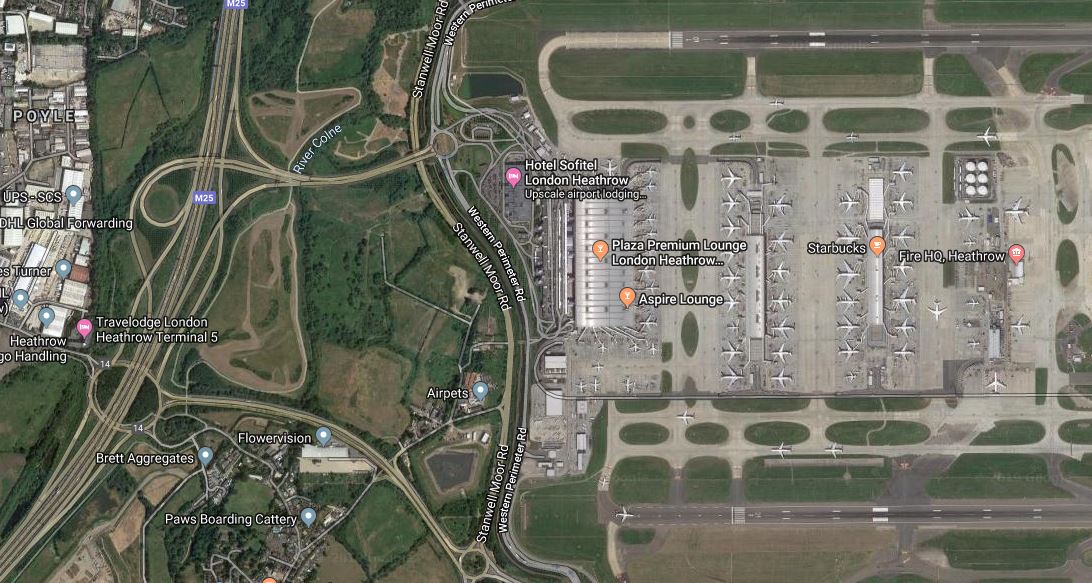
I remember the construction of Terminal 5 well, if only because, I was stuck in or moving slowly along that section of the M25 so many times.
As this immense construction project, is probably in living memory of much of the population of West London, how will they react to the thought of all the disruption, that building the third runway will cause.
Would Uxbridge, throw Boris out, if he approved the building of a third runway at Heathrow?
Heathrow Is A Pollution Blackspot
Various factors mean, that the surroundings of Heathrow are a pollution blackspot, mainly caused by the large number of diesel vehicles on the M4 and M25 motorways and others bringing passengers and goods to the airport.
I believe that any Planning Permission for the third runway, will require Heathrow to do something about the pollution. This could be easier than anybody thinks, as more of us will be using electric vehicles by the time the runway opens.
Heathrow are already proposing their ULEZ or Ulta Low Emission Zone.
Heathrow Rail Access Will Improve
Crossrail will eventually serve Heathrow in a year or so and this will improve rail access to the Airport significantly.
Other rail links are also in prospect.
- The Western Rail Approach to Heathrow could be open by 2024.
- Heathrow Southern Railway could be built.
- The West London Orbital could be built.
The first two would be privately financed.
This better rail access may reduce the traffic and pollution around the airport, but it will make it easier, for passengers to use the airport and traffic will grow.
High Speed Rail
Increasingly, Heathrow and the other London airports, will come under competition from High Speed Rail.
Eurostar has upwards of seventy percent of the London-Paris and London-Brussels passenger markets.
I have travelled a few times from London to Amsterdam on Eurostar and feel that four hours is my limit for comfortable train travel.
I estimate the following journeys would be possible on Eurostar.
- London and Cologne via Brussels in four hours
- London and Bordeaux via Paris in four and a half hours.
- London and Frankfurt in Five hours.
Another competitor to air services out of London will be London and Edinburgh services on the East Coast Main Line, which are being updated with new faster trains and journey times under four hours.
Air Cargo And Heathrow
I looked up air cargo in Wikipedia and these points are there.
- Fifty-percent of all air frieght is belly-cargo on airlines.
- An industry expert estimates that 15-20 tonnes of air cargo is worth 30-40 economy passenger seats, when both are on passenger planes.
- In 2017, the IATA observed a 9% rise in freight tonne kilometres
- Boeing is doubling its 767F production since 2016 to three per month in 2020.
Heathrow dominates the air cargo traffic into and out of the UK and last year it handled 1,788,815 tonnes of cargo, which was a 5.3% increase in tonnage on 2017.
However, it does appear that the second largest cargo airport in the UK; East Midlands, handled about the same amount of freight as Heathrow in April 2018.
There is also the East Midlands Gateway close to that airport, which will be a massive logistics park., with a rail connection.
Perhaps the pressures of the congested Heathrow, with some nudging from the Government could remove the cargo aircraft from the airport to more suitable airports like East Midlands and Doncaster Sheffield.
Manchester Airport Is The Most Important Airport North Of London
Manchester Airport is the busiest Airport after Heathrow and Gatwick and over the next few years it will catch up to a certain extent.
In Changes Signalled For HS2 Route In North, I said this about Manchester Airport’s rail connectivity if High Speed Two and Northern Powerhouse Rail are combined across the Pennines.
If High Speed Two and Northern Powerhouse Rail are developed as laid out in the Transport for the North report, the following cities will be connected to Manchester Airport.
- Birmingham – High Speed Two
- Blackpool – Northern Powerhouse Rail/West Coast Main Line
- Bradford – High Speed Two/Northern Powerhouse Rail
- Carlisle – Northern Powerhouse Rail/West Coast Main Line
- Edinburgh – Northern Powerhouse Rail/East Coast Main Line
- Glasgow – Northern Powerhouse Rail/West Coast Main Line
- Hull – High Speed Two/Northern Powerhouse Rail
- Leeds – High Speed Two/Northern Powerhouse Rail
- London – High Speed Two
- Newcastle -High Speed Two/Northern Powerhouse Rail
- Preston – Northern Powerhouse Rail/West Coast Main Line
- Sheffield – Northern Powerhouse Rail
- Sunderland – Northern Powerhouse Rail
- York – High Speed Two/Northern Powerhouse Rail
Manchester Airport will probably become the most important station in the North with High Speed connections to a large part of England and Scotland.
Heathrow and Gatwick will find they have a very big and well-connected Northern competitor.
Extinction Rebellion And Other Environmental Protesters
Most of the environmental protesters like Extinction Rebellion seem to have focused their attention on Heathrow, where airports are concerned.
They will fight tooth and nail to stop Heathrow’s third runway.
Will Heathrow Get The Planning Permission They Need?
I think that this is the sort of planning decision, that will end up with the Secretary of State for Environment, Food and Rural Affairs; Theresa Villiers.
Her Wikipedia entry says this.
Villiers favours construction of a high-speed rail link from London to Birmingham and Manchester, arguing that flyers could use capacity at airports such as Birmingham International and Manchester International Airport.
She is also quoted as being against a third runway at Heathrow, when she was a member of Davisd Cameron’s cabinet.
Grant Schapps, who is the current Secretary of State for Transport, could be more supportive to Heathrow’s application.
The Mood Of The UK About The Environment
The view of the average UK voter on the environment has changed markedly in the last few years, driven by documentaries, events and politics from around the world.
Boris’s father; Stanley Johnson has written books on the environment and received the Greenpeace Award for Outstanding Services to the Environment, so this could fit with his opposition to a third runway at Heathrow, when he was Mayor of London.
Do Heathrow Airport Have A Plan B?
In Heathrow Plans Runway Over M25 In 30-Year Expansion, I outlined how I thought the runway would be built.
The Times says this about the construction program.
Only the runway would be built by the opening date of early 2026.
Other facilities such as new terminals, car parks, hotels and transit systems would open from 2030, with an expansion of Terminal 5 the priority
This means that the extra runway capacity can be used initially to better accommodate the same number of flights.
Perhaps Plan B would mean changing the order of construction, leaving a space for the third runway and getting Planning Permission to build it in perhaps starting in 2028.
Conclusion
This is a tough one to call and I know what I would do. I would just let it fester until the decision was forced by another factor.
But Boris is the Prime Minister and will have to make a decision!
D
From Green Gin To Sustainable Steel, Government Fires Up £140m Hydrogen Push
The title of this post, is the same as that of this article on Business Green.
The projects are wide ranging.
Green Gin
This is said about gin production by Orkney Distilling Ltd.
The successful projects feature a number of eye-catching initiatives, including the HySpirits project which has been awarded just under £200,000 to explore how the European Marine Energy Centre could work with local gin producer Orkney Distilling Ltd to convert its distillery from using liquid petroleum gas to hydrogen produced using renewable power.
I have been told that making whisky produces carbon dioxide. Does gin?
My source, also said carbon dioxide frpm Scotch whisky production has been used in the growing of soft fruit.
I found this article on The Courier, which is entitled Time To Cut Back On Whisky’s CO2 Emissions and this article on Scottish Capture and Storage, which is entitled Carbon Capture In The Heart Of The City.
Both are worth reading.
This is a paragraph from the second article.
The carbon capture process at this site is relatively simple, because the off gas from fermentation is already very pure in CO2. The process is not about enhancing CO2 concentration, but more about removing impurities. That involves a number of washing stages to remove water and impurities from the gas given off during fermentation, before it is compressed, stored, and eventually transported by road.
The article also says that the distillery produces four tonnes of carbon dioxide per day, which compared to the emissions of Chinese, Indian and United States coal-fired power stations is small beer, but it does show how in some industrial processes capturing the carbon dioxide can be relatively easy in some industrial processes and of a high quality for perhaps using in food and medical products.
But I can’t find a article connecting carbon dioxide from whisky to food production.
The Dolphyn Project
This is said about the Dolphyn Project.
A further £427,000 has been awarded to the Dolphyn project, which plans to mount electrolysers onto floating wind turbine platforms to produce hydrogen. One wind turbine alone has the potential to produce enough low carbon hydrogen to heat around 2,500 homes, fuel over 120-240 buses, or run eight to 12 trains,” the government said
I can’t find much on the Internet about this project, except this extract from this document on the Institution of Engineering and Technology web site, which is called Transitioning To Hydrogen.
The Deepwater Offshore Local Production of Hydrogen
(Dolphyn) project will consider large-scale retrofit
hydrogen production from offshore floating wind
turbines in deep water locations (Figure 19).This is a partnership project led by ERM with Engie,
Tractebel Engie and ODE. The project looks to
utilise the vast UK offshore wind potential to power
electrolysers to produce hydrogen from the water the
turbines float on. Large 10MW turbines consisting of
desalinisation technology and PEM electrolysers will
feed hydrogen at pressure via a single flexible riser to
a sub-sea manifold with other turbines’ lines. The gas
is then exported back to shore via a single trunkline.
A 20-by-20 array array would have a 4GW capacity,
producing sufficient hydrogen to heat more then 1.5
million homes.This project may include the offshore wind supply
of hydrogen supported with hydrogen from steam
methane reformation with carbon capture technology.
This project is well aligned to work the ACORN75
project at St Fergus.
Note that the project is talking about gigawatts of energy and providing enough hydrogen to heat millions of homes.
I think that the Dolphyn Project is badly named, as Google thinks you’re looking for projects about aquatic animals.
Gigastack
This is said about Gigastack.
Meanwhile, a consortium featuring Ørsted, ITM Power, and Element Energy is celebrating after securing just shy of £500,000 to help move forward with its Gigastack feasibility study, a six-month project to investigate the potential for delivering bulk, low-cost, and zero-carbon hydrogen.
There’s more here on this page on the ITM Power web site, where this is the first paragraph.
Project to demonstrate delivery of bulk, low-cost and zero-carbon hydrogen through gigawatt scale PEM electrolysis, manufactured in the UK.
As you’d expect from the name, they are looking at creating gigawatts of hydrogen.
Steel
This is said about steel.
The funding awards came as the government also launched a new call for evidence seeking views on how the government should structure and manage a planned £250m Clean Steel Fund. The government said the proposed fund would help the industry embrace clean technologies and move on to “a pathway that is consistent with the UK Climate Change Act” and its new net zero emission goal.
So what has hydrogen got to do with steel?
Search for hydrogen steelmaking on Google and you get lots of articles including this article from the Stockholm Environmental Institute, which is entitled Hydrogen Steelmaking For A Low-Carbon Economy.
This is a paragraph.
In the spring of 2016, three Swedish companies – LKAB (iron ore mining), SSAB (steel manufacturer) and Vattenfall (power utility) – announced their ambition to develop and implement a novel process for fossil-free steel production in Sweden. This process would use hydrogen (instead of coal) for the direct reduction of iron oxide/ore (H-DR), combined with an electric arc furnace (EAF). It would be almost completely fossil-free when the hydrogen is produced from electrolysis of water by use of renewable electricity. The concept is called Hydrogen Breakthrough Ironmaking Technology, or HYBRIT for short.
My knowledge of process engineering, tells me, that even if the Swedes don’t succeed, someone will and here in the UK, we’re ideally placed to take advantage, as we have the wind power to produce the hydrogen.
Conclusion
The future’s bright, the future’s green hydrogen!
, The North Sea can provide us with more than enough hydrogen, so long as the wind blows and there’s water to electrolyse..
Nespresso
Just heard the CEO of Nrdpresso defending his product, where seventy-two percent of the product goes into landfill.
Ridiculous!
My tea-bag goes straight into the food composting bin!
So much more environmentally-friendly!
Batteries Are Beautiful – Silent Sailing Is An Eco-Winner
The title of this post, is the same as that of this article on Riviera Maritime Media.
It is a must-read article about the way, ships will be powered in the future.
Already, the Norwegian operator; Hurtigruten, has ordered two hybrid powered cruise ships, the first first of which is the MS Raold Amundsen.
Aberthaw Power Station Set To Close, Risking 170 Jobs
The title of this post is the same as that pf this article on the BBC.
This is first two paragraphs.
Wales’ last coal-fired power station looks set to close in March due to “market conditions”, putting about 170 jobs at risk.
RWE said it was proposing closing the 1.56-megawatt Aberthaw B Power Station in Vale of Glamorgan on 31 March.
Read the section called Oerations in the Wikipedia entry for Aberthaw power station.
This is a sentence from that section.
Coal now mainly comes from the Ffos-y-fran Land Reclamation Scheme in Merthyr Tydfil.
I may be very much against, the burning of coal for the generation of electricity or heat, but surely an exception should be made, when it is part of a process to clear up the considerable mess left by coal mining. As Aberthaw power station can use the Welsh coal in conjunction with bio-mass, perhaps there could be an argument to mothball one of the later coal-fired power stations.
Carbon Capture And Storage or a sensible use for the carbon dioxide, will be developed within the next ten years and in conjunction with one of the more modern coal-fired power stations, it could be used to help clean up the detritus of coal mining.
If nothing else, we could plant a lot of trees on the sites being reclaimed.
Bare in mind, that carbon dioxide produced by a coal-fired power station or cement factory is all in one place and can probably be collected using well-established engineering processes. On the other hand try collecting the carbon dioxide produced by a large fleet of diesel trucks.
 The Anonymous Widower