Call For Rail Sector To Mobilise To Get Ukrainian Agricultural Exports Moving
The title of this post, is the same as that of this article on Railway Gazette.
These are the first two paragraphs.
Rail has a central role in the European Commission’s plan to establish ‘Solidarity Lanes’ for the transport of Ukrainian agricultural exports which would normally use the Black Sea ports that are being blockaded by Russia.
Announcing its plan, the commission said the Russian blockade is threatening global food security, creating an urgent need for alternative transport routes. Ukraine is the largest exporter of sunflower oil (50% of world exports), the third largest of rapeseed (20%) and barley (18%), the fourth of maize (16%) and the fifth of wheat (12%).
It certainly is a big problem and not just for Ukraine, but for any country that habitually buys these agricultural products from Ukraine.
But it will probably require a lot of investment to solve.
These are points from the article.
- Trains handling 1,400 tonnes are possible.
- The average waiting time for wagons at the Ukrainian border is sixteen days.
- The capacity of existing freight corridors must be expanded and new ones must be created.
After reading the whole article, it does seem that an EU plan is being created.
I have my thoughts.
Gauge Change
Consider.
- There will be a gauge change between standard and Russian gauge.
- Spanish company; Talgo has developed the technology, so that trains can run on both gauges and even change between gauges at a slow speed.
- The technology is used on the Strizh train, which runs passenger services between Berlin and Moscow via Warsaw.
I feel it is likely, that Talgo could develop freight wagons to move the agricultural products between Ukraine and ports in Poland or Germany.
Talgo’s Plans
In A Spaniard In The Works!, I outlined Talgo’s plans, which included building a factory at Longannet in Scotland.
But their plans must have been disrupted, as the company did not secure the High Speed Two Classic-Compatible rolling stock contract.
On the other hand Longannet could be an ideal place to build trains for Eastern Europe. They could go on a ferry to Gdansk, Helsinki or other ports.
Carbon-Cutting Test Run Sees Welsh Timber Return To Railway
The title of this post, is the same as that of this article on RailBusinessDaily.
These are the first two paragraphs.
For the first time since 2005, a freight train carrying Welsh timber left Aberystwyth as part of a trial that could see regular freight traffic return to the Cambrian line.
The successful trial, aimed at exploring the feasibility of transporting timber by rail to reduce carbon emissions, opens up the possibility of removing hundreds of large lorries from the rural roads of mid Wales.
These are a few details and points from the article.
- The terminal at Aberystwyth appears to have been just outside Aberystwyth station.
- The timber was taken to Kronospan at Chirk in North Wales.
- The 700 ton load of ten wagons was hauled by a pair of Class 37 locomotives.
- The pair was needed because of the route.
- Network Rail claim that upwards of sixteen trucks were taken off the roads of mid-Wales.
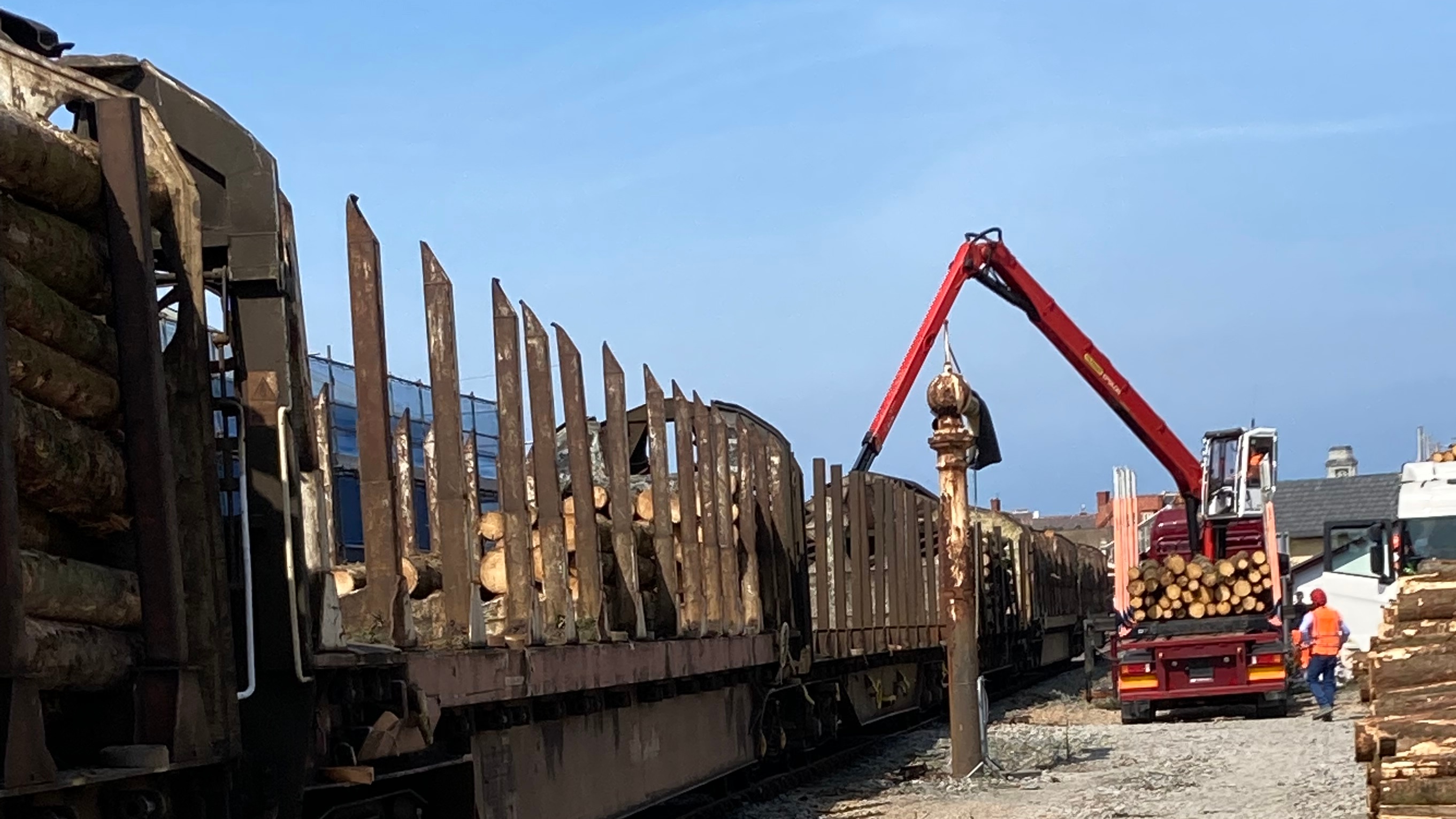
This Network Rail picture shows the loading of timber at Aberystwyth station.
And this Network Rail picture shows the two Class 37 locomotives.
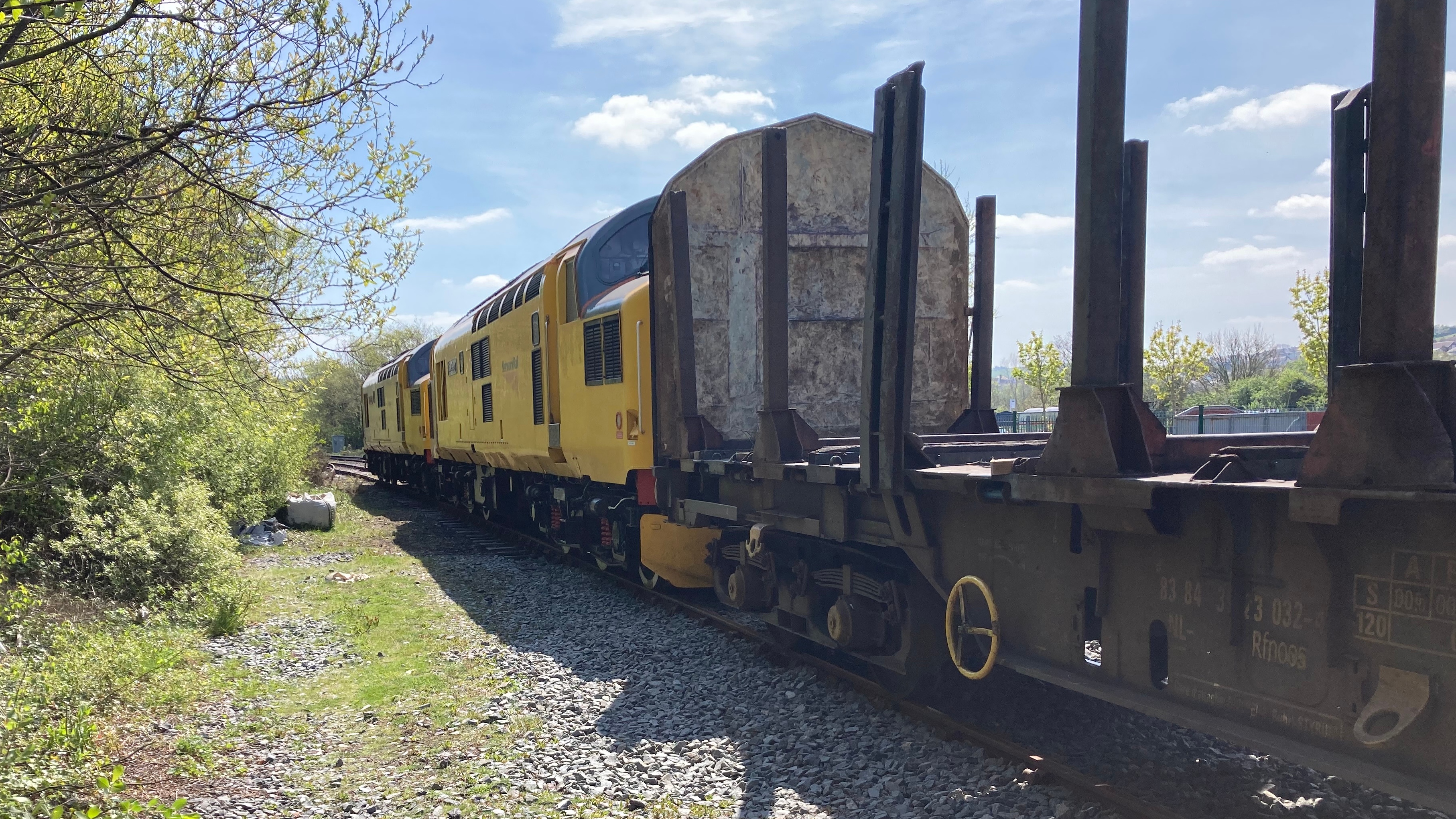
It looks to me, that the locomotives pushed the empty train in and pulled the full train out. Once on its way, the train took the Cambrian Line to Shrewsbury and then it was about twenty miles to tyhe Kronospan factory at Chirk.
This video shows the train leaving.
I appears to have been filmed at a convenient level crossing.
Conclusion
It must have been a success, as they are going to repeat the exercise.
There would appear to be only one problem. The pair of Class 37 locomotives make a bit of a noise.
- The pair have a power of 2610 kW.
- I estimate that the journey between Aberystwyth and Chirk will take around two hours and thirty minutes.
- Aberystwyth and Chirk is a distance of about a hundred miles.
It looks to me that this journey could be handled by one of the new Class 99 locomotives, that I wrote about in Class 99 Electro-Diesel Locomotive Order Confirmed.
I also doubt whether a battery-electric Class 99 locomotive could handle the route, but a hydrogen-powered locomotive, that fuelled at Aberystwyth might be able to do it.
I do think though, that passenger trains between Aberystwyth and Shrewsbury could in the future be hydrogen-powered.
So if hydrogen were to be provided at Aberystwyth, hydrogen haulage of the timber trains would be a possibility.
Royal Mail Rolling Back The Years To Put More Post On Trains
The title of this post, is the same as that of this article on The Daily Telegraph.
This is the sub-title.
Post transported by train will treble under plan to ditch planes and lorries.
These are some points from the article.
- They are in discussion with Network Rail.
- Roughly 4pc to 5pc of Britain’s mail is transported on the railways.
- Keith Williams is executive Chairman of Royal Mail and also was the independent chair of the recent Government-supported Rail Review.
- One of the aims of the strategy is to rescue the share price.
- Royal Mail are building some fully-automated parcel-hubs, with the first two at Warrington and Northampton.
I have some further thoughts.
The Warrington Parcel Hub
This appears to be at the Omega Business Park on the closed RAF Burtonwood airfield.
This Google Map shows Warrington.
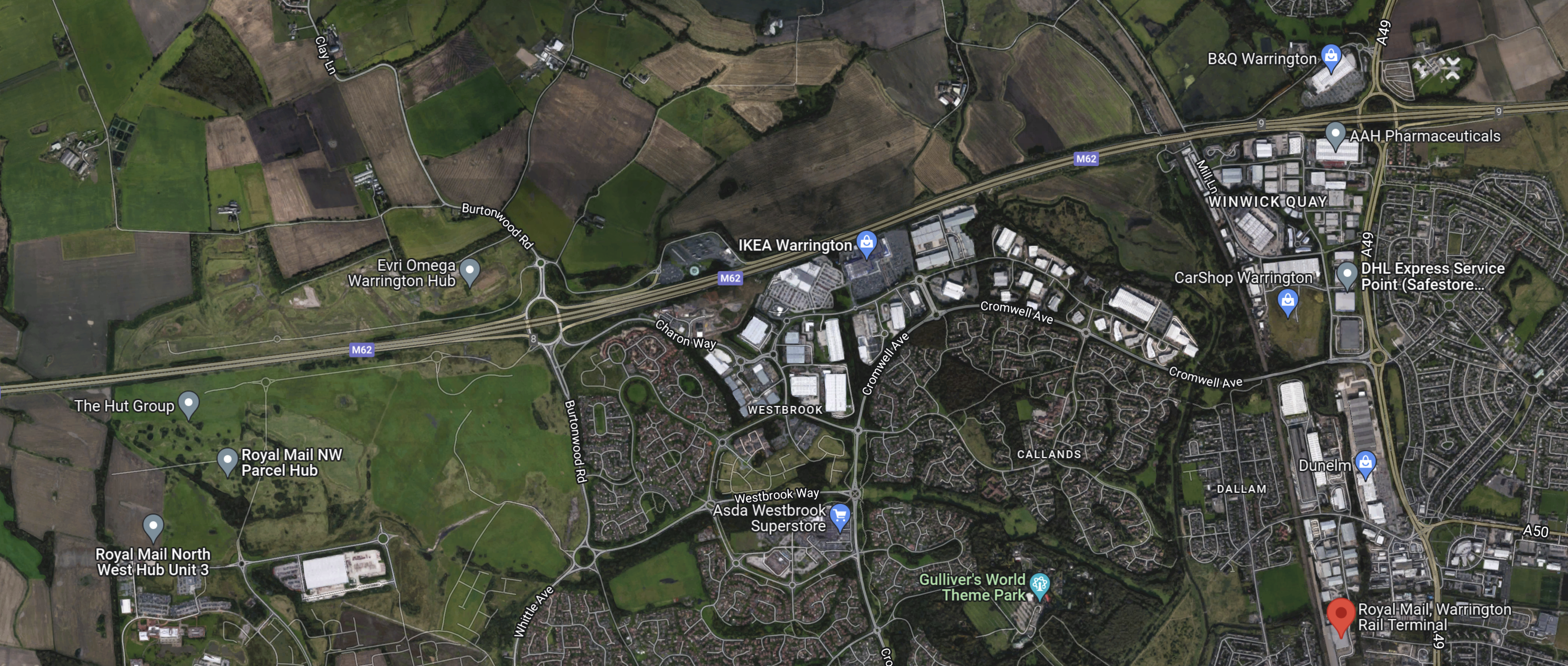
Note.
- The M62 running across the map in an East-West direction.
- The two junctions on the M62 are 8 and 9, with junction 8 to the West and junction 9 to the East.
- The Omega Business Park is on both sides of the M62 to the West of Junction 8.
- Royal Mail appear to have three sheds to the South of the motorway.
- Amazon, Asda, Hermes, The Hut Group and others have sheds in the Omega Business Park.
- The red arrow indicates the location of Royal Mail’s Warrington Rail Terminal, where mail services between London and Scotland call.
This second Google Map shows Royal Mail’s Warrington Rail Terminal in more detail.
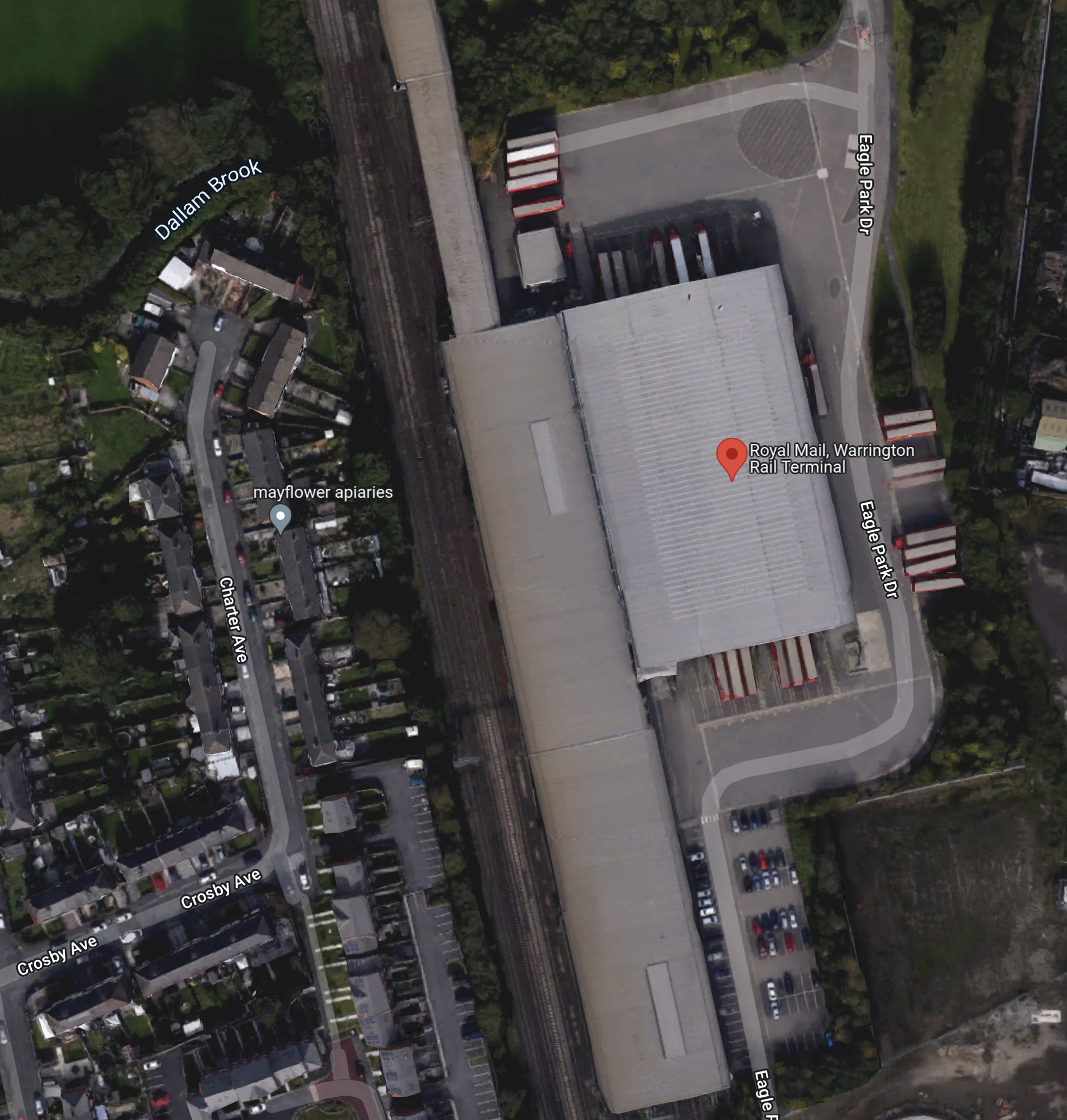
Note.
- The West Coast Main Line runs North-South to the West of the terminal.
- It looks to be a cramped site.
- I doubt that Royal Mail would want to transfer parcels between the rail terminal and the parcel hub, because of the number of trucks involved and the carbon they will generate.
- They could use Hydrogen or battery trucks, but that would be a considerable expense.
Perhaps the best thing to do, would be to bore a tunnel.
- It’s about six kilometres.
- Electric shuttles would be zero-carbon.
- Everything could be highly-automated.
- No drivers would be needed.
It would probably cost less to run.
Royal Mail At Northampton
Where the Northampton Loop Line meets the West Coast Main Line between Rugby and Northampton, there is a massive logistics park, which is shown in this Google Map.
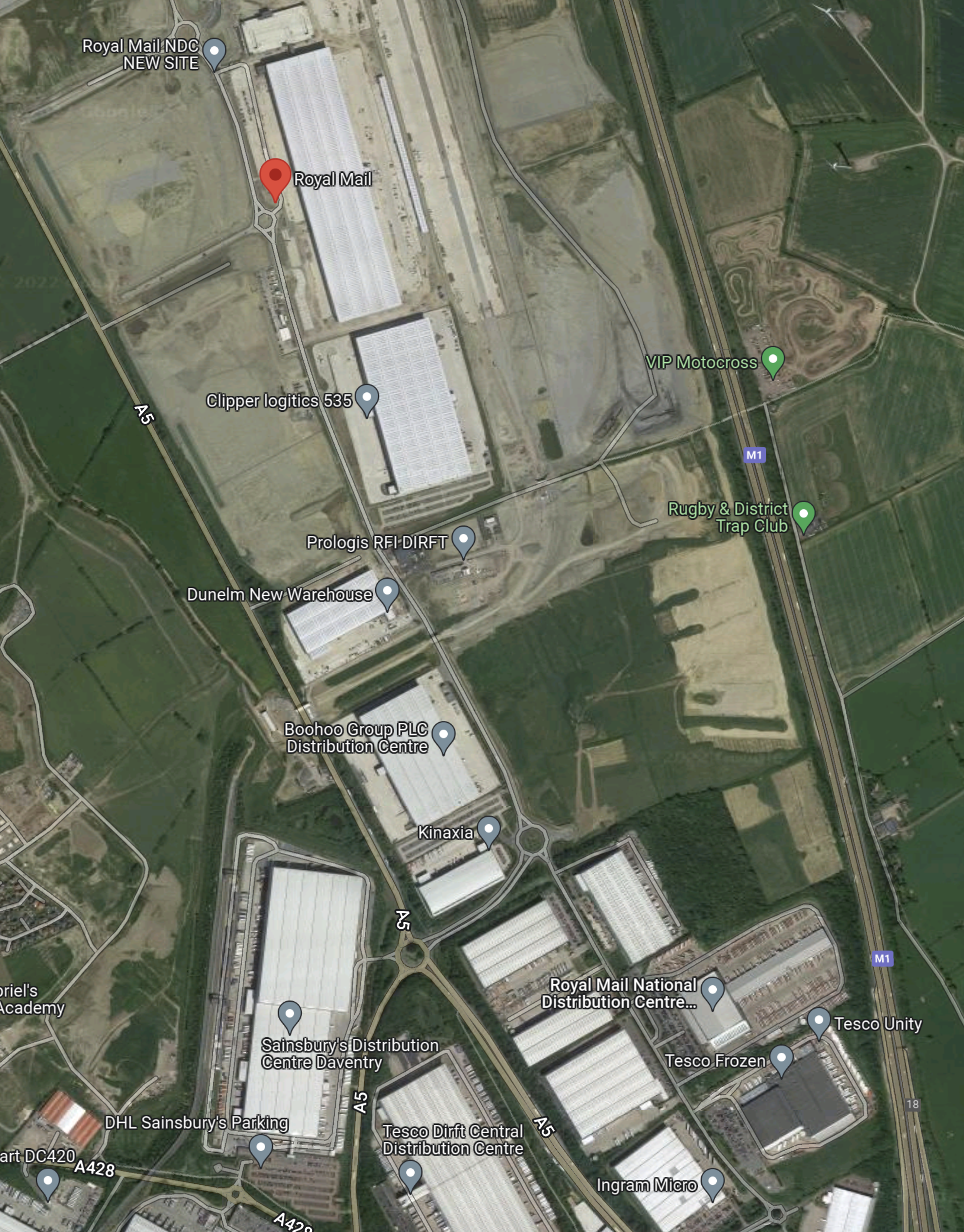
Note.
- There are at least three Royal Mail sites here.
- One at the top of the map is labelled Royal Mail NDC NEW SITE.
- One at the bottom of the map is labelled Royal Mail National Distribution Centre.
- There is a rail connection.
This must be a very large investment for Royal Mail.
Further Parcel Hubs
No further hubs are mentioned in the article. But I’m sure, that the systems at Warrington and Northampton could be replicated.
The East Coast, Great Western And Midland Main Lines
I suspect, when these lines are fully electrified, they could be brought into the system.
A Hub At Calais
Why not?
Conclusion
It looks a good plan and one that can be realised.
GB Railfreight Names Locomotive For Ukraine
The title of this post is the same as that of this article on Railnews.
This is the first paragraph.
GB Railfreight has unveiled a Class 66 locomotive bearing the nameplates ‘Glory to Ukraine’, and painted in a special livery using the Ukrainan colours. GBRf said it ‘stands with Ukraine, and this newly painted locomotive honours the people affected by the conflict as they continue to courageously defend their homeland’.
Perhaps not in the same class as this article from the Guardian, which is entitled Lithuania Names Road Leading To Russian Embassy ‘Ukrainian Heroes’ Street’.
But every little bit helps!
The TruckTrain
Note that I first came across the TruckTrain, when I wrote Innovative Composite Masts Look To Reduce Cost And Increase Efficiency Of Rail Electrification.
I have now decided that the concept could be so revolutionary, that it needs its own post.
The TruckTrain
TruckTrain is a concept with roots in Coventry University that could be off-beam enough to become a new normal.
The TruckTrain Web Site
The TruckTrain web site is the main source of information for the TruckTrain.
A sales leaflet for the TruckTrain can be accessed from the Home page.
The About page on the web site, gives this description of the TruckTrain.
TruckTrains® are short, fast, bi-directional self-propelled fixed freight train formations able to operate at passenger train speeds. Train sets can work in multiple in response to operational and commercial imperatives. Each vehicle is powered and all axles are powered to deliver the acceleration and braking required to achieve and to sustain this demanding level of performance. The initial configuration will use diesel-electric power to ensure freedom of operation over the national network. A hybrid design able to operate on electrified lines has also been developed together with an all-electric variant capable of extremely high-speed performance.
The Specifications page on the web site gives a detailed specification of the TruckTrain.
These are my thoughts.
The Basic Design Concept
The leaflet on their web site describes the concept.
This visualisation at the bottom of the leaflet shows four TruckTrains forming a train carrying twelve intermodal containers, each of which I suspect are 20 feet long.

Note.
- Each of the four TruckTrains appears to be carrying three intermodal containers.
- A 20 foot container is 6.096 metres long, so three are 18.288 metres long.
- Each TruckTrain has two bogies and four axles.
- The cabs at the two ends of each TruckTrain are different sizes.
- The longest carriages in use on the UK rail network are the 26 metre carriages used by Hitachi in their Class 800 and other trains.
I can deduce that with a twenty metre load space, a TruckTrain would accommodate any of the following.
- Three twenty-foot containers.
- A forty foot container and a twenty foot container.
- Large numbers of pallets.
- Ability to handle roll-cages as regularly used by supermarkets.
- A curtain-sided load space.
Any of these would give six metres for the two cabs.
This should be enough space for two cabs, but there are other possibilities.
- The longer cab could have a pantograph on the roof to use 25 KVAC electrification.
- The space behind the driver cab in the longer cab could be used for power-train gubbins.
- There must also be space under the load space for more power-train gubbins.
I feel certain, that an electrically-powered TruckTrain is more than a possibility.
The Width And Height Of A TruckTrain
This sentence from the Wikipedia entry for intermodal container, says this about their size.
Intermodal containers exist in many types and a number of standardized sizes, but ninety percent of the global container fleet are so-called “dry freight” or “general purpose” containers – durable closed rectangular boxes, made of rust-retardant Corten steel; almost all 8 feet (2.44 m) wide, and of either 20 or 40 feet (6.10 or 12.19 m) standard length, as defined by International Organization for Standardization (ISO) standard 668:2020. The worldwide standard heights are 8 feet 6 inches (2.59 m) and 9 feet 6 inches (2.90 m) – the latter are known as High Cube or Hi-Cube (HC / HQ) containers.
The Specifications page for the TruckTrain says this.
2-7 car Freight multiple unit capable of carrying combinations of 6 to 21 TEU of ISO containers, Hi-cube containers or swap bodies or 175 cubic meters of palletised cargo per vehicle with refrigeration available for both variants.
And the sales leaflet for the TruckTrain says this.
Performance and train path profile similar to a Turbostar passenger DMU.
Does that also mean that the width and height of a TruckTrain are no greater than that of a Class 170 train, which are respectively 2.69 and 3.77 metres?
It appears that international standards allow for a wagon floor height of 0.94 metres, which gives the following train heights to the top of the container.
- Standard container – 3.53 metres
- High Cube container – 3.84 metres
It will be a tight fit, but companies like Stadler use smaller wheels on some of their UK trains, which also have a height of 3.95 metres
I suspect that with a bit of selective bridge-raising TruckTrains will be able to go anywhere a Turbostar can go.
Connecting TruckTrains Together
The pictures of the TruckTrain on the web-site and the leaflet appears to show a standard multiple unit coupler like a Dellner.
The Specifications page for the TruckTrain says this.
2-7 car Freight multiple unit capable of carrying combinations of 6 to 21 TEU of ISO containers.
Is seven the maximum or just a marketing limit?
The technology and software to connect the trains and run them as a formation has been well and truly tested in many multiple units.
Motive Power Of TruckTrains
The About page for the TruckTrain says this.
The initial configuration will use diesel-electric power to ensure freedom of operation over the national network. A hybrid design able to operate on electrified lines has also been developed together with an all-electric variant capable of extremely high-speed performance.
As I said earlier, the pantograph could go on the roof of the longer cab for electric operation and the diesel engine could go under the load, as it does on most diesel multiple units.
I would think though, that one of the best variants would mount batteries under the load space.
Hydrogen would probably be a no-no, as this would limit the availability of the train to serve certain routes.
Performance Of TruckTrains
The Specifications page for the TruckTrain says this.
Maximum speed 140 kph for the inter-modal version, 160 kph for the pallet carrier.
As some of the routes, where these trains would be used is out of Felixstowe, where there is a 100 mph operating speed on the Great Eastern Main Line, I suspect that TruckTrains will sell better with a 100 mph (160 kph) operating speed on electric power.
125 mph Truck Trains
If they were running on a fully electrified route, I suspect the technology is available to run TruckTrains at 125 mph, which would make them ideal for parcels and light freight.
Manufacture Of TruckTrains
I don’t see that there would be many problems in manufacturing TruckTrains.
- 100 mph (160 kph) bogies are readily available for freight trains.
- A wagon manufacturer would probably be happy to design and build the chassis.
- The cabs could possibly be a standard multiple unit design.
- There shouldn’t be any problems with the power-train.
- Multiple running and splitting/joining technology is very much proven.
Certified rail components would probably be available for other parts and uses.
Combi TruckTrains
Combi Aircraft is defined in Wikipedia like this.
Combi aircraft in commercial aviation are aircraft that can be used to carry either passengers as an airliner, or cargo as a freighter, and may have a partition in the aircraft cabin to allow both uses at the same time in a mixed passenger/freight combination.
Would a Combi TruckTrain have applications on some routes in the world, where a passenger route carries the occasional container up and down the route?
Several ideas might be possible.
- The simplest would probably to have a twenty or forty foot passenger module, which could be lifted in and out like a standard intermodal freight container.
- TruckTrains could also be built with the load space fitted out for passengers, so they became a Class 153 replacement, that could be coupled to a freight TruckTrain.
- Could a TruckTrain be fitted out as a specialised work train to take workers and equipment to a work site, which had difficult road access?
It could almost be like a rail equivalent of Thunderbird 2.
Point-To-Point TruckTrains
The classic point-to-point train, could be run by someone like Toyota, where the engines for their cars are made in North Wales and the cars are assembled at Burnaston near Derby. I know there is a doubt over the future of Toyota’s engine plant, due to the stopping of manufacture of cars running on fossil fuels, but surely, an appropriate number of TruckTrains shuttling on the route would give advantages over a fleet of trucks, like, speed and reliability.
In the leaflet, they mention that the TruckTrain has been designed to use single-track short-terminals. These would surely be ideal for a company that decides to use TruckTrain as a point-to-point train between an important supplier and their main factory or distribution centre.
TruckTrains Could Use Stations
There has been a lot of talk recently about using major stations as freight terminals at night.
I doubt that a TruckTrain would have any problems using stations.
International TruckTrains
Why not? In Kraft Heinz And Freight Innovation, I talked about an international freight movement, that would be ideal for TruckTrains.
TruckTrains And Ferries
Could we even see the revival of train ferries?
Imagine a terminal at a port in Ireland, which could load and unload containers between standard gauge TruckTrains and trucks.
- A short length of standard gauge track would lead from the terminal to the quay, so that the TruckTrains could be driven on and off the ferry, either using a shunter or the TruckTrains’ own battery or diesel power.
- On the other side of the water, the TruckTrain would use the UK railways to get to its destination.
This concept would allow freight to go between most of Western Europe and Ireland with only a transfer to and from trucks at both ends.
It could even be improved with dual-gauge TruckTrains, which might be able to run between Ireland and Spain, through the Channel Tunnel.
Conclusion
I like the concept and I can’t see why it would not be successful worldwide.
Innovative Composite Masts Look To Reduce Cost And Increase Efficiency Of Rail Electrification
The title of this post is the same as that of this article on New Civil Engineer.
This is the sub-title.
Engineering consultancy Furrer+Frey will this week unveil its innovative composite masts for rail electrification, which could revolutionise the way that rail electrification is undertaken.
Other points from the article include.
- Development has been undertaken with Cranfield, Southampton and Newcastle Universities and Prodrive and TruckTrain.
- The project was part funded by the Department for Transport and Innovate UK through the First Of A Kind competition.
- The first composite masts have been created and tested at St Bride’s feeder station, just outside Newport in Wales.
This Google Map shows the area, where the test will take place.
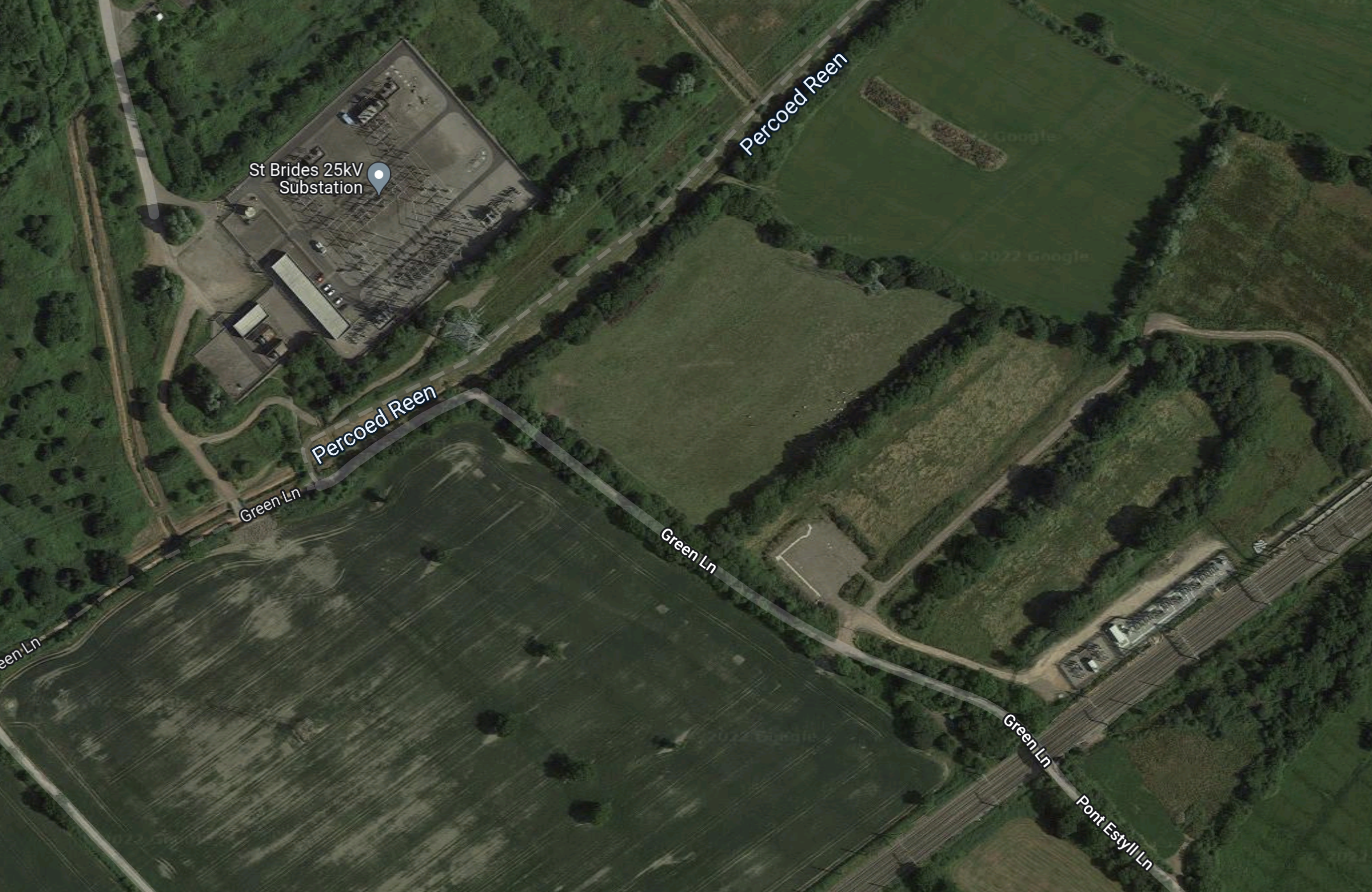
Note.
- The South Wales Main Line crossing the South-East corner of the map.
- Newport station is to the East and Cardiff station is to the West.
- The St. Brides feeder station alongside the railway, by the Green Lane bridge.
I would assume that the connection to the National Grid is via the St. Brides 25 kV Substation in the North-West corner of the map.
The article lists the features of the design.
- A typical steel mast weighs 750 Kg., whereas a composite mast weight just 80 Kg.
- I suspect that these masts can be lifted around by a couple of average workers.
- They have lower wind resistance.
- Piles can be less deep. The prototype piles are 1.25 m., as against many that are over four metres on recent schemes.
- The piles have sensors to detect, when they are out of kilter and need replacing.
- Currently, wonky masts need to be identified by hands-on measurement or observant drivers.
- Two masts have been tested to destruction, to see if they match the theory.
But this to me as an Electrical Engineer is the clincher.
Furrer+Frey GB head of UK projects Noel Dolphin says this about the new design.
When they do take it to a mass manufacturing stage, it will be without carbon fibre inside, which presents another opportunity. The other ultimate goal is that the structure is insulating in itself. It’s another big saving if you can remove the insulators on the electrification cantilevers, as they’re expensive in themselves.
It’s all going the way of much more affordable electrification.
I have a few further thoughts.
The Involvement Of Prodrive
Prodrive are best known for their involvement in motorsport, as the home page of their web site indicates.
But as their site also indicates they get involved in other forms of high-performance disruptive engineering, where their experience is relevant.
Prodrive build the prototypes, but won’t build the production masts, although I suspect, their expertise will be used.
The TruckTrain
TruckTrain is a concept with roots in Coventry University that could be off-beam enough to be the new normal.
I have updated my thoughts on the TruckTrain and it is now in a post called The TruckTrain.
My Conclusion About TruckTrains
I like the concept and I can’t see why it would not be successful worldwide.
The Involvement Of TruckTrain With Furrer+Frey
This puzzled me for a time, as undoubtedly, the TruckTrain will be able to use standard electrification.
But in the TruckTrain leaflet, they mention that the TruckTrain has been designed to use single-track short-terminals.
So did they approach Furrer+Frey to find out about electrifying short terminals and the Swiss company felt TruckTrain was a concept they could support?
Obviously, if the TruckTrain is developed to be a battery-electric train, some mini freight terminals will need the ability to charge the TruckTrain.
Could A TruckTrain Be Used to Support Electrification?
Would a TruckTrain be the ideal support vehicle to erect or repair electrification?
If you take the problem, when the wires have been damaged, a TruckTrain could get to the site at 100 mph, much faster than a truck on the road. It could also have a platform to lift the engineers for inspection and repair.
A TruckTrain could be more than just a transport system.
Conclusion
Furrer + Frey’s lightweight composite electrification masts are a good idea.
Teamed with TruckTrains, they could prove a very powerful freight concept, where new mini freight terminals are needed.
Russia Destroys Ukraine’s Dream
The Antonov An-225 Mriya was a unique aircraft.
It was the biggest aircraft in the world and was regularly used to move heavy or awkward cargoes around the world, as a reading of its Wikipedia entry will disclose.
Mriya is Ukrainian for dream.
But all that useful work has come to an end.
This article on CNN is entitled World’s Largest Plane Destroyed In Ukraine.
These are the first two paragraphs.
The world’s largest plane, the Antonov AN-225, has been destroyed during the Russian invasion of Ukraine, according to Ukrainian officials, generating alarm and sadness among the aviation world in which it occupies almost cult status.
The enormous aircraft, named “Mriya,” or “dream” in Ukrainian, was parked at an airfield near Kyiv when it was attacked by “Russian occupants,” Ukrainian authorities said, adding that they would rebuild the plane.
I know it’s only a plane and in the current scheme of things, that is a minor loss, but the Mriya has proved itself to be so uniquely useful in moving awkward cargoes, that the plane would surely have played a major part in the humanitarian relief and the rebuilding of Ukraine.
Given, that the plane would have surely been of use to the Russians, it just shows how utterly stupid, they have been in this war.
Lithuania To Germany Intermodal Service To Launch In April
duiThe title of this post, is the same as that of this article on Railway Gazette.
These are the first two paragraphs.
Lithuanian national railway’s freight business LTG Cargo is to launch a service carrying containers and semi-trailers from the Kaunas Intermodal Terminal to Duisburg in Germany on April 4.
Trains with a capacity of up to 36 semi-trailers and containers will run thrice-weekly on the 1 500 km route. This will be LTG Cargo’s first westward service operating in three countries, with operations in Poland and Germany handled by its LTG Cargo Polska subsidiary.tail
These are more information and my thoughts.
The Route
The route appears to follow a route from Kaunas to Warsaw via
- Marijampolė
- Šeštokai
- Mockava
- Suwalki
- Buchwalowo
- Bialystok
Note.
- The links on the names are to the town’s Wikipedia entry.
- The border between Lithuania and Poland is between Mockava ans Suwalki.
- There are freight yards and change of gauge facilities at Šeštokai and Mockava.
Some of these towns are probably worth a visit, especially if like me, you have Jewish ancestors from the area.
My father’s great-great-grandfather possibly came from Konigsberg in East Prussia and arrived in the UK around 1800.
The Russian And Standard Gauge Solution
Consider.
- Estonia, Latvia and Lithuania have Russian gauge railways which is 1520 mm.
- Poland, Germany, France, Italy and the UK have standard gauge railways, which is 1435 mm.
The solution has been to build between Kaunus and Šeštokai, to build Russian gauge and standard gauge tracks side by side.
Kaunas Intermodal Terminal
This Google Map may show the Kaunas Intermodal Terminal.
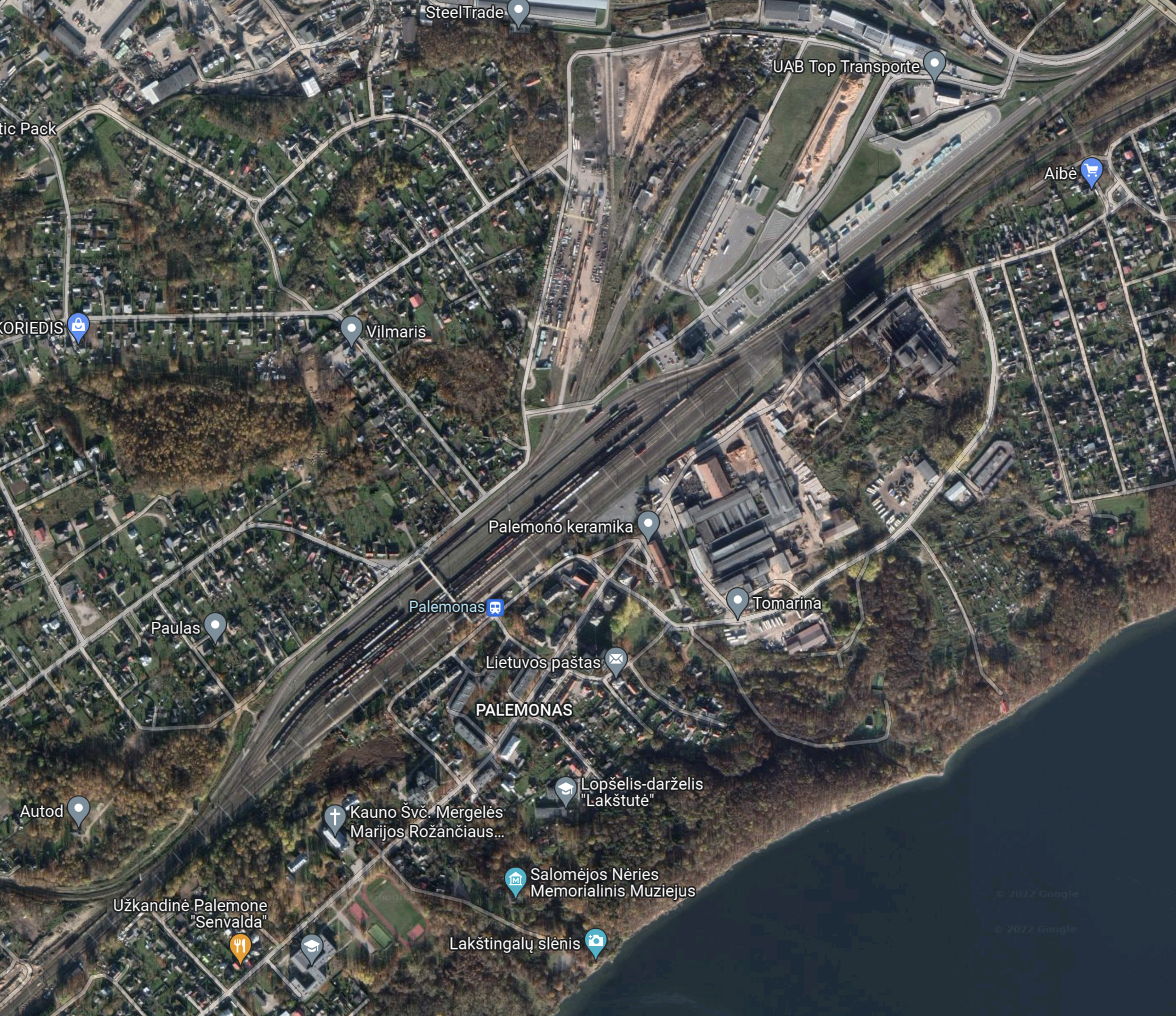
Note the rail yards in the middle of the map, have both Russian and standard gauge tracks.
Rail Baltica
The route taken is the standard gauge route of Rail Baltica, which is an EU project.
- It will run between Helsinki and Warsaw.
- Intermediate stops will be Pärnu, Riga, Riga International Airport, Panevėžys, Kaunas and Bialystok
- Vilnius will be served by a branch from Kaunus.
- The line will be double track.
- The line will be electrified with 25 KVAC overhead.
- Passenger trains will operate at up to 249 kph.
- Freight trains will operate at up to 120 kph.
- A tunnel will be built later between Helsinki and Tallinn.
Completion of the route between Warsaw and Tallinn is planned for 2026.
Rail Baltica I
Rail Baltica I is the first section of the route to be opened and is described like this in Wikipedia.
The name Rail Baltica is also sometimes used to mean the first phase of European gauge railway construction from the Poland-Lithuania border to Kaunas in Lithuania.
It opened in October 2016.
The new freight service will use this route to connect to Bialystok and Warsaw.
Conclusion
I have been on the roads in this area of Poland and rail freight services are needed to take the pressure off the roads.
Conference Calls For More Freight Routes To And From Spain
The title of this post, is the same as that of this article on Railway Gazette.
This is the first paragraph.
Salvador Galve, Chairman of the Railway Commission of the General Council of Industrial Engineers, presented the European Alliance for the Development of Railway Corridors in the Iberian Peninsula initiative at a conference held in Madrid on March 9.
These are some points from the article.
- Less than 4% of freight is currently transported by rail in Spain, compared with an average of 18% across the EU.
- The Spanish government wants to raise this to 20%.
- Incidentally, in the UK, rail freight is at a level of 5 %.
- Italy has seven main lines connecting it to its neighbours, Spain has only two!
- Spain also has a break of gauge, whereas the UK and Italy do not!
- Plans exist for more freight corridors in Spain, and linking these to ports in North Africa and logistics hubs in the rest of Europe.
- Zaragoza, could be turned into a key southern European logistics hub, linked by tunnels to the main line between Toulouse and Bordeaux.
But to me the most interesting plan is set out in this paragraph.
On March 1 the Infrastructure Ministry gave its provisional approval for study into the feasibility of converting the single track, non-electrified line from Huesca to Canfranc from 1 668 mm gauge to 1 435 mm gauge, ahead of any possible reconstruction of the through route to Pau in France in the longer term.
It has always been on my bucket list to visit the magnificent Canfranc station.
Wagons Ordered For Growing Freight Traffic
The title of this post, is the same as that of this article on Railway Gazette.
This is the first paragraph.
GB Railfreight and leasing company Porterbrook have placed an order for Greenbrier Europe to supply 50 JNA 60 m3 capacity four-axle box wagons for transporting construction materials.
Other points from the article.
- The wagons will be built in Romania.
- They will be delivered in the Autumn.
- Porterbrook research is indicating a possible increase of 35 % in construction sector traffic between now and 2034.
Certainly, judging by the number of posts about freight, the sector seems to be innovating and running more trains.
 The Anonymous Widower