Levelling Up Freight
This project was one of the winners in the First Of A Kind 2022 competition run by Innovate UK.
In this document, this is said about the project.
Project No: 10037240
Project title: Levelling Up Freight
Lead organisation: 3SQUARED LTD.
Project grant: £393,271
Public description:
Background
Rail freight is vital to Britain. It contributes almost £2.5bn to the economy and plays a big part in reducing congestion and emissions. Rail is more environmentally friendly than road, with every tonne of freight transported by rail producing 76% less emissions compared to road (RDG “Levelling Up Britain” 2021). The green benefits of rail freight are being driven heavily by the DfT with incentive schemes such as Modal Shift Revenue Support (MSRS) – a £20m grant, which
freight carriers can bid for a share of to support modal shift to rail.
Despite widescale use of MSRS, finding new freight routes for additional trains is challenging because:
- Road haulage is seen as easier and more accessible than rail freight, especially at short
notice, for short journeys and for single containers. - Highways are less regulated with no significant barriers to commercial participation, and
therefore are free to use the latest technologies to develop and evolve solutions at a faster
pace. - Railway planning systems and processes limit the availability and visibility of freight paths
(slots in the timetable which can accept a freight train) resulting in under-utilisation of
network capacity.
Our innovative freight planning solution (PathPlanner) will make the use of rail for freight as
accessible and easy to use as the road network. PathPlanner is specifically designed to overcome
the current operational challenges and blockers that make moving to rail prohibitive.
Proof-of-Concept Demonstration
In 2021, NR completed a £17m upgrade around Southampton to enable longer trains in/out of the docks. Completing April 2023, Solent Stevedores is investing c.£3m to strengthen their capability to receive and dispatch longer and more trains – from 9 to 16 per day.
However, NR’s business case did not include any understanding of capacity in/out of the port, so
Solent Stevedores is currently unsighted as to how, or if, they can find the additional paths.
There are significant gains to be made if they can; 7 extra trains equate to:
- £12.6m additional revenue p.a.
- A reduction of 55,000 HGVs.
- A reduction of carbon by 1,165 tonnes.
Our project will demonstrate a Proof-of-Concept solution at Southampton Docks that will facilitate
Solent Stevedores, and Eddie Stobart Logistics (ESL) – 2 off our project partners – to find additional
freight paths and transfer containers from HGVs to trains.
My Thoughts And Conclusions
As I programmed scheduling and resource allocation systems for forty years, I am probably one of the most experienced programmers at writing this type of system.
That experience suggests that their objectives are possible.
Decarbonising Auxiliary Load In Freight Today
This project was one of the winners in the First Of A Kind 2022 competition run by Innovate UK.
In this document, this is said about the project.
Project No: 10039629
Project title: Decarbonising Auxiliary Load In Freight Today
Lead organisation: G-VOLUTION LTD
Project grant: £378,514
Public description: Freight locomotives have auxiliary electric power requirements which account for up to 10-15% of the total power demand, covering engine and traction motor cooling, safety and signalling systems and locomotive control systems.
These loads are currently serviced by an alternator on ubiquitous diesel ICE powertrains. This demand is persistent, requiring the diesel ICEs to remain powered up/idling during the significant periods of dwell time faced by freight services. Up to 20% of freight locomotive fuel consumption and emissions, from CO2 and particulates, therefore arise from non-traction aspects.
Whilst extreme traction requirements for freight operations restricts adoption of full decarbonised powertrains – unless compromises for traction power or range are made – no existing rail technology targets the significant auxiliary power requirements.
In response, G-volution have engaged a team cutting across the full UK supply chain to realise and integrate a first-of-a-kind system for on-board auxiliary power on freight locomotives, based on high energy-density fuel cells and a carbon neutral bio-LPG fuel system.
Whilst initially representing the lowest cost/technical barrier route to catalyse significant CO2, exhaust emission and diesel fuel savings in freight, this approach has potential to also substitute traction power in the long term, and supports the transition to green hydrogen as a rail transport fuel.
Through a live demonstration with a UK freight operator, the project will therefore prove that high efficiency fuel cells, which are able to use a range of cleaner, greener, cheaper zero net carbon renewable fuels, can work in the rail environment and also stimulate significant commercial benefits for all operators, via reduced fuel costs and future environmental levies.
My Thoughts And Conclusions
Note that another G-volution project is described in Grand Central DMU To Be Used For Dual-Fuel Trial.
I also suspect, this auxiliary power unit could have other applications.
What Is A Freight Skate?
The Freight Skate was one of the winners in the First Of A Kind 2022 competition run by Innovate UK.
The Description In The First Of A Kind 2022 Winners Document
In this document, this is said.
Project No: 10039606
Project title: “Freight Skate” a self-powered freight bogie and platform
Lead organisation: TDI (EUROPE) LIMITED
Project grant: £400,000
Public description: Governments have recognised that the continued dependence on the motor/freight vehicles is unsustainable and that modal shift to low and zero-carbon public transport solutions, both for passengers and freight, is essential if legislative commitments to Net Zero are to be met.
The Freight Skate provides a sustainable, low cost, reliable and high-quality rail freight experience which will drive down emissions and increase profits to freight companies and assist in bringing about the much-needed modal shift from road to train. To achieve this objective, it required us to use different ways of thinking across every aspect of the programme – design, supply, build and system implementation. This approach has yielded the desired results.
The skate chassis was originally designed with steering axles for passenger trains. It is a unique and tested design which we believe lends itself to operating as an independent 4-wheel unit that can be virtually coupled to form a platform for 10′, 20′,30′ or 40′ containers. The study would also allow us to optimise loading for 9’6″ HC units; Three units could also be used to carry 2 x 40′ containers. An individual unit would carry a 10′ container.
TDI plans to commercialise the Freight Skate vehicle over the next 3 years, with the product entering freight terminal service in 2025.
My Thoughts And Conclusions
If you search the Internet for “Freight Skate” you find nothing, but I think the concept is a development of the TruckTrain, which I wrote about in The TruckTrain, as both concepts are from Coventry.
I really liked the TruckTrain concept, when I saw it earlier this year.
First Of A Kind 2022 Winners Announced
The title of this post, is the same as that of this news item from Innovate UK.
This paragraph explains the competition.
The Department for Transport and Innovate UK are delighted to announce the first set of winners for the First of Kind (FOAK) 2022 competition. Winners will receive funding to help develop novel technology which improves rail freight services and lowers carbon emissions from trains.
I shall cover some of the winning ideas in future posts, which I will link to this post.
10039629 – Decarbonising Auxiliary Load In Freight Today
10037240 – Levelling Up Freight
10038447 – Transforming High-Speed Rail Logistics
10039606 – “Freight Skate” A Self-Powered Freight Bogie And Platform
10039559 – A Rapidly Deployable Rail Stress Sensor For Next Generation Freight Monitoring
10037294 – EventGo – Intelligent Rail Service Demand Forecasting for Event-Based Travel
10037862 – NextGen Data-Driven Timetable Performance Optimisation Tool
10039201- Protection and Resilience for OLE using ComputerVision Techniques (PROLECT)
10038989 – FEIDS – FOAS Enabled Intruder Detection System
10038342 – Rail Flood Defender
10039258 – Optimal Prediction of Sand For Adhesion
10038790 – Unauthorised Cable Removal And Fault Triage
10036632 – Trains With Brains(R)
10038228 – SBRI: FOAK 2022 Optimising Railway Possessions
10037542 – Portable Track Geometry Measurement System
10038973 – State Of The Railway Compiler Data Solution (SORClite): Open Access Real-Time Signalling Data
10036245 – ECML Net Zero Traction Decarbonisation
10039100 – UBER – Ultra-High Power Battery For Low Emission Rail
10037562 – ZERRCI – Zero Emissions Repowering Of Railway Construction Infrastructure
10038683 – Axle Mounted Motor For Retrofit To DMU’s To Enable Zero Emissions In Stations
10038972 – Zero Emission Powering of Auxiliary Loads In Stations
10038627 – ERiCS – Emissions Reductions in Closed Stations
10037158 – 25kV Battery Train Charging Station Demonstration
British Land Plans Underground London Logistics Hub
The title of this post, is the same as that of this article on Construction Enquirer.
This is the sub-title to the article.
British Land is planning to create an underground low-carbon logistics hub in central London.
Note.
- The former Crossrail box works site beneath Kingdom Street in Paddington is being turned into the logistics hub.
- The site was returned to British Land’s ownership when the Elizabeth Line opened.
- There will be a 13-storey office above the box.
- The 21-storey office at the Five Kingdom Street site has been reduced to seven storeys, to meet today’s expectations for environmentally-sustainable design and occupier wellbeing.
- The urban logistics hub would facilitate deliveries within Westminster using electric vehicles and cargo bikes
It looks to me, that this logistics hub has similar aims and objectives, to British Land’s other planned hub, that I wrote about in Finsbury Square Car Park Becomes British Land Hub For Delivery Drivers.
Conclusion
British Land seem to have a plan to develop low carbon logistics hubs.
Amber Train Links The Baltic States To Western Europe
The title of this post, is the same as that of this article on Railway Gazette.
These paragraphs outline the freight link.
A trial Amber Train service between the Baltic States left the Estonian port of Muuga on September 13, arriving the following day at Kaunas in Lithuanian where its load of semi-trailers was transferred to 1 435 mm gauge wagons for onward transport to destinations including France and the Netherlands.
The 1 520 mm gauge wagons returned to Muuga with trailers for onward sea transport to Finland.
This Google Map shows the Estonian port of Muuga Harbour.
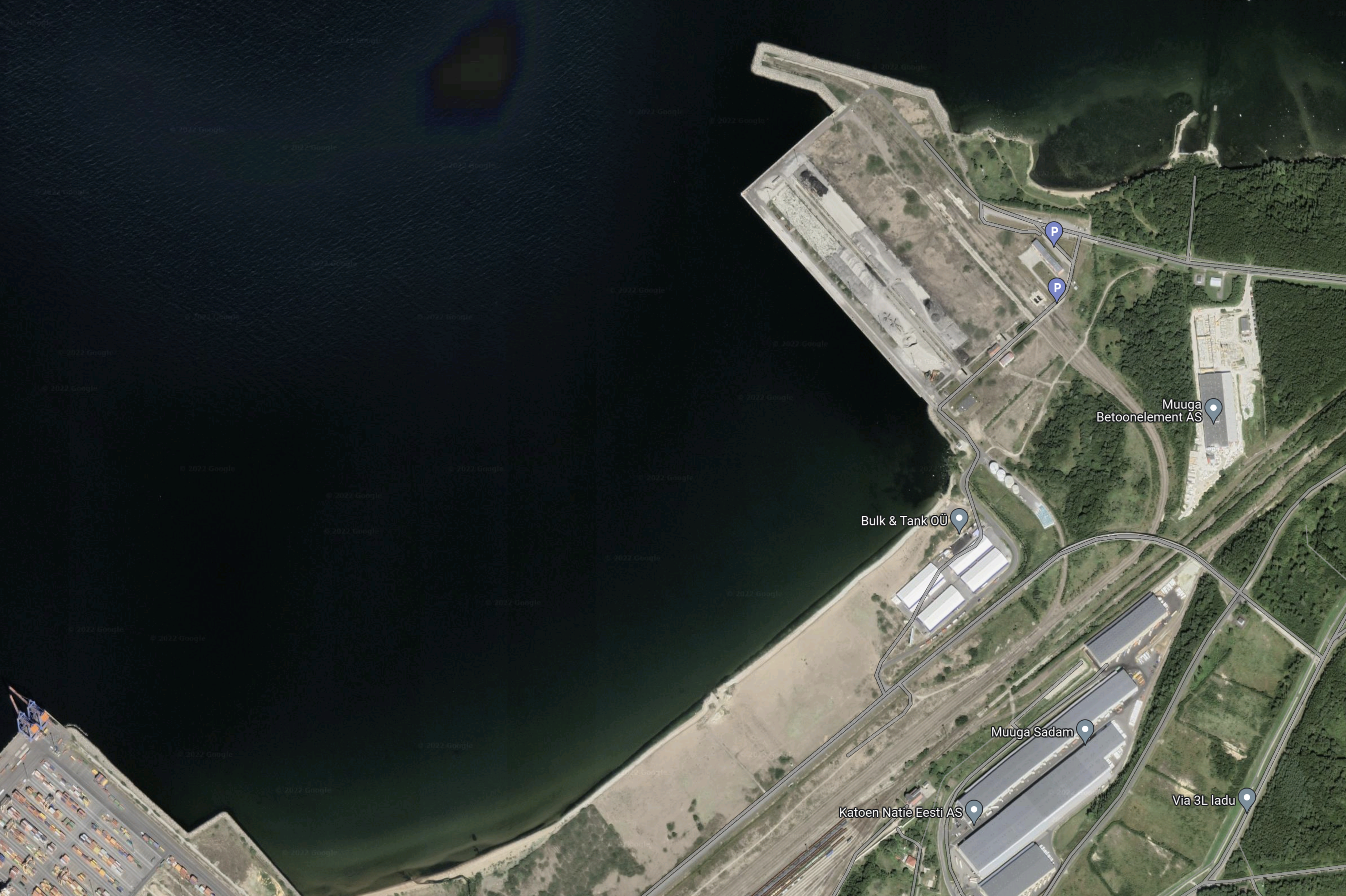
Note.
- Muuga Harbour is the largest cargo port in Estonia, located on the southern coast of the Gulf of Finland, 17 kilometres (11 mi) northeast of the capital Tallinn
- It is one of the few ice-free ports in northernmost Europe and one of the most modern ports in the Baltic Sea region.
- Enlarging the picture shows a lot of rail lines.
It looks like Muuga Harbour is an ideal Northern terminus for the Amber Train freight service.
This Google Map shows the area of the Kaunus Intermodal Terminal.
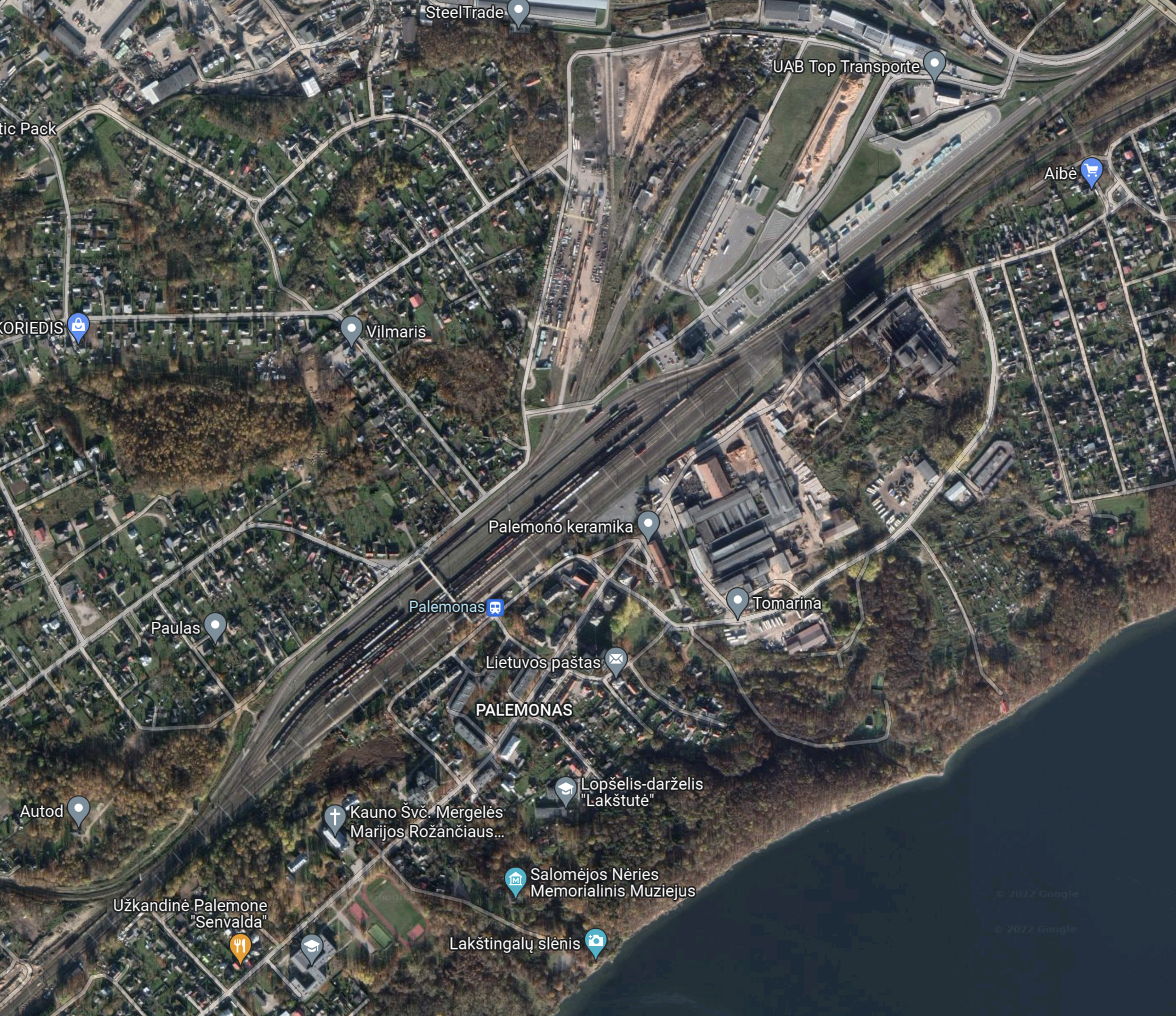
Note.
- The railway runs diagonally across the map.
- Estonia is to the North-East.
- Poland is to the South-West.
This map shows how the different gauges are used in the North-East of the previous map.
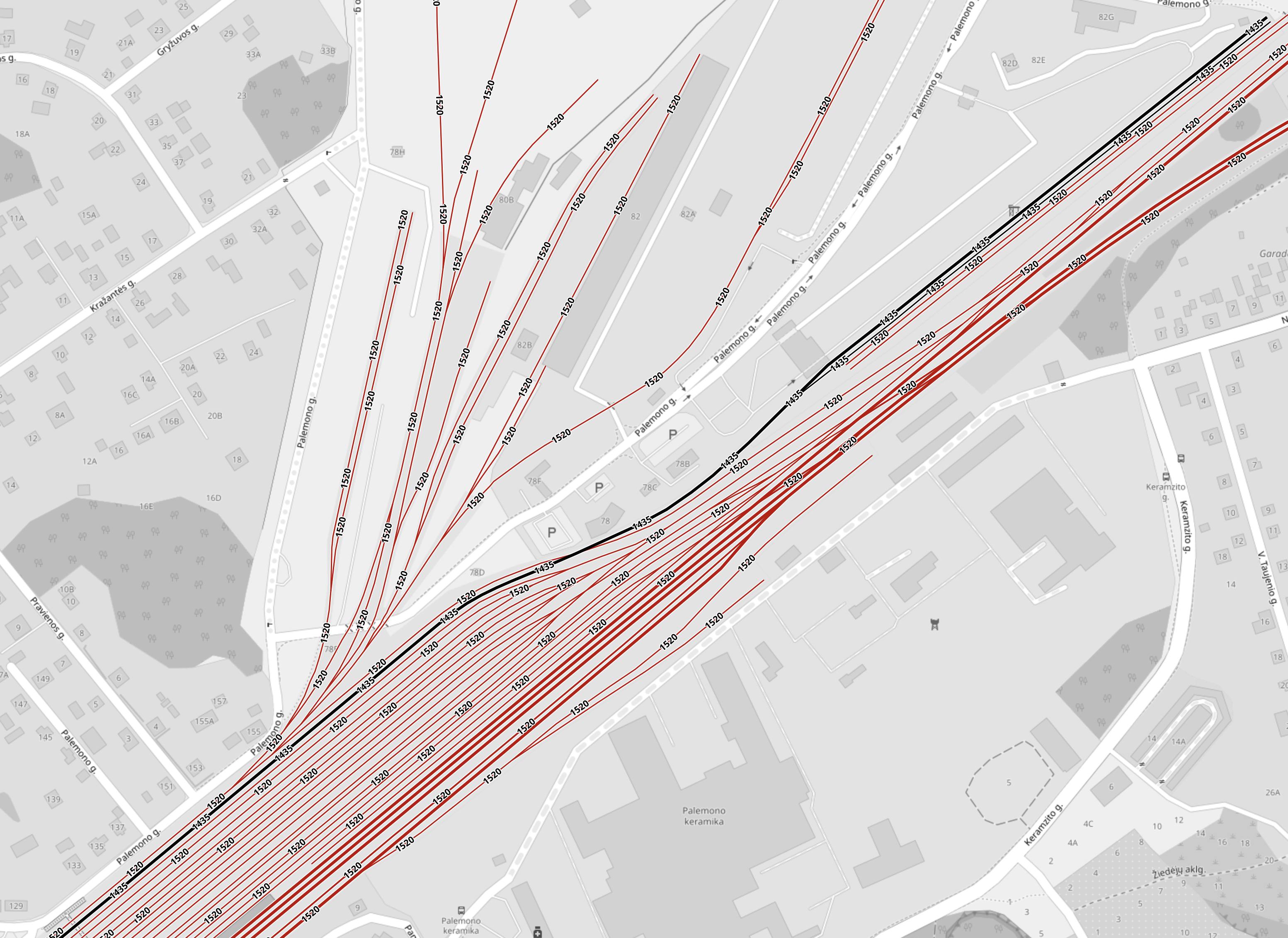
Note.
- Standard gauge tracks are shown in black.
- Russian gauge tracks are shown in red.
- The standard gauge track ends in the North-East corner of the map.
Trucks would probably moved between trains on parallel tracks in this freight terminal.
It appears to be a very simple way to run piggy-back trains of trucks between The Baltic States and Finland and Central and Western Europe.
Rail Baltica
According to Wikipedia, the location for the Kaunas Intermodal Terminal was chosen as it is compatible with the route of Rail Baltica, which will create a new standard gauge route between Kaunas and Tallinn in Estonia.
The Amber Train
The Amber Train has an impressive web site, where this is said on the home page.
Amber Train is a joint project of the national railways of Lithuania, Latvia and Estonia. It is an excellent example of cooperation, that offers road and railway clients convenient and efficient freight logistics.
Amber Train is an intermodal train, which runs on the route Šeštokai / Kaunas – Riga – Talinn, thus connecting the three Baltic States by railways and opening new business opportunities for freight shippers.
Exclusivity of the project is the connection of Western and North Europe, using the unique Šeštokai and Kaunas intermodal terminals, which enable the transshipment of freight from the European gauge to the 1520 mm gauge and vice versa.
The train is planned to run 2 times per week (with a future perspective to run up to 4 times per week), delivery time is 24 hours. Train length – up to 43 container wagons.
It is planned, that already in 2021 customers will be offered the opportunity to transport semi-trailers by railways via all three Baltic States. For this purpose, special “pocket” wagons are already in production.
Operations are managed by AB LTG Cargo (Part of Lithuanian Railways group), Latvia’s LDZ Loģistika and Estonia’s Operail.
It appears to be a well-thought out service.
A few years ago, I was on the roads of North-East Poland, about a hundred miles South of Kaunas.
These roads were crowded with large trucks going between The Baltic States and Finland and Central and Western Europe.
I suspect that once the Amber Train is fully established, a proportion of these trucks will go by rail.
Plan To Build £150m Green Hydrogen Plant At Felixstowe Port
The title of this post, is the same as that of this article in The Times.
These two paragraphs introduce the project.
A £150 million green hydrogen plant is to be built at the UK’s busiest container port according to proposals by ScottishPower, it emerged yesterday.
The energy company has devised plans for a 100MW plant at the Port of Felixstowe which will provide fuel to power trains, trucks and ships.
There’s a lot more to this project than it would appear at first.
Where Will The Electrolyser Be Sited?
The Times article says this.
The site will be around the size of a football pitch, on brownfield land within the port.
I have flown my virtual helicopter over the port and there could be a couple of suitable football pitch-sized plots.
Where Will The Electricity Come From?
The East Anglia Array is a proposed massive series of offshore wind farms, which will be about thirty miles off the Suffolk coast.
Wikipedia says this about the size.
Up to six individual projects could be set up in the area with a maximum capacity of up to 7.2 GW.
But the main thing about the East Anglian Array is that it is being developed by a partnership of ScottishPower and Vattenfall.
Negotiations shouldn’t be difficult.
This Google Map shows the town of Felixstowe.
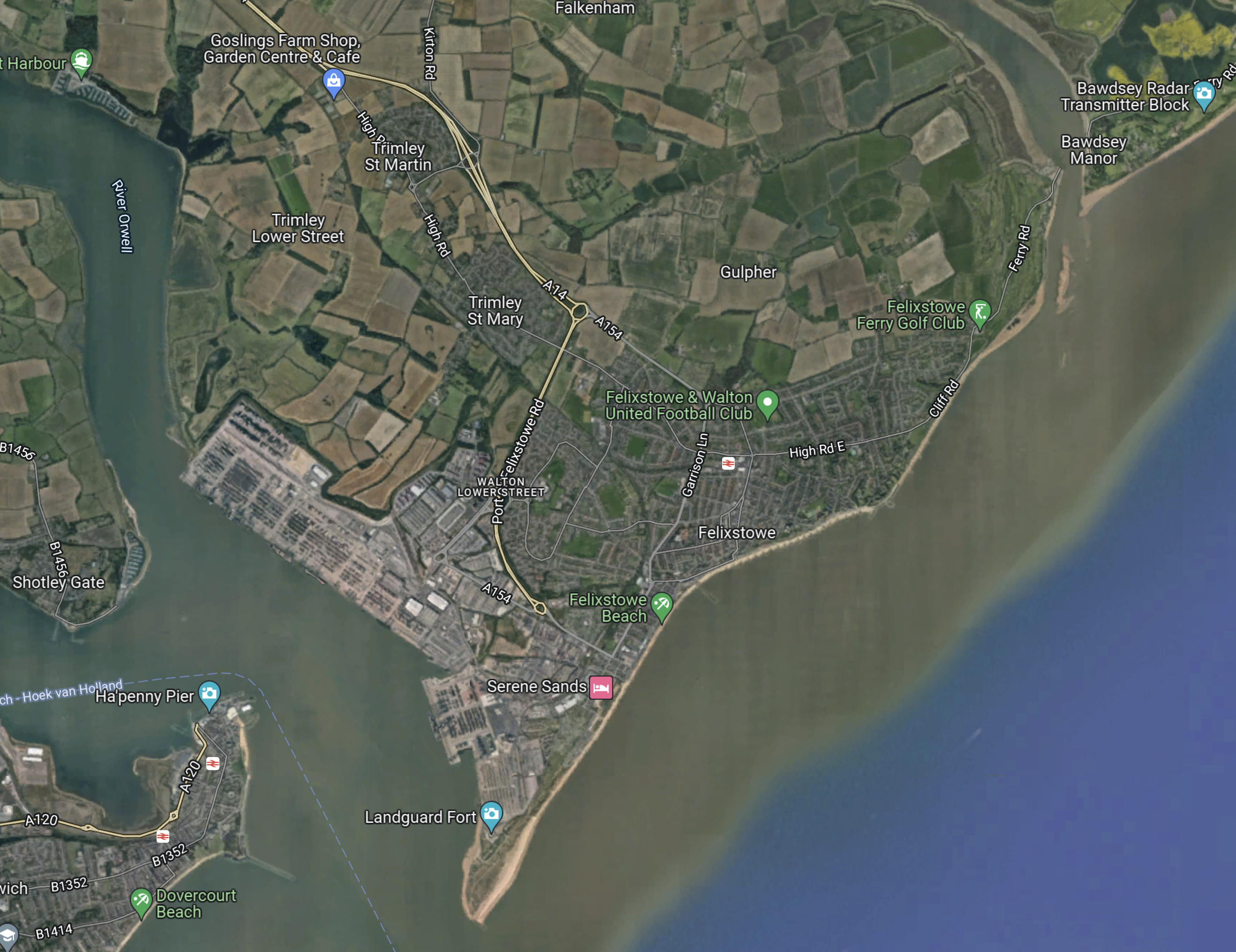
Note.
- The Ports of Felixstowe and Harwich are opposite each other on the two banks of the River Orwell.
- The power cable to the East Anglia Array comes ashore at Bawdsey in the North-East corner of the map.
- The Port of Felixstowe has two rail links, which are not electrified.
I suspect that the electric power to the electrolyser might well be routed underwater to the Port of Felixstowe either from Bawdsey or possibly direct from the wind farm.
A Meeting With A Crane Driver
I used to regularly go to Ipswich Town away matches and at one match, I met a senior crane operator from the Port of Felixstowe. We got talking about electrifying the rail link to the port and decarbonisation of the port in general.
He was adamant that electrification of the rail lines in the port, wouldn’t be a good idea as containers occasionally get dropped or crane drivers aren’t as accurate as they should be.
Hydrogen-Powered Freight Locomotives
When, I told him about the possibilities of hydrogen rail locomotives, he felt this was the way to go, as no rail electrification would be needed in the port.
Hydrogen-electric hybrid locomotives would also be able to take containers cross-country to the main electrified routes to the North and West, where they would raise their pantographs and use electric power.
How many trucks would be removed from the A14, A1 and M6?
Will Greater Anglia Convert Their Class 755 Trains to Hydrogen?
Class 755 trains have a short PowerPack in the middle and are designed for conversion to hydrogen-electric operation.
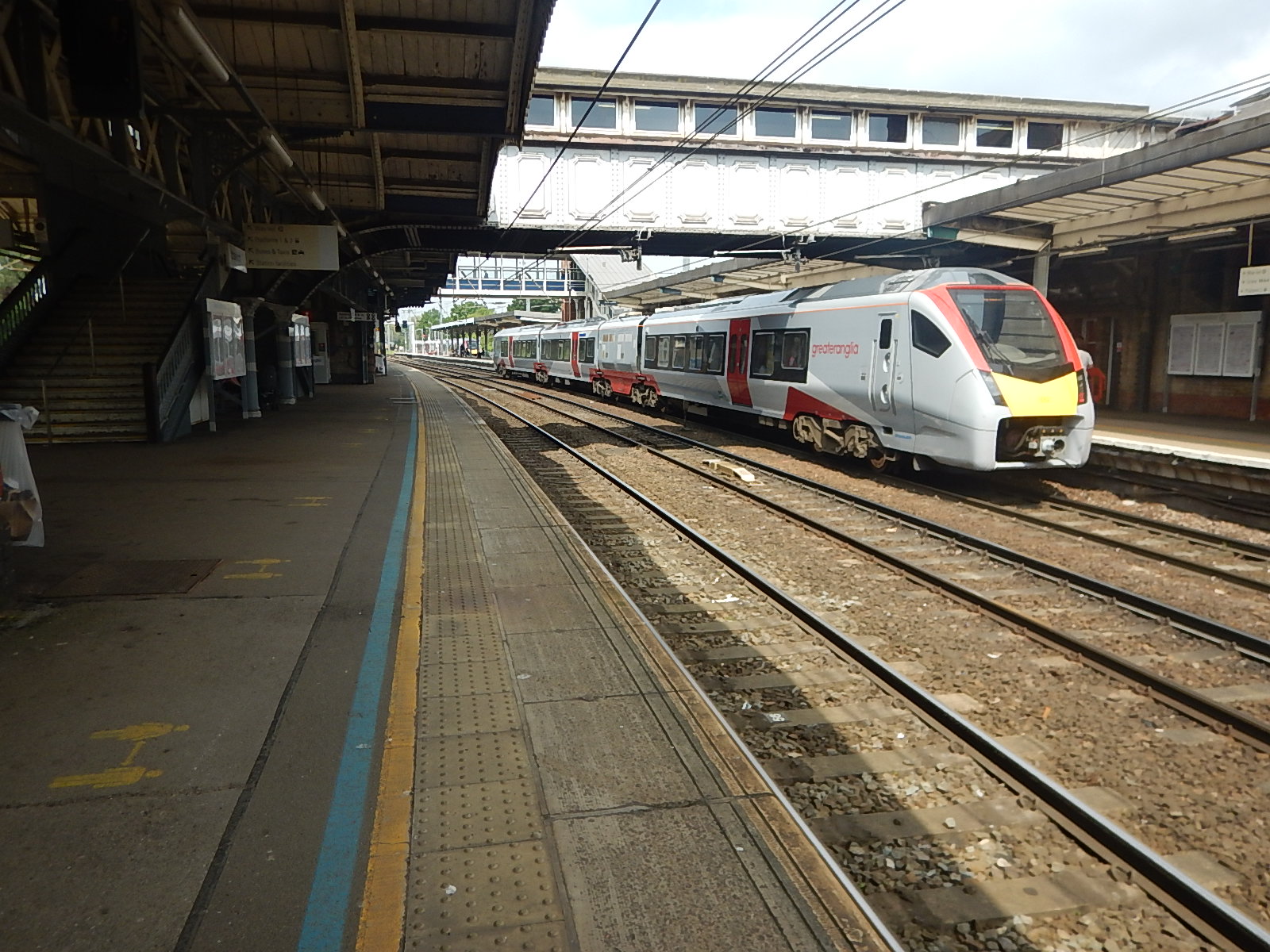
Note the PowerPack has four slots for diesel engines, batteries or hydrogen fuel-cells.
A Better Working Environment
But my fellow supporter felt the biggest gain in the port, would come with replacement or updating of all the vehicles and handling equipment, as if all these machines were hydrogen-powered, this would greatly improve the working conditions for the dock workers.
ScottishPower’s Vision
This press release on ScottishPower’s web site is entitled ScottishPower Vision For Green Hydrogen Fuels Hub At Port Of Felixstowe.
Conclusion
The Port of Felixstowe is doing the planning for this in the right way, as ensuring the hydrogen supply in the port first, is the logical way to transition to hydrogen power.
But then, I’ve watched the Port of Felixstowe grow since the 1960s and they usually get their decisions right.
The press release starts with these bullet points.
- ScottishPower explores green hydrogen at Port of Felixstowe to help decarbonise the UK’s busiest port.
- The project could help kick-start the low carbon transformation of the UK’s heavy transport sector.
- 100MW facility could deliver up to 40 tonnes of green hydrogen per day – enough to power 1300 hydrogen trucks.
- International export also being explored.
And these two paragraphs.
ScottishPower, with Hutchison Ports, is exploring the opportunity to develop, build and operate a multi-hundred MW green hydrogen production facility at the Port of Felixstowe – with the potential to decarbonise industry and transportation in the region.
Both companies have set out their vision to help create a greener port, which could provide clean fuel for customers at Britain’s busiest container port.Plans are being developed to use green hydrogen for onshore purposes, such as road, rail and industrial use, with the potential to create liquid forms, such as green ammonia or e-methanol. This could, in turn, provide clean fuels for shipping and aviation, and create opportunities for cost-effective export to international markets. The project aims to continue engineering and site development works to align with customer demand from 2025 onwards.
It is certainly a very extremely ambitious vision!
But then the county of my conception, has a tremendous determination to succeed. And often against all conventional logic!
The Channel Crossing Problem
My company provided the project management computer system; Artemis, that planned how both the tunnel and the rail link to London was built. So I heard numerous stories of inadequate infrastructure on both sides of the Channel.
I also for a time was a business partner of the man, who had been project manager on a previous attempt to build a Channel Tunnel, that was cancelled by Harold Wilson’s government in 1975, who had a lot of interesting input.
I have heard over the years of these inadequacies,
- The Dartford Crossing wouldn’t be able to handle the traffic generated at busy times.
- The Eurotunnel terminal in Folkestone wasn’t built large enough.
- The port of Dover is too small.
- The roads to the Port of Dover were inadequate.
- The rail terminal at St. Pancras doesn’t have the capacity to run services to the places that are better served by train.
The government only has one major improvement in place, which is a new Thames Crossing, but that will only make matters worse, as more traffic will be tempted to cross the Channel to get to Europe.
It is my belief, that we need more innovative services to provide more capacity.
- A German company called CargoBeamer, is developing a system, whereby unaccompanied freight trailers can be moved thousands of miles across Europe by rail. Their plans include services to Birmingham, Cardiff, Manchester and Scotland.
- I would also run a CargoBeamer service from Calais to Holyhead to create a direct freight service between Ireland and Europe.
- Ebbsfleet needs to be developed as a destination for the Elizabeth Line and an extra terminal for both daytime and sleeper trains to Europe.
- High speed freight trains, based on existing 160 mph EMUs could be used.
- Given the position of the new Thames Crossing on the Isle of Grain, perhaps a new ferry port could be built on the island to partially replace Dover.
- Could some Eurotunnel services start from Watford Gap?
We have to be bold.
Rolls-Royce Lists Sites For New Reactor
The title of this post, is the same as that of this article on The Times.
The headline is a bit misleading, as the site is for a factory to build the reactors.
These paragraphs list the sites.
Rolls-Royce, the engineering company, has shortlisted six sites for a factory that will build its proposed small nuclear reactors.
The constituency of Rishi Sunak, the chancellor, in Richmond, North Yorkshire, is among the locations, which have been whittled down from more than 100 proposals.
The other sites are Sunderland, Deeside in Wales, Ferrybridge in West Yorkshire, Stallingborough in Lincolnshire, and Carlisle.
As Rishi Sunak resigned last night, does that rule out Richmond?
I feel that Rolls-Royce will choose this location with care, as any good company would.
I have a few thoughts.
Will Rolls-Royce Go For Zero-Carbon Manufacture?
If you intend to build large numbers of small modular nuclear reactors, it is not a good idea from a marketing or public relations point of view to release tonnes of carbon in their manufacture.
This page on the Rolls-Royce web site has a title of Destination Net Zero, where this is said.
We have already pledged to reduce emissions from our own operations to net zero by 2030, and to play a leading role in enabling the sectors in which we operate to reach net zero by 2050. Now, we are now laying out our technology pathway and setting clear short-term targets to show how we will achieve those goals.
I am sure Rolls-Royce will go for zero-carbon manufacture.
This will probably mean the site will need to have access to the following.
- Renewable electricity from wind, solar or hydro.
- Hydrogen
- Zero-carbon steel, copper and other raw materials
An external supply of hydrogen may well be the least important, as they recently purchased a German electrolyser developer and manufacturer, that I wrote about in Rolls-Royce To Develop mtu Hydrogen Electrolyser And Invest In Hoeller Electrolyser.
Will The Factory Have A Rail Connection?
A rail connection could have four main purposes.
- Bringing in raw materials like steel.
- Delivering manufactured components to site.
- If the factory is a major source of employment, rail is the greenest way to bring in staff from further away.
- If large shipments are brought in and delivered by zero-carbon rail, it generally doesn’t annoy the locals.
Note.
- The huge Britishvolt gigafactory at Blyth will have a rail connection for the transport of lithium and finished batteries.
- Transport of nuclear fuel and waste around the UK is generally done by train, with perhaps the last few miles by truck.
I think it will be very unlikely, that the new factory will not have a rail connection.
Will Power Station Modules Be Transportable By Rail?
Given that in the UK, there will need to be a railhead at or near the power station for fuel and waste, I believe that if modules were transportable by rail, this could give big advantages to the roll-out of the reactors.
If a former Magnox nuclear site like Bradwell is to be home to a fleet of small modular reactors, the electrified railhead is already in place at Southminster station.




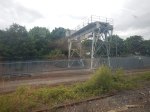
The crane and the track probably need a bit of a refurbishment, but overall, it looks in reasonable condition.
If you sell nuclear as zero-carbon, rail is the easiest way to ensure zero-carbon delivery of modules.
The standard loading gauge in the UK is W10, which is 2.9 metres high and 2.5 metres wide.
- A standard twenty-foot container is six metres long, which must help.
- W10 gauge allows the transport of standard Hi-Cube shipping containers, which are 9 ft 6 in. high, on flat rail wagons.
- If the modules can fit into Hi-Cube shipping containers, this would make transport easier everywhere, as all ports and railways can handle these containers.
Would it be possible to fit all components into this relatively small space?
It could be difficult, but I suspect it is possible to achieve, as it would make the reactors easier to sell.
- Sites would only need to be able to receive Hi-Cube shipping containers.
- These could be trucked in from a nearby railhead.
- Containers on a railway are a very secure way of transporting goods.
- Rolls-Royce has masses of experience in shipping large turbofan engines in standard shipping containers. Some are shipped in very carefully controlled air conditions to minimise damage.
- Hi-Cube shipping containers can go through the Channel Tunnel.
I am fairly sure, that Rolls-Royce are designing the power station, so that it fits into a number of Hi-Cube shipping containers. It would give other advantages.
- Smaller components would probably speed up assembly.
- Smaller components may also mean that smaller cranes could be used for assembly.
There may need to be some gauge enhancement to be able to access some sites in the UK.
- This article on Rail Engineer, is entitled Showing Your Gauge, and it details how gauge is being enhanced to W10 and W12 in the UK.
- Network Rail have also published a map, which shows where W10 gauge is possible. Click here to view.
I am fairly certain, that most railways in the world can handle Hi-Cube shipping containers.
Availability Of Staff
Rolls-Royce will obviously opt for a place, where there is good availability of staff.
Conclusion
I feel that any of the sites mentioned could be the ideal place for the factory.
If I had to have a bet, I’d put it the factory at Stallingborough in Lincolnshire.
- It is close to the Zero Carbon Humber energy and hydrogen hub.
- There is plenty of space.
- There is a rail connection.
- It is close to the Port of Immingham.
- It is close to British Steel at Scunthorpe.
It is also not that far from Derby by road or rail.
Nestlé Unveils New Double-Stacking Rail Logistics Plan To Reduce Carbon Footprint
The title of this post, is the same as that of this press release from Nestlé.
These paragraphs explain the concept.
Nestlé UK & Ireland has unveiled plans to increase freight capacity on trains to allow the double-stacking of products, an important step towards reducing its carbon footprint.
The new curtain-sided rail container with a raising roof, designed to transport double-stacked palletised products by rail, was displayed at the Multimodal Exhibition in Birmingham this week.
The design of the container overcomes an important barrier as the height of road trailers differs from rail containers due to the height constraints of the rail network, meaning transport by rail had not been a winning option for Nestlé until now.
Utilising a hydraulic raising roof mechanism, the unit allows the business to double-stack its food and drink products. The roof is then lowered to just above the height of the stock, making it compliant with the height requirements of rail transport, while being able to get more products on board.
It is currently under test between the Midlands and London.
The press release also mentions, that it could be used to deliver to Tesco, who are extensive users of rail freight and have been for some years.

