Visiting The Consultation For Ferrybridge Next Generation Power Station At Knottingley
Yesterday, I visited the first meeting for the consultation on Ferrybridge Next Generation Power Station, which was held in the old town hall at Knottingley.
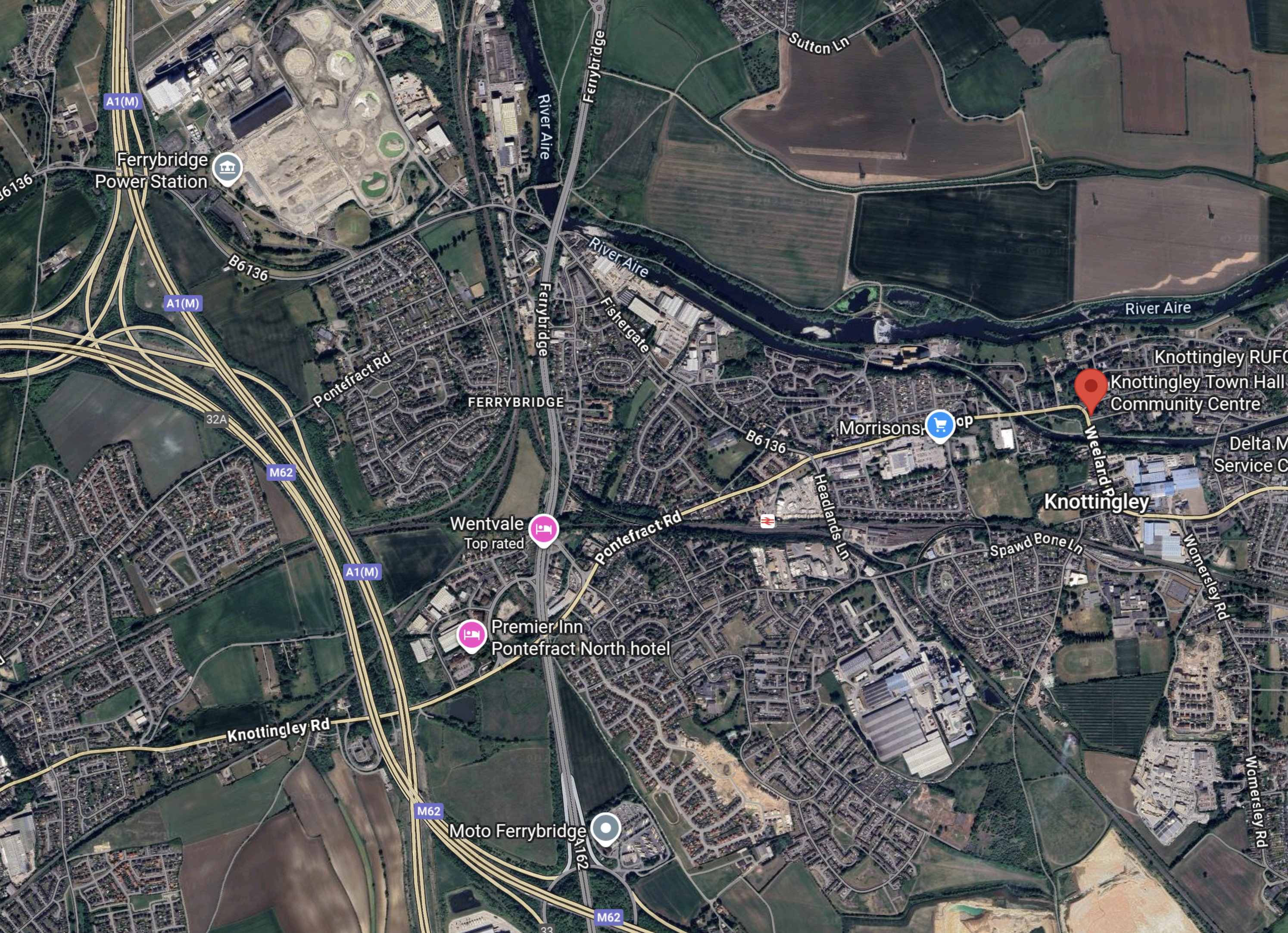
This Google Map shows the power station in relation to Knottingley.
Note.
- The meeting was held in the Knottingley Town Tall Community Centre, which is marked by the red arrow.
- I had arrived by train from Wakefield at Knottingley station and I was lucky enough to be able to get a taxi to the Town Hall.
- Knottingley station is marked on the map about a twenty-minute walk to the West of the Town Hall.
- The Ferrybridge power station site is in the North-West corner of the map and appears to be bordered by the B6136 road.
- The A1 (M) and the M 62 motorways run North-South past the power station site.
- The A (M) motorway continues North-South to Newcastle and Scotland, and London respectively.
- The M62 motorway continues West-East to Liverpool and Manchester, and Hull respectively.
- The well-appointed Moto Ferrybridge services is accessible from both motorways.
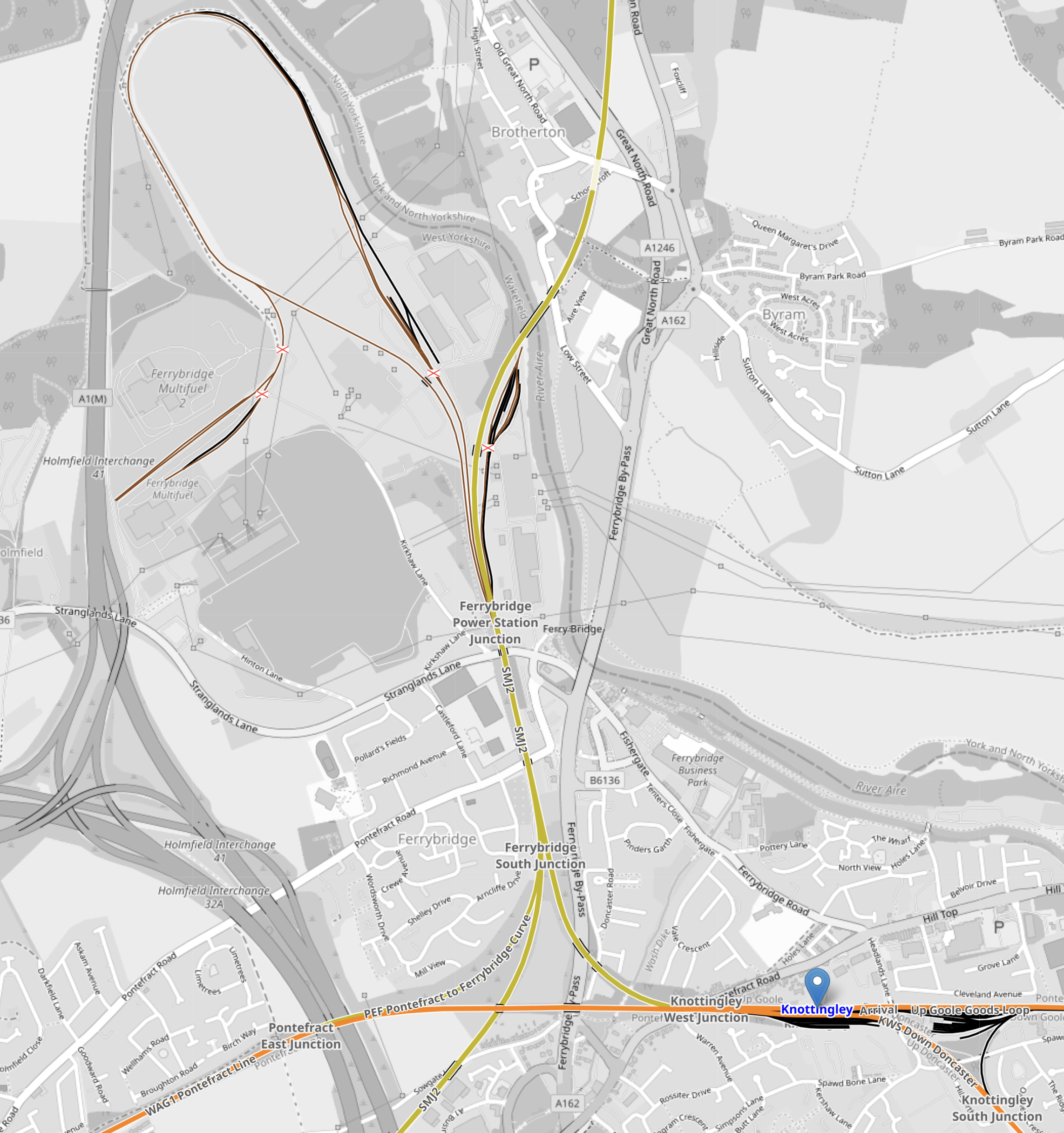
This OpenRailwayMap shows the rail lines in the area.
Note.
- The A 62 and A 1(M) motorways running down the West side of the map.
- Knottingley station is on the Pontefract Line, and is marked by a blue arrow.
- The Pontefract Line could have connections from both East and West to the Ferrybridge power station site via Ferrybridge Power Station junction.
- The loop, where the merry-go-round coal trains turned, appears to be still intact at the North of the power station site.
Will these rail lines be any use in the building and operation of the new power station?
These are my thoughts.
Fuel For The Power Station
The brochure for the consultation says this about the fuel for the Ferrybridge Next Generation Power Station.
Ferrybridge Next Generation Power Station will be designed to run on 100% hydrogen, natural gas or a
blend of natural gas and hydrogen.
The brochure has an informative section, which is entitled Natural Gas Pipeline Corridors.
Additionally, I should say, that I lived within a couple of hundred metres of a major gas pipeline in Suffolk, for over twenty years and it was the most unobtrusive of neighbours.
The brochure also says this about hydrogen safety.
As with all of our sites, appropriate measures will be
in place to ensure safe operation. Hydrogen is not
inherently more dangerous than other fuel sources.Hydrogen is flammable and must be handled with care,
just like other flammable fuels. To ignite, hydrogen
must be combined with an additional oxidising agent,
such as air or pure oxygen, in a specific concentration
and with an ignition source (a spark).
It is nearly sixty years ago now, since I worked as an Instrument Engineer, in ICI’s Castner-Kellner works at Runcorn, where hydrogen, chlorine and caustic soda were produced by the electrolysis of brine.
The plant was an unhealthy one, as it used a lot of mercury and my main task, was to design instruments to detect mercury in air and operators’ urine.
The Wikipedia entry for the Castner-Kellner process is a fascinating read and explains why it is being replaced by much better modern mercury-free processes.
I asked Google AI, if the Castner-Kellner process is still used and received this reply.
No, the Castner-Kellner process, a type of mercury cell for producing chlorine and caustic soda, is now largely obsolete due to occupational health and mercury pollution concerns, though a few plants may still operate globally. Modern chlor-alkali processes primarily use safer diaphragm cell and membrane cell technologies to produce chlorine and other chemicals from brine electrolysis.
I suspect that countries, where life is cheap, still use this process, which is very dangerous to those that work on the plant.
INEOS now own ICI in Cheshire and they still produce a large proportion of the hydrogen, chlorine and caustic soda, that the UK needs, but in a much safer way.
The question has to be asked about how hydrogen will be delivered to the Ferrybridge site.
Consider.
- SSE are developing a large hydrogen store at Aldbrough.
- Centrica are developing a large hydrogen store at Brough.
- Both of these stores could be connected to the German AquaVentus system, as the Germans are short of hydrogen storage.
- There is an East Coast Hydrogen Delivery Plan, which could probably have an extension pipeline to the Ferrybridge site.
- The East Coast Hydrogen Delivery Plan, talks of a hydrogen capacity of 4.4 GW.
I don’t feel, that this is the sort of project, that will be delivered until the mid-2030s, at the earliest.
There is also one other important development, that will require hydrogen at Ferrybridge.
I asked Google AI, if there will be hydrogen-powered coaches by 2030 and received this reply.
Yes, there will be hydrogen-powered coaches and buses by 2030, particularly in the UK and EU, with government strategies and funding promoting their deployment, especially for routes requiring high range and quick refueling where battery-electric models may be less suitable. For example, the EU’s CoacHyfied project is developing fuel cell coaches, and the UK government envisions hydrogen playing a role in its transport decarbonization by 2030, with potential to accelerate its zero-emission bus goals.
The nearest you can get to a hydrogen-powered coach in England, is to take an upmarket Wrightbus upmarket hydrogen-powered bus between Sutton station and Gatwick Airport.
- It is mouse quiet and vibration-free.
- It handles the hills with alacrity.
- I wrote about my journey in Sutton Station To Gatwick Airport By Hydrogen-Powered Bus.
That journey convinced me of the superiority in many ways of a hydrogen bus or coach over its diesel cousins.
I believe that this superiority will see large growth in hydrogen-powered long-distance coaches in the next few years.
But I also feel that some specialist transport, like horse transport, will go the hydrogen route.
As there are services at Ferrybridge, where two important motorways cross, I can envisage that the services will need to be able to refuel passing hydrogen buses, coaches trucks and other heavy vehicles, as well as the occasional car.
So would it be possible to supply hydrogen for the motorway services, by the same route as the power station?
I believe that the hydrogen could come from Saltend to the East of Hull, so I gave Google AI the phrase “Saltend zero-carbon hydrogen” and received this reply.
Saltend is home to several initiatives for producing and utilizing zero-carbon hydrogen, most notably the H2H Saltend project by Equinor, which aims to build the world’s largest hydrogen production plant with carbon capture capabilities by 2026 to supply industrial users at the Saltend Chemicals Park. Additionally, a new green hydrogen facility is planned for the park by Meld Energy with a target operation in early 2027, and a separate low-carbon hydrogen plant by ABP, HiiROC, and px Group is also being developed to meet local industrial demand. These projects collectively contribute to the broader Zero Carbon Humber initiative, which seeks to significantly reduce industrial emissions in the region.
Note.
- Saltend will certainly have enough zero-carbon hydrogen for everybody who wants it.
- Delivery dates in a couple of years are being talked about.
- Local industrial demand could be satisfield using specialised trucks, just as ICI used in the 1960s.
- As the Germans want to connect their AquaVentus system to Humberside, any excess hydrogen, could always be sold across the North Sea.
- OpenRailwayMap shows that Saltend is rail-connected.
But how do you get hydrogen between Saltend and Ferrybridge?
I am sure, that hydrogen could be delivered by truck from Saltend to Ferrybridge, but would the locals allow a stream of hydrogen trucks on the roads.
On the other hand, both Saltend and Ferrybridge are both rail-connected, so would it be possible to deliver the hydrogen by rail?
Google AI says this about railway wagons for hydrogen.
Railway wagons for hydrogen transport include liquid hydrogen tank cars (tankers) for transporting cryogenic liquid hydrogen and compressed gas tank cars for carrying hydrogen in its gaseous state or bound within carrier mediums like ammonia or methanol. Hydrogen fuel cell technology is also being developed for use on trains themselves, with a hydrogen fuel cell generator wagon providing power for main-line, non-electrified freight routes.
I believe that it will be possible to develop trains of an appropriate length to shuttle hydrogen between where it is produced and where it is used.
Such a specially-designed shuttle train would be ideal for moving hydrogen between Saltend and Ferrybridge.
- Once at Ferrybridge, the train would be connected to the local hydrogen system feeding the power station, the motorway services and any local businesses that needed hydrogen.
- The trains could be hydrogen fuel cell powered, so they could use any convenient route.
- Like hydrogen powered buses, I suspect they could be mouse quiet.
- The trains would be sized to perhaps deliver a day’s hydrogen at a time.
- There could only be minor changes needed to the rail system.
- If required, the trains could could deliver their cargo in the dead of night.
It could even be based on the contept of the TruckTrain, which I wrote about in The TruckTrain.
Significant Step Forward For Keadby 3 Carbon Capture Power Station
The title of this post, is the same as that of this press release from SSE.
These three paragraphs outline the project.
A landmark project in the Humber which could become the UK’s first power station equipped with carbon capture technology has taken a major leap forward following an announcement by the UK Government today.
Keadby 3 Carbon Capture Power Station, which is being jointly developed by SSE Thermal and Equinor, has been selected to be taken forward to the due diligence stage by the Department for Business, Energy and Industry Strategy (BEIS) as part of its Cluster Sequencing Process.
This process will give the project the opportunity to receive government support, allowing it to deploy cutting edge carbon capture technology, and to connect to the shared CO2 pipelines being developed through the East Coast Cluster, with its emissions safely stored under the Southern North Sea. The common infrastructure will also supply low-carbon hydrogen to potential users across the region.
The press release also says this about the power station.
- Keadby 3 power station could have a generating capacity of up to 910MW.
- It could be operational by 2027.
- It would capture up to one and a half million tonnes of CO2 a year.
It would provide low-carbon, flexible power to back-up renewable generation.
The H2H Saltend Project
The press release also says this about the H2H Saltend project.
Equinor’s H2H Saltend project, the ‘kick-starter’ for the wider Zero Carbon Humber ambition, has also been taken to the next stage of the process by BEIS. The planned hydrogen production facility could provide a hydrogen supply to Triton Power’s Saltend Power Station as well as other local industrial users. In June, SSE Thermal and Equinor entered into an agreement to acquire the Triton Power portfolio.
I wrote about H2H Saltend and the acquisition of Triton Power in SSE Thermal And Equinor To Acquire Triton Power In Acceleration Of Low-Carbon Ambitions.
In the related post, I added up all the power stations and wind farms, that are owned by SSE Thermal and it came to a massive 9.1 GW, which should all be available by 2027.
Collaboration Between SSE Thermal And Equinor
The press release also says this about collaboration between SSE Thermal and Equinor.
The two companies are also collaborating on major hydrogen projects in the Humber. Keadby Hydrogen Power Station could be one of the world’s first 100% hydrogen-fuelled power stations, while Aldbrough Hydrogen Storage could be one of the world’s largest hydrogen storage facilities. In addition, they are developing Peterhead Carbon Capture Power Station in Aberdeenshire, which would be a major contributor to decarbonising the Scottish Cluster.
This collaboration doesn’t lack ambition.
I also think, that there will expansion of their ambitions.
Horticulture
Lincolnshire is about horticulture and it is a generally flat county, which makes it ideal for greenhouses.
I wouldn’t be surprised to see a large acreage of greenhouses built close to the Humber carbon dioxide system, so that flowers, salad vegetables, soft fruit, tomatoes and other plants can be grown to absorb the carbon dioxide.
It should also be noted that one of the ingredients of Quorn is carbon dioxide from a fertiliser plant, that also feeds a large tomato greenhouse.
We would have our carbon dioxide and eat it.
Other Uses Of Carbon Dioxide
Storing carbon dioxide in depleted gas fields in the North Sea will probably work, but it’s a bit like putting your rubbish in the shed.
Eventually, you run out of space.
The idea I like comes from an Australian company called Mineral Carbonation International.
- I wrote about their success at COP26 in Mineral Carbonation International Win COP26 Clean Energy Pitch Battle.
- The company has developed the technology to convert carbon dioxide into building products like blocks and plasterboard.
- Their mission is to remove a billion tonnes of CO2 by 2040 safely and permanently.
We would have our carbon dioxide and live in it.
I also think other major uses will be developed.
A Large Battery
There is the hydrogen storage at Aldbrough, but that is indirect energy storage.
There needs to be a large battery to smooth everything out.
In Highview Power’s Second Commercial System In Yorkshire, I talk about Highview Power’s proposal for a 200MW/2.5GWh CRYOBattery.
This technology would be ideal, as would several other technologies.
Conclusion
Humberside will get a giant zero-carbon power station.
SSE Thermal And Equinor To Acquire Triton Power In Acceleration Of Low-Carbon Ambitions
The title of this post, is the same as that as this press release from SSE.
These are the first three paragraphs.
SSE Thermal and Equinor have entered into an agreement to acquire Triton Power Holdings Ltd from Energy Capital Partners for a total consideration of £341m shared equally between the partners.
The transaction represents another step forward for the two companies’ existing collaboration, supporting the long-term decarbonisation of the UK’s power system whilst contributing to security of supply and grid stability through flexible power generation in the shorter term.
Triton Power operates Saltend Power Station which is 1.2GW CCGT (Combined Cycle Gas Turbine) and CHP (Combined Heat & Power) power station located on the north of the Humber Estuary in East Yorkshire.
This deal is more complicated than it looks and these are my thoughts.
What About The Triton Power Workers?
The press release says this.
The 82 existing employees will continue to be employed by Triton Power. In line with just transition principles, the joint venture is committed to transitioning the assets for the net zero world through responsible ownership and operation, and in consultation with the local workforce and representatives.
It does sound that they are following the right principles.
Saltend Power Station
Saltend power station is no tired ancient asset and is described like this in Wikipedia.
The station is run on gas using single shaft 3 × Mitsubishi 701F gas Turbines machines with Alstom 400 MWe generators. The station has a total output of 1,200 MW; of that 100 MW is allocated to supply BP Chemicals. Each gas turbine has a Babcock Borsig Power (BBP) heat recovery steam generator, which all lead to one steam turbine per unit (single shaft machine means Gas turbine and Steam Turbine are on the same shaft). The waste product of electricity generation is steam at the rate of about 120 tonnes/h which is sold to BP Chemicals to use in their process. This makes Salt End one of the most efficient[clarification needed] power stations in the UK. The plant is scheduled to use hydrogen from steam reformed natural gas for 30% of its power.
Note.
- It was commissioned in 2000.
- It appears there are seven CCGT power stations in England that are larger than Saltend.
- The power station seems to have had at least four owners.
The press release says this about SSE and Equinor’s plans for Saltend power station.
The transaction underscores SSE Thermal and Equinor’s shared ambition to decarbonise the Humber, which is the UK’s most carbon-intensive industrial region, as well as the UK more widely. Initial steps to decarbonise Saltend Power Station are already underway, targeting partial abatement by 2027 through blending up to 30% of low-carbon hydrogen. In addition, carbon capture provides an additional valuable option for the site. SSE Thermal and Equinor will continue to work towards 100% abatement.
Note.
- It appears that initially, Saltend power station will move to running on a mixture of 30 % hydrogen and 70 % natural gas.
- Carbon capture will also be applied.
- It looks like that in the future all carbon-dioxide emitted by the power station will be captured and either stored or used.
The press release says this about the source of the hydrogen.
Saltend Power Station is a potential primary offtaker to Equinor’s H2H Saltend hydrogen production project. H2H Saltend is expected to kick-start the wider decarbonisation of the Humber region as part of the East Coast Cluster, one of the UK’s first carbon capture, usage and storage clusters.
H2H Saltend is described in this page on the Equinor web site, which has a title of The First Step To A Zero Carbon Humber, where this is said.
This project represents a bold but practical first step towards delivering the world’s first net zero industrial cluster by 2040. This unparalleled project can play a leading role in the UK’s journey to net zero by 2050, renew the UK’s largest industrial cluster, and unlock technology that will put the UK at the forefront of a global hydrogen economy.
There is also a video.
SSE Thermal And Equinor Low-Carbon Thermal Partnership
This is a section in the press release, where after giving their policy about the workers, it says this about the acquisition of Triton Power.
This acquisition strengthens SSE Thermal and Equinor’s portfolio of joint projects, which bring together expertise in power, natural gas, hydrogen and carbon capture and storage. This portfolio includes three development projects within the Humber region:
- Keadby 3 Carbon Capture Power Station, which could be the UK’s first flexible power station equipped with carbon capture.
- Keadby Hydrogen Power Station, which could be one of the world’s first 100% hydrogen-fuelled power stations.
- Aldbrough Hydrogen Storage, located in East Yorkshire, which could be one of the world’s largest hydrogen storage facilities.
The two companies are also developing Peterhead Carbon Capture Power Station, situated on the Aberdeenshire coast in Scotland and there are further opportunities for hydrogen blending across SSE’s generation portfolio, including at Keadby 2.
Note.
- There is no mention of the three Dogger Bank Wind Farms, each of which will be 1200 MW, that are owned by SSE Renewables and Equinor.
- I wrote about Aldbrough Gas Storage in The Massive Hydrogen Project, That Appears To Be Under The Radar.
- According to this press release from Equinor, which is entitled SSE Thermal And Equinor Join Forces On Plans For First-Of-A-Kind Hydrogen And Carbon Capture Projects In The Humber, Keadby Hydrogen power station will have a capacity of 1800 MW.
The Complete System
The system has the following power sources.
- Dogger Bank A – 1200 MW – Expected commissioning in 2023/24
- Dogger Bank B – 1200 MW – Expected commissioning in 2024/25
- Dogger Bank C – 1200 MW – Expected commissioning in 2024/25
- Keadby power station – 735 MW
- Keadby 2 power station – 893 MW – Could be Part-Hydrogen
- Keadby 3 power station – 910 MW – Carbon Capture
- Keadby Hydrogen power station – 1800 MW – Hydrogen
- Saltend power station – 1200 MW – Part-Hydrogen
That totals up to 9138 MW.
Fuel will come from three sources.
- The God of the winds.
- Natural gas
- Hydrogen
Hydrogen will be sourced from.
- Blue hydrogen from H2H Saltend
- Green Hydrogen could come from electrolysers driven by wind power.
Hydrogen would be stored in Aldbrough Gas Storage.
I am by training a Control Engineer and controlling these power sources is either a wonderful dream or your most entwined and complicated nightmare.
Conclusion
I suspect on an average day, this cluster of power stations and sources could reliably supply as much zero-carbon power as two large nuclear stations.
 The Anonymous Widower