Chinese firm ‘Will Not Bid’ To Run Essex Nuclear Plant
The title of this post, is the same as that of this article on The Times.
This is the sub-heading.
Sources no longer expect planning applications to be submitted by China General Nuclear Power Group for Bradwell B
These three paragraphs give brief details of the current situation.
Plans for China’s state-run nuclear company to develop and operate a proposed nuclear site in Essex will no longer go ahead, The Times can reveal amid renewed focus on Chinese involvement in Britain’s critical infrastructure.
Bradwell B, the proposed nuclear power station, was earmarked for investment by China General Nuclear Power Group (CGN) in 2015. CGN is the majority investor in the proposed development alongside French energy company EDF.
But government and industry sources told The Times and Times Radio they no longer expected planning applications to be submitted by CGN for the site, and EDF will look to take back the lease from the Chinese firm at the earliest opportunity.
So what will happen to the Bradwell Site?
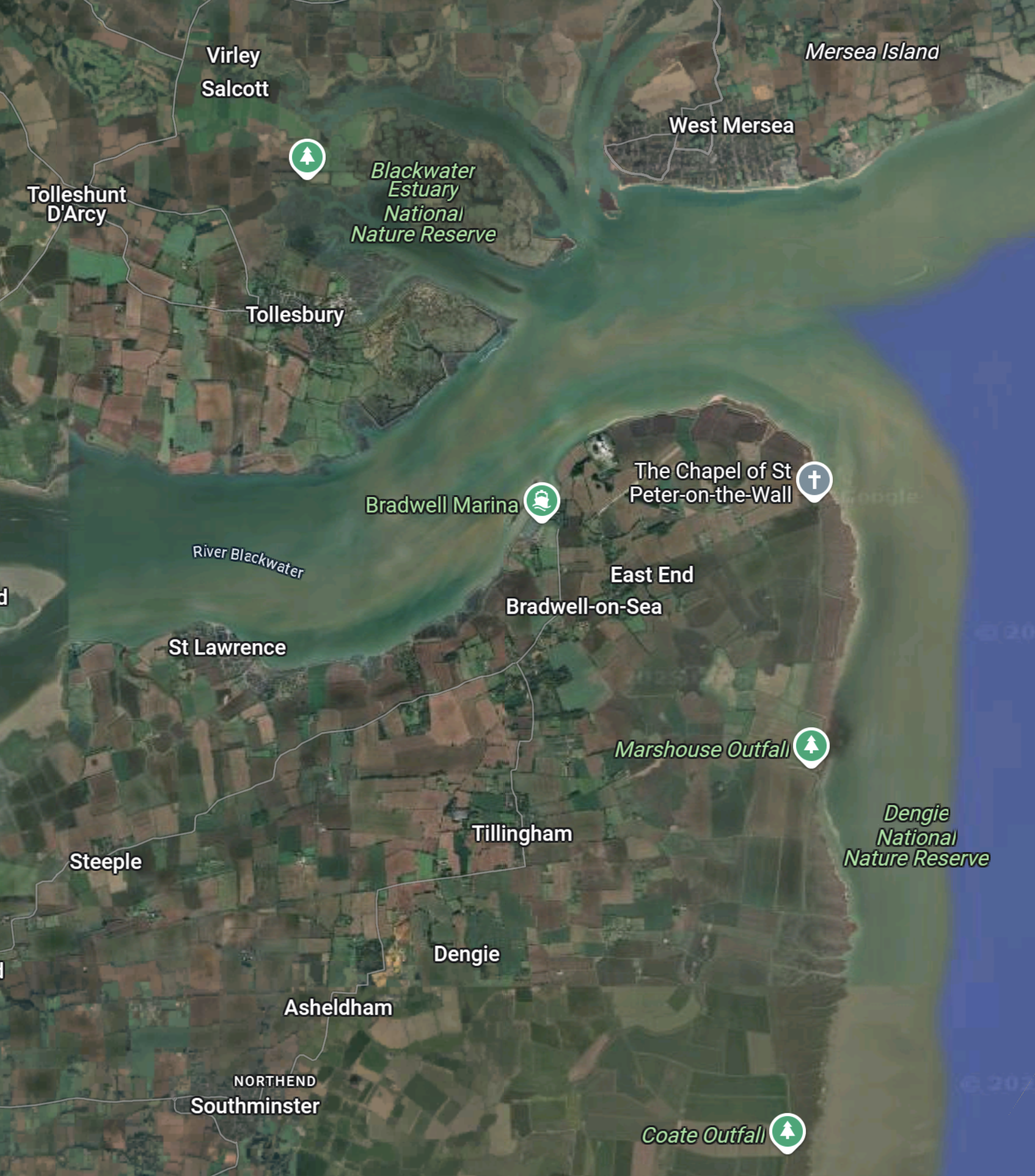
This Google Map shows the Blackwater Estuary to the North of Southend.
Note.
- The Blackwater Estuary is at the top of the map.
- Bradwell Marina and Bradwell-on-Sea can be seen on the map to the South of the Blackwater Estuary.
- Southminster has a rail connection, which was used to handle the nuclear fuel and now has a passenger service to Wickford on the Southend Victoria to London Liverpool Street Line.
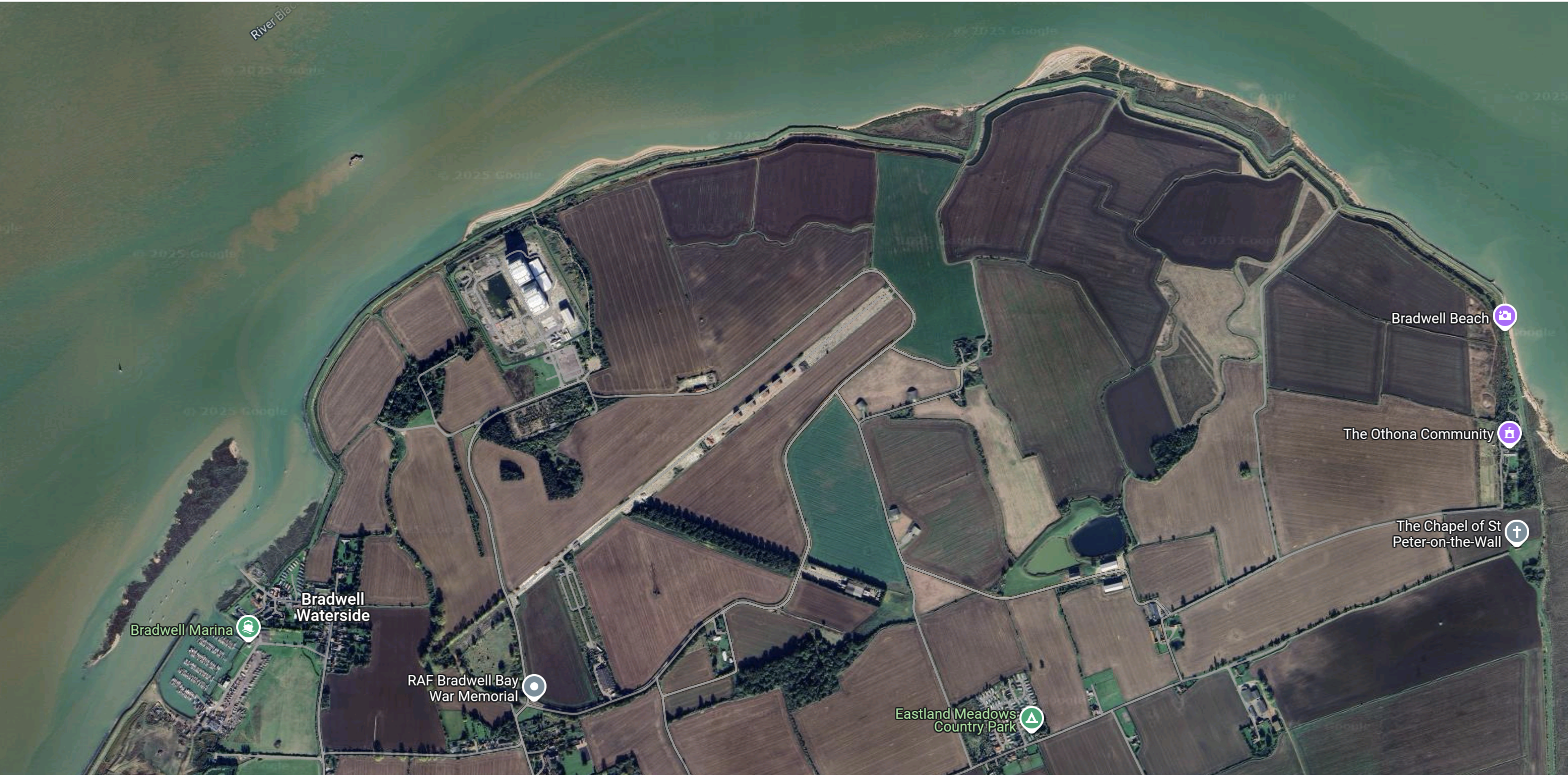
This second Google Map shows Bradwell-on-Sea and the North of the peninsular in greater detail.
Note.
- The remains of the three runways of the Second World War RAF Bradwell Bay can be picked out.
- The remains of Bradwell A nuclear power station are towards the coast to the North-West of the former runways.
- It is large site.
I wonder, if the site could be used for backup to all the offshore wind farms in the area.
This is a list of all the wind farms, that are planned in the sea to the North and East of the Bradwell site.
- The East Anglia Array is partly operational, but could grow to as much as 7.2 GW.
- Greater Gabbard is 504 MW
- Gunfleet Sands is 172 MW
- London Array is 630 MW
- North Falls is 504 MW
Note.
- That is a total of roughly 9 GW.
- There’s also plenty of space in the sea for more turbines.
All these wind turbines will need backup for when the wind goes on strike.
These are possibilities for backup.
Another Hinckley Point C Or Sizewell C
You can see why the government wants to build a big nuke on the Bradwell site.
The 3.26 GW of a power station, which would be the size of Hinckley Point C would provide more than adequate backup.
But the builders of these power stations haven’t exactly covered themselves in glory!
- Construction of Hinckley Point C started in the late 2010s and first power is expected in 2031.
- Hinckley Point C power station has all the stink of bad project management.
- The Nimbbies would also be out in force at Bradwell.
There are also all the financial problems and those with the Chinese, indicated in The Times article.
A Fleet Of Small Modular Reactors
Hinckley Point C will hopefully be a 3260 MW nuclear power station and Rolls-Royce are saying that their small modular reactors will have a capacity of 470 MW.
Simple mathematics indicate that seven Rolls-Royce SMRs could do the same job as Hinckley Point C.
The advantages of providing this capacity with a fleet of SMRs are as follows.
- Each reactor can be built separately.
- They don’t all have to be of the same type.
- The total 3260 MW capacity could also be built at a pace, that matched the need of the wind farms.
- Building could even start with one of each of the chosen two initial types, the Government has said it will order.
- I also believe that there could be advantages in the sharing of resources.
- The rail link to Southminster would enable the bringing in of the smaller components needed for SMRs by rail.
Hopefully, the power of a big nuke could be added to the grid in a shorter time.
A Number of Long Duration Energy Stores
Highview Power is building 4 x 200 MW/2.5 GWh liquid air batteries for Orsted in the UK ; 2 in Scotland and 2 in England. They are backed by the likes of Centrica, Goldman Sachs, Rio Tinto, the Lego family trust and others.
Each GWh of liquid air needs a tank about the largest size of those used to store LNG. I suspect like LNG tanks they could be partly underground to reduce the bulk.
A Hybrid System
Bradwell is a large site and could easily accommodate a pair of Highview Power batteries, two SMRs, and all the other electrical gubbins, which would total to around 1.5 GW/5 GWh. This should be sufficient backup, but there would be space to add more batteries or SMRs as needed.
Another Headache For Fossil Fuels: Liquid Air Energy Storage
The title of this post, is the same as that of this article on Clean Technica.
This article is an honest American look at Highview Power’s liquid air batteries and a must-read.
This is the first paragraph.
Whatever happened to liquid air energy storage? The UK startup Highview Power was going to bring its new liquid air system to the US back in 2019, providing the kind of scaled-up and long duration energy storage needed to support more wind and solar power on the grid. Highview switched gears and headed back home where the grass is greener. Our loss is the UK’s gain…
They first wrote about Highview Power in 2011, which shows how long some of these projects take to come to fruition.
The article also has this view on the state of offshore wind in the United States today.
Perhaps it’s just as well that Highview dropped its US plans when it did. Offshore wind stakeholders in the US were just beginning to find their footing along the Atlantic coast when President Trump took office on January 20 and promptly sent the offshore industry into a death spiral.
If I lived in the US today, I’d thinking about leaving given Trump’s barmy energy policies.
This paragraph from Highview Power’s web site, discloses their backers.
The £300 million funding round was led by the UK Infrastructure Bank (UKIB) and the British multinational energy and services company Centrica, alongside a syndicate of investors including Rio Tinto, Goldman Sachs, KIRKBI and Mosaic Capital.
So at least some American companies believe in Highview Power. KIRKBI is the investment vehicle of the family, that invented Lego.
AI Forecast To Fuel Doubling In Data Centre Electricity Demand By 2030
The title of this post, is the same as that as this article in The Times.
This is the sub-heading.
International Energy Agency predicts that artificial intelligence could help reduce total greenhouse gas emissions
These are the first two paragraphs.
Data centres will use more than twice as much electricity by 2030 than they do today as artificial intelligence drives demand, the International Energy Agency predicts.
The agency forecast that all data centres globally will use about 945 terawatt-hours of electricity each year by 2030, roughly three times as much as the UK’s total annual demand of 317 terawatt-hours in 2023.
I am very much an optimist, that here in the UK, we will be able to satisfy demand for the generation and distribution of electricity.
- Our seas can accommodate enough wind turbines to provide the baseload of electricity we will need.
- Roofs and fields will be covered in solar panels.
- SSE seem to be getting their act together with pumped storage hydro in Scotland.
- I am confident, that new energy storage technologies like Highview Power with the packing of companies like Centrica, Goldman Sachs, Rio Tinto and others will come good, in providing power, when the wind doesn’t blow and the sun doesn’t shine.
- Hopefully, Hinckley Point C and Sizewell C will be online and soon to be joined by the first of the new small modular nuclear reactors.
- Hopefully, Mersey Tidal Power will be operating.
- There will be innovative ideas like heata from Centrica’s research. The economical water heater even made BBC’s One Show last week.
The only problem will be the Nimbies.
Europe’s Biggest Battery Storage Project Goes Live In Scotland
The title of this post, is the same, as this article in The Times.
This is the sub-heading.
Zenobe’s site at Blackhillock can store surplus generation for when the wind doesn’t blow and the sun doesn’t shine
These are the first two paragraphs.
Europe’s biggest battery storage project has entered commercial operation in Scotland, promising to soak up surplus wind power and prevent turbines being paid to switch off.
Zenobe said the first phase of its project at Blackhillock, between Inverness and Aberdeen, was now live with capacity to store enough power to supply 200 megawatts of electricity for two hours. It is due to be expanded to 300 megawatts by next year.
I believe we can do better, than install large lithium-ion batteries.
We need to get the pumped storage like Coire Glas, the liquid air like Highview Power and the gravity batteries like Gravitricity going as fast as we can.
They are more environmentally friendly than Tesla’s lithium ion tiddlers and a second generation liquid air battery appears to be 200 MW and 2.5 MWh, so they can supply 200 MW for 12.5 hours.
The Blackhillock battery can do just two hours.
Two of them working as a pair, with a 1 GW wind farm, are as big as a small modular nuclear reactor, so could do the same job, with respect to power supply, using machinery and tank designs, that have been used for decades.
I suspect, that like 1960s coal-fired power stations, they would keep running for fifty years and be simply recycled as steel, copper and other scrap.
Highview Power could make Bishops Stortford famous!
UK Government Sets 8-Hour Minimum For LDES Cap-And-Floor Sheme
The title of this post, is the sa,e as that of this article on Energy Storage News.
This is the sub-heading.
The UK government has published a Technical Decision Document confirming crucial aspects of its long duration electricity storage (LDES) cap-and-floor scheme, which includes increasing the minimum duration required from six hours to eight
These paragraphs give full details.
The document, released by regulator Ofgem on 11 March, details the final overarching rules and requirements for the scheme as well as how it will be implemented, though significant detail still remains to be worked out.
The scheme will provide a cap-and-floor revenue protection for 20-25 years that will allow all capital costs to be recoverable, and is effectively a subsidy for LDES projects that may not be commercially viable without it. Most energy storage projects being deployed in the UK today are lithium-ion battery energy storage systems (BESS) of somewhere between 1-hour and 3-hour in duration (very occasionally higher).
One of the most significant new details of the scheme is that, following industry feedback, the minimum duration for projects to qualify has been increased from six hours to eight hours of continuous rated power.
The ‘continuous rated power’ aspect prevents shorter duration projects from bidding in a smaller section of their MW capacity in order to act like an 8-hour system.
Another interesting detail pointed out by several commentators is that the cap is a ‘soft’ one, meaning it will allow extra revenue to be shared between developers and consumers. Exact details on the ratio are yet to be determined.
As a Graduate Control Engineer from Liverpool University in the 1960s, I hope that the move from a six to eight hours minimum duration is feasible.
I wasn’t dealing with power systems, but with multi-vessel chemical plants.
These are my thoughts.
The biggest project, I was dealing with a few years later in the 1970s, was the modeling of all the the reservoirs and pipelines by the Water Resoures Board.
As the supply side of the water industry hasn’t had too many issues with the volume of water supplied, I feel that the main modelers must have done a reasonable job.
Six To Eight Hours Of Continuous Operation
The article says this about uprating from six to eight hours of continuous operations.
All the systems that have been proposed for cap-and-floor operation, seem to have some form of physical storage.
- Energy Dome appears to have tents of carbon dioxide.
- Energy Vault uses stacks of heavy weights.
- Form Energy has tanks of rust.
- Gravitricity has huge weights in disued mine shafts.
- Highview Power has large tanks of liquid air.
- Pumped storage hydro has two lakes, that hold water.
- Rheenergise has two large tanks, of a water-based slurry.
So to go from six to eight hours will hopefully just need some more storage.
Highview Power appears to use similar gas tanks to those used to store natural gas or hydrogen.
This image clipped from Highview’s web site, shows large tanks for liquified gas storage.
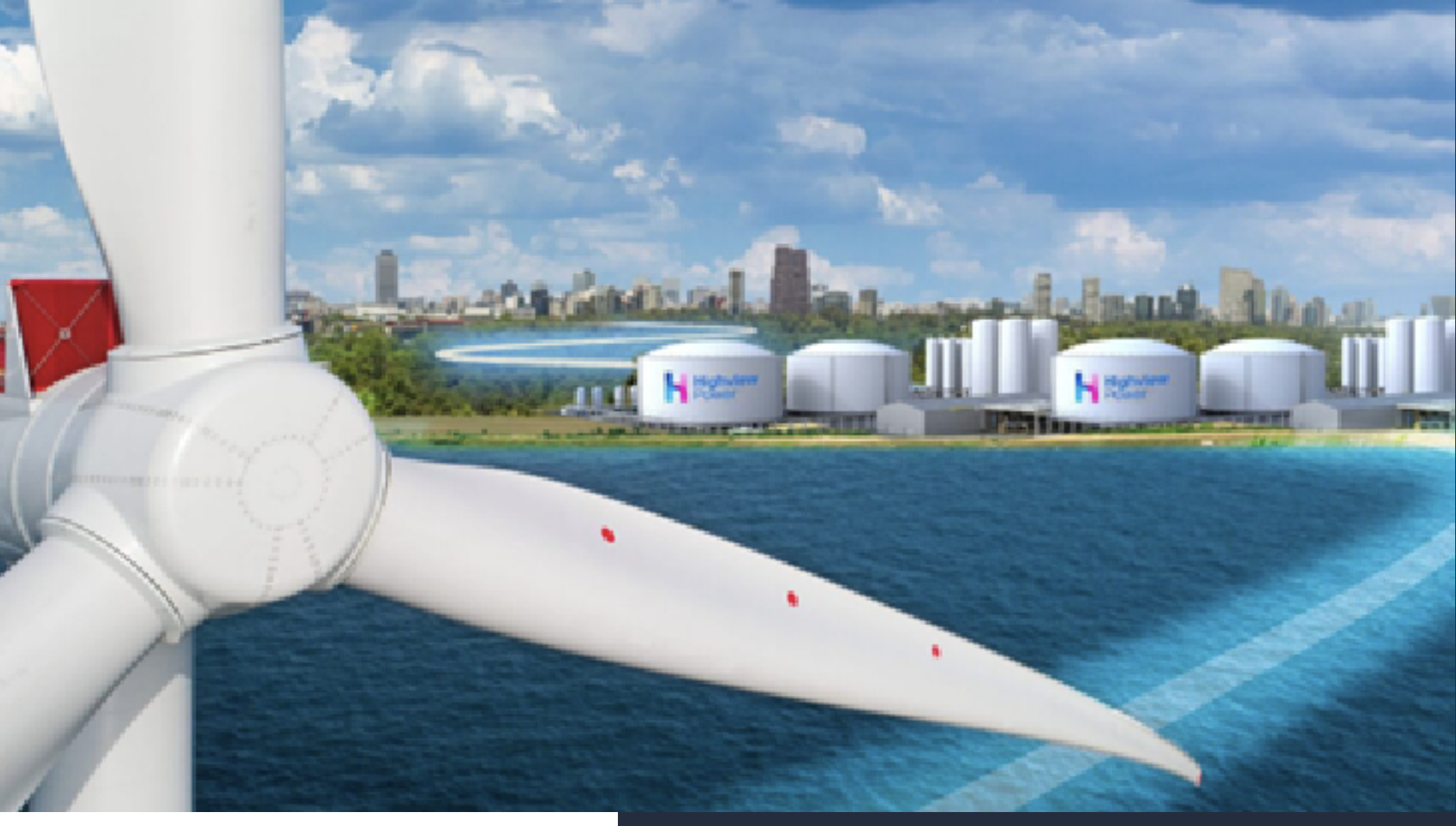
With tanks like these, which can hold GW-equivalents of liquid air, Highview could be building batteries with storage to rival the smaller pumped storage hydroelectric power stations. They are already talking of 200 MW/2.5 GWh systems, which would have a 12.5 hour continuous rating and would probably need two to three tanks.
Coire Glas Pumped Storage
I’ll use Coire Glas pumped storage hydro electric power station as an example.
As currently planned SSE’s Cioire Glas pumped storage hydroelectric power station is 1.5 GW/30 GWh, so it has a a 20 hour continuous rating.
In The UK’s Pumped Storage Hydroelectricity, I gave a rough estimate of the pumped storage hydroelectricity systems in operation or planed as nearly 11 GW/224GWh.
The Soft Cap
The article says this about a soft cap.
Another interesting detail pointed out by several commentators is that the cap is a ‘soft’ one, meaning it will allow extra revenue to be shared between developers and consumers. Exact details on the ratio are yet to be determined.
I seem to remember that when I was modeling a larger multi-vessel chemical plant at ICI, I was using sharing between vessels, to get the system to operate on a PACE-231R analog computer.
So I suspect a soft cap is possible.
UK Wind Risks ‘Exponentially Rising’ Curtailment Without Energy Storage
The title of this post, is the same as that of this article on Recharge.
This is the sub-heading.
UK liquid battery pioneer Highview Power is working with renewable energy giant Orsted on plan to store excess power from its Hornsea offshore wind projects
This is the introductory paragraph.
The UK wind sector faces “exponentially” increasing curtailment of assets without a rapid rollout of energy storage, says the chief of liquid battery pioneer Highview Power, which is working with Orsted on a project to store excess offshore wind power.
The article also states that according to Octopus Energy, this cost could have been as high as a billion pounds last year.
In Grid Powers Up With One Of Europe’s Biggest Battery Storage Sites, I described how Ørsted were planning to build a large BESS near the Swardeston substation in Norfolk, where the Hornsea 3 wind farm will connect to the grid.
Have Ørsted decided to put a Highview Power battery on the Swardeston site, as it can be a bigger battery, as Highview Power talk about 200MW/2.5GWh capacity batteries on the projects page of the web site?
Highview also say this about co-operation with Ørsted on that page.
Highview Power and Ørsted’s joint study shows that the co-location of LAES with Ørsted’s offshore wind offers a step forward in reducing wind curtailment, and helping to move to a more flexible, resilient zero carbon grid.
The words are accompanied by pictures of a smart gas storage site, which shows four of the largest tanks, that might be used to store LNG.
In Could A Highview Power CRYOBattery Use A LNG Tank For Liquid Air Storage?, I estimated that one of the largest LNG tanks could hold about a GWh of energy.
So Highview Power’s visualisation on their project page would be a 4 GWh battery.
.
How To Keep The Lights On When The Wind Doesn’t Blow
The title of this post, is the same as that of this article in The Times.
This is the sub-heading.
Britain came close to a blackout this month. Gas is being phased out and renewables are intermittent, so can energy storage stop us going dark?
These are the first two paragraphs.
It was 8.29pm on the first Tuesday in January when the alert was issued by the electricity control room. Freezing temperatures had coincided with unusually low wind speeds, and it was making the National Energy System Operator (Neso) jittery.
Engineers forecast a 1.6GW shortfall — the requirement for about 1.5 million homes — for a three-hour period from 4pm the following afternoon. “System operators are requested to notify Neso of any additional megawatt capacity,” the message said.
Luckily, the plea worked.
The article then goes on to describe the various technologies that are being deployed.
The article starts by talking about pumped storage hydroelectricity.
This paragraph gives a superb illustration about how things have changed in energy and energy storage in the UK in the last few decades.
In the past, when coal provided the bulk of British power, this system was used to meet fluctuating demand levels. But now it is also required to meet fluctuating supply levels from renewable sources. Martin Pibworth, chief commercial officer at SSE, started with the company as a trainee in 1998. “Back then, at our Foyers pumped storage plant [at Loch Ness] we would switch modes, from pumping to not pumping and back again, maybe 600 to 700 times a year. Last year we switched modes there 6,500 times. It’s an insight into how the market has changed and how much more flexibility is needed, and how responsive that has to be.”
We have to be more agile, with our handling of storage to back up the various methods of generation.
Could Highview Power’s Batteries Be Used Offshore?
When I first saw Highview Power’s Liquid Air batteries or Long Duration Energy Storage (LDES), I liked them.
This was partly because I’d investigated large tanks for chemical reactions and I like their mathematics.
But it was mainly because the concept had been developed by a lone inventor in Bishops Stortford.
In Could A Highview Power CRYOBattery Use A LNG Tank For Liquid Air Storage?, I bcalculated, that a 5,000 cubic metre tank could hold about a GWh of electricity as liquid air.
So just as steel and concrete tanks were placed on the sea floor to hold oil and gas, could they be placed on the sea floor to hold compressed air?
I don’t see why not!
I suspect, that it’s all fairly standard offshore engineering.
If you want more storage, you would just add more tanks.
Could They Be Combined With Electrical Substations?
I don’t see why not!
There may be advantages with respect to safety and noise.
US DOE Offers US$1.76 billion Loan To Hydrostor For A-CAES California Project
The title of this post, is the same as that of this article on Energy Storage News.
These three paragraphs give more detail.
The US Department of Energy’s (DOE) Loan Programs Office (LPO) has made a conditional commitment for a loan to long-duration energy storage (LDES) developer and operator Hydrostor of up to US$1.76 billion.
If finalised, the loan would be used to help fund the Willow Rock Energy Storage Centre, a 500MW/4,000MWh, 8-hour advanced compressed air energy storage system (A-CAES) in Eastern Kern County, California, led by Hydrostor subsidiary GEM A-CAES.
Compressed air energy storage (CAES) charges by pressurising air and funnelling it into a storage medium, often a salt cavern, and discharges it by releasing the compressed air through a heating system, which expands air before it is sent through a turbine generator.
Note.
- Both the Canadian Hydrostor and the British Highview Power use air in their batteries, with the Canadians using compressed air, often in salt caverns and the British using liquid air in tanks.
- Highview Power’s first large scale battery will be 200MW/2.5GWh, which is about half the size of Hydrostor’s, which will be 500MW/4.0GWh.
- Having mathematically-modeled large tanks full of chemicals in the 1970s for ICI, I wouldn’t be surprised, if the Highview Power battery is more easily scalable.
This could be an interesting technological shootout.
Complicating matters could be Trump’s policies to big batteries.
This article on Utility Dive, which is entitled Potential Trump Policies Pose Risks For US Storage Sector, With Musk Impact Uncertain.
Analysts Say Gives A Reasoned.
Higher battery material tariffs and phased-down IRA tax credits threaten a 15% drop in U.S. storage deployment through 2035 in a “worst-case” scenario,
BNEF analysts said.
‘Europe’s Biggest Battery Farm’ Built On Coal Mine
The title of this post, is the same as that of this article on the BBC.
This is the sub-heading.
Work is under way to create what has been described as Europe’s largest battery storage project at Coalburn in South Lanarkshire.
These three paragraphs add a bit more detail.
Developers say the two huge neighbouring battery farms – one at the site of a former opencast coal mine – will store enough electricity to power three million homes.
Battery Energy Storage Systems (BESS) are being built across the UK to help balance the electricity grid, which is becoming increasingly powered by renewables.
Almost 90% of the electricity generated in Scotland last year was from low carbon sources like wind, solar or nuclear, according to figures from the Scottish government.
A search of the Internet found this paragraph describing the size of the battery.
The CIP BESS portfolio (Coalburn 1, Coalburn 2, and Devilla) will have total power capacity of 1.5GW and will be able to store and supply the grid with a total of 3GWh of electricity, equivalent to the electricity demand of over 4.5 million households, across a 2-hour period.
Note.
- CIP is Copenhagen Infrastructure Partners, who are a large developer of energy infrastructure.
- It appears there are three separate 500 MW/ 1 GWh batteries being developed together.
- The batteries can supply electricity for two hours.
This looks like a sensible project in an area, where there could be plenty of spare electricity.
Competition With Highview Power
Highview Power’s web site has a Projects section, where this is said.
Scotland And The North-East, UK
Highview Power’s next projects will be located in Scotland and the North East and each will be 200MW/2.5GWh capacity. These will be located on the national transmission network where the wind is being generated and therefore will enable these regions to unleash their untapped renewable energy potential and store excess wind power at scale.
I can see Highview Power’s 200MW/2.5GWh liquid air batteries and 500 MW/ 1 GWh Battery Energy Storage System (BESS) competing for the same projects.
However, it does appear at Trafford Energy Park, both types of battery appear to be being installed.
- Carlton Power Secures Planning Consent For World’s Largest Battery Energy Storage Scheme
- Centrica Invests In Renewable Energy Storage Capabilities To Boost UK’s Energy Security And Accelerate Transition To Net Zero
Perhaps the two together give the best response?

