Sizewell C – North Park And Ride
This document on the Planning Inspectorate web site, is a description of the Northern Park-and-Ride for the Sizewell C Project.
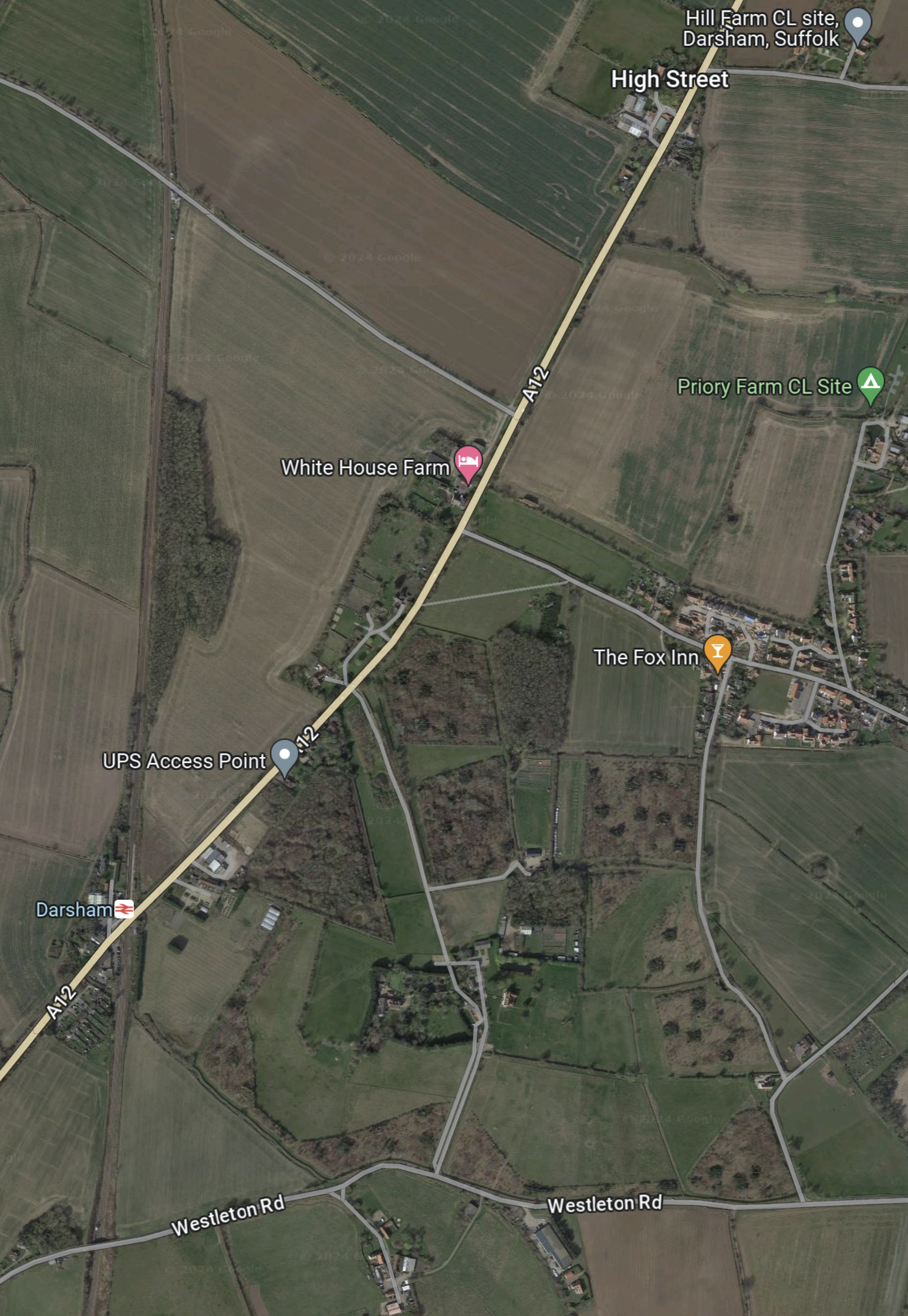
This Google Map shows the area of the Park-and-Ride site.
Note.
- The main road running SW-NE is the A 12 between Ipswich, Felixstowe and Woodbridge in the South and Lowestoft and Great Yarmouth in the North.
- The East Suffolk Line runs North-South at the West side of the map.
- Darsham station, which is indicated by the red logo on a white background is situated, where road and railway cross.
- The Fox Inn is in the village of Darsham and indicated by an orange arrow.
- The pink arrow to the North-West of the Fox Inn indicates White House Farm.
- The lane going North-West from the A 12 to the North of the farm is Willow Marsh Lane.
The document on the Planning Inspectorate says this about the site.
The site comprises approximately 27.9 hectares (ha) of predominantly
agricultural land but also includes sections of the A12 and Willow Marsh Lane
towards the north of the site. It is located west of the village of Darsham and
west of the A12, to the east of the East Suffolk line, and to the north of
Darsham railway station (see Chapter 1, Figure 1.1 of this volume). Further
detail on the site and the environmental baseline is provided in Chapters 1
and 4 to 12 of this volume of the Environmental Statement.
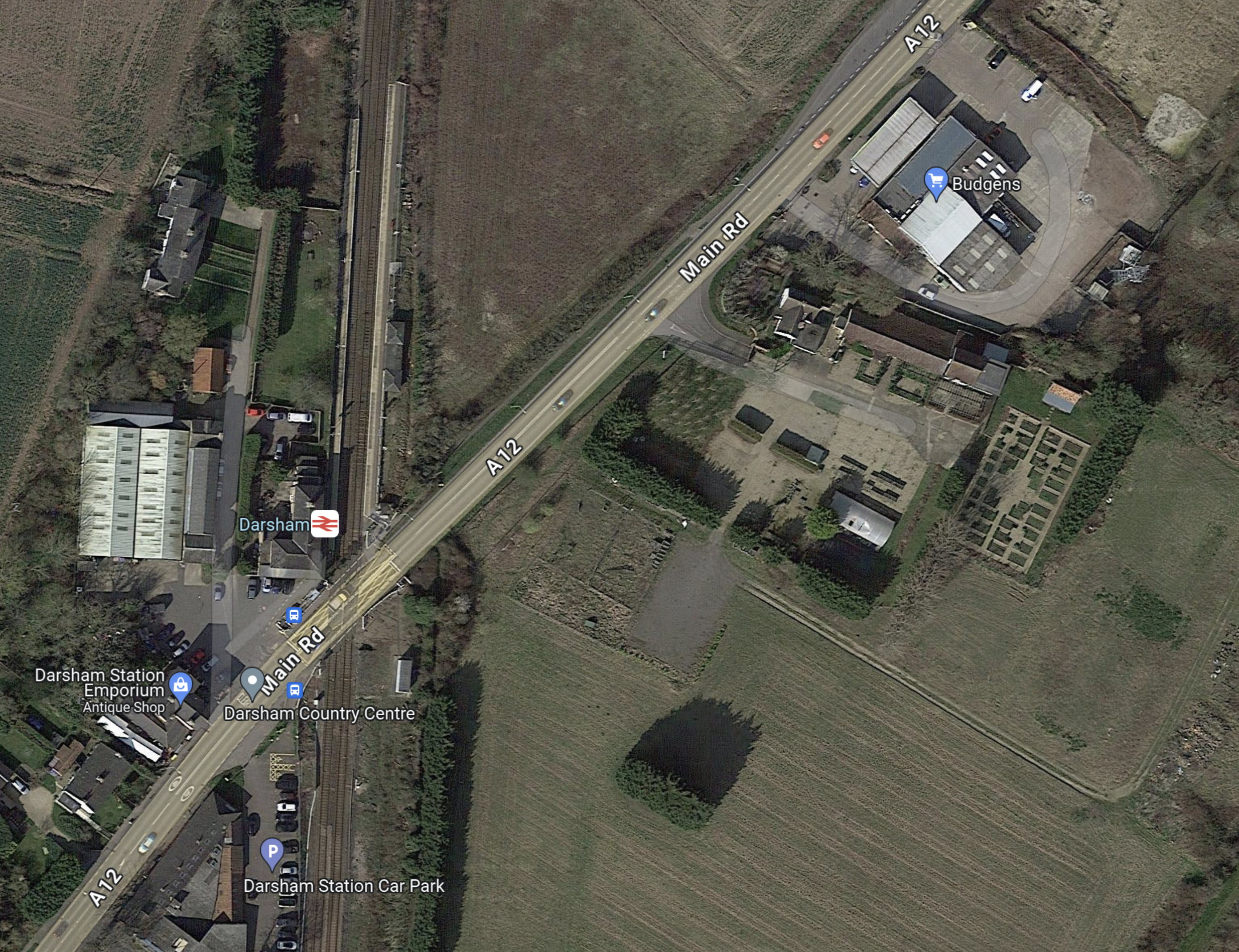
This second Google Map shows Darsham station.
Note.
- Darsham station has long platforms.
- Crossing the line is by means of the level crossing.
- The Budgens store, which is indicated by the blue arrow also sells fuel.
- The station has a bus service.
- The Southern end of the Park-and-Ride site lies between the railway and the road at the North of the map.
The document on the Planning Inspectorate says this about walking between the Park-and-Ride site and the station.
There would be a pedestrian route from Darsham railway station along the
footway on the A12 to the south-east of the site. Pedestrians accessing the
site would leave the A12 and enter through a security gate provided in the
security fencing. Further details of access measures (such as key fobs,
CCTV, intercom system) would be agreed at the detailed design stage.
I could probably manage that at 76.
These are further thoughts.
The Current Rail Service
Currently, the rail service is as follows.
- One train per hour (tph) in both directions.
- |Trains are Class 755 trains, built by Stadler in Switzerland a few years ago.
- Each train can carry up to 229 passengers.
- Up to three trains can run together.
- Trains going to and from Lowestoft in the North call at Oulton Broad South, Beccles, Brampton and Halesworth.
- Trains going to and from Ipswich in the South call at Saxmundham, Wickham Market, Melton and Woodbridge.
- Travellers for London Liverpool Street change at Ipswich.
- The first train from London Liverpool Street would get you to Darsham at 11:00.
- This is not a bad train service but it could be improved.
Direct Trains Between London Liverpool Street And Lowestoft
In 2016, I wrote Making Sense Of The New East Anglia Franchise.
I wrote the following about Greater Anglia’s plans to run four trains per day between London Liverpool Street and Lowestoft.
There are going to be four direct services between London and Lowestoft each day. This probably initially means two trains to London in the morning peak and two trains back in the evening one.
When, I first moved back to Suffolk in the 1970s, I regularly caught a diesel-hauled train from Wickham Market to London for the day.
This is all motherhood and apple pie for those in Lowestoft wanting to go to London, but I suspect it isn’t the easiest service for a train operator to schedule efficiently and make money.
Would a train operator really want to start a full train at Lowestoft at say six in the morning and then have it wait around all day in London before returning in the evening?
The East Suffolk Line from Ipswich to Lowestoft has the following characteristics.
- It is fifty miles long.
- It is not electrified.
- It has a speed limit of 40-55 mph.
- There are nine intermediate stations. Many are just a single platform, and car parking is fairly limited.
- It has enough double-track and a passing loop at Beccles station to run a train in both directions at the same time.
- As it ran long trains in the past, I suspect, that most of the stations have platforms that can handle at least six-carriage trains.
- Trains would appear to take around ninety minutes for the whole journey
But the most important characteristic, is that every time the line is improved, more passengers come rushing out of the woodwork.
There would certainly be no problem with running bi-mode Flirts on this route, as London-Lowestoft is just the type of route for which they are designed.
- They would use their on-board diesel engines on the East Suffolk Line.
- As some would work along the busy lines to London, I suspect their top speed under electric power would be the same as the EMUs.
- Services to and from London, once on the Great Eastern Main Line, would join the high-speed race to and from the capital.
- At the start and finish of the day, the trains could use the electrified main line to position between Ipswich and Crown Point depot at around 100 mph.
- Abellio could use either a single three- or four-car train or perhaps two trains coupled together.
This service would pass through Darsham station, so it could provide a direct link between London and the Park-and-Ride.
It might also stop at stations like Manningtree, Colchester, Chelmsford and Stratford.
I am fairly certain, that a London Liverpool Street and Lowestoft services, that stopped at Darsham station, would improve labour availability and construction efficiency at Sizewell C.
A Connection To Yarmouth
There used to be a direct Yarmouth to Lowestoft Line, but now it is possible to use the Wherry Lines, with a reverse at Reedham station.
So will we be seeing the direct London-Lowestoft trains being extended to Yarmouth?
As Yarmouth hasn’t had a direct connection to London for years and there are lots of fast, capable new trains, I wouldn’t be surprised.
Especially, as Network Rail are talking about reinstating the Reedham Chord to create a more direct route between East Anglia’s largest North-Eastern towns. This is said about the Reedham Chord in Direct Yarmouth Services in the Wikipedia entry for Lowestoft station.
In January 2015, a Network Rail study proposed the reintroduction of direct services between Lowestoft and Yarmouth by reinstating a spur at Reedham. Services could once again travel between two East Coast towns, with an estimated journey time of 33 minutes, via a reconstructed 34-chain (680 m) north-to-south arm of the former triangular junction at Reedham, which had been removed in c. 1880. The plans also involve relocating Reedham station nearer the junction, an idea which attracted criticism.
If we take these current approximate timings.
- Ipswich to Lowestoft takes 90 minutes.
- Lowestoft to Reedham takes 27 minutes.
- Reedham to Yarmouth takes 16 minutes.
That means the service today would take 133 minutes, with a train reverse at Reedham station.
Note.
- Modern three-car bi-mode Flirt trains, with better speed, acceleration and braking than the current Class 170 trains.
- The short-cut along the Reedham Chord, which could save as much as ten minutes.
- A few selective improvements to save a minute here and there.
- Lowestoft station is redeveloped forty metres to the West and eighty metres to the South, as detailed in Wikipedia under Relocation Of The Station.
- I think it would be possible for an Ipswich-Yarmouth service to do the trip in around two hours.
The service would have the following characteristics.
- It would be timetabled for under the all-important two hours.
- Trains would turnround efficiently in a few minutes at either end of the line.
- It could be hourly with four trains or two-hourly with just two, used to run the service.
- All stops would be at the same minutes past each hour at each station.
- Trains would always leave Ipswich and Yarmouth at the same number of minutes past the hour.
- Lowestoft and Yarmouth get a regular hourly direct train service in just thirty-three minutes.
- Intriguingly if the trains left Ipswich and Yarmouth at the same time, they would pass each other at Beccles station, which incorporates a passing loop.
- As Beccles and its passing loop, fits so well into this schedule, I suspect that it was designed with the Reedham Chord and this type of service in mind.
- There would be no prizes for guessing the beer, that should be served on a train on this route.
I don’t think any better than an hourly service, could be run, without some extra passing loops or double-track.
This extension would make commuting between Sizewell and Yarmouth easier.
Bus Route Between Darsham And Sizewell
The document on the Planning Inspectorate says this about the buses and the route.
There would be a maximum of 100 daily bus arrivals and 100 daily bus
departures from the proposed development to the Sizewell C main
development site.Bus services between the proposed development and the Sizewell C main
development site would travel south on the A12 and use the new A12/B1122
roundabout (Yoxford Roundabout – see Volume 7 of the ES) to access the
B1122 and the Sizewell link road (once operational – see Volume 6 of the
ES) towards the Sizewell C main development site.
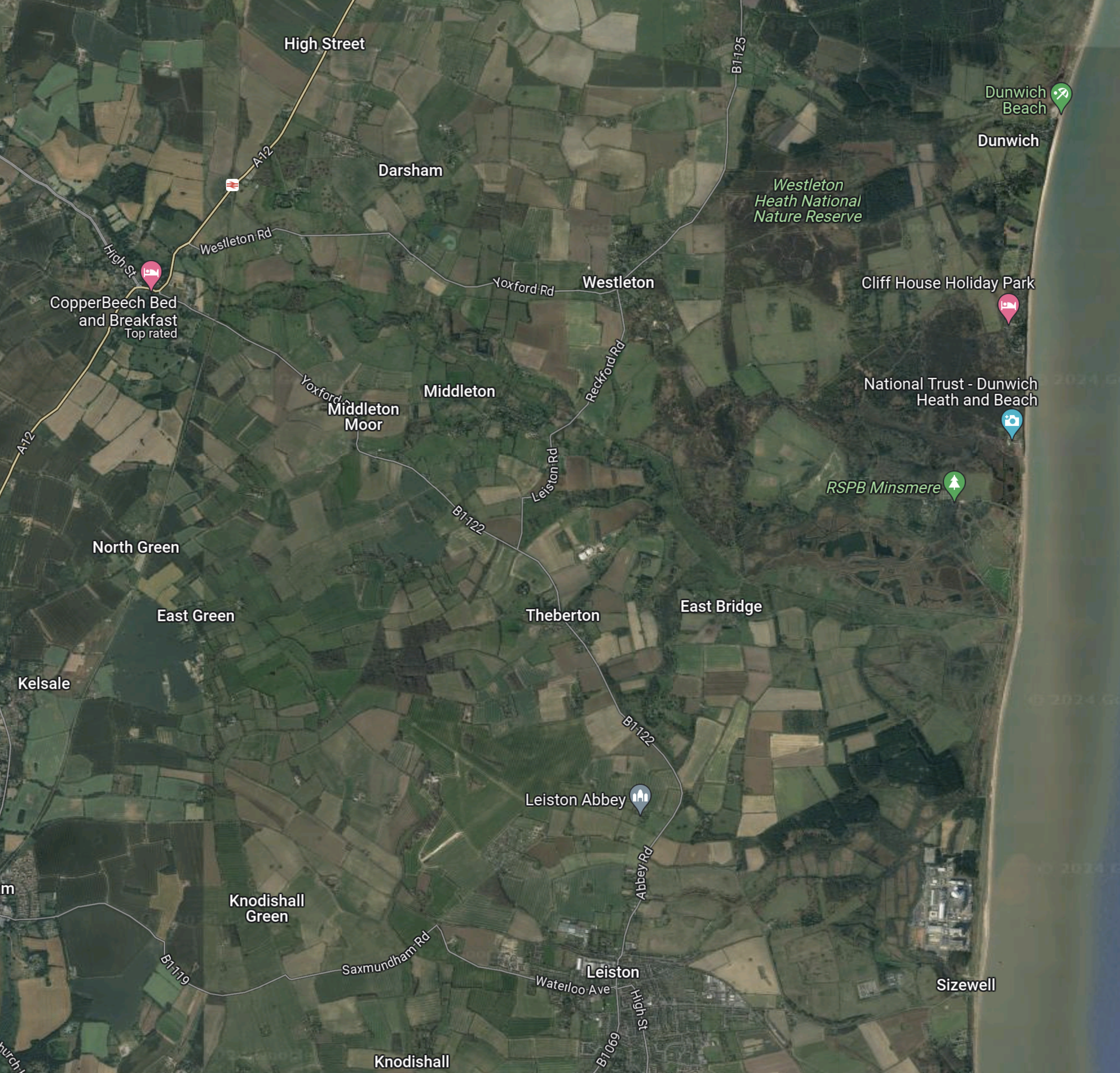
This Google Map shows Darsham station and the Sizewell site, as it exists today.
Note.
- The Sizewell site is in the South-East corner of the map.
- Darsham station is in the North-West corner of the map.
This second Google Map shows the A 12 between Darsham station and Yoxford.

Note.
- Darsham station is at the top of the map on the A 12.
- The village of Yoxford is on an S-bend of the A 12.
- A B& B is marked by a pink arrow.
The B 1122 connects Yoxford to the South-East corner of the map.
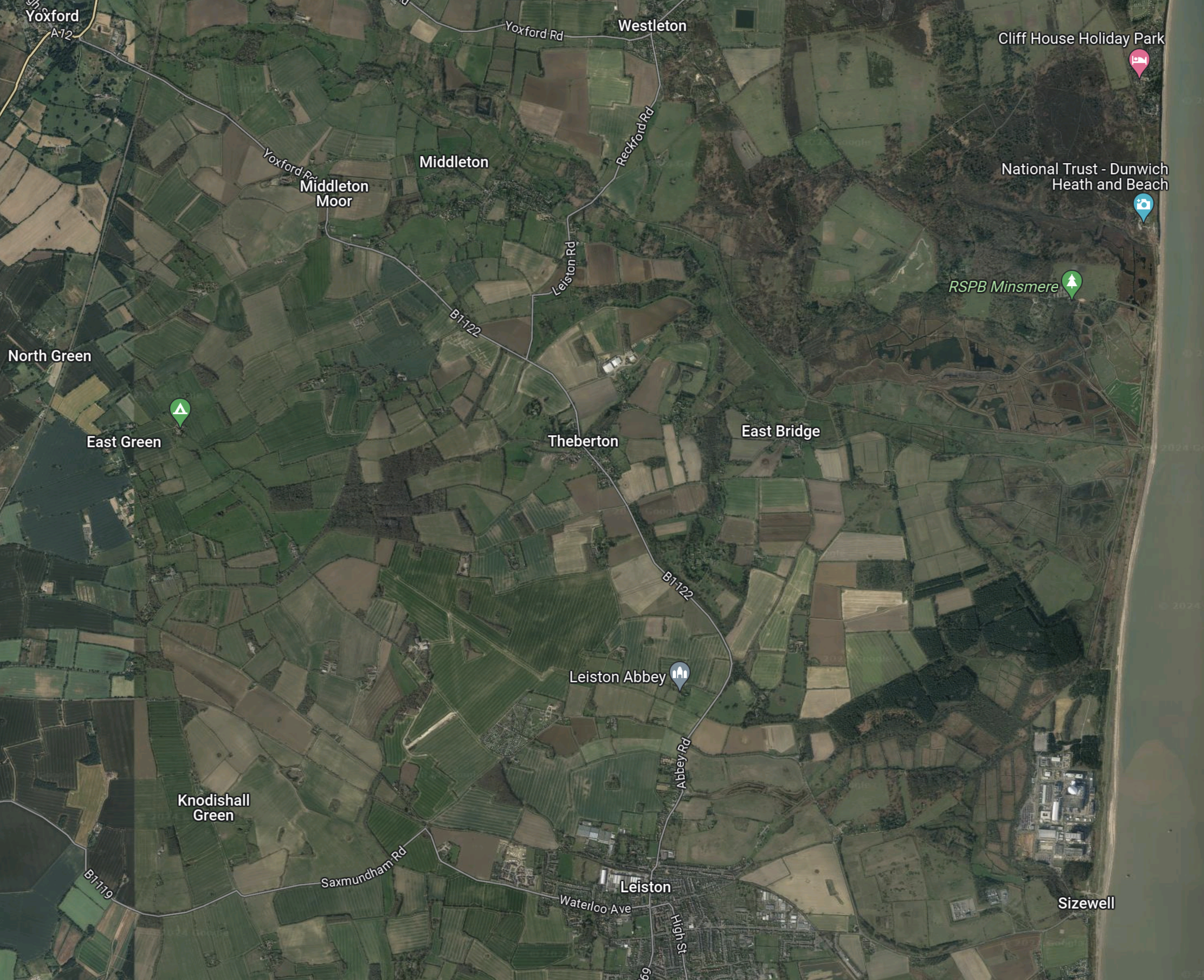
This third Google Map shows the route between Yoxford and Sizewell.
Note.
- Yoxford is in the North-West corner of the map.
- Sizewell is in the South-East corner of the map.
- Leiston Abbey is indicated by the arrow to the North of Leiston.
The B 1122 can be picked out through Middleton Moor and Theberton and then as it skirts Leiston Abbey.
Sizewell C seem to have made a good effort to get the workers to the site.
Why Isn’t A Passenger Train Run Between Ipswich And The Sizewell Site?
In Network Rail Prepares To Send Four Trains A Night Through Suffolk To Sizewell, I came to this conclusion.
I am fairly certain, that it is possible to move four freight trains in and out of the Sizewell site during the night, without doing any major works to the East Suffolk Line between Ipswich and Saxmundham junction.
- Adding extra track at Wickham Market would probably cause major disruption.
- Some level crossings will probably be improved.
But without a full double track between Ipswich and Saxmundham junction, I doubt there could be any increase in passenger services.
But with those track works, it might be possible to run an hourly service between Ipswich and Aldeburgh with calls at Westerfield, Woodbridge, Wickham Market, Saxmundham, Sizewell and Leiston.
This would give a two tph service between Saxmundham and Ipswich.
Objections To The Park-and-Ride
This document from Darsham Parish Council is entitled Consultation Response To Sizewell C.
This is the first paragraph.
Darsham Parish Council (Darsham PC) continues to oppose the proposed location of the Northern Park and Ride (NPR). We believe its location on an already busy single carriageway section of the A12 just north of the level crossing at Darsham Station, coupled with proposed roundabouts at Willow Marsh Lane and the A1120 junction in Yoxford are a recipe for traffic chaos extending northwards up the A12. We have no confidence in the traffic estimates submitted by EDF, which we believe underestimate the amount of local, through, agricultural and tourist traffic. This will be exacerbated by the proposed motel and further proposed development south of the station. We believe that traffic congestion on this main artery into Suffolk will adversely impact tourism throughout the AONB, which generates more than £360 million pa to the local economy (2018 figure). Further, we believe these volumes of traffic will generate excessive noise, vibration and pollution with serious negative impacts on those living alongside or close to the A12. Most significantly, Darsham PC has been advised that location of the NPR on this site could pose a significant flood risk to the railway (see below).
The Parish Council is also worried about flood risk to the railway.
The site of the NPR slopes down from Willow Marsh Lane towards the railway. A consulting engineer has advised us that the heavy clay soil here could pose a drainage and flood risk problem when compacted during the construction period. An appropriate sustainable semi-permeable surface could be utilised for car parking spaces to reduce run-off, with suitable drainage and reservoir capacity at the southern end to protect the railway from flooding. We submitted this evidence to EDF during the consultation period, but it has been ignored.
I suspect as with the opposition to Sizewell B, the opposition is led by second home owners, worried about the value of their investment.
State-of-the-Art Bradford Hydrogen Production Facility Approved
The title of this post, is the same as that of this press release from Renewable Connections.
These two paragraphs outline the project.
Bradford Hydrogen Production Facility, a partnership project between Hygen and N-GEN, developed by Renewable Connections, has received consent from Bradford Council. It is anticipated once built, the groundbreaking hydrogen production facility will produce enough hydrogen to remove up to 800 diesel-fuelled buses a day from West Yorkshire roads.
The facility on the old Birkshall gas storage site on Bowling Back Lane in Bradford will produce low carbon hydrogen which can be used to decarbonise vehicles and industry. Businesses and other users in West Yorkshire will be able to use the refuelling facilities on site, with distribution experts Ryze delivering hydrogen to industrial users across the region.
This Google Map shows the area of Bowling Back Lane.
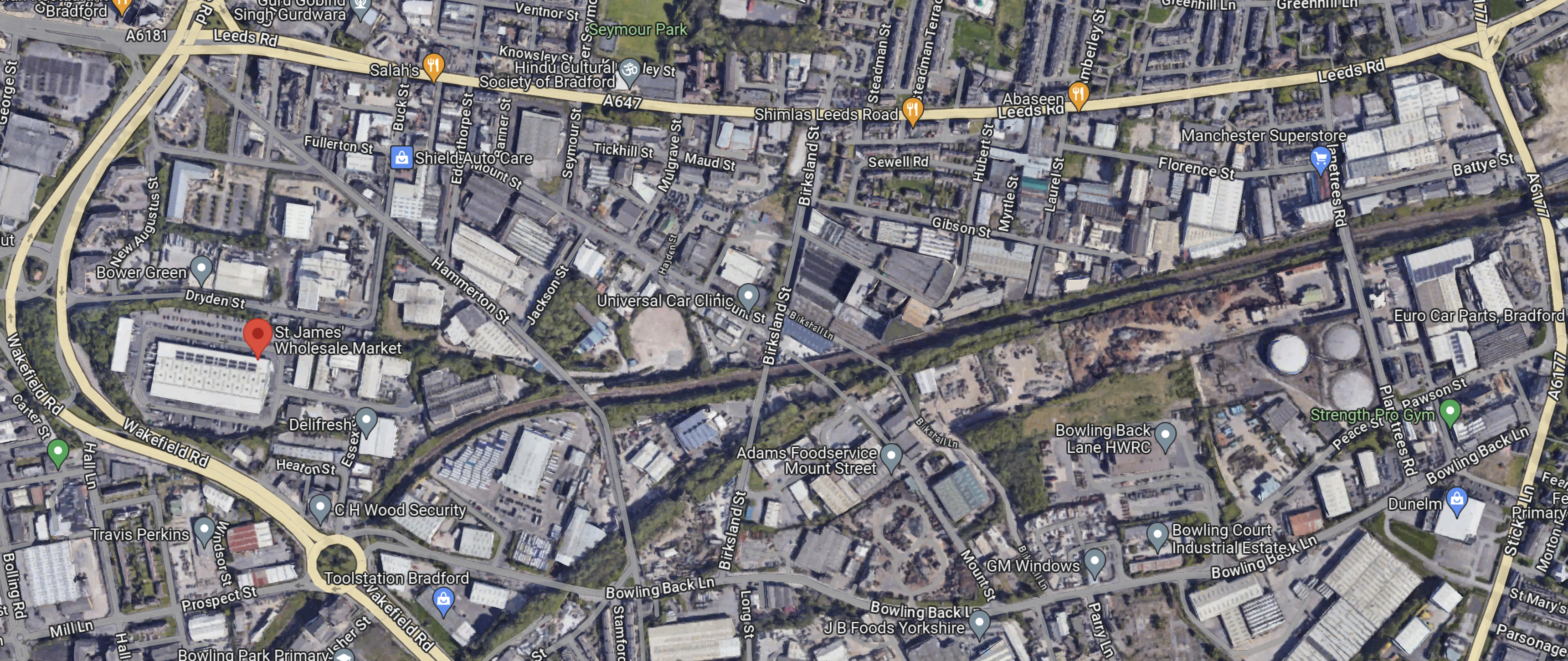
Note.
- The railway running East-West across the middle of the map.
- The red arrow indicates St. James Wholesale Market, which will be the site of the new station.
- Bowling Bank Lane runs East across the nap from the roundabout to the South of the market.
- There appear to be three gas storage tanks to the North of Bowling Back Lane, towards the East of the map.
I suspect that the electrolyser will be built to the West of the current gas storage tanks.
I have a few thoughts.
It Could Be A Large Site
This Google Map shows an enlargement of the area, between Birkshall Lane and the gas storage tanks.
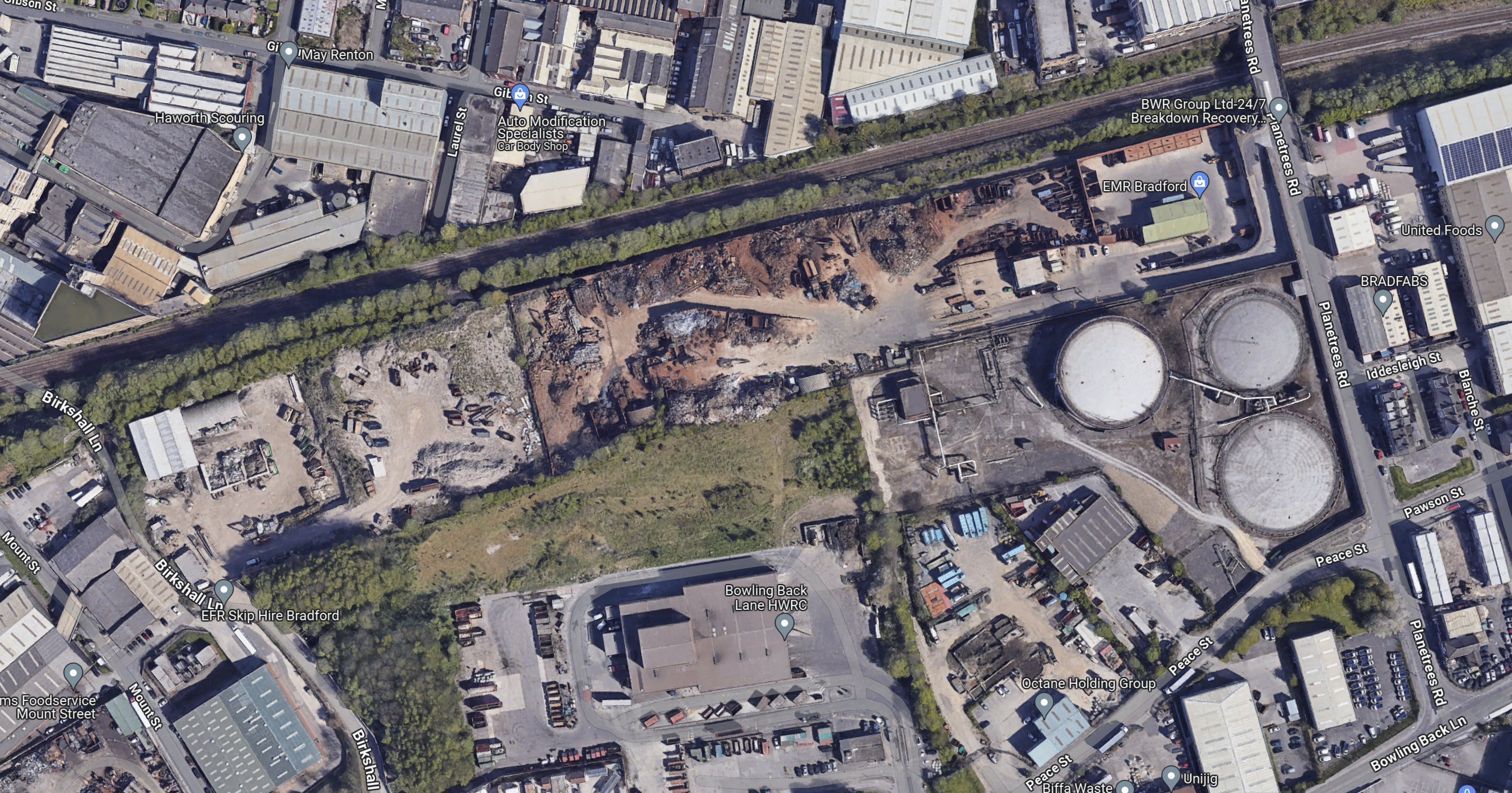
Note.
- Birkshall Lane runs across the South-West corner of the map.
- Several of the businesses in the area seem to concern recycling.
- The site would appear to stretch from the railway in the North to the gas storage tanks in the East and Birkshall Lane in the West.
I can envisage the space around the electrolyser being developed into a business park for businesses that need hydrogen.
Could There Be A Refuelling Facility For Hydrogen Trains?
I believe that in the next ten years, that many freight trains will be hauled by hydrogen-hybrid locomotives.
As the railway through Bradford used to incorporate a third track, I believe that there could be space for a simple facility to fill up hydrogen-powered locomotives.
Are The Gas Tanks Still Used?
The reason I ask this question, is that if they are and still supply Bradford with natural gas, excess hydrogen could be blended up to a low percentage with natural gas to supply Bradford gas users.
It would certainly be a useful capability.
Conclusion
The electrolyser appears to be well-positioned.
Wrightbus Nears Completion Of First Hydrogen Buses For Continental Europe
The title of this post, is the same as that of this article on Sustainable Bus.
This is the first paragraph.
UK bus manufacturer Wrightbus announced through a Linkedin post it is in the final stages of completing its first batch of left-hand-drive single-deck hydrogen buses, known as the Kite Hydroliner, destined for Germany and adhering to full VDV compliance. In May 2022 Wrightbus secured an order from RVK Cologne for 20 fixed and 40 optional orders.
This paragraph is also significant.
The buses come equipped with stated range of 1,030 kilometers, a fully flat saloon floor, rapid refueling in under 8 minutes, and are crafted “using key components from tier 1 global suppliers”.
A 1030 kilometre (640 miles) range is enough to go between London and Carlisle and back.
Hydrogen Bus Fleet Project Gains Momentum
The title of this post, is the same as that of this article from Energy Live News.
This is the sub-heading.
Luxfer Gas Cylinders and Ricardo have formed a partnership to advance a project that aims to deploy 150 hydrogen-powered buses on UK routes by 2024
I first came across this project in June 2022 and wrote Ricardo Repowers Double Decker Diesel Bus With Hydrogen Fuel Cells, where I said this.
The title of this post, is the same as that of this press release from Ricardo.
Ricardo, a global strategic, environmental, and engineering consulting company, in partnership with Stagecoach North East, has repowered a diesel, double decker bus with a hydrogen fuel cell propulsion system. Delivering zero tailpipe emissions, Ricardo is now seeking to secure customers to invest in the production of a fleet of passenger vehicles fit for the future of sustainable shared mobility.
The project, part funded by the Department of Transport, through its Hydrogen Transport Hub Demonstration competition, saw Ricardo, working with Stagecoach North East to retro-fitted hydrogen fuel cell technology into an existing double decker bus. It created a zero emissions demonstrator that is now undergoing a ten-week test and demonstration programme around the Tees Valley and Brighton and Hove. Feedback and data from the trials will support the team to explore future market opportunities and applications with bus operators and other partners across the UK and beyond.
Given that there are around 38,000 existing buses in the UK, many of which still have a few years of life left, this surely must be an affordable way of creating more zero-carbon hydrogen buses.
It appears that Ricardo are aiming to have an initial batch of 150 buses in service from late 2024.
It looks to me, that this project is certainly gaining momentum.
Wrightbus To Provide Hydrogen Buses For Sizewell C Nuclear Plant
The title of this post, is the same as that of this article on the BBC.
This is the sub-heading.
Ballymena bus manufacturer Wrightbus is providing four hydrogen buses to the Sizewell C nuclear power site as part of a pilot scheme.
These first three paragraphs outline the scheme.
If successful, up to 150 buses could be ordered, making it one of the largest hydrogen bus fleets in the world.
Construction of the plant is to begin next year and multiple vehicles will be needed to move workers to and from the site.
Sizewell C will test the performance of four double-decker buses.
As I used to live in that area, I know the buses are bad and this will surely help.
Hydrogen Fuel Cell-Electric Coach Driveline Coming From Wrightbus
The title of this post, is the same as that of this article on RouteOne.
These are the first two paragraphs.
Wrightbus has been awarded up to £534,000 of government funding via the Advanced Propulsion Centre (APC) for the development, testing and validation of a hydrogen fuel cell-electric coach driveline.
The Ballymena manufacturer will receive the money from an £11 million pot administered by APC as a second round of the Advanced Route to Market Demonstrator scheme (ARMD2), which itself is part of over £50 million of public funding towards 30 “cutting edge manufacturing projects” in the UK.
I have never driven a coach, but I do feel that this project could be a winner.
- From riding in hundreds of their products over the years, I’m sure Wrightbus could produce a coach that satisfies the demands of coach companies and their passengers.
- Long routes like London and Scotland are popular coach routes and are of the order of 400 miles. Would passengers tolerate a thirty minute stop halfway to charge the batteries on an electric coach?
- Through, the experiences of the vehicle leasing company, I owned, I know that finance for quality coaches is not hard to come by and they are a good investment.
I also believe that a hydrogen-powered coach could be a flagship product for the hydrogen-powered transport sector.
We’ve all been on a motorway and seen coaches in the fast lane at 70 mph.
What effect will that have if the coach was emblazoned with “Green Hydrogen Coach – London-Glasgow Non-Stop In 7 Hrs”?
Sussex Will Be Leader In Hydrogen Energy Production
The title of this post, is the same as that of this article on The Argus.
These are the first three paragraphs.
The county is today launching its bid to become a pioneer for use and production of hydrogen energy.
Experts will unveil Brighton’s hydrogen strategy this morning showing how the city and surrounding areas are championing a clean energy infrastructure.
With plans for a Worthing crematorium to become the first in the world powered entirely by hydrogen, development of a green energy production facility in Shoreham, and a growing fleet of hydrogen-powered buses in Crawley, the region is already breaking ground in the hydrogen industry – and shows no sign of stopping.
These are my thoughts.
The Plan Is Comprehensive
This document of the Council website, is entitled the Greater Brighton Hydrogen Strategy.
It is very comprehensive and discusses hydrogen in Sussex from all angles.
Every Council in the UK needs to have their own comprehensive strategy like this.
The Report Cautions That Greater Brighton May Need More Renewable Energy
Consider.
- The Rampion wind farm, with a capacity of 400 MW is already operating in the sea South of Brighton.
- This should be joined by the 1200 GW rampion 2 wind farm in the next few years.
It is unlikely substantial onshore wind and solar farms will be built in the area.
Gatwick Airport Is Expected To Need A Hydrogen Supply
The strategy says this about Gatwick and the two Rampion wind farms.
The offshore wind farm Rampion is large enough to be considered nationally significant infrastructure. There
is a second development for this wind farm planned for 2025-6, which will connect into Bolney substation as
per the existing wind farm.The GBEB energy plan suggested that an electrolyser could be sited there, although there are no identified demand locations nearby other than potential refuelling of passing traffic on the A23.
However, considering the relative distance to Gatwick airport, which is expected to be a significant future
demand, there may be an opportunity for a direct pipeline. This would be further into the future and requires
further analysis and bilateral engagement between Rampion and Gatwick. Engagement with Rampion found
that, given the large population supplied by the Rampion wind farms, and the relative lack of other large-scale
renewables locally, these wind farms are unlikely to face significant curtailment and will fully contribute to
decarbonising the local electricity grid. Therefore, using Rampion to produce hydrogen by electrolysis is not
seen as the best use case in the near term.
It looks to me, that because of the electricity demand in the Brighton and Gatwick area, that a big decision needs to be made to create some more renewable capacity.
Could this mean a Rampion 3 or perhaps a fleet of small modular nuclear reactors at Dungeness?
An Electrolyser At Bolney Substation
This Google map shows the position of Bolney substation.
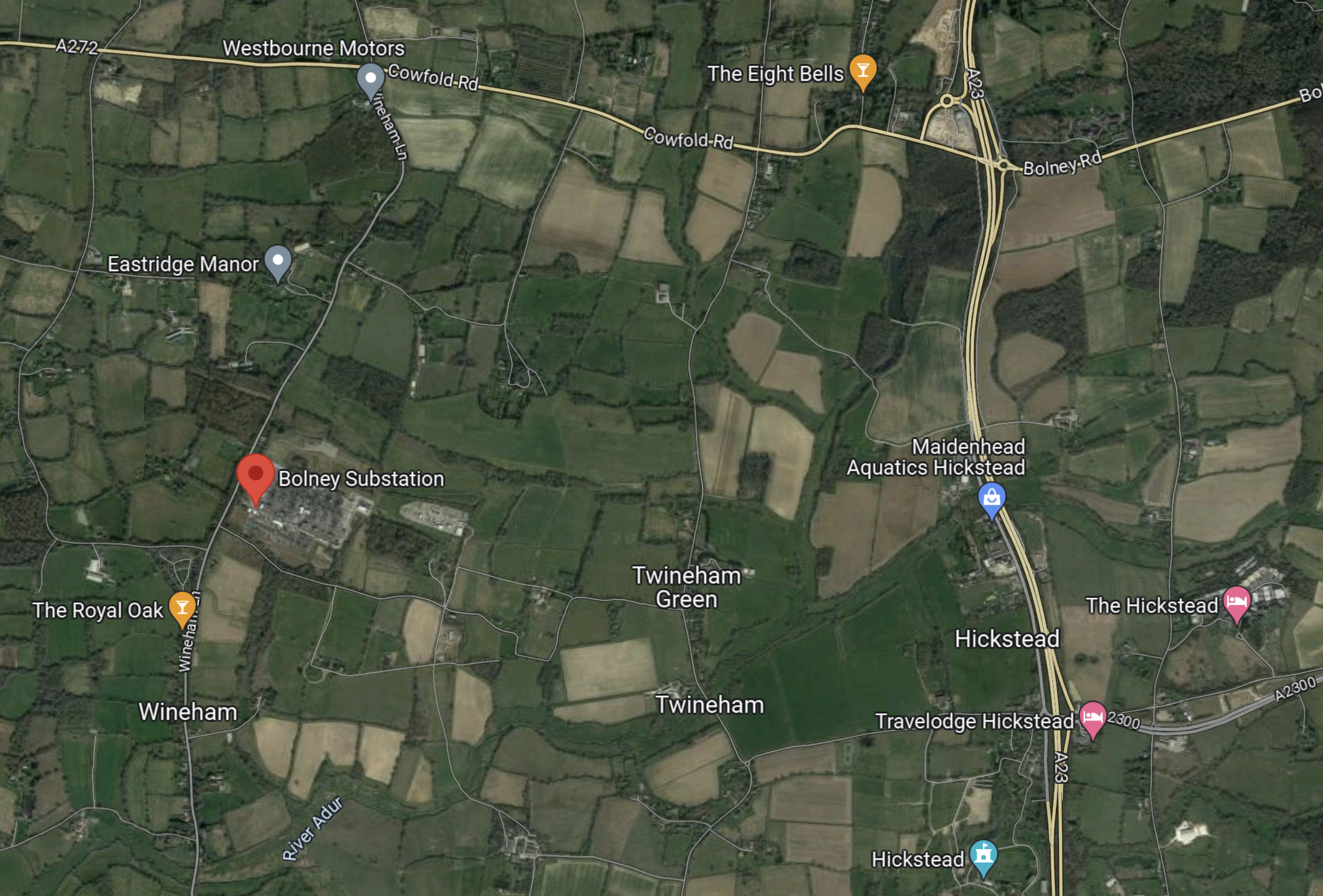
Note.
- The A23 is the main London-Brighton road.
- Bolney substation is indicated by the red arrow.
- The substation doesn’t have very good road access.
- I also suspect that the locals wouldn’t like an electrolyser in their midst.
On a brief look, I suspect that an electrolyser at Bolney substation will be a non-starter.
Shoreham Port As A Hydrogen Hub
The strategy mentions Shoreham Port several times, but gives the impression that progress is slow.
This Google Map shows Shoreham Port.
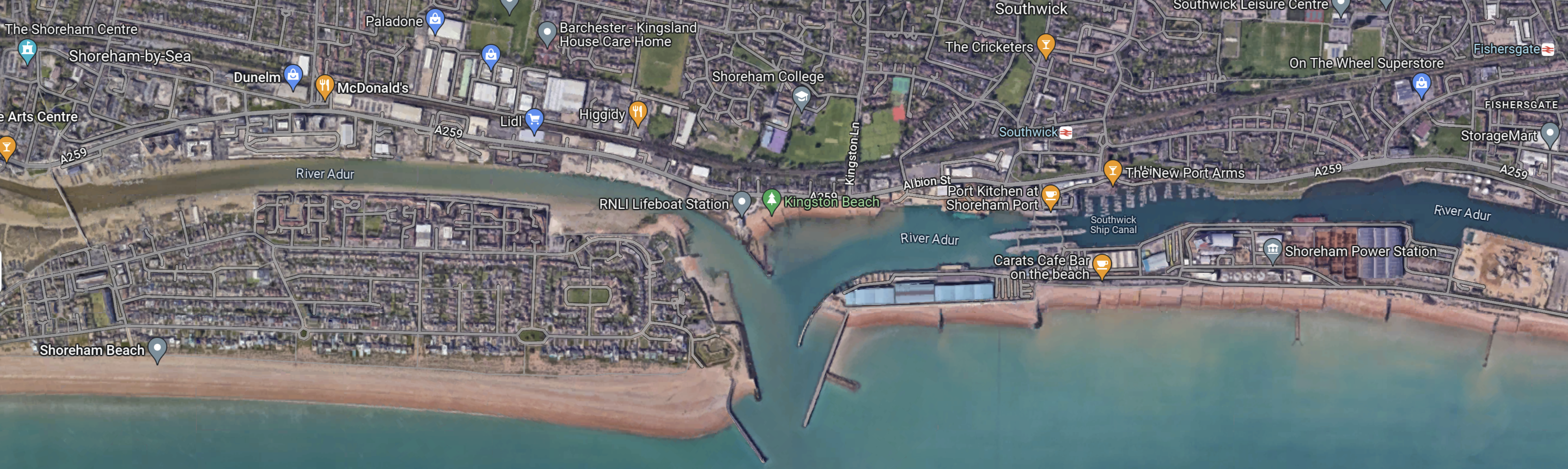
Note.
- Shoreham is in the West.
- The port reaches a long way to the East.
- The 420 MW gas-fired Shoreham Power station, is at the Eastern end of the port, close to the sea.
There appears to be spaces along the water for developing hydrogen infrastructure.
This page on the H2Green web site is entitled Agreement to Develop Clean Energy Hub for Shoreham Port, Sussex, starts with this paragraph.
Getech, the geoscience and geospatial technology provider and data-led energy asset developer, is pleased to announce that its wholly owned hydrogen subsidiary, H2 Green, has signed a Collaboration Agreement (the “Agreement”) with Shoreham Port.
It lists these three highlights.
- H2 Green granted a two-year legally binding exclusive right to develop a renewable energy hub (the “Hub”) at the Port of Shoreham, West Sussex.
- Under plans submitted by H2 Green to Shoreham Port, the Hub will initially focus on the provision of green hydrogen and renewable electricity to the Port’s fleet of 39 heavy forklift trucks and 12 heavy goods vehicles.
- Green Hydrogen will be sourced by a scalable green hydrogen production, storage and refuelling facility – the economics of which will be optimised by its integration with new solar and wind electricity generation capacity.
- The Hub will then be expanded to facilitate the decarbonisation of more than 800 heavy goods vehicles that enter Shoreham Port daily, and to provide fuel to port and coastal marine vessels.
That is all good stuff, but I do wonder, where the renewable electricity is going to come from.
In Further Thoughts On BP’s Successful INTOG Bid, I looked at BP’s plan for a 50 MW wind farm.
- It will be about twenty miles offshore from Aberdeen.
- With an appropriate electrolyser 50 MW of electricity would produce twenty tonnes of hydrogen per day.
- The electrolyser could be onshore or even offshore.
- The technology has all been developed.
Could H2Green be thinking of developing a similar hydrogen production facility?
Hydrogen ‘The Only Option’ For Metrobus Fastway ZE
The title of this post, is the same as that of this article on Route One.
This is the introductory paragraph.
Hydrogen fuel cell-electric remains the most realistic zero-emission technology for usage cases requiring very high mileage and utilisation capabilities. That is the verdict from the Go-Ahead Group after its Metrobus subsidiary launched 20 Wrightbus GB Kite Hydroliner single-deckers on 29 June.
This paragraph gives more details.
Go-Ahead Group Chair Claire Hollingsworth, who was present at the launch alongside Under-Secretary of State for Transport Richard Holden and other stakeholders and dignitaries, underlines the need for hydrogen on Fastway. “These are the most intensive routes in the Go-Ahead network,” she explains. “We need 300 miles of range and have little time to plug in.”
Let’s face it, a bus that takes a lot of time to fuel-up can’t be as efficient, as one that takes just a few minutes. Especially, if the buses are running a large number of hours per day.
The whole article is a must read and surely Go-Ahead’s conclusion to other modes of transport, that do long distances, like heavy trucks, long-distance coaches and railway locomotives.
Discover How Greater Brighton Is Championing The Transition To Hydrogen
The title of this post, is the same as that of this news item from Brighton & Hove Council.
This is the introduction to the news item.
Local experts will present the strengths and opportunities for developing the hydrogen economy in the Sussex area at an online launch on 11 July.
Register for the online launch of the Hydrogen Strategy
Developed by local company Ricardo, on behalf of Hydrogen Sussex, the Greater Brighton Hydrogen Strategy shows that with the right focus, collaboration and action, the region has real potential to stand out within the UK hydrogen landscape and gain economic and environmental benefits.
Brighton & Hove Council seem to be taking a sensible approach, but then they do have one of the world’s most respected hydrogen companies; Ricardo, a few miles to the West.
This section outlines, how Brighton is embracing hydrogen.
Hydrogen is a fast-growing sector with the potential to enable decarbonisation, support national energy security, create green growth and improve air quality.
The Greater Brighton and wider Sussex area has already broken ground in the Hydrogen industry, with advanced engineering, education and research being very well represented. Local initiatives include:
-
- Hydrogen buses: Metrobus has just launched 15 hydrogen buses to serve the Crawley and Gatwick area, with a further 34 hydrogen buses joining their fleet over the next 18 months.
- Shoreham Port: The port is working with partners H2Green to create a Green Energy Hub, producing green hydrogen in a multi-megawatt electrolysis plant – initially for Shoreham Port, and then supplying green hydrogen across the region.
- Maritime sector: Sussex’s engineering companies are at the forefront of hydrogen decarbonisation in the maritime sector. Bramble Energy, Cox Marine, Ceres Power and Ricardo are just some of the local companies which have received Government funding to tackle marine decarbonisation.
- Sussex and Brighton universities: The two universities in the area have PHD studies on innovations in the sector, with Brighton University partnering with companies to win government research funding.
- Worthing Crematorium: Could become the first in the world to trial a switch to 100% hydrogen. If testing is successful with cremator manufacturer DFW Europe, hydrogen technology will be brought over to Worthing Crematorium as early as spring 2024.
The region is already home to several hydrogen technology companies and has a strong capacity for innovation which could be developed to expand its engineering excellence.
That list looks fairly comprehensive.
Conclusion
Other towns, cities and regions in the UK, should look at what Brighton is doing, with respect to hydrogen.
Go-Ahead Adds 20 FC Buses To Gatwick Fleet
The title of this post, is the same as that of this article on electrive.com.
I described my ride on these buses in My Second Ride In A Wrightbus Single-Decker Hydrogen Bus.
I am publishing this post for this key paragraph on the electrive.com article.
When the order was placed in 2021, Martin Harris, Managing Director of Brighton & Hove and Metrobus, already specified why hydrogen buses were now being used for the first time: “We run services 24 hours a day, with hilly terrain, heavy passenger loads and duty cycles well in excess of the national average at up to 370 miles per day. Those provide really challenging conditions for any technology but we concluded that hydrogen provides the most efficient replacement for our diesel buses.”
It is interesting to note, that the hydrogen buses in Birmingham, Dublin and Liverpool are used on longer routes.
 The Anonymous Widower