Hydrogen Train Operation Planned
The title of this post is the same as that of this article on the Railway Gazette.
This is the first paragraph.
The Länder of Brandenburg and Berlin are planning the joint award of a contract for the development and operation of hydrogen fuel cell powered trains on the RB27 Heidekrautbahn route.
According to Wikipedia, the Heidekrautbahn looks to be an interesting rail line, which is used a lot for leisure and museum (heritage) trains.
Wikipedia also says this about the hydrogen trains.
At the end of 2017, considerations were presented for a pilot project to deploy four Coradia iLint vehicles manufactured by Alstom on the heather track, switching part of the rail service from diesel to hydrogen . This would take about 165 tons of hydrogen, reduce diesel consumption by about 552,000 liters and thus reduce the emission of CO 2 by about 2.5 million kg per year. In the case of a grant commitment, use from 2020 would be conceivable.
Note that this was translated by Google from the Wikipedia entry, which was in German.
The Railway Gazette article states that the trains will run from 2022.
So it looks like the Germans will be making haste slowly on this project.
The
Bi-Mode Trains In Prospect As HS2 Northern Routes Confirmed
The title of this post is the same as that of this article on Railway Gazette.
Bi-Mode Trains On High Speed Lines
There are some, who believe that all trains should run on electrified lines.
But my belief is simpler – All trains should be electric, but they might be able to run on tracks with or without electrification.
There are currently, four proven ways to provide traction power on board an electrically-driven train.
- Diesel
- Hydrogen
- Gas Turbine
- Stored energy – Battery and/or capacitor.
Each have their advantages and disadvantages.
Talgo who are on the short list to build trains for High Speed Two, already make a train called RENFE Class 730, which has the following specification.
- 2.4 MW on 25 KVAC overhead electrification
- 3.8 MW on diesel
- Dual-gauge; Iberian and standard.
- Eleven coaches
- Maximum speed of 160 mph
High Speed Two is designed for 225 mph running, so the trains would need to be faster than these.
But suppose a train was to run say between Euston and Holyhead or any important place a hundred miles or so from High Speed Two.
It would be unlikely that the last part of the route without electrification, would be a high speed line, with a maximum speed in excess of 125 mph.
If it were a high speed line, then it would probably be electrified.
So a typical specification for a bi-mode for High Speed Two would probably be something like.
- Maximum speed of 225 mph on High Speed Two using the electrification.
- Maximum speed of 125 mph on the alternative power source.
- Ability to go between at least Crewe and Holyhead (84 miles) and back without refuelling.
Effectively, the train has two performance regimes; one for electrified high speed lines and one for classic lines without electrification.
A Possible Design For A Bi-Mode High Speed Train
Eurostar’s Class 374 train, which is one of the latest high speed trains is described like this in Wikipedia.
The Velaro e320, named because of plans to operate at 320 km/h (200 mph), would be 16 cars long, to meet the Channel Tunnel safety specifications but would have distributed traction with the traction equipment along the length of the train, not concentrated in power cars at each end.
Note.
- Distributed power gives better acceleration and smoother braking.
- The trains also appear to have at least six pantographs, so does that mean that each feeds a number of cars?
- I suspect there will be an electrical bus running the length of the train which will feed the traction motors.
- In my design of train, each car would have batteries and/or capacitors to handle the regenerative braking.
- The energy storage would give the train a limited range away from electrification.
For the required range between Crewe and Holyhead, there would probably be a need for diesel or hydrogen power.
I feel though, that in this day and age, no-one would build a new train that used diesel, if they could get the performance from hydrogen power or some other clean source.
Perhaps one of the middle cars of the train could be a power car fuelled by hydrogen.
This should be something that works, as British Rail and Stadler have both used this layout successfully.
On What Routes Would The Train Be Used?
I have used the service between London and Holyhead as an example and this is probably the longest route away from High Speed Two.
Any route that is in range from High Speed Two or a connected electrified route, could be served by these trains, if it was so desired and the train could be run on the route.
I wouldn’t be surprised to see one of these trains have the capability to go as far North as Aberdeen and Inverness.
Conclusion
Bi-mode high speed trains could be designed, if anybody needed them.
But for short extensions from High Speed Two, energy storage would probably suffice.
How Do Porterbrook’s Battery/FLEX Trains Compare With Eversholt’s Hydrogen-Powered Trains?
In the two green corners of this ultra-heavyweight fight to provide electric trains for rail routes without electrification, there are two ROSCOs or rolling stock operating companies.
Eversholt Rail Group
Eversholt Rail Group‘s product is the Class 321 Hydrogen, which is an upgrade of a Class 321 train with batteries and hydrogen-power.
Porterbrook
Porterbrook‘s product is the Class 350 Battery/FLEX, which is an upgrade of a Class 350 train with batteries.
How Do The Two Trains Compare?
I will list various areas and features in alphabetical order.
Age
The Class 350 trains date from 2008-2009 and others were introduced to the UK rail network as early as 2004.
The Class 321 trains date from the 1990s, but that shouldn’t be too much of a problem as they are based on the legendary Mark 3 Coach.
Scores: Porterbrook 4 – Eversholt 3
Batteries And Supercapacitors
This is an area, where the flow of development and innovation is very much in favour of both trains.
Currently, a 1000 kWh battery would weigh about a tonne. Expect the weight and volume to decrease substantially.
Scores: Porterbrook 5 – Eversholt 5
Battery Charging – From Electrification
No problem for either train.
Scores: Porterbrook 5 – Eversholt 5
Battery Charging – From Rapid Charging System
I believe that a third-rail based rapid charging system can be developed for battery/electric trains and I wrote about this in Charging Battery/Electric Trains En-Route.
No problem for either train.
Scores: Porterbrook 5 – Eversholt 5
Development And Engineering
Fitting batteries to rolling stock has now been done successfully several times and products are now appearing with 400 kWh and more energy storage either under the floor or on the roof of three and four-car electrical multiple units.
I feel that adding batteries, supercapacitors or a mixture of both to typical UK electric multiple units is now a well-defined process of engineering design and is likely to be achieved without too much heartache.
It should be noted, that the public test of the Class 379 BEMU train, was a rare rail project, where the serious issues found wouldn’t even fill a a thimble.
So I have no doubt that both trains will get their batteries sorted without too much trouble.
I do feel though, that adding hydrogen power to an existing UK train will be more difficult. It’s probably more a matter of space in the restricted UK loading gauge.
Scores: Porterbrook 5 – Eversholt 3
Electrification
Both types of train currently work on lines equipped with 25 KVAC overhead electrification, although other closely-related trains have the ability to work on 750 VDC third-rail electrification.
Both trains could be converted to work on both systems.
Scores: Porterbrook 5 – Eversholt 5
Interiors
The interior of both trains will need updating, as the interiors reflect the period, when the trains were designed and built.
Eversholt have already shown their hand with the Class 321 Renatus.
The interiors is a design and refurbishment issue, where train operating companies will order the trains and a complimentary interior they need, for the routes, where they intend to run the trains.
Scores: Porterbrook 5 – Eversholt 5
Operating Speed
Both trains in their current forms are 100 mph trains.
However some versions of the Class 350 trains have been upgraded to 110 mph, which allows them to work faster on busy main lines and not annoy 125 mph expresses.
I am pretty sure that all Class 350 trains can be 110 mph trains.
Scores: Porterbrook 5 – Eversholt 4
Public Perception
The public judge their trains mainly on the interiors and whether they are reliable and arrive on time.
I’ve talked to various people, who’ve used the two scheduled battery/electric services, that have run in the UK.
All reports were favourable and I heard no tales of difficulties.
In my two trips to Hamburg, I didn’t get a ride on the Coradia iLint hydrogen-powered train, but I did talk to passengers who had and their reactions were similar to those who travelled to and from Harwich in the UK.
I rode on the Harwich train myself and just like Vivarail’s Class 230 train, which I rode in Scotland, it was impressive.
I think we can say, that the concept and execution of battery/electric or hydrogen-powered trains in the UK, will be given a fair hearing by the general public.
Scores: Porterbrook 5 – Eversholt 5
Range Without Electrification
Alstom talk of ranges of hundreds of miles for hydrogen trains.and there is no reason to believe that the Class 321 Hydrogen trains will not be capable of this order of distance before refuelling.
Bombardier, Vivarail and others talk of battery ranges in the tens of miles before a recharge is needed.
The game-changer could be something like the technique for charging electric trains, I outlined in Charging Battery/Electric Trains En-Route.
This method could give battery trains a way of topping up the batteries at station stops.
Scores: Porterbrook 3 – Eversholt 5
Conclusion
The total scores are level at forty-seven.
All those, who say that I fiddled it, not to annoy anybody are wrong.
The level result surprised me!
I feel that it is going to be an interesting engineering, technical and commercial battle between the two ROSCOs, where the biggest winners could be the train operating companies and the general public.
I wouldn’t be surprised to see two fleets of superb trains.
A Tale Of Two Trains
Last week I attempted to have rides in two ground-breaking trains.
- A battery-powered version of Vivarail‘s Class 230 train.
- A hydrogen-powered Alstom Coradia iLint.
Some months ago, I also had an early public run in a Crossrail Class 345 train.
The latter trains have now been introduced more fully into service, although there are still some Class 315 trains in service between Liverpool Street and Shenfield stations.
Transport for London performed the introduction with plenty of well-trained staff about to both handle any problems and ask passengers for feedback.
It was all very professional and despite Crossrail’s well-reported lateness, it is difficult to find bad reports about the performance of the Class 345 trains between Liverpool Street and Shenfield.
Vivarail’s Class 230 Train
I went to the Bo’ness and Kinneil Railway, to see this train last Wednesday and wrote about the train in Battery Class 230 Train Demonstration At Bo’ness And Kinneil Railway.
- This service was not a paid-for public service but a free demonstration open to all, who wanted to turn up.
- Many people did for the first run at 11:00 and they looked to be a mixture of locals, people with transport interests, families and enthusiasts.
- Vivarail came mob-handed with engineers, designers, public relations staff and the Chairman; Adrian Shooter.
- There was no restrictions as to who talked to whom.
Search the Internet and it is very difficult to find negative reaction to the demonstration.
This article with a video in the Scotsman is entitled Video: Battery Trains On Track To Cut Emissions and gives a lot of information.
- Each car weighs thirty tonnes.
- Chassis and body are aluminium.
- Each car has two 100 kWh batteries underneath.
- New batteries in 2019 will enable sixty mph for forty miles and take just four minutes to charge.
- Regenerative brakes recharge the batteries.
The article has a very positive, typified by this paragraph.
Beyond the recycled exterior, Adrian explains how renewable energy and eco-friendliness are at the heart of the train’s design and a sign of things to come.
I haven’t read any reports from bloggers, enthusiasts or the general public about the train, but like myself, I suspect many went home quietly satisfied after watching a very professional demonstration.
My only negative comment about the Vivarail demonstration, is that it could probably have done with a modicum of classic marketing and upsexing.
Alstom’s Coradia iLint
Last week was the second time, that I tried to get a ride on this train.
- But as with my first trip, although I saw a train, none were actually running.
- This time, I heard that there was a shortage of drivers and one train had gone back to the manufacturer.
- These innovative trains are going to attract visitors from all over the world and I think that Alstom are not being at all professional with their handling of the testing.
- There was just no information, let alone staff at any of the stations, that will be served by the hydrogen-powered trains.
The important people were happy enough to turn up for the grand launch, but did not see fit to provide the information for the general public, who are interested in a genuine innovation, that could cut carbon emissions.
Conclusion
We will see a diesel-powered Class 230 train in service this December and it will then be possible to judge this innovative train on a fair basis.
But after the professional demonstration I saw in Scotland, I very much feel that this launch will not be handled in a sloppy way, such that it leaves a lot of disillusioned travellers.
But I am beginning to wonder, if Alstom’s project was launched too early without real planning to gain lots of brownie points about green issues.
It is one thing to get a new train working on a test track, but passengers with their own needs and appointments to keep, add a whole new dimension.
Alstom may well not be alone, as Porterbrook seem to be having troubles with launching their innovative Class 769 train.
Will There Be Hydrogen-Powered Class 230 Trains?
In the October 2018 Edition of Modern Railways, there is an article which is entitled Vivaral Delivers First Class 230.
In addition to discussing the deployment on the Marston Vale Line, the article has various sub-sections describing future plans for the Class 230 trains.
One such sub-section is entitled Isle of Hydrogen Hybrid?.
This is the first paragraph.
Vivarail is still waiting to hear whether it will receive a European Union grant to develop a hydrogen fuel cell version of the Class 230, although Mr. Shooter was hopeful confirmation of this would be received in September. The application has been made with a range of other organisations including Canadian fuel cell company Ballard.
Other points from the sub-section include.
- The train will be a hydrogen-battery hybrid.
- The design would be similar to the diesel-battery hybrid for the Borderlands Line.
- The hydrogen fuel cells would be in the centre vehicle.
It is also said that hydrogen storage can’t be on the roof, due to the UK’s restrictive loading gauge.
Conclusion
At the moment, it’s just adding another prototype train to a long list of trains with a better environmental footprint.
If this train is successful, it will be a three-car independently-powered train, with no emissions and low noise, which will be ideal for a lot of routes in the UK and possibly other countries, which share out passenger loading gaue and requirements.
Will Alstom Use The Buxtehude To Cuxhaven Route As A Test Route For The iLint Train?
I think there are various factors that could make the route between Buxtehude and Cuxhaven stations an ideal test route for hydrogen-powered iLint trains.
Bremervörde Depot
This Google Map shows the area of Bremervörde station.
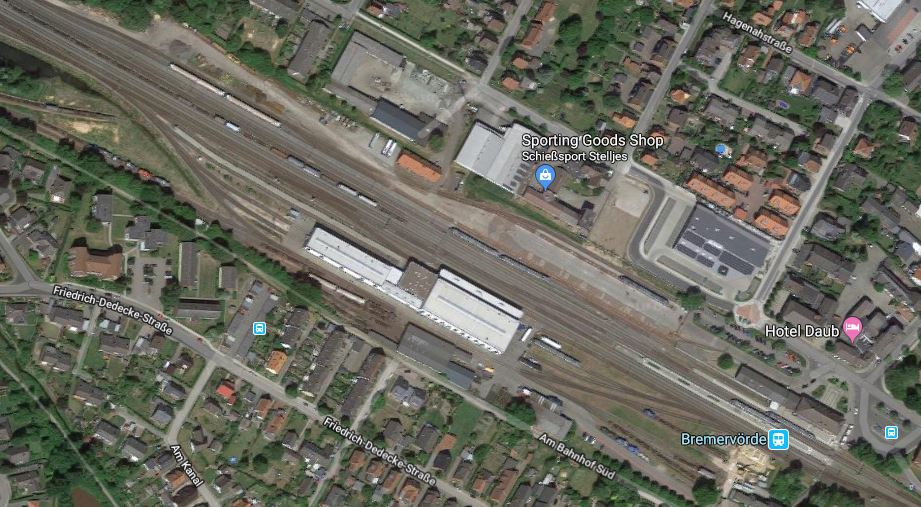
There appears to be a lot of space.
In this article on Railway Technology, which is entitled iLint: The World’s First Hydrogen-Powered Train, this is said.
As part of the deal, Alstom will provide maintenance for the trains over a 30-year period. Meanwhile, leading gas company Linde will supply hydrogen for the new trains and erect the first-ever hydrogen filling station for trains in Bremervörde. The plan is that hydrogen will be produced onsite via electrolysis and wind energy at a later stage of the project.
As I passed through Bremervörde station, on my trip to the line at the weekend, I took this picture.
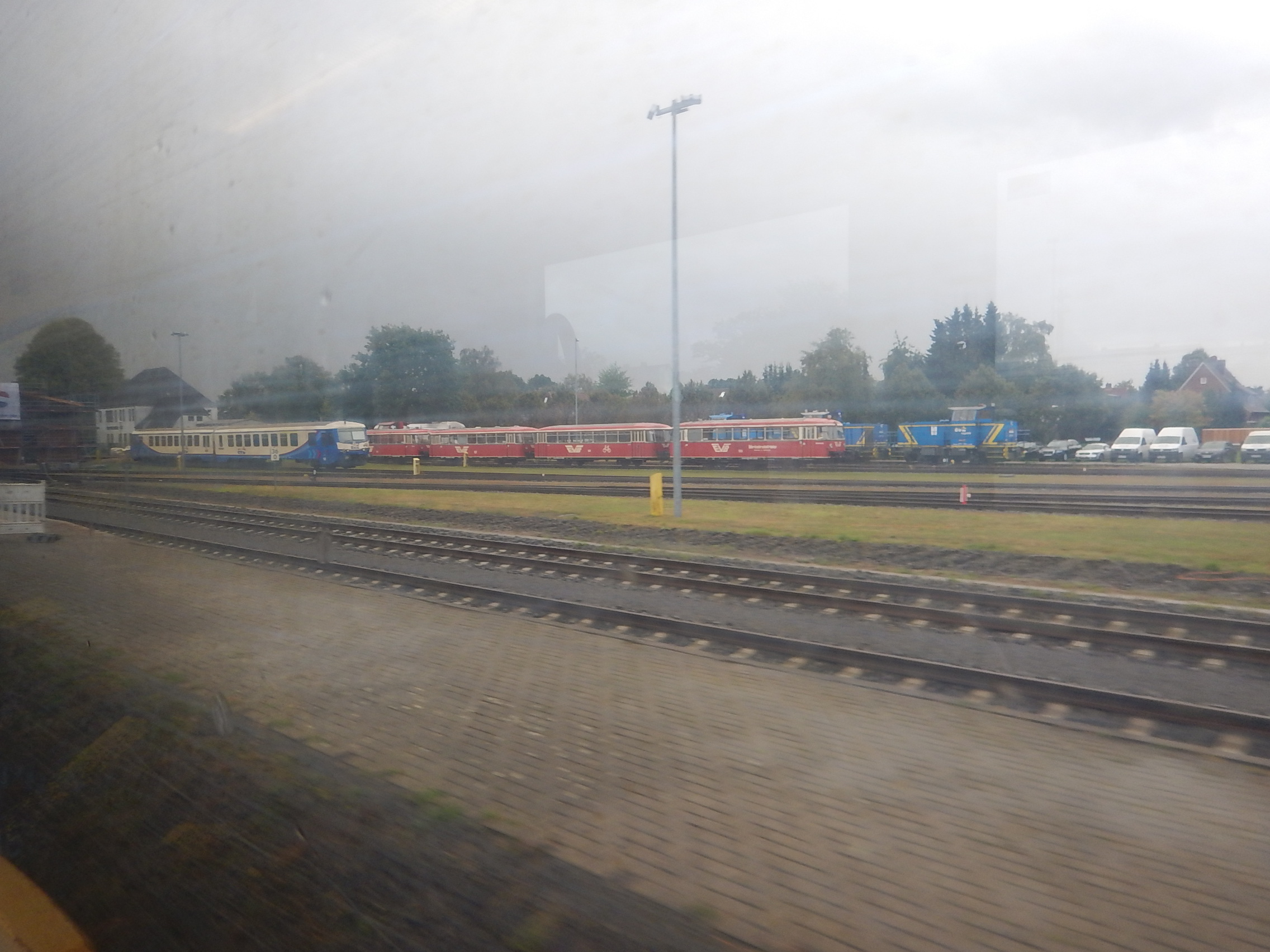
There would be plenty of space for the proposed hydrogen plant and to stable both the working fleet and any other trains, that were being tested for other places in Europe.
Linde would would only have to ensure that the hydrogen plant was sized for all future needs.
The Buxtehude To Cuxhaven Route
The route between Buxtehude and Cuxhaven has the following characteristics.
- It is about a hundred kilometres long.
- It is mainly single track except for the section through Bremerhaven, where it has at least two electrified tracks.
- There are passing places.
- The scheduled service is one train per hour (tph) in both directions.
- The line appears to have reasonably new signalling.
- There are numerous level crossings.
- I didn’t see any other traffic on the line, but I suspect there must be extra paths for freight, service trains, empty stock movements and a heritage service that uses part of the route.
I suspect that it could make an ideal test route, if extra trains could be squeezed in between the scheduled service.
Distance From the Salzgitter Factory
The Lint trains are built at in a factory at Salzgitter, which is between Hanover and Bruaunwieg, which is about four hours away.
The iLint trains could do this making their own small amounts of steam, but they would probably be dragged by a diesel locomotive.
Testing An Electric iLint
I think that we’ll eventually see a pantograph on the iLint, for one of three reasons.
- It would allow running on overhead electrification to charge the battery and reduce hydrogen consumption.
- It would allow creation of a diesel/electric hybrid version, that might be a lower capital cost alternative for shorter lines.
- It would create a battery.electric hybrid for short extension routes.
Alstom could possibly create a range of solutions for a wide range of applications.
The Buxtehade To Cuxhaven route includes a section of electrified line, which would surely be ideal for the testing of these trains.
Conclusion
I think that Alstom will use the route to test hydrogen-powered trains.
A Sighting Of The Two Coradia iLint Hydrogen Trains
I finally got to see the two Coradia iLint trains, parked at Bremervörde station.

On bahn.de they were talking about weather warnings, so perhaps Alstom and the operator were just being prudent. After all they didn’t want another Hindenburg disaster!
Not that there’s much chance of that these days when modern materials are used to build safe methods of hydrogen storage.
UK Hydrogen Train Demonstrator To Be Tested In 2019
The title of this post, is the same as that on this article on Railway Gazette.
This is the first two paragraphs.
A memorandum of understanding for the development of a hydrogen fuel cell demonstrator train was signed by leasing company Porterbrook and the University of Birmingham’s Centre for Railway Research & Education at InnoTrans on September 19.
Porterbrook is to provide an ex-Thameslink Class 319 25 kV 50 Hz/750 V DC third rail electric multiple-unit for the Hydro Flex project. The partners expect it to be equipped with a fuel cell system and ready for demonstration runs in mid-2019. It would retain the ability to use electrical power.
Action is certainly happening in the development of low-emission trains and it appears, that the train leasing companies are taking an active lead.
An Analysis Of The Route Between Buxtehude And Cuxhaven
Alstom have chosen the route between Buxtehude and Cuxhaven, as the launch route for their hydrogen-powered Coradia iLint train.
I’ll now look at the route.
Buxtehude Station
Buxtehude station is on the outskirts of Hamburg.
This Google Map shows the station.

Note.
- There is a double-track electrified line through the station.
- There appears to be a West-facing bay platform, which conveniently has what looks to be a train in DB red, in the platform.
Services at Buxtehude include.
- Line S3 of the Hamburg S-Bahn between Pinneberg and Stade. This line appears to be electrified with 15 KVAC overhead wires.
- Service RE 5 between Cuxhaven and Hamburg via Otterndorf, Stade and Buxtehude. This route is only electrified between Hamburg and Stade.
- Service RE 33 between Cuxhaven and Buxtehude via Bremerhaven and Bremervörde. This route is not electrified.
Service three is the one that from yesterday has been run by the Coradia iLint trains.
Between Buxtehude And Bremervörde
I followed this route in my helicopter and it is a single-track line through reasonably open country with in places trees along the line.
If this line was in the UK, it would be something like the Breckland Line or Great Eastern Main Line. through Norfolk, both of which have an operating speed of between 140-160 kph.
So I wouldn’t be surprised that the Coradia iLint could be almost at its maximum speed of 140 kph for long periods between stations.
Bremervörde Station
This Google Map shows Bremervörde station.
It would appear to be on a large site and there might even be a depot.
There’s certainly space to add a couple of large wind turbines to generate electricity, that could be used to create hydrogen through electrolysis.
Between Bremervörde And Bremerhafen HBf
As with the line to the East of Bremervörde, it is fairly straight across what appears to be fairly flat and through a mixture of open countryside and woodland.
This Google Map shows Bremerhafen Wulfdorf station.
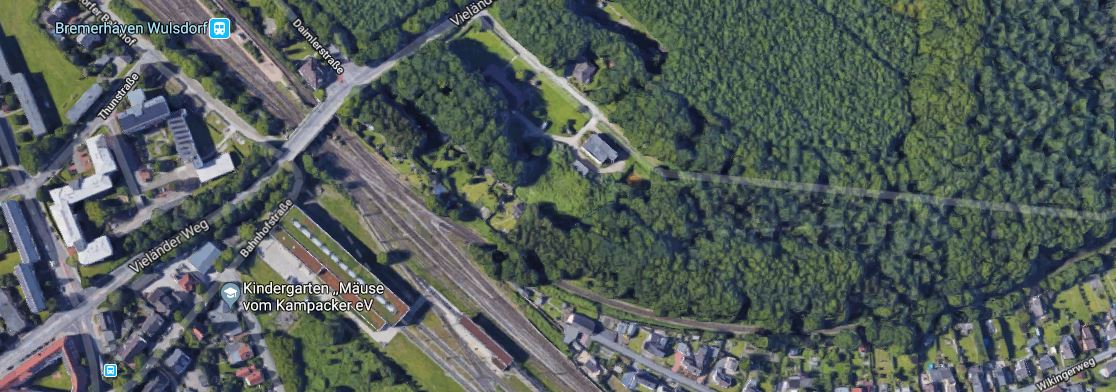
The line from Buxtehude can be seen joining from the East.
The line is electrified to Bremerhafen HBf station.
So will the Coradia iLint trains change to overhead power at Bremerhafen Wulfdorf?
From Bremerhafen HBf To Cuxhaven
This Google Map shows Bremerhaven HBf station.
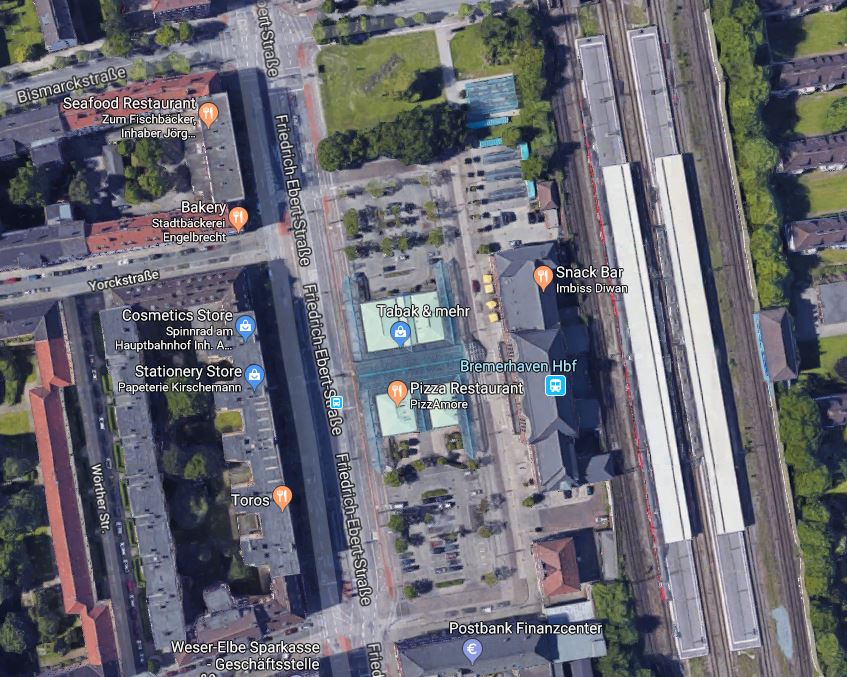
It looks to be a typical functional German station with four platforms, which are all electrified.
The electrification continues Northwards for a few kilometres, but once out of Bremerhaven, the line becomes single track without electrification.
I found this passing loop at the two-platform Dorum station, shown here on a Google Map.
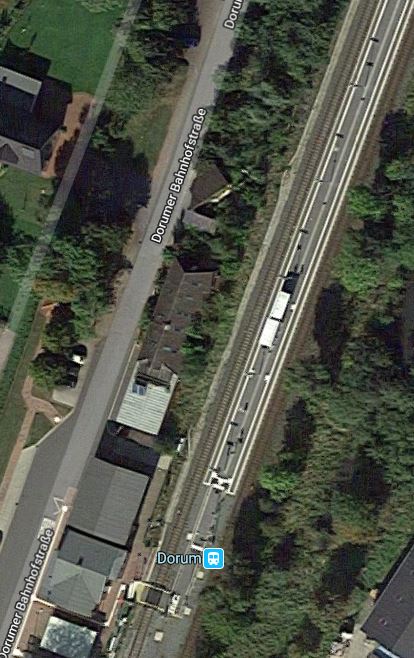
Note how the tracks go either side of an island platform.
I suspect there are other places for trains to pass or they could easily be created.
The route ends at Cuxhaven station, shown in this Google Map.
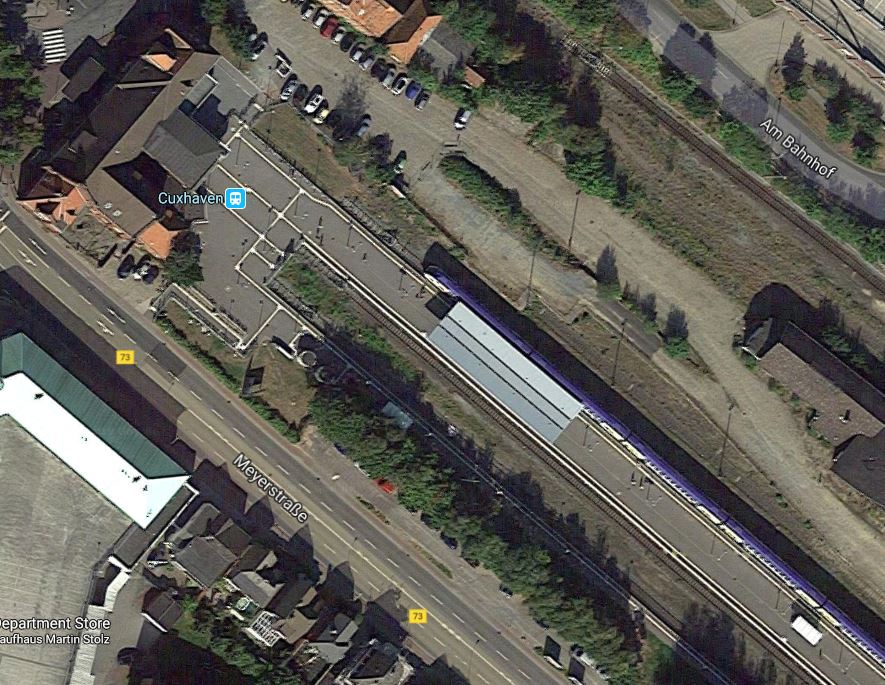
In addition to the service to Buxtehude, there is also a another service on a shorter and more direct route to Hamburg along the estuary of the River Elbe.
Summing up this section of the route.
- It is single-track with at least one passing loop.
- There are just four stations.
- It is electrified for a few miles at the Southern end.
I’ve also never seen a line with so many level crossings.
Services Between Cuxhaven And Buxtehude Via Bremerhaven HBf
The current service is hourly, with what looks to be these timings.
- Buxtehude to Bremerhaven HBf – 1:43 – Incldes 14 stops
- Bremerhaven HBf to Buxtehude – 1:37
- Bremerhaven HBf to Cuxhaven 0:51 – Includes 4 stops
- Cuxhaven to Bremerhaven HBf – 0:44
- Buxtehude to Cuxhaven – 2:34
- Cuxhaven to Buxtehude – 2:21
Turnrounds are the following times.
Buxtehute – 28 minutes
Cuxhaven – 12 minutes
This gives a round trip of five hours and thirty-five minutes.
So it would appear that at least five Coradia Lint 41 trains are needed to provide the service.
Coradia Lint Trains
From what I can find on the Internet, the Coradia Lint trains are diesel-mechanical units, where the wheels are driven directly from the two diesel engines.
I’m not sure, but the engines may be mounted under the cabs!
Coradia iLint Trains
I suspect that the hydrogen-powered iLint trains could be driven by simply replacing the diesel engine, with a suitable traction motor.
What surprises me, is that there appears to be no plans to fit a pantograph to the iLint, so that the intelligent brain on the train can use overhead electrification, when it exists.
This would mean that the range of the train on hydrogen would be increased, if the route was partially electrified.
Coradia iLint Trains Between Buxtehude to Cuxhaven
On the Buxtehude to Cuxhaven route, using electrification could be used to advantage to power the train and charge the batteries through Bremerhaven, where about ten kilometres is electrified using 15 KVAC overhead wires.
Also, in Buxtehude station, which has 15 KVAC electrification on other lines, the bay platform that it appears will be used for the hydrogen-powered trains could be electrified to charge the batteries, during the twenty-eight minutes, that the train is in the station. Perhaps, they could use a system such as I wrote about in Is This The Solution To A Charging Station For Battery Trains?
A similar system could be installed at Cuxhaven.
Surely, it is better to use the turnround times at each end of the route to charge the batteries, as this means less hydrogen will be consumed and the train’s range on a tankful will be increased!
There is an interesting comparison to be made here, with a route, I know well in the UK; Cambridge to Norwich.
- Both routes are around 100 km.
- Both routes are fairly flat and reasonably straight.
- The operating speed of the UK line is 140 kph and I suspect the German line is about the same.
- The UK line has six intermediate stops, whereas the German route has fourteen stops.
- Both lines are run by diesel trains with similar operating speeds.
But the UK route is timed at one hour and nineteen minutes, as opposed to the two hours thirty-four minutes of the German one.
The German route does have twelve more stops, but even if two minutes is allowed for each stop, that doesn’t explain the difference.
The German route must be run at a slower speed than the UK one.
As the Germans improve the speed, journey times will surely reduce.
Conclusion
I am led to the conclusion, that Buxtehude to Cuxhaven route is an ideal route on which to test hydrogen-powered trains, but that as the trains develop, journey times will reduce substantially.
Hydrogen Trains Have Arrived
According to this page on the Internet, Alstom launched the Coradia iLint today.
These are some of the pictures.


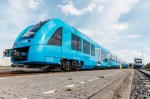
I shall go for a ride.
The web page says this about the test route.
On behalf of LNVG, the Coradia iLint trains will be operated on nearly 100km of line running between Cuxhaven, Bremerhaven, Bremervörde and Buxtehude, replacing EVB’s existing diesel fleet.
As Buxtehude is close to Hamburg, the easiest way to experience the trains would be to fly to Hamburg.
 The Anonymous Widower