Alstom Coradia iLint Hydrogen-Powered Train Video
I’ve just found this video from Alstom.
Intriguingly, the video was filmed at Braunschweig Hauptbahnhof, which is in another part of Germany, about two hundred kilometres to the South-East of Hamburg.
There does seem to be several local services radiating from the City on lines without electrification.
Hydrogen Trains To Be Trialled On The Midland Main Line
This article on Railway Gazette is entitled Bimode And Hydrogen Trains As Abellio Wins Next East Midlands Franchise.
Abellio will be taking over the franchise in August this year and although bi-mode trains were certain to be introduced in a couple of years, the trialling of hydrogen-powered trains is a surprise to me and possibly others.
This is all that is said in the article.
Abellio will also trial hydrogen fuel cell trains on the Midland Main Line.
It also says, that the new fleet will not be announced until the orders are finalised.
In this post, I’m assuming that the hydrogen trial will be performed using the main line trains.
Trains for the Midland Main Line will need to have the following properties
- 125 mph on electric power
- 125 mph on diesel power
- Ability to go at up to 140 mph, when idigital n-cab signalling is installed and the track is improved.
- UK gauge
- Ability to run on hydrogen at a future date.
I think there could be three types of train.
- A traditional bi-mode multiple unit, with underfloor engines like the Hitachi Class 800 series, is obviously a possibility.
- An electrical multiple unit, where one driving car is replaced by a bi-mode locomotive with appropriate power.
- Stadler or another manufacturer might opt for a train with a power pack in the middle.
The second option would effectively be a modern InterCity 225.
- South of Kettering, electricity would be used.
- North of Kettering, diesel would be used
- Hydrogen power could replace diesel power at some future date.
- Design could probably make the two cabs and their driving desks identical.
- The locomotive would be interchangeable with a driver car.
Bi-modes would work most services, with electric versions working to Corby at 125 mph.
Which manufacturer has a design for a 125 mph, hydrogen-powered train?
Alstom
Alstom have no 125 mph UK multiple unit and their Class 321 Hydogen train, is certainly not a 125 mph train and probably will still be under development.
Bombardier
In Mathematics Of A Bi-Mode Aventra With Batteries, I compared diesel and hydrogen-power on bi-mode Aventras and felt that hydrogen could be feasible.
In that post, I wrote a section called Diesel Or Hydrogen Power?, where I said this.
Could the better ambience be, because the train doesn’t use noisy and polluting diesel power, but clean hydrogen?
It’s a possibility, especially as Bombardier are Canadian, as are Ballard, who produce hydrogen fuel-cells with output between 100-200 kW.
Ballard’s fuel cells power some of London’s hydrogen buses.
The New Routemaster hybrid bus is powered by a 138 kW Cummins ISBe diesel engine and uses a 75 kWh lithium-ion battery, with the bus being driven by an electric motor.
If you sit in the back of one of these buses, you can sometimes hear the engine stop and start.
In the following calculations, I’m going to assume that the bi-mode |Aventra with batteries has a power source, that can provide up to 200 kW, in a fully-controlled manner
Ballard can do this power output with hydrogen and I’m sure that to do it with a diesel engine and alternator is not the most difficult problem in the world.
So are Bombardier designing the Bi-Mode Aventra With Batteries, so that at a later date it can be changed from diesel to hydrogen power?
All an Aventra needs to run is electricity and the train, the onboard staff and passengers don’t care whether it comes from overhead wires, third-rail, batteries, diesel or hydrogen.
Bombardier also have the technology for my proposed locomotive-based solution, where one driver-car of an Aventra is replaced by what is effectively a locomotive.
If Bombardier have a problem, it is that they have no small diesel train to replace Abellio’s small diesel trains. Could the longer services use the bi-mode Aventras and the shorter ones Aventras with battery power?
CAF
CAF probably have the technology, but there would be a lot of development work to do.
Hitachi
Hitachi have the bi-mode trains in the Class 802 trains, but haven’t as yet disclosed a hydrogen train.
Siemens
They’ve made a few noises, but I can’t see them producing a bi-mode train for 2022.
Stadler
In a few weeks time, I will be having a ride in a Stadler-built Class 755 train, run by Abellio Greater Anglia.
The Class 755 train is a bi-mode 100 mph train, from Stadler’s Flirt family.
Could it be stretched to a 125 mph train?
- Stadler have built 125 mph electric Flirts.
- It is my view, that Stadler have the knowledge to make 125 mph trains work.
- Flirts are available in any reasonable length.
- I’ve read that bi-mode and electric Flirts are very similar for drivers and operators.
These could work the Midland Main Line.
If the mainline version is possible, then Abellio could replace all their smaller diesel trains with appropriate Class 755 trains, just as they will be doing in East Anglia.
Stadler with the launch of the Class 93 locomotive, certainly have the technology for a locomotive-based solution.
East Midlands Railway would be an all-Stadler Flirt fleet.
As to hydrogen, Stadler are supplying hydrogen-powered trains for the Zillertalbahn, as I wrote in Zillertalbahn Orders Stadler Hydrogen-Powered Trains.
Talgo
Talgo could be the joker in the pack. They have the technology to build 125 mph bi-mode trains and are building a factory in Scotland.
My Selection
I think it comes down to a straight choice between Bombardier and Stadler.
It should also be noted, that Abellio has bought large fleets from both manufacturers for their franchises in the UK.
Zero-Carbon Pilots At Six Stations
This promise is stated in the franchise.
Once the electrification reaches Market Harborough in a couple of years, with new bi-mode trains, running on electricity, the following stations will not see any passenger trains, running their diesel engines.
- St. Pancras
- Luton Airport Parkway
- Luton
- Bedford
- Wellingborough
- Kettering
- Corby
- Market Harborough
These are not pilots, as they have been planned to happen, since the go-ahead for the wires to Market Harborough.
Other main line stations include.
- Beeston
- Chesterfield
- Derby
- East Midlands Parkway
- Leicester
- Long Eaaton
- Loughborough
- Nottingham
- Sheffield
Could these stations be ones, where East Midlands Railway will not be emitting any CO2?
For a bi-mode train to be compliant, it must be able to pass through the station using battery power alone.
- As the train decelerates, it charges the onboard batteries, using regernerative braking.
- Battery power is used whilst the train is in the station.
- Battery power is used to take the train out of the station.
Diesel power would only be used well outside of stations.
How would the trains for the secondary routes be emission-friendly?
- For the long Norwich to Derby and Nottingham to Liverpool routes, these would surely be run by shorter versions of the main line trains.
- For Stadler, if secondary routes were to be run using Class 755 trains, the battery option would be added, so that there was no need to run the diesel engines in stations.
- For Bombardier, they may offer battery Aventras or shortened bi-modes for the secondary routes, which could also be emission-free in stations.
- There is also the joker of Porterbrook’s battery-enhaced Class 350 train or BatteryFLEX.
I think that with the right rolling-stock, East Midlands Railway, could be able to avoid running diesel engines in all the stations, where they call.
Why Are Abellio Running A Hydrogen Trial?
This is a question that some might will ask, so I’m adding a few reasons.
A Train Manufacturer Wants To Test A Planned Hydrogen Train
I think that it could be likely, that a train manufacturer wants to trial a hydrogen-powered variant of a high-speed train.
Consider.
- The Midland Main Line is about 160 miles long.
- A lot of the route is quadruple-track.
- It is a 125 mph railway for a proportion of the route.
- It has only a few stops.
- It is reasonably straight with gentle curves.
- Part of the route is electrified.
- It is connected to London at one end.
In my view the Midland Main Line is an ideal test track for bi-mode high speed trains.
A Train Manufacturer Wants To Sell A Fleet Of High Speed Trains
If a train manufacturer said to Abellio, that the fleet of diesel bi-mode trains they are buying could be updated to zero-carbon hydrogen bi-modes in a few years, this could clinch the sale.
Helping with a trial, as Abellio did at Manningtree with Bombardier’s battery Class 379 train in 2015, is probably mutually-beneficial.
The Midland Main Line Will Never Be Fully Electrified
I believe that the Midland Main Line will never be fully-electrified.
- The line North of Derby runs through the Derwent Valley Mills World Heritage Site. Would UNESCO allow electrification?
- I have been told by drivers, that immediately South of Leicester station, there is a section, that would be very difficult to electrify.
- Some secondary routes like Corby to Leicester via Oakham might be left without electrification.
But on the other hand some sections will almost certainly be electrified.
- Around Toton, where High Speed Two crosses the Midland Main Line and the two routes will share East Midlands Hub station.
- Between Clay Cross North Junction and Sheffield, where the route will be shared with the Sheffield Spur of High Speed Two.
- The Erewash Valley Line, if High Speed Two trains use that route to Sheffield.
The Midland Main Line will continue to need bi-mode trains and in 2040, when the Government has said, that diesel will not be used on UK railways,
It is my view, that to run after 2040, there are only two current methods of zero-carbon propulsion; on the sections without overhead electrification battery or hydrogen power.
So we should run trials for both!
Abellio Know About Hydrogen
Abellio is Dutch and after my trip to the Netherlands last week, I wrote The Dutch Plan For Hydrogen, which describes how the Dutch are developing a green hydrogen economy, where the hydrogen is produced by electricity generated from wind power.
So by helping with the trial of hydrogen bi-mode trains on the Midland Main Line, are Abellio increasing their knowledge of the strengths and weaknesses of hydrogen-powered trains.
In Thoughts On Eurostar To North Netherlands And North West Germany, I proposed running bi-mode trains on the partially-electrified route between Amsterdam and Hamburg via Groningen and Bremen, which would be timed to connect to Eurostar’s services between London and Amsterdam. These could use diesel, hydrogen or battery power on the sections without electrification.
If hydrogen or battery power were to be used on the European bi-mode train, It would be possible to go between Sheffield and Hamburg on a zero-carbon basis, if all electric power to the route were to be provided from renewable sources.
Abellio Sees The PR Value In Running Zero-Carbon Trains
In My First Ride In An Alstom Coradia iLint, I talked about running hydrogen-powered trains on a hundred mile lines at 60 mph over the flat German countrside
The Midland Main Line is a real high speed railway, where trains go at up to 125 mph between two major cities, that are one-hundred-and-sixty miles apart.
Powered by hydrogen, this could be one of the world’s great railway journeys.
If hydrogen-power is successful, Abellio’s bottom line would benefit.
Conclusion
This franchise will be a big improvement in terms of carbon emissions.
As I said the choice of trains probably lies between Bombardier and Stadler.
But be prepared for a surprise.
The Dutch Plan For Hydrogen
The Dutch Plan For Hydrogen
I have cut this out of The Train Station At The Northern End Of The Netherlands, so don’t read if if you’ve read it before.
Searching Google for hydrogen around Groningen, I found this document on the Internet, which is entitled Green Hydrogen Economy In The Northern Netherlands.
It is a fascinating read about what you can do with hydrogen generated from wind and biomass.
This is a sentence from the document.
Large scale green hydrogen product.ion together with harbor transport and storage facilities will be located at Eemshaven, with green chemicals production in Delfzijl
It is an ambitious statement.
Eemshaven
It also appears that Eemshaven will be the main connection point for electricity from offshore wind farms. This is said.
In the Eemshaven an offshore electricity cable from Norway, the NorNed cable with a capacity of 700 MW, comes on land. The Cobra cable, with a capacity of 700 MW, from Denmark is foreseen to connect at the Eemshaven to the onshore grid. The Gemini wind farm is connected to the grid in the Eemshaven with a capacity of 600 MW. Within 10 years it is foreseen that another 4.000 MW offshore wind will have their electricity cable to the Eemshaven.
Does all this explain, the building of a station at Eemshaven? Delfzijl station was built in 1883 and has its own connection to Groningen.
The following proposed actions are from the document
Build A 1,000 MW Electrolysis Plant
This is an extract from the of the document.
A 1.000 MW electrolysis plant that runs 8.000 hours a year, uses 8 billion kWh and 1,5 million m3 pure water to produce 160 million kg Hydrogen. A reverse osmosis plant has to produce the 1.5 million m3 pure water, using sea water or surface water as input. If an electricity price of 2‐2,5 €ct/kWh and a total investment between 500 million and 1 billion Euro with a 10 year life time is assumed, a green hydrogen cost price around 2‐3 €/kg will be the result. This is about competitive with present hydrogen prices, produced from natural gas by steam reforming.
How much energy is contained in a Kg of hydrogen?
This page on IdealHY says the following.
Hydrogen is an excellent energy carrier with respect to weight. 1 kg of hydrogen contains 33.33 kWh of usable energy, whereas petrol and diesel only hold about 12 kWh/kg.
At three euros for a kilogram of hydrogen, that works out at nine euro cents for a kWh.
Build A 1000 MW Biomass Gasification Plant
The title is a section in the document and this is an extract from the section.
Green hydrogen can be produced by electrolysis using green electricity, but can be produced also from biomass via gasification. Biomass gasifiers use solid biomass as an input and deliver a green syngas, a mixture of hydrogen, carbon‐monoxide (CO) and carbon‐dioxide (CO2), and char as an output. The CO could be used, together with water (H2O), to produce extra hydrogen. The resulting products from biomass gasification are green hydrogen and CO2. However, from CO2 and green hydrogen every chemical product could be produced. Therefore, the combination of green hydrogen and CO2 or green syngas creates the opportunity for a fully green chemical industry in the Northern Netherlands.
The process is still being developed. My first question, is can you use animal manure as a feedstock? It should be noted that The Netherlands used to have a very large and smelly manure problem.
Offshore Hydrogen Production From Far Offshore Wind Farms
The title is a section in the document and this is an extract from the section.
Offshore wind farms produce electricity which can be brought onshore via an electricity cable. Such an offshore electricity cable is expensive. The farther offshore the wind farm is located the more expensive the electricity cable cost. At the North Sea, an alternative solution for these wind farms is to convert the electricity into hydrogen at an existing oil/gas platform and to transport this hydrogen eventually mixed with gas via an existing gas pipeline. Onshore the hydrogen is separated from the natural gas and cleaned to be transported via pipeline, ship or truck to the markets.
I think that the technology and existing infrastructure could be made to work successfully.
- Europe has over fifty years experience of handling offshore gas networks.
- Recent developments have seen the emergence of floating wind turbines.
- Would it be easier to refurbish redundant gas platforms and use them to collect electricity and create hydrogen, rather than demolish them?
- Hydrogen is only produced when the wind blows.
- There is no need to store electricity and we’ve been storing gas since the Victorians.
There will be problems, like the integrity of an ageing pipeline, but I suspect that the expertise to solve them exists.
Will there be a North Sea, where every part has a large wind farm?
Note that the Hornsea Wind Farm has an area of 1830 square miles and could generate around 6 GW, when fully developed.You could fit 120 wind farms of this size into the North Sea. Even if only a small proportion could be developed, a sizeable amount of hydrogen could be produced.
A Market For 300,000‐tonnes Green Methanol + 300,000‐tonnes Green Ammonia
The title is a section in the document and this is an extract from the section.
Hydrogen (H2) and Carbon‐dioxide (CO2) can be used in chemical processes to produce a wide variety of chemical products. Two of the main building blocks in chemistry are methanol and ammonia. Methanol can be produced from H2 and CO2. Ammonia is produced from H2 and nitrogen (N2), captured from the air.
Wind power and biomass have been used tp create the basic chemicals for the petro-chemical industry.
The Construction Of Green Hydrogen Fuel Cell Balanced Data Centres
The title is a section in the document and this is an extract from the section.
Google builds a very large data center in the Eemshaven, see picture below. The reasons for Google to choose for the Eemshaven are the existence of an offshore data cable, enough space and green electricity. Google as well as other companies that install and operate data centers wants to run on green electricity. Therefore, Google has signed a power purchase agreement with Eneco to buy green electricity for 10 years. For this reason, Eneco builds an onshore wind farm nearby. On a yearly average this wind farm produces enough electricity to meet the data center demand.
However, supply and demand are not at every time in balance. At moments that there is no wind, other power plants must take over the electricity supply. Now, these are fossil fired power plants.In future, these power plants will be closed and supply and demand needs to be balanced in another way. And of course, that needs to be done with renewable electricity. This can be done by fuel cells fueled with green hydrogen. Fuel cells can follow demand and supply variations very fast with high efficiencies. Fuel cells are quiet and have no emissions, except very clean, demineralized, water.
I like this concept.
Surely, we could build a few data centres in places like Lincolnshire.
Build A Pipeline To Rotterdam And Germany
The Dutch have ambitious plans to export the hydrogen.
Other Ideas
The report is full of clever ideas and I suggest you take the time to read it fully!
Hydrogen Trains In The Northern Netherlands
The document says this about trains powered by hydrogen fuel cells.
In the Northern Netherlands, 50 diesel trains are daily operated on non‐electric lines. These trains, operated by ARRIVA have two or three carriages and a power of 450‐600KW supplied by Diesel‐Electric engines. Fuel cell‐electric hydrogen trains could replace these diesel trains. Alstom is a company that builds these fuel cell hydrogen trains and will perform a test next year on the line Groningen‐Bremen. Because the depreciation time for trains is 25 years, not all trains will be bought new. Some trains may need to be retrofitted with fuel cell‐electric power supply, which is technically feasible. When all these 50 diesel trains are replaced an investment in new and retrofitted trains of about …? Million Euros is needed. The total hydrogen consumption of these trains is about 5,000 ton.
These points are shown in a table.
- Total (diesel) trains in the Northern Netherlands is 50 units
- Hydrogen consumption approximately 25 kg H2/100km
- Train operations average 6 days per week. Train is operated approximately 1.200 km per day, based on two times per hour per trajectory of 50km.
- Train operations average 6 days per week. 330 days per year.
- Capital expenditure per train approximately …. ? 50 Units …? Million Euro
- 50,000 tonnes of hydrogen will be needed.
- The fuel bill at three euros a Kg will be 150 million euro.
Would this be economic?
From various comments, I suspect that Stadler are working on a hydrogen-powered GTW.
But failing that, as Stadler are developing a diesel/electric/battery Flirt for the South Wales Metro and some of the routes from Groningen are only about 30 km, I wouldn’t be surprised to see diesel/electric/battery GTWs running across the flat lands of the North.
Battery trains could be fitted with pantographs and recharge in Groningen, where most of the platforms are electrified.
There are a lot of possibilities and engineers will come up with the best solution with regards to operation and economics.
Conclusion
Thr Dutch have big plans for a hydrogen-based economy in the North of the Netherlands.
Where is the UK Government’s master plan for hydrogen?
My First Ride In An Alstom Coradia iLint
I’m finally, riding in a hydrogen-powered Alstom Coradia iLint train through the German countryside.

Not as quiet as the two battery trains, I’ve ridden, but that’s because It feels to me that the traction motors are crudely under the passengers and cardan shafts are used to drive the wheels!
Battery electric trains with regenerative braking should be virtually free of any mechanical noise. Both the Class 379 and Class 230 battery demonstrators were almost silent. As electricity generated from hydrogen doesn’t appear to generate much noise, then a hydrogen-powered train can also be almost silent.
From talking to fellow passengers, it would appear that the train has been very reliable in service.
Alstom are proving hydrogen would work well in a train designed for that purpose, but updating a DMU with a mechanical transmission, possibly isn’t the way to go.
Class 321 Breeze Train
I think that the Class 321 Breeze train will be quieter and faster.
It appears too, that if Alstom’s conversion follows the design of the Class 321 Renatus, the train will have a totally flat floor.
Come to think of it, I can’t think of a train running in the UK, that doesn’t have a totally flat floor!
The iLint, like the Lint has several sets of steps.
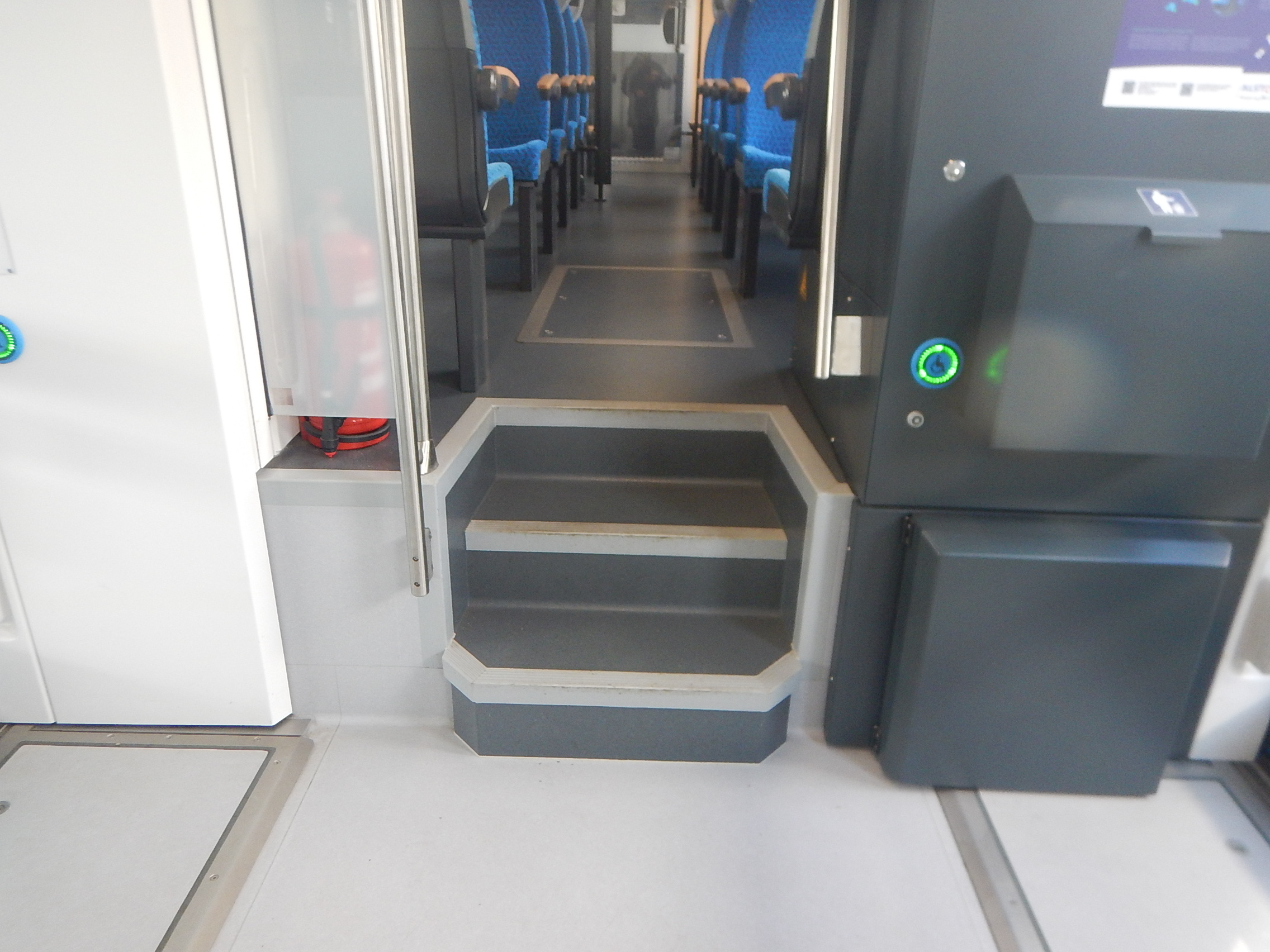
These are not acceptable in a modern train, bus or tram.
Lint 41 And iLint Compared
It is interesting to compare the iLint with the current diesel Lint 41s on the route.
- The iLint is faster and may accelerate better.
- The iLint is based on the bigger Lint 54, so it has more seats and two doors instead of one on each side of the cars.
- The newer iLint appears to have a higher quality interior.
I feel that the iLint will be quicker on a real.route.
The Future Of Buxtehude And Cuxhaven
Currently, to go between Buxtehude and Cuxhaven and back to Buxtehude takes around five hours. So that means the current hourly service needs five trains.
But if the iLint could do a round trip in four hours, the number of trains would be teduced to four.
If to increase capacity, all trains were pairs of iLints, the number of trains required would be eight.
Supposing it was required to double frequency, this would mean sixteen trains would be needed!
And how many trains have been ordered? Sixteen!
Coincidence or good planning?
Publicising The Achievement
When Bombardier created the Class 379 IPEMU, they made certain that there was a lot of local publicity including a report on BBC Look East.
I made a point of asking local residents about the train and no-one had heard of it. Although, I must say that students who regularly used the train, were very much in favour.
This was the only information, I found about the train.
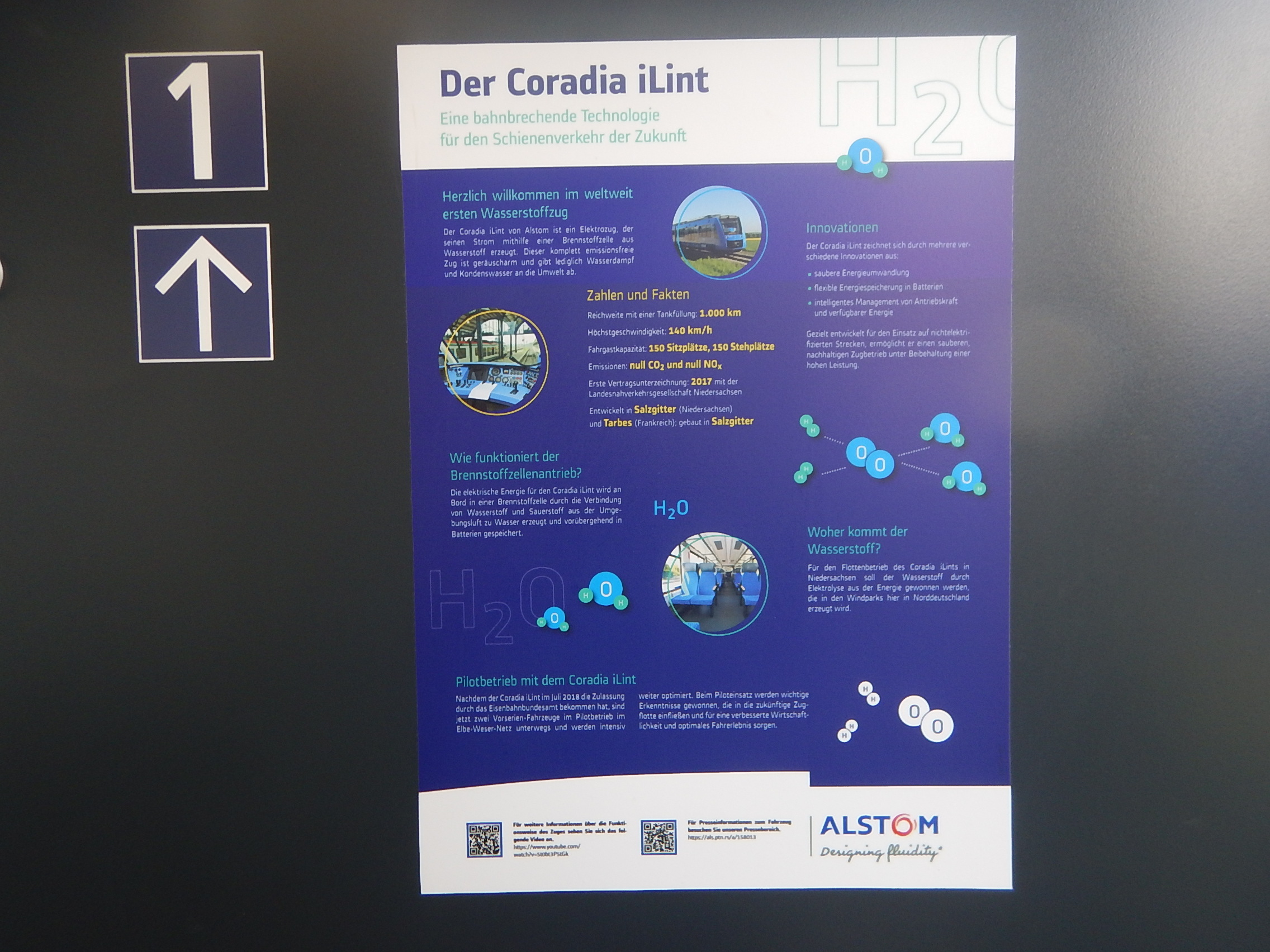
It was only in German, which I can read,. But surely, such an important achievement deserves better publicity and explanation in perhaps German, English and French.
Conclusion
Alstom have proved that hydrogen-power is possible in a smaller train, suitable for regional routes.
My reservations are totally about the Lint, which is an inferior train compared to many others that I’ve ridden in the UK and Europe.
I wouldn’t like to use the train in a wheel-chair!
The next generation of purpose-built trains with hydrogen power will be much better!
Is This Stadler’s Plan For A Multi-Mode Future?
We have not seen any of Stadler’s bi-mode Flirts in service yet although Greater Anglia’a Class 755 trains have been rumoured to be speeding between London and Norwich in ninety minutes from this May!
Today, I rode on one of Stadler’s diesel GTWs between Groningen and Eemshaven in the Netherlands, which I wrote about in The Train Station At The Northern End Of The Netherlands.
GTWs are a diesel electric train with a power-pack car in the middle of the three car train. The diesel electric Flirts are a later train with a similar layout to the GTW.
So are the diesel GTWs and Flirts just a bi-mode without a pantograph? Or more likely the bi-mode is a diesel electric train with the addition of a pantograph and extra electrical gubbins.
Looking at the visualisations on Wikipedia of the bi-mode Class 755 train and the all-electric Class 745 train, it appears that the next-to-end car has the pantograph.
Are these cars with the pantograph identical on both the bi-mode and the all-electric versions? It would certainly be sensible from a engine erring point of view.
So could it be that all that is needed to convert a diesel electric Flirt into a bi-mode Flirt is to add the pantograph car and swap the power pack car for a bi-mode one? The old power pack car could then be converted into another bi-mode power pack car to convert another train.
But the power pack cars are not as simple as they look. They have four slots for diesel engines. Three-car and four-car Class 755 trains have two and four engines respectively.
I believe that one or more of the slots can be filled with a battery to create Flirts like the tri-mode ones proposed for South Wales.
So could we see some of the Greater Anglia Flirts converted in this way? Surely, Colchester Town to Sudbury could be a service that could benefit from battery power West of Marks Tey?
Today, I had a chat with a GTW driver, who said that the train he’d been driving was diesel-electric and that he had heard that batteries or hydrogen power could be used on the eoute.
The lines around Groningen seem to employ quite a few GTWs and distances are not overly long. So could some be converted to 1500 VDC electric/diesel/battery tri-modes? There is electrification at Groningen station and some of the bay platforms used by GTWs already have wires.
If the conversion is successful, then Stadler could be on a Swiss roll, as there are a lot of GTWs and Flirts out there, many of which are diesel-electric, like the one I rode today.
Would a train operator prefer to upgrade a diesel electric train that works well or buy a new bi-mode from another train manufacturer?
Could also an electric Flirt be converted into a bi-mode, by splitting the train and sticking a power pack car in the middle. Engineering common sense says that the passenger cars must be very similar to those of diesel Flirts to simplify manufacture of the trains.
We already know, that four-car Flirts are only three-car trains with an extra passenger car. Stadler could mix-and-match passenger, pantograph and power pack cars to give operators what they need.
Intelligent computer software would choose which power option to be used and the driver would just monitor, that the train was behaving as needed.
Looking at my route yesterday between Groningen and Eemshaven, it is a route of just under forty kilometres or twenty-five miles. Adrian Shooter is talking of ranges of sixty miles with battery versions of Class 230 trains. So I don’t find it impossible to create a tri-mode GTW or Flirt for this lonely route at the very North of the Netherlands.
Conclusion
Stadler seem to have created a very imitative modular train concept.
As some Flirts can travel at 125 mph, could they be serious bidders to provide the new trains for the Midland Main Line?
Ashington Blyth and Tyne Line Reopening Mulled Over In Six ‘Quick Win’ Rail Projects For Northern Transport
The title of this post is the same as that of this article on Rail Technology Magazine.
This is the first paragraph.
A series of ‘quick wins’ have been identified to fix the “current crisis” in the north’s transport network in a report by the IPPR.
What are the quick wins?
This page on the IPPR website gives access to the report which is entitled Quick Wins For The North’s Transport Network.
These quick wins are given in the report.
Reopening Of The Ashington, Blyth And Tyne Railway Or Northumberland Line For Passenger Services
This summary is given.
North of Newcastle, and along the North East coast, there is an area with great potential but numerous challenges. This area contains several small and medium-sized towns: Blyth (population 37,000) and Ashington (population 28,000) are the largest (Centre for Towns 2017). The public sector dominates in terms of employment (education, health and public administration provide one-quarter of jobs), and the areas’ private sector is largely in the ‘everyday economy’ of retail (5,900 jobs) and food and beverage services (4,130 jobs) (ONS 2018c). The Port of Blyth handles 2 million tonnes of freight each year, and there are some significant development sites for renewable energy in the area (Port of Blyth 2018).
The history of the area is a vital consideration for its transport infrastructure. The area boomed during the industrial revolution as coal mining and port towns grew – Ashington was once considered the world’s largest coal-mining village (Whitfield 2018). The Ashington-Blyth and Tyne railway line once connected a number of Northumberland settlements between Ashington and Newcastle – it was not a single route, but a small network, built in 1840 to link the collieries to the River Tyne, and was opened up to passengers in 1841 (NCC 2015). But in 1964, passenger services were withdrawn under the ‘Beeching Axe’,although it has remained open for freight.
This idea has been talked about for years and I wrote about it in Northumberland Unveils £3.5m Rail Project To Bring Back Passenger Services.
This is a project, where it is probably time to stop talking and get the planning started, before updating the railways.
Surely, if it can be done for £3.5m, it must be good value. I suspect it will cost more, but not as much as Network Rail’s estimate of £191m.
Leeds/Bradford Airport Parkway Rail Station
Consider.
- Leeds Bradford Airport handles four million passengers per year.
- It has no direct rail access.
- It has direct services to airports like New York.
- It connects via hub airports like Heathrow and Schipol to a wide number of destinations.
- It could capture more of the localo air passengers with better connections.
The proposal is to build a Parkway station the Harrogate Line, between Horsforth station and Bramhope Tunnel.
- It would be a 1.3 kilometre drive in a shuttle bus to the Airport.
- The station would serve as a Park-and-Ride station for Leeds, Harrogate and other destinations.
This Google Map shows the area.
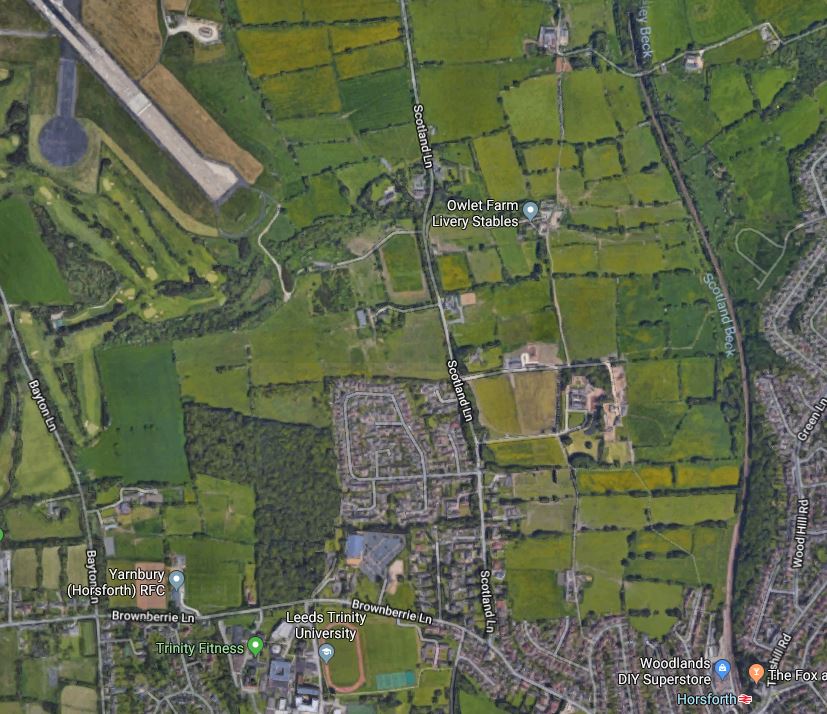
Note.
- The Airport is in the North-West corner.
- Horsforth station is in the South-East corner.
- The Harrogate Line runs North South from Horsforth station.
The new Park-and-Ride station could be built on any convenient location near to the Airport.
It looks to be a simple plan, that has been costed at £23m.
Consider these points about the Harrogate Line.
- It is only thirty-six miles.
- Services take around seventy minutes between Leeds and York via Harrogate
- It appears to be double-track
- The operating speed is sixty mph between Leeds and Harrogate.
- It doesn’t appear to be very busy.
I suspect it would be a good idea to iimprove this line, so that Northern’s Class 170 trains can stretch their legs.
If there was a Park-and-Ride station at Leeds Bradford Airport would First TransPennine want to run a service to the Airport?
I can see this plan, stimulating a lot of rail improvements between Leeds and York.
Supporting The Development Of Hydrogen Trains
The IPPR report says this.
Transport for the North plans to work toward the roll-out of hydrogen trains.
Consider.
- The North has a lot of routes, where hydrogen-powered trains could be used.
- Alstom are converting trains to hydrogen-power at Widnes in the North-West.
- Hydrogen is or can be produced by petro-chemical companies in the North.
I feel that increasingly, the North will have another big problem, for which hydrogen could be a solution.
Currently, there is a massive expansion of offshore windpower, which will produce a lot of electricity at awkward and random times, when it won’t have an obvious use.
So it will need to be stored!
One sensible method energy storage is to use the electricity to electrolyse water or brine to produce hydrogen and other gases. The hydrogen is then stored and can be burnt or used in a fuel cell to generate heat and/or electricity.
I can see a lot of innovation being employed to create hydrogen filling stations for users, such as companies with large fleets of smaller vehicles, railway companies, emergency power sup lies and other applications.
Unlike the production of hydrogen using steam-reforming of methane, electrolysis using renewable energy doesn’t produce any carbon dioxide.
Tees Valley Rail Interventions
The report talks of these interventions.
- Darlington station upgrade.
- Middlesbrough station upgrade.
- Teesport To Northallerton gauge clearance.
One of the main reasons for doing this, is that it will improve access to Teesport, which will bring wide benefits to the North.
Integration Of Traffic Management To Improve Air Quality
This is from the report.
Air quality is a major health problem across the world – especially in major cities. Vehicle emissions are the major contributor to this problem – particulate matter and nitrogen oxides cause numerous health problems, including asthma and lung cancer. Road transport accounts for at least 50 per cent of these emissions – and this is likely to be an underestimate (Cox and Goggins 2018). Clearly the volume of traffic is the principal cause, but so is the ‘stop/start’ of traffic flows, which tends to further increase emissions (O’Brien et al 2014). Exhaust fumes aren’t the only source – 60 per cent of particulate matter emissions come from the tyres and brakes.
Suggestions to reduce emissions include.
- Freight priority schemes
- Bus or cycle priority at signals to encourage transport modal change.
- Change signal timings to improve air quality
- Inform the public to change travel plans when air quality is poor.
- Low emission zones
Some of these measures will go down like a lead balloon.
Tees Crossing
This is from the report.
Roads are essential for the internal operation of Tees Valley’s economy and in order to connect it to the wider North. Passenger rail connectivity remains poor and light rail is non-existent. The economy’s residential and employment centres are highly dispersed across its geography. A modern bus network might relieve pressure, but the deregulated and underfunded network has seen passenger numbers fall and services cut (Brown 2018). The level of freight activity in Teesport and Hartlepool mean that these ports are highly dependent on the road network as well as rail.
The proposed solution js to build another road bridge across the Tees.
Conclusion
It seems a package of sensible measures, but opposition to some may ean they are not implemented.
Vivarail Spearheads Development Of Green Fuel Technologies
The title of this post is the same as that of this press release from Vivarail.
The press release describes and shows visuals of their new hydrogen-powered Class 230 train.
These are a few points from the press release.
A Four-Car Train
This is said about the basic philosophy of the design.
Vivarail’s on-going success in launching new technologies to the UK market means it is the only train manufacturer with a fully approved base train to work from. The hydrogen train will follow the design of the Transport for Wales fleet with two driving motor cars powered by Hoppecke batteries, the only difference being that instead of a diesel genset beneath the intermediate car the hydrogen train will have two carriages housing the fuel cells and hydrogen tanks.
Building on an approved base train must be the way to go.
Underfloor Power
This is said about the position of the hydrogen tanks and the fuel cells.
Unlike other trains the Vivarail Class 230s will store all the equipment beneath the floor making a much more stream-lined and efficient vehicle able to carry more passengers and deliver faster journey times.
I would suspect that Vivarail have designed tanks and fuel cells, that take up less space.
Modular Design
The design appears to be modular from this extract.
Vivarail’s standard modular power pack designs allow easy transition from one power source to another – in this case simply adapting a genset to a fuel cell. Both sit in the same space envelope beneath the train and indeed a train built as a diesel unit could be converted to run with hydrogen if required.
Would you design it, any other way?
Range Of 650 Miles
This is a thousand kilometres and seems to be the design range of most hydrogen trains.
Class-Leading Acceleration
It is a good idea to look at the ratio of weight to length of a basic trains, that will be converted to hydrogen power.
- Alstom – The Class 321 train has a figure of 1.72 tonnes/metre.
- Vivarail – The D78 Stock train has a figure of s 1.32 tonnes/metre.
The difference is probably because the D78 Stock is built from aluminium.
Keeping the weight down is a good way to increase the rate of acceleration.
Regenerative Braking
Why would you design a train without it?
Conclusion
The only supplier mentioned in the press release is Hoppecke, who will be making the batteries.
It looks to me that Vivarail have looked at every component for a hydrogen train and chosen the best ones with respect to performance, size and weight.
I shall be looking forward to taking a ride!
A Visualisation Of An Alstom Breeze Hydrogen-Powered Train
I have found a visualisation of an Alstom Breeze hydrogen-powered train on Twitter.
Hydrogen For Hydrogen-Powered Trains And Other Vehicles
I have received e-mails worrying about how hydrogen-powered trains and other vehicles, like buses and trucks, will get the fuel they need.
Production Of Hydrogen
There are two major methods of producing large quantities of hydrogen.
Steam Reforming Of Natural Gas
Steam reforming is used to convert natural gas into hydrogen by using high temperature and pressure steam in the presence of a nickel catalyst.
This section in Wikipedia is entitled Industrial Reforming, says this.
Steam reforming of natural gas is the most common method of producing commercial bulk hydrogen at about 95% of the world production of 500 billion m3 in 1998. Hydrogen is used in the industrial synthesis of ammonia and other chemicals. At high temperatures (700 – 1100 °C) and in the presence of a metal-based catalyst (nickel), steam reacts with methane to yield carbon monoxide and hydrogen.
It gives this chemical equation for the reaction.
CH4 + H2O ⇌ CO + 3 H2
I have two questions about steam reforming.
- How much fossil fuel energy is needed to create the high temperatures and pressures to make the process work?
- What happens to the carbon monoxide (CO)? Is it burnt to provide heat, thus producing more carbon dioxide (CO2)?
I therefor question the use of steam reforming to produce hydrogen for vehicles, especially, as a system might be required to be installed in a train, bus or freight depot.
The only time, where steam reforming could be used, is where an existing refinery producing large quantities of hydrogen by the process is close TO the point of use.
Electrolysis Of Water Or Brine
It is fifty years, since I worked in the chlorine-cell rooms of ICI’s Castner-Kellner chemical complex at Runcorn.
The process used was the Castner-Kellner Process and this is the first paragraph of the Wikipedia entry.
The Castner–Kellner process is a method of electrolysis on an aqueous alkali chloride solution (usually sodium chloride solution) to produce the corresponding alkali hydroxide, invented by American Hamilton Castner and Austrian Karl Kellner in the 1890s.
Brine from Cheshire’s extensive salt deposits is electrolysed using a graphite anode and a mercury cathode to produce chlorine, hydrogen, sodium hydroxide and sodium metal.
Large amounts of electricity are needed, but the biggest problem is the poisonous mercury used in the process.
My work incidentally concerned measuring the mercury in the air of the plant.
Since the 1960s, the technology has moved on, and ICI’s successor INEOS, still produces large quantities of chlorine at Runcorn using electrolysis.
More environmentally-friendly processes such as membrane cell electrolysis are now available, which produce chlorine, hydrogen and sodium hydroxide.
In the 1960s, the production of chlorine and hydrogen was a 24/7 process and I would suspect that INEOS have a good deal to use electricity from wind and other sources in the middle of the night.
The Future Of Hydrogen
Hydrogen is a clean fuel, that when it burns to produce heat or is used in a fuel cell to produce electricity, only produces steam or water.
There is also a lot of research going into hydrogen fuel-cells, hydrogen storage and batteries, and some of this will lead to innovative use of hydrogen as a fuel.
As an example, there is a growing market for fuel-cell forklifts. The first one was built in 1960, so fifty years from idea to fulfilment seems about right.
How many other applications of hydrogen will be commonplace in ten years?
- City buses
- Local delivery vans for companies like Royal Mail and UPS.
- Taxis
- Refuse trucks
I also think, some surprising applications will emerge driven by the need to clean up the air in polluted cities.
Ideally, these applications will need a hydrogen filling station at the depot.
Modern electrolysis technologies should lead to the development of simple cells, for the electrolysis of water to produce hydrogen and oxygen.
Powered by renewable energy sources or nuclear, this technology could be used to create zero-carbon hydrogen at the point of use.
Diesel Or Hydrogen?
The diesel engine in a New Routemaster bus is a Cummins diesel with these characteristics.
- 4.5 litre
- 138 kW
- 400 Kg
So how much would a 150 kW fuel-cell weigh?
A Ballard FCveloCity-HD, which is capable of producing 100 kW, weighs around 300 Kg.
I feel that as hydrogen and battery technology improves, that more and more city vehicles will be hydrogen-powered.
Hyundai Launch A Hydrogen-Powered Truck
This page on the Hyundai web site is entitled Hyundai Motor Presents First Look At Truck With Fuel Cell Powertrain.
It will be launched this year and looks impressive. Other articles say they have tied up with a Swiss fuel-cell manufacturer called H2 Power and aim to sell a thousand hydrogen-powered trucks in Switzerland.

