Hydrogen Trains Ready To Steam Ahead
The title of this post is the same as that of an article in today’s copy of The Times.
This is the first two paragraphs.
Hydrogen trains will be introduced in as little as two years under ambitious plans to phase out dirty diesel engines.
The trains, which are almost silent and have zero emissions, will operate at speeds of up to 90 mph and release steam only as a by-product. The new trains, which will be called “Breeze” will be employed on commuter and suburban lines by early 2021.
From the article and other published sources like Wikipedia, I can say the following.
Train Formation
The formation of some of the current Class 321 trains is as follows.
DTSO(A)+TSO+MSO+DTSO(B)
Note.
- The two DTSO cars are identical and are Driving Trailer Standard Open cars.
- The TSO car is a Trailer Standard Open car.
- The MSO car is a Motor Standard Open, which contains the four traction motors, the pantograph and all the electrical gubbins.
The refurbished Class 321 Renatus train has a new AC traction system.
In the past, the Trailer car has been removed from some of these trains, to make a three-car Class 320 train, which has this formation.
DTSO(A)+MSO+DTSO(B)
The Times says this about the formation of the hydrogen trains.
New images released by Alstom show that the existing four-carriage 321s will be reduced to three as part of the conversion process, which will be carried out at the company’s plant in Widnes, Cheshire. The front and rear third of the train will be used to house hydrogen gas storage tanks.
It would appear to me that Alstom have decided to go down a route based on the proven Class 320 train.
The TSO car will be removed and the existing or re-tractioned MSO car will be sandwiched between two rebuilt DTSO cars containing large hydrogen tanks and the hydrogen fuel cells to generate the electricity to power the train.
Although, Alstom’s pictures show a three-car train, I can’t see any reason, why a four-car train would not be possible, with the addition of a TSO car.
The train would obviously need to have enough power.
But then a standard Class 321 train is no wimp with a 100 mph operating speed and one MW of power, which is a power level not far short of the 1.68 MW of a modern four-car Class 387 train.
The MSO Car
You could almost consider that a Class 321 train is an MSO car, with a Driving Trailer car on either side and an extra Trailer car to make a four-car train.
In an original Class 321 train, the MSO car has the following.
- Two motored bogies, each with two traction motors.
- A pantograph on the roof to pick up the 25 KVAC overhead power.
- A transformer and the other electrical gubbins.
This picture shows the side view of an MSO car in an unmodified Class 321 train.
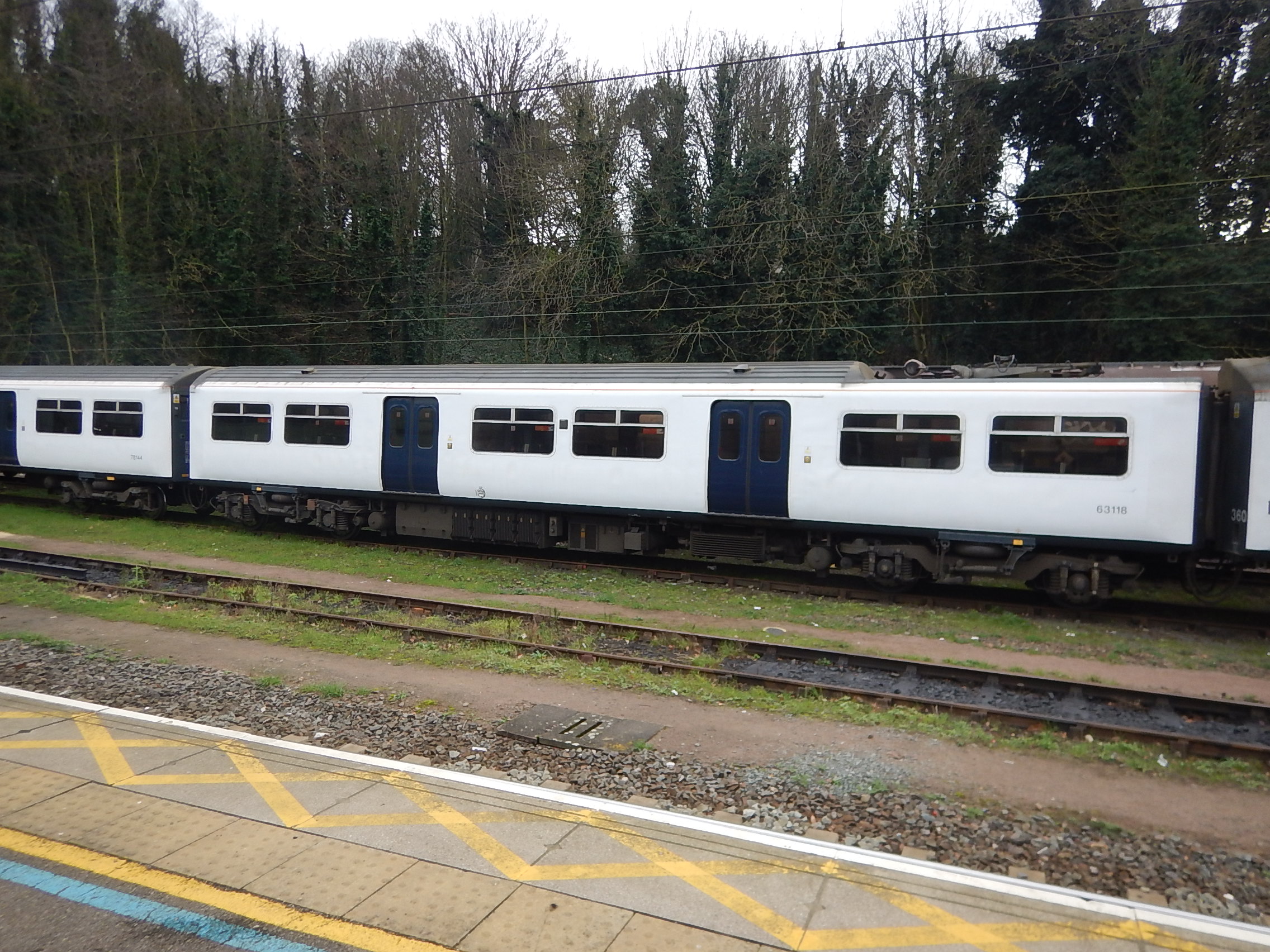
It does appear to be rather full under the MSO car, but I suspect, that modern AC equipment will take up less space. Although, the air-conditioning will have to be squeezed in.
Some if not all cars are labelled as PMSO, to indicate they have the train’s pantograph.
British Rail designed a lot of Mark 3 coach-based Electric Multiple Units like this, with a power car in the middle and trailer cars on either side. For instance, the legendary Class 442 train, is of five cars, with all the traction motors and electrical gear in the middle car. It still holds the speed record for third-rail-powered trains. British Rail certainly got the dynamics right.
The upgraded Class 321 Renatus trains have a new AC traction system.
- This will be state-of-the-art, more efficient and probably more reliable.
- New traction motors handle regenerative braking.
But is it more powerful than the original system?
If it was, it would give better acceleration.
This modern traction system will probably be a starting point for the electrical system of a hydrogen-powered Class 321 train.
It would have to be able to accept electrical power from the following sources.
- The pantograph, when connected to the 25 KVAC overhead electrification.
- The two Driving Trailer Standard Open cars with their hydrogen tanks and fuel-cells..
The voltages will probably be different, but this should not be a problem for a modern well-designed electrical system.
Batteries And Regenerative Braking
The Times has a graphic, which shows a part-cutaway of the train.
There is an arrow and explanation labelled Traction System, where this is said.
Ensures appropriate energy is transmitted between fuel cell and battery. Drives wheels and collects energy during braking.
I would suspect that a single battery would be placed in the MSO car, so that the battery could be close to the traction motors under the car.
Battery Size Calculation
The battery should be big enough to handle the energy generated when braking from the train’s maximum speed.
Obviously, Alstom have not disclosed the weight of the train, but a three-car Class 320 train, which is a Class 321 train without the trailer car, weighs 114.5 tonnes and has 213 seats. So I suspect that because of the hydrogen tanks, there will be about 140 seats in the hydrogen-powered train. So could it hold 300 passengers with the addition of standees?
I don’t know how much a hydrogen tank weighs, but I suspect it is more bulky than heavy.
Fuel cells of the required size, seem to weigh in the order of hundreds of kilograms rather than tonnes.
So I think I will assume the following for my kinetic energy calculation.
- A 200 tonne train
- 300 passengers at 90 Kg each with baggage, bikes and buggies.
- A speed of 87 mph.
This gives a 227 tonne train, when fully loaded.
Omni’s Kinetic Energy Calculator gives a kinetic energy of just under 50 kWh.
So this amount of energy will be needed to accelerate the train to the operating speed and could be substantially recovered at a station stop from the operating speed.
As the train will also need hotel power for doors, air-conditioning and other train systems, a battery of perhaps around 100 kWh would give enough power.
Obviously, Alstom will have done a complete computer simulation, they will have much better and more accurate figures.
As 50 kWh traction batteries are of the size of a large suitcase, I doubt there would be a problem putting enough battery capacity in the MSO car.
Obviously, these are very rough calculations, but it does appear that with modern lightweight tanks, hydrogen trains are feasible, with readily-available components.
But then Alstom have already converted a Coradia Lint to hydrogen power.
Will The Train Be A Series Hybrid?
In a series hybrid, like a New Routemaster bus, the vehicle is driven by an electric motor, powered by a battery, which in the case of the bus is charged by a small diesel engine. Braking energy is also recycled to the battery.
In Alstom’s Breeze train, the traction motors in the MSO car would be connected to the battery.
When the power in the battery is low, the train’s computer will top up the battery from the overhead electrification, if it is available or use the hydrogen fuel cells.
I suspect the computer would always leave enough spare capacity in the battery to accommodate the energy generated during braking.
Passenger Capacity and Range
I have estimated that the passenger capacity of the train is around three hundred.
This picture from Alstom, shows a side view of one DTSO car of the train.
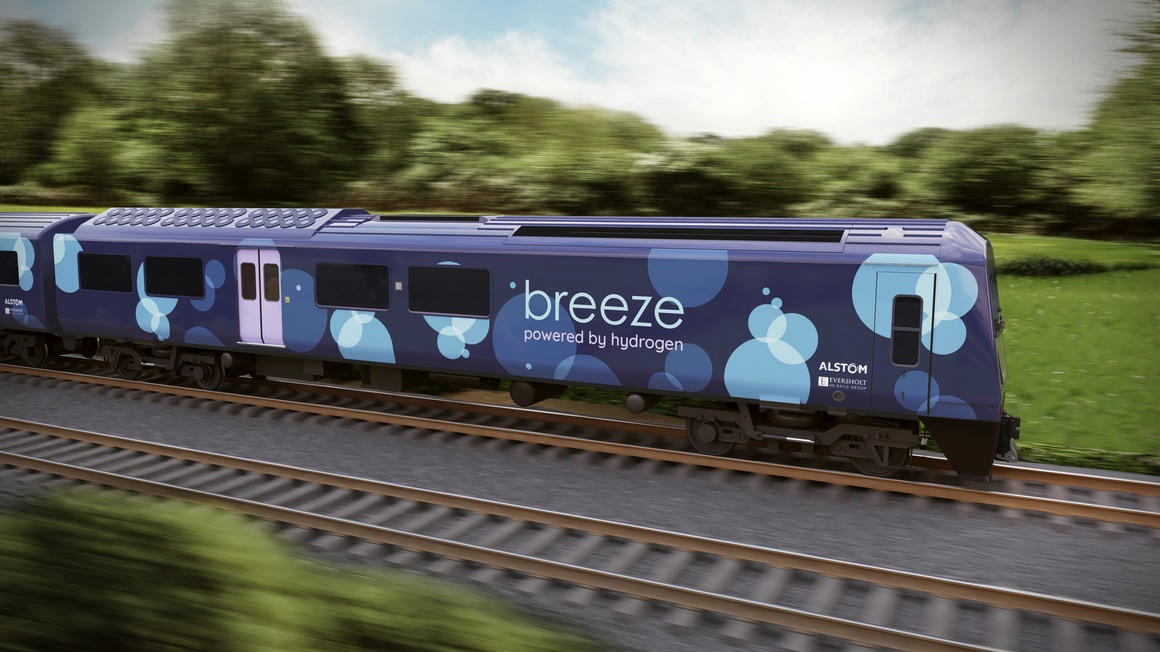
The windows, probably denote the size of the passenger compartment. So instead of having the capacity of a three-car train, it probably only carries that of a two-car train.
Compare this visualisation with a picture of an unmodified DTSO car.

There’s certainly a lot of space under the DTSO car, which I’m sure Alstom will use creatively. Can the fuel cells fit underneath?
From the cutaway view of the proposed train in The Times, it would appear that the section behind the driving compartment is occupied by the hydrogen tank.
The hydrogen fuel cells or at least their vents are on the roof at the back end of the car.
The Times gives the range of the train as in excess of 625 miles.
To put this into context, the Tyne Valley Line has a length of sixty miles, so a train could do at least five round trips between Newcastle and Carlisle without refuelling.
It’s certainly no short-range trundler!
I deduce from the extreme range quoted by The Times, that Alstom’s Breeze is an extremely efficient train and probably a series hybrid.
If the train is very efficient, that could mean, that there is the possibility to use smaller tanks to increase the train’s passenger capacity to fit a particular route better.
Use Of The Pantograph
All the articles published today don’t say anything about the pantograph.
But I can’t see any reason, why when 25 KVAC overhead electrification exists, it couldn’t be used.
Being able to use available electrification is also a great help in positioning trains before and after, trains perform their daily schedule.
750 VDC Operation
British Rail did get a lot of things right and one was that nearly all of their electrical multiple units could work or be modified to work on both forms of electrification in the UK; 25 KVAC overhead and 750 VDC third-rail.
So I believe that a 750 VDC version of Alstom’s Breeze will be possible.
A Replacement For A Two-Car Diesel Multiple Unit
There are large numbers of two-car diesel multiple units in the UK.
- Class 150 trains – 137
- Class 156 trains – 114
- Class 165 trains – 48
- Class 170 trains – 44
All would appear to have a similar passenger capacity to Alstom’s Breeze.
Some though will be converted into more efficient diesel-battery hybrids.
But there will still be a sizeable number of replacements, where the Breeze will be suitable.
The Breeze will have a major advantage, if as I expect, it has the ability to run using 25 KVAC or 750 VDC electrification.
It will be able to work routes that are partially electrified.
Possible Routes
The Times says this about possible routes.
Although the company refused to be drawn on the destination of the new trains, it is believed that they could be used on unelectrified lines in the north-west or north-east.
It is worth looking at the location of Alstom’s factory in Widnes, where the Class 321 trains will be converted. This Google Map shows the area.
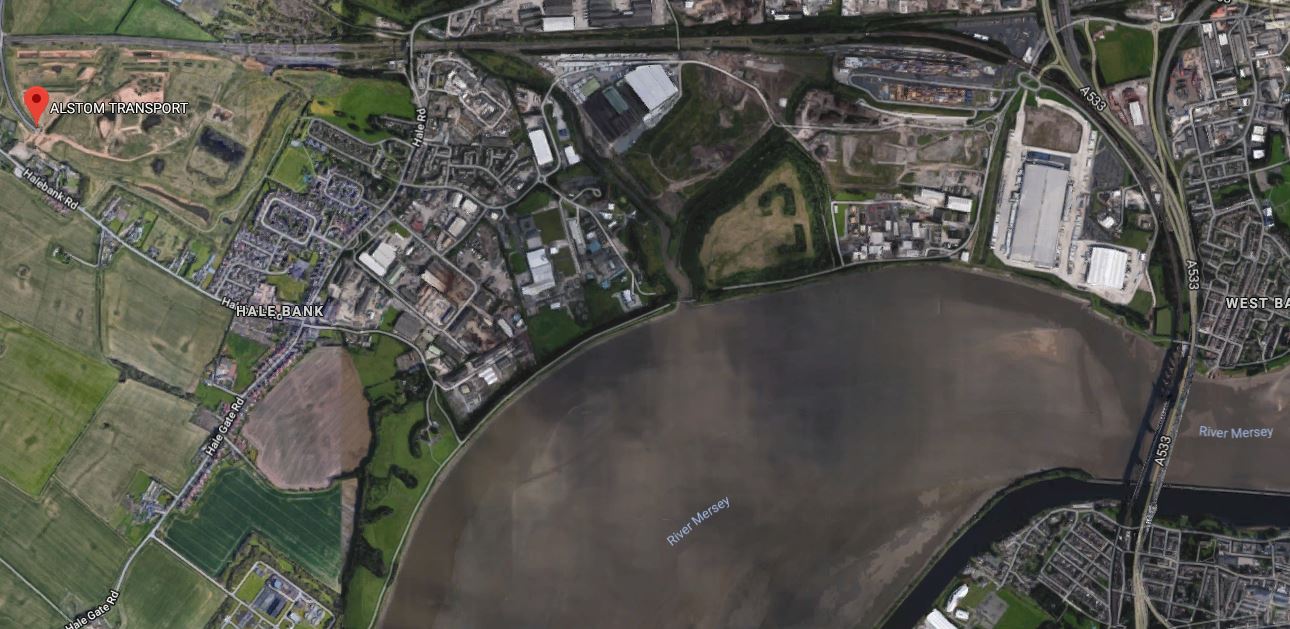
Note.
- The main railway between Liverpool and Crewe running across the top of the map and then crossing the River Mersey to go South.
- The Alstom factory is shown by a red arrow in the North-West corner of the map.
Not shown on the map, as it is just to the South on the South Bank of the Mersey, is INEOS’s massive Castner-Kellner works, which is a major producer of hydrogen, as it was when I worked there in the late 1960s.
I doubt that Alstom will be short of hydrogen to test the new trains.
Alstom and INEOS could even build a pipeline across the Mersey.
The Liverpool and Crewe Line is electrified and recently, the Halton Curve has been upgraded to form a new route between Liverpool and Chester via Runcorn, Frodsham and Helsby.
The Wikipedia entry for the Halton Curve has a section called Hydrogen Fuel Cell Train Trials, where this is said.
The Chester to Liverpool line via the Halton Curve is proposed for a trial by Alstom of their zero emissions hydrogen fuel cell trains. The line was chosen as Alstom’s new technology facility is at Halebank on the Liverpool border adjacent to the line, with hydrogen supplied via the nearby Stanlow refinery.
I should say, that I personally prefer the INEOS route for hydrogen, where it is a by-product of the electrolysis of brine, which is mainly to produce chlorine. Even in the 1960s, ICI performed a lot of production at night to take advantage of more affordable electricity.
The other route that goes close to Alstom’s factory is the Liverpool Lime Street to Manchester route via Warrington.
Increasing Capacity
I believe that effectively two-car trains with a capacity of 300 passengers,running between say the cities of Liverpool and Chester would not be large enough.
The current Class 321 trains are four-car trains and the conversion to Alstom’s Breeze trains, will result in the removal of the Trailer car, which contains the toilet.
The power of the MSO car in the current Class 321 trains is 1,000 kW.
During the conversion for use in Alstom’s Breeze trains, the power system will be updated.
- Four new AC traction motors will be fitted.
- A battery to store electricity and handle regenerative braking will be fitted. I estimated earlier, that this could be at least 100 kWh.
- The ability to connect to the hydrogen fuel cells in the two updated Driving Trailer Standard Open cars will be fitted.
I also suspect a well-designed computer control system will be added.
As a time-expired Control Engineer, I believe that the updated MSO car can be designed to deliver any amount of power between say 1,000 kW and 1,600 kW.
Alstom will obviously know, how much power will be needed to accelerate their proposed three-car train to the operating speed of 87 mph.
Four-Car Alstom Breeze Trains
Suppose though that the trailer car was also updated and added to the train.
- The weight would rise to 223 tonnes.
- Passenger capacity would rise to 450.
- Maximum kinetic energy at 87 mph, would rise to 55 kWh.
Provided the MSO car is powerful enough, a four-car Alstom Breeze would appear to be feasible.
Five-Car Alstom Breeze Trains
What would the sums look like for a five-car Alstom Breeze.
- Two trailer cars would be added.
- The weight would rise to 246 tonnes.
- Passenger capacity would rise to 600.
- Maximum kinetic energy at 87 mph, would rise to 63 kWh.
With the priviso of the power of the MSO car, it certainly looks like a five-car Alstom Breeze could be feasible.
It looks like at least three different sizes of train are possible.
- Three-car – 300 passengers
- Four-car – 450 passengers
- Five-car – 600 passengers
Only three different types of car will be needed.
- Driving Trailer Standard Open – DTSO – With hydrogen tanks and hydrogen fuel cells and less seating than in the current trains.
- Motor Standard Open – MSO – With new AC power system and a battery.
- Trailer Standard Open – TSO – With seats and possibly a Universal Access Toilet, bike racks or a buffet.
Note.
- All DTSO would be more-or-less identical, but some might have larger tanks and more fuel-cells.
- All MSO cars would be identical.
- TSO cars would be specified by the customer and could be tailored to a particular route.
The train’s computer, would automatically determine what train had been assembled and adjust power settings and displays accordingly.
Suppose four Class 321 trains were to be converted to Alstom Breezes.
You could end up with.
- Four three-car trains.
- Four spare Trailer Standard Open cars.
Or.
- Four four-car trains.
Or.
- Two three-car trains.
- Two five-car trains
The permutations are endless.
It is an infinitely flexible system, which can produce trains of a variety of lengths.
I would suspect that Eversholt will want customers to take complete trains, to maximise their returns and not end up with too many orphaned trailer cars.
Are There Any Spare Trailer Cars?
I ask this question, as in the last few years, twelve four-car Class 321 trains, have been converted to three-car Class 320 trains. As part of this process the trailer car is removed.
I would assume the twelve trailer cars have been put into store.
Could they be used to create five-car Alstom Breeze trains?
Will Alstom Breeze Trains Work In Multiple?
Class 321 trains can do this and I suspect that the Alstom Breezes will have the capability.
But it will probably be mainly for train recovery, than general operation.
Although, running two shorter trains as a longer one, is always useful, when there is a large sporting or other event happening.
Manufacturing
Alstom’s design eases the conversion.
Each type of car has its own manufacturing process,
Driving Trailer Standard Open
This would need to be done to all DTSO cars.
- The car is checked, cleaned and externally refurbished.
- The seats and most of the interior is removed.
- The driving compartment is updated.
- The hydrogen tank is added behind the driving compartment.
- The hydrogen fuel cells are added, with vents on the roof.
- The new interior with seats is fitted behind the hydrogen tank and fuel cells.
- No work would need to be done to the bogies, except that needed for maintenance.
- Finally, the new livery would be applied.
All DTSO cars would be treated in the same manner, although some might have smaller hydrogen tanks and detailed differences due to customer preferences and route needs.
Motor Standard Open
This would need to be done to all MSO cars.
- The car is checked, cleaned and externally refurbished.
- The seats and most of the interior is removed.
- The electrical equipment is replaced with the new AC system with a battery.
- The bogies would be fitted with the new AC traction motors.
- The new interior is fitted.
- Finally, the new livery would be applied.
All MSO cars would probably be treated in the same manner.
Trailer Standard Open
This would need to be done to all TSO cars.
- The car is checked, cleaned and externally refurbished.
- The seats and most of the interior is removed.
- The new interior is fitted.
- Finally, the new livery would be applied.
All TSO cars would probably be treated in a similar manner, but the interior fitment would depend on the customer’s requirements.
This picture shows a side view of an unmodified TSO car.
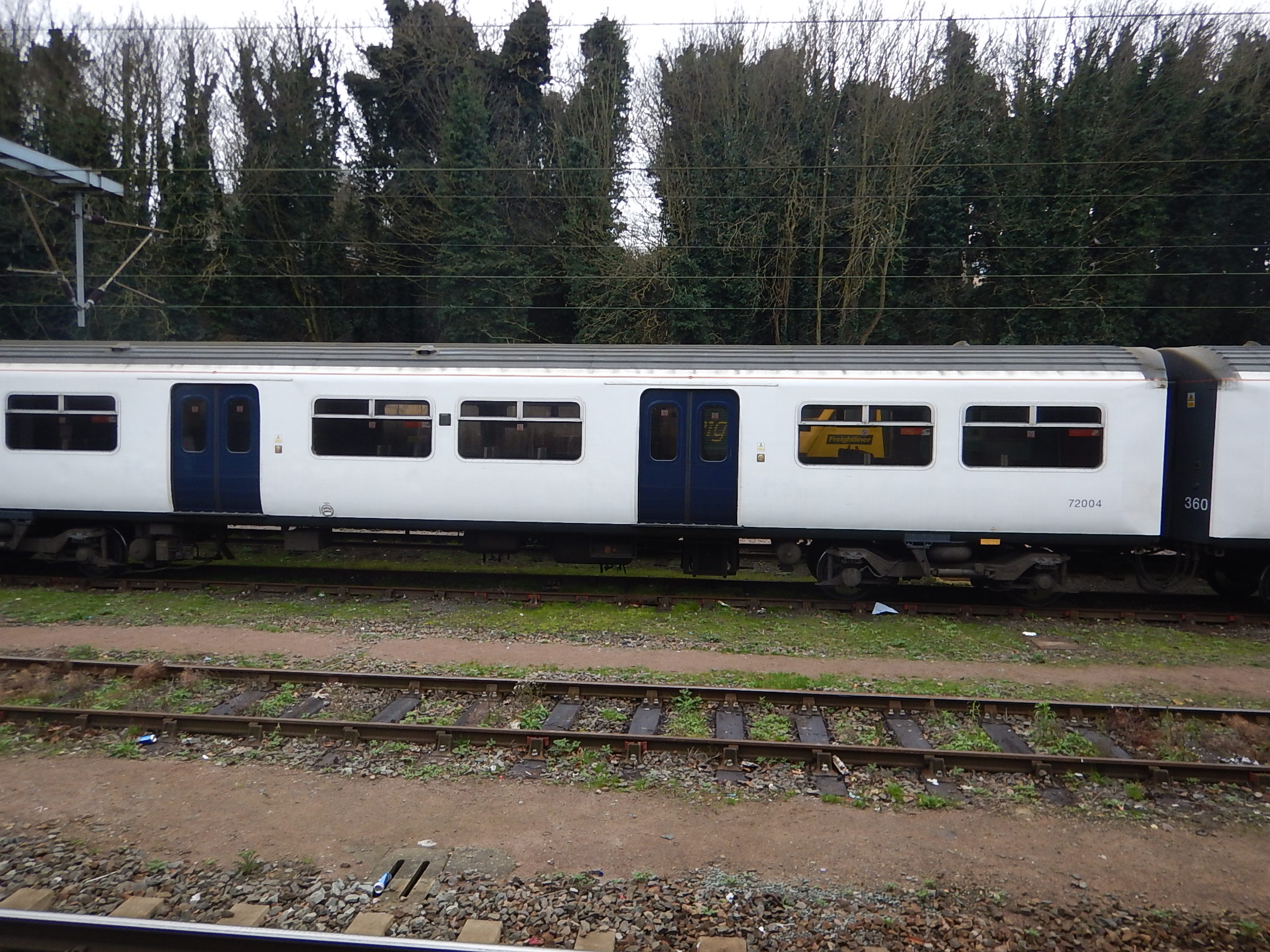
There is certainly a lot of space underneath the car.
I wonder if Alstom have any plans for using this space?
Summing Up Manufacturing
The process for the three types of cars is very similar and is very typical of the work regularly done to give mid-life updates to trains in the UK.
Alstom’s Widnes factory has already performed a major upgrade to Virgin Trains’ Pendelinos and I doubt that the work will hold many terrors for the factory, if the design phase is good.
Train Testing
So many train projects have been let down recently, by the lack of suitable test facilities and poorly-planned testing.
The Halton Curve route between Liverpool and Chester would appear to be an ideal route to test the trains.
- Liverpool Lime Street station has recently been upgraded in size.
- Chester station is not busy.
- The route is about forty miles long.
- I estimate that trains will take about forty minutes
- The route passes Alstom’s factory in Widnes.
- The route is about half-electrified, between Liverpool Lime Street and Runcorn.
- Access is good to the North Wales Main Line for long range testing.
Running on both electrification and hydrogen can be tested with a changeover at Runcorn station.
A Liverpool to Chester service would go through the following sequence.
- Arrive at Runcorn station, after running from Liverpool using existing 25 KVAC electrification.
- Drop the pantograph.
- Continue towards Chester on hydrogen power.
The sequence would be reversed in the opposite direction.
I don’t believe Alstom could want for a better test route.
I can only see one major problem.
Liverpudlians are a curious breed and I predict they will turn up in droves at a new attraction in their midst.
Conclusion
I very much feel that by using hydrogen tanks in the two driving cars Alstom have created a pragmatic flexible design, that will prove if hydrogen trains are a viable proposition for the UK.
Things that I particularly like.
- The first trains being two-car DMU-sized.
- The ability to use electrified lines.
- The extraordinary range.
- The performance.
- Trains of different length and capacity can be created from three different car types.
- The testing process.
But I have my doubts that the initial train has enough capacity.
Although I suspect that it could be increased by adding one or more trailer cars.
Axed Rail Routes May Be Reopened Under New Department for Transport Plans
The title of this post is the same as that on this article on Sky News.
This is the first two paragraphs.
The Department for Transport has confirmed it is actively working with a number of groups to explore the possibility of reopening old rail routes, axed under the so-called Beeching cuts of the 1960s.
It follows a call by Transport Secretary Chris Grayling a year ago, encouraging those in the public and private sector to submit proposals for potential projects to regenerate old lines.
It also quotes a Department of Transport spokesman.
This is on top of exploring reopening the Northumberland Line for passenger use, supporting the reinstatement of stations on the Camp Hill Line, developing new rail links to Heathrow and a new station at Cambridge South
He apparently, didn’t say more because of confidentiality.
The article then talks about the success of the Borders Railway in Scotland.
So is this just a good news story for Christmas or is there a plan to reopen old railway lines?
I feel that a several factors are coming together, that make the reopening of railway lines and the creation of new ones more likely.
Digital Signalling
Signalling is expensive, but where you have rolling stock to a high modern standard, with digital in-cab signalling, does this mean that new or reopened rail lines can be built without conventional signalling?
In addition, installing digital signalling on some routes, would probably make it easier to add a new station. Surely, it must just be a reprogramming of the route!
It could be a problem that, I would expect that on a digitally-signalled line, all trains must be capable of using it. But in many areas of the country, like East Anglia, these routes will be run by new trains.
Digital signalling must also make it easier to design more efficient single-track railways, with perhaps a passing loop to allow higher frequencies.
More Efficient Track Construction
Network Rail and their contractors and suppliers are getting better and more efficient at building track and bridges through difficult terrain and places, judging by some of their construction in recent years, such as the Acton Dive-Under and the Ordsall Chord. They have also overseen some notable successes in the refurbishment of viaducts and tunnels.
It should also be noted that the reopening of the Borders Railway was a successful project in terms of the engineering and was completed on budget and on time.
According to Wikipedia, though there was criticism of the infrastructure.
This is said.
The line’s construction has been described as resembling a “basic railway” built to a tight budget and incorporating a number of cost-saving features, such as using elderly two-carriage diesel trains and running the line as single track.
But looking back on the line from over three years since it opened, it has certainly been judged by many to be an undoubted success.
Would it have had the same level of success, if it had been built as a double-track electrified railway?
Single-Track Lines
The Borders Railway is a good example of an efficient single-track railway, that runs a half-hourly service.
Other routes like the East Suffolk Line and the Felixstowe Branch Line, show how good design can handle more than the most basic levels of traffic, with perhaps selective double track or a well-placed passing loop.
They may be dismissed by rail purists as basic railways, but when well-designed, they are able to provide the service that is needed along the route, for a construction cost that is affordable.
I would though advocate, that if a new single-track railway is built, that provision is made where possible to be able to add the second track. But not at too great an expense or to provide a service level that will never be needed.
I believe that good design of a new railway can cut the construction cost by a fair amount.
Single-Platform Stations
Several of the new stations built in recent years have been stations with only a single-platform.
- Cranbrook – A station in Devon on the West of England Main Line to serve a new housing development.
- Ebbw Vale Parkway – A parkway station in Ebbw Vale.
- Galashiels – A station, that handled 356,000 passengers last year. It is a unique station on a narrow site, that shares facilities with a large bus station on the other side of the road. It is a very functional transport interchange.
- James Cook – A basic but practical station, that serves the hospital in Middlesbrough. – It cost just over £2million in 2014.
- Newcourt – A £4million station handling over 100,000 passengers per year.
- Pye Corner – A basic station in Newport handling nearly 100,000 passengers per year.
The stations have several common characteristics.
- They can all handle at least a four-car train.
- The single-platform is used for services in both directions.
- Disabled access is either level or by a gently-sloping ramp.
Only James Cook station has a footbridge over the track.
These single-platform stations must cost less, as for instance a footbridge with lifts costs upwards of a million pounds.
Note that of the nine stations on the Borders Railway only three have two platforms.
Single-Platform Terminal Stations
There are also several terminal stations in the UK with only one platform.
- Aberdare – Handling over 500,000 passengers per year.
- Aberystwyth – Handling around 300,000 passengers per year.
- Alloa – Handling around 400,000 passengers per year.
- Aylesbury Vale Parkway – Handling over 100,000 passengers per year.
- Blackpool South – Handling over 100,000 passengers per year.
- Exmouth – Handling nearly a million passengers per year.
- Felixstowe – Handling around 200,000 passengers per year.
- Henley-on-Thames – Handling around 800,000 passengers per year.
- Marlow – Handling nearly 300,000 passengers per year.
- Merthyr Tydfil – Handling around 500,000 passengers per year.
- North Berwick – Handling around 600,000 passengers per year.
- Redditch– Handling over a million passengers per year.
- Seaford – Handling over 500,000 passengers per year.
- Shepperton – Handling around 400,000 passengers per year.
- Sheringham – Handling around 200,000 passengers per year.
- Walton-on-the-Naze – Handing around 130,000 passengers per year
- Windsor & Eton Central – Handling nearly two million passengers per year.
Many of these stations have only a single hourly train. whereas Redditch and Windsor & Eton Central stations have three trains per hour (tph).
As a single terminal platform can probably handle four tph, I suspect that most terminals for branch lines could be built with just a single platform.
No Electrification
Chris Grayling has said that the East West Rail Link will be built without electrification.
I wasn’t surprised.
- Network Rail has a very poor performance in installing electrification.
- There have been complaints about the visual intrusion of the overhead gantries.
- Electrification can cause major disruption to road traffic during installation, as bridges over the railway have to be raised.
In addition, I’ve been following alternative forms of low- or zero-carbon forms of train and feel they could offer a viable alternative
Bi-Mode, Hydrogen And Battery-Electric Trains
When the Borders Railway was reopened, unless the line had been electrified, it had to be run using diesel trains.
But in the intervening three years, rolling stock has developed and now a new or reopened railway doesn’t have to be electrified to be substantially served by electric trains.
- Bi-Mode trains are able to run on both diesel and electric power and Hitachi’s Class 800 trains are successfully in service. They will be shortly joined by Porterbrook’s innovative Class 769 trains.
- Hydrogen-powered trains have already entered service in Germany and they are being developed for the UK.
- Battery-electric trains have already been successfully demonstrated in the UK and will enter service in the next few years.
All of these types of train, will be able to run on a new railway line without electrification.
Bi-mode trains are only low-carbon on non-electrified lines, whereas the other trains are zero-carbon.
The trains on the Borders Railway must be prime candidates for replacement with hydrogen-powered or battery-electric trains.
Adding It All Up
Adding up the factors I have covered in this section leads me to conclude that rail developments over the last few years have made it possible to create a new railway line with the following characteristics.
- An efficient mainly single-track layout.
- Single-platform stations.
- A single-platform terminal station capable of handling well upwards of a million passengers per year.
- Service levels of up to four trains per hour.
- Zero-carbon operation without electrification.
- Low levels of visual and noise intrusion.
The new railway will also be delivered at a lower cost and without major disruption to surrounding road and rail routes.
The Need For More Housing And Other Developments
There is a very large demand for new housing and other developments all over the UK.
Several proposed rail projects are about connecting new developments with the rail network.
In London Overground Extension To Barking Riverside Gets Go Ahead, I listed a few developments in London, where developers and their financial backers, were prepared to put up around £20,000 for each house to fund decent rail-based transport links.
Obviously, developments in London are expensive, but with all the new developments, that have been built close to stations in the last few years, I suspect that infrastructure financiers. like Legal and General and Aviva, know how much being by a rail station is worth.
Conclusion
Both public and private infrastructure financiers will take advantage of the good railway and rolling stock engineering, which will mean the necessary rail links to new developments will be more affordable and zero-carbon.
Hybrid Power On The Railways
In my opinion, one of the best hybrid transmissions is that of London’s New Routemaster bus. This description of the drive-train is from Wikipedia.
The bus is a hybrid diesel-electric driven by a battery-powered electric motor, charged by a diesel fuelled generator and recovering energy during braking by regenerative braking.
It is a classic serial hybrid vehicle.
- There is no mechanical connection between the engine and the driving wheels.
- The diesel engine only runs, when the battery charge is low.
- The electric motor is always powered directly from the battery.
- The control systems for the drive-train are very simple.
- It is very efficient, as the engine only runs when needed and regenerative braking is employed.
- The bus can run on battery power only, for short distances.
- The various components of the drive-train can be placed in convenient places and connected by power and control cables.
In the New Routemaster, the components are placed as follows.
- The diesel engine is half-way up the back stairs.
- The battery is under the front stairs.
- The electric motor is under the floor in front of the rear axle.
This flexibility is very useful in a large vehicle.
Hybrid transmissions are starting to be employed on the railways.
These are the applications in use or planned.
Alstom Coradia iLint
The Alstom Coradia iLint is a hydrogen-powered two-car multiple unit.
This video shows the operation of the train.
<span class=”embed-youtube”></span>
It would appear to be a serial hybrid, where the hydrogen fuel-cell charges the battery and this drives the train through an electric motor,
I suspect most hydrogen trains will work in a similar way.
Class 321 Hydrogen Train
Some Class 321 trains are being converted to run on hydrogen. Unlike the Coradia iLint, the trains will also be able to use electricity from electrification.
MTU Hybrid PowerPacks
MTU have produced a Hybrid PowerPack, which is being retrofitted into several trains, including Class 170 trains in the UK.
Class 93 Locomotive
The recently-announced Class 93 locomotive appears to be a hybrid locomotive with a large diesel engine and about 125 kWh of batteries, that can also use electrification.
High Speed Bi-Mode Aventra
I am sure that Bombardier’s proposed High Speed Bi-Mode Aventra, which features batteries and 125 mph running under both diesel and electric power is a hybrid train.
Conclusion
Just as hybrid cars are becoming more numerous, I suspect we’ll be seeing more hybrid trains in the future.
A Video Of The Alstom Coradia iLint
This video of the Alstom Coradia iLint has been uploaded to YouTube.
I must go and get a ride!
Ballard Receives Order From Porterbrook for Fuel Cell Module to Power UK HydroFLEX Train
The title of this post is the same as this article on Cision.
The article says that the copy has been provided by Ballard.
This is the first paragraph.
VANCOUVER and DERBY, U.K., Dec. 13, 2018 /CNW/ – Ballard Power Systems (NASDAQ: BLDP; TSX: BLDP) today announced that it has received a purchase order from Porterbrook Leasing Company Limited (“Porterbrook”; http://www.porterbrook.co.uk), a leading participant in the rail leasing market, for an FCveloCity®-HD fuel cell module and related support to power a HydroFLEX train in the U.K.
The article says this about the HydroFLEX train.
The HydroFLEX will be the U.K.’s first fully sized hydrogen demonstrator train. It will showcase how hydrogen can be used to power a train that retains the ability to operate across existing electric routes, on either 3rd rail or 25kV overhead power. Testing and demonstration runs are planned for the summer of 2019 at RailLive, which will take place at Long Marston in Warwickshire.
That sounds like it could be a date for my diary.
Strictly A Demonstrator
In this article on Rail Engineer, which is entitled Hydroflex – The Next Iteration Of The Flex Concept,there is a section entitled Strictly A Demonstrator, from which this was taken.
In response to Rail Engineer’s questions, BCRRE said that the demonstrator version focuses on delivering an electric/hydrogen bi-mode to UK gauge.
So the HydroFLEX is more about research., which I believe is a good route.
- My feelings on seeing the Alstom Coradia iLint in Germany, was that they had launched too early!
- Getting a University to run a demonstrator might show up the smaller problems associated with a complex project.
- Birmingham University may also have access to better mathematics and computing.
- The interior of the train can be used for test equipment and hydrogen tanks.
I also suspect that a well-designed demonstrator could help with the repurposing of Porterbrook’s extensive fleet, by doing appropriate research.
The Fuel Cell
The Ballard fuel cell is a HD variant of their FCveloCity family.
This page on the Ballard web site is the data sheet.
- The fuel cells come in three sizes 60, 85 and 100 kW
- The largest fuel cell would appear to be around 1.2 m x 1 m x 0.5 m and weigh around 400 Kg.
- The fuel cell has an associated cooling subsystem, that can provide heat for the train.
It would appear that mounting the fuel cell under the train floor would be a feasible proposition. I would assume that the cell would be placed under one of the driver cars.
If you search the Internet, you’ll find there is a lot of fuel cell companies out there innovating like crazy and fighting for market share.
I don’t think there will be any problem with the fuel cell in the HydroFLEX train.
The Electrical System
The electrical system of the Class 319 train is simple.
- There is a 750 VDC busbar, which connects to all four cars.
- The busbar is fed by the 25 KVAC overhead or 750 VDC third-rail electrification.
- One of the middle cars has the pantograph and the other has four 247.5 kW traction motors, which power the whole train.
- There is no regenerative braking capability.
- The two driver cars are only differentiated, by the seats installe by the operator.
It looks to me that this was a sensible piece of 1980s engineering by British Rail to create a low-cost dual-voltage train.
I do wonder, if the originator of this system is still hale and hearty. I suspect they are, as they certainly know how to design for a long life.
When Porterbrook commissioned the Class 769 train, the two diesel generators under the driver cars were connected into this busbar.
They didn’t add any energy storage to the train, although as I said in Brush Traction Signs Contract With Skeleton Technologies For Modules For Class 769 Trains, they have added SkelStart capacitors to start the diesel generators.
Effectively, the Class 769 train is an electric or diesel train, just like the Class 319 train is an overhead or third-rail electrificsation train.
Will the fuel cell of the HydroFLEX train be connected to the electrical system of the train in the same way?
Or will energy storage, be added to the drive train?
In a more advanced design, batteries or capacitors could be in the motored car.
- They would be charged from the busbar.
- They would power the traction motors.
If the traction motors, were to be changed to modern ones, that could perform regenerative braking, then this energy could be used to recharge the battery.
The Fuel Tank
I suspect as the train is for research, that a standard off-the-shelf hydrogen tank will be used.
This page on the Fuel Cells And Hydrogen Joint Undertaking, is entitled Improved Hydrogen Tanks For Fuel Cell Cars Of The Future.
This is the first paragraph.
The EU funded COPERNIC project, supported by the Fuel Cells and Hydrogen Joint Undertaking (FCH JU), succeeded in improving the quality of materials and design of hydrogen storage tanks for cars. It also made the manufacturing of these tanks more cost efficient, helping to make hydrogen cars a more viable and competitive option.
I think it is highly likely, that a well-designed hydrogen tank, could probably share the space under the driver car with the fuel cell.
If it can’t then as it’s a research project a few seats can be taken out.
Hydrogen Train Operation Planned
The title of this post is the same as that of this article on the Railway Gazette.
This is the first paragraph.
The Länder of Brandenburg and Berlin are planning the joint award of a contract for the development and operation of hydrogen fuel cell powered trains on the RB27 Heidekrautbahn route.
According to Wikipedia, the Heidekrautbahn looks to be an interesting rail line, which is used a lot for leisure and museum (heritage) trains.
Wikipedia also says this about the hydrogen trains.
At the end of 2017, considerations were presented for a pilot project to deploy four Coradia iLint vehicles manufactured by Alstom on the heather track, switching part of the rail service from diesel to hydrogen . This would take about 165 tons of hydrogen, reduce diesel consumption by about 552,000 liters and thus reduce the emission of CO 2 by about 2.5 million kg per year. In the case of a grant commitment, use from 2020 would be conceivable.
Note that this was translated by Google from the Wikipedia entry, which was in German.
The Railway Gazette article states that the trains will run from 2022.
So it looks like the Germans will be making haste slowly on this project.
The
Bi-Mode Trains In Prospect As HS2 Northern Routes Confirmed
The title of this post is the same as that of this article on Railway Gazette.
Bi-Mode Trains On High Speed Lines
There are some, who believe that all trains should run on electrified lines.
But my belief is simpler – All trains should be electric, but they might be able to run on tracks with or without electrification.
There are currently, four proven ways to provide traction power on board an electrically-driven train.
- Diesel
- Hydrogen
- Gas Turbine
- Stored energy – Battery and/or capacitor.
Each have their advantages and disadvantages.
Talgo who are on the short list to build trains for High Speed Two, already make a train called RENFE Class 730, which has the following specification.
- 2.4 MW on 25 KVAC overhead electrification
- 3.8 MW on diesel
- Dual-gauge; Iberian and standard.
- Eleven coaches
- Maximum speed of 160 mph
High Speed Two is designed for 225 mph running, so the trains would need to be faster than these.
But suppose a train was to run say between Euston and Holyhead or any important place a hundred miles or so from High Speed Two.
It would be unlikely that the last part of the route without electrification, would be a high speed line, with a maximum speed in excess of 125 mph.
If it were a high speed line, then it would probably be electrified.
So a typical specification for a bi-mode for High Speed Two would probably be something like.
- Maximum speed of 225 mph on High Speed Two using the electrification.
- Maximum speed of 125 mph on the alternative power source.
- Ability to go between at least Crewe and Holyhead (84 miles) and back without refuelling.
Effectively, the train has two performance regimes; one for electrified high speed lines and one for classic lines without electrification.
A Possible Design For A Bi-Mode High Speed Train
Eurostar’s Class 374 train, which is one of the latest high speed trains is described like this in Wikipedia.
The Velaro e320, named because of plans to operate at 320 km/h (200 mph), would be 16 cars long, to meet the Channel Tunnel safety specifications but would have distributed traction with the traction equipment along the length of the train, not concentrated in power cars at each end.
Note.
- Distributed power gives better acceleration and smoother braking.
- The trains also appear to have at least six pantographs, so does that mean that each feeds a number of cars?
- I suspect there will be an electrical bus running the length of the train which will feed the traction motors.
- In my design of train, each car would have batteries and/or capacitors to handle the regenerative braking.
- The energy storage would give the train a limited range away from electrification.
For the required range between Crewe and Holyhead, there would probably be a need for diesel or hydrogen power.
I feel though, that in this day and age, no-one would build a new train that used diesel, if they could get the performance from hydrogen power or some other clean source.
Perhaps one of the middle cars of the train could be a power car fuelled by hydrogen.
This should be something that works, as British Rail and Stadler have both used this layout successfully.
On What Routes Would The Train Be Used?
I have used the service between London and Holyhead as an example and this is probably the longest route away from High Speed Two.
Any route that is in range from High Speed Two or a connected electrified route, could be served by these trains, if it was so desired and the train could be run on the route.
I wouldn’t be surprised to see one of these trains have the capability to go as far North as Aberdeen and Inverness.
Conclusion
Bi-mode high speed trains could be designed, if anybody needed them.
But for short extensions from High Speed Two, energy storage would probably suffice.
How Do Porterbrook’s Battery/FLEX Trains Compare With Eversholt’s Hydrogen-Powered Trains?
In the two green corners of this ultra-heavyweight fight to provide electric trains for rail routes without electrification, there are two ROSCOs or rolling stock operating companies.
Eversholt Rail Group
Eversholt Rail Group‘s product is the Class 321 Hydrogen, which is an upgrade of a Class 321 train with batteries and hydrogen-power.
Porterbrook
Porterbrook‘s product is the Class 350 Battery/FLEX, which is an upgrade of a Class 350 train with batteries.
How Do The Two Trains Compare?
I will list various areas and features in alphabetical order.
Age
The Class 350 trains date from 2008-2009 and others were introduced to the UK rail network as early as 2004.
The Class 321 trains date from the 1990s, but that shouldn’t be too much of a problem as they are based on the legendary Mark 3 Coach.
Scores: Porterbrook 4 – Eversholt 3
Batteries And Supercapacitors
This is an area, where the flow of development and innovation is very much in favour of both trains.
Currently, a 1000 kWh battery would weigh about a tonne. Expect the weight and volume to decrease substantially.
Scores: Porterbrook 5 – Eversholt 5
Battery Charging – From Electrification
No problem for either train.
Scores: Porterbrook 5 – Eversholt 5
Battery Charging – From Rapid Charging System
I believe that a third-rail based rapid charging system can be developed for battery/electric trains and I wrote about this in Charging Battery/Electric Trains En-Route.
No problem for either train.
Scores: Porterbrook 5 – Eversholt 5
Development And Engineering
Fitting batteries to rolling stock has now been done successfully several times and products are now appearing with 400 kWh and more energy storage either under the floor or on the roof of three and four-car electrical multiple units.
I feel that adding batteries, supercapacitors or a mixture of both to typical UK electric multiple units is now a well-defined process of engineering design and is likely to be achieved without too much heartache.
It should be noted, that the public test of the Class 379 BEMU train, was a rare rail project, where the serious issues found wouldn’t even fill a a thimble.
So I have no doubt that both trains will get their batteries sorted without too much trouble.
I do feel though, that adding hydrogen power to an existing UK train will be more difficult. It’s probably more a matter of space in the restricted UK loading gauge.
Scores: Porterbrook 5 – Eversholt 3
Electrification
Both types of train currently work on lines equipped with 25 KVAC overhead electrification, although other closely-related trains have the ability to work on 750 VDC third-rail electrification.
Both trains could be converted to work on both systems.
Scores: Porterbrook 5 – Eversholt 5
Interiors
The interior of both trains will need updating, as the interiors reflect the period, when the trains were designed and built.
Eversholt have already shown their hand with the Class 321 Renatus.
The interiors is a design and refurbishment issue, where train operating companies will order the trains and a complimentary interior they need, for the routes, where they intend to run the trains.
Scores: Porterbrook 5 – Eversholt 5
Operating Speed
Both trains in their current forms are 100 mph trains.
However some versions of the Class 350 trains have been upgraded to 110 mph, which allows them to work faster on busy main lines and not annoy 125 mph expresses.
I am pretty sure that all Class 350 trains can be 110 mph trains.
Scores: Porterbrook 5 – Eversholt 4
Public Perception
The public judge their trains mainly on the interiors and whether they are reliable and arrive on time.
I’ve talked to various people, who’ve used the two scheduled battery/electric services, that have run in the UK.
All reports were favourable and I heard no tales of difficulties.
In my two trips to Hamburg, I didn’t get a ride on the Coradia iLint hydrogen-powered train, but I did talk to passengers who had and their reactions were similar to those who travelled to and from Harwich in the UK.
I rode on the Harwich train myself and just like Vivarail’s Class 230 train, which I rode in Scotland, it was impressive.
I think we can say, that the concept and execution of battery/electric or hydrogen-powered trains in the UK, will be given a fair hearing by the general public.
Scores: Porterbrook 5 – Eversholt 5
Range Without Electrification
Alstom talk of ranges of hundreds of miles for hydrogen trains.and there is no reason to believe that the Class 321 Hydrogen trains will not be capable of this order of distance before refuelling.
Bombardier, Vivarail and others talk of battery ranges in the tens of miles before a recharge is needed.
The game-changer could be something like the technique for charging electric trains, I outlined in Charging Battery/Electric Trains En-Route.
This method could give battery trains a way of topping up the batteries at station stops.
Scores: Porterbrook 3 – Eversholt 5
Conclusion
The total scores are level at forty-seven.
All those, who say that I fiddled it, not to annoy anybody are wrong.
The level result surprised me!
I feel that it is going to be an interesting engineering, technical and commercial battle between the two ROSCOs, where the biggest winners could be the train operating companies and the general public.
I wouldn’t be surprised to see two fleets of superb trains.
A Tale Of Two Trains
Last week I attempted to have rides in two ground-breaking trains.
- A battery-powered version of Vivarail‘s Class 230 train.
- A hydrogen-powered Alstom Coradia iLint.
Some months ago, I also had an early public run in a Crossrail Class 345 train.
The latter trains have now been introduced more fully into service, although there are still some Class 315 trains in service between Liverpool Street and Shenfield stations.
Transport for London performed the introduction with plenty of well-trained staff about to both handle any problems and ask passengers for feedback.
It was all very professional and despite Crossrail’s well-reported lateness, it is difficult to find bad reports about the performance of the Class 345 trains between Liverpool Street and Shenfield.
Vivarail’s Class 230 Train
I went to the Bo’ness and Kinneil Railway, to see this train last Wednesday and wrote about the train in Battery Class 230 Train Demonstration At Bo’ness And Kinneil Railway.
- This service was not a paid-for public service but a free demonstration open to all, who wanted to turn up.
- Many people did for the first run at 11:00 and they looked to be a mixture of locals, people with transport interests, families and enthusiasts.
- Vivarail came mob-handed with engineers, designers, public relations staff and the Chairman; Adrian Shooter.
- There was no restrictions as to who talked to whom.
Search the Internet and it is very difficult to find negative reaction to the demonstration.
This article with a video in the Scotsman is entitled Video: Battery Trains On Track To Cut Emissions and gives a lot of information.
- Each car weighs thirty tonnes.
- Chassis and body are aluminium.
- Each car has two 100 kWh batteries underneath.
- New batteries in 2019 will enable sixty mph for forty miles and take just four minutes to charge.
- Regenerative brakes recharge the batteries.
The article has a very positive, typified by this paragraph.
Beyond the recycled exterior, Adrian explains how renewable energy and eco-friendliness are at the heart of the train’s design and a sign of things to come.
I haven’t read any reports from bloggers, enthusiasts or the general public about the train, but like myself, I suspect many went home quietly satisfied after watching a very professional demonstration.
My only negative comment about the Vivarail demonstration, is that it could probably have done with a modicum of classic marketing and upsexing.
Alstom’s Coradia iLint
Last week was the second time, that I tried to get a ride on this train.
- But as with my first trip, although I saw a train, none were actually running.
- This time, I heard that there was a shortage of drivers and one train had gone back to the manufacturer.
- These innovative trains are going to attract visitors from all over the world and I think that Alstom are not being at all professional with their handling of the testing.
- There was just no information, let alone staff at any of the stations, that will be served by the hydrogen-powered trains.
The important people were happy enough to turn up for the grand launch, but did not see fit to provide the information for the general public, who are interested in a genuine innovation, that could cut carbon emissions.
Conclusion
We will see a diesel-powered Class 230 train in service this December and it will then be possible to judge this innovative train on a fair basis.
But after the professional demonstration I saw in Scotland, I very much feel that this launch will not be handled in a sloppy way, such that it leaves a lot of disillusioned travellers.
But I am beginning to wonder, if Alstom’s project was launched too early without real planning to gain lots of brownie points about green issues.
It is one thing to get a new train working on a test track, but passengers with their own needs and appointments to keep, add a whole new dimension.
Alstom may well not be alone, as Porterbrook seem to be having troubles with launching their innovative Class 769 train.
Will There Be Hydrogen-Powered Class 230 Trains?
In the October 2018 Edition of Modern Railways, there is an article which is entitled Vivaral Delivers First Class 230.
In addition to discussing the deployment on the Marston Vale Line, the article has various sub-sections describing future plans for the Class 230 trains.
One such sub-section is entitled Isle of Hydrogen Hybrid?.
This is the first paragraph.
Vivarail is still waiting to hear whether it will receive a European Union grant to develop a hydrogen fuel cell version of the Class 230, although Mr. Shooter was hopeful confirmation of this would be received in September. The application has been made with a range of other organisations including Canadian fuel cell company Ballard.
Other points from the sub-section include.
- The train will be a hydrogen-battery hybrid.
- The design would be similar to the diesel-battery hybrid for the Borderlands Line.
- The hydrogen fuel cells would be in the centre vehicle.
It is also said that hydrogen storage can’t be on the roof, due to the UK’s restrictive loading gauge.
Conclusion
At the moment, it’s just adding another prototype train to a long list of trains with a better environmental footprint.
If this train is successful, it will be a three-car independently-powered train, with no emissions and low noise, which will be ideal for a lot of routes in the UK and possibly other countries, which share out passenger loading gaue and requirements.

