Hauling With Hydrogen: DHL Adding Fuel-Cell Vans To Its Delivery Fleet
The title of this article is the same as that of this article on Forbes.
This is the first paragraph.
Hydrogen is the most abundant element in the universe, but vehicles powered by the clean fuel are somewhat scarce. In the latest sign that that’s changing, DHL is adding hydrogen fuel-cell vans to its fleet to cut carbon emissions with faster refueling time and longer-range than battery-electric vehicles offer.
The whole article is well worth a read.
Conclusion
This initiative by DHL, like the development of hydrogen-powered double-decker buses for London and Liverpool, is another well-thought out project to move the world towards a zero-carbon and low pollution future.
All three projects are multi-vehicle projects, where fuelling can be done on a centralised basis.
Looking at the large cities of the UK, there must be several large fleets, that could be converted to hydrogen.
- City buses
- Royal Mail and other parcel and mail delivery vehicles
- Taxis
- Refuse trucks
I can see a range of solutions for providing zero-carbon and low-pollution transport, which vary dependent on the application and fleet size.
Specialised bicycle systems – Locally, I’ve seen bread deliveries, a nappy service and a plumber. There was also an item on the BBC about a hospital using a bicycle for local deliveries of samples, drugs and blood.
One-vehicle electric vehicle systems – Many small busineses, trademen and house-owners have a vehicle that they keep off the road in their premises or garage. A pathway needs to be developed, so that they can exchange their current vehicle for a battery-electric one, which also plays its part in storing surplus electricity. The technology is there, but it needs to be packaged, so people can afford to take that route.
Multi-vehicle electric vehicle systems – This is obvious for companies with lots of delivery vans, but this could be extended to blocks of flats and office developments, where all parking spaces have charging points and service charges could be set to encourage electric car use.
Multi-vehicle hydrogen systems – I’That’s where this article started and I think, this could expand, as the technology of both the vehicles and the hydrogen fuelling improve.
,There could be lots of niches, which a tailored-solution could solve.
The Cement Truck Example
I would love to know how many miles the average cement truck does in a day. But obviously the companies know and calculations would show the size of hydrogen tank needed for a couple of days work in a city like Leeds.
- Range with a full load wouldn’t be more than perhaps fifteen miles.
- The return trip would be empty and needs less power.
- The depot would have a hydrogen fuelling system, Fuelling a hydrogen truck should be no more difficult than fuelling a diesel one.
- Whilst in the depot, if power is needed to turn the drum and mix the cement, this could be provided by a direct electrical connection.
- The truck could leave the depot with a full battery.
- Hydrogen trucks might be used for local deliveries with perhaps diesel hybrid trucks for longer deliveries
I suspect that looking at the system as a whole entity could produce a very good system.
If say it cut carbon emissions and pollution by upwards of fifty percent, would it give the company a marketing advantage.
Perhaps, each building should be taxed for the amount of carbon dioxide and pollution its construction created?
North West Hydrogen Alliance Focuses On Low-Carbon Transportation
The title of this post is the same as that of this article on Gasworld.
This is an extract.
A study is currently underway to look at the feasibility of using hydrogen produced at chemical company INOVYN’s Runcorn site to power buses on the street of Liverpool.
It was also recently announced the Liverpool City Region will become the first area in the North of England to trial hydrogen buses following a £6.4m government funding bid, with a new refuelling station at BOC’s hydrogen plant in St Helens.
INOVYN is owned by INEOS, so are they getting involved with hydrogen?
I knew that site well in the late 1960s, when I worked there in the chlorine cell rooms, that made hydrogen and chlorine by electrolysing brine.
Life goes round in circles.
I heard some in those days, say hydrogen was a bit of a problem! Now it’s a valuable resource.
But I always remember a senior engineer, saying the only waste products that should come out of a chemical plant was pure water.
Bosch Likely To Slash Platinum In New Fuel Cells
The title of this post, is the same as that of this article on Automotive News Europe.
This is the first paragraph.
Bosch expects platinum to play only a minor role in its new fuel cells, with the supplier only needing a tenth of the metal used in current fuel cell vehicles, Reuters estimates.
The amount will be similar to that in the average catalytic converter, which must surely be a good thing.
Bosch are in a joint venture with Swedish fuel cell maker, Powercell
London To Have World-First Hydrogen-Powered Double-Decker Buses
The title of this post, is the same as that of this article in the Guardian.
This is the first three paragraphs.
London will have the world’s first hydrogen-powered doubledecker buses on its streets next year, as the capital steps up attempts to tackle its polluted air.
Transport for London (TfL) has ordered 20 of the buses, which cost around £500,000 each and only emit water as exhaust.
As well as cutting polluting exhaust emissions, the buses will run on green hydrogen produced via North Kent offshore wind farms, according to TfL.
After the announcement of the Alexander Dennis hydrogen buses for Liverpool, that I wrote about in New Facility To Power Liverpool’s Buses With Hydrogen, I wondered how long it would take Wrightbus to respond?
It appears to be less than a month.
This is also said about the buses.
The buses will also feature amenities such as USB charging points, and promise a smoother, quieter ride. They will operate first on three routes in west London and to Wembley, which served over 10 million passenger journeys last year.
I will add these comments.
USB Charging Points
I’ve only ever used USB charging points three times on the move.
- On a Vivarail Class 230 train.
- On a newly-refurbished Scotrail Class 158 train.
- In a LEVC TX electric black cab.
All installations were under a few years old and it is definitely the way passenger transport is going.
London Overground’s new Class 710 trains will be fitted with USB charging points and wi-fi.
Smoother, Quieter Ride
I have ridden in the following electric or hydrogen-powered vehicles
- A battery-electric Vivarail Class 230 train
- A battery-electric Class 379 train
- Several battery-electric and hydrogen-powered buses in London.
- A hydrogen-powered Alstom Coeadia iLint train.
- An LEVCC TX electric black cab.
With the exception of the iLint train, which has a mechanical transmission, all are smooth and quiet.
So I have no reason to disbelieve this claim in The Guardian article.
Three Routes In West London
This article in Air Quality News gives more details on the routes.
The vehicles will be introduced on routes 245, 7 and N7, with people travelling to Wembley Stadium, or from west London to the West End.
- Route 7 runs between East Acton and Oxford Circus.
- Route 245 runs between Alperton Sainsburys and Golders Green station.
Both are operated by Metroline from Perivale East garage, where they appear to be the only routes served from the garage, which has a capacity of forty buses.
This Google Map shows a 3D picture of Perivale East garage.
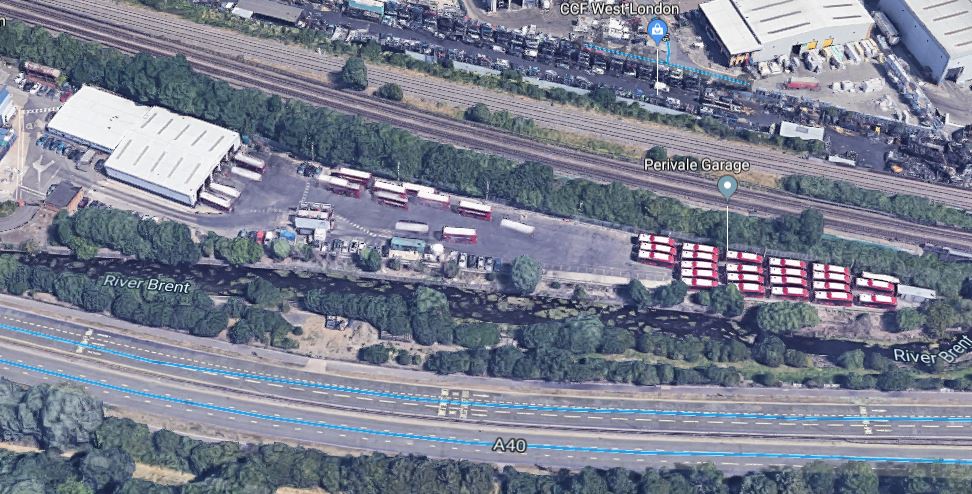
The garage is squeezed into a triangle of land between the Acton-Northolt Line, the Central Line and the six-lane A40 road.
- It’s not near any houses.
- It’s surrounded by trees and industrual units.
- Is the site large enough to generate hydrogen on site?
- Could hydrogen be brought in by rail?
- It could easily hold the twenty hydrogen buses and a few others.
I can certainly see why Transport for London have chosen to use hydrogen buses on routes 7, 245, N7, based at Periavale East garage.
Design
This is a paragraph from the Air Quality News article.
TfL says they are investing £12m in the new buses and the fuelling infrastructure with Northern Ireland firm Wrightbus as the manufacturer, which uses a fuel cell from Ballard to power a Siemens drivetrain.
Wikipedia says this about the transmission of a New Routemaster bus, that was built by Wright.
Hybrid diesel-electric in series; 18 kW] Microvast Lithium Titanate battery,Microvast LpTO, Siemens ELFA2 electric traction motor.
I should point out that it appears that originally, the New Routemaster had a larger 75 kWh battery. Has the technology improved?
Is the transmission and the chassis based on the Wright-designed New Routemaster chassis and transmission, substituting a Ballard fuel cell for the Cummins diesel engine?
The Cummins diesel engine in the New Routemaster is rated at 185 hp or 138 kW.
This page on the Ballard web site is the data sheet of Ballard’s FCveloCity family of fuel cells.
- The fuel cells come in three sizes 60, 85 and 100 kW
- The largest fuel cell would appear to be around 1.2 m x 1 m x 0.5 m and weigh around 400 Kg.
- The fuel cell has an associated cooling subsystem, that can provide heat for the bus.
It strikes me that this fuel cell is smaller and weighs less than a typical diesel engine fitted to a double-decker bus.
With a larger battery, regenerative braking and a clever transmission would a 100 kW fuel-cell provide enough power for the bus?
Wright have obviously solved the problem and found space for the hydrogen tank, otherwise they wouldn’t have received the order.
Drawing on their experience with the New Routemaster and adding the proven fuel cell technology of Ballard looks at first glance to be a low-risk route to a hydrogen-powered bus.
Conclusion
Wright Group and Transport for London appear to have designed a well-thought out solution to the problem of providing zero-emission buses for London and delivering the first buses next year!
We now have two hydrogen double-decker bus projects under way.
- London and Wright Group
- Liverpool and Alexander Dennis
Both appear to be fully-integrated projects, which include the supply of hydrogen to the buses.
When both are proven, there could be very keen competition between the two companies to sell systems all over the UK and the wider world.
It should be noted, that double-decker buses are not that common outside of the UK, Ireland, Hong Kong and Singapore.
But could these two zero-emission projects open up the rest of the world, to these most British of products?
How Much Energy Can Extracted From A Kilogram Of Hydrogen?
This article on EnergyH, is entitled About Hydrogen Energy.
This is said.
Hydrogen has an energy density of 39 kWh/kg, which means that 1 kg of hydrogen contains 130 times more energy than 1kg of batteries. So lots of energy can be stored with hydrogen in only a small volume.
But as in most things in life, you can’t have it all as fuel cells are not 100 % efficient.
Wikipedia has a sub-section which gives the in-practice efficiency of a fuel cell, where this is said.
In a fuel-cell vehicle the tank-to-wheel efficiency is greater than 45% at low loads and shows average values of about 36% when a driving cycle like the NEDC (New European Driving Cycle) is used as test procedure. The comparable NEDC value for a Diesel vehicle is 22%. In 2008 Honda released a demonstration fuel cell electric vehicle (the Honda FCX Clarity) with fuel stack claiming a 60% tank-to-wheel efficiency.
For the purpose of this exercise, I’ll assume a conservative forty percent.
This means that a kilogram of hydrogen would generate 16 kWh
Raise that efficiency to fifty percent and 19 kWh would be generated.
Conclusion
Fuel cell efficiency will be key.
Writing On The Wall For Oil Say Funds
The title of this post is the same as that of an article on page 37 of today’s copy of The Times.
This is the first two paragraphs.
Several big fund managers believe that oil companies should shut themselves down because soon they will be impossible to invest in as the world switches to tenewable energy.
A survey of 39 fund managers with $10.2 trillion under manaement found that 24 per cent wanted the oil industry “to wind down their businesses and return cash to shareholders” All but two of the funds said that oil stocks would not be attrative investments within ten years if they failed to respond to climate risks.
It’s pretty strong stuff.
So could we see a reduction in the use of oil and gas as a fuel?
In some countries including Denmark, Iceland, the United Kingdom and the United States, renewable energy is growing at a good rate.
The UK did draw the full set, in being blessed with the full set of coal, oil, wind, wave and tidal. We also have a bit of geothermal, hydro and solar.
We will still extract coal, gas and oil, but not for fuel.
- Very high quality coal is needed for steel-making, where carbon-capture could be used.
- Gas and oil are used as chemical feedstock for plastics, everyday chemicals and pharmaceuticals.
Hydrogen gas, produced by electrolysis for use as fuel, a chemical feedstock and central heating.
Shell have already purchased First Energy, who are a domestic energy supplier in the UK, so are they getting out of oil?
Are fund managers and oil companies starting to go in the same direction, with a lot of the world’s drivers sticking slavishly to petrol and the dreaded diesel?
Startup Nikola Bets Hydrogen Will Finally Break Through With Big Rigs
The title of this post is the same as that of this article on Forbes.
Read the article, as it is an interesting concept.
- Nikola Motor will not only build the trucks, but the hydrogen filling station network across North America.
- They believe big trucks are ideal for hydrogen power.
- They will also make their hydrogen filling station network available to car makes.
- The founder of the company; Trevor Milton, claims it’s easier to package hydrogen tanks in big vehicles than small ones.
- He also claims that hydrogen-powered trucks are much lighter than battery ones.
- Hydrogen will be produced from renewable sources, where it is needed.
- They are raising $1.2billion dollars to fund it.
First trucks will be delivered in 2022,, if all goes well with the funding.
I have no idea, whether it will work successfully, but surely a network of hydrogen filling stations, generating their own hydrogen across a Continent could be the kick, that hydrogen power for vehicles needs.
The UK is a small island and comparing it to North America, probably means the concept wouldn’t work in the UK, but if it works in North America, it will work in Europe.
But, if Trevor Milton’s mathematics work for big trucks in North America, they may well work with trains in the UK. A few hydrogen filling stations for trains and locomotives at strategic depots might power a whole new generation of rail vehicles. The rail filling stations could be co-located with filling stations for hydrogen road vehicles.
Trucks In Cities And Large Urban Areas
As I walk around London I see lots of large trucks, that can be put into a few categories.
- Articulated delivery trucks, often for the big supermarkets.
- Eight-wheel rigid trucks moving loads of building materials or soil and rubble dug out of construction sites.
- Refuse trucks.
- Skip trucks
- Cement mixer trucks
With the exception of the first, many of these vehicles don’t do a large number of miles in a working day.
Will we see companies like Nikola Motor and others developing hydrogen or battery-powered trucks for these niches?
If they do, I can see some interesting working and fuelling strategies developing.
Would Hydrogen Trucks Be Ideal For Cross-Channel Traffic?
Imagine a journey between Stuttgart and the Toyota plant in Derby.
- Using the European hydrogen network, the truck arrives at Calais with a low hydrogen level.
- On arrival in Dover it goes to a convenient hydrogen station and fills up with enough hydrogen to make the five hundred mile return journey to Derby.
- The return journey to Stuttgart, would use a hydrogen filling station at Calais to speed the truck on it’s way.
Because of the distances involved, I’m sure hydrogen would work for regular high-value truck journeys across the Channel, even if different tractors were used on either side of the Channel, as they often are now!
You could also argue, that this journey would be better done by rail. But if that is the case, why is it so much cross-Channel freight moved by trucks?
Conclusion
Hydrogen will continue to attract innovation and it is not time to write it off yet.
France, Denmark Eye Hydrogen Future
The title of thid post is the same as that of this article on Energy Reporters.
A few points from the article.
- EDF has launched a hydrogen production and distribution company called Hynamics.
- EDF is now the largest shareholder in McPhy, a electrolyses, hydrogen storage and charging station provider.
- European gas-fired power stations will run on twenty percent hydrogen.
- Hydrogen will be used to decarbonise the gas network by 2050.
- Hynamics said it was planning 40 projects in France, Belgium, Germany and Britain.
- In Denmark, Ørsted, is working on plans to convert electricity from its wind turbines into hydrogen.
The article is a must-read.
The Dutch Plan For Hydrogen
The Dutch Plan For Hydrogen
I have cut this out of The Train Station At The Northern End Of The Netherlands, so don’t read if if you’ve read it before.
Searching Google for hydrogen around Groningen, I found this document on the Internet, which is entitled Green Hydrogen Economy In The Northern Netherlands.
It is a fascinating read about what you can do with hydrogen generated from wind and biomass.
This is a sentence from the document.
Large scale green hydrogen product.ion together with harbor transport and storage facilities will be located at Eemshaven, with green chemicals production in Delfzijl
It is an ambitious statement.
Eemshaven
It also appears that Eemshaven will be the main connection point for electricity from offshore wind farms. This is said.
In the Eemshaven an offshore electricity cable from Norway, the NorNed cable with a capacity of 700 MW, comes on land. The Cobra cable, with a capacity of 700 MW, from Denmark is foreseen to connect at the Eemshaven to the onshore grid. The Gemini wind farm is connected to the grid in the Eemshaven with a capacity of 600 MW. Within 10 years it is foreseen that another 4.000 MW offshore wind will have their electricity cable to the Eemshaven.
Does all this explain, the building of a station at Eemshaven? Delfzijl station was built in 1883 and has its own connection to Groningen.
The following proposed actions are from the document
Build A 1,000 MW Electrolysis Plant
This is an extract from the of the document.
A 1.000 MW electrolysis plant that runs 8.000 hours a year, uses 8 billion kWh and 1,5 million m3 pure water to produce 160 million kg Hydrogen. A reverse osmosis plant has to produce the 1.5 million m3 pure water, using sea water or surface water as input. If an electricity price of 2‐2,5 €ct/kWh and a total investment between 500 million and 1 billion Euro with a 10 year life time is assumed, a green hydrogen cost price around 2‐3 €/kg will be the result. This is about competitive with present hydrogen prices, produced from natural gas by steam reforming.
How much energy is contained in a Kg of hydrogen?
This page on IdealHY says the following.
Hydrogen is an excellent energy carrier with respect to weight. 1 kg of hydrogen contains 33.33 kWh of usable energy, whereas petrol and diesel only hold about 12 kWh/kg.
At three euros for a kilogram of hydrogen, that works out at nine euro cents for a kWh.
Build A 1000 MW Biomass Gasification Plant
The title is a section in the document and this is an extract from the section.
Green hydrogen can be produced by electrolysis using green electricity, but can be produced also from biomass via gasification. Biomass gasifiers use solid biomass as an input and deliver a green syngas, a mixture of hydrogen, carbon‐monoxide (CO) and carbon‐dioxide (CO2), and char as an output. The CO could be used, together with water (H2O), to produce extra hydrogen. The resulting products from biomass gasification are green hydrogen and CO2. However, from CO2 and green hydrogen every chemical product could be produced. Therefore, the combination of green hydrogen and CO2 or green syngas creates the opportunity for a fully green chemical industry in the Northern Netherlands.
The process is still being developed. My first question, is can you use animal manure as a feedstock? It should be noted that The Netherlands used to have a very large and smelly manure problem.
Offshore Hydrogen Production From Far Offshore Wind Farms
The title is a section in the document and this is an extract from the section.
Offshore wind farms produce electricity which can be brought onshore via an electricity cable. Such an offshore electricity cable is expensive. The farther offshore the wind farm is located the more expensive the electricity cable cost. At the North Sea, an alternative solution for these wind farms is to convert the electricity into hydrogen at an existing oil/gas platform and to transport this hydrogen eventually mixed with gas via an existing gas pipeline. Onshore the hydrogen is separated from the natural gas and cleaned to be transported via pipeline, ship or truck to the markets.
I think that the technology and existing infrastructure could be made to work successfully.
- Europe has over fifty years experience of handling offshore gas networks.
- Recent developments have seen the emergence of floating wind turbines.
- Would it be easier to refurbish redundant gas platforms and use them to collect electricity and create hydrogen, rather than demolish them?
- Hydrogen is only produced when the wind blows.
- There is no need to store electricity and we’ve been storing gas since the Victorians.
There will be problems, like the integrity of an ageing pipeline, but I suspect that the expertise to solve them exists.
Will there be a North Sea, where every part has a large wind farm?
Note that the Hornsea Wind Farm has an area of 1830 square miles and could generate around 6 GW, when fully developed.You could fit 120 wind farms of this size into the North Sea. Even if only a small proportion could be developed, a sizeable amount of hydrogen could be produced.
A Market For 300,000‐tonnes Green Methanol + 300,000‐tonnes Green Ammonia
The title is a section in the document and this is an extract from the section.
Hydrogen (H2) and Carbon‐dioxide (CO2) can be used in chemical processes to produce a wide variety of chemical products. Two of the main building blocks in chemistry are methanol and ammonia. Methanol can be produced from H2 and CO2. Ammonia is produced from H2 and nitrogen (N2), captured from the air.
Wind power and biomass have been used tp create the basic chemicals for the petro-chemical industry.
The Construction Of Green Hydrogen Fuel Cell Balanced Data Centres
The title is a section in the document and this is an extract from the section.
Google builds a very large data center in the Eemshaven, see picture below. The reasons for Google to choose for the Eemshaven are the existence of an offshore data cable, enough space and green electricity. Google as well as other companies that install and operate data centers wants to run on green electricity. Therefore, Google has signed a power purchase agreement with Eneco to buy green electricity for 10 years. For this reason, Eneco builds an onshore wind farm nearby. On a yearly average this wind farm produces enough electricity to meet the data center demand.
However, supply and demand are not at every time in balance. At moments that there is no wind, other power plants must take over the electricity supply. Now, these are fossil fired power plants.In future, these power plants will be closed and supply and demand needs to be balanced in another way. And of course, that needs to be done with renewable electricity. This can be done by fuel cells fueled with green hydrogen. Fuel cells can follow demand and supply variations very fast with high efficiencies. Fuel cells are quiet and have no emissions, except very clean, demineralized, water.
I like this concept.
Surely, we could build a few data centres in places like Lincolnshire.
Build A Pipeline To Rotterdam And Germany
The Dutch have ambitious plans to export the hydrogen.
Other Ideas
The report is full of clever ideas and I suggest you take the time to read it fully!
Hydrogen Trains In The Northern Netherlands
The document says this about trains powered by hydrogen fuel cells.
In the Northern Netherlands, 50 diesel trains are daily operated on non‐electric lines. These trains, operated by ARRIVA have two or three carriages and a power of 450‐600KW supplied by Diesel‐Electric engines. Fuel cell‐electric hydrogen trains could replace these diesel trains. Alstom is a company that builds these fuel cell hydrogen trains and will perform a test next year on the line Groningen‐Bremen. Because the depreciation time for trains is 25 years, not all trains will be bought new. Some trains may need to be retrofitted with fuel cell‐electric power supply, which is technically feasible. When all these 50 diesel trains are replaced an investment in new and retrofitted trains of about …? Million Euros is needed. The total hydrogen consumption of these trains is about 5,000 ton.
These points are shown in a table.
- Total (diesel) trains in the Northern Netherlands is 50 units
- Hydrogen consumption approximately 25 kg H2/100km
- Train operations average 6 days per week. Train is operated approximately 1.200 km per day, based on two times per hour per trajectory of 50km.
- Train operations average 6 days per week. 330 days per year.
- Capital expenditure per train approximately …. ? 50 Units …? Million Euro
- 50,000 tonnes of hydrogen will be needed.
- The fuel bill at three euros a Kg will be 150 million euro.
Would this be economic?
From various comments, I suspect that Stadler are working on a hydrogen-powered GTW.
But failing that, as Stadler are developing a diesel/electric/battery Flirt for the South Wales Metro and some of the routes from Groningen are only about 30 km, I wouldn’t be surprised to see diesel/electric/battery GTWs running across the flat lands of the North.
Battery trains could be fitted with pantographs and recharge in Groningen, where most of the platforms are electrified.
There are a lot of possibilities and engineers will come up with the best solution with regards to operation and economics.
Conclusion
Thr Dutch have big plans for a hydrogen-based economy in the North of the Netherlands.
Where is the UK Government’s master plan for hydrogen?
McPhy Launches “Augmented McFilling”, Its New Smart Hydrogen Station Architecture For Heavy Duty Vehicles
The title of this post, is the same as that of this article on Nasdaq.
It shows the way that lots of individuals and companies are putting effort into the hydrogen economy.
 The Anonymous Widower