Torvex Energy
Hydrogen And Chlorine Production At ICI Mond Division in The 1960s.
In my time in the late 1960s, when I worked For ICI Mond Division, I spent time in the Castner-Kellner works trying fairly unsuccessfully to develop an analyser to detect mercury-in-air in the Castner-Kellner process, that created chlorine and hydrogen from brine.
The process is not a nice one as it uses a mercury cathode and Wikipedia says this about safety.
The mercury cell process continues in use to this day. Current-day mercury cell plant operations are criticized for environmental release of mercury leading in some cases to severe mercury poisoning (as occurred in Japan). Due to these concerns, mercury cell plants are being phased out, and a sustained effort is being made to reduce mercury emissions from existing plants.
ICI felt that a mercury-in-air analyser would help to make the plant safer.
But ICI did have an alternative way to produce the chlorine they needed for selling as a gas or liquid or using as a base chemical for products like disinfectants, bleaches and dry cleaning fluids, without the use of mercury.
It was only a small plant and I was taken there once.
As with the Castner-Kellner process, it used a series of electrolyser cells.
- These were smaller and had a tub, with a concrete lid.
- The anode and cathode and the pipes collecting the hydrogen and the chlorine went through the lid.
- They were rebuilt regularly.
- As with the Castner-Kellner process, brine is electrolysed.
- The process was old and probably dated from before the Castner-Kellner process.
But of course as there was no mercury, the hydrogen and chlorine were pure and could be used for certain types of manufacture like pharmaceuticals.
Torvex Energy
This article on Hydrogen Fuel News is entitled Stockton R&D Firm Unveils New Hydrogen From Seawater Production Process.
These are some points from the article.
- Torvex Energy, a Stockton research and development company, recently unveiled a new technique for producing hydrogen from seawater.
- This unique method of producing hydrogen from seawater does not result in oxygen gas emissions.
- As such, it is clearly quite different from more traditional water electrolysis methods used for producing green H2.
- The team behind the production method call it an environmentally friendly technique.
- There is no desalination process.
- The firm has patents pending on this unique form of electrochemical process.
- It worked with the Material Processing Institute to establish proof of concept for this purpose.
I originally felt that Torvex Energy may have updated the ancient ICI process, that I saw over forty years ago, but when I asked the company, they said it was different.
It now appears that they haven’t, which means they must have found a totally new process.
There is certainly an ongoing patent application with a number of gb1900680.8.
How Efficient Is The Torvex Energy Process?
This will be key and there is nothing on their web site or on the Internet to indicate, if the Torvex Energy process is more or less efficient than traditional electrolysis.
Offshore Hydrogen Production
The main application for the Torvex Energy process must surely be in the production of hydrogen offshore.
- A fleet of floating wind turbines could surround a mother platform with a Torvex Energy process.
- The hydrogen could then be sent ashore in a pipeline.
- If there to be a handy depleted gas field, this possibly could be used to store the gas.
Depending on the efficiency of the Torvex Energy process, this could be a more cost-effective way to bring energy ashore, as gas pipelines can be more affordable, than HVDC electrical links. Especially, if the pipeline already exists.
Conclusion
Torvex Energy would have appeared to have made a major breakthrough in the production of hydrogen.
Fortescue Unveils World-First Electric Train Using Gravity To Recharge
The title of this post, is the same as that of this article on InnovateAus.
These two paragraphs summarise the project.
Fortescue has announced the development of an electric train that recharges itself using gravity, as the Australian resources giant finalises its acquisition of UK-based Williams Advanced Engineering.
Fortescue is dedicating $50 million, in partnership with Williams Advanced Engineering (WAE), for research and development on the Infinity Train, which fully recharges its battery using gravitational energy when it descends.
Note.
- Most of Australia’s iron ore is mined in the Pilbara region of Western Australia.
- There are at least four railways in Pilbara leading to the coast.
- As the mines are higher than the coast, the heavily loaded trains will be going downhill, whereas the empties will be going uphill.
- There would certainly appear to be scope for charging going to the coast and coming back on a full battery with the empties.
- 94 % of Australia’s iron ore exports are transported by train from Pilbara to the coast.
There are hundreds of locomotives used for transportation of Iron ore from Pilbara to the coast.
Will Williams Convert Existing Locomotives?
I suspect they will as this is route that Wabtec is taking with their FLXdrive locomotives.
Will Williams Convert Locomotives For Other Pilbara Companies?
I suspect what Andrew Twiggy Forest wants he gets.
Could Williams Convert Other Diesel Electric Locomotives
I suspect they could and I wouldn’t rule out seeing a battery-electric Class 66 locomotive.
I laid out my thoughts in Could Class 66 Locomotives Be Converted Into Battery-Electric Locomotives?.
“Game-Changing” Long-Duration Energy Storage Projects To Store Power In Hydrogen, Compressed Air And Next-Gen Batteries Win UK Government Backing
The title of this post, is the same as that of this press release from EDF.
These are the first two paragraphs.
EDF UK has received £2 million in funding from the Department for Business, Energy & Industrial Strategy (BEIS) to support four innovative methods of storing energy for longer periods of time.
The four longer-duration energy storage demonstration projects will help to achieve the UK’s plan for net zero by balancing the intermittency of renewable energy, creating more options for sustainable, low-cost energy storage in the UK.
These are the projects.
Tech Transfer And Modification Of Metal Hydride Storage Used In Fusion Sector For Hydrogen (Protium) Storage
The project is described like this in the press release.
The first project will store electricity as hydrogen in a chemical form using depleted uranium hydride (UH3). The project will utilise Urenco’s depleted uranium liability – a waste product from fuel production and reprocessed spent MOX fuel – to safely store hydrogen as UH3, which has approximately twice the volumetric energy density as liquid H2. The project will see EDF R&D lead a consortium combining expertise in engineering and materials from University of Bristol, operating metal hydride storage at UKAEA and handling depleted uranium from Urenco.
Sounds like a good project. Especially, as it finds a use for Urenco‘s depleted uranium.
Pivot Power
Pivot Power, part of EDF Renewables, will work on two projects.
- Delivering Power On Demand From Solar PV Using 40MWh Vanadium Flow Battery Storage System
- Accelerate Commercialisation Of Zinc-Based Battery Storage
The first project was described in Longer Duration Energy Storage Demonstration Programme, Stream 1 Phase 1: Details Of Successful Projects.
This is what EDF says about the two projects which are linked.
Pivot Power, part of EDF Renewables, will support the delivery of two demonstration projects. The first project, delivered in partnership with Invinity Energy Systems plc (AIM:IES), will establish the feasibility of developing one of the UK’s largest storage-enabled solar power resources. If selected, Phase Two of this project, which includes a utility-scale 10 MW / 40 MWh Invinity Vanadium Flow Battery, would receive funding under the programme.
Pivot Power will also work alongside e-Zinc, with support from Frontier Economics, to ‘metalize energy’, deploying breakthrough technology that stores energy in zinc, an inexpensive and widely available metal that has a high energy density.
I’m a believer in storing energy in zinc, until it is proven, it’s not a good method.
The final project was also described in Longer Duration Energy Storage Demonstration Programme, Stream 1 Phase 1: Details Of Successful Projects.
The EDF press release adds this.
The final project will explore how electricity, converted into compressed air, can be stored in EDF’s existing gas storage facilities, where EDF Thermal Generation and R&D will partner with io consulting and Hydrostor.
I have a good feeling about this project.
Bill Gates Invests In Verdox’s Carbon Capture Technology
The title of this post, is the same as that of this article on The Times.
This is the first paragraph.
Bill Gates has invested in a carbon capture start-up. His Breakthrough Energy Ventures fund has taken part in an $80 million fundraising for Verdox, a Massachusetts-based business whose technology aims to remove carbon dioxide directly from the air.
I have my doubts that this technology will ever be economic, especially as plant, trees and in particular rain forests, do a good job at using the carbon dioxide. Planting trees is also one of those feel-good community activities.
This last paragraph gives a few details of the process.
Verdox, which is a spinout from the Massachusetts Institute of Technology, claims that its system is cheaper and more efficient. It uses a special plastic, which when charged with electricity, can extract CO2 from a mixture of gases. A change in voltage releases the CO2.
It is a process with a good pedigree, but you’ve still got to find a way to store or use the carbon dioxide.
Plants worked out how to do that eons ago.
HS2 To Trial New Building Method Which Could Provide Carbon-Free Energy
The title of this post, is the same as that of this article on Rail Technology Magazine.
This is the first three paragraphs.
Part of HS2’s Innovation programme, an HS2 building site in London is to become a test bed for a new building method which could ultimately provide carbon-free energy to stations on the new high speed route.
The new approach will be trialled by contractors Mace Dragados at the project’s Euston station site in London and will draw ground heat up through the foundations of a newly-built construction site office.
Developed by Keltbray, the innovative new technology is estimated to harness enough energy to supply 80% of the building’s heating and hot water needs.
It’s an incredibly simple, but extremely powerful idea, that revolutionises heating, cooling and hot water in buildings.
Read the article and then read the brochure on the Keltbray web site.
Hydrogen Refuelling Station For Vehicles Lands At Teesside Airport
The title of this post, is the same as that of this article on the Northern Echo.
This is the introductory paragraph.
A refuelling station that will serve hydrogen-powered vehicles based in the Tees Valley is now up and running at Teesside Airport as part of a £2.5million region-wide trial.
A selection of vehicles and equipment is being trialled, including some for the emergency services.
The trial will be overseen by Teesside University.
The University also runs the Tees Valley Hydrogen Innovation Project, which is described on this page on the University web site.
Up, Up And Away: Flying AirCar Earns Its Wings
The title of this post, is the same as that of this article on The Times.
This is the first paragraph.
A supercar that comes with wings attached has been given the green light to take to the skies.
It has been given European certification.
I will be very surprised if the Klein Vision AirCar is a success!
Quiet, Clean And Fast – MTU Hybrid Drive From Rolls-Royce For Lake Constance Belt Railway
The title of this post, is the same as that of this press release from Rolls-Royce.
It is the earliest press release from the company, about the MTU Hybrid PowerPack that I can find.
It dates from May 2018.
The press release opens with these bullet points.
- Successful simulation of hybrid train operation on Lake Constance Belt Railway
- MTU Hybrid PowerPack reduces emissions, noise levels and operating costs on the existing infrastructure
- Development is part of the Rolls-Royce electrification strategy.
It looks to me, that the press release was produced as marketing material for the launch of the MTU Hybrid PowerPack, which took place in 2018.
These are my thoughts.
Lake Constance Belt Railway
The Lake Constance Belt Railway is introduced like this by Wikipedia.
The Lake Constance Belt Railway (German: Bodenseegürtelbahn) is a continuous, single-track railway from Stahringen to Lindau-Aeschach in the German states of Baden-Württemberg and Bavaria. It runs mainly along the northern shore of Lake Constance (Bodensee).
Note.
It was originally built by three different railway companies in what were then three different countries that are all now states in Germany; Bavaria, Baden and Wurttemberg.
- It is a 74 kilometre or 46 mile line.
- It is a standard gauge railway.
- The line has lots of curves.
- It appears to have about a dozen stations.
The railway also passes through Friedrichshafen, where MTU Friedrichshafen is based.
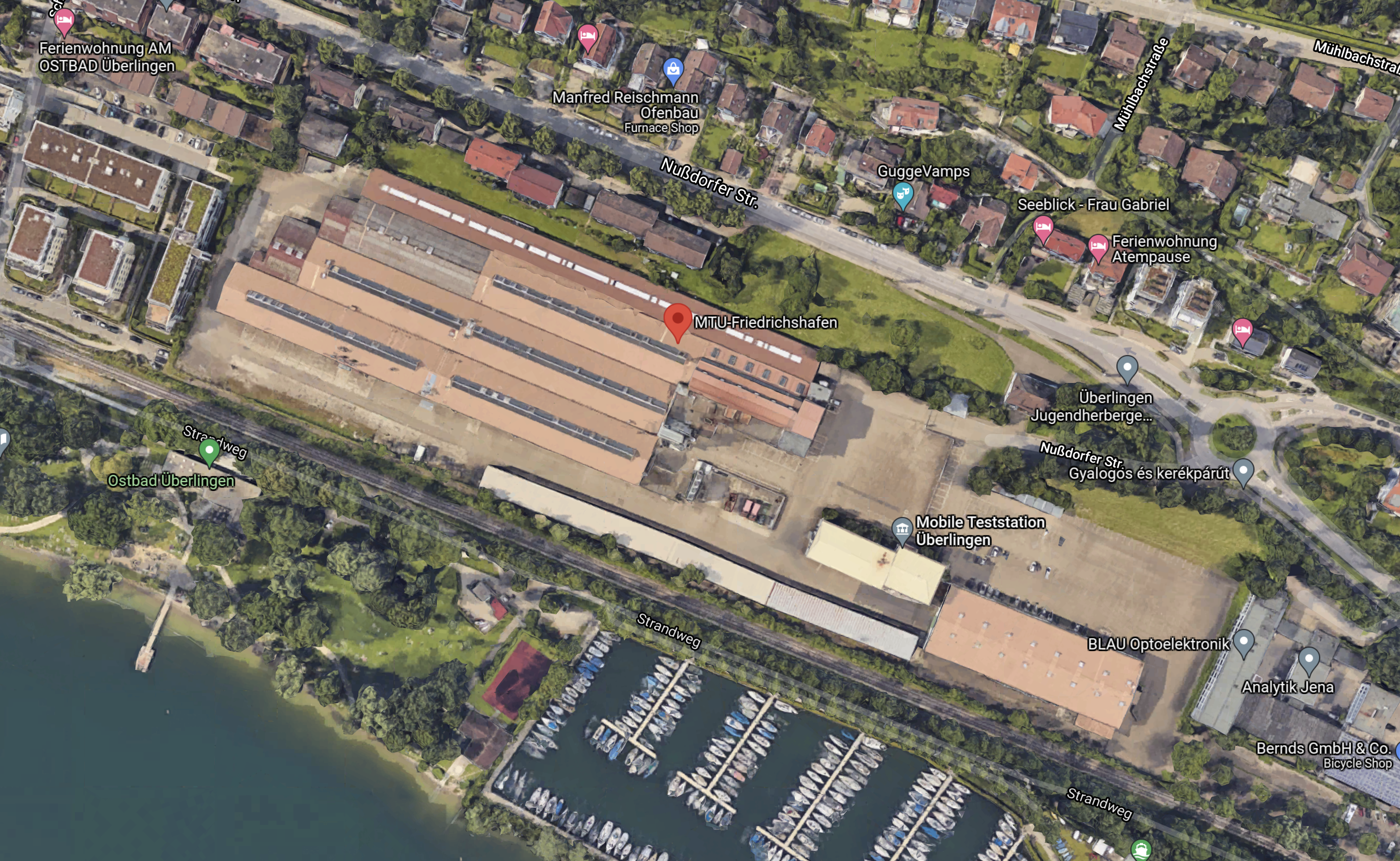
Note.
- MTU Friedrichshafen factory is indicated by a red arrow.
- The Lake Constance Belt Railway running between the factory and marina.
It’s all very handy for the factory.
Railway Operations
Services on the railway appear to be run using DB Class 611 trains.
- They are two-car tilting, diesel multiple units.
- They have a top speed of 160 kph or 99 mph.
- They have two MTU engines of 540 kW.
- Forty are still in service.
These trains were replaced with similar but more modern DB Class 612 trains.
- These have similar performance, but are fitted with Cummins engines.
- There have also been problems with the tilting mechanism with these trains
Forty of the earlier trains are are still in service on the Lake Constance Belt Railway and other routes.
It would appear that electrification could be the solution for this single track railway, which is only forty-six miles long.
But it appears some of the locals have objected.
Could it be that MTU Friedrichshafen felt they could provide a better solution?
Simulation Of The Route
The press release describes how the route was simulated.
The operation of the current VT 612 railcar was simulated – it had been retrofitted in virtual reality with MTU Hybrid PowerPacks. That such a retrofit is also possible in a real-world environment has also been demonstrated by a feasibility study carried out by the Deutsche Bahn subsidiary, DB Systemtechnik. This is particularly relevant because these are vehicles that travel fast on curving track. Only these trains, which are fitted with “tilt technology“, are able to negotiate the numerous curves encountered on the Lake Constance Belt Railway track at high speed and thus provide a fast service between Basel and Ulm.
It looks to be an interesting solution to maintain a fast service on a difficult route, that has a twisty bit in the middle.
The press release also describes the MTU Hybrid PowerPack to provide an efficient solution.
The MTU Hybrid PowerPack is a high-tech product from Friedrichshafen and the result of collaboration between the local companies Rolls-Royce Power Systems and ZF Friedrichshafen. It combines the following components to produce an intelligent drive system: a modern MTU diesel engine with exhaust gas aftertreatment, which meets current emission regulations in addition to the future EU Stage V that will come into force as of 2021, an innovative ZF automatic transmission, an electric motor that recovers energy in braking mode and also serves as a drive unit, and an advanced battery system to store the recovered brake energy. The Hybrid PowerPack has demonstrated its reliability, for example, in real-life test runs with a length of around 15,000 kilometres.
Certainly, MTU have done their research and where better, than with a local problem?
Very Light Rail – A Revolution
The title of this post, is the same as that of this article on Rail Engineer.
It is a good explanation of what very light rail is all about and the design concepts behind the first vehicle, which is called Revolution.
My feeling is that Any Very Light Rail vehicle should be able to run a short branch line route as capably as a Class 153 train.
But hopefully with better passenger and driver comfort and facilities.
- The speed of Revolution is 65 mph and that of a Class 153 train is 75 mph, so is that close enough?
- I would hope that Revolution has better acceleration as it has an electric transmission.
- Revolution has 56 seats and a wheelchair space and is PRM-compliant, whereas the Class 153 train has a few more seats and only some are PRM-compliant.
- Revolution has wi-fi and power sockets and most Class 153 trains don’t.
The quality of the seats and the view from the trains will probably be the tie-breaker.
The article doesn’t say, but surely they would find more applications, if they could run in pairs, do they might be able to replace a two-car Class 150 train.
Reading the whole article gives me the impression, that the designers have done thorough job to design a lightweight train, that both passengers and drivers will like.
I will reserve my judgement until I see and ride one of these trains.
An Automated Shuttle Train
In An Automated Shuttle Train On The Greenford Branch Line, I proposed an automated shuttle on the Greenford branch.
The Greenford Branch Line has the following features.
- It is 2.5 miles long.
- It is double-track.
- It is not electrified.
- There is a single platform station at both ends with three intermediate stations.
- The service frequency is two tph.
- Trains take 11-12 minutes to go between the two terminals.
- Freight trains also use the line.
To run the ideal four tph, trains would need to do a round trip between West Ealing and Greenford in fifteen minutes.
Suppose the Revolution vehicle was automated with the driver having a supervisory role.
- The train would shuttle between West Ealing and Greenford, leaving each station, when it was ready, so as many trips as possible were performed.
- On seeing a green signal, the driver would tell the train to proceed top the other station, if they knew it to be safe.
- If a freight train needed to come through, the shuttle train would stay in either West Ealing or Greenford stations out of the way protected by the signalling, until the freight train had cleared the track.
- Freight trains and the shuttle would never be on the same piece of track at the same time, which would greatly aid safety.
I suspect that at least three trains would go between the two stations in every hour, with perhaps four in the Peak.
Mote – World’s First Carbon Removal Plant Converting Wood Waste To Hydrogen
The title of this post, is the same as that of this article on Hydrogen Central.
This paragraph caught my eye.
Mote is also in discussions with carbon utilization company CarbonCure Technologies on the potential of permanently storing its CO2 in concrete via CarbonCure’s carbon removal technologies, deployed in hundreds of CO2 mineralization systems at concrete plants worldwide.
So I looked up CarbonCure Technologies web site.
This page gives an overview of their technology.
According to their web site, they can add carbon dioxide to precast concrete sections. How much carbon dioxide would it have been possible to bury, if the tunnel linings for Crossrail had used CarbonCure’s technology?
 The Anonymous Widower