What Is INTOG?
This page on the Crown Estate Scotland web site outlines INTOG.
This is the introduction at the top of the page.
Innovation and Targeted Oil & Gas (INTOG) is a leasing round for offshore wind projects that will directly reduce emissions from oil & gas production and boost further innovation.
Developers can apply for seabed rights to build two types of offshore wind project:
IN – Small scale, innovative projects, of less than 100MW
TOG – Projects connected directly to oil and gas infrastructure, to provide electricity and reduce the carbon emissions associated with production
INTOG is designed, in response to demand from government and industry, to help achieve the targets of the North Sea Transition Sector Deal, which is a sector deal between government and the offshore oil and gas industry.
I have a few thoughts and have also found some news stories.
Isolated Communities
This document from the Department of Business, Industry and Industrial Strategy lists all the Contracts for Difference Allocation Round 4 results for the supply of zero-carbon electricity that were announced yesterday.
The document introduces the concept of Remote Island Wind, which I wrote about in The Concept Of Remote Island Wind.
I don’t know of one, but there might be isolated communities, with perhaps a dodgy power supply, who might like to improve this, by means of a small offshore wind farm, meeting perhaps these criteria.
- Less than 100 MW.
- Agreement of the locals.
- A community fund.
- An important use for the electricity.
Locations and applications could be.
- A small fishing port, where winds regularly bring the grid cable down in winter.
- A village with a rail station to perhaps charge battery-electric trains.
- A deep loch, where floating wind turbines are erected.
- To provide hydrogen for transport.
We shall see what ideas are put forward.
Floating Power Stations
Floating wind farms are generally made up of individual turbines on floats.
- Turbines can be up to the largest used onshore or on fixed foundations.
- The Kincardine floating offshore wind farm in Scotland uses 9.5 MW turbines.
- The floats are anchored to the sea bed.
- There is a power cable connecting the turbines appropriately to each other, the shore or an offshore substation.
But we are talking innovation here, so we might see some first-of-a-kind ideas.
Single Floating Turbines
A large floating wind farm, is effectively a large number of floating wind turbines anchored in the same area of sea, and connected to the same floating or fixed substation.
I can’t see any reason, why a single floating wind turbine couldn’t be anchored by itself to provide local power.
It might even be connected to an onshore or subsea energy store, so that it provided a more constant output.
Surely, a single turbine perhaps ten miles offshore wouldn’t be a very large blot on the seascape?
I grew up in Felixstowe and got used to seeing HM Fort Roughs on the horizon from the beach. That is seven miles offshore and some people, I know have windsurfed around it from the beach.
TwinHub
I talked about TwinHub in Hexicon Wins UK’s First Ever CfD Auction For Floating Offshore Wind.
TwinHub mounts two turbines on one float and this is a visualisation of a TwinHub being towed into place.
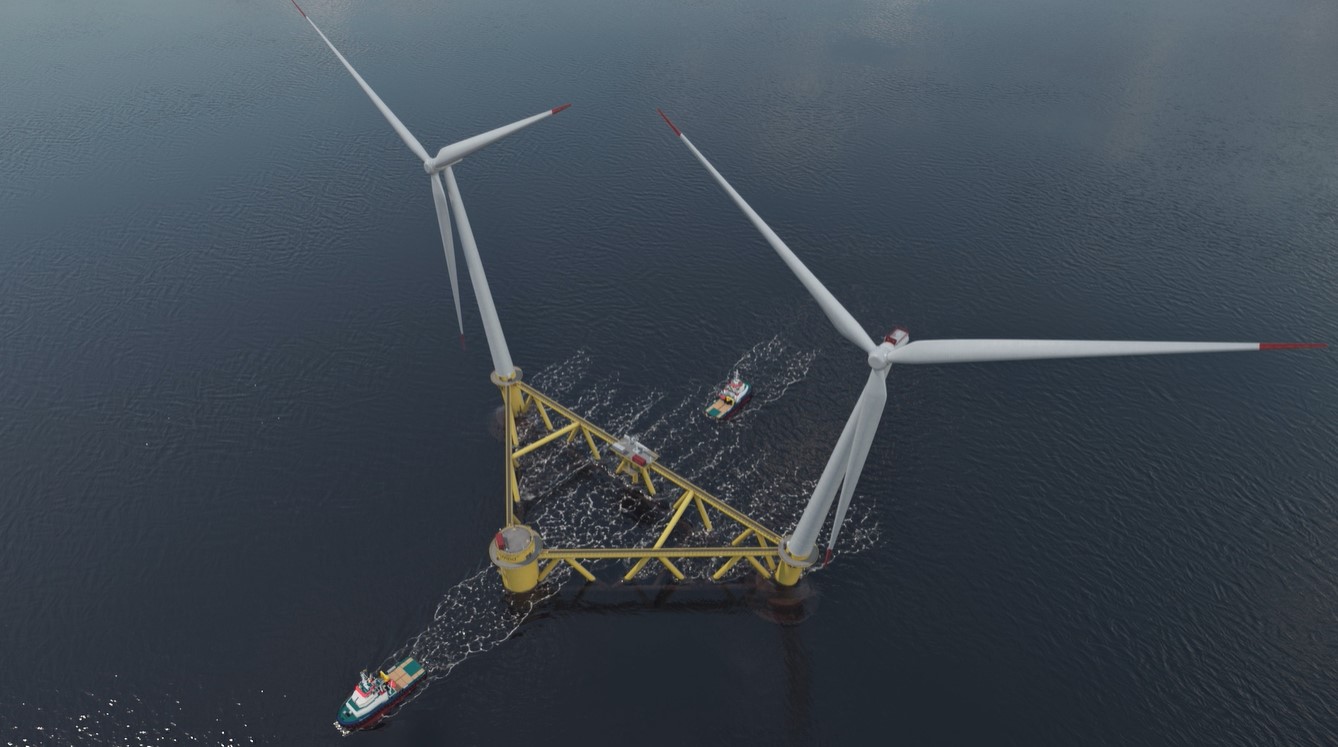
Note.
- The design turns into the wind automatically, so that the maximum amount of electricity is generated.
- A Contract for Difference for a 32 MW TwinHub has been awarded, at a strike price of £87.30/MWh, that will be installed near Hayle in Cornwall.
- With a capacity factor of 50 %, that will produce just over 140,160 MWh per year or over £12 million per year.
This article on the BBC, which is entitled Funding Secured For Floating Wind Farm Off Cornwall, gives more details of the Hayle TwinHub.
The possibility of a floating wind farm off the coast of Cornwall has moved a step closer after securing government funding, project bosses have said.
Swedish company Hexicon plans to install its TwinHub system, with the hope it could begin operating in 2025.
It would be deployed about 10 miles (16km) off Hayle.
Project supporters said it could be a boost to the local economy and help establish Cornwall in the growing renewable energy sector.
Figures have not been released, but it is understood the government funding has effectively secured a fixed price for the power TwinHub would produce for 15 years, making it economically viable.
The article says that this 32 MW system could develop enough electricity for 45,000 homes.
This could be a very suitable size for many applications.
- As at Hayle, one could be floated just off the coast to power a remote part of the country. As Cornwall has a few old mine shafts, it might even be backed up by a Gravitricity system on shore or another suitable non-lithium battery.
- Could one float alongside an oil or gas platform and be tethered to it, to provide the power?
Scotland’s hydroelectric power stations, prove that not all power stations have to be large to be successful.
Vårgrønn and Flotation Energy’s Joint Bid
This article on offshoreWIND.biz is entitled Vårgrønn And Flotation Energy To Jointly Bid in INTOG Leasing Round, gives a few details about their joint bid.
But there is nothing substantial about ideas and locations.
I can see several joint ventures with a suitable system, bidding for various projects around the Scottish coast.
Cerulean
Cerulean sounds like it could be a sea monster, but it is a shade of blue.
This article on offshoreWind.biz is entitled Cerulean Reveals 6 GW Floating Offshore Wind Bid Under INTOG Leasing Round.
These are the two introductory paragraphs.
Green energy infrastructure developer Cerulean Winds has revealed it will bid for four seabed lease sites with a combined capacity of 6 GW of floating wind to decarbonise the UK’s oil and gas sector under Crown Estate Scotland’s Innovation and Targeted Oil and Gas (INTOG) leasing round.
This scale will remove more emissions quickly, keep costs lower for platform operators and provide the anchor for large-scale North-South offshore transmission, Cerulean Winds said.
Note.
- It is privately-funded project, that needs no government subsidy and will cost £30 billion.
- It looks like each site will be a hundred turbines.
- If they’re the same, they could be 1.5 GW each.
- Each site will need £7.5 billion of investment. So it looks like Cerulean have access to a similar magic money tree as Kwasi Kwarteng.
Effectively, they’re building four 1.5 GW power stations in the seas around us to power a large proportion of the oil and gas rigs.
For more on Cerulean Winds’ massive project see Cerulean Winds Is A Different Type Of Wind Energy Company.
Will There Be An Offshore Wind Supermarket?
I can see the big turbine, float and electrical gubbins manufacturers establishing a one-stop shop for developers, who want to install small wind farms, that meet the INTOG criteria.
So suppose, the archetypal Scottish laird in his castle on his own island wanted a 6 MW turbine to go green, he would just go to the B & Q Offshore web site and order what he needed. It would then be towed into place and connected to his local grid.
I can see modular systems being developed, that fit both local infrastructure and oil and gas platforms.
Conclusion
I can see scores of projects being submitted.
I even know the son of a Scottish laird, whose father owns a castle on an island, who could be taking interest in INTOG. They might also apply under Remote Island Wind in another leasing round.
But we will have to wait until the end of March 2023, to find out who have been successful.
Boson Energy To Use Nonrecyclable Trash To Make Carbon-Negative Hydrogen
The title of this post, is the same as that of this article on Hydrogen Fuel News.
This is the first paragraph.
Boson Energy, an Israeli-Swedish-Polish startup is preparing to move ahead with a form of carbon-negative hydrogen production using nonrecyclable garbage.
It is worth reading the Boson Energy web site.
Nestlé Unveils New Double-Stacking Rail Logistics Plan To Reduce Carbon Footprint
The title of this post, is the same as that of this press release from Nestlé.
These paragraphs explain the concept.
Nestlé UK & Ireland has unveiled plans to increase freight capacity on trains to allow the double-stacking of products, an important step towards reducing its carbon footprint.
The new curtain-sided rail container with a raising roof, designed to transport double-stacked palletised products by rail, was displayed at the Multimodal Exhibition in Birmingham this week.
The design of the container overcomes an important barrier as the height of road trailers differs from rail containers due to the height constraints of the rail network, meaning transport by rail had not been a winning option for Nestlé until now.
Utilising a hydraulic raising roof mechanism, the unit allows the business to double-stack its food and drink products. The roof is then lowered to just above the height of the stock, making it compliant with the height requirements of rail transport, while being able to get more products on board.
It is currently under test between the Midlands and London.
The press release also mentions, that it could be used to deliver to Tesco, who are extensive users of rail freight and have been for some years.
Does Anybody Have Good Contacts At Network Rail?
In the 1980s, I did some business with British Rail, as it then was.
I provided my Daisy software and they used it to analyse signal failures.
It led to a guy called J S Firth, writing a paper called Failure Recording And Analysis On British Rail.
He had the courtesy to send me a copy of the paper, which mentions SigTech, which appears to have been a business unit of the British Railways Board.
All my dealings with Firth and his colleagues were in person at an office block in front of Marylebone station, which is now a posh hotel.
And then, a few months ago, someone contacted me from Network Rail.
Apparently, his father had worked on the signal failure project with me and he was now working in Milton Keynes for Network Rail on a similar project.
He asked if I had a copy of the paper.
At the time, I didn’t, but today I had a small sort out and found a copy.
Unfortunately, I have now lost the piece of paper on which I wrote the guy’s details.
Does anybody have any ideas, how I can find the guy, who contacted me?
Energy Dome Launches World’s First CO2 Battery Long-Duration Energy Storage Plant
The title of this post, is the same as that of this article on Renewable Energy Magazine.
This is the first paragraph.
Energy Dome, a provider of utility-scale long-duration energy storage, has successfully launched its first CO2 Battery facility in Sardinia, Italy. This milestone marks the final de-risking of the CO2 Battery technology as Energy Dome enters the commercial scaling phase, becoming the first commercial long-duration energy storage technology on the market offering a reliable alternative to fossil fuels for dispatchable baseload power globally.
I like their technology and you can find more about it on their web site.
They say this about how they use the unique properties of carbon dioxide.
CO2 is the perfect fluid to store energy cost effectively in a closed thermodynamic process as it is one of the few gases that can be condensed and stored as a liquid under pressure at ambient temperature. This allows for high density energy storage without the need to go at extreme cryogenic temperatures.
And it’s not that carbon dioxide is a rare and expensive gas.
This is certainly technology to watch.
First Order In For Revolutionary Modular Railway Footbridge
The title of this post, is the same as that of this article on New Civil Engineer.
Greater Anglia seem to have ordered the footbridge for Stowmarket station, without seeing a real one.
A prototype is also being installed at the former Widmerspool station on the Old Dalby Test Track.
I wrote about the proposed footbridge at Stowmarket in Stowmarket Station To Go Step-Free.
Offshore Wind Champion Appointed As £160m Floating Offshore Wind Fund Opens For Expressions Of Interest
The title of this post, is the same as that of this press release from Kwasi Kwarteng.
These three paragraphs describe the policy.
Ambitious plans to expand offshore wind around the United Kingdom to power homes and businesses with cheap, homegrown energy received a further boost today with the appointment of a new government champion and a multimillion-pound manufacturing fund opening for expressions of interest.
The appointment of Tim Pick as the first UK Offshore Wind Champion was confirmed by Prime Minister Boris Johnson and Business and Energy Secretary Kwasi Kwarteng today.
The Floating Offshore Wind Manufacturing Investment Scheme (FLOWMIS) will provide £160 million in government funding to boost floating offshore wind capability around the UK at sites in Scotland, Wales and elsewhere by supporting manufacturers and giving private investors the confidence to back this emerging sector which is expected to rapidly expand in the years ahead.
Floating offshore wind needs the following components.
- Wind turbines, which are the same as those used onshore.
- Floats, which are generally made from steel, but concrete can also be used. There are a few proven designs, like the Windfloat from Principle Power.
- Mooring systems for the turbines.
- Electrical substations and cables.
There is also a need for deep water docks, with large cranes to assemble the systems, prior to towing the turbines into position.
Floating offshore wind is a new industry and there will be new ideas coming through from innovators.
I feel that the strategy could help bring new ideas through.
The Story Behind The Concrete Panels On The Elizabeth Line
These are a selection of the pictures I took yesterday inside Elizabeth Line stations.

































Note.
- The walls and ceilings appear to be covered in light grey panels with holes.
- The material appears to look like concrete.
- Every one is a totally different shape, so how were they manufactured?
This article on Ian Visits is entitled How Crossrail Is Using 3D-Printing To Build Its Stations.
This is the two opening paragraphs.
When you start to use the new Elizabeth line stations, among its many achievements will be the first large scale use of 3D-printing in concrete.
The use of 3D printing has made possible one of the more distinctive features of the future Elizabeth line stations — the curved concrete panels that will line the inside of the passenger tunnels and some stations, and sinuously glide around corners in a way never seen before in a tube station.
There will be a total of something like 36,000 of these panels and although printing each in concrete is possible, Crossrail would probably have been delivered in the 2040s or 2050s.
The contractors used an innovative process called FreeFAB, which had been invented by an Australian architect.
- The process creates a wax mould for each panel using 3D printing.
- This mould is then used to create the actual panel.
- After each panel is cast, the wax is melted off and recycled.
- The panels are made in a factory in Doncaster.
We will see a lot more of this technique used in the construction industry.
Ukraine’s New Stealth Weapon
This article on Electrek is entitled Ukraine Is Now Using These 200-Mile-Range Electric Bikes With NLAW Rockets To Take Out Russian Tanks.
This is the first paragraph.
Ukrainian electric motorbike company Delfast has seen its electric bikes used for some vastly diverse tasks, such as breaking Guinness World Records and outfitting Mexican police. But their latest use is perhaps the bikes’ most important mission yet: helping Ukrainian soldiers strike a David vs. Goliath blow against Russia’s barbaric invasion of their country.
How do you protect your tank against a silent by deadly soldier coming to get you with a Belfast-made NLAW on a Ukrainian Delfast at 50 mph?
I suspect a fit well-trained soldier can outride a Russian T72 tank, hide in the forest and setup his NLAW. Now that’s humiliation!
It also appears from these two paragraphs, that Ukrainian snipers are also enjoying the advantages of electric bikes.
Another local Ukrainian company, ELEEK, has also supplied its country’s armed forces with silent, powerful electric motorbikes for use on the battlefield.
In that case, the electric motorbikes were requested for use by sniper teams.
The Ukranians seem to be a very inventive nation.
Two More Floating Wind Projects In The Celtic Sea
In Two Celtic Sea Floating Wind Projects Could Be Delivered By 2028, I said this.
There now appears to be four floating wind farms under development in the Celtic Sea between the South-West corner of Wales and the Devon and Cornwall Peninsular.
- Blue Gem Wind – Erebus – 100 MW Demonstration project – 27 miles offshore
- Blue Gem Wind – Valorus – 300 MW Early-Commercial project – 31 miles offshore
- Falck Renewables and BlueFloat Energy – Petroc – 300 MW project – 37 miles offshore
- Falck Renewables and BlueFloat Energy Llywelyn – 300 MW project – 40 miles offshore
But they do create a starter for a GW.
Last night, I found two other projects being developed in the Celtic Sea, under the collective name of the Llŷr Project.
The sponsoring company, which appears to be called Llŷr Wind has a web site, with a title of Harnessing Welsh Energy, which has this outline description underneath.
Situated off the Pembrokeshire coast, in southwest Wales, is a flagship project that could transform the world’s ability to generate renewable electricity from wind. The Llŷr projects are exploring the potential of two innovative floating offshore wind technologies.
The next statement is key.
Combined, the two 100MW projects will generate enough renewable electricity to power around 250,000 homes. If successful, we will be able to offer highly cost-effective, floating offshore wind farms to the rest of the world by 2030.
The Llŷr Project would appear to be a research project to find the best way to generate electricity using floating wind turbines in deep water.
- It appears that the two wind farms will use different floats for the turbines.
- The Llŷr projects are located in the approaches to the Bristol Channel in the Celtic Sea approximately 40 kilometres offshore at depths averaging 60-70 metres.
- These offshore sites enjoy high average windspeeds which are, typically, in excess of 10 metres per second. That is over twenty miles per hour.
- Each 100MW project will comprise 6 to 8 next-generation turbines which are too large to be deployed on land.
- 6 x 20 MW turbines will be 120 MW.
- 8 x 12 MW turbines will be 96 MW.
- Each project will have an offshore substation.
- There will be up to two connections for each substation.
- Will the Llŷr Projects test manufacturers’ new turbine designs?
- It is hoped that installation of the turbines will start in 2025/26, with power being delivered in 2026/7.
- The project is being developed by Floventis Energy, which is a joint venture of SBM Offshore and Cierco.
It does look to me that SBM Offshore, who are a Dutch company, are using their extensive oil and gas experience to develop floating offshore wind.
This appears to be a very well-thought out research project in a location, where there is everything needed.
- Lots of wind, which can be boosted by dragons if needed.
- Deep water.
- Ports for assembly of turbines onto floats.
- Steelworks and fabrication.
- Good electrical connections to the National Grid.
- Excellent universities.
- Good transport connections.
- An experienced engineering workforce.
There is also the ultimate potential of 50 GW of floating offshore wind in the Celtic Sea.
Conclusion
The Llŷr Project could have a very positive input into the worldwide development of floating offshore wind.
I have read the web sites of Floventis, SBM Offshore and Cierco and these companies appear to be aiming to dominate the floating offshore wind industry.
Their strategy is stated on the Floventis web site.
Our strategy is simple. We plan to maximize the local benefits of our projects and minimize their impact. Our technologies are far more benign than conventional offshore wind and more suited for deployment in remote and sensitive environments.
Already driving demonstration projects in California and the UK, Floventis is building a portfolio of projects to take floating offshore wind, through a stepwise process – increasing project size, to full scale commercial development proposals by 2030.
We believe that the floating offshore wind industry is a model for a “just transition” to clean energy, at scale, which will reward communities, in the broadest sense, with skilled jobs and enhanced social equity.
I can certainly live with that! And I’m certain the world can too!

