10GW Green Hydrogen Project Aims To Electrolyze Water Drawn From Desert Air
The title of this post, is the same as that of this article on Hydrogen Fuel News.
This is the first paragraph.
Desert Bloom, an AUD$10.75 billion (USD $7.63 billion) 10GW green hydrogen project will begin construction in Australia’s Northern Territory in 2022.
Desert Bloom is not a small project and uses new technology from Aqua Aerem.
Grand Central DMU To Be Used For Dual-Fuel Trial
The title of this post, is the same as that of this article on Railway Gazette.
This is the first two paragraphs.
An Alstom Class 180 Adelante diesel-hydraulic multiple-unit is to be converted to run on a combination of diesel and liquefied natural gas in a dual-fuel technology demonstration project.
One car of the DMU which Arriva-owned open access inter-city operator Grand Central leases from Angel Trains is to be equipped with dual-fuel technology company G-volution’s Optimiser system, which is used in the road sector. The modifications are expected to be straightforward, enabling trials on the national network to start later this year.
The article dates from May 2019 and I suspect the small matter of the pandemic and Grand Central’s resulting three closures due to lockdowns are the reason this development hasn’t been heard of since.
But this was the London end of the Class 180 train, that I rode from Mirfield to King’s Cross.
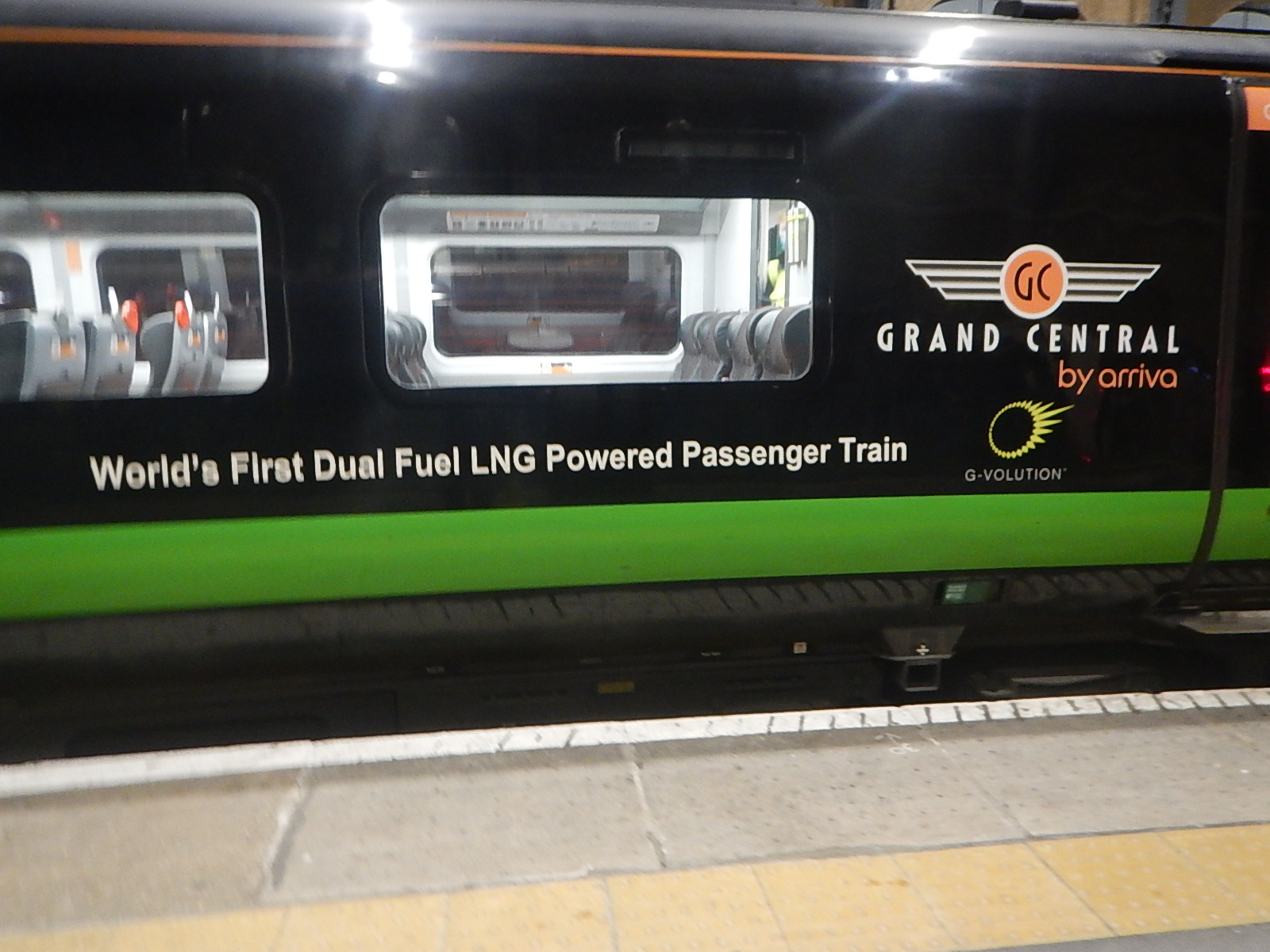
I haven’t ridden in a Class 180 train for some years and there was nothing to indicate from the performance, that it was not a standard train.
There are fourteen of these 125 mph trains.
This explanatory video of G-volution’s technology is on the G-volution web site.
Note that in the video, one of G-volution’s Managing Director; Chris Smith says that the technology is fuel agnostic and will work with a range of fuels including ammonia, biodiesel, bio-LPG, hydrogen and methanol.
Conclusion
It will be very interesting to see what is decided to be the ideal fuel-combination and how much reduction is possible for the various emissions.
I’ll end with two questions.
Will Passengers Like The New Trains?
What is there not to like! Same train and performance with lower emissions.
Will Cummins Like What G-volution Have Done To Their Engines?
Cummins might be a bit miffed, as they built the QSK19 engines for the Class 180 trains and may have their own plans for them. But they are a pragmatic and flexible company in my experience and generally they do what the customer needs or wants. Decarbonisation is surely in everybody’s interest.
Incidentally, the same Cummins diesel engines are used in the TransPennine Express, Class 185 trains, I’ve been riding in most of today.

There are fifty-one of these 100 mph trains in use in the UK. They could be ideal for some long routes, if they could be converted to low-emission.
Alstom And Liebherr Sign A Collaboration Agreement, In Order To Optimise Hydrogen Fuel Cells
The title of this post, is the same as that of this press release from Alstom.
The press release starts with these points.
-
Liebherr is developing air management technology that is particularly well suited to hydrogen fuel cells.
-
Alstom’s hydrogen strategy is part of its ambition to innovate by pioneering smarter and greener mobility solutions for all.
This paragraph then gives the basic outline of the agreement.
Alstom has signed a collaboration agreement with Liebherr – Aerospace & Transportation SAS, a France-based company specialising in the manufacture of compressors for fuel cells. This agreement is aimed at optimising hydrogen systems, including improving the reliability and durability of fuel cells, increasing their power density and reducing the cost of such solutions.
The press release gives a lot more details about Alstom’s hydrogen collaborations with other companies
Alstom seem very serious about hydrogen-powered trains.
A Simple Solution To The Tricky Problem Of Eye Drops
Since the cataract in my left eye has been removed, I have supposed to be putting drops in my eyes seven times a day. It’s four of one and three of another.
But it has all changed since the District Nurse brought me a pair of these shields.

The bottle with the drops is poked through the bottom of the shield and the cut goes over the eye. To get one drop, you squeeze the bottle gently.
I find the best place to be drop the drops, is lying on my back on my Chinese carpet, with my head on a cushion that C embroidered.

My father would have liked this device.
In his printing business he specialised in creating special cards and forms for the office systems of the 1950s and 1960s. So he would create guides and spacers out of wood in his workshop, so that his staff could perform complex operations quickly and efficiently.
It has certainly made putting the drops in my eye a lot easier.
Conclusion
The hospital should have given me a shield with the drops. The wholesale price can’t be that expensive.
Charco Neurotech: $10m Boost For Firm Helping People With Parkinson’s
The title of this post, is the same as that as this article on The Times.
Parkinson’s is an awful disease and my scientific nose says that the company named in the article; Charco Neurotech may be on to something.
The important markers are all there and if I’d spotted it earlier, I would have put a few pounds into the company.
Who’d have thought that wearing a vibrator on your chest would have a positive effect against a terrible disease.
I wouldn’t be surprised to find the device has uses with other diseases and conditions.
Will JCB Dig The Whole World Out Of A Hole?
JCB and the Bamford family in general have form, where hydrogen is concerned.
- JCB have developed internal combustion engines, that will run on hydrogen.
- Jo Bamford owns Wrightbus and they are building hydrogen-fuelled buses in Northern Ireland.
- JCB were an early investor in hydrogen electrolyser company; ITM Power.
- JCB have signed a large contract for the delivery of hydrogen with Fortescue Future Industries.
I have just watched this amazing video, where Lord Bamford explains his philosophy on hydrogen.
Ballard Buys UK Fuel Cell Specialist Arcola
The title of this post, is the same as that of this article on Electrive.
This is the first paragraph.
The Canadian fuel cell manufacturer Ballard Power Systems acquires Arcola Energy, a British specialist for the integration of fuel cell systems in heavy commercial vehicles such as buses, trucks and trains. Both sides had previously worked together for years.
The price is stated as around forty million dollars in cash and shares.
As Arcola started just round the corner from where I live in Dalston, I wish them well!
Mineral Carbonation International Win COP26 Clean Energy Pitch Battle
The title of this post, is the same as that of this article on Gasworld.
I have been following Australian company; Mineral Carbonation International for a few months and I am glad to see their technology, which turns carbon dioxide into bulk solid materials like building blocks and plasterboard, has now been recognised at a high level.
This is a screen capture of their home page.

The company certainly has a dream!
Read the website.
I believe that it is technology like this that will help to save the world from climate change.
I am glad that the great and good at COP26 are thinking along the same lines as myself!
Rolls-Royce Joins Boeing And World Energy For Successful 100% Sustainable Aviation Fuel Flight
The title of this post, is the same as that of this Press Release from Rolls-Royce.
These are the first two paragraphs.
Rolls-Royce, working with Boeing and World Energy, has carried out a successful test flight of its 747 Flying Testbed aircraft using 100% Sustainable Aviation Fuel (SAF) on a Trent 1000 engine.
The aircraft flew from Tucson airport in Arizona, passing over New Mexico and Texas, with a Trent 1000 engine running solely on 100% SAF while the remaining three RB211 engines ran on standard jet fuel, arriving back at the airport three hours and 54 minutes later. Initial indications confirm there were no engineering issues, providing further proof of the fuel’s suitability for commercial use.
Until new zero-carbon technology is developed, which possibly uses hydrogen as a fuel, I believe that Sustainable Aviation Fuel is the best route that the world can take to cut the carbon emissions from flying.
Shetland Blasts Off Into Space Race As Britain’s First Rocket Launch Pad Skyrora
The title of this post, is the same as that of this article on The Times.
This second paragraph, explains what Skyrora are doing.
Skyrora, a technology company with its headquarters in Edinburgh, has agreed a deal for scores of rocket launches over the next decade from a site on Unst, the most northerly of the Shetland islands.
This Google Map shows the most Northerly part of Unst.
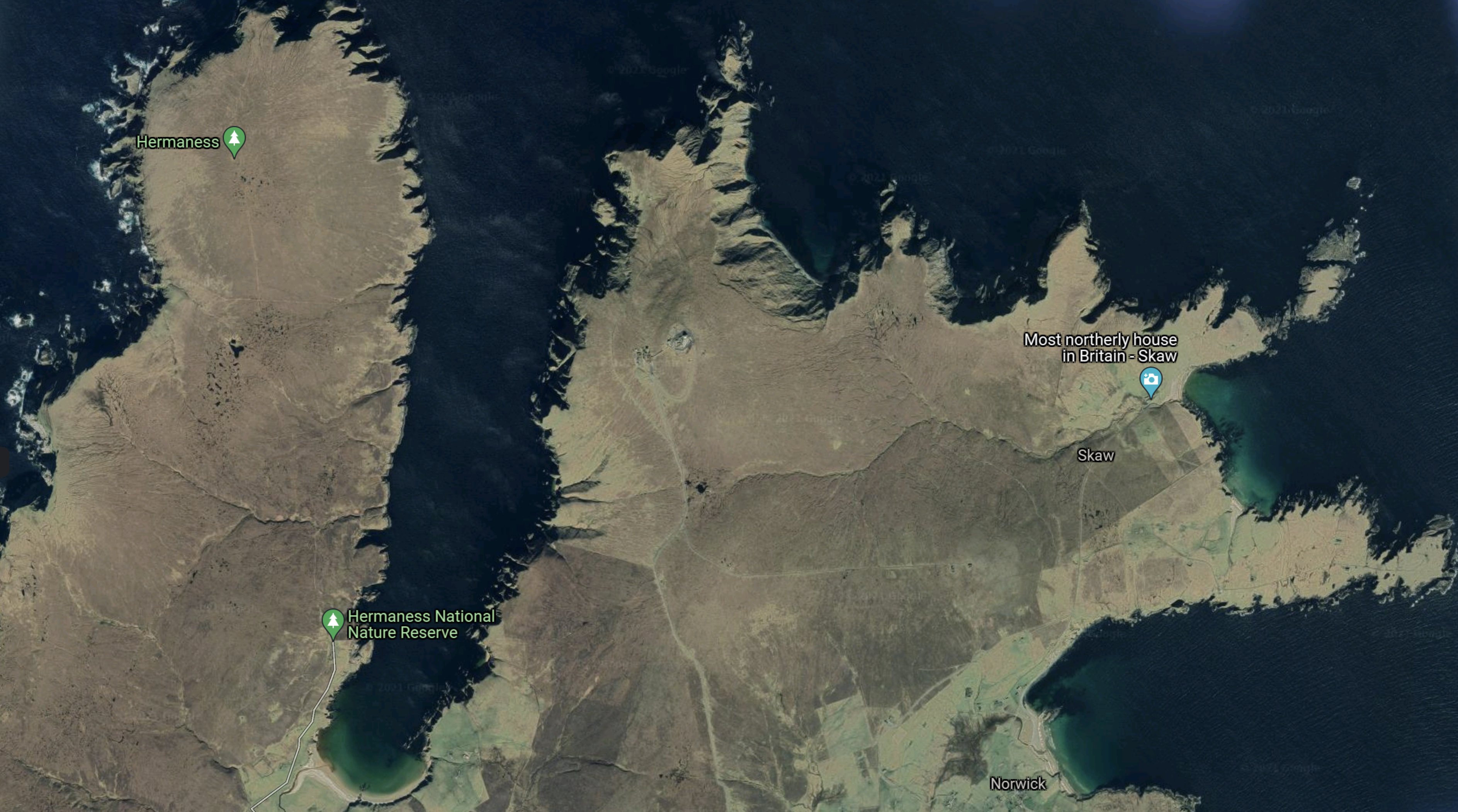
There’s not really much there, except birds, trees and the most northerly house in Britain.
Enlarging to the West of the house, gives this second Google Map.

Note the Remote Radar Head Saxa Vord, which has a Wikipedia entry as RAF Saxa Voe.
- It is now a fully-operational radar station again, after closure in 2006.
- It is at the same latitude as St. Petersburg and Anchorage.
- In 1992, it measured a wind speed of 197 mph, before the equipment blew away.
The Wikipedia entry is worth a read, as it gives a deep insight into radar and its tracking of Russian intruders in the Cold War.
This third Google Map shows a 3D closeup of the radar.
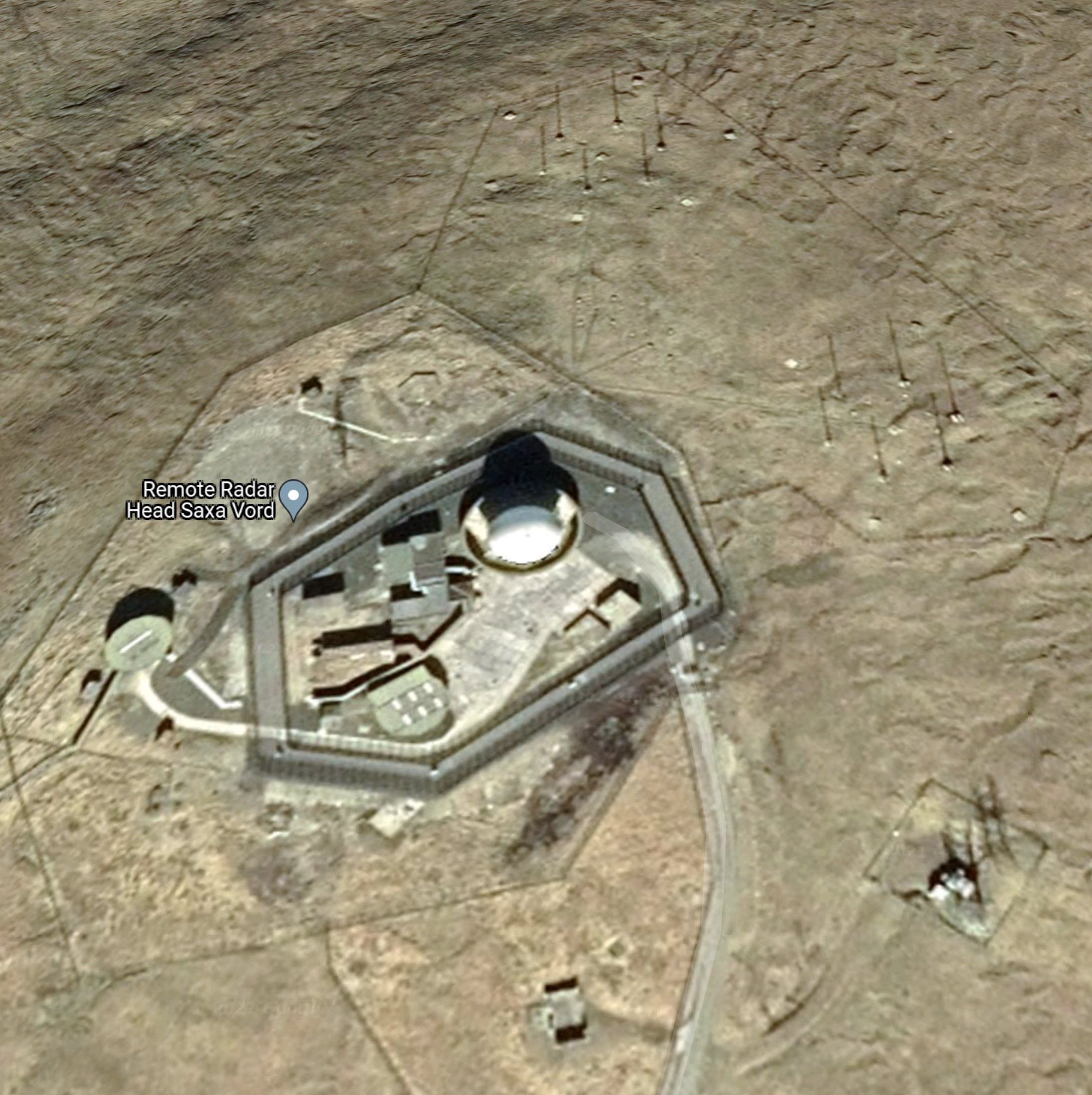
No staff are based at Saxa Vord, although maintenance staff do visit.
According to The Times, the space port will be at Lamba Ness, which is to the East of the most northerly house in Britain.

The peninsular in the South-East is marked Lamba Ness.
It may seem a very bleak place, but it could have one thing, that rocketry will need – rocket fuel!
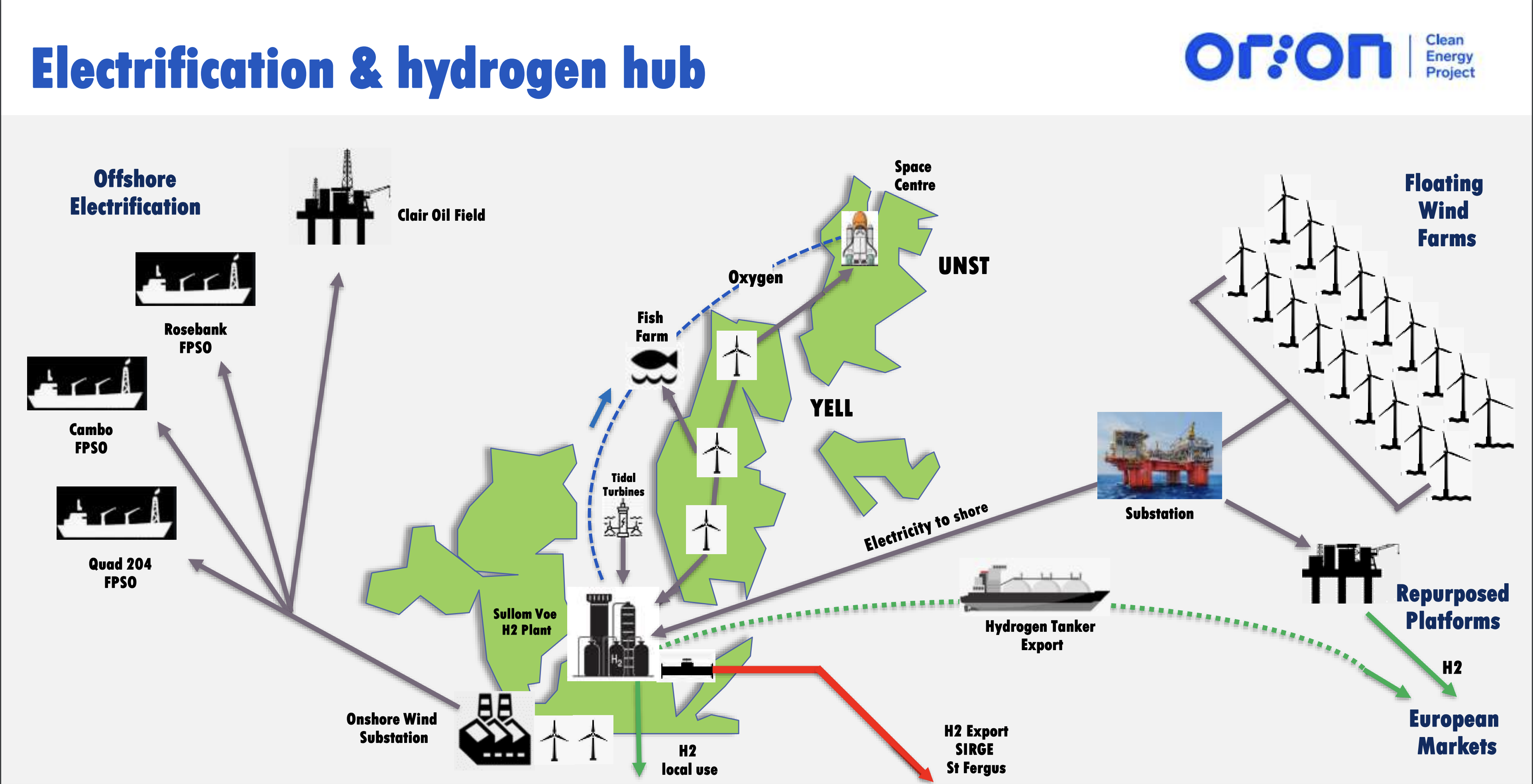
In Do BP And The Germans Have A Cunning Plan For European Energy Domination?, I introduced Project Orion, which is an electrification and hydrogen hub and clean energy project in the Shetland Islands.
The project’s scope is described in this graphic.
Note
- Project Orion now has its own web site.
- A Space Centre is shown on the Island of Unst.
- There is an oxygen pipeline shown dotted in blue from the proposed Sullom Voe H2 Plant to the Fish Farm and on to the Space Centre.
- I suspect if required, there could be a hydrogen pipeline.
The Space Centre on Unst could be fuelled by renewable energy.
Who Are Skyrora?
They have a web site, which displays this mission statement.
Represents a new breed of private rocket companies developing the next generation of launch vehicles for the burgeoning small satellite market.
The Times also has this paragraph.
At the end of last year, the company also completed trials of the third stage of its Skyrora XL rocket, including its orbital transfer vehicle which, once in orbit, can refire its engines 15 times to carry out tasks such as acting as a space tug, completing maintenance or removing defunct satellites.
The company seems to have big ambitions driven by innovation and a large range of ideas.
Conclusion
I shall be following this company.

