Arriving In Liverpool Lime Street Station – 10th May 2025
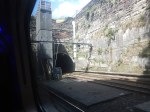
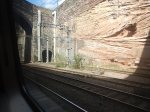
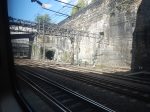
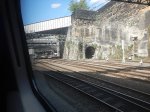
Liverpool Lime Street station has one of the more spectacular approaches of British railway stations, as these pictures show.
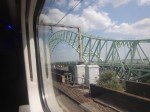







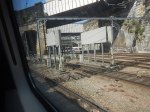
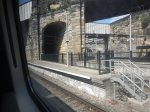
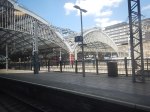
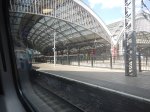
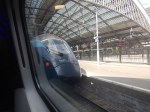
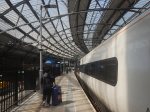
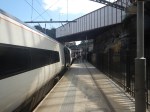
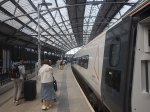
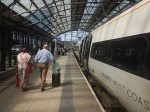
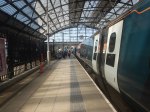
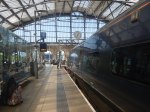

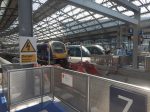
These sections describe the approach.
Crossing The Mersey
You cross the Mersey at Runcorn on the Ethelfreda or Britannia Bridge, which is described in this Wikipedia entry.
It was completed in 1868 and hopefully in a few years, it will be carrying High Speed Two trains between London and Liverpool.
On your right as you cross the Mersey to Liverpool is the Silver Jubilee road bridge, which is a through arch bridge that opened in 1961 to replace a historic transporter bridge. I am just a little bit too young to have seen the transporter bridge.
Further to your right, you can see the Mersey Gateway Bridge, which is a cable-stayed bridge, that opened in 2017 and is described in this Wikipedia entry.
Drax’s Biomass
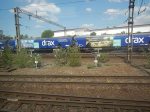
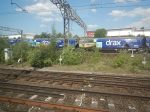
As you approach Lime Street station, you pass through Edge Hill, where there are the GB Railfreight sidings, where the biomass trains for Drax power station are marshalled for their journey across the Pennines. These Drax trains seem to be one of the few freight trains in the UK, that carry advertising. Tesco trains also do, but their’s is just big letters.
In Do Cummins And Stadler Have a Cunning Plan?, I talked about the possible conversion at some date in the future of GB Railfreight’s new electro-diesel Class 99 locomotives to electro-hydrogen locomotives. These locomotives will surely be ideal for hauling Drax’s biomass trains across the Pennines.
I do believe that these Class 99 locomotives are the future of heavy freight trains in the UK. In Iarnród Éireann Looks At Diesel Loco Replacement Options, I write about speculation, that Stadler may build a version for the Irish.
Through The Edge Hill Cutting
From Edge Hill a deep cutting through the sandstone takes you into Lime Street station.
It looked good in the sun, but the first time I arrived in the city to start my studies at Liverpool University, it was chucking it down and the cutting was very dark and wet.
It was a very different welcome to that, which I got yesterday.
My Train Arrived In Platform 10
Liverpool Lime Street has two cast iron train sheds.
- The Western shed has platform 1 to 5 and generally handles trains from the East.
- The Eastern shed has platform 6 to 10 and generally handles trains from the South.
Note.
- Changing between trains is just a step-free walk across the station concourse.
- Both sections have their own taxi rank and full-size clock.
- The Ticket Office is in the Western train shed.
I just walked from my train to the Ticket Office, bought a Lancashire Day Ranger ticket and then walked fifty metres to my next train.
How many stations have such an easy change of trains?
Is Liverpool Lime Street Station Ready For High Speed Two?
Consider.
- I travelled North in an 11-car Class 390 train, which is 265.3 metres long and can carry 607 passengers.
- As the last pictures show, the train fitted easily into platform 10.
- High Speed Two plans to send 200 metre classic-compatible trains to Liverpool Lime Street, with each having a capacity of up to 528.
It looks to me, that these High Speed Two classic-compatible trains will fit into Liverpool Lime Street station, at any platform that currently accepts an eleven-car Class 390 train.
Looking on Real Time trains over the last few days, I’ve found eleven-car Class 390 trains using platforms 9, 10 and 6.
It seems that Network Rail’s engineers have done a superb job to turn the Grade II Listed station, into one of the best operationally.
Iarnród Éireann Looks At Diesel Loco Replacement Options
The title of this post, is the same as that of this article on Railway Gazette.
These three paragraphs introduce the article.
The Stadler Class 99 electro-diesel locomotive for UK operator GB Railfreight was receiving close scrutiny from Iarnród Éireann at InnoTrans in Berlin, with the Irish national operator confirming to Railway Gazette International that it had discussed with the manufacturer how the type might be adapted for operation in Ireland.
Iarnród Éireann Chief Executive Jim Meade told Railway Gazette International ‘we will eventually need to replace our aging diesel fleet with dual-mode locomotives because our freight strategy will take us down that direction after we complete our electrification programme.
‘The replacement for the class 071s and 201s eventually will have to be a bi-mode electric with some form of HVO [renewable diesel fuel] traction in the long term; even the Class 201s are beyond mid-life already.
The Class 99 locomotive is a version of the Stadler Eurodual locomotive, which is described in this Stadler data sheet.
The Wikipedia entry for the Stadler Euro Dual is also informative and lists a dozen different versions of the locomotive, that have been sold to various countries and operators.
This paragraph summarises how the design can handle different gauges and electrical voltages.
The Euro Dual was designed from the onset as a highly modular platform, allowing it to be offered to customers in various different configurations, covering various gauges and voltage systems.
I doubt Stadler would have great difficulty producing an Irish gauge locomotive capable of running on whatever electrification, the Irish erect.
Will The Irish Class 99 Have Enough Power?
The power of the various diesel locomotives are as follows.
- Current Irish Class 071 – 1.68 MW
- Current Irish Class 201 – 2.4 MW
- UK Class 66 – 2.4 MW
- UK Class 99 – 1.79 MW
It would appear that the Class 99 is less powerful than the Irish Class 201 and the UK Class 66, but the Wikipedia entry for the Class 99 says this.
The chief executive of GBRf, John Smith, reports that the Class 99, despite having a less powerful diesel engine than the Class 66, will outperform the Class 66 at low speeds. The greater tractive effort means that the Class 99 on diesel power can deliver more power at the rail than the 66.
But as the Class 99 has 6.17 MW in electric mode, the solution must be to electrify the difficult sections.
I have just looked at the Felixstowe Branch Line, which will be very much Class 99 territory. I am fairly sure, that with some short lengths of electrification on the single-track sections, any performance problems with the Class 99 on the branch could be solved.
Could The Irish Class 99 Use Hydrogen As Secondary Power?
This OpenRailwayMap shows all the railways on the island of Ireland.
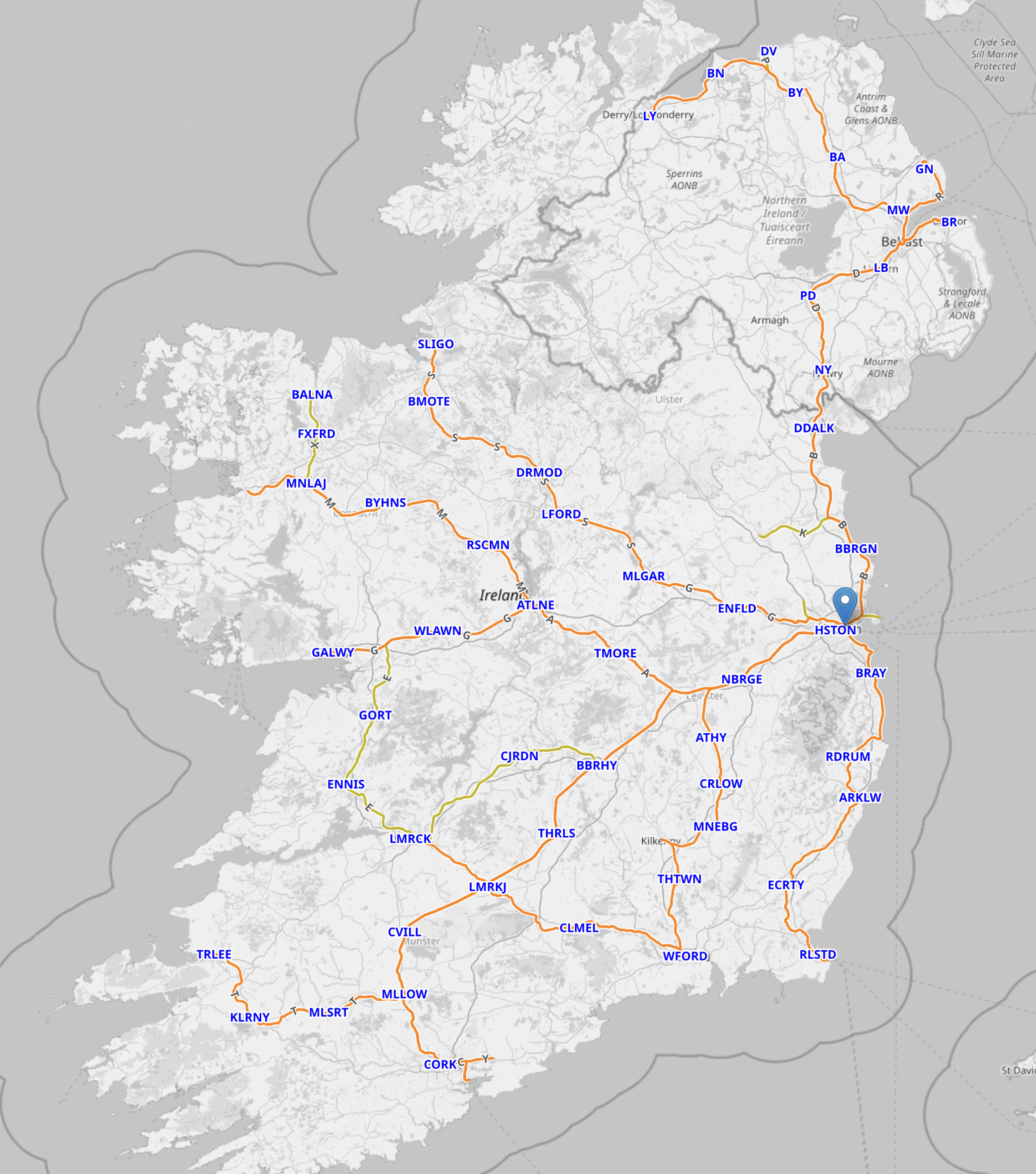
Note.
- All railways on the island of Ireland have an Irish gauge of 1.6 m.
- Only the DART in Dublin is electrified with 1,500 VDC overhead.
- There are 2,733 km. of track.
- New lines are still being added and old ones have been reopened in recent years.
- There will surely be pressure for the Irish to decarbonise their railways, both North and South of the Northern Irish border.
- There are no rail connections to another country, except for the link between Northern Ireland and the Republic of Ireland, which is between two similar systems.
- It is unlikely, that there will ever be a rail link between the Irish gauge railways on the island of Ireland and the standard gauge railways of Europe.
Effectively, the island of Ireland has an isolated network of tracks on which they could build a zero-carbon railway system.
- Signalling could be an off-the-shelf digital system.
- Zero-carbon traction power could be trains powered by either electricity and/or hydrogen.
- Both electricity and hydrogen would need substantial amounts of new rolling stock.
- Electricity would require electrification at €1,000,000 per single track kilometer, which could be around €5.5 billion for the electrification alone.
- Electrification would also need many bridges, stations and tunnels to be modified or rebuilt.
- Hydrogen would need a refuelling infrastructure and could go anywhere that diesel can.
- Hydrogen locomotives and trains, would be one-to-one replacements for diesel locomotives and trains.
It would appear that because of their geographic isolation, hydrogen could be an ideal zero-carbon fuel for the railways of Ireland.
In Do Cummins And Stadler Have a Cunning Plan?, I speculated that the electro-diesel Class 99 locomotive could be converted into an electro-hydrogen Class 99 locomotive, as Cummins are building diesel engines that can be converted into hydrogen ones.
Ireland with its unusual network could change to a zero-carbon railway in the following way.
- Purchase a fleet of diesel locomotives and trains that can run on Hydrotreated Vegetable Oil (HVO) and be convertible to hydrogen.
- A version of the Class 99 with or without the electrical gubbins would satisfy the locomotive replacement.
- A version of the tri-mode Stadler FLIRT like a Class 745 train, would satisfy the train replacement.
- All new trains and locomotives would replace the current stock and run on HVO.
- The hydrogen infrastructure would be built.
- The new trains and locomotives would be gradually converted to run on green hydrogen.
Within a few years, the island of Ireland would have a zero-carbon railway.
Advantages Of A Fully-Hydrogen Railway
These are a few advantages.
- One fuel for all trains.
- All trains and locomotives would be one manufacturer.
- No expensive electrification.
- Hydrogen trains and locomotives have a long range.
- No infrastructure modification for gauge clearance.
- Ireland has plenty of onshore and offshore wind for hydrogen.
- Standard fuelling systems are being developed.
- There would be no disruption as the trains changed to HVO and little disruption as they changed to hydrogen.
I believe that there would be a large increase in train usage both from locals and visitors, which can only be good for the Irish economy.
Managing The Project
This could be one of those rare projects that flows well.
- The changeover to hydrogen could involve very little rail infrastructure work.
- The hydrogen filling stations could be more-or-less independent of the rail infrastructure.
- Trains and locomotives could go into service, when they are accepted and the staff have been trained.
- Trains and locomotives would only be converted to hydrogen, as routes are made hydrogen-capable.
- There should be no gauging problems with the new trains and locomotives.
- There is only one train manufacturer.
Hopefully, it will all be delivered on time and on budget.
Iarnród Éireann And Latvia’s DIGAS To Trial Europe’s First Retrofitted Hydrogen Freight Locomotive
The title of this post, is the same as that of this press release from Irish Rail.
This is the sub-heading.
Cleaner, cheaper and practical initiative towards decarbonisation goals
These are the first three sections.
Cleaner
Iarnród Éireann Irish Rail is providing a locomotive and will test a retrofitted hydrogen locomotive using a cleaner burning renewable fuel.
Cheaper
DIGAS will provide a cost-effective way how to introduce a hydrogen in the fleet of existing diesel locomotives by retrofitting diesel locomotives with a specialised internal combustion engine (ICE) hydrogen system.
Practical
The collaboration will demonstrate a practical path towards complete decarbonisation of the diesel locomotive fleet.
Note.
- The eighteen 071 Class locomotives were built in Canada by General Motors.
- Some date from as early as 1976.
- In the UK, there is a similar project to convert Class 66 locomotives to dual fuel, which I wrote about in Clean Air Power Adds Hydrogen To Class 66 Fuel Mix.
It does look that the technology is being developed to convert freight locomotives to hydrogen.
Rolls-Royce Commences Series Production Of Hybrid-Ready MTU PowerPacks For Irish Rail
The title of this post, is the same as that of this article on CleanTechnica.
This is the introductory paragraph.
Rolls-Royce is to supply its very first series production MTU PowerPacks which are prepared for future use as hybrid traction units: Iarnród Éireann Irish Rail, the national railway operator of the Republic of Ireland, has ordered 41 of these MTU Hybrid-ready PowerPacks. Fitted with MTU 6H 1800 R86 engines, the PowerPacks comply with the EU Stage V emissions directives and each delivers 375 kW from the diesel engine as well as 150 kW from the electrical machine.
Later the aim would be to add batteries to the PowerPacks to make the trains fully hybrid.
I do think Rolls-Royce MTU might have a game-changer here.
- You take a modern fleet of diesel multiple units like a British Class 170 trains or an Irish Class 22000 trains,
- For starters you replace the old diesel engine, with a modern one that meets all the latest environmental regulations.
- It surely helps both sales and engineering, when the old diesel engine was supplied by MTU.
- Later you fit appropriately sized batteries to the PowerPack to create full hybrids with regenerative braking.
In Iarnród Éireann Orders Stage V MTU PowerPacks, I said this about fuel consumption and emissions.
The aim is to achieve a reduction of over thirty percent in both fuel consumption and carbon dioxide emissions.
I would suspect that with savings like that, the case for conversion might be an easy sell.
Iarnród Éireann Orders Stage V MTU PowerPacks
The title of this post, is the same as that as this article on Railway Gazette International.
The IE 22000 Class trains appear to be the main rolling stock of Irish Rail.
The Railway Gazette International article describes in detail how MTU are updating the standard diesel engines in these trains with their latest Hybrid PowerPacks.
The aim is to achieve a reduction of over thirty percent in both fuel consumption and carbon dioxide emissions.
From reading the article, it doesn’t appear to be a challenging project, once the testing is complete.
It does appear that MTU seem to get these conversion projects right.
Progress On The Porterbrook HybridFLEX Project
There is another engine conversion project, that uses MTU PowerPacks, underway in the UK, which I wrote about in Rolls-Royce And Porterbrook Launch First Hybrid Rail Project In The UK With MTU Hybrid PowerPacks, in September 2018.
Porterbrook call it the HybridFLEX project. I wonder how it is getting on.
This article on Diesel and Gas Turbine Worldwide, which is entitled Ricardo Leading Hybrid Train Project In UK, is the last reference I can find in January 2019.
As there are over two hundred trains, that can be converted in the UK, I’m looking forward to the rolling out of Porterbrook’s HybridFLEX project.
I suspect operators are too, as they’d like to save all that diesel.
Irish Rail And Porterbrook Order MTU Hybrid PowerPacks
The title of this post is the same as that of this this article on the International Rail Jotnal..
This is the first paragraph.
Irish Rail (IE) and British rolling stock leasing company Porterbrook have signed contracts with Rolls-Royce for the supply of 13 MTU Hybrid PowerPacks, the first firm orders for the hybrid rail drives.
Other points are made in the article.
- IE has ordered nine PowerPacks for Class 22000 trains. If the technology works they intend to convert all 63 trainsets, which will need 234 PowerPacks, as each car has a diesel engine.
- Porterbrook has ordered four for Class 168 and Class 170 trains.
- The PowerPacks will be delivered between mid-2020 and 2021.
- The MTU engines are built to EU Stage 5 emission regulations.
- The PowerPacks can switch to battery power in stations and sensitive areas.
- Under battery power, noise is reduced by 75 % and CO2 emissions by up to 25 %
- Operating costs are significantly reduced.
- The PowerPacks have regenerative braking, thus they reduce brake pad wear.
- Due to electric power, the trains have been acceleration, which may reduce journey times.
It seems that passengers, train operating companies, train leasing companies and those that live by the railway are all winners.
If the concept works reliably and meets its objectives, I can see MTU selling a lot of Hybrid PowerPacks.
Which Operators Will Be Used For Trials?
This is a valid question to ask and I’ll put my thoughts together.
Irish Rail Class 22000 Train
These trains only run in Ireland with one operator;Irish Rail, so they will be used for trials.
As each car has one MTU diesel engine and Irish rail are stated in Wikipedia as wanting to run three-car and six-car sets, could they be converting one train of each length?
British Rail Class 168 Train
All the nineteen Class 168 trains of various lengths are in Chiltern Railway’s fleet, they will be the trial operator.
Chiltern also have nine two-car trains, which could be ideal for trial purposes as they will need two Hybrid PowerPacks.
British Rail Class 170 Train
Porterbrook own upwards of thirty two-Car Class 170 trains with CrossCountry, Greater Anglia and West Midlands Trains.
As Greater Anglia and West Midlands Trains are replacing their Class 170 trains, this means that CrossCountry will soon be the only user of two-car units.
The four two-car trains from Greater Anglia, will be going to Trains for Wales (TfW).
TfW currently has thirty two-car Pacers in its fleet, which must be replaced by the end of 2019.
TfW is bringing in the following trains.
- Nine four-car Class 769 trains from Porterbrook.
- Eight three-car Class 17 trains from Greater Anglia
- Four two-car Class 17 trains from Greater Anglia
This is a total of sixty-eight cars.
So TfW are replacing a load of scrapyard specials with quality, more powerful trains, with approximately 13 % more capacity.
TfW are proposing to use the Class 170 trains on the following routes.
- Heart of Wales line (from 2022)
- Regional services between South and West Wales
- South Wales metro lines – Ebbw Vale/Maesteg (until 2022)
- Crewe-Shrewsbury local services (from 2022)
There is a mixture of routes here and it would be a good trial,
Other Trains
If the MTU PowerPack proves successful and leads to widespread conversion of the Class 168 and Class 170 fleets, will we see the twenty Class 171 trains and thirty-nine Class 172 trains converted to hybrid power?
Conclusion
It looks like a good solid project to me!
 The Anonymous Widower