Is Lumo The Ryanair Of Rail?
Someone had to draw the comparison between Lumo and Ryanair and it was The Times, that used a headline of Lumo, The Ryanair Of Rail, Gets The Green Light On East Coast, for their article about the new London and Edinburgh rail service in their article today.
But how alike are the two business models?
Standard Planes And Trains
The Boeing 737 and the Airbus A 320, as used by Ryanair and easyJet are the two workhorses of short haul airlines.
It can also be said, that Hitachi’s AT-300 train is becoming the workhorse of long-distance rail services in the UK.
Customised Interiors
Ryanair and easyJet do customise the interiors of their aircraft to a certain extent and from pictures on the Internet Lumo appear to have done the same.
If you look at the widths of the planes and trains on Wikipedia, you find these values.
- Airbus A 320 – 3.95 metres
- Boeing 737 – 3.8 metres
- Class AT-300 train – 2.7 metres
Dividing by the number of seats across, which is six for the planes and four for the train gives these figures.
- Airbus A 320 – 0.66 metres
- Boeing 737 – 0.63 metres
- Class AT-300 train – 0.67 metres
I know there is an aisle down the middle, so let’s say that it is 0.60 metres. This gives these spaces for each seat.
- Airbus A 320 – 0.56 metres
- Boeing 737 – 0.53 metres
- Class AT-300 train – 0.53 metres
I think that is adequate space for a designer to do a good job.
This picture shows the interior of a Great Western Railway Class 802 train, which use a similar body shell to the trains used by Lumo.
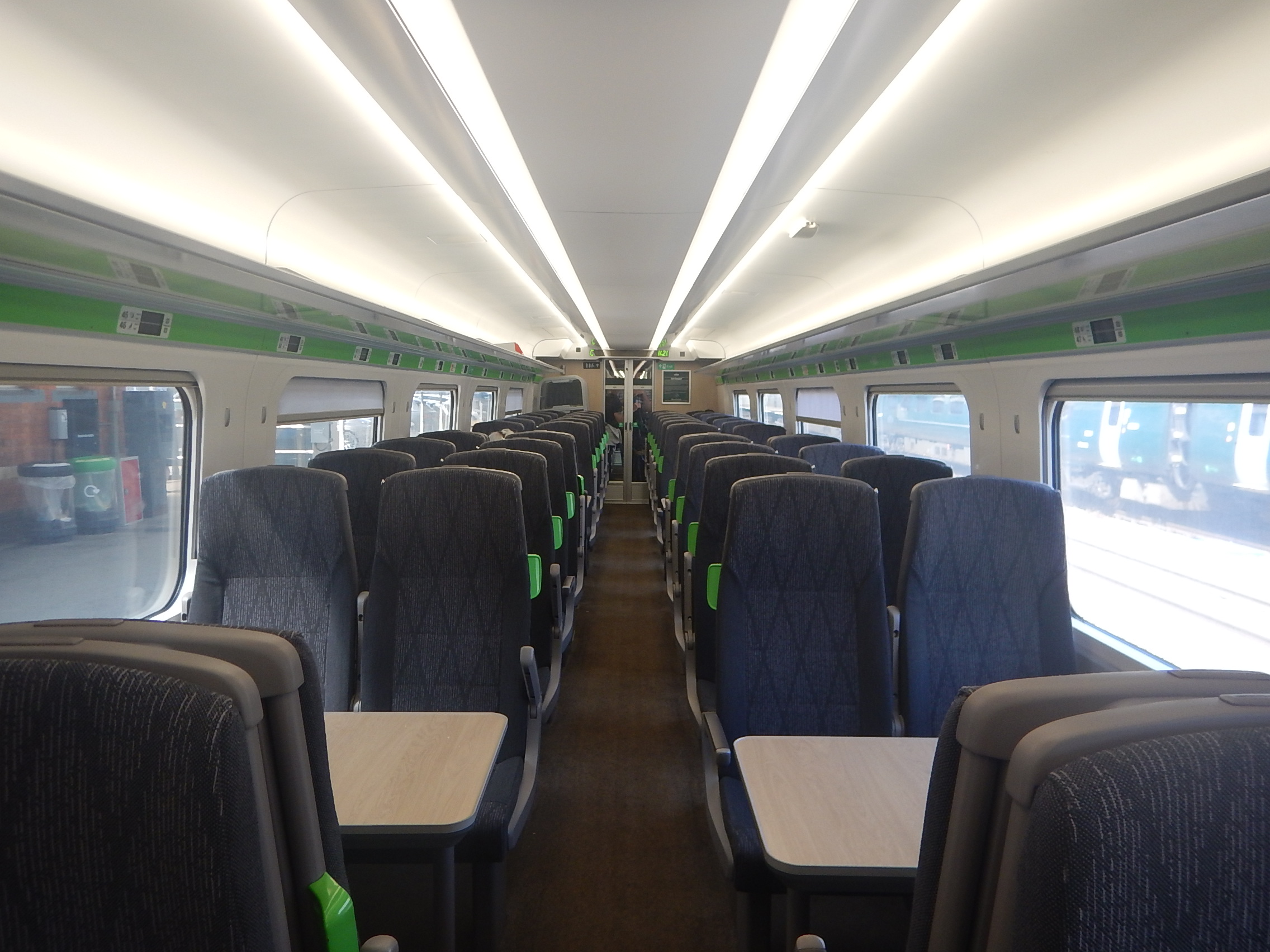
Note.
- The aisle looks to be similar in width to a seat.
- There is a bag shelf above the windows and lots of coat hooks.
As both Lumo and Great Western Railway are both First Group companies, is it likely that the interior dimensions are similar, so that standard trolleys could be used and training could be eased and shared between companies in the group.
This picture shows a trolley fitting in between the tables on a Great Western Railway service.

I suspect, if they design everything together, Lumo could make best use of a narrow aisle to give the seats a bit more width.
This last picture shows TransPennine Express Class 802 train at Willesden Junction station.
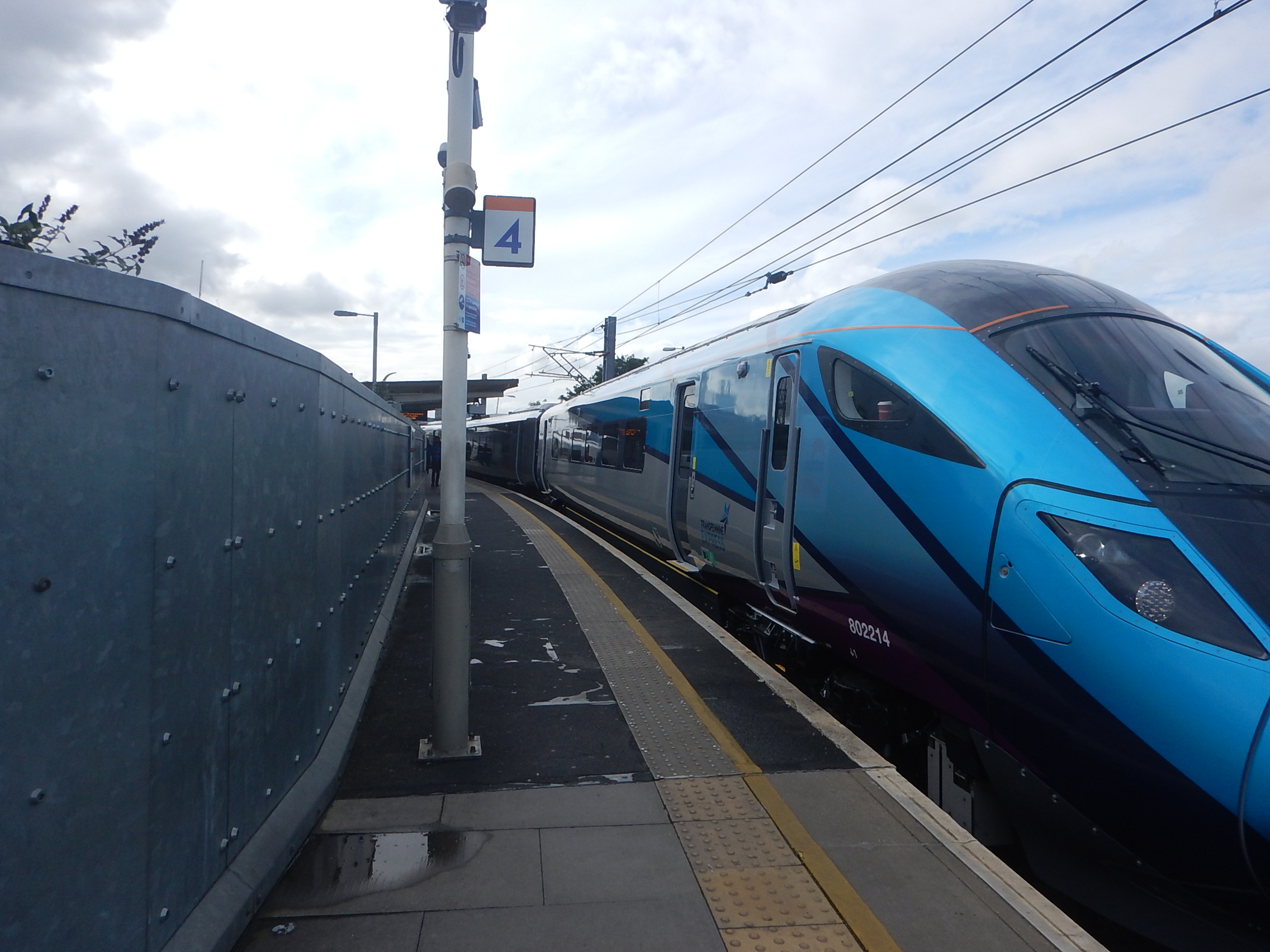
Note how the lower part of the side of the train is curved. Is this to get a bit more room for the seat squab?
Passengers Per Metre
This is only a rough calculation and shows typical passengers, fuselage or car length and passengers per metre.
- Airbus A 320 – 164 passengers – 37.57 metres – 4.4 px/metre
- Boeing 737 – 160 passengers – 37.0 metres – 4.3 px/metre
- Class AT-300 train – 96 passengers – 26 metres – 3.7 px/metre
Passenger density in the train is about fourteen percent less.
Toilets
In The Definitive Seating Layout Of Lumo’s Class 803 Trains, I said this.
This article on Economy Class and Beyond is entitled Enter Lumo – The New East Coast Railway Competitor.
It contains a drawing from Lumo, which shows the layouts of the seats on the train.
-
- Coach A – 44 Standard seats – 8 Priority seats – 2 Wheelchair spaces – 2 Tip up seats – Accessible toilet – 56 Total seats
- Coach B – 84 Standard seats – 12 Priority seats – Bike store – Toilet – 96 Total seats
- Coach C – 84 Standard seats – 12 Priority seats – 96 Total seats
- Coach D – 84 Standard seats – 12 Priority seats – Bike store – Toilet – 96 Total seats
- Coach E – 52 Standard seats – 8 Priority seats – 2 Tip up seats – Accessible toilet – 62 Total seats
Note.
-
- This is a total of 406 seats.
- Judging by the position of the tip-up seats they are for staff and perhaps emergency use, if say a coffee gets spilled on a seat.
- Each car has a pair of tables, where four can sit. As Lumo’s business model allows early booking, if you and your partner want to take the kids to see granny on her birthday, you should be able to get a table, by booking early.
- There are two bike stores in Coaches B and D.
These are some further thoughts.
Toilet Provision
I was on an LNER Class 800 train earlier this week and needed to go to the toilet.
-
- I wasn’t sure which way I needed to go, as I couldn’t see a sign pointing me to the toilet, but in the end I struck lucky.
- You don’t have that problem with Lumo’s trains, as there appears to be a toilet at both ends of the three middle coaches, either in your car or the next.
- If you’re in one of the driver cars, there is an accessible toilet at the blunt end.
I don’t think anybody will argue with the toilet provision on Lumo’s trains.
Typically a Boeing 737 or an Airbus A320 will have two toilets for about 160 passengers.
Lumo’s trains have two accessible toilets and two ordinary ones for 406 passengers.
Ease Of Boarding
If you want to catch a train at virtually any station in the UK, in most cases, you just turn up something like fifteen minutes before the departure time, present your ticket and get on the train.
Planes used to be like that in the UK, but they aren’t any more.
Catering
In the article in The Times, Matt Lee, who is Lumo’s customer experience director, said they have been free to develop their own systems. He says this about the catering.
Catering will be a Deliveroo-style service: passengers can order M&S or Pret sandwiches in advance and have them delivered to their seat. “We are a testbed for other FirstGroup train operators.
Will they do gluten-free?
Luggage
Lumo have a luggage courier service called LumoLuggage.
Service Expansion
Suppose an airline or a train operating company wants to run additional services to add capacity to a route.
With an airline, they will need to obtain additional take-off and landing slots to fly the route.
But Lumo are running five-car trains on a route, where all the stations can handle nine-car trains and possibly a pair of five-car trains.
So Lumo just add extra cars to the fleet, so that they match the number of cars running on the route to the demand.
The only costs to increase the capacity are those of the extra cars and a proportionate number of extra staff.
Conclusion
I can see this service model being copied by other train operators in other countries.
I’m looking forward to going North on Wednesday.
The Dalston Junction Crossing At Night
This picture shows the diagonal light-controlled crossing at Dalston Junction station at night.

This Google Map shows the junction.

Note.
- The North-South Road is Kingsland High Street.
- The Road going East is Dalston Lane, where my grandmother was born on the North side of the road, about a hundred metres along.
- On the South side of Dalston Lane is Dalston Junction station, with a West-facing bus-stop in front.
- The Road going West is the Balls Pond Road of Beyond Our Ken and Round The Horne fame.
- The building at the West of the junction is the solicitors shown in the first picture.
- On the North side of the Balls Pond Road is an East-facing bus stop, which is paired with the one by the station. A bus at the stop can be seen in the first picture.
The diagonal light-controlled crossing can seen crossing between the two sides of the junction between the yellow meshes of the box junction.
The junction has had this layout for a few years now and it works.
- I live about a kilometre to the West of Dalston Junction and regularly take a bus to stop on the West side of the junction before crossing diagonally to catch the Overground.
- Coming home, I catch a bus from just outside the station
- As buses are generally about once every ten minutes, I generally don’t wait long.
- The crossing has made a big improvement to the junction, as it connects the two stations and the Kingsland Road.
How many other busy junctions could be improved by a similar diagonal crossing?
It should also be noted that since the crossing has been installed, Dalston has gained an Aldi, a Co-op. a Marks and Spencer Simply Food Spencer Simply Food, a Pret, a Premier Inn and several better fast food places.
The improvement of the walking routes has certainly brought more people up the junction and to the two stations.
Who Stole All The M & S Gluten-Free Food?
Over the last few weeks, certain gluten-free lines in Marks and Spencer have started getting difficult to find.
Some of the things, I like that have been difficult have included.
- Ginger snap biscuits.
- Gluten-free pies
- Scones
- Bloomer slices
- Gluten-free muesli
Note that my supper is usually something I cook myself from scratch or one of the many M & S ready meals, that contain no gluten. It is usually washed down by a bottle of Adnams low-alcohol beer and followed by some fruit. Tonight, the fruit will be one of my favourites, which are strawberries and bananas.
I did think that the shortage of the lines I mentioned was due to a supply problem.
But then, there have not been shortages of other lines, that I buy, that are not specifically gluten-free.
So is it some gluten-free suppliers are having problems? Possibly.
But!
Regular readers of this blog will know that I believe that those coeliacs on a long-term gluten free diet seem to be unlikely to suffer a severe dose of the dreaded covids. There was no battle with the second dose!
I know for a start that my immune system gives short shift to any viral invaders, as it did with the AstraZeneca vaccine before they came to a truce.
So have others, including some with more medical knowledge than myself, come to the same conclusion about coeliac disease, the immune system, gluten and the covids and have gone gluten-free for safety?
For example, I’ve heard that those suffering from long covid have been tested for coeliac disease.
I’d love to be able to analyse the sales of gluten-free food.
Is There Anybody Out There, Who’d Like To Share a Beef Bourguignon?
Recently, Marks and Spencer introduced a range of meat dishes, one of which was Beef Bourguignon.


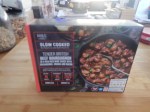
So I bought one today.
- There is a range of about six dishes.
- All of the range seems to be gluten-free and is marked as such.
- As they don’t look gluten-free from the picture, they would be ideal for serving at a mixed meal, where some diners were gluten-free and others were not!
- They seem to be simple to cook.
- The Use-By date is the 27th October.
If I have a quibble, it is that they are only for two and they also say Do Not Reheat on the box, which means that coeliacs like me, who live alone have a problem.
Perhaps they need a single portion.
But to solve my problem, if there is anybody reading this, who is close to Dalston and would like to test the Beef Bourguignon, then get in touch before the 27th!
Stratford Station Secures Funding For Plans Set To Relieve Overcrowding
The title of this post, is the same as that of this article on Rail Technology Magazine.
These are the first two paragraphs.
Reduced congestion at London’s Stratford station is on the table as Network Rail secure a £2m boost from the Department for Transport.
Stratford Station has seen a surge in demand – despite the impact of the pandemic – ever since the 2012 Olympics, and the forecast for this is set to grow even more as the area continues to regenerate.
Something needs to be done as it is he busiest non-terminal station in London, that before the pandemic was handling over 42 million passengers per year.
Nothing specific is said, except that more space will be created for passengers with better wayfinding.
Although the article says that this could be a five year project.
The Current Station
This is an extract from It’s Time To Detopsify Stratford Station, which was a previous look at Stratford station in May this year.
This map from cartometro.com shows the Topsy-like nature of the platforms at Stratford.
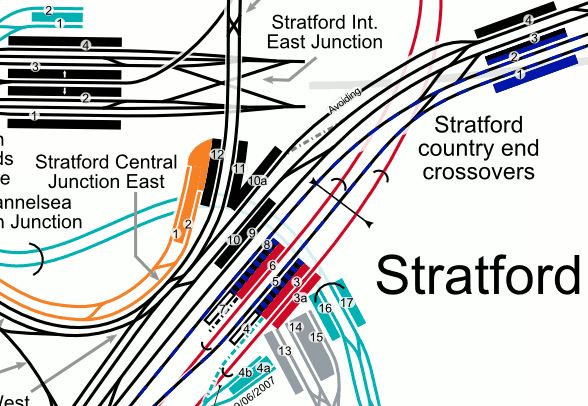
Note.
- The Docklands Light Railway is shown in turquoise.
- The DLR platforms in the North-West corner of the map are those of Stratford International station.
- High Speed One and the four platforms of Stratford International station are shown in black.
- The North London Line of the London Overground is shown in orange.
- The North London Line terminates in Platforms 1 and 2, which have a level link to Platform 12.
- Platform 12 is on the anti-clockwise platform for the High Meads Loop and has step-free access to the subway system underneath the station.
- Platform 11 is on the clockwise platform for the High Meads Loop and has level access to Platform 10a and full step-free access,
- Platform 10a is used by some services to East Anglia.
- Crossrail is shown in blue.
- The Central Line is shown in red.
- The Jubilee Line is shown in silver.
It is not the best passenger-friendly station layout.
What Would I Do?
These are what I would like to see.
Better Information on the Overground Platforms
If I am returning from Stratford after doing some shopping at Eastfield, I will often climb up the stairs or rise in the lift to the two Overground platforms 1 and 2. I will often find two trains there, but there is no indication to say which will be the first train to leave.
Use Of The High Meads Loop
The High Meads Loop is a double-track loop at the Southern end of the branch of the West Anglia Main Line that leads to Stratford.
- It is mainly underneath the Eastfield shopping centre.
- It serves Platforms 11 and 12 in Stratford station.
As the single-track loop of the Wirral Line under Liverpool can handle up to sixteen trains per hour (tph), I believe that the High Meads Loop could be used as the Southern terminus for an improved service to Cambridge, Stansted Airport and up the Lea Valley to Cheshunt, Chingford, Harlow and Hertford East.
The signage from when Stratford had a Stansted Express service is still there and shown in this picture.

This is almost symptomatic of the chaotic nature of the station.
I get the impression from this sign, that one of the original design criteria of the High Meads Loop and the Overground platforms at Stratford for the North London Line was to create an easy route for the whole of North London to Stansted Airport and Cambridge.
Or is it just a symptom of Too Many Cooks Syndrome, where everybody had their own ideas and no-one took charge and designed Stratford station properly?
Let’s hope Network Rail are fully in charge, as this is not a project to interest Sadiq Khan, as it’s not in South London and that area of London won’t benefit.
A Better Connection Between Stratford Station And Southeastern HighSpeed Services
I have just looked up how it is recommended you might travel between Richmond and Faversham.
The timetable recommends a double-change at Clapham Junction and Victoria.
I would take the Overground to Stratford and then change to the Southeastern HighSpeed services.
- This route is a single change.
- The change is step-free.
- The change involves passing the best station stop in the UK; Marks and Spencer’s large store in the Eastfield Shopping Centre, where takeaway food is well placed for passing trade.
But the change is badly signposted and could be a long walk with a heavy case.
There is probably a need for some form of people mover that connects all the platforms at Stratford station to the platforms at Stansted International station.
Conclusion
Sort it!
Is This The Proof That Coeliacs On A Gluten-Free Diet Don’t Get The Covids?
I took this picture in Marks and Spencer’s food store on Finsbury Pavement this morning,

I know Easter is coming, but it did seem to me that they had over-ordered the gluten-free hot cross buns.
But have their gluten-free sales held up extremely well during the pandemic?
Are their large numbers of gluten-free customers, still well enough to be buying the good things in life?
Certainly, throughout the pandemic, there’s never been a shortage of gluten-free scones!
Or it could be a simple case of a computer saying “Let them eat loadsa buns!” in the City of London!
A Train Of My Own!
To get to the the best Marks and Spencer food shop near me, I walk to Essex Road station and take a train to Moorgate or Old Street stations depending on the weather.
As it was sunny today, I took a private train to Old Street station.
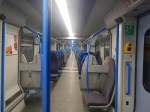
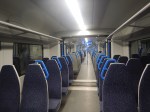
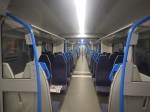
Everybody else was asked to get on the Rail Replacement Bus.
The Small Sign That Means So Much To A Coeliac
I’ve bought Marks & Spencer’s mackerel pate for any years.
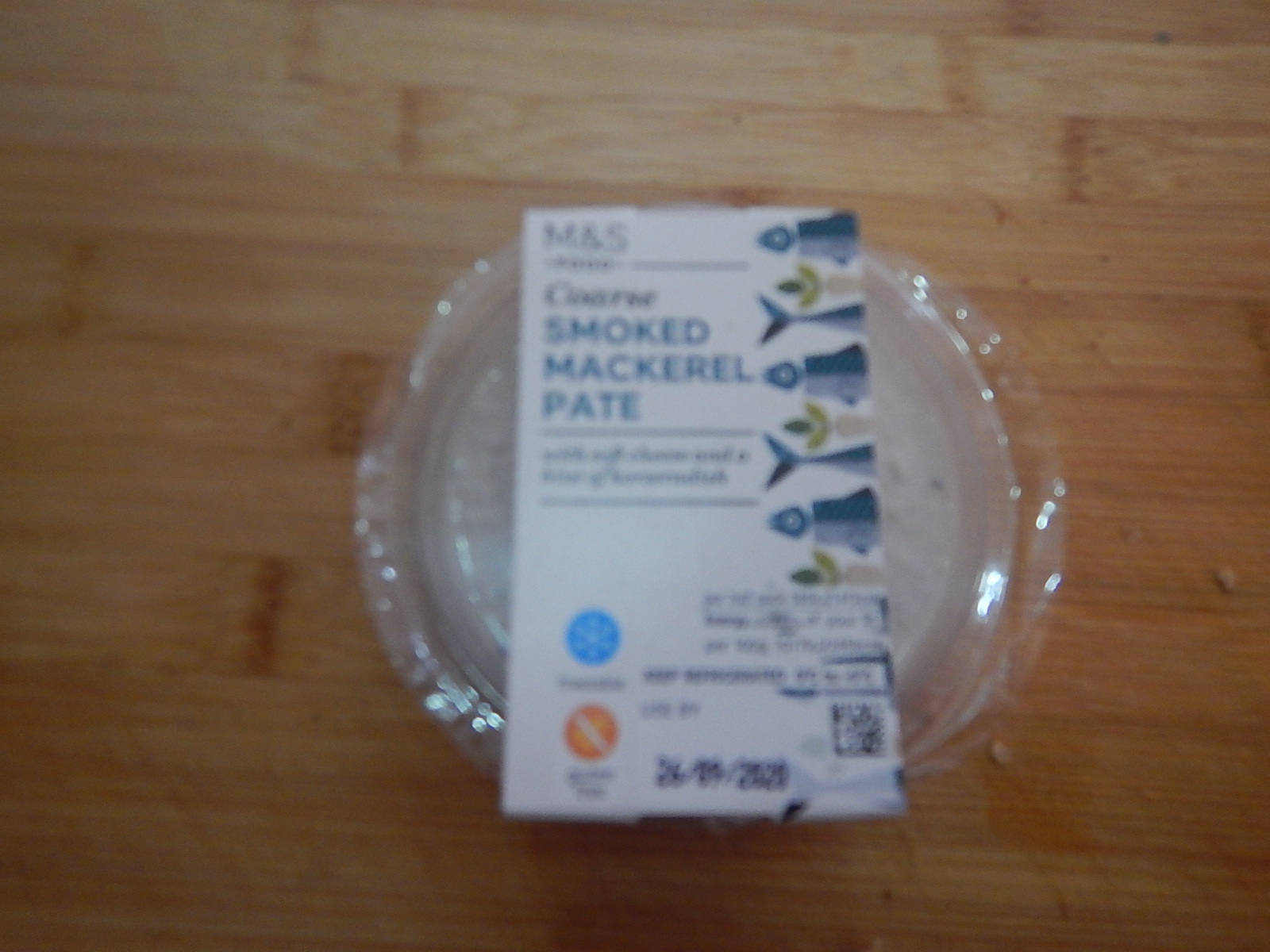
It’s the first time, I’ve noticed the packaging has the gluten-free symbol.
More please! My eyesight needs glasses to read the allergies!
Coronavirus Lockdown In Sweden: a New Take On Safe Shopping — No Assistants
The title of this post is the same as that of this article on The Sunday Times.
It could be the way, that convenience stores will be going! Even my local Marks and Spencer in Dalston, allows you to scan using an app, put the goods in your bag and just walk out!
I must try it, as it would mean that I would have to touch less equipment and won’t have to stand there like a wally, whilst the assistant verifies my age, after I have purchased low alcohol beer.
There could also be little robots like Daleks or R2-D2 wandering around, who you could ask questions, like “Where is the Adnams 0.5% low-alcohol beer?”. They would reply “Follow me!” and lead you to your next purchase.
 The Anonymous Widower