Centrica And Equinor Agree Major New Deal To Bolster UK Energy Security
The title of this post, is the same as that as this news item from Centrica.
This is the sub-heading.
Centrica and Equinor have today announced a £20 billion plus agreement to deliver gas to the UK. The new deal will see Centrica take delivery of five billion cubic meters (bcm) of gas per year to 2035.
These three paragraphs add more detail to the deal.
The expansive ten-year deal continues a long-term relationship with Equinor that dates back to 2005 bringing gas from Norway to the UK.
In 2024, the UK imported almost two-thirds (66.2%) of its gas demand, with 50.2% of the total imports coming from Norway1. This is an increase from the UK importing around a third of its gas requirements from Norway in 20222 and underlines the strategic importance of the Norwegian relationship to UK energy and price security.
The contract also allows for natural gas sales to be replaced with hydrogen in the future, providing further support to the UK’s hydrogen economy.
I believe there is more to this deal than, is stated in the news item.
These are my thoughts.
Where Does AquaVentus Fit In?
The AquaVentus web site has a sub heading of Hydrogen Production In The North Sea.
This video on the web site shows the structure of the project.
I clipped this map from the video.

Note.
- The thick white line running North-West/South-East is the spine of AquaVentus, that will deliver hydrogen to Germany.
- There is a link to Esbjerg in Denmark, that is marked DK.
- There appears to be an undeveloped link to Norway, which goes North,
- There appears to be an undeveloped link to Peterhead in Scotland, that is marked UK.
- There appears to be a link to just North of the Humber in England, that is marked UK.
- There appears to be an extra link, that would create a hydrogen link between Norway and Humberside.
- Just North of the Humber are the two massive gas storage sites of Aldbrough owned by SSE and Brough owned by Centrica.
- Aldbrough and Rough gas storage sites are being converted into two of the largest hydrogen storage sites in the world!
- There appear to be small ships sailing up and down the East Coast of the UK. Are these small coastal tankers, that are distributing the hydrogen to where it is needed?
When it is completed, AquaVentus will be a very comprehensive hydrogen network.
RWE
I should add that AquaVentus is a project of German energy company; RWE.
It should be noted that RWE are the largest generator of electricity in the UK.
They will soon be even larger as they are developing these offshore wind farms in British waters.
- Dogger Bank South – 3 GW
- Norfolk Boreas – 1.4 GW
- Norfolk Vanguard East – 1.4 GW
- Norfolk Vanguard West – 1.4 GW
Note.
- This is 7.2 GW of electricity.
- The three Norfolk wind farms wwere possibly acquired at a bargain price from Vattenfall.
- None of these wind farms have Contracts for Difference.
- RWE are developing large offshore electrolysers.
- East Anglia is in revolt over pylons marching across the landscape.
I wonder, if RWE will convert the electricity to hydrogen and bring it ashore using AquaVentus, coastal tankers or pipelines to existing gas terminals like Bacton.
The revenue from all this hydrogen going to Germany could explain the rise in Government spending, as it could be a Magic Money Tree like no other.
HiiROC
HiiROC is a Hull-based start-up company backed by Centrica, that can turn any hydrocarbon gas, like chemical plant waste gas, biomethane or natural gas into turquoise hydrogen and carbon black.
I asked Google about the size of Norway’s chemical industry and got this reply.
Norway’s chemical industry, including oil refining and pharmaceuticals, is a significant part of the country’s economy. In 2023, this sector generated sales of NOK 175 billion (approximately €15.2 billion), with 83% of those sales being exports. The industry employed 13,800 full-time equivalents and added NOK 454 billion (approximately €3.9 billion) in value.
Isn’t AI wonderful!
So will Norway use HiiROC or something similar to convert their natural gas and chemical off-gas into valuable hydrogen?
If AquaVentus were to be extended to Norway, then the hydrogen could be sold to both the UK and Germany.
A scenario like this would explain the option to switch to hydrogen in the contract.
Aldbrough And Brough
Earlier, I said that just North of the Humber are the two massive gas storage sites of Aldbrough owned by SSE and Brough owned by Centrica.
I have read somewhere, that Germany is short of hydrogen storage, but I’m sure Centrica and SSE will help them out for a suitable fee. Centrica are also thought to be experts at buying energy at one price and selling it later at a profit.
Conclusion
I have felt for some time, that selling hydrogen to the Germans was going to be the Conservative government’s Magic Money Tree.
Has this Labour government decided to bring it back to life?
Site Investigations Underway At RWE’s Three Norfolk Offshore Wind Project Sites
The title of this post, is the same as that of this article on offshoreWIND.biz.
This is the sub-heading.
RWE has kicked off geophysical and geotechnical site investigations at the Norfolk Boreas, Norfolk Vanguard East, and Norfolk Vanguard West offshore wind project sites in the UK, rights to which the German company acquired from Vattenfall earlier this year.
All three projects in RWE’s 4.14 GW wind farm off the Norfolk coast, at last seem to be making progress.
According to the Wikipedia entry for the List Of Offshore Wind Farms In The United Kingdom, this is the last status.
Norfolk Boreas
Owner: RWE
Turbines: Vestas
Status: Contract for Difference – Round 4
Commissioning Date: 2027
Norfolk Vanguard East
Owner: RWE
Turbines: Vestas
Status: Early Planning
Commissioning Date: Before 2030
Norfolk Vanguard West
Owner: RWE
Turbines: Vestas V236-15.0 MW
Status: Early Planning
Commissioning Date: Before 2030
Note.
- All three Norfolk wind arms, will be using Vestas turbines.
- The data for Norfolk Vanguard West shows that Vestas V236-15.0 MW turbines will be used.
- In SeAH To Deliver Monopiles For Vattenfall’s 2.8 GW Norfolk Vanguard Offshore Wind Project, I discussed the monopiles for the Norfolk wind farms. Will these be standardised across the Norfolk wind farms?
- In RWE Orders 15 MW Nordseecluster Offshore Wind Turbines At Vestas, I speculated that RWE had standardised on these large turbines for their North Sea wind farms, which would surely be a sensible action to take.
Using the same large turbines and monopiles for a number of wind farms, will surely give advantages in manufacture, installation, operation and and servicing for RWE, SeAH Wind and Vestas.
The finances should also be more beneficial.
These are my thoughts.
Will The Norfolk Wind Farms Produce Hydrogen For Germany?
Consider.
- As Hornsea 4 wind farm makes landfall in Norfolk, Norfolk should have enough renewable electricity.
- The Norfolk Nimbies will object to more electricity transmission lines across Norfolk.
- H2ercules, which is the large German hydrogen network will need lots of green hydrogen.
- Wilhelmshaven, which will be the main hydrogen feed point for H2ercules, is just across the North Sea at Wilhelmshaven.
- There are no Houthis roaming the North Sea.
- Hydrogen could be transported from the Norfolk wind farms to Wilhelmshaven by pipeline or coastal tanker.
- German companies are building the Norfolk wind farms.
I believe that there is a good chance, that the Norfolk wind farms will produce hydrogen for Germany.
This will have the following benefits.
- Germany will get the hydrogen it needs.
- The hydrogen link will improve energy security in Europe.
- The UK government will receive a nice cash flow.
The only losers will be the dictators, who supply Europe with energy.
Wood To Optimise Hydrogen Storage For Centrica’s Rough Field
The title of this post, is the same as that of this press release from Wood plc.
These are the first three paragraphs.
Wood, a global leader in consulting and engineering, has been awarded a contract by Centrica Energy Storage (CES) for the redevelopment of the UK’s Rough field in readiness for future hydrogen storage.
The Rough reservoir, located in the Southern North Sea, has been used to store natural gas safely for over thirty years and has the potential to provide over half of the UK’s hydrogen storage requirements.
The front-end engineering design (FEED) contract, awarded to Wood, entails new pipelines, a new unmanned installation, as well as onshore injection facilities at the Easington Gas Terminal, is the first step in making the field hydrogen ready.
Offshore Magazine has this article about the deal, which is entitled Wood Assessing Hydrogen Storage Needs For North Sea Rough Reservoir.
This is a paragraph from the Offshore Magazine article.
Centrica aims to position the Rough Field as the world’s largest long-duration hydrogen storage facility, although FID on the redevelopment project would depend on government support.
It would be a very important project.
Why would Centrica be planning for this massive increase in hydrogen storage?
There could only be one reason.
There is going to be a massive increase in hydrogen production and use.
In Where’s The Plan, Rishi?, I laid out what I believe will happen in the next few years.
- In RWE Goes For An Additional 10 GW Of Offshore Wind In UK Waters In 2030, I detailed how RWE intended to add an extra 10 GW of offshore wind to the seas around the UK.
- As our current offshore wind capacity is around 15 GW, so another 10 GW would surely be very welcome.
- The Germans will develop H2ercules, which is their massive project to create a hydrogen network to bring hydrogen to Southern Germany.
- A hydrogen hub at Wilhelmshaven is being built by Uniper to feed H2ercules with green hydrogen from around the world.
But would it not be better, if instead of feeding H2ercules with hydrogen from around the world, some came from the UK, a few hundred miles across the North Sea?
- RWE are developing the 3 GW Dogger Bank South wind farm, which is not in the best place for a cable to the UK. So could this wind farm have an offshore electrolyser and send the hydrogen to Wilhelmshaven, by pipeline or coastal tanker?
- RWE are also developing the 4.2 GW Norfolk cluster of wind farms to the North-East of Great Yarmouth. It might be better, if the output of these wind farms took a hydrogen route to Wilhelmshaven.
- I also believe that a third offshore electrolyser might be situated North of the Wash to bring more hydrogen to Germany.
- Hydrogen could also be sent from the Rough facility to Wilhelmshaven.
The coastal tanker route gives flexibility, so green hydrogen could be sent as required to the UK mainland.
Rishi Sunak’s Manifesto Speech – June 11
I also reported on Rishi Sunak’s Manifesto Speech, which he made on June 11th. This is an extract
This document on the Policy Mogul web site is entitled Rishi Sunak – Conservative Party Manifesto Speech – Jun 11.
These are three paragraphs from the speech.
We don’t just need military and border security. As Putin’s invasion of Ukraine has shown, we need energy security too. It is only by having reliable, home-grown sources of energy that we can deny dictators the ability to send our bills soaring. So, in our approach to energy policy we will put security and your family finances ahead of unaffordable eco zealotry.
Unlike Labour we don’t believe that we will achieve that energy security via a state-controlled energy company that doesn’t in fact produce any energy. That will only increase costs, and as Penny said on Friday there’s only one thing that GB in Starmer and Miliband’s GB Energy stands for, and that’s giant bills.
Our clear plan is to achieve energy security through new gas-powered stations, trebling our offshore wind capacity and by having new fleets of small modular reactors. These will make the UK a net exporter of electricity, giving us greater energy independence and security from the aggressive actions of dictators . Now let me just reiterate that, with our plan, we will produce enough electricity to both meet our domestic needs and export to our neighbours. Look at that. A clear, Conservative plan not only generating security, but also prosperity for our country.
It is now nineteen days since Rishi made that speech and I can’t remember any reports about an energy security policy, which he outlined in the last paragraph of my extract from his speech.
He particularly mentioned.
- New gas-powered stations
- Trebling our offshore wind capacity
- Having new fleets of small modular reactors.
He also said we would have sufficient electricity to export to our neighbours. As I said earlier some of this energy will be in the form of hydrogen, which has been created by offshore electrolysers.
If we are exporting electricity and hydrogen to Europe, this is likely to have three effects.
- An improvement in Europe’s energy security.
- H2ercules will improve and decarbonise German industry, using UK hydrogen.
- The finances of UK plc will improve.
It looks like there will be winners all round.
Conclusion
Centrica’s plan for a massive hydrogen store at Rough, close to SSE’s existing gas storage in the salt caverns at Aldbrough, would appear to make sense, if the UK’s excess of offshore wind is converted into green hydrogen, which is then stored and distributed as needed.
The Core Of Sunak’s Manifesto
I have a feeling, that the core of Sunak’s manifesto is a massive German project called H2ercules, which is intended to bring low-carbon hydrogen to industry in South Germany.
There will be a massive hydrogen hub at Wilhelmshaven on the North-Western coast, which is being built by Uniper, from which hydrogen will be imported and distributed.
I suspect that the Germans aim to source the hydrogen worldwide from places like Australia, the Middle East and Namibia. It would be brought from and round the Cape by tanker. The Suez route would be too risky.
But RWE, who are one of the UK’s largest electricity suppliers, are planning to deliver 7.2 GW of electricity in British waters on the Dogger Bank and North-East of Great Yarmouth.
Both wind farms would be difficult to deliver profitably to the UK, because Eastern England already has enough electricity and the Nimbies are objecting to more pylons.
I believe that RWE will build offshore electrolysers and coastal hydrogen tankers will take the hydrogen to Wilhelmshaven.
H2ercules will be fed with the hydrogen needed.
By the end of the next parliament, the Germans could be paying us substantial sums for green hydrogen, to decarbonise their industry.
Rishi Sunak hinted in his speech, that we will be exporting large amounts of energy.
Much of it will be in the form of green hydrogen to Germany.
If we need hydrogen for our industry, we would create it from some of our own wind farms.
RWE Goes For An Additional 10 GW Of Offshore Wind In UK Waters In 2030
This press release from RWE is entitled RWE And Masdar Join Forces To Develop 3 Gigawatts Of Offshore Wind Projects Off The UK Coast.
This is the last paragraph.
The UK plays a key role in RWE’s strategy to grow its offshore wind portfolio RWE is a leading partner in the delivery of the UK’s Net Zero ambitions and energy security, as well as in contributing to the UK build-out target for offshore wind of 50 GW by 2030. RWE already operates 10 offshore wind farms across the UK. Following completion of the acquisition of the three Norfolk offshore wind projects from Vattenfall announced at the end of 2023, RWE is developing nine offshore wind projects in the UK, representing a combined potential installed capacity of around 9.8 GW, with RWE’s pro rata share amounting to 7 GW. Furthermore, RWE is constructing the 1.4 GW Sofia offshore wind project in the North Sea off the UK’s east coast. RWE’s unparalleled track record of more than 20 years in offshore wind has resulted in 19 offshore wind farms in operation, with a goal to triple its global offshore wind capacity from 3.3 GW today to 10 GW in 2030.
Note.
- Nine offshore wind projects in the UK, representing a combined potential installed capacity of around 9.8 GW
- RWE are saying they intend to add 6.7 GW in 2030.
The eight offshore wind farms, that RWE are developing in UK waters would appear to be.
- Sofia – 1,400 MW
- Norfolk Boreas – 1380 MW
- Norfolk Vanguard East – 1380 MW
- Norfolk Vanguard West – 1380 MW
- Dogger Bank South – 3000 MW
- Awel y Môr – 500 MW
- Five Estuaries – 353 MW
- North Falls – 504 MW
This is a total of 9897 MW, which ties in well with RWE’s new capacity figure of 9.8 GW.
The Location Of RWE’s Offshore Wind Farms
RWE’s wind farms seem to fit in groups around the UK.
Dogger Bank
This wind farm is on the Dogger Bank.
- Dogger Bank South – 3000 MW – Planned
This wind farm would appear to be rather isolated in the middle of the North Sea.
RWE could have plans to extend it or even link it to other wind farms in the German area of the Dogger Bank.
Lincolnshire Coast
This wind farm is along the Lincolnshire Coast.
- Triton Knoll – 857 MW – 2022
As there probably isn’t much heavy industry, where Triton Knoll’s power comes ashore, this wind farm can provide the power needed in the area.
But any excess power in the area can be exported to Denmark through the Viking Link.
Norfolk Coast
These wind farms are along the Norfolk Coast.
- Norfolk Boreas – 1380 MW – Planned
- Norfolk Vanguard East – 1380 MW – Planned
- Norfolk Vanguard West – 1380 MW – Planned
These three wind farms will provide enough energy to provide the power for North-East Norfolk.
North Wales Coast
These wind farms are along the North Wales Coast.
- Awel y Môr – 500 MW – Planned
- Gwynt y Môr – 576 MW – 2015
- Rhyl Flats – 90 MW – 2009
- North Hoyle – 60 MW – 2003
These wind farms will provide enough energy for the North Wales Coast.
Any spare electricity can be stored in the 1.8 GW/9.1 GWh Dinorwig pumped storage hydroelectric power station.
Electric Mountain may have opened in 1984, but it is surely a Welsh giant decades ahead of its time.
Suffolk Coast
These wind farms are along the Suffolk Coast.
- Five Estuaries – 353 MW – Planned
- Galloper – 353 MW – 2018
- North Falls – 504 MW – Planned
These wind farms will provide enough energy for the Suffolk Coast, which except for the Haven Ports, probably doesn’t have many large electricity users.
But if the area is short of electricity, there will be Sizewell B nuclear power station to provide it.
Teesside
This wind farm is along the Teesside Coast
- Sofia – 1,400 MW – Planned
Teesside is a heavy user of electricity.
These six areas total as follows.
- Dogger Bank – 3,000 MW
- Lincolnshire Coast – 857 MW
- Norfolk Coast – 4140 MW
- North Wales Coast – 1226 MW
- Suffolk Coast – 1210 MW
- Teesside – 1,400 MW
Backup for these large clusters of wind farms for when the wind doesn’t blow will be provided as follows.
- Dogger Bank – Not provided
- Lincolnshire Coast- Interconnectors to Denmark and Scotland
- Norfolk Coast – Not provided
- North Wales Coast – Stored in Dinorwig pumped storage hydroelectric power station
- Suffolk Coast – Sizewell B and Sizewell C
- Teesside – Interconnectors to Norway and Scotland and Hartlepool nuclear power stations
Note.
- The interconnectors will typically have a 2 GW capacity.
- The 1.9 GW/9.1 GWh Dinorwig pumped storage hydroelectric power station must be one of the best wind farm backups in Europe.
There is a very solid level of integrated and connected assets that should provide a reliable power supply for millions of electricity users.
How Will Dogger Bank And The Norfolk Coast Wind Clusters Work Efficiently?
The Dogger Bank and the Norfolk Coast clusters will generate up to 3 and 4.14 GW respectively.
So what purpose is large amounts of electricity in the middle of the North Sea?
The only possible purpose will be to use giant offshore electrolysers to create hydrogen.
The hydrogen will then be transported to point of use by pipeline or tanker.
Feeding H2ercules
I described H2ercules in H2ercules.
H2ercules is an enormous project that will create the German hydrogen network.
The H2ercules web site, shows a very extensive project, as is shown by this map.

Note.
- Hydrogen appears to be sourced from Belgium, the Czech Republic, The Netherlands and Norway.
- RWE’s Dogger Bank South wind farm will be conveniently by the N of Norway.
- RWE’s Norfolk cluster of wind farms will be conveniently by the N of Netherlands.
- The Netherlands arrow points to the red circles of two hydrogen import terminals.
For Germany to regain its former industrial success, H2ercules will be needed to be fed with vast amounts of hydrogen.
And that hydrogen could be in large amounts from the UK sector of the North Sea.
Uniper’s Wilhelmshaven Hydrogen Hub
This page on the Uniper web site is entitled Green Wilhelmshaven: To New Horizons
This Uniper graphic shows a summary of gas and electricity flows in the Wilhelmshaven Hydrogen Hub.

Note.
- Ammonia can be imported, distributed by rail or ships, stored or cracked to provide hydrogen.
- Wilhelmshaven can handle the largest ships.
- Offshore wind energy can generate hydrogen by electrolysis.
- Hydrogen can be stored in underground salt caverns.
I suspect hydrogen could also be piped in from an electrolyser in the East of England or shipped in by a hydrogen tanker.
All of this is well-understood technology.
Sunak’s Magic Money Tree
Rishi Sunak promised a large giveaway of tax in his manifesto for the 2024 General Election.
As we are the only nation, who can provide the colossal amounts of hydrogen the Germans will need for H2ercules, I am sure we will be well paid for it.
A few days ago we celebrated D-Day, where along with the Americans and the Canadians, we invaded Europe.
Now eighty years later, our hydrogen is poised to invade Europe again, but this time for everybody’s benefit.
This document on the Policy Mogul web site is entitled Rishi Sunak – Conservative Party Manifesto Speech – Jun 11.
These are three paragraphs from the speech.
We don’t just need military and border security. As Putin’s invasion of Ukraine has shown, we need energy security too. It is only by having reliable, home-grown sources of energy that we can deny dictators the ability to send our bills soaring. So, in our approach to energy policy we will put security and your family finances ahead of unaffordable eco zealotry.
Unlike Labour we don’t believe that we will achieve that energy security via a state-controlled energy company that doesn’t in fact produce any energy. That will only increase costs, and as Penny said on Friday there’s only one thing that GB in Starmer and Miliband’s GB Energy stands for, and that’s giant bills.
Our clear plan is to achieve energy security through new gas-powered stations, trebling our offshore wind capacity and by having new fleets of small modular reactors. These will make the UK a net exporter of electricity, giving us greater energy independence and security from the aggressive actions of dictators . Now let me just reiterate that, with our plan, we will produce enough electricity to both meet our domestic needs and export to our neighbours. Look at that. A clear, Conservative plan not only generating security, but also prosperity for our country.
I believe that could be Rishi’s Magic Money Tree.
Especially, if the energy is exported through electricity interconnectors or hydrogen or ammonia pipelines and tankers.
Will This Be A Party Anyone Can Join?
Other wind farm clusters convenient for the H2ercules hydrogen import terminals on the North-West German coast include.
- Dogger Bank – SSE, Equinor – 5008 MW
- East Anglian – Iberdrola – 3786 MW
- Hornsea – Ørsted – 8056 MW
That totals to around 16.5 GW of wind power.
I can see offshore electrolysers producing hydrogen all around the coasts of the British Isles.
What Happens If Sunak Doesn’t Win The Election?
RWE and others have signed contracts to develop large wind farms around our shores.
They didn’t do that out of the goodness of their hearts, but to make money for themselves and their backers and shareholders.
Conclusion
I believe a virtuous circle will develop.
- Electricity will be generated in the UK.
- Some will be converted to hydrogen.
- Hydrogen and electricity will be exported to the highest bidders.
- European industry will, be powered by British electricity and hydrogen.
- Money will be paid to the UK and the energy suppliers for the energy.
The more energy we produce, the more we can export.
In the future more interconnectors, wind farms and electrolysers will be developed.
Everybody will benefit.
As the flows grow, this will certainly become a Magic Money Tree, for whoever wins the election.
Do RWE Have A Comprehensive Hydrogen Plan For Germany?
What is interesting me, is what Germany company; RWE is up to. They are one of the largest UK electricity producers.
In December 2023, they probably paid a low price, for the rights for 3 x 1.4 GW wind farms about 50 km off North-East Norfolk from in-trouble Swedish company; Vattenfall and have signed contracts to build them fairly fast.
In March 2024, wrote about the purchase in RWE And Vattenfall Complete Multi-Gigawatt Offshore Wind Transaction In UK.
Over the last couple of years, I have written several posts about these three wind farms.
March 2023 – Vattenfall Selects Norfolk Offshore Wind Zone O&M Base
November 2023 – Aker Solutions Gets Vattenfall Nod To Start Norfolk Vanguard West Offshore Platform
December 2023 – SeAH To Deliver Monopiles For Vattenfall’s 2.8 GW Norfolk Vanguard Offshore Wind Project
Then in July 2023, I wrote Vattenfall Stops Developing Major Wind Farm Offshore UK, Will Review Entire 4.2 GW Zone
Note.
- There does appear to be a bit of a mix-up at Vattenfall, judging by the dates of the reports.Only, one wind farm has a Contract for Difference.
- It is expected that the other two will be awarded contracts in Round 6, which should be by Summer 2024.
In December 2023, I then wrote RWE Acquires 4.2-Gigawatt UK Offshore Wind Development Portfolio From Vattenfall.
It appears that RWE paid £963 million for the three wind farms.
I suspect too, they paid for all the work Vattenfall had done.
This transaction will give RWE 4.2 GW of electricity in an area with very bad connections to the National Grid and the Norfolk Nimbies will fight the building of more pylons.
So have the Germans bought a pup?
I don’t think so!
Where Is Wilhemshaven?
This Google Map shows the location of Wilhemshaven.
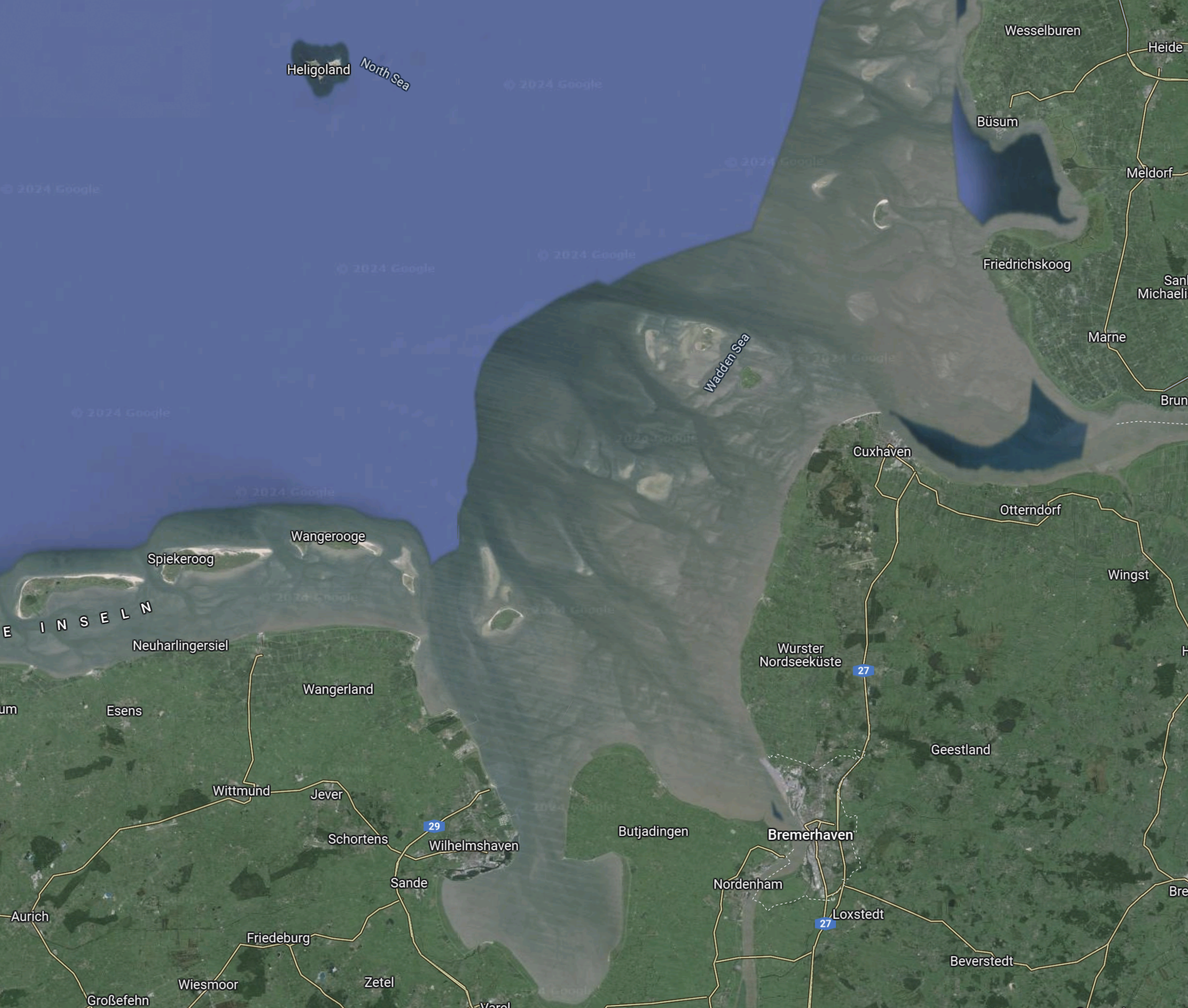
Note.
- Heligoland is the island at the top of the map.
- The Germans call this area the Wdden Sea.
- The estuaries lead to Wilhelmshaven and Bremerhaven.
- Cuxhaven is the port for Heligoland, which is connected to Hamburg by hydrogen trains.
This second map shows between Bremerhaven and Wilhelmshaven.
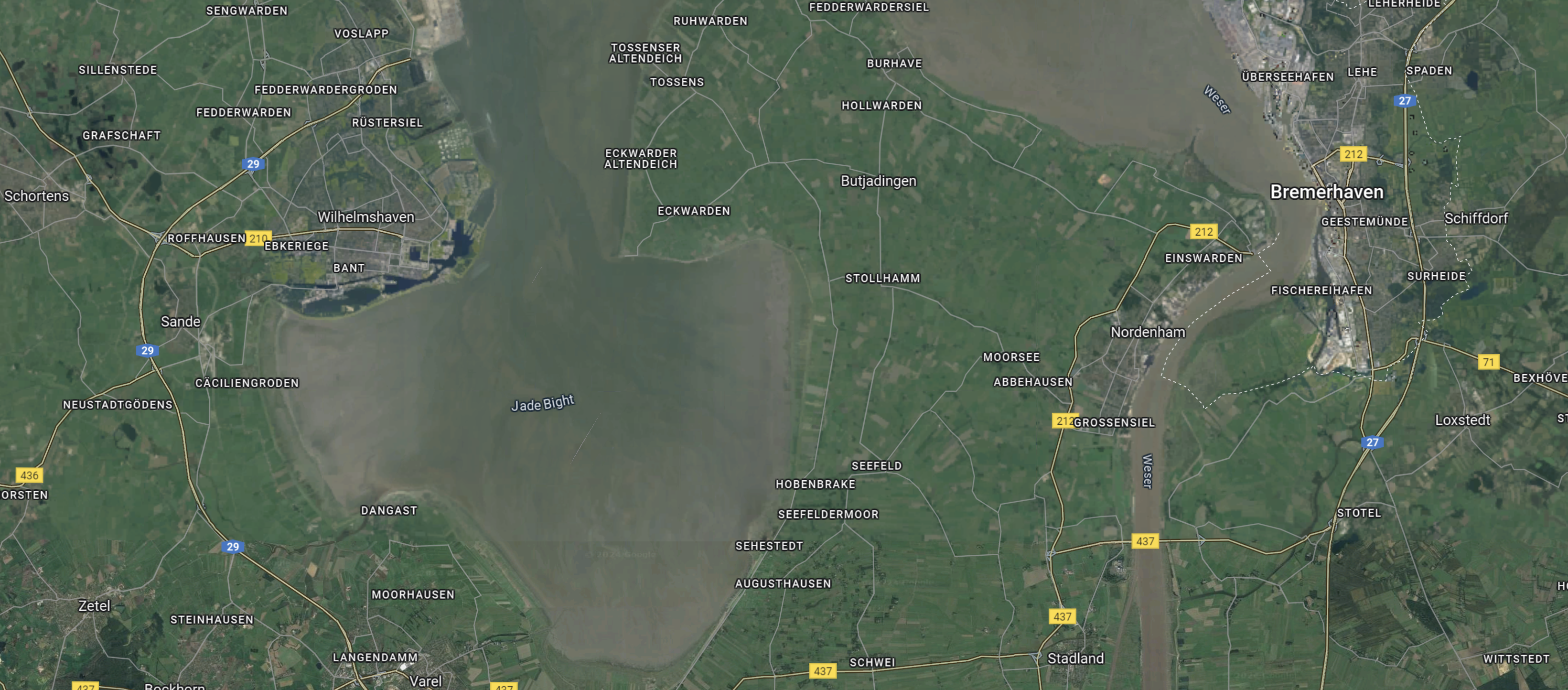
Note.
- Wilhelmshaven is to the West.
- Bremerhaven is in the East.
- The River Weser runs North-South past Bremerhaven.
I’ve explored the area by both car and train and it is certainly worth a visit.
The Wilhemshaven Hydrogen Import Terminal
German energy company; Uniper is building a hydrogen import terminal at Wilhemshaven to feed German industry with hydrogen from places like Australia, Namibia and the Middle East. I wrote about this hydrogen import terminal in Uniper To Make Wilhelmshaven German Hub For Green Hydrogen; Green Ammonia Import Terminal.
I suspect RWE could build a giant offshore electrolyser close to the Norfolk wind farms and the hydrogen will be exported by tanker or pipeline to Germany or to anybody else who pays the right price.
All this infrastructure will be installed and serviced from Great Yarmouth, so we’re not out of the deal.
Dogger Bank South Wind Farm
To make matters better, RWE have also signed to develop the 3 GW Dogger Bank South wind farm.
This could have another giant electrolyser to feed German companies. The wind farm will not need an electricity connection to the shore.
The Germans appear to be taking the hydrogen route to bringing electricity ashore.
Energy Security
Surely, a short trip across the North Sea, rather than a long trip from Australia will be much more secure and on my many trips between the Haven Ports and The Netherlands, I haven’t yet seen any armed Houthi pirates.
RWE And Hydrogen
On this page on their web site, RWE has a lot on hydrogen.
Very Interesting!
H2ercules
This web site describes H2ercules.
The goal of the H2ercules initiative is to create the heart of a super-sized hydrogen infrastructure for Germany by 2030. To make this happen, RWE, OGE and, prospectively, other partners are working across various steps of the value chain to enable a swift supply of hydrogen from the north of Germany to consumers in the southern and western areas of the country. In addition to producing hydrogen at a gigawatt scale, the plan is also to open up import routes for green hydrogen. The transport process will involve a pipeline network of about 1,500 km, most of which will consist of converted gas pipelines.
Where’s the UK’s H2ercules?
Conclusion
The Germans have got there first and will be buying up all of our hydrogen to feed H2ercules.
RWE And the Norfolk Wind Farms
In March 2024, I wrote RWE And Vattenfall Complete Multi-Gigawatt Offshore Wind Transaction In UK, which described how Vattenfall had sold 4.2 GW of offshore wind farms, situated off North-East Norfolk to RWE.
This map from RWE shows the wind farms.
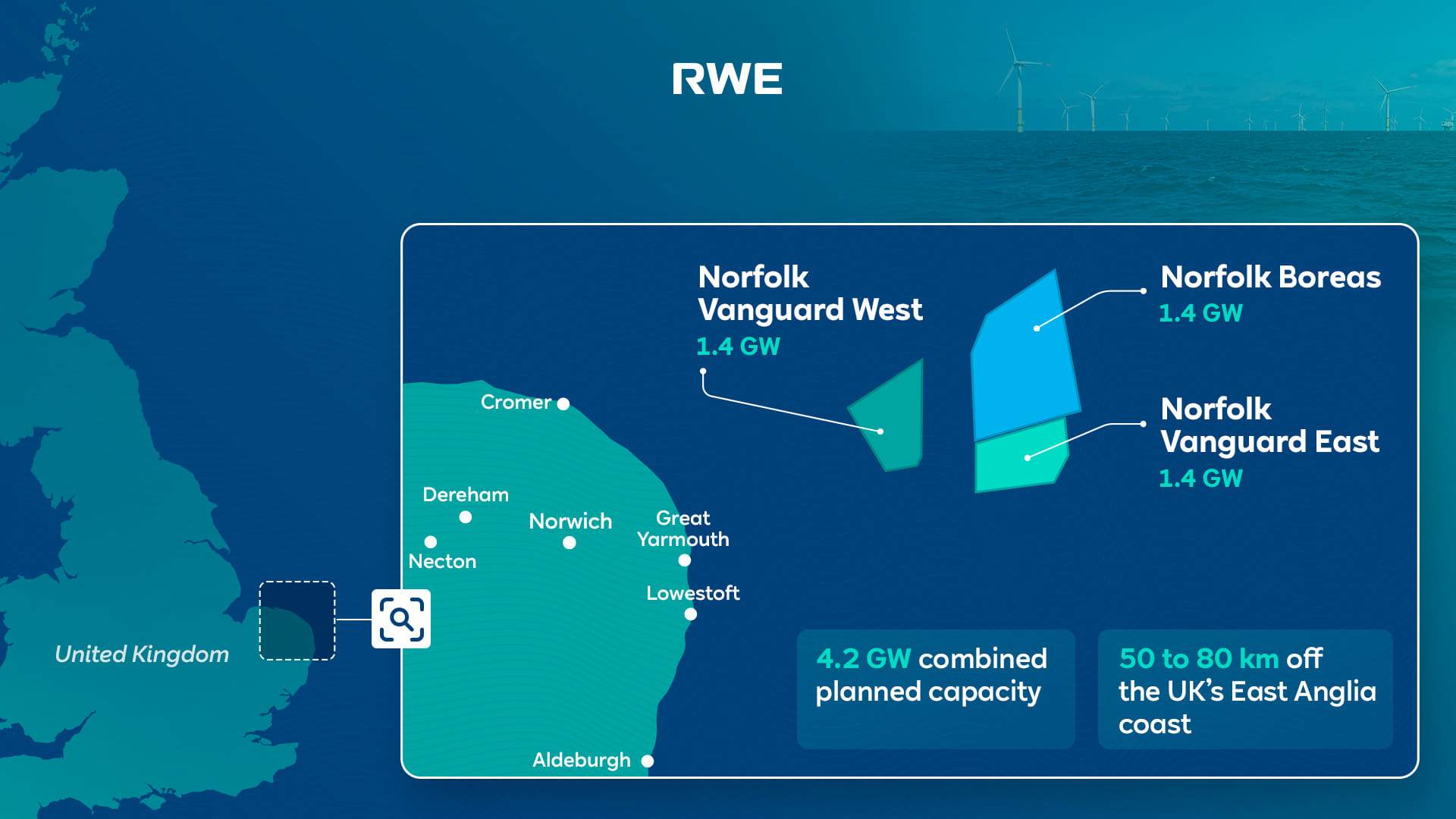
Note.
- The Norfolk Zone consists of three wind farms; Norfolk Vanguard West, Norfolk Boreas and Norfolk Vanguard East.
- The three wind farms are 1.4 GW fixed-foundation wind farms.
- In Vattenfall Selects Norfolk Offshore Wind Zone O&M Base, I describe how the Port of Great Yarmouth had been selected as the O & M base.
- Great Yarmouth and nearby Lowestoft are both ports, with a long history of supporting shipbuilding and offshore engineering.
The wind farms and the operational port are all close together, which probably makes things convenient.
So why did Vattenfall sell the development rights of the three wind farms to RWE?
Too Much Wind?
East Anglia is fringed with wind farms all the way between the Wash and the Thames Estuary.
- Lincs – 270 MW
- Lynn and Inner Dowsing – 194 MW
- Race Bank – 580 MW
- Triton Knoll – 857 MW
- Sheringham Shoal – 317 MW
- Dudgeon – 402 MW
- Hornsea 3 – 2852 MW *
- Scroby Sands – 60 MW
- East Anglia One North – 800 MW *
- East Anglia Two – 900 MW *
- East Anglia Three – 1372 MW *
- Greater Gabbard – 504 MW
- Galloper – 353 MW
- Five Estuaries – 353 MW *
- North Falls – 504 MW *
- Gunfleet Sands – 172 MW
- London Array – 630 MW
Note.
- Wind farms marked with an * are under development or under construction.
- There is 4339 MW of operational wind farms between the Wash and the Thames Estuary.
- An extra 6781 MW is also under development.
If all goes well, East Anglia will have over 11 GW of operational wind farms or over 15 GW, if the three Norfolk wind farms are built.
East Anglia is noted more for its agriculture and not for its heavy industries consuming large amounts of electricity, so did Vattenfall decide, that there would be difficulties selling the electricity?
East Anglia’s Nimbies
East Anglia’s Nimbies seem to have started a campaign against new overground cables and all these new wind farms will need a large capacity increase between the main substations of the National Grid and the coast.
So did the extra costs of burying the cable make Vattenfall think twice about developing these wind farms?
East Anglia and Kent’s Interconnectors
East Anglia and Kent already has several interconnectors to Europe
- Viking Link – Bicker Fen and Jutland – 1.4 GW
- LionLink – Suffolk and the Netherlands – 1.8 GW – In Planning
- Nautilus – Suffolk or Isle of Grain and Belgium – 1.4 GW – In Planning
- BritNed – Isle of Grain and Maasvlakte – 1.0 GW
- NeuConnect – Isle of Grain and Wilhelmshaven – 1.4 GW – Under Construction
- GridLink Interconnector – Kingsnorth and Warande – 1.4 GW – Proposed
- HVDC Cross-Channel – Sellinge and Bonningues-lès-Calais – 2.0 GW
- ElecLink – Folkestone and Peuplingues – 1.0 GW
- Nemo Link – Richborough and Zeebrugge – 1.0 GW
Note.
- Five interconnectors with a capacity of 6.4 GW.
- A further four interconnectors with a capacity of 6 GW are on their way.
At 12.4 GW, the future capacity of the interconnectors between South-East England and Europe, is nor far short of South-East English wind power.
There are also two gas pipelines from the Bacton gas terminal between Cromer and Great Yarmouth to Europe.
The Wikipedia entry for the Bacton gas terminal gives these descriptions of the two gas pipelines.
Interconnector UK – This can import gas from, or export gas to, Zeebrugge, Belgium via a 235 km pipeline operating at up to 147 bar. There is a 30-inch direct access line from the SEAL pipeline. The Interconnector was commissioned in 1998.
BBL (Bacton–Balgzand line) – This receives gas from the compressor station in Anna Paulowna in the Netherlands. The BBL Pipeline is 235 km long and was commissioned in December 2006.
It would appear that East Anglia and Kent are well connected to the Benelux countries, with both electricity and gas links, but with the exception of the Viking Link, there is no connection to the Scandinavian countries.
Did this lack of connection to Sweden make convincing the Swedish government, reluctant to support Vattenfall in their plans?
Bringing The Energy From The Norfolk Wind Farms To Market
It looks to me, that distributing up to 4.2 GW from the Norfolk wind farms will not be a simple exercise.
- Other wind farms like the 2852 MW Hornsea 3 wind farm, may need a grid connection on the North Norfolk coast.
- The Nimbies will not like a South-Western route to the National Grid at the West of Norwich.
- An interconnector to Denmark or Germany from North Norfolk would probably help.
But at least there are two gas pipelines to Belgium and the Netherlands.
RWE, who now own the rights to the Norfolk wind farms, have a large amount of interests in the UK.
- RWE are the largest power producer in the UK.
- They supply 15 % of UK electricity.
- They have interest in twelve offshore wind farms in the UK. When fully-developed, they will have a capacity of almost 12 GW.
- RWE are developing the Pembroke Net Zero Centre, which includes a hydrogen electrolyser.
RWE expects to invest up to £15 billion in the UK by 2030 in new and existing green technologies and infrastructure as part of this.
Could this be RWE’s plan?
As the Norfolk wind farms are badly placed to provide electricity to the UK grid could RWE have decided to use the three Norfolk wind farms to produce hydrogen instead.
- The electrolyser could be placed onshore or offshore.
- If placed onshore, it could be placed near to the Bacton gas terminal.
- There are even depleted gas fields, where hydrogen could be stored.
How will the hydrogen be distributed and/or used?
It could be delivered by tanker ship or tanker truck to anyone who needs it.
In Developing A Rural Hydrogen Network, I describe how a rural hydrogen network could be developed, that decarbonises the countryside.
There are three major gas pipelines leading away from the Bacton gas terminal.
- The connection to the UK gas network.
- Interconnector UK to Belgium.
- BBL to The Netherlands.
These pipelines could be used to distribute hydrogen as a hydrogen blend with natural gas.
In UK – Hydrogen To Be Added To Britain’s Gas Supply By 2025, I describe the effects of adding hydrogen to the UK’s natural gas network.
RWE And Vattenfall Complete Multi-Gigawatt Offshore Wind Transaction In UK
The title of this post, is the same as that of this article on offshoreWIND.biz.
This is the sub-heading.
RWE and Vattenfall have completed the sale of three offshore wind projects in the UK. With the transaction completed, RWE has expanded its offshore wind portfolio in the UK by 4.2 GW.
There is also this RWE infographic, which shows the three wind farms in relation to the East Anglian coast.
RWE are getting to be a big player in UK offshore wind, with these wind farm in operation or planned.
- Galloper – 353 MW – Operation
- Gwynt y Môr – 576 MW – Operation
- Rhyll Flats – 90 MW – Operation
- Triton Knoll – 857 MW – Operation
- Sofia – 1400 MW – Under Construction – Completion in 2026
- Norfolk Boreas – 1380 MW – Planned – Completion in 2027
- Norfolk Vanguard East – 1380 MW – Planned – Completion before 2030
- Norfolk Vanguard West – 1380 MW – Planned – Completion before 2030
- Dogger Bank South – 3000 MW – Planned
- Awel y Môr – 500 MW – Planned
- Five Estuaries – 353 MW – Planned
- North Falls – 504 MW – Planned
That is a total of 11,773 MW, of which 10,607 MW is on the German side of the UK.
With RWE likely to have some success in auctions this year, these figures, are likely to increase and some wind farms will start construction.
Iberdrola Preparing Two East Anglia Offshore Wind Projects For UK’s Sixth CfD Round
The title of this post, is the same as that of this article on offshoreWIND.biz.
This is the sub-heading.
ScottishPower Renewables, Iberdrola’s company in the UK, is getting the East Anglia One North and East Anglia Two offshore wind projects ready for the upcoming auction round for Contracts for Difference (CfD).
These three paragraphs give more details.
This is according to project updates Iberdrola published as part of its financial results for 2023.
Iberdrola says “good progress is being made in the key engineering and design work” for the two projects and, while they were not presented in the UK’s fifth CfD Allocation Round (AR5), preparations are being made to take part in Allocation Round 6 (AR6).
The two offshore wind farms are part of the GBP 6.5 billion (around EUR 7.6 billion) East Anglia Hub project, which also includes East Anglia Three, currently in construction and expected to start delivering electricity in 2026. The 1.4 GW East Anglia Three was awarded Contract for Difference in July 2022.
It is now possible to build a table of Iberdrola’s East Anglian Hub.
- East Anglia One – 714 MW – Commissioned in 2020.
- East Anglia One North – 800 MW – To be commissioned in 2026.
- East Anglia Two – 900 MW – To be commissioned in 2026.
- East Anglia Three – 1372 MW – To be commissioned in 2026.
Note.
- East Anglia One is the largest windfarm in Iberdrola’s history
- These four wind farms are connected to the shore at Bawdsey on the River Deben.
These wind farms are a total of 3786 MW.
In addition there are RWE’s three Norfolk wind farms.
- Norfolk Boreas – 1386 MW – To be commissioned in 2027.
- Norfolk Vanguard East – 1380 MW – To be commissioned before 2030.
- Norfolk Vanguard West – 1380 MW – To be commissioned before 2030.
These wind farms are a total of 4146 MW, with a grand total of 7932 MW.
What Will Happen To The Electricity?
Consider.
- It is a lot of electricity.
- The good people of Norfolk are already protesting about the cables and pylons, that will connect the electricity to the National Grid.
- The good people of Suffolk will probably follow, their Northern neighbours.
- The wind farms are owned by Spanish company; Iberdrola and German company; RWE.
I wonder, if someone will build a giant electrolyser at a convenient place on the coast and export the hydrogen to Europe by pipeline or tanker.
- The ports of Felixstowe, Great Yarmouth and Lowestoft could probably handle a gas tanker.
- The Bacton gas terminal has gas pipelines to Belgium and The Netherlands.
In addition, there are various electricity interconnectors in use or under construction, that could send electricity to Europe.
- National Grid’s Lion Link to the Netherlands.
- NeuConnect to Germany from the Isle of Grain.
Whoever is the UK’s Prime Minister in 2030 will reap the benefits of these East Anglian and Norfolk wind farms.
In addition.
- The Hornsea wind farm will have tripled in size from 2604 MW to 8000 MW.
- The Dogger Bank wind farm will have grown from 1235 MW to 8000 MW.
- There is 4200 MW of wind farms in Morecambe Bay and around England.
They would be so lucky.
RWE Acquires 4.2-Gigawatt UK Offshore Wind Development Portfolio From Vattenfall
The title of this post, is the same as that of this press release from RWE.
These three bullet points, act as sub-headings.
- Highly attractive portfolio of three projects at a late stage of development, with grid connections and permits secured, as well as advanced procurement of key components
- Delivery of the three Norfolk Offshore Wind Zone projects off the UK’s East Anglia coast will be part of RWE’s Growing Green investment and growth plans
- Agreed purchase price corresponds to an enterprise value of £963 million
These two paragraphs outline the deal.
RWE, one of the world’s leading offshore wind companies, will acquire the UK Norfolk Offshore Wind Zone portfolio from Vattenfall. The portfolio comprises three offshore wind development projects off the east coast of England – Norfolk Vanguard West, Norfolk Vanguard East and Norfolk Boreas.
The three projects, each with a planned capacity of 1.4 gigawatts (GW), are located 50 to 80 kilometres off the coast of Norfolk in East Anglia. This area is one of the world’s largest and most attractive areas for offshore wind. After 13 years of development, the three development projects have already secured seabed rights, grid connections, Development Consent Orders and all other key permits. The Norfolk Vanguard West and Norfolk Vanguard East projects are most advanced, having secured the procurement of most key components. The next milestone in the development of these two projects is to secure a Contract for Difference (CfD) in one of the upcoming auction rounds. RWE will resume the development of the Norfolk Boreas project, which was previously halted. All three Norfolk projects are expected to be commissioned in this decade.
There is also this handy map, which shows the location of the wind farms.
Note that there are a series of assets along the East Anglian coast, that will be useful to RWE’s Norfolk Zone development.
- In Vattenfall Selects Norfolk Offshore Wind Zone O&M Base, I talked about how the Port of Great Yarmouth will be the operational base for the Norfolk Zone wind farms.
- Bacton gas terminal has gas interconnectors to Belgium and the Netherlands lies between Cromer and Great Yarmouth.
- The cable to the Norfolk Zone wind farms is planned to make landfall between Bacton and Great Yarmouth.
- Sizewell is South of Lowestoft and has the 1.25 GW Sizewell B nuclear power station, with the 3.2 GW Sizewell C on its way, for more than adequate backup.
- Dotted around the Norfolk and Suffolk coast are 3.3 GW of earlier generations of wind farms, of which 1.2 GW have connections to RWE.
- The LionLink multipurpose 1.8 GW interconnector will make landfall to the North of Southwold
- There is also the East Anglian Array, which currently looks to be about 3.6 GW, that connects to the shore at Bawdsey to the South of Aldeburgh.
- For recreation, there’s Southwold.
- I can also see more wind farms squeezed in along the coast. For example, according to Wikipedia, the East Anglian Array could be increased in size to 7.2 GW.
It appears that a 15.5 GW hybrid wind/nuclear power station is being created on the North-Eastern coast of East Anglia.
The big problem is that East Anglia doesn’t really have any large use for electricity.
But the other large asset in the area is the sea.
- Undersea interconnectors can be built to other locations, like London or Europe, where there is a much greater need for electricity.
- In addition, the UK Government has backed a consortium, who have the idea of storing energy by using pressurised sea-water in 3D-printed concrete hemispheres under the sea. I wrote about this development in UK Cleantech Consortium Awarded Funding For Energy Storage Technology Integrated With Floating Wind.
A proportion of Russian gas in Europe, will have been replaced by Norfolk wind power and hydrogen, which will be given a high level of reliability from Suffolk nuclear power.
I have some other thoughts.
Would Hydrogen Be Easier To Distribute From Norfolk?
A GW-range electrolyser would be feasible but expensive and it would be a substantial piece of infrastructure.
I also feel, that placed next to Bacton or even offshore, there would not be too many objections from the Norfolk Nimbys.
Hydrogen could be distributed from the site in one of these ways.
- By road transport, as ICI did, when I worked in their hydrogen plant at Runcorn.
- I suspect, a rail link could be arranged, if there was a will.
- By tanker from the Port of Great Yarmouth.
- By existing gas interconnectors to Belgium and the Netherlands.
As a last resort it could be blended into the natural gas pipeline at Bacton.
In Major Boost For Hydrogen As UK Unlocks New Investment And Jobs, I talked about using the gas grid as an offtaker of last resort. Any spare hydrogen would be fed into the gas network, provided safety criteria weren’t breached.
I remember a tale from ICI, who from their refinery got a substantial amount of petrol, which was sold to independent petrol retailers around the North of England.
But sometimes they had a problem, in that the refinery produced a lot more 5-star petrol than 2-star. So sometimes if you bought 2-star, you were getting 5-star.
On occasions, it was rumoured that other legal hydrocarbons were disposed of in the petrol. I was once told that it was discussed that used diluent oil from polypropylene plants could be disposed of in this way. But in the end it wasn’t!
If hydrogen were to be used to distribute all or some of the energy, there would be less need for pylons to march across Norfolk.
Could A Rail Connection Be Built To The Bacton Gas Terminal
This Google Map shows the area between North Walsham and the coast.
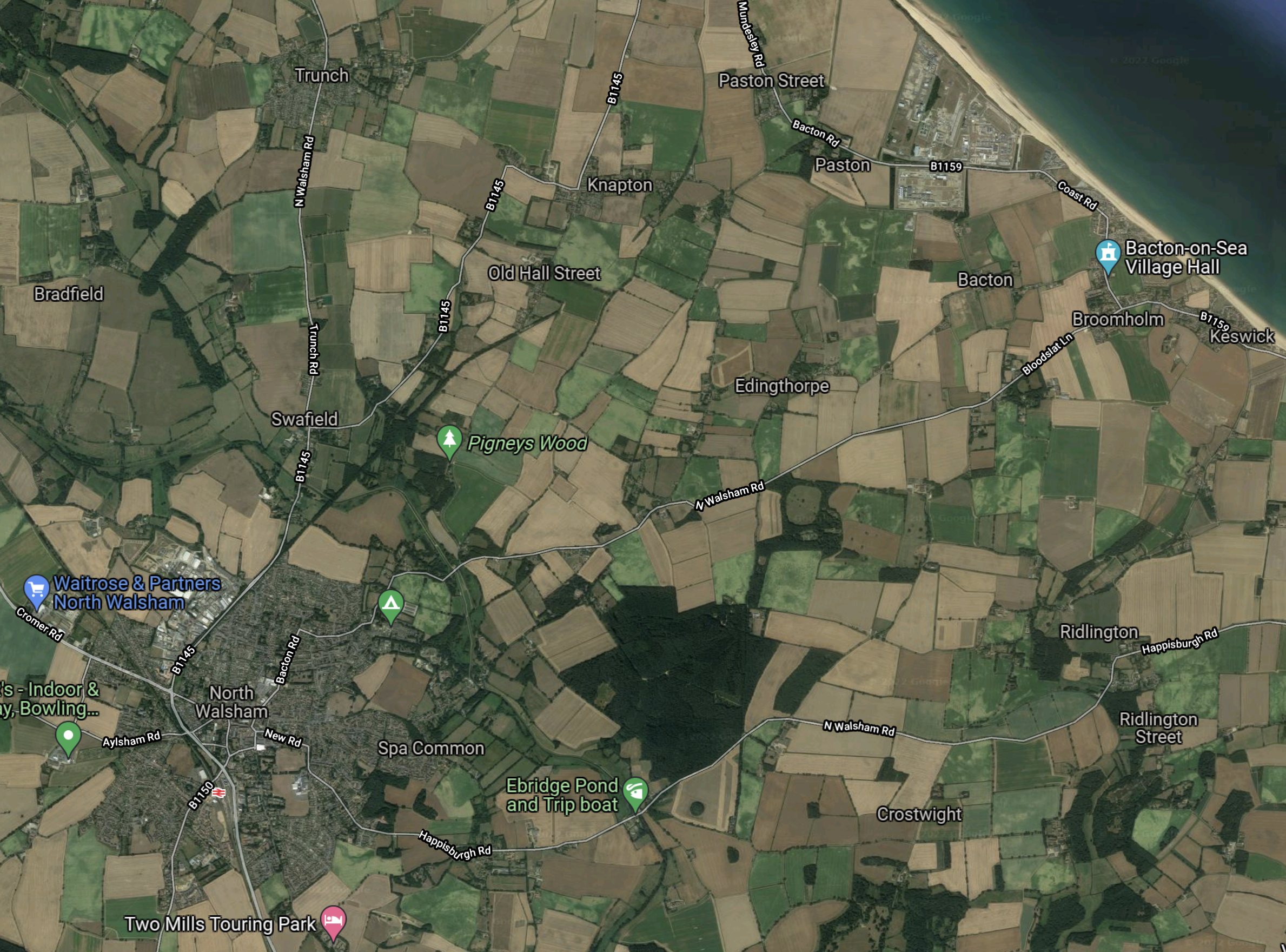
Note.
- North Walsham is in the South-Western corner of the map.
- North Walsham station on the Bittern Line is indicated by the red icon.
- The Bacton gas terminal is the trapezoidal-shaped area on the coast, at the top of the map.
ThisOpenRailwayMap shows the current and former rail lines in the same area as the previous Google Map.

Note.
- North Walsham station is in the South-West corner of the map.
- The yellow track going through North Walsham station is the Bittern Line to Cromer and Sheringham.
- The Bacton gas terminal is on the coast in the North-East corner of the map.
I believe it would be possible to build a small rail terminal in the area with a short pipeline connection to Bacton, so that hydrogen could be distributed by train.
There used to be a branch line from North Walsham station to Cromer Beach station, that closed in 1953.
Until 1964 it was possible to get trains to Mundesley-on-Sea station.
So would it be possible to build a rail spur to the Bacton gas terminal along the old branch line?
In the Wikipedia entry for the Bittern Line this is said.
The line is also used by freight trains which are operated by GB Railfreight. Some trains carry gas condensate from a terminal at North Walsham to Harwich International Port.
The rail spur could have four main uses.
- Taking passengers to and from Mundesley-on-Sea and Bacton.
- Collecting gas condensate from the Bacton gas terminal.
- Collecting hydrogen from the Bacton gas terminal.
- Bringing in heavy equipment for the Bacton gas terminal.
It looks like another case of one of Dr. Beeching’s closures coming back to take a large chunk out of rail efficiency.
Claire Coutinho And Robert Habeck’s Tete-a-Tete
I wrote about their meeting in Downing Street in UK And Germany Boost Offshore Renewables Ties.
- Did Habeck run the RWE/Vattenfall deal past Coutinho to see it was acceptable to the UK Government?
- Did Coutinho lobby for SeAH to get the contract for the monopile foundations for the Norfolk Zone wind farms?
- Did Coutinho have a word for other British suppliers like iTMPower.
Note.
- I think we’d have heard and/or the deal wouldn’t have happened, if there had been any objections to it from the UK Government.
- In SeAH To Deliver Monopiles For Vattenfall’s 2.8 GW Norfolk Vanguard Offshore Wind Project, I detailed how SeAH have got the important first contract they needed.
So it appears so far so good.
Rackheath Station And Eco-Town
According to the Wikipedia entry for the Bittern Line, there are also plans for a new station at Rackheath to serve a new eco-town.
This is said.
A new station is proposed as part of the Rackheath eco-town. The building of the town may also mean a short freight spur being built to transport fuel to fire an on-site power station. The plans for the settlement received approval from the government in 2009.
The eco-town has a Wikipedia entry, which has a large map and a lot of useful information.
But the development does seem to have been ensnared in the planning process by the Norfolk Nimbys.
The Wikipedia entry for the Rackheath eco-town says this about the rail arrangements for the new development.
The current rail service does not allow room for an extra station to be added to the line, due to the length of single track along the line and the current signalling network. The current service at Salhouse is only hourly during peak hours and two-hourly during off-peak hours, as not all trains are able to stop due to these problems. Fitting additional trains to this very tight network would not be possible without disrupting the entire network, as the length of the service would increase, missing the connections to the mainline services. This would mean that a new 15-minute shuttle service between Norwich and Rackheath would have to be created; however, this would interrupt the main service and cause additional platforming problems. Finding extra trains to run this service and finding extra space on the platforms at Norwich railway station to house these extra trains poses additional problems, as during peak hours all platforms are currently used.
In addition, the plans to the site show that both the existing and the new rail station, which is being built 300m away from the existing station, will remain open.
. As the trains cannot stop at both stations, changing between the two services would be difficult and confusing, as this would involve changing stations.
I feel that this eco-town is unlikely to go ahead.
Did RWE Buy Vattenfall’s Norfolk Zone To Create Green Hydrogen For Europe?
Consider.
- Vattenfall’s Norfolk Zone is a 4.2 GW group of wind farms, which have all the requisite permissions and are shovel ready.
- Bacton Gas terminal has gas pipelines to Europe.
- Sizewell’s nuclear power stations will add security of supply.
- Extra wind farms could be added to the Norfolk Zone.
- Europe and especially Germany has a massive need for zero-carbon energy.
The only extra infrastructure needing to be built is the giant electrolyser.
I wouldn’t be surprised if RWE built a large electrolyser to supply Europe with hydrogen.
 The Anonymous Widower