Would A Train Manufacturer Save CrossCountry’s Iconic Aberdeen And Penzance Route?
The article in The Times about the cancelling of CrossCountry’s iconic Aberdeen and Penzance route was entitled After 104 Years UK’s Longest Train Route Is Cancelled For Ever, I gave my post the same name and both received a number of nostalgic comments, from those, who had ridden the route or wished they had.
The Characteristics Of The Line
This article on the BBC is entitled We Had To Be On Last Run Of UK’s Longest Train Route.
This is said in the BBC article.
The connection – first established back in 1921 – is 775 miles (1,247km) long.
But electrification is rather thin on the ground.
Between Leeds and Edinburgh stations is electrified and I suspect that some of the route through Birmingham New Street and Bristol Parkway stations are also electrified, so perhaps, a battery-electric train could get a top-up on the way.
But as Leeds and Edinburgh is around 220 miles, there’s about 550 miles of the route or 70 % without electrification.
Battery Power, Hydrogen Power Or Both?
If diesel is ruled out on environmental grounds, it means that only battery or hydrogen power could be used for the route.
Despite some of the progress made by battery-electric trains in the last few years, I feel that unless the route has a large number of charging stations, then battery-electric trains will not be a practical solution.
This is a paragraph from The Times article.
Rail bosses said one of the reasons for ending the train was the difficulty keeping such a long journey on time. The fact that most customers made only short journeys along the route was also a consideration.
And this is another.
As an “express” service it was severely challenged, partly because of the long waits at a number of stations along the way, including 14 minutes at both Edinburgh Waverley and Bristol Temple Meads, and seven minutes at Birmingham New Street and Exeter St Davids.
Stopping regularly to charge the batteries, is going to make timekeeping more difficult and will probably end up with irritable passengers, after all the waiting.
So I suspect, hydrogen would be the ideal power for such a long service over a route with such sparse electrification.
But the trains, would be fitted with regenerative breaking to battery, so that kinetic energy is conserved as much as possible in the station stops.
I believe, that the trains should effectively be tri-mode or hydrogen-hybrid trains, but then many drivers praise the frugality of their hybrid cars.
Would Efficient Hydrogen-Hybrid Trains Attract More Passengers?
Consider.
- All the battery and hydrogen trains and buses, with one exception, that I have ridden on, have been mouse-quiet.
- The exception was a German hydrogen train, that had a very noisy mechanical transmission.
- I also would expect that the trains would be capable of keeping up a cruising speed of 100 mph or perhaps even 125 mph.
- This would enable them to handle the current timetable, which is written for 125 mph Class 222 diesel trains.
An efficient, unobtrusive, reliable and speedy service would surely attract passengers.
What’s In It For The Manufacturer?
Consider.
- There are not many 775 mile routes in the UK.
- But, there are many long rail around the world, that need decarbonising or even creating.
- Some countries, like China, India and France are creating more electrified high speed long-distance lines.
- Others countries, like Australia and the United States are planning and building high speed long-distance lines.
Perhaps, what is needed is a drop-in solution to decarbonise and/or create new high speed long-distance railways.
Could Aberdeen and Penzance be an ideal test bed to trial and demonstrate, your drop-in hydrogen solution?
I am reminded of a story, told to me, by a guy, who was selling an expensive air traffic control radar to an Arab state.
The initial presentations were done in the company’s offices in London.
The only working radar was installed at Prestwick Airport and had been working successfully for a couple of years, so the Arabs would be taken on a visit.
As they were very important clients, the salesman was told, that he was entitled to borrow the chairman’s executive jet for the trip.
The flight to Scotland was uneventful, but as they left the plane, the pilot said to the salesman. “There’s no finer view, than the Scottish Highlands at this time of year, I could fix it, that I gave them the view of a lifetime on the way home.”
After thinking about it for a few seconds, the salesman asked the pilot to fix it.
When they returned to the plane after a successful demonstration, the pilot said. “It’s on if you want it?”
The tale had a very happy ending, in that the Arabs bought an Air Traffic Control radar.
To return to the hydrogen trains; What better route is there to show off the capabilities of your high speed hydrogen-hybrid trains?
- There is the spectacular scenery of the North of Scotland, The Pennines and Cornwall.
- The Firth of Forth is crossed on the Forth Rail Bridge.
- There is running on the wires between Edinburgh and Leeds.
- There is the spectacular views of Durham and York from the train.
- There will be several hours of running on hydrogen.
- The Saltash Bridge is crossed.
What better route is there to sell trains?
Could CrossCountry Customer Service Be Improved?
I’ve never done a long journey on CrossCountry.
But surely, if the trains were designed for the route and the manufacturer was showing them off, the trains could have a top-of-the-range specification and high-quality service?
If you’re going to be stuck on a train for over a dozen hours the service must be good.
Conclusion
Get everything right and the train service would be an unquestionable asset to the UK and extremely good for the manufacturer.
After 104 Years UK’s Longest Train Route Is Cancelled For Ever
The title of this post, is the same as that of this article on The Times.
These three paragraphs describe the last journey.
With a muted fanfare the UK’s longest train rolled out of Aberdeen on Friday morning for its final sojourn down to Penzance, ending a service that connected both ends of the country for more than 100 years.
The 8.20am CrossCountry train took 13 hours and 20 minutes, with stops at 35 stations along the way, to cover the 774-mile route. Passengers spent more than two hours of the journey in the stations.
The service, which was launched in 1921, headed south through York, Bristol, Taunton and Truro on its way past some of the country’s finest landscapes, and arrived in Penzance at 9.31pm.
Looking at a ticket site and it appears that by using two trains from Aberdeen to King’s Cross and Paddington to Penzance you can be a few minutes faster, if you know your Underground.
This route will get quicker.
- As the East Coast Main Line rolls out its new digital signalling, this should speed up trains, by allowing some running at 140 mph instead of the current 125 mph.
- LNER will also be bringing their new tri-mode (electric/battery/diesel) trains into service, which could give some speed improvements on the diesel section North of the Forth Bridge in terms of speed and ride noise, especially as ScotRail will be partially electrifying part of this section.
- GWR should also be upgrading some of their fleet to tri-mode, which should improve speed and ride noise on the sections, where the route is not electrified.
- CrossCountry could compete, by buying new trains, but it would be a big financial risk, as the London route should get quicker, as track improvements and increased use of digital signalling speed up services from London to Aberdeen and Penzance.
CrossCountry ‘s owner; Arriva isn’t standing still, but have applied for extra Grand Central open access services on the East Coast Main Line to Scunthorpe and Cleethorpes and a new service from Newcastle to Brighton via Birmingham, which will partly fill the gap caused by the loss of the Aberdeen and Penzance service, by linking with GWR at Reading and LNER at Newcastle.
Thoughts About Electrification Through Devon And Cornwall
Distances
I’ll start by looking at a few distances.
- Penzance and Taunton – 162.3 miles
- Penzance and Exeter St. David’s – 131.5 miles
- Penzance and Plymouth – 79.5 miles
- Taunton and Exeter St. David’s – 30.7 miles
- Plymouth and Exeter St. David’s – 52 miles
- Taunton and Newbury – 89.6 miles
- Plymouth and Taunton – 82.8 miles
- Taunton and Paignton – 59 miles
- Taunton and Patchway – 51.7 miles
Note.
- Patchway and Newbury are already electrified to Cardiff Central and London Paddington respectively.
- Bombardier’s engineer told me eight years ago, that the battery-electric Class 379 had a range of sixty miles.
- Stadler’s FLIRT Akku has a Guinness world record of 139 miles on one battery charge. See this page on the Stadler web site.
- Even Stadler’s Class 777 trains for Merseyrail have a range of 84 miles on battery power. See New Merseyrail Train Runs 135km On Battery.
The rail distances in Devon and Cornwall are getting closer to being within the capability of trains fitted with batteries.
Station Stop Times
These are typical times that trains stop in the more important stations between Taunton and Penzance.
- Taunton – < 2 mins
- Tiverton Parkway – < 2 mins
- Exeter St. Davids – 2 mins
- Newton Abbot – < 2 mins
- Totnes – < 2 mins
- Plymouth – 11 minutes
- Devonport – < 2 mins
- Saltash – < 2 mins
- Menheniot – < 2 mins
- Liskeard – < 3 mins
- Bodmin Parkway – 2 mins
- Lostwithiel – 2 mins
- Par – 2 mins
- St. Austell – 2 mins.
- Truro – 2 mins
- Redruth – 2 mins
- Camborne – 2 mins
Note.
- The timings were for today.
- The Cardiff and Penzance services were being run by five-car Class 802 trains.
- Most station stops are around two minutes or less, but Plymouth on this train was eleven minutes.
I find it interesting that the Plymouth stop takes so much longer.
Train Stops At Plymouth
I looked at about twenty trains stopping at Plymouth, that included these services.
- London Paddington and Penzance
- Penzance and London Paddington
- Cardiff Central and Penzance
- Penzance and Cardiff Central
Note.
- I found an average time of eight minutes.
- Eleven minutes was a common stop.
- Eight minutes could be enough time for the rail equivalent of a Formula One splash and dash.
- CrossCountry services were going through the station in three minutes.
I am led to believe that the timetable used by the GWR trains would allow a quick battery charge at Plymouth station.
This OpenRailwayMap shows the platforms at Plymouth station.
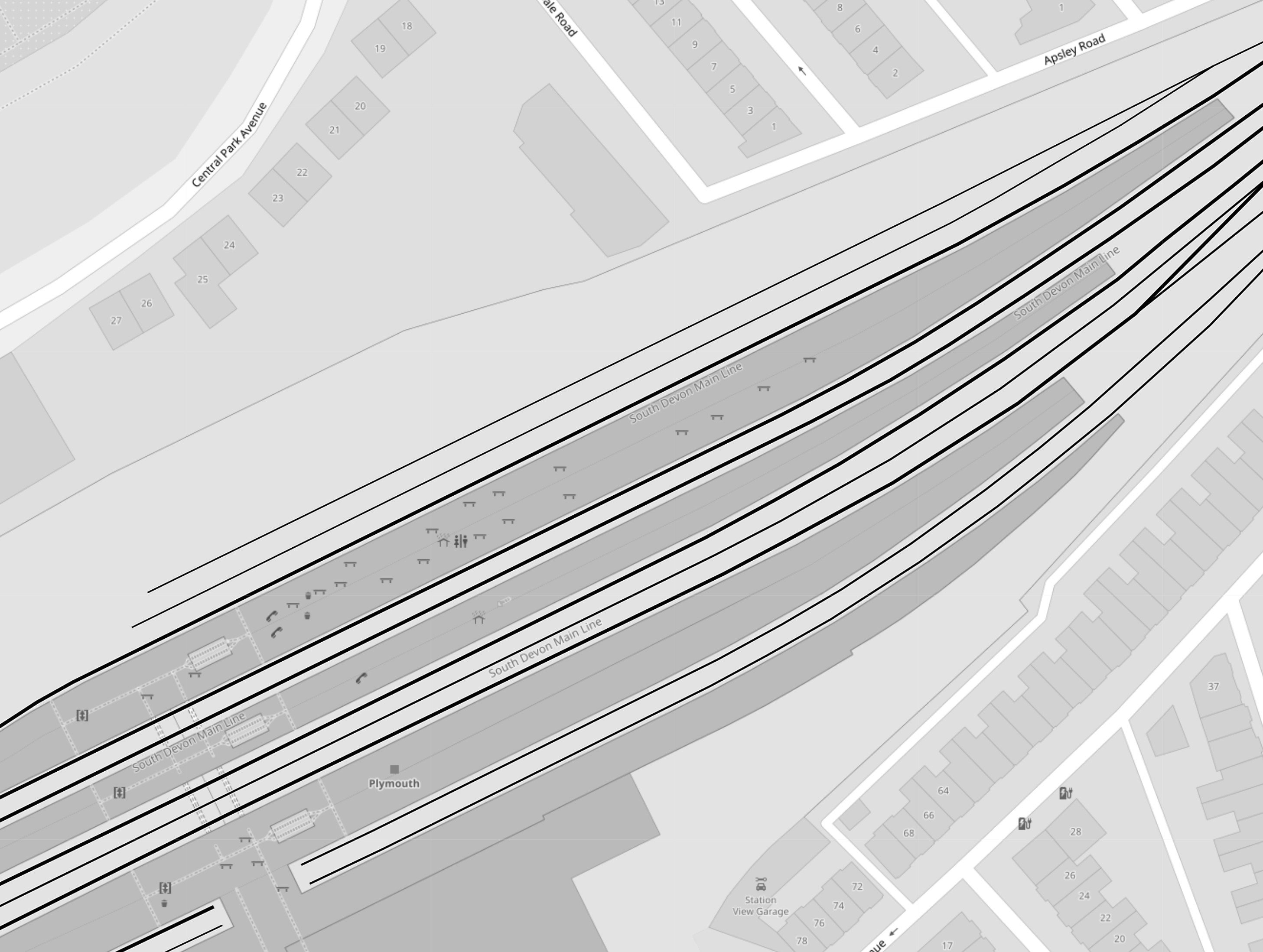
Note.
- London is to the East and Penzance is to the West.
- Platform numbers increase from South to North.
- The two East-facing bay platforms are Platforms 1 and 2.
- The West-facing bay platform in the South-West corner is Platform 3.
- Platform 4 shares the island with the bay platforms 1, 2 and 3.
- Most trains going to Penzance use Platform 4.
- Platforms 5 and 6 share the centre island platform.
- Platforms 7 and 8 share the Northernmost island platform.
- Most trains going towards London use Platform 7.
- Wikipedia indicates that the track layout is comprehensive and allows a lot of operational flexibility.
Although the station was completed around forty years ago, it could have been designed for handling modern battery-electric trains.
- There are three bay platforms numbered 1 to 3, to charge local services and send them on their way.
- Trains can arrive and depart in the five through platforms, numbered 4 to 8, from either direction.
- Two days ago, a nine-car London Paddington to Plymouth train terminated in Platform 7. After waiting an hour it returned to London. An hour would be enough time to fully-charge a train.
- As many platforms as needed could be electrified.
I am fairly sure, that most battery-electric trains could be timetabled to leave Plymouth station with full batteries.
Turnround At Penzance
I have found these turnrounds.
- 802113 arrived from Paddington at 1142 and left for London at 1215
- 802022 arrived from Paddington at 1307 and left for London at 1415
- 802103 arrived from Paddington at 1500 and left for London at 1615
This OpenRailwayMap shows the platforms at Penzance station.
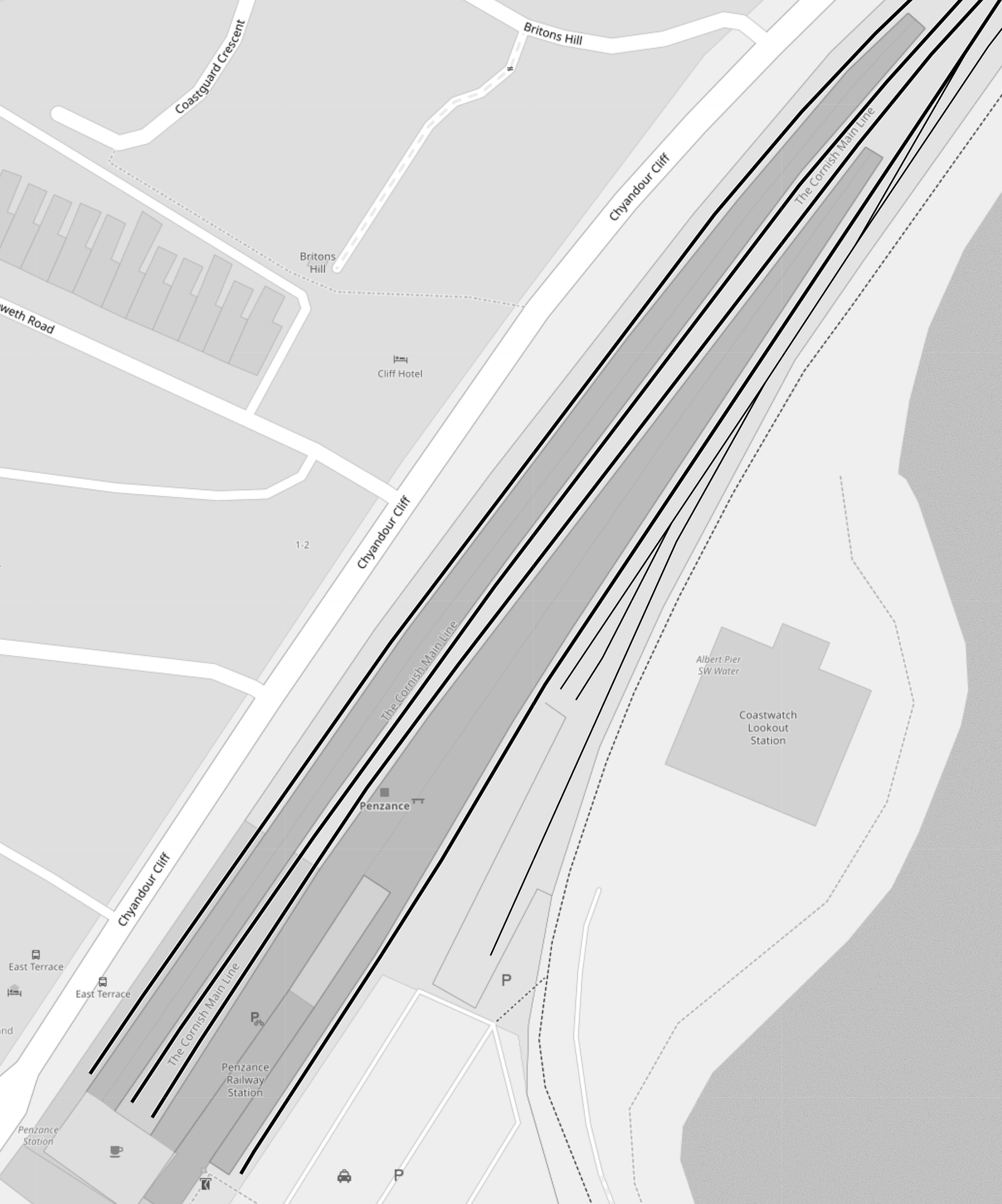
Note.
- The three example trains used Platform 1.
- Platform 1 is the long platform on the landward side of the station.
- Platforms are numbered 1 to 4 from left to right.
- An appropriate number of platforms would be electrified to charge trains terminating at Penzance.
Trains would appear to have plenty enough time to recharge, so they would start their return journey with full batteries.
Engineering Ambition
Several times in my life, I’ve got fired up about engineering or software projects and I like to think, I’ve produced the best and fastest solution.
For this reason, I believe that Hyperdrive Innovation, who are now part of Turntide Technologies, and Hitachi will set themselves three objectives with the design of the the battery packs for the Class 802 train.
- The battery-electric Class 802 will outperform the Stadler FLIRT Akku in terms of speed and distance.
- The battery packs will be plug-compatible with the diesel engines, so there will only be minor software modification to the trains.
- The train will be able to be handle all Great Western Railway’s routes without using diesel.
- I wouldn’t be surprised that on many routes the train will cruise at over 110 mph on batteries.
I also suspect they want the Akku’s Guinness world record, which will mean the range will be in excess of 139 miles.
Battery Range Needed For Routes
These are routes that need to be covered by battery-electric Class 802 trains or similar.
- Avanti West Coast – Crewe and Chester – 22.2 miles
- Avanti West Coast – Crewe and Holyhead – 105.5 miles
- Avanti West Coast – Crewe and Llandudno Junction – 65.5 miles
- Avanti West Coast – Crewe and Wrexham – 34.4 miles
- Avanti West Coast – Shrewsbury and Wolverhampton – 29.7 miles
- Great Western Railway – Penzance and Plymouth – 79.5 miles
- Great Western Railway – Plymouth and Taunton – 82.8 miles
- Great Western Railway – Taunton and Patchway – 51.7 miles
- Great Western Railway – Newbury and Taunton – 89.6 miles
- Great Western Railway – Taunton and Paignton – 59.0 miles
- Great Western Railway – Weston-super-Mare and Chippenham – 43.5 miles
- Great Western Railway – Oxford and Great Malvern – 65.6 miles
- Great Western Railway – Oxford and Hereford – 86.3 miles
- Great Western Railway – Oxford and Worcester Foregate Street – 57.6 miles
- Great Western Railway – Oxford and Worcester Shrub Hill – 57.2 miles
- Great Western Railway – Cheltenham Spa and Swindon – 43.2 miles
- Great Western Railway – Cardiff Central and Carmarthen – 77.4 miles
- Great Western Railway – Cardiff Central and Pembroke Dock – 118.9 miles
- Great Western Railway – Cardiff Central and Swansea – 45.7 miles
- Hull Trains – Beverley and Temple Hirst Junction – 44.3 miles
- Hull Trains – Hull and Temple Hirst Junction – 36.1 miles
- LNER – Hull and Temple Hirst Junction – 36.1 miles
- LNER – Middlesbrough and Longlands Junction – 22.2 miles
- LNER – Sunderland and Longlands Junction – 48.5 miles
- LNER – Lincoln Central and Newark Northgate – 16.6 miles
- LNER – Leeds and Bradford – 13 miles
- LNER – Leeds and Harrogate – 18 miles
- LNER – Leeds and Huddersfield – 17 miles
- LNER – Stirling and Inverness – 146 miles
- LNER – Edinburgh Haymarket and Aberdeen – 130 miles
- LNER – Peterborough and Doncaster via Great Northern and Great Eastern Joint Line – 93.7 miles
- South Western Railway – Basingstoke and Exeter St. David’s – 124.5 miles
- TransPennine – Hull and Micklefield – 42 miles
- TransPennine – Longlands Junction and Saltburn – 34.7 miles
- TransPennine – York and Scarborough – 42 miles
- TransPennine – Doncaster and Cleethorpes – 52.1 miles
- TransPennine – Stockport and Doncaster – 55.4 miles
- TransPennine – Stockport and Cleethorpes – 107.5 miles
Note.
- Stirling and Inverness and Edinburgh Haymarket and Aberdeen could be shortened by up to thirty miles, by planned electrification in Scotland.
- I have assumed that the TransPennine Upgrade has been completed.
- It looks like a battery-electric Class 802 train could use the Great Northern and Great Eastern Joint Line diversion via Lincoln.
- I am slightly surprised, that the longest stretch of line without electrification and with a passenger service is Basingstoke and Exeter St. David’s.
Charging will be needed at some places to charge the battery-electric trains. Stations fitted with chargers could include Aberdeen, Carmarthen, Cleethorpes, Exeter St. David’s, Hereford, Holyhead, Hull, Inverness, Paignton, Penzance, Pembroke Dock, Plymouth, Swansea, Taunton, Weston-super-Mare, Worcester.
Most chargers would be a length of electrification in the platform, where the battery-electric trains terminated or passed through.
More On LNER’s Ten New Bi-Modes
I wrote about these trains in LNER Seeks 10 More Bi-Modes.
This was my conclusion.
There is a lot of scope to develop LNER’s services.
I think it is likely that the order will go to Hitachi.
But as I indicated, I do believe that there is scope for a manufacturer to design a zero-carbon train, that was able to serve Aberdeen and Inverness.
-
- I suspect a fleet of ten trains would be sufficient.
- Trains would use the 25 KVAC overhead electrification, where it exists and hydrogen or battery power North of the wires.
The trains would also be capable of being upgraded to higher speeds, should the East Coast Main Line be turned into a High Speed Line.
I also think, that whatever trains are bought, there will be a large upgrading of the existing Hitachi fleet, which will add batteries to a lot of trains.
In the July 2023 Edition of Modern Railways, there is an article, which is entitled LNER Embraces Pioneering Spirit, which takes the form of an interview with LNER’s Managing Director; David Horne.
In a section, which is entitled ‘225’ Replacement, this is said.
Meanwhile, Mr Horne is looking to what might replace the InterCity 225 fleet, now smartly repainted in a scheme which pays homage to the original ‘Swallow’ livery. While there were fears this fleet may be withdrawn as an economy measure, the ‘225s’ are now on lease until at least next summer.
But Mr Horne says obsolescence issues are a real challenge and LNER will struggle to maintain the fleet beyond 2025, and from the May 2023 timetable change the number of daily diagrams was reduced from five to four to conserve the fleet’s mileage. Much of the heavy maintenance work had previously been carried out at Wabtec’s Doncaster site, but this facility is no longer available, and while a recent reliability improvement programme is bearing fruit, the challenges remain. The crunch point comes with the transition to ETCS at the southern end of the ECML as part of the East Coast Digital Programme – Mr Horne says LNER does not want to fit cab signalling on the ‘225s’.
The solution to this issue is to procure additional trains to run alongside the 65 Azumas, and LNER went out to tender in October 2020 for a fleet of 10 trains with self-power capability.
While a preferred bidder has been identified, the business case to proceed with the procurement is awaiting approval, but Mr Horne is still hopeful this project can be progressed.
The current plan envisages the new trains broadly replacing the ‘225s’ on Leeds and York diagrams, but a major benefit with the new fleet would be during engineering work – at present LNER has to withdraw services to places such as Harrogate and Hull to concentrate its bi-mode Azumas on services using non-electrified diversionary routes, and having more stock with self-power capability would ease the issue.
Currently, LNER has these Azumas and InterCity 225s in its fleet.
- Five-car bi-mode Class 800 trains – 10
- Nine-car bi-mode Class 800 trains – 13
- Five-car electric Class 801 trains – 12
- Nine-car electric Class 801 trains – 30
- Nine-car electric ImterCity 225 trains – 8
Note.
- There are 23 bi-mode trains and 50 electric trains.
- There are 167 bi-mode carriages and 302 electric carriages.
- Currently 31.5 % of the trains are bi-mode.
- With ten new bi-mode trains and no InterCity 225 trains, 44 % of the fleet will be bi-mode.
Is this increase in the percentage of the fleet, that are bi-mode acceptable?
I wonder, if there is a more affordable and flexible way to increase the fleet size.
In the Wikipedia entry for the Class 800 train, there is a section, which is entitled Traction And Generator Units, where this is said.
The Class 800 and Class 802 bi-mode are equipped with three GU per five-car set and five GU per nine-car set; a five-car set has a GU situated under vehicles 2/3/4 and a nine-car set has a GU situated under vehicles 2/3/5/7/8. In comparison, the electric-orientated Class 801 features a single GU for a five to nine-car set, which provides emergency power for limited traction and auxiliaries if the power supply from the overhead line fails. By adding or removing GUs, a Class 800 can be converted into a Class 801 and vice versa.
Let’s look at LNER’s needs, which are actually two separate sub-needs.
- There is a need for ten new trains to replace the InterCity 225 trains.
- There is a need to increase the size of the bi-mode fleet to be able to use the Great Northern and Great Eastern Joint Line and other non-electrified routes to by-pass engineering works.
Note.
- I suspect that as Mr Horne explained, there are only five or possibly four InterCity 225s diagrammed on a particular day, then perhaps ten five-car bi-mode Class 800 trains, might be able to cover for the retirement of the InterCity 225s.
- These trains would work as pairs to Leeds and York to replace the InterCity 225 capacity.
- If required they could split and join at Leeds and York to serve other destinations.
- The diversion route of the Great Eastern Joint Line has an unelectrified distance of 93.7 miles and the route is electrified at both ends.
- Would a battery-electric Class 800 train handle this distance? I suspect if Stadler can do it, then Hitachi and Turntide Technology will be able to do it too!
LNER will have replaced the InterCity 225s and acquired ten new five-car blockade runners.
As an order for ten new five-car battery-electric trains, is not to be sneezed at, I suspect Hitachi will make sure that their new battery-electric variants have enough range.
So this would mean that the range of a five cat battery-electric Class 800 train, should be in excess of 93.7 miles.
It should be noted that the five-car Class 800 and Class 802 trains have specific advantages when it comes to converting them to battery-electric trains.
- They are modern trains, that are still in production, every bit of information about the train is known down to the last nut, bolt and plastic clip.
- Like most modern trains, hey have a sophisticated computer system controlling the train.
- They have spaces for three, four or maybe even five diesel engines under the floor, which could be used for a battery-pack in every car designed to hold a diesel engine.
- The train has an electric bus between nose and tail.
- As is shown, when the trains change between diesel and electric, the pantograph can go up and down with all the alacrity of a whore’s drawers.
- The trains can be converted between bi-mode and electric, by adding or removing diesel packs. I doubt this feature will be removed, as batteries replace diesels.
With my Electrical and Control Engineer’s hard hat on, I doubt there is anything to stop a Class 800 or Class 802 train being fitted with three or more batteries to create a 125 mph train, with a range approaching two hundred miles on battery power.
The initial name of these Hitachi trains was the Hitachi Super Express. Is this train the Hitachi Super Battery Express?
But it would appear, that for their initial needs, LNER, just need a range to handle the near hundred miles of the Great Northern and Great Eastern Joint Line.
Inverness and Aberdeen will come later.
Hull Trains
This page on the Lumo web site is entitled Greener Travel Between Edinburgh And London.
These are the first three paragraphs.
A new, 100% electric rail service is to start running between London and Edinburgh with fares for as little as £14.90 in a bid to encourage greener and more affordable travel between the capitals.
Called Lumo, it will provide low-carbon, affordable long-distance travel for over 1 million passengers per year. Over 74,500 passengers currently fly between Edinburgh and London each month3.
And with single tickets between the capitals starting from just £14.90, Lumo will be a comfortable, convenient alternative to flying that is affordable for all. Some 60% of all single fares will be available at a cost of £30 or less.
I’m sure Hull Trains, who are owned by First Group like Lumo would like to position themselves in the 100 % electric low-carbon box too!
Currently, Hull Trains’s five-car Class 802 trains, run 88.6 and 72.2 miles using diesel on round-trips to Beverley and Hull respectively from London.
If batteries were fitted to their trains to give a battery range of around a hundred miles, Hull Trains could call themselves 100 % electric.
No new infrastructure would be required, but a short length of overhead electrification in a convenient platform at Hull station would ensure the train left for London and Beverley with a full battery.





The pictures show Hull Trains’s Class 802 train in Platform 7 at Hull station.
Penzance And Taunton
This to me is the key section as if you can run a battery-electric train between these two stations it allows so many of the services to be run using zero-carbon traction.
These are distances from Taunton.
- Exeter St. David’s – 30.7 miles
- Newbury – 89.6 miles
- Okehampton – 55.3 miles
- Paignton – 59.0 miles
- Patchway – 51.7 miles
- Plymouth – 82.8 miles
Note.
- I’ve added Okehampton, as I feel that if Dawlish had another encounter with Poseidon, Okehampton with its proposed Parkway station on the A30 could be the terminus for coaches to and from Cornwall.
- All would be possible with a battery-electric train, with a hundred-mile range, leaving Taunton with a full battery.
- Charging could be needed at Okehampton and Paignton.
What is needed is some form of charging in the Taunton area.
This OpenRailwayMap shows Taunton station.

Note.
- The station has four through platforms.
- All Great Western Railway services to and from Devon and Cornwall stop in the station.
- I feel it would be possible to electrify the station, so that all stopping trains could charge the batteries.
But the problem would be, that as typically trains only stop for a couple of minutes at Taunton, there may not be enough time to take enough charge on board.
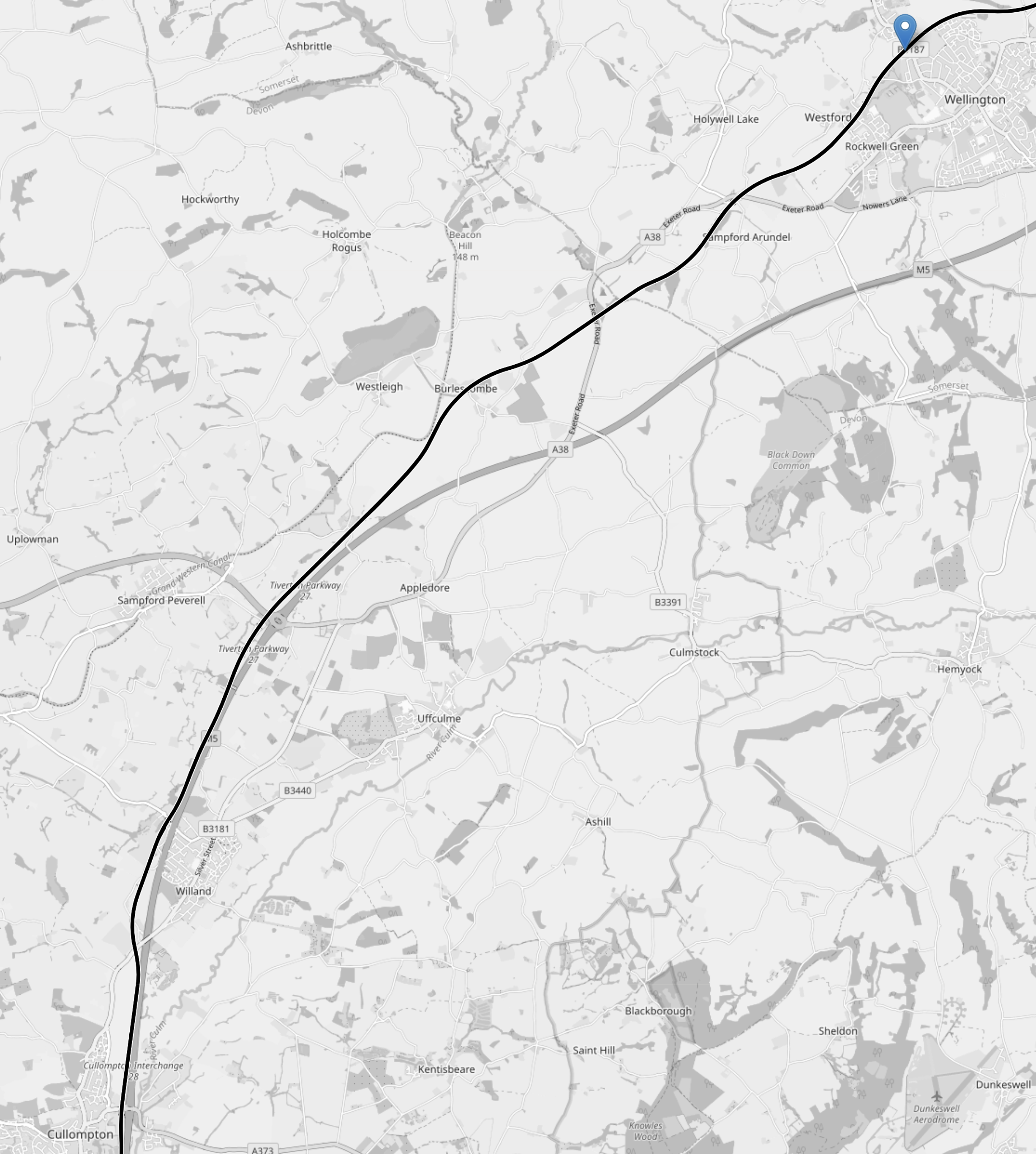
This OpenRailwayMap shows the track between Wellington and Collumpton, between Taunton and Exeter.
Note.
- The black line is the railway between Taunton and Exeter.
- The blue arrow in the North-East corner of the map indicates the position of the proposed Wellington station.
- Collumpton is in the South-West corner of the map and has also been put forward for a new Collumpton station.
- I talked about the reopening of these two stations in Reopening Of Wellington and Cullompton Stations.
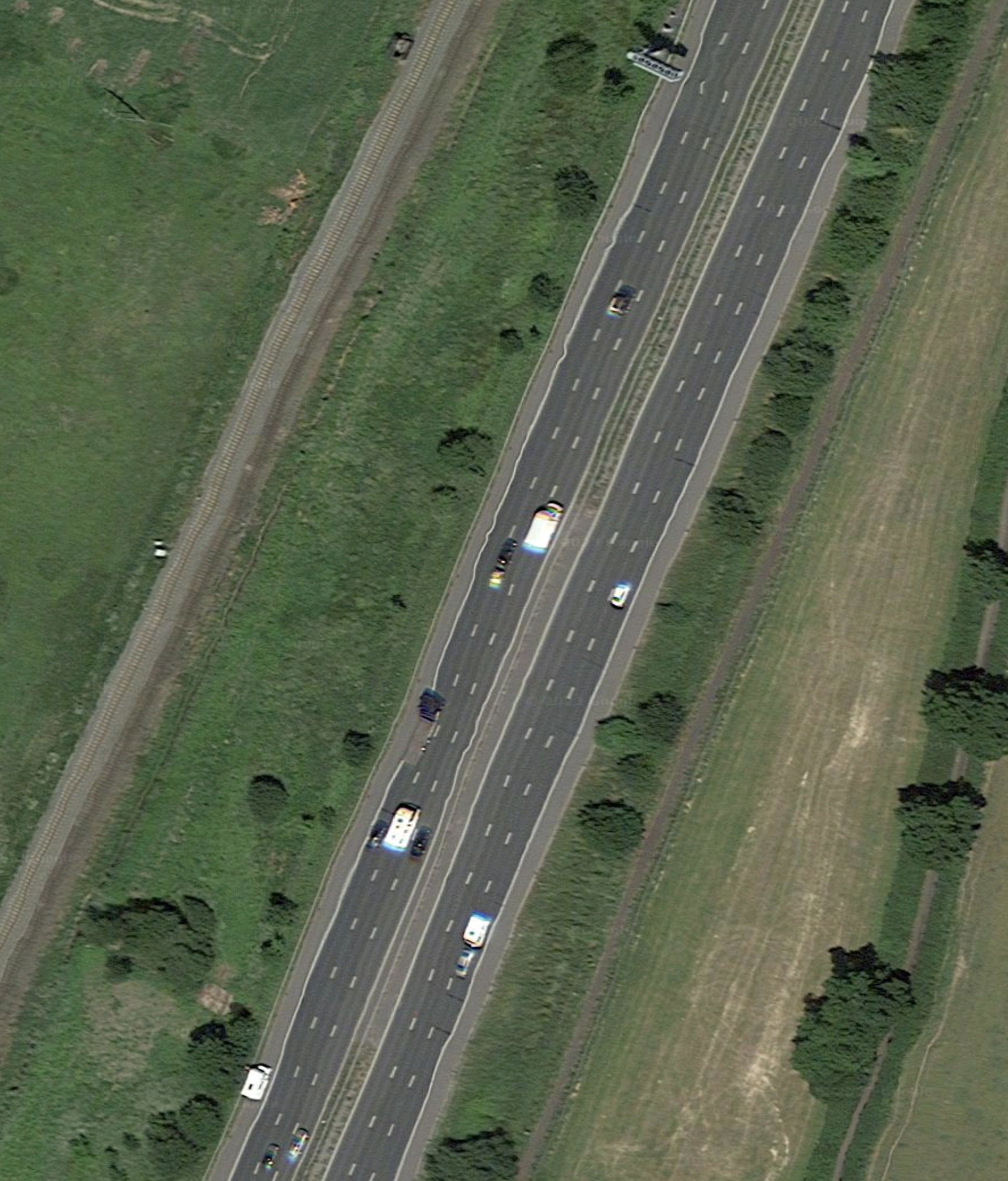
- The M5 to the North of Collumpton runs closely alongside the railway.
- According to Real Time Trains, it takes just under ten minutes to go the thirteen miles between Wellington and Collumpton.
This Google Map shows a section of the M5 North of Collumpton.
And this Google Map shows Tiverton Parkway station.
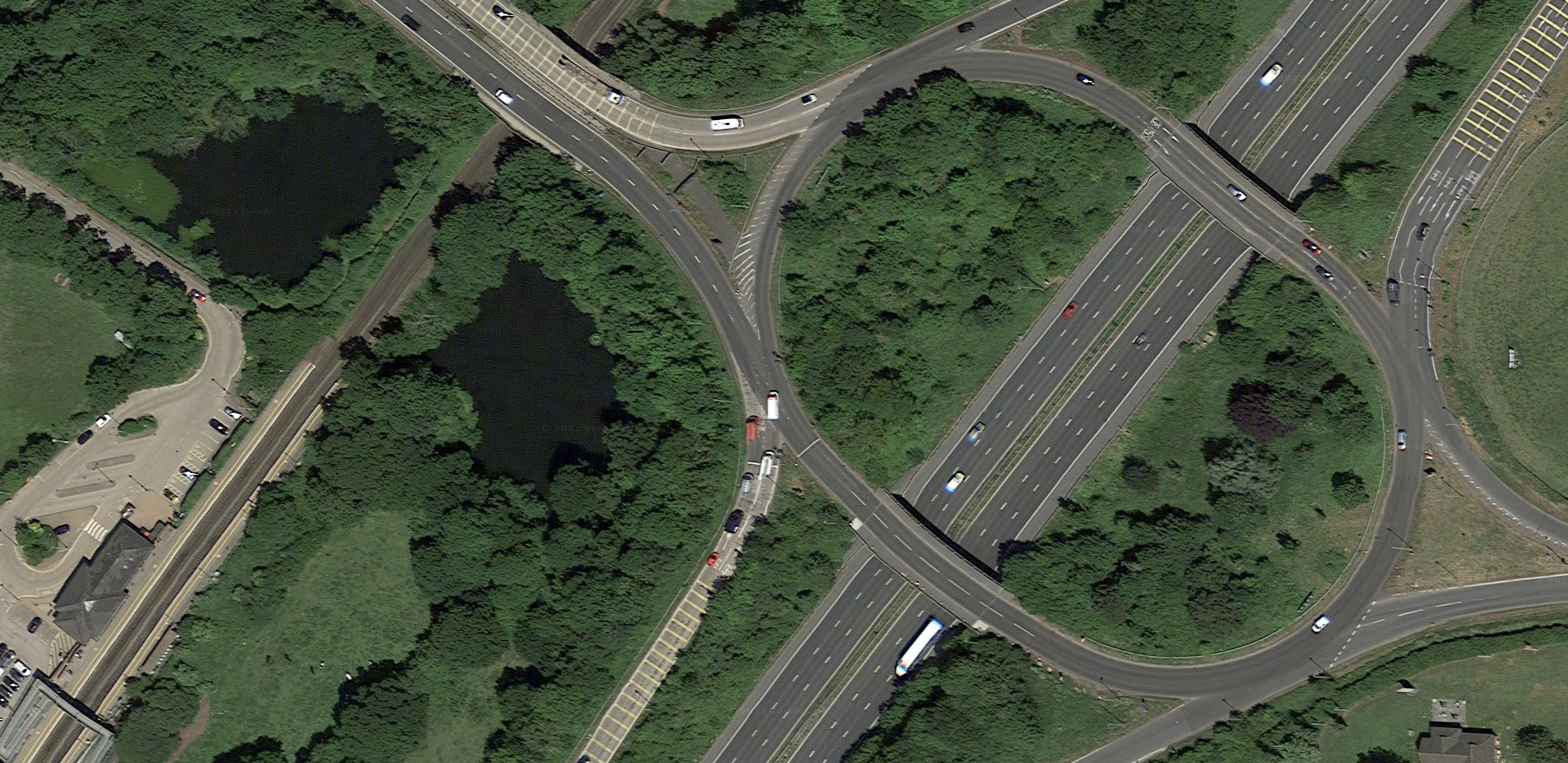
Note how the railway runs alongside the M5 to the West.
I feel that if the two new stations of Wellington and Collumpton are built between Taunton and Exeter St. David’s, then why not partially electrify the route, so that all trains would leave or pass through Taunton and Collumpton stations with full batteries.
- Going West the trains would reach Exeter St. David’s, Okehampton or Plymouth.
- Going East trains would reach Newbury for Reading and Paddington, and Patchway for Cardiff.
I believe that a battery-electric solution is possible, that would enable the decarbonisation of the Great Western Main Line all the way to Penzance.
Hitachi And Eversholt Rail To Develop GWR Intercity Battery Hybrid Train – Offering Fuel Savings Of More Than 20%
The title of this post is the same as that of this press release from Hitachi.
The press release starts with these bullet points.
- Batteries replacing an engine to cut fuel usage and reduce carbon emissions
- First time a modern UK intercity train, in passenger service, will use alternative fuel
- Tri-mode train can improve air quality and reduce noise across South West route’s non-electrified stations
They follow these with this introductory paragraph.
In a UK-first, Hitachi Rail and Eversholt Rail have signed an exclusive agreement aimed at bringing battery power – and fuel savings of more than 20% – to the modern Great Western Railway Intercity Express Trains that carry passengers between Penzance and London.
After a couple more paragraphs, the press return returns to the Penzance theme.
GWR’s Intercity Express Train fleet currently calls at 15 non-electrified stations on its journey between Penzance and London, all of which could benefit from trains running on battery-only power.
The press release then sets out their aims.
The projected improvements in battery technology – particularly in power output and charge – create opportunities to replace incrementally more diesel engines on long distance trains. With the ambition to create a fully electric-battery intercity train – that can travel the full journey between London and Penzance – by the late 2040s, in line with the UK’s 2050 net zero emissions target.
Penzance gets another mention, but the late 2040s for a fully electric-battery intercity train between Penzance and London, is not an ambitious target.
Hitachi Intercity Tri-Mode Battery Train
Hitachi have called the train the Intercity Tri-Mode Battery Train and the specification is shown in this infographic.

Note that fuel & carbon savings of at least 20 % are claimed.
Penzance To London In A Class 802 Train
It would appear that Penzance and London has been chosen as the trial route.
These figures were obtained from Real Time Trains figures for the 1015 from Penzance on the 14th December 2020.
- Penzance to St. Erth – 5.65 miles – 8 mins – 42.4 mph – 1 mins stop
- St. Erth to Camborne – 7.2 miles – 10 mins – 43.2 mph – 1 mins stop
- Camborne to Redruth – 3.65 miles – 5 mins – 43.8 mph – 2 mins stop
- Redruth to Truro – 9 miles – 10 mins – 54 mph – 2 mins stop
- Truro to St. Austell – 14.7 miles – 15 mins – 58.8 mph – 1 mins stop
- St. Austell to Par – 4.5 miles – 6 mins – 45 mph – 1 mins stop
- Par to Bodmin Parkway – 8 miles – 11 mins – 43.6 mph – 1 mins stop
- Bodmin Parkway to Liskeard – 9.2 miles – 12 mins – 46 mph – 1 mins stop
- Liskeard to Plymouth – 17.8 miles – 25 mins – 42.7 mph – 9 mins stop
- Plymouth to Totnes – 23.1 miles – 25 mins – 55.4 mph – 1 mins stop
- Totnes to Newton Abbot – 8.8 miles – 9 mins – 59.3 mph – 2 mins stop
- Newton Abbot to Exeter St. Davids – 20.2 miles – 18 mins – 71.3 mph – 2 mins stop
- Exeter St. Davids to Tiverton Parkway – 16.5 miles – 14 mins – 70.7 mph – 1 mins stop
- Tiverton Parkway to Taunton – 14.2 miles – 11 mins – 77.4 mph – 2 mins stop
- Taunton to Reading – 106.7 miles – 76 mins – 84.2 mph – 5 mins stop
- Reading to Paddington – 36 miles – 25 mins – 86.4 mph
The route can be broken neatly into four very different sections.
- Penzance and Plymouth – 79.5 miles – 112 mins – 42.5 mph – 75 mph operating speed
- Plymouth and Exeter St. Davids – 52 miles – 57 mins – 54.7 mph – 100 mph operating speed
- Exeter St. Davids and Newbury – 120.4 miles – 95 mins – 76 mph – 100 mph operating speed
- Newbury and Paddington – 53 miles – 36 mins – 88.3 mph – 100-125 mph operating speed
Note.
- The speed builds up gradually as the journey progresses.
- Only between Newbury and Paddington is electrified.
How does Penzance and Paddington stand up as a trial route?
- Penzance and Plymouth has eight intermediate stops about every nine-ten miles.
- The nine minute stop at Plymouth, is long enough to charge the batteries, should that be incorporated in the trial.
- The Cornish Main Line is generally double track, with an operating speed of 75 mph.
- Plymouth and Exeter includes the running by the sea, through Dawlish.
- Exeter could be given an extended stop to charge the batteries.
- Exeter and Newbury is a faster run and the batteries may help with performance.
- The Reading and Taunton Line has an operating speed of 110 mph.
- Remember the trains are designed for 140 mph and they achieve nothing like that on diesel.
- At each of the fifteen stops, the performance, noise and customer reaction can be evaluated. Strange, but my experience of battery trains, says that they are very much quieter than similar electric trains.
The route has a good selection of the types of routes, that Great Western Railway has in its network.
It would appear to be a good route to sort out the good and bad points of the train.
I have a few thoughts.
Possible Destinations For A Intercity Tri-Mode Battery Train
Currently, the following routes are run or are planned to be run by Hitachi’s Class 800, 802, 805 and 810 trains, where most of the route is electrified and sections do not have any electrification.
- GWR – Paddington and Bedwyn – 13.3 miles
- GWR – Paddington and Bristol Temple Meads- 24.5 miles
- GWR – Paddington and Cheltenham – 43.3 miles
- GWR – Paddington and Great Malvern – 76 miles
- GWR – Paddington and Oxford – 10.4 miles
- GWR – Paddington and Penzance – 252 miles
- GWR – Paddington and Swansea – 45.7 miles
- Hull Trains – Kings Cross and Hull – 36 miles
- LNER – Kings Cross and Harrogate – 18.5 miles
- LNER – Kings Cross and Huddersfield – 17 miles
- LNER – Kings Cross and Hull – 36 miles
- LNER – Kings Cross and Lincoln – 16.5 miles
- LNER – Kings Cross and Middlesbrough – 21 miles
Note.
- The distance is the length of line on the route without electrification.
- Five of these routes are under twenty miles
- Many of these routes have very few stops on the section without electrification.
I suspect that GWR and LNER have plans for other destinations.
What Is The Kinetic Energy Of A Five-Car Class 802 Train At Various Speeds?
I will do my standard calculation.
- Empty train weight – 243 tonnes (Wikipedia for Class 800 train!)
- Passenger weight – 302 x 90 Kg (Includes baggage, bikes and buggies!)
- Train weight – 270.18 tonnes
Using Omni’s Kinetic Energy Calculator, the kinetic energy at various speeds are.
- 60 mph – 27 kWh
- 75 mph – 42 kWh
- 80 mph – 48 kWh
- 90 mph – 61 kWh
- 100 mph – 75 kWh
- 110 mph – 91 kWh
- 125 mph – 117 kWh – Normal cruise on electrified lines.
- 140 mph – 147 kWh – Maximum cruise on electrified lines.
A battery must be large enough to capture this kinetic energy, which will be generated, when the train stops.
Acceleration And Deceleration Of A Five-Car Class 802 Train
The first Intercity Tri-Mode Battery Trains will be conversions of Class 802 trains.
This page on the Eversholt Rail web site, has a data sheet for a Class 802 train.
The data sheet shows the following for a five-car Class 802 train.
- It can accelerate to 120 kph/75 mph in 100 seconds in electric mode.
- It can accelerate to 160 kph/100 mph in 160 seconds in electric mode.
- It can accelerate to 120 kph/75 mph in 140 seconds in diesel mode.
- It can decelerate from 120 kph/75 mph in 50 seconds in electric mode.
- It can decelerate from 160 kph/100 mph in 90 seconds in electric mode.
Note.
- 75 mph is the operating speed of the Cornish Main Line and possibly the Highland Main Line.
- 100 mph is the operating speed for a lot of routes in the UK.
- It would appear that trains accelerate to 75 mph forty second faster in electric mode, compared to diesel mode.
- In diesel mode acceleration slows markedly once 100 kph is attained.
Can we assume that performance in battery mode, will be the same as in electric mode? I will assume that this is valid.
Battery Use In A Station Stop
Suppose the train is travelling at 75 mph with a full load of passengers and makes a station stop, without the use of the diesel engines.
- If the train is decelerating from 75 mph, there must be space for 42 kWh in the battery.
- Because regenerative braking is not 100 % efficient, only perhaps 80 % would be stored in the battery. This is 33.6 kWh.
- To accelerate the train to 75 mph, the battery must supply 42 kWh, as diesel power will not be used for this purpose.
- The train will take 50 seconds to decelerate, 100 seconds to accelerate and perhaps 60 seconds in the station or 210 seconds in total.
- Let’s say the battery will need to supply 2 kWh per minute per car for hotel power, that will be 35 kWh for the 210 seconds.
Adding and subtracting inputs and outputs to the battery gives this equation 33.6 – 35 – 42 = -43.4 kWh
The energy in the battery has been reduced by 43.4 kWh, at each 75 mph stop.
Repeating the calculation for a 100 mph stop, which takes 310 seconds, gives an equation of 60 -51.7 – 75 = -66.7 kWh.
Note that in this calculation, I have assumed that the efficiency of regenerative braking is 80 %. These are a selection of figures.
- For 60 % efficiency, the stops would cost 51.8 kWh from 75 mph and 81.7 kWh from 100 mph.
- For 80 % efficiency, the stops would cost 43.4 kWh from 75 mph and 66.7 kWh from 100 mph.
- For 90 % efficiency, the stops would cost 39.2 kWh from 75 mph and 59.2 kWh from 100 mph.
So it is important to raise the efficiency of regenerative braking to as near to 100 % as possible.
It should also be noted that with an 80 % efficiency of regenerative braking, hotel power has an effect.
- With 1 kWh per minute per car, the stops would cost 25.9 kWh from 75 mph and 40.8 kWh from 100 mph.
- With 2 kWh per minute per car, the stops would cost 43.4 kWh from 75 mph and 66.7 kWh from 100 mph.
- With 3 kWh per minute per car, the stops would cost 60.9 kWh from 75 mph and 92.6 kWh from 100 mph.
It is important to reduce the hotel power of the train, as low as possible.
With a 90 % regeneration efficiency and hotel power of 1 kWh per car per minute, the figures are 21.7 kWh from 75 mph and 33.3 kWh from 100 mph.
London Paddington And Penzance By Intercity Tri-Mode Battery Train
Listing the stops between London Paddington and Penzance and their speeds gives the following.
- St. Erth – 75 mph
- Camborne – 75 mph
- Redruth – 75 mph
- Truro – 75 mph
- St. Austell – 75 mph
- Par – 75 mph
- Bodmin Parkway – 75 mph
- Liskeard – 75 mph
- Plymouth – 75 mph
- Totnes – 100 mph
- Newton Abbot – 100 mph
- Exeter St. Davids – 100 mph
- Tiverton Parkway – 100 mph
- Taunton – 100 mph
- Reading – Electrified
This is nine stops from 75 mph, five from 100 mph and one where the electrification is used.
- Each 75 mph stop needs 43.4 kWh from the battery.
- Each 100 mph stop needs 66.7 kWh from the battery.
To achieve Hitachi’s aim of low noise and pollution-free station stops between London Paddington and Penzance will need 724.1 kWh of power from the battery.
With 80 % regeneration efficiency and hotel power of 2 kWh per minute per car gives a figure of 724.1 kWh.
With 90 % regeneration efficiency and hotel power of 1 kWh per minute per car gives a figure of 361.8 kWh.
The battery must also have sufficient capacity to handle the regenerative braking. I would suspect that provision will be made for a stop from 125 mph, which is 117 kWh.
So will the battery for the route be somewhere between 500 and 1000 kWh?
Note that each of the three MTU 12V 1600 diesel engines, fitted to a Class 800 train, weigh around two tonnes and Tesla claim an energy density of 250 Wh/Kg for their batteries.
This would mean a battery the weight of one of the diesel engines would have a capacity of 500 kWh.
A train with a full 500 kWh battery at Newbury could arrive in Penzance with some juice in the battery, if regenerative braking could be efficient and the demands of the train to run internal systems were at a low level.
Hitachi’s Increasing Efficiency Of Class 80x Trains
The next variant of the Class 80x trains to come into service, should be the Class 803 trains for East Coast Trains.
- These trains will be all-electric like LNER’s Class 801 trains.
- They are designed for a four-hour limited-stop service between London Kings Cross and Edinburgh.
- They will be one-class and average single fares will be £25,
This sentence from Wikipedia, describes a big difference between Class 803 and Class 801 trains.
Unlike the Class 801, another non-bi-mode AT300 variant which despite being designed only for electrified routes carries a diesel engine per unit for emergency use, the new units will not be fitted with any, and so would not be able to propel themselves in the event of a power failure. They will however be fitted with batteries to enable the train’s on-board services to be maintained, in case the primary electrical supplies would face a failure.
I wouldn’t be surprised to find out that the Class 803 trains have been put on a diet to increase their acceleration to meet the demanding schedule, which has been promised by East Coast Trains.
Hitachi has also given out clues to other efficiency improvements.
- Class 807 trains for Avanti West Coast, will have no diesel engines or batteries.
- Class 810 trains for East Midlands Railway will have a revised nose and different headlights. Is this for better aerodynamics?
- Class 810 trains, also have slots for four diesel engines. I can’t see why they would need all this power on the relatively-flat Midland Main Line. Will two of the slots be used by batteries to reduce fuel consumption and/or increase efficiency?
Hitachi are only doing, what all good engineers would do.
Low-Carbon Between Plymouth and Penzance
In How Much Power Is Needed To Run A Train At 125 mph?, I estimated that an all-electric Class 801 train needs around 3.42 kWh per vehicle mile to maintain 125 mph.
It will need less power to maintain the 75 mph of the Cornish Main Line. I would suspect that as air resistance is based on the square of the speed, that the energy consumption of the Class 802 train could be something under 2 kWh per vehicle. Or even less!
The Cornish Main Line is 79.5 miles between Plymouth and Penzance, but the Intercity Tri-Mode Battery Train, will not be on diesel all the way.
- At each station stop deceleration and acceleration, the train will not be using diesel. This could take a mile away for each station.
- All braking will be regenerative to the battery.
I suspect that by using the gradients on the route to advantage and by using diesel in selected areas, that a good driver or a well-written driver assistance system giving advice could safely navigate an Intercity Tri-Mode Battery Train all the way to Penzance on a minimum amount of diesel.
It’s not as if the train will be stranded, as they would have two onboard diesel engines.
I have a suspicion, that with a top-up at Plymouth, if Hitachi can raise efficiencies to a maximum and power consumption to a minimum, that on one battery, the train might be able to run between Plymouth and Penzance for much of the way, without using diesel.
The question also has to be asked, as to what would be the performance of the train with two diesel engines replaced by batteries?
I suspect this is something else to be determined in the trial.
Will Hitachi’s Intercity Tri-Mode Battery Train And Regional Battery Train Have The Same Battery Packs?
The specification of Hitachi’s closely-related Regional Battery Train is described in this Hitachi infographic.

The Regional Battery Train is stated to have a battery range of 90 km/56 miles at 162 kph/100 mph.
Operating speed and battery range have not been disclosed yet for the Intercity Tri-Mode Battery Train. I await them with great interest.
I would expect that it is likely, that Hitachi’s two battery trains and others that follow, will use identical battery packs for ease of manufacture, services and operation.
In their press release, which announced the Battery Regional Train, Hitachi said this.
Hitachi has identified its fleets of 275 trains as potential early recipients of the batteries for use in the UK, as well as installing them on new metro and intercity trains that will be needed in the coming years to replace ageing diesel fleets.
Battery trains produce no greenhouse gases, air pollution and are a far quieter, offering passengers cleaner air in stations, less noise disruption and a carbon-free way to travel. Installing batteries on to existing fleets can also extend their range and allow passengers to reach stations on non-electrified branch lines without having to change train.
They didn’t exactly say all battery packs will be the same, but they were close to it, by saying that they can already be fitted to 275 trains. I would read those paragraphs to say, that a series of trains would use the same technology for different purposes.
What Will Be The Battery Range Of A Hitachi Intercity Tri-Mode Battery Train?
This page on the Eversholt Rail web site, has a data sheet for a Class 802 train, which says that a five-car Class 802 train has an operating speed of 110 mph on diesel power.
According to Wikipedia and other sources, a Class 802 train has three diesel engines.
If the Regional Battery Train has replaced three diesel engines with battery packs in a five-car train like a Class 802 train to get the 90 km/56 mile range, would this mean?
- Replacing one diesel engine with a battery pack, give a range of thirty kilometres or about nineteen miles.
- Replacing two diesel engines with battery packs double the range to sixty kilometres or thirty-eight miles.
It looks like a Hitachi Intercity Tri-Mode Battery Train with one of the same battery-packs should easily reach several of the destinations in my list.
But they would need charging before return or some assistance from the two remaining diesel engines.
I talk about charging the Intercity Tri-Mode Battery Train in Charging The Batteries On An Intercity Tri-Mode Battery Train.
Conclusion
It sounds like a worthwhile train to me and I await the results of the trial with interest.
Charging The Batteries On An Intercity Tri-Mode Battery Train
There are several ways the batteries on an Intercity Tri-Mode Battery Train could be charged.
- On an electrified main line like the Great Western or East Coast Main Lines, the electrification can be used in normal electrified running.
- A short length of electrification at the terminal or through stations can be used.
- The diesel engines could be used, at stations, where this is acceptable.
Alternatively, a custom design of charger can be used like Vivarail’s Fast Charge system.
In Vivarail’s Plans For Zero-Emission Trains, I said this.
Vivarail Now Has Permission To Charge Any Train
Mr. Shooter said this about Vivarail’s Fast Charge system.
The system has now been given preliminary approval to be installed as the UK’s standard charging system for any make of train.
I may have got the word’s slightly wrong, but I believe the overall message is correct.
In the November 2020 Edition of Modern Railways, there is a transcript of what Mr. Shooter said.
‘Network Rail has granted interim approval for the fast charge system and wants it to be the UK’s standard battery charging system’ says Mr. Shooter. ‘We believe it could have worldwide implications.’
I hope Mr. Shooter knows some affordable lawyers, as in my experience, those working in IPR are not cheap.
I think it’s very likely, that Vivarail’s Fast Charge system could be installed at terminals to charge Hitachi’s Intercity Tri-Mode Battery Trains.
-
- The Fast Charge systems can be powered by renewable energy.
- The trains would need to be fitted with third rail shoes modified to accept the high currents involved.
- They can also be installed at intermediate stations on unelectrified lines.
Vivarail is likely to install a Fast Charge system at a UK station in the next few months.
These are my thoughts about charging trains at various stations.
Penzance station
This Google Map shows Penzance station.
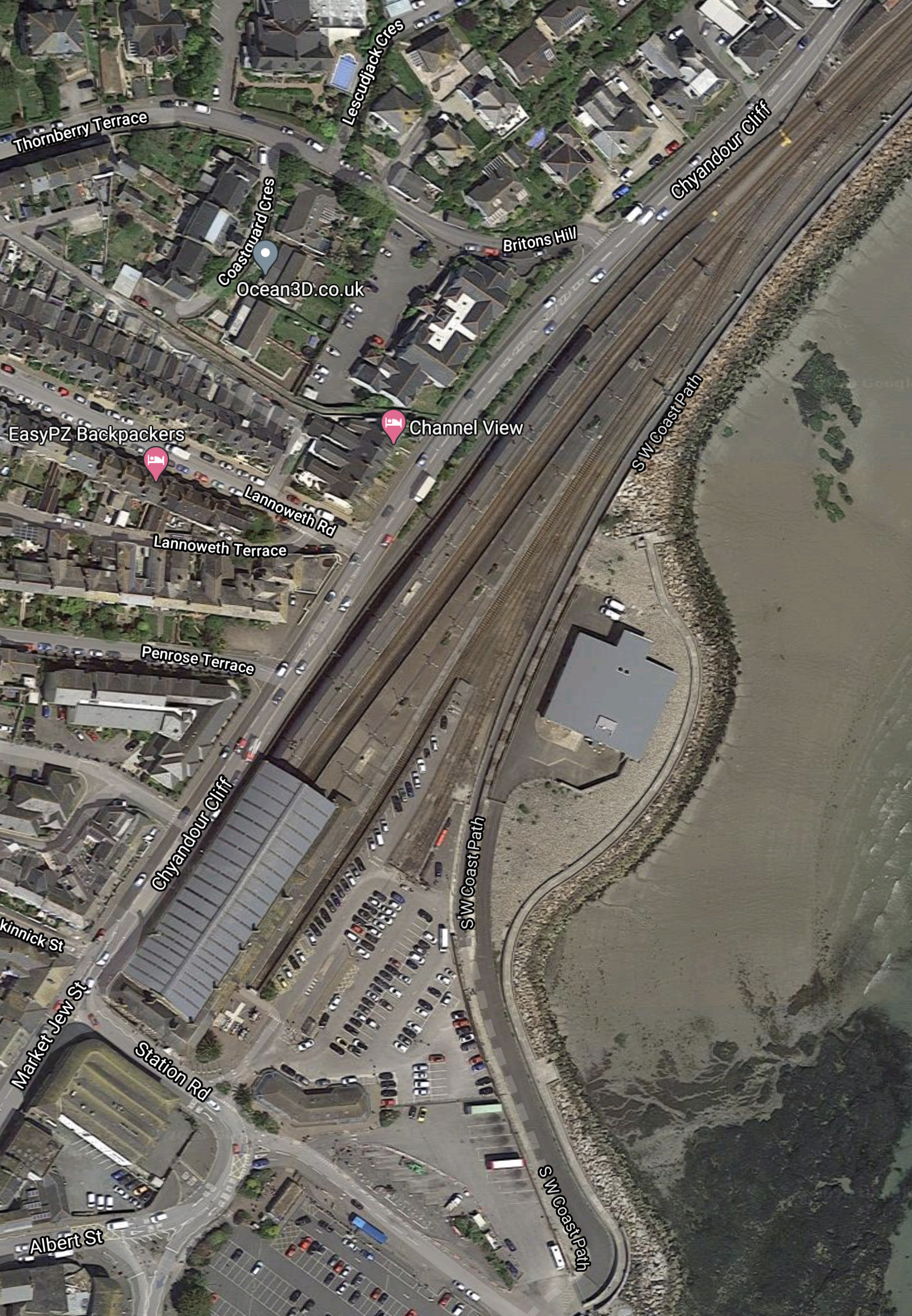
Penzance would be an ideal station to fully charge the trains, before they ran East.
- The station has four long platforms.
- There appears to be plenty of space just to the East of the station.
- Penzance TMD is nearby.
This picture shows Platform 4, which is on the seaward side of the station. The train in the platform is one of GWR’s Castles.
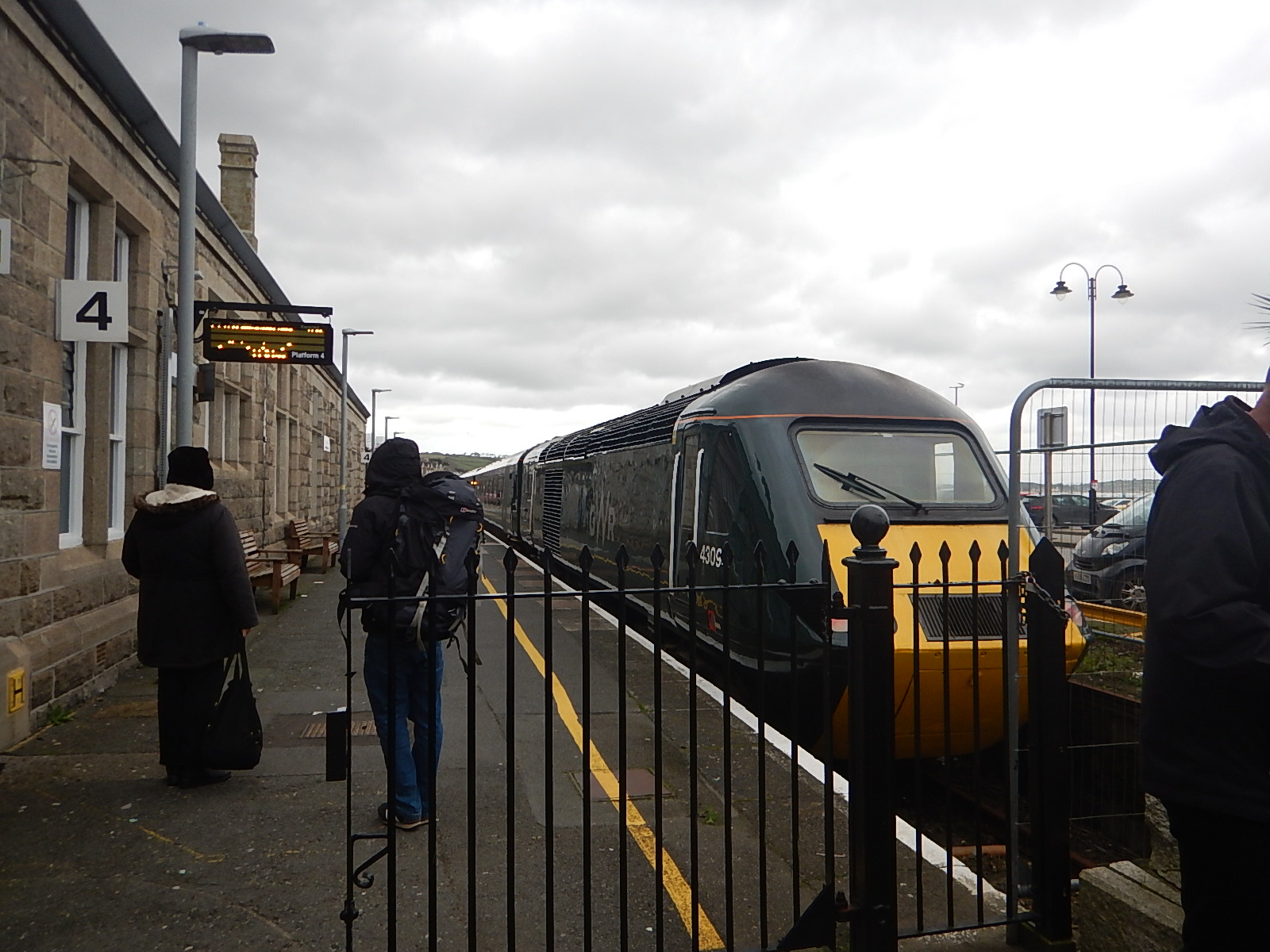
It is partly outside the main station, so might be very suitable to charge a train.
If trials were being performed to Penzance, it appears that the station would be a superb choice to charge trains.
My only worry, is would the location have enough power to charge the trains?
Plymouth Station
This Google Map shows Plymouth station.
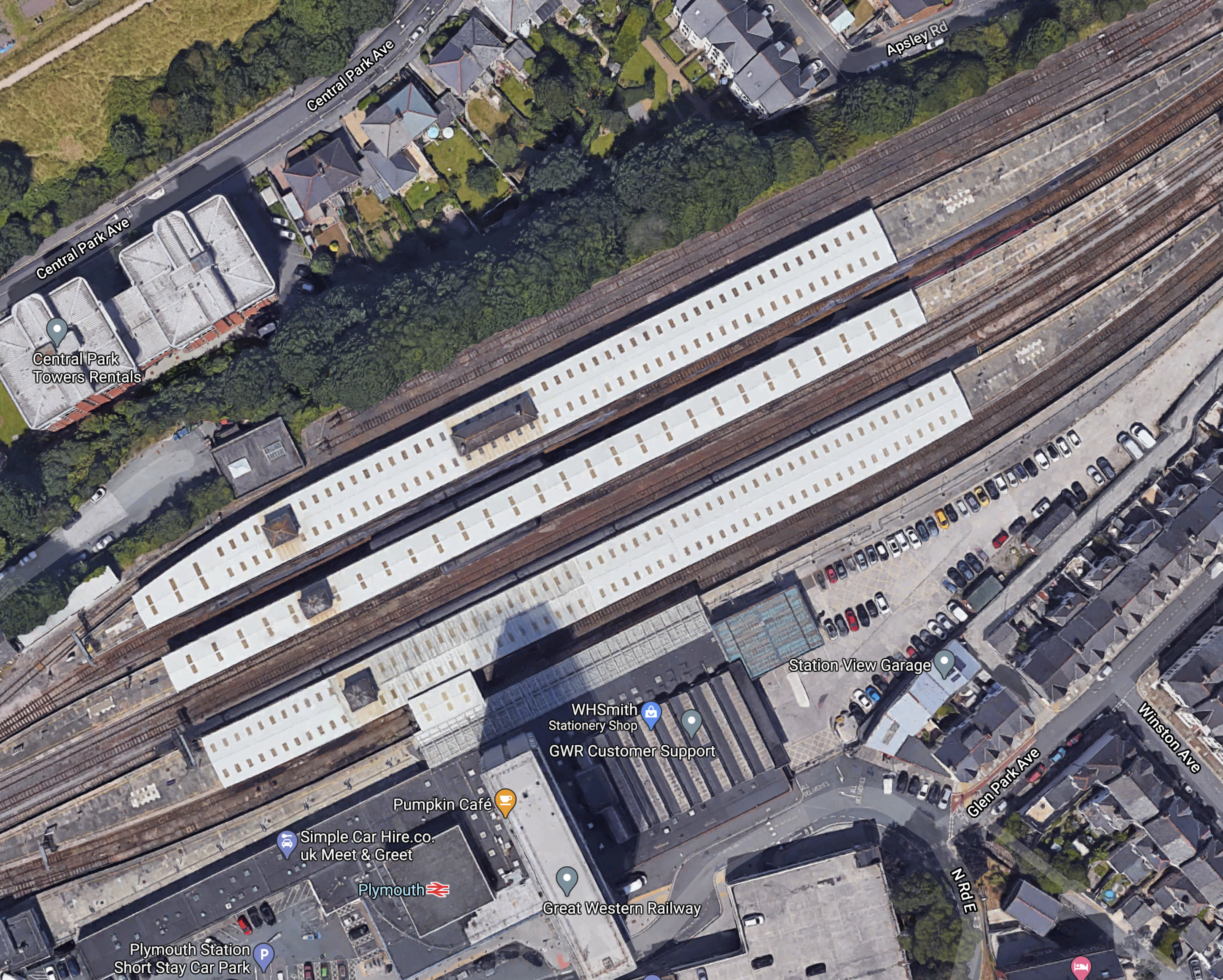
It is another spacious station with six platforms.
Chargers could be installed as needed for both expresses and local trains.
A Zero-Carbon Devon and Cornwall
If the battery trains perform as expected, I can see the Devon and Cornwall area becoming a low if not zero carbon railway by the end of this decade.
- The Castles would be retired.
- They would be replaced by battery electric trains.
- Charging would be available on all platforms at Penzance, Plymouth and possible some other intermediate stations and those on some branch lines.
It certainly wouldn’t hurt tourism.
Station Stop Performance Of The Intercity Tri-Mode Battery Train
Hitachi have stated that the their Intercity Tri-Mode Battery Trains will not use their diesel engines in stations and to leave the station.
The first Intercity Tri-Mode Battery Trains will be conversions of Class 802 trains.
This page on the Eversholt Rail web site, has a data sheet for a Class 802 train.
The data sheet shows the following for a five-car Class 802 train.
- It can accelerate to 120 kph/75 mph in 100 seconds in electric mode.
- It can accelerate to 160 kph/100 mph in 160 seconds in electric mode.
- It can accelerate to 120 kph/75 mph in 140 seconds in diesel mode.
- It can decelerate from 120 kph/75 mph in 50 seconds in electric mode.
Note.
- 75 mph is the operating speed of the Cornish Main Line and possibly the Highland Main Line.
- 100 mph is the operating speed for a lot of routes in the UK.
- It would appear that trains accelerate to 75 mph forty second faster in electric mode, compared to diesel mode.
- In diesel mode acceleration slows markedly once 100 kph is attained.
Can we assume that performance in battery mode, will be the same as in electric mode?
I am always being told by drivers of electric cars, trains and buses, that they have sparkling performance and my experience of riding in battery electric trains, indicates to me, that if the battery packs are well-engineered, then it is likely that performance in battery mode could be similar to electric mode, although acceleration and operating speed my be reduced to enable a longer range.
If this is the case, then the following times for a station call with a 75 mph operating speed are possible.
- Electric mode – 50 + 60 + 100 = 210 seconds
- Diesel mode – 50 + 60 + 140 = 250 seconds
- Battery mode – 50 + 60 + 100 = 210 seconds
Note.
- The three figures for each mode are deceleration time, station dwell time and acceleration time.
- Times are measured from the start of deceleration from 75 mph, until the train accelerates back to 75 mph.
- I have assumed the train is in the station for one minute.
I suspect with a stop from 100 mph, that there are greater savings to be made than the forty seconds at 75 mph, due to the reduced acceleration in diesel mode past 100 kph.
Savings Between London Paddington And Penzance
There are fifteen stops between London Paddington and Penzance, which could mean over ten minutes could be saved on the journey.
This may not seem that significant, but it should be born in mind, that the fastest journey times between London and Penzance are between five hours and eight minutes and five hours and fourteen minutes.
So these small savings could bring a London Paddington and Penzance journey much closer to five hours.
Savings Between London Kings Cross And Inverness
There are probably not as great savings to be made on this route.
- The electrification runs as far as Stirling.
- There are only five intermediate stops between Stirling and Inverness
- Stirling and Inverness are 151 miles apart.
On the other hand, the route has a lot of gradients, which may give opportunities to use the batteries to boost power on climbs and save fuel and emissions.
Conclusion
Replacing one or more of the diesel engines on a Class 800, 802, 805 or 810 train, on a route, where the full complement of diesel engines is not required, may well result in time savings on the journey, simply by reducing the time taken to accelerate back to operating speed.
I have indicated two routes, where savings can be made, but there may be other routes, where savings are possible.
Beeching Reversal – New Station For Langport And Somerton Area
This is one of the Beeching Reversal projects that the Government and Network Rail are proposing to reverse some of the Beeching cuts.
This Google Map shows the Langport and Somerton area.
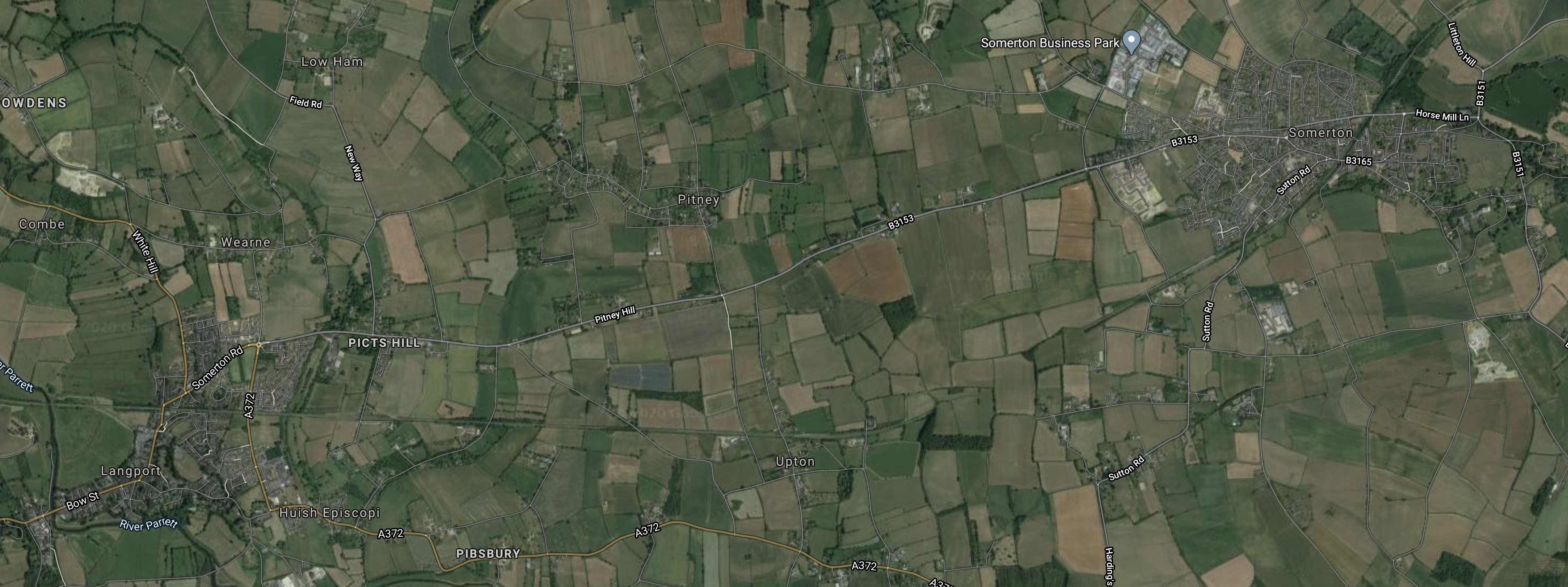
Note.
- This map is probably best clicked to see in a large size.
- Langport is in the South-West corner of the map.
- Somerton is in the North-East corner of the map.
- The Reading-Taunton Line goes through both villages, although both stations are now closed.
- Somerton station was in a cutting in the middle of the village.
The station’s location is shown in this second Google Map.
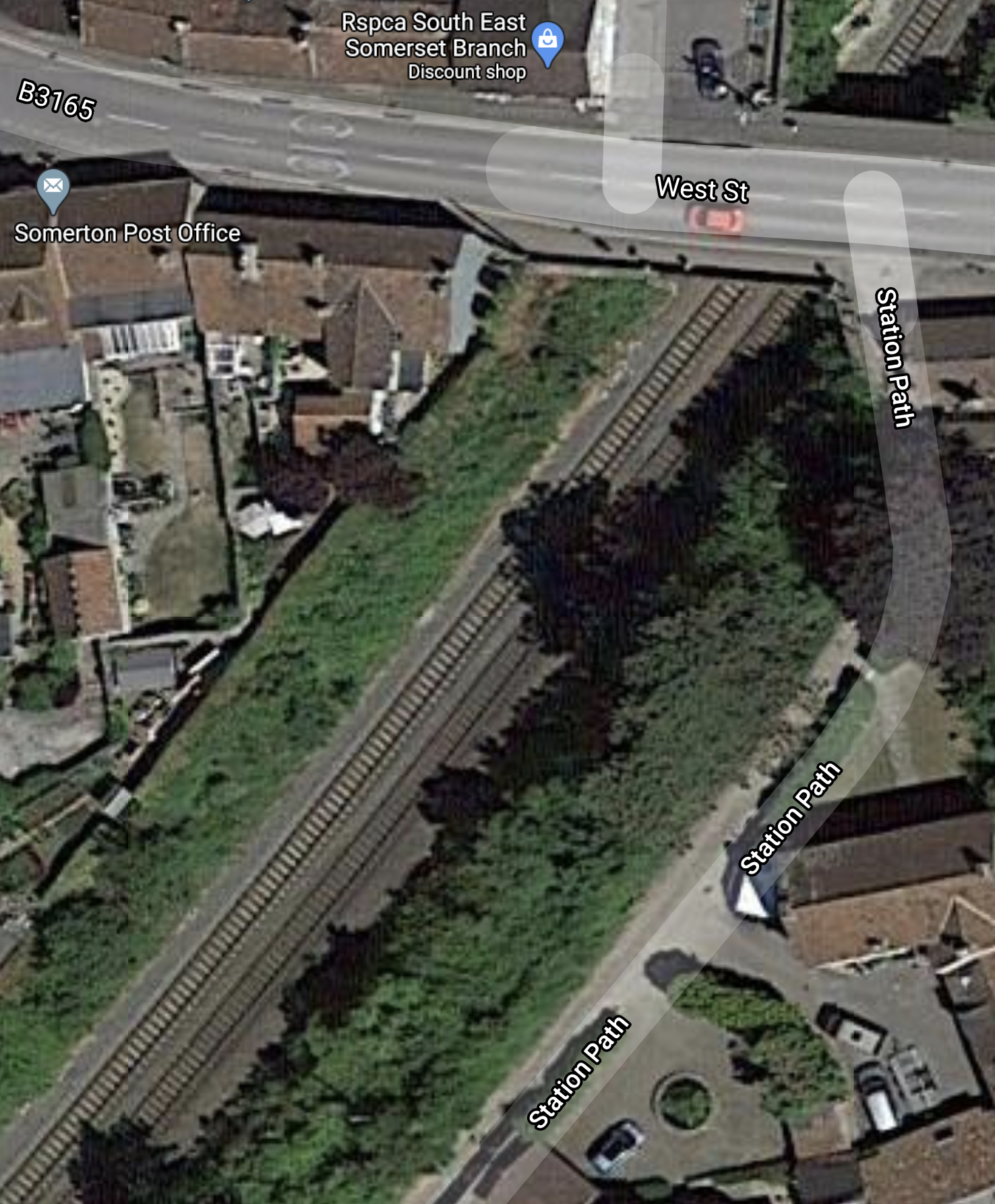
According to the Wikipedia entry for Somerton station, this seems to be the plan.
A May 2018 transport strategy suggested that a station should be opened to serve the Somerton and Langport area.
Judging from the map, there should be space for a two-platform station.
Services Though Somerton Station
Currently, there are three Great Western Railway (GWR) services on this route.
- London Paddington and Exeter St. Davids via Reading, Newbury, Pewsey, Westbury, Castle Cary, Taunton and Tiverton Parkway.
- London Paddington and Plymouth via Reading, Taunton, Tiverton Parkway, Exeter St Davids, Newton Abbot and Totnes.
- London Paddington and Penzance via Reading, Taunton, Tiverton Parkway, Exeter St Davids, Newton Abbot, Totnes, Plymouth, Liskeard, Bodmin Parkway, Lostwithiel, Par, St Austell, Truro, Redruth, Camborne and St Erth.
All services have a frequency of one train per two hours (tp2h)
The frequency of trains between Reading and Taunton on the 24th July was around each hour as follows.
- 7 – 4/1
- 8 – 4/1
- 9 – 5/2
- 10 4/0
- 11 6/2
- 12 5/2
- 13 – 5/1
- 14 – 5/2
- 15 – 4/1
- 16 – 3/0
- 17 – 7/2
- 18 – 3/0
- 19 – 3/0
- 20 – 3/0
- 21 – 3/1
- 22 – 0/0
- 23 – 0/0
- 24 – 1/1
Note.
- The first figure is the total number of trains per hour (tph).
- The second figure is the total number of freight tph.
There is under two tph in both directions and under one freight tph.
As the Reading-Taunton Line is a 110 mph route, my scheduling experience, says that with 125 mph Class 800 trains running all the passenger services, there should be some space for a few more services on the route.
So could this mean a fourth service between London Paddington and the South West?
- The new service could call at the new Somerton station.
- It could terminate at Exeter St. Davids. Penzance, Plymouth or a new destination of Taunton station.
- The Beeching Reversal project of Transforming The Newquay Line, would enable termination at Newquay station.
- The Beeching Reversal project of Increased Service Provision Bodmin General-Bodmin Parkway, would enable termination at Bodmin General station.
- The Restoring Your Railway Fund project of Reopening Of Wellington and Cullompton Stations, will need calling trains at the two stations.
- The Restoring Your Railway Fund project of Reinstatement Of Rail Access To Devizes Via A New Station At Lydeway will also need callers.
Are we seeing the emergence of a stopping service, between London Paddington and Exeter St. Davids?
Hitachi’s Proposed Class 800 Trains With Batteries
Hitachi’s proposed train is described in this infographic.
Note the phrase – Allows Discontinuous Electrification; at the top of the infographic.
Suppose the train ran these legs.
- Newbury – Westbury – 42 miles
- Westbury – Taunton – 48 miles
- Taunton – Exeter St. Davids – 30 miles
- Exeter St. Davids – Plymouth – 52 miles
All would be under the 55 mile limit for battery range.
Conclusion
It looks like GWR are building up to increase services between London Paddington and Exeter St Davids.
Beeching Reversal – Increased Service Provision Bodmin General-Bodmin Parkway
This is one of the Beeching Reversal projects that the Government and Network Rail are proposing to reverse some of the Beeching cuts.
This Google Map shows the relationship of the two Bodmin General and Bodmin Parkway stations.
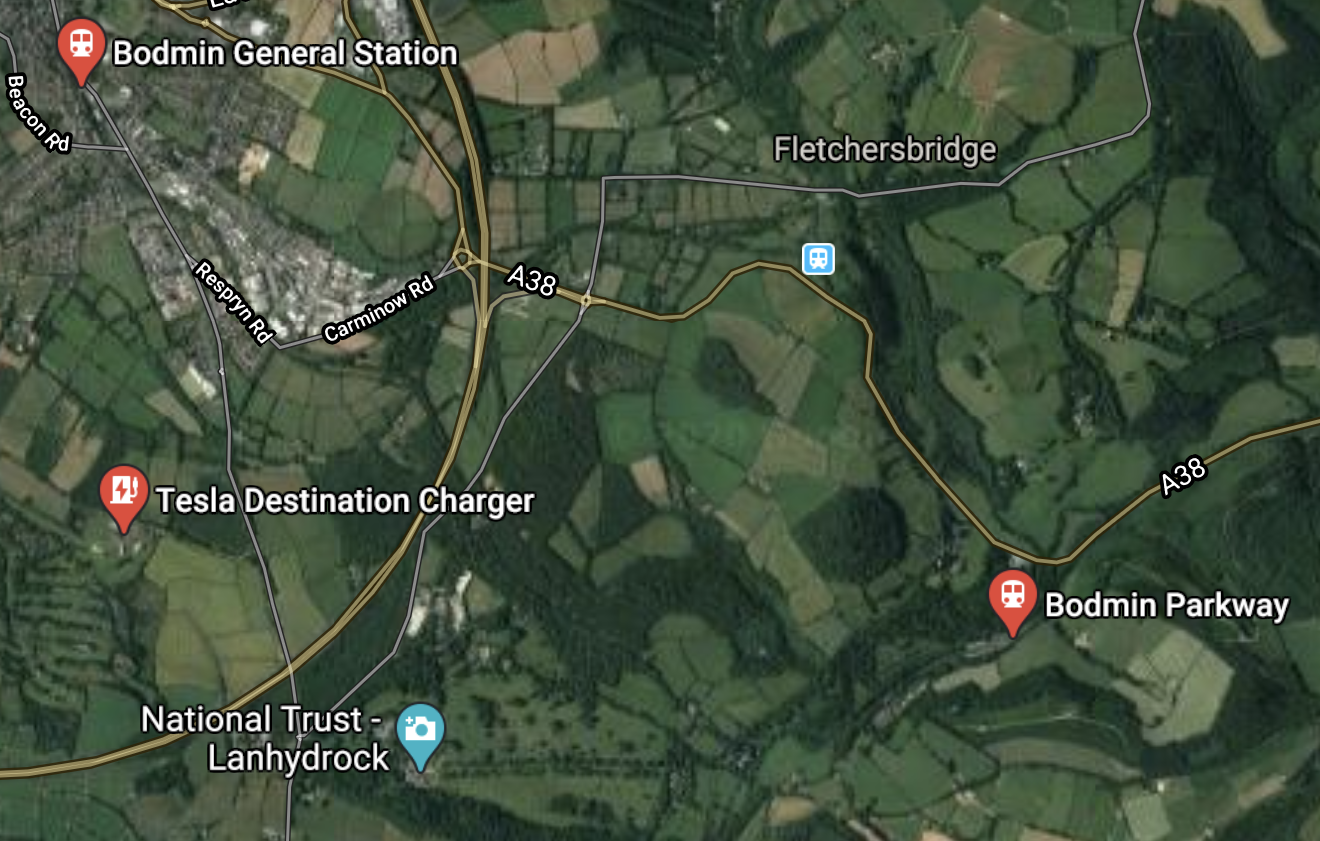
The two stations are clearly visible.
The aim of this Beeching Reversal project would appear to set up a more regular service between Bodmin Parkway station on the Cornish Main Line and Bodmin General station in the town.
This video shows some of the current trains run by the Bodmin and Wenford railway, between the two stations.
This article on Cornwall Live is entitled Plan To Link Heritage Railway At Bodmin To Mainline Train Services, gives a few scant details.
- There will be a second platform at Bodmin General station.
- This will allow extra services.
Looking at the space around Bodmin Parkway station, it should be possible to have a very comprehensive track layout, that connects the Bodmin branch to the main line.
It also appears that the platform is fully-funded from Great Western Railway (GWR) and Cornwall County Council.
Could A Shuttle Be Run Using Vivarail’s Pop-up Metro Concept?
Using Vivarail’s Pop-up Metro between the two stations is surely a possibility, with charging at either station.
What Do GWR Want In Return For Their Funding?
I think that GWR could have a couple of uses for a platform at Bodmin General station.
Reorganising The Services Between London Paddington and the South-West
Currently, there are three services on this route.
- London Paddington and Exeter St. Davids via Reading, Newbury, Pewsey, Westbury, Castle Cary, Taunton, Tiverton Parkway.
- London Paddington and Plymouth via Reading, Taunton, Tiverton Parkway, Exeter St Davids, Newton Abbot, Totnes.
- London Paddington and Penzance via Reading, Taunton, Tiverton Parkway, Exeter St Davids, Newton Abbot, Totnes, Plymouth, Liskeard, Bodmin Parkway, Lostwithiel, Par, St Austell, Truro, Redruth, Camborne, St Erth.
All services have a frequency of one train per two hours (tp2h)
Perhaps by reorganising the train paths, GWR could run another 1 tp2h service between London Paddington and Bodmin or Newquay station after the Transformation Of The Newquay Line.
Joining And Splitting Between London Paddington And The South-West
GWR’s Hitachi Class 80x trains have the ability to run in pairs, that are split and joined at convenient places en route.
This YouTube video, shows them doing it in Plymouth station.
As a means of evening out passenger loadings on pairs of trains running to the South-West, the two large stations of Exeter St. Davids and Plymouth would surely be possibilities for the manoeuvre.
I also think that Bodmin Parkway station could be used to split and join two trains from Cornwall.
- One train would come from Penzance and the West.
- The other could come from either Newquay or Bodmin General stations.
- In the future the second train, might come from a new Wadebridge station.
Bodmin Parkway station might need some small modifications, but it should be remembered that the closely-related Class 395 trains, do the deed and quickly disappear at Ashford International station.
Creating A Bodmin-Wadebridge Railway
There are also plans in the Beeching Reversal projects for the Reinstatement of the Bodmin-Wadebridge Railway
For trains to travel between Bodmin Parkway and Wadebridge stations, trains will need to reverse in the new platform at Bodmin General station.
Local Services From Exeter And Plymouth
From what I have read on the Internet, the Bodmin and Wenford Railway is an important tourist attraction and is one of several around Bodmin including the beaches and the Camel Trail.
So perhaps, a connection between Bodmin and Exeter and/or Plymouth in a vintage InterCity 125 could be a nice little earner for GWR and an appropriate way to arrive at the steam railway.
Steam Local Services From Exeter And Plymouth
Why not?
The new platform at Bodmin General station could probably take a locomotive and four coaches and all the facilities to handle steam engines are in the vicinity of the station.
Could The New Platform Be Used For High Speed Freight Shuttles?
Why not?
Rail Operations Group is looking at the possibility of running Class 769 trains as freight shuttles.
Bodmin could make an ideal Cornish terminal, as it’s the right side of county and has the main A38 close by.
Could The Platform Be Used To Charge Battery Electric Trains?
I feel that First Group are starting to embrace battery trains.
In Hitachi Trains For Avanti, I talked about how a fellow First Group company were reporting, that they might have battery trains.
If Great Western Railway were running extra trains into Cornwall, would a new platform at Bodmin General station, be an ideal place to charge a train?
Conclusion
A second platform at Bodmin General station could open up a lot of possibilities for train operating companies.
 The Anonymous Widower