Call For Innovations In Offshore Wind – RWE Launches Global Innovation Competition 2023
The title of this post, is the same as that of this press release from RWE.
This is the sub-heading.
Solutions wanted in the domains of ecology, circularity and system integration – Deadline for submission is 17th of April 2023
This is the first paragraph.
RWE, one of the world leaders in offshore wind, has launched its second annual Innovation Competition. The company is looking for solutions in the domains of ecology, system integration and circularity in offshore wind. RWE is dedicated to exploring and supporting innovative solutions that can both accelerate the pace of deployment of offshore wind, as well as contribute to sustainable development of offshore wind farms worldwide.
As someone who explored the dynamics of towing out and erecting floating oil platforms in the 1970s, I don’t think my experience fits entering. But I’ll be thinking about something.
Dogger Bank Wind Farm Officially Celebrates Its Operations And Maintenance Base Opening
The title of this post is the same as that of this news item on the Dogger Bank wind farm web site.
These bullet points introduce the item.
- 150 guests and employees gathered to celebrate the official opening.
- The state-of-the-art base will be the hub for operations and monitor 5% of UK electricity from its control room.
- Over 400 long-term jobs have been created locally to support Operations and Maintenance from South Tyneside for the 35-year life of the wind farm.
- The world-class facility will be operated in line with the UK Green Building Council’s (UKGBC) Net Zero Carbon Buildings Framework
This Google Map shows the location of the base.
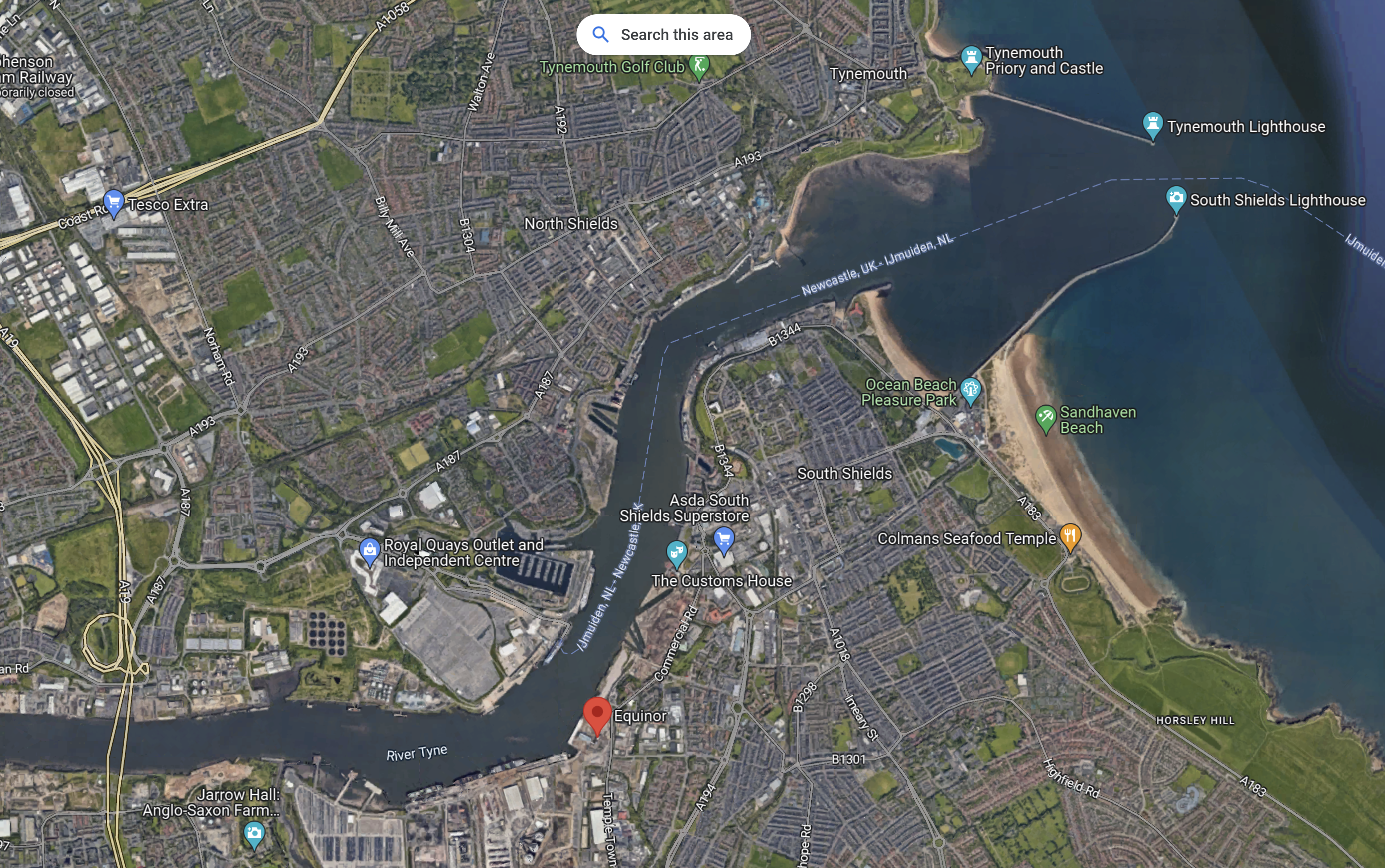
The red arrow indicates the base, which appears to be convenient for the North Sea.
This second Google Map shows a close up if the site.
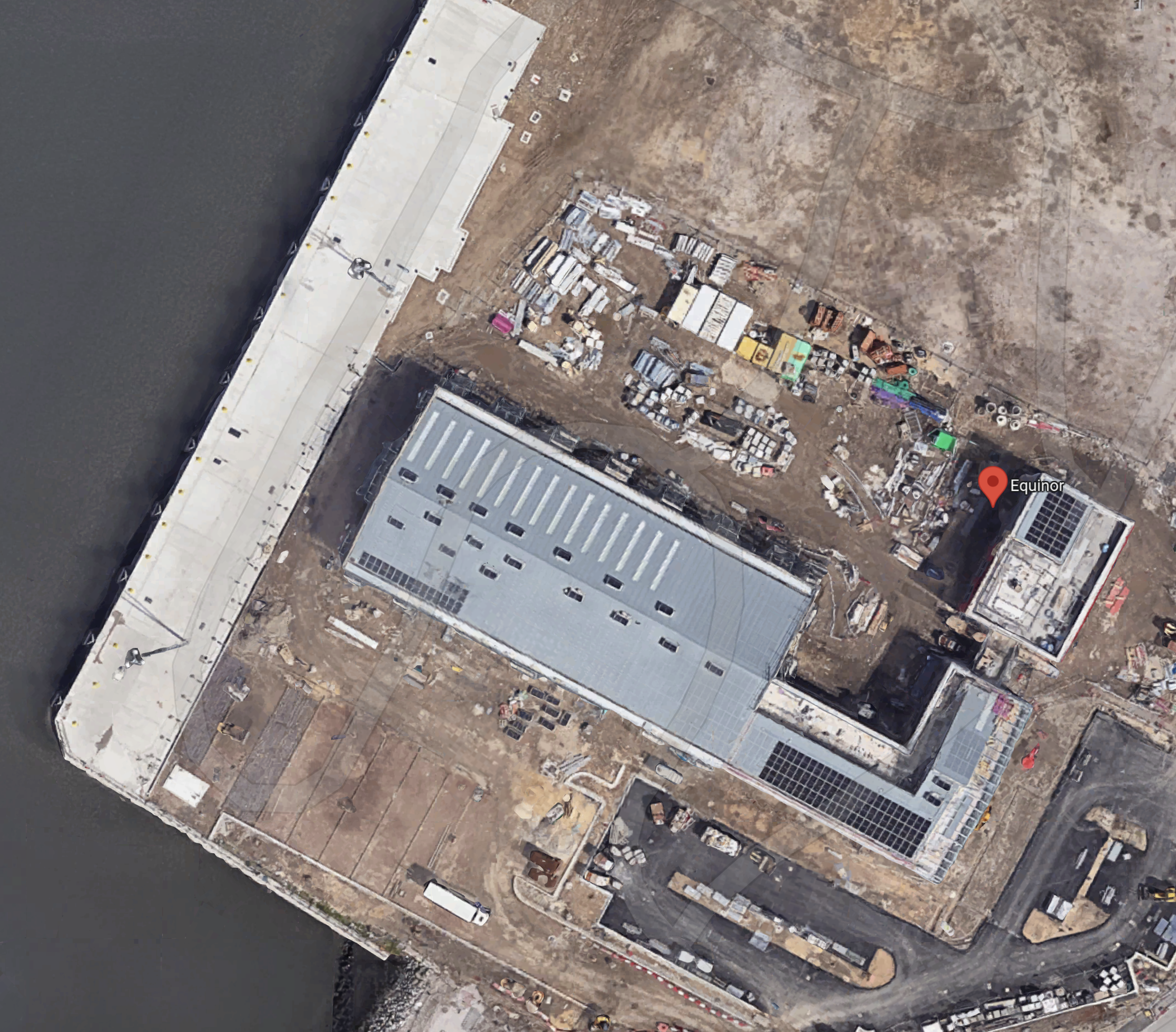
There is a nice long quayside, which in the future could be large enough to assemble floating turbines.
This third image is a Google Map 3D visualisation of the site from across the Tyne.
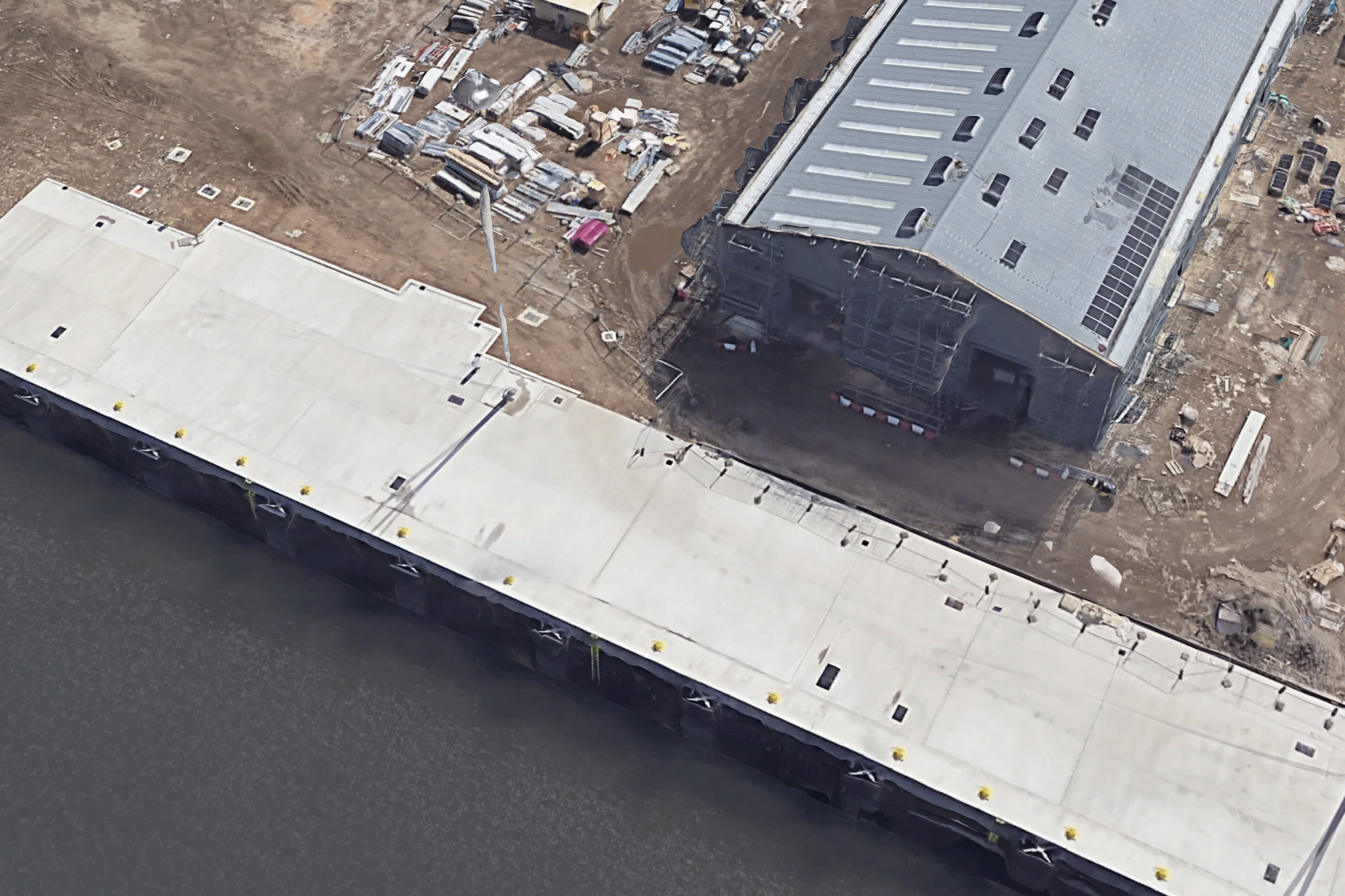
The news item says this about the ownership and operation of the Dogger Bank wind farm.
Dogger Bank Wind Farm is a joint venture between SSE Renewables (40%), Equinor (40%) and Vårgrønn (20%). SSE Renewables is lead operator for the development and construction of Dogger Bank Wind Farm. Equinor will be lead operator of the wind farm on completion for its expected operational life of around 35 years.
Initially, the Port of Tyne base will operate and maintain these wind farms.
- Dogger Bank A – 1235 MW
- Dogger Bank B – 1235 MW
- Dogger Bank C – 1218 MW
This gives a total of 3688 MW.
Note.
- SSE Renewables and Equinor are also developing the 1500 MW Dogger Bank D wind farm.
- This would bring the total up to 5188 MW.
- RWE are also developing the 3000 MW Dogger Bank South wind farm.
Leases were signed for both the Dogger Bank D and Dogger Bank South wind farms in January 2023.
I doubt all of these wind farms will be operated and maintained from the Port of Tyne base, due to the different ownership of Dogger Bank South.
But, I do hope that the facility can be expanded to handle Dogger Bank D.
ITM Signs 200MW Electrolyser Deal
The title of this post, is the same as that of this article on renews.biz.
This is the sub-heading.
Agreements with Linde Engineering will be for installation at RWE’s GET H2 Nukleus project in Germany
These paragraphs outline the deal.
ITM Power has signed two contracts for electrolysers, totalling 200MW, which will be installed in green hydrogen plants in Germany that will be supplied by North Sea offshore wind.
The contracts, both with Linde Engineering, are each for 100MW of PEM electrolysers.
The machines will be installed at two plants operated by RWE in Lingen, Germany.
Note.
- Linde Engineering and ITM Power were preselected by RWE for these orders.
- ITM Power seem to be going through scale-up problems.
But the comments in the article and the orders, surely show that ITM Power is now more likely to recover.
Lützerath: German Coal Mine Stand Off Amid Ukraine War Energy Crunch
The title of this post, is the same as that on this article on the BBC.
This is the sub-heading.
From her tiny wooden treehouse, which sways precariously in the winter wind, a young woman watches an enormous mechanical digger tear into the earth below, its jaws edging ever closer to the village which she’s determined to save.
And these two paragraphs outline the protest.
Lützerath, in western Germany, is on the verge – literally – of being swallowed up by the massive coal mine on its doorstep.
Around 200 climate change activists, who are now all that stand in the way of the diggers expanding the Garzweiler opencast mine, have been warned that if they don’t leave by Tuesday they’ll be forcibly evicted.
But this is not about coal or bituminous coal, as we know it in the UK, this mine will produce lignite or brown coal.
Read both Wikipedia entries linked to the previous sentence and you find some choice phrases.
For bituminous coal.
- Within the coal mining industry, this type of coal is known for releasing the largest amounts of firedamp, a dangerous mixture of gases that can cause underground explosions.
- Extraction of bituminous coal demands the highest safety procedures involving attentive gas monitoring, good ventilation and vigilant site management.
- The leading producer is China, with India and the United States a distant second and third.
For lignite.
- It has a carbon content around 25–35%. and is considered the lowest rank of coal due to its relatively low heat content.
- When removed from the ground, it contains a very high amount of moisture which partially explains its low carbon content.
- The combustion of lignite produces less heat for the amount of carbon dioxide and sulfur released than other ranks of coal. As a result, environmental advocates have characterized lignite as the most harmful coal to human health.
- Depending on the source, various toxic heavy metals, including naturally occurring radioactive materials may be present in lignite which are left over in the coal fly ash produced from its combustion, further increasing health risks.
- Lignite’s high moisture content and susceptibility to spontaneous combustion can cause problems in transportation and storage.
I don’t think, that we’ve ever burned lignite in the UK for electricity, as it is just too filthy.
This map shows the mine.

Note.
- The autobahn at the West of the map, is a six-land highway, so gives an idea of the scale.
- The village of Lützerath is towards the bottom of the map in the middle.
- What has been left after the mining, is going to take a lot of restoration.
It almost appears that some of the scenes of devastation, we are seeing in the Ukraine are also happening in Germany due to the frantic search for energy.
A 1960s-Educated Engineer’s Attitude To Coal
I was one of about four-hundred engineers in my year at Liverpool University in the 1960s.
- Quite a few of those engineers were from coal-mining areas and some were children of miners.
- I remember the graduate recruitment fair at the University in 1968, where the representative from the National Coal Board sat there alone, as if he’d got the 1960s version of Covid-19.
- Some went and talked to him, as they felt sorry for him.
- As far as I know, not one of us, went to work for the National Coal Board.
Engineers and other graduates of the 1960s, didn’t feel that coal was the future.
Had Aberfan and the other pit disasters of the era killed coal as a career, amongst my generation of the UK population?
What Should The Germans Do?
It is my view that whatever the Germans do, burning brown coal, should not be on the list. It’s just too polluting.
This article on euronews is entitled Germany And Poland Have A Dirty Big Secret – An Addiction To Brown Coal.
A few years ago, I was in Katowice on Poland and I have never seen such pollution in Europe, since the smogs of the 1950s.
The euronews article says this.
In eastern Germany some members of a little-known group claim they are being ethnically cleansed, not by militia groups, but by the coal mining industry.
Bulldozers have so far destroyed over 130 Sorb villages to make way for the mining of Europe’s dirtiest kind of fossil fuel – brown coal, or lignite as it is also known.
Brown coal mines are open cast and devour vast tracts of land. As well as whole villages farming and wildlife are destroyed.
The Penk family live in the village of Rohne. They feel their whole culture is also being destroyed.
Note that the Sorbs have a Wikipedia entry, which says there are 60,000 Sorbs in Germany.
One thing the Germans are doing is investing in the UK renewable energy industry.
- RWE own or part-own over 7 GW of offshore wind farms in the UK, some of which are under development.
- enBW and BP are developing 3 GW of offshore wind farms in the UK.
- Over twenty offshore wind farms use Siemens Gamesa turbines.
- The NeuConnect interconnector is being built between the Isle of Grain and Wilhelmshaven.
Would it not be better for the physical and mental health of German citizens, if they abandoned their dirty love of brown coal and spent the money in the North Sea?
Ramboll To Develop Offshore Wind-To-Hydrogen Concept
The title of this post, is the same as that of this article on offshoreWIND.biz.
This is the sub-heading.
Ramboll has been selected to investigate the feasibility of producing hydrogen offshore at a multi-gigawatt scale with NortH2 in the Dutch part of the North Sea.
Note.
- NortH2 has a web site.
- There is a very rich About NortH2 page.
- NortH2 is a consortium made up of Equinor, Eneco, Gasunie, Groningen Seaports, RWE and Shell Netherlands.
- The consortium aims to use 4 GW to produce hydrogen by 2030 and 10 GW by 2040.
The world needs more ambitious projects like this.
RWE Looking for Innovators To Boost UK’s Offshore Wind Supply Chain
The title of this post, is the same as that of this article on offshoreWIND.biz.
RWE appear to be looking for innovators in three areas.
- Autonomous solutions and the best way to integrate them into wind farm site investigations, construction, and operations and maintenance (O&M) is the first challenge for which RWE is looking for responses.
- The second challenge is about solutions to measure and reduce the environmental impacts of offshore wind farm construction and operations on birds.
- The last challenge focuses on ideas and innovations in cable monitoring and protection, aiming to secure a reduction in offshore wind farm cable failures.
As sums of around £25,000 are talked about in the article, it could be worth applying, if you have a relevant idea.
Is it slightly flattering to the UK’s skills, that a German company is backing British innovation?
But then I was involved in a British invention, which was also backed by the Germans and made me a reasonable amount of money.
Plans Emerge For 8 GW Of Offshore Wind On Dogger Bank
Wikipedia has an entry, which is a List Of Offshore Wind Farms In The United Kingdom.
The totals are worth a look.
- Operational – 13279 MW
- Under Construction – 4125 MW
- Proposed Under The UK Government’s Contracts For Difference Round 3 – 2412 MW
- Proposed Under The UK Government’s Contracts For Difference Round 4 – 7026 MW
- Exploratory Phase, But No Contract for Difference – Scotland – 24,826 MW
- Exploratory Phase, But No Contract for Difference – England – 14,500 MW
Note.
- That gives a Grand Total of 66,168 MW or 66.168 GW.
- The government’s target is 50 GW of offshore wind by 2030.
- The typical UK power need is around 23 GW, so with nuclear and solar, we could be approaching three times the electricity generation capacity that we currently need.
The figures don’t include projects like Berwick Bank, Cerulean Wind, Norfolk Vanguard or Northern Horizons, which are not mentioned in Wikipedia’s list.
I regularly look at the list of wind farms in this Wikipedia entry and noticed that the number of Dogger Bank wind farms had increased.
They are now given as.
- Dogger Bank A – 1200 MW – Completion in 2023/24
- Dogger Bank B – 1200 MW – Completion in 2024/25
- Dogger Bank C – 1200 MW – Completion in 2024/25
- Dogger Bank D – 1320 MW – No Completion Given
- Dogger Bank South – 3000 MW – No Completion Given
Note, that gives a Grand Total of 7920 MW or 7.920 GW.
This article on offshoreWIND.biz is entitled BREAKING: SSE, Equinor Plan 1.3 GW Dogger Bank D Offshore Wind Project.
It was published on the October 6th, 2022 and starts with this summary.
SSE Renewables and Equinor are looking into building what would be the fourth part of Dogger Bank Wind Farm, the world’s largest offshore wind farm, whose three phases (A, B and C) are currently under construction. Surveys are now underway at an offshore site where the partners want to develop Dogger Bank D, which would bring Dogger Bank Wind Farm’s total capacity to nearly 5 GW if built.
Obviously, there are a few ifs and buts about this development, but it does look like SSE Renewables and Equinor are serious about developing Dogger Bank D.
More Dogger Bank Gigawatts for UK As RWE Moves Forward With Two 1.5 GW Projects
This subheading describes, the 3 GW wind farm, that I listed earlier as Dogger Bank South.
These three paragraphs describe the projects.
RWE is now moving forward with two new offshore wind farms in the Zone, each with a 1.5 GW generation capacity, after the company obtained approval from the UK Secretary of State for Business, Energy and Industrial Strategy (BEIS) to enter into an Agreement for Lease with The Crown Estate this Summer, following the Round 4 leasing process.
The wind farms will be built at two adjacent sites located just southwest of the Dogger Bank A offshore wind farm and are dubbed Dogger Bank South (DBS) East and Dogger Bank South (DBS) West.
RWE has also started with geophysical seabed surveys within the wind turbine array areas for its two new projects.
It appears that they have already got the leasing process started.
When Will Dogger Bank D And Dogger Bank South Be Operational?
Consider.
- In How Long Does It Take To Build An Offshore Wind Farm?, showed that a lot of offshore wind farms have gone from planning permission to first operation in six years.
- I don’t think that there will be planning permission problems on the Dogger Bank.
- The two wind farms are a continuation of Dogger Bank A, B and C and the Sofia wind farms.
- A lot of the construction, would be more of the same.
With average luck, I can see Dogger Bank D and Dogger Bank South in full production before the end of 2028.
SolarDuck & RWE Will Build A Floating Solar Park In The North Sea
The title of this post, is the same as that of this article on CleanTechnica.
This is the sub-title.
SolarDuck and RWE will work together on an offshore floating solar project in the North Sea that will include battery storage.
These two paragraphs explain the concept.
Offshore wind is poised to provide a significant proportion of Europe’s electrical energy in the near future. But those towers and turbines have to be spaced fairly far apart to avoid interfering with each other. That leaves a lot of open ocean in between them, ocean that has sunlight falling on it all day long.
SolarDuck, a Dutch/Norwegian company, is working on floating solar technology that would float on the surface of the ocean to generate electricity to supplement the output from those offshore wind turbines. They already need to have undersea cables to carry their electricity ashore. Why not leverage that infrastructure to carry electricity from solar panels as well?
I would only worry about the economics.
I very much feel that the structures can be robust enough, given the wealth of experience with offshore oil and gas platforms and the experience in World War 2 with Lily and Clover.
 The Anonymous Widower