New Baltic Sea Interconnector On Horizon As Lithuania, Latvia, and Germany Plan Cross-Border Link
The title of this post, is the same as that of this article on offshoreWIND.biz.
This is the sub-heading.
Lithuania, Latvia, and Germany are planning a joint offshore interconnector that would enable electricity trading between the Baltic countries and Germany and allow for the integration of up to 2 GW of offshore wind capacity in Lithuania and Latvia
These first two paragraphs add more detail to the article.
The energy ministers of the three countries signed a joint declaration of intent on 18 February, paving the way for the development of the Baltic-German PowerLink interconnector, which would, in addition to electricity trading and offshore wind capacity integration, also enable the expansion of onshore renewable energy capacity.
The Lithuanian, Latvian, and German transmission system operators (TSOs) – Litgrid, Augstsprieguma tīkls and 50Hertz – agreed to assess the feasibility of the hybrid electricity interconnection.
As Germany, has the following connections under development in the West.
- AquaVentus to Aberdeen, Humberside, Denmark, Norway and The Netherlands.
- NeuConnect to the Isle of Grain In England.
- GriffinLink, which is an offshore link to England.
The Germans seem to be putting themselves at the centre of an energy distribution system, that has the capability to stabilise European and UK electricity for thousands of years. Especially, if the network grows to include more countries.
This paragraph says this about the Baltic-German PowerLink project.
The Baltic-German PowerLink project concept developed by Litgrid, Augstsprieguma tīkls, and 50Hertz includes a 2 GW, approximately 600 kilometres long hybrid offshore connection, with the connection point in the Baltic States planned to be on the border between Lithuania and Latvia. The exact location is to be determined after technical studies.
Note.
- The interconnectors may be long, but they are not longer than anything built successfully before in European waters.
- The UK and the Island of Ireland are well-linked.
- There would appear to be no need for challenging projects like the Morocco-UK Power Project
I suspect that Germany will get the energy it needs and the British Isles will get a nice little earner.
If Europe is generating large amounts of wind and solar energy with its variable output it will need lots of energy storage.
What Countries Have The Terrain For Pumped Storage Hydro In Europe?
I asked Google AI and received this answer.
Key countries with ideal, high-elevation terrain and significant existing or planned capacity include:
Alpine Region (The Heart of European Pumped Storage):
Switzerland: Extremely high capacity due to steep, mountainous landscapes and significant water sources, hosting the world’s oldest working pumped storage plant.
Austria: Heavily mountainous, it is a major player in PSH expansion and modernization.
France: Home to one of Europe’s largest, the Grand Maison hydroelectric power station.
Italy: Holds high capacity with numerous planned projects.
Germany: Strong existing infrastructure.
Southern Europe:
Spain: Features some of Europe’s largest plants (e.g., La Muela/Cortes-La Muela).
Portugal: Significant recent investment in large-scale projects like the Tâmega complex.
Other Potential Areas:
Norway: High potential due to its mountainous, water-rich terrain.
United Kingdom: High project volume currently under construction.
Balkans & Central Europe:
Countries like Bulgaria, Romania, and the Czech Republic have suitable terrain for further development.
These countries benefit from significant hydraulic head (steep drop) and natural or artificial reservoir potential, making them ideal for storing energy for peak consumption hours.
Note.
- As expected, the Alpine region is Top of the League.
- The UK is holding its own despite its small mountains.
- There is a lot of potential to be developed.
But then Electric Mountain in Snowdonia is certainly at the top table of pumped storage systems despite being built in the 1980s.
What Countries Have The Terrain For Hydrogen Storage In Europe?
I asked Google AI and received this answer.
Key European countries with suitable geological terrain—specifically salt caverns and depleted gas fields—for large-scale, underground hydrogen storage include Germany, the Netherlands, Denmark, the United Kingdom, and France. Other significant regions for storage potential include Spain, Hungary, and Austria, which are developing porous storage facilities.
Key Regions & Terrain Types:
Salt Caverns (North-Western Europe): Germany, the Netherlands, Denmark, France, and the UK have substantial salt deposits suitable for creating caverns, identified as cost-efficient for large-scale storage.
Depleted Gas Fields (Porous Rock): The Netherlands, Germany, and parts of Central/Southern Europe (Spain, Hungary) have significant capacity in existing porous storage, particularly in the North Sea region.
Specific Projects: Germany (Uniper’s Krummhörn project), Netherlands (HyStock), and France (HYPSTER at Etrez) are active, with Spain and Denmark emerging as major hydrogen hubs.
Capacity Potential: The Netherlands, for instance, holds massive potential (35-60 TWh) due to its offshore and onshore depleted fields.
Salt cavern projects, which offer high-deliverability storage, are heavily concentrated in the North-Western European industrial corridor.
I was lucky enough have a tour of ICI’s salt mine in Cheshire, when I worked there in the 1960s and I remember these facts from those days.
- There was enough salt in the ground under Cheshire to last several thousand years.
- Most salt was extracted from boreholes, for making chlorine using electrolysis and the Castner-Kellner process.
- Hydrogen was a by-product and much of it was mixed with coal gas to raise steam for the works.
The same technique used to make boreholes to extract the salt, is used to hollow caverns in the salt to store gases like hydrogen.
Once, when they were digging salt out of the salt mine at Winsford, a worker broke into an unmarked borehole and ICI nearly lost the mine because of the water rushing in.
Two stories stand out from the rescue of the mine.
- There was a need for dry clothes for all the workers, so ICI took a truck to Marks & Spencer in Northwich and emptied it of anything they might need. I was told the story enriched with plagues of locusts.
- A Ford Transit was found to have travelled a few thousand miles underground in axle deep salt slurry. Rather, than scrap it and buy another, it was offered back to Ford, who were delighted to swap it for a new one. I heard that Ford said, that the accelerated corrosion research would have taken many years, if done on the roads.
Always think out of the box.
Aberdeen’s Exceed Secures Centrica Rough Contract
The title of this post, is the same as that of this article on Energy Voice.
This is the sub-heading.
Well and reservoir management firm Exceed has secured a contract with Centrica Energy Storage for the redevelopment of the Rough gas storage field.
This is the introductory paragraph.
Exceed said its role in the initial stages of the project, which is exploring converting the Rough field into a hydrogen storage facility, could create more than 30 jobs.
In Wood To Optimise Hydrogen Storage For Centrica’s Rough Field, I talked about changing Rough from a gas to a hydrogen store, so it looks like Centrica are going to create a vast hydrogen storage facility.
This all fits with my belief, that Centrica’s Rough facility and SSE’s nearby Aldbrough storage facility, will at sometime in the future be connected to the Germany hydrogen pipeline; AquaVentus to perform backup to hydrogen produced in the North Sea.
I also feel that the hydrogen trading will be of benefit to Centrica and SSE.
The last section of the Energy Voice article is entitled Rough Hydrogen Storage Concerns.
The following facts are given.
There are currently eight geological gas storage sites across Great Britain, containing approximately 3.1bcm in capacity and maximum deliverability rates of 124mcm/day.
Five of these gas storage sites are in salt caverns while the remaining three are depleted oil and gas fields, with the Centrica’s Rough field in the North Sea the only site located offshore.
The British Geological Survey estimates the UK could store up to 3,000 TWh of hydrogen.
Currently, we use the following energy in a year.
- 263 TWh of electricity
- 705 TWh of natural gas
So we use a total of 968 TWh of energy.
3,000 TWh of hydrogen would keep the UK going for three years. So we should be fine!
The Massive Hydrogen Project, That Appears To Be Under The Radar
This page on the SSE Thermal web site, is entitled Aldbrough Gas Storage.
This is the introductory paragraph.
The Aldbrough Gas Storage facility, in East Yorkshire, officially opened in June 2011. The last of the nine caverns entered commercial operation in November 2012.
This page on Hydrocarbons Technology is entitled Aldbrough Underground Gas Storage Facility, Yorkshire.
It gives these details of how Aldbrough Gas Storage was constructed.
The facility was originally planned to be developed by British Gas and Intergen in 1997. British Gas planned to develop Aldbrough North as a gas storage facility while Intergen planned to develop Aldbrough South.
SSE and Statoil became owners of the two projects in 2002 and 2003. The two companies combined the projects in late 2003. Site work commenced in March 2004 and leaching of the first cavern started in March 2005.
The storage caverns were created by using directional drilling. From a central area of the site, boreholes were drilled down to the salt strata located 2km underground.
After completion of drilling, leaching was carried out by pumping seawater into the boreholes to dissolve salt and create a cavern. Natural gas was then pumped into the caverns and stored under high pressure.
Six of the nine caverns are already storing gas. As of February 2012, dewatering and preparation of the remaining three caverns is complete. Testing has been completed at two of these caverns.
The facility is operated remotely from SSE’s Hornsea storage facility. It includes an above ground gas processing plant equipped with three 20MW compressors. The gas caverns of the facility are connected to the UK’s gas transmission network through an 8km pipeline.
Note.
- The caverns are created in a bed of salt about two kilometres down.
- It consists of nine caverns with the capacity to store around 370 million cubic metres (mcm) of gas.
- Salt caverns are very strong and dry, and are ideal for storing natural gas. The technique is discussed in this section in Wikipedia.
As I worked for ICI at Runcorn in the late 1960s, I’m very familiar with the technique, as the company extracted large amounts of salt from the massive reserves below the Cheshire countryside.
This Google Map shows the location of the Aldbrough Gas Storage to the North-East of Hull.
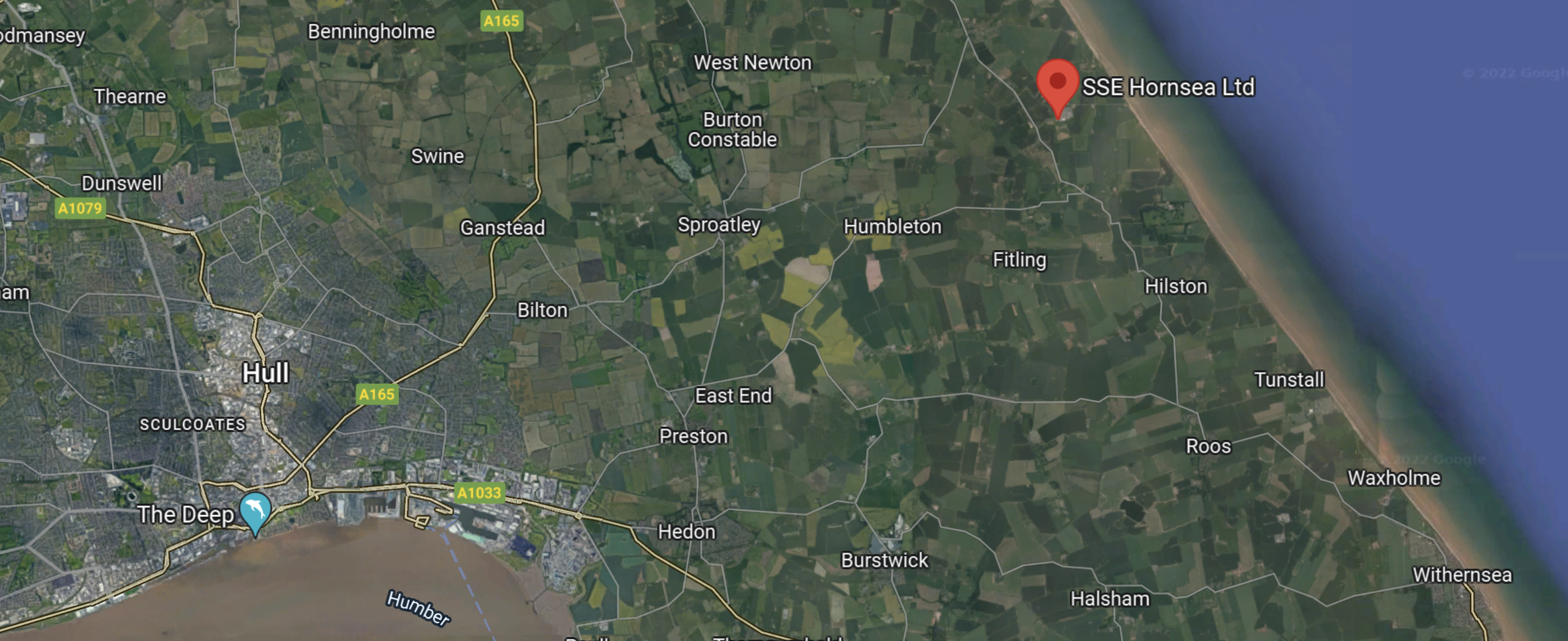
Note.
- The red-arrow marks the site of the Aldbrough Gas Storage.
- It is marked on the map as SSE Hornsea Ltd.
- Hull is in the South-West corner of the map.
This Google Map shows the site in more detail.
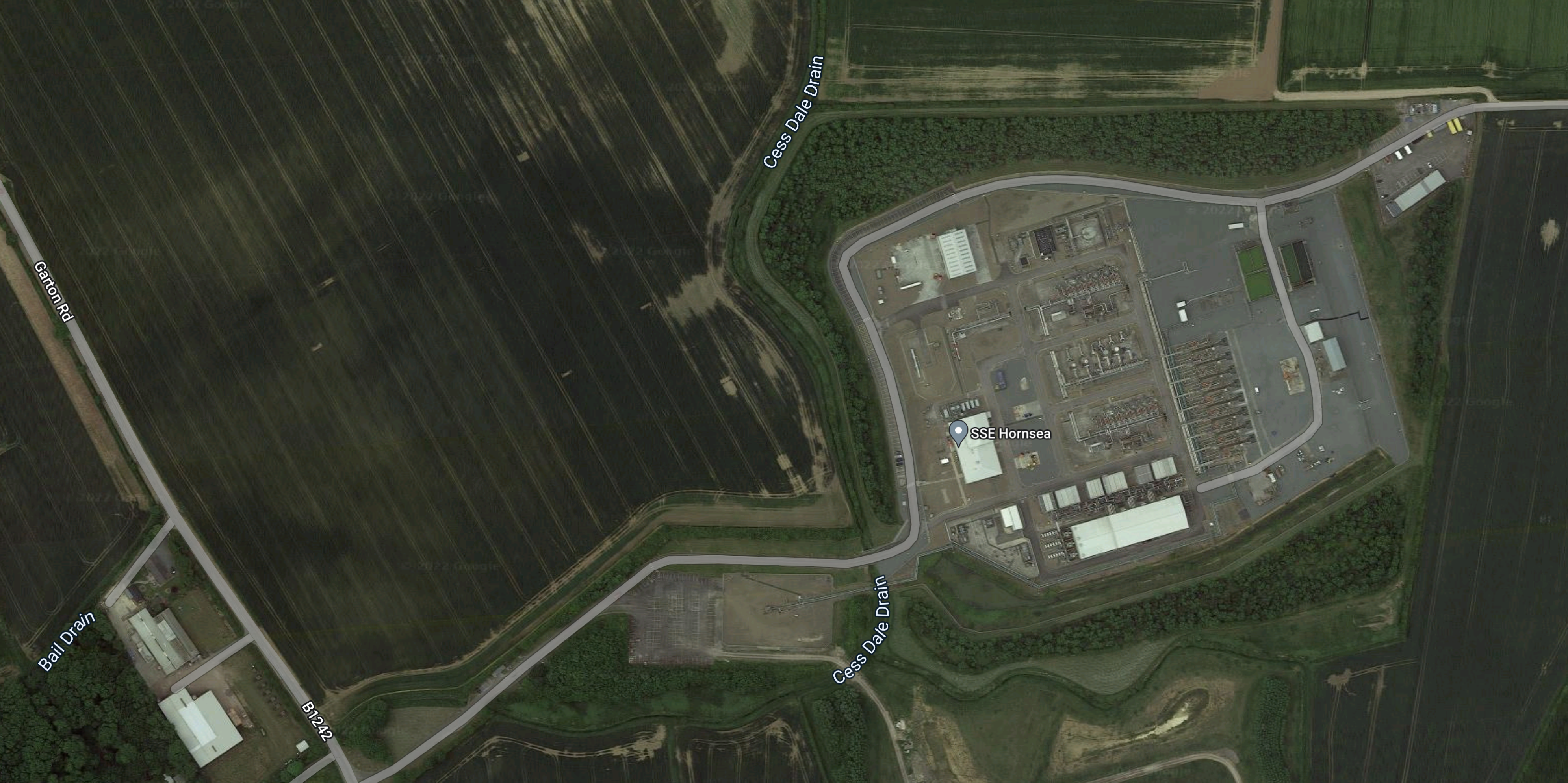
It appears to be a compact site.
Atwick Gas Storage
This page on the SSE Thermal web site, is entitled Atwick Gas Storage.
This is said on the web site.
Our Atwick Gas Storage facility is located near Hornsea on the East Yorkshire coast.
It consists of nine caverns with the capacity to store around 325 million cubic metres (mcm) of gas.
The facility first entered commercial operation in 1979. It was purchased by SSE in September 2002.
This Google Map shows the location of the Atwick Gas Storage to the North-East of Beverley.
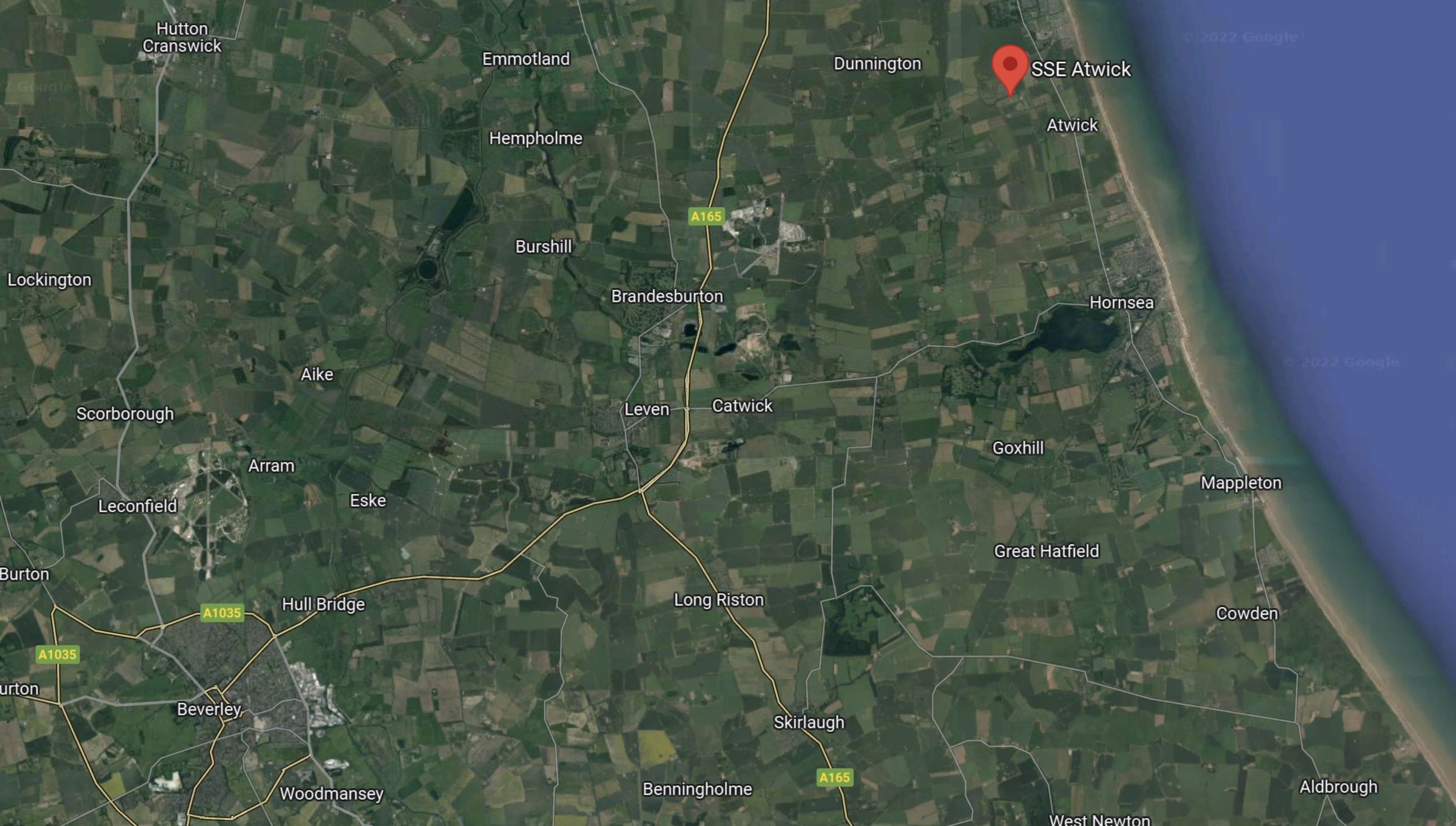
Note.
- The red-arrow marks the site of the Atwick Gas Storage.
- It is marked on the map as SSE Atwick.
- Beverley is in the South-West corner of the map.
This Google Map shows the site in more detail.
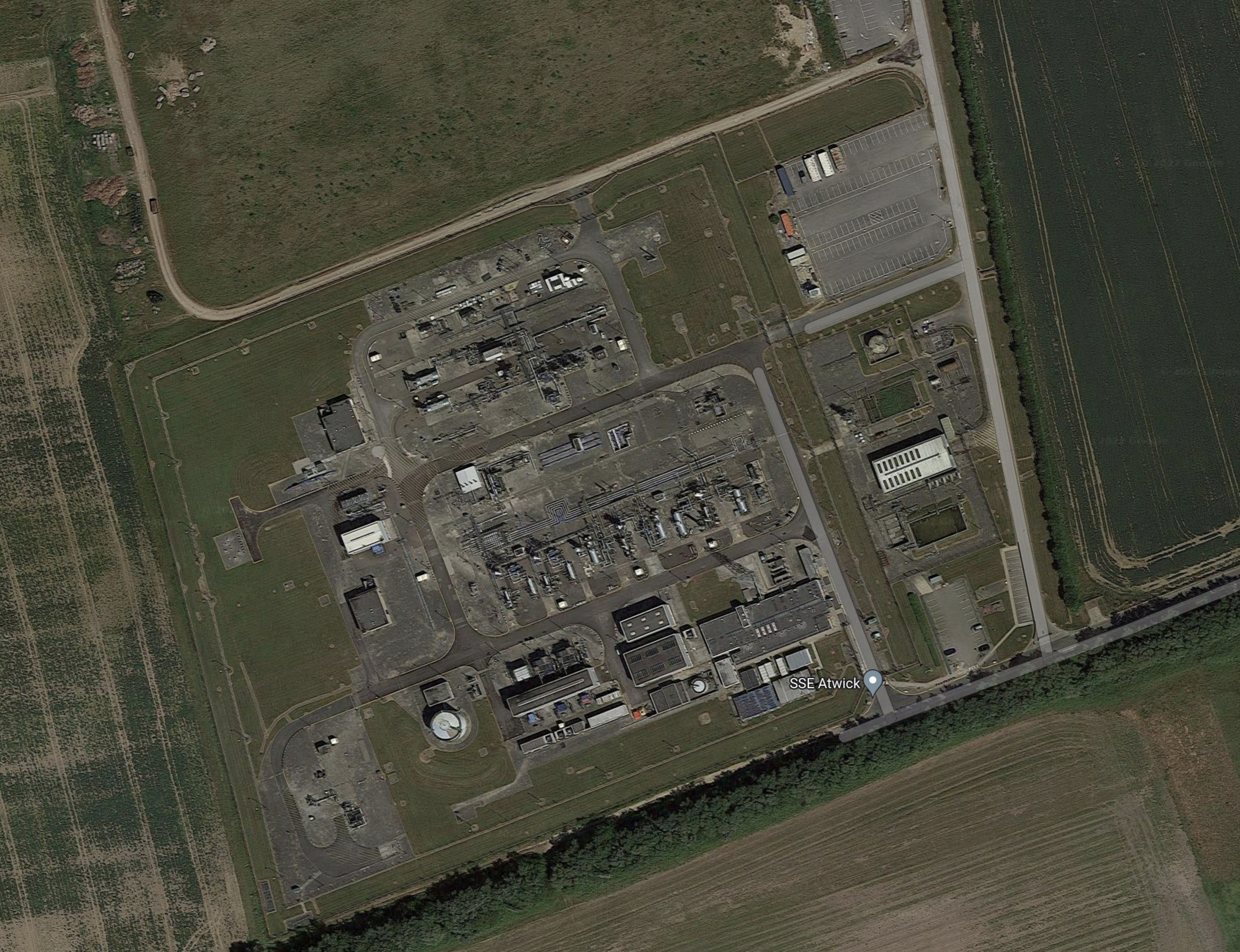
As with the slightly larger Aldbrough Gas Storage site, it appears to be compact.
Conversion To Hydrogen Storage
It appears that SSE and Equinor have big plans for the Aldbrough Gas Storage facility.
This page on the SSE Thermal web site is entitled Plans For World-Leading Hydrogen Storage Facility At Aldbrough.
These paragraphs introduce the plans.
SSE Thermal and Equinor are developing plans for one of the world’s largest hydrogen storage facilities at their existing Aldbrough site on the East Yorkshire coast. The facility could be storing low-carbon hydrogen as early as 2028.
The existing Aldbrough Gas Storage facility, which was commissioned in 2011, is co-owned by SSE Thermal and Equinor, and consists of nine underground salt caverns, each roughly the size of St. Paul’s Cathedral. Upgrading the site to store hydrogen would involve converting the existing caverns or creating new purpose-built caverns to store the low-carbon fuel.
With an initial expected capacity of at least 320GWh, Aldbrough Hydrogen Storage would be significantly larger than any hydrogen storage facility in operation in the world today. The Aldbrough site is ideally located to store the low-carbon hydrogen set to be produced and used in the Humber region.
Hydrogen storage will be vital in creating a large-scale hydrogen economy in the UK and balancing the overall energy system by providing back up where large proportions of energy are produced from renewable power. As increasing amounts of hydrogen are produced both from offshore wind power, known as ‘green hydrogen’, and from natural gas with carbon capture and storage, known as ‘blue hydrogen’, facilities such as Aldbrough will provide storage for low-carbon energy.
I have a few thoughts.
Will Both Aldbrough and Atwick Gas Storage Facilities Be Used?
As the page only talks of nine caverns and both Aldbrough and Atwick facilities each have nine caverns, I suspect that at least initially only Aldbrough will be used.
But in the future, demand for the facility could mean all caverns were used and new ones might even be created.
Where Will The Hydrogen Come From?
These paragraphs from the SSE Thermal web page give an outline.
Equinor has announced its intention to develop 1.8GW of ‘blue hydrogen’ production in the region starting with its 0.6GW H2H Saltend project which will supply low-carbon hydrogen to local industry and power from the mid-2020s. This will be followed by a 1.2GW production facility to supply the Keadby Hydrogen Power Station, proposed by SSE Thermal and Equinor as the world’s first 100% hydrogen-fired power station, before the end of the decade.
SSE Thermal and Equinor’s partnership in the Humber marks the UK’s first end-to-end hydrogen proposal, connecting production, storage and demand projects in the region. While the Aldbrough facility would initially store the hydrogen produced for the Keadby Hydrogen Power Station, the benefit of this large-scale hydrogen storage extends well beyond power generation. The facility would enable growing hydrogen ambitions across the region, unlocking the potential for green hydrogen, and supplying an expanding offtaker market including heat, industry and transport from the late 2020s onwards.
Aldbrough Hydrogen Storage, and the partners’ other hydrogen projects in the region, are in the development stage and final investment decisions will depend on the progress of the necessary business models and associated infrastructure.
The Aldbrough Hydrogen Storage project is the latest being developed in a long-standing partnership between SSE Thermal and Equinor in the UK, which includes the joint venture to build the Dogger Bank Offshore Wind Farm, the largest offshore wind farm in the world.
It does seem to be, a bit of an inefficient route to create blue hydrogen, which will require carbon dioxide to be captured and stored or used.
Various scenarios suggest themselves.
- The East Riding of Yorkshire and Lincolnshire are agricultural counties, so could some carbon dioxide be going to help greenhouse plants and crops, grow big and strong.
- Carbon dioxide is used as a major ingredient of meat substitutes like Quorn.
- Companies like Mineral Carbonation International are using carbon dioxide to make building products like blocks and plasterboard.
I do suspect that there are teams of scientists in the civilised world researching wacky ideas for the use of carbon dioxide.
Where Does The Dogger Bank Wind Farm Fit?
The Dogger Bank wind farm will be the largest offshore wind farm in the world.
- It will consist of at least three phases; A, B and C, each of which will be 1.2 GW.
- Phase A and B will have a cable to Creyke Beck substation in Yorkshire.
- Phase C will have a cable to Teesside.
Creyke Beck is almost within walking distance of SSE Hornsea.
Could a large electrolyser be placed in the area, to store wind-power from Dogger Bank A/B as hydrogen in the Hydrogen Storage Facility At Aldbrough?
Conclusion
SSE and Equinor may have a very cunning plan and we will know more in the next few years.
Salt Deposits And Gas Cavern Storage In The UK
This post is mainly to point to this useful document on the government web site, that is entitled Salt Deposits And Gas Cavern Storage In The UK With A Case Study Of Salt Exploration From Cheshire.
 The Anonymous Widower