Faroes-Style Tunnels Could ‘Transform’ Fortunes For Shetland Isles
The title of this post, is the same as that of this article on the BBC.
This is the sub-heading.
The Faroese prime minister says Shetland could boost growth and revitalise island life by following his country in replacing ageing ferries with undersea tunnels.
These three paragraphs add more details.
Shetland Islands Council says it is pushing ahead with plans to build tunnels to four outlying isles in the archipelago including Unst, the most northerly place in the UK.
“I think we have learned in the Faroe Islands that investment in infrastructure is a good investment,” Aksel Johannesen told BBC News.
Shetland Islands Council says its multi-million pound project is likely to be funded by borrowing money and paying it back through tolls, potentially providing a new transport model for other Scottish islands.
This map shows the ferries in the Shetland Islands.
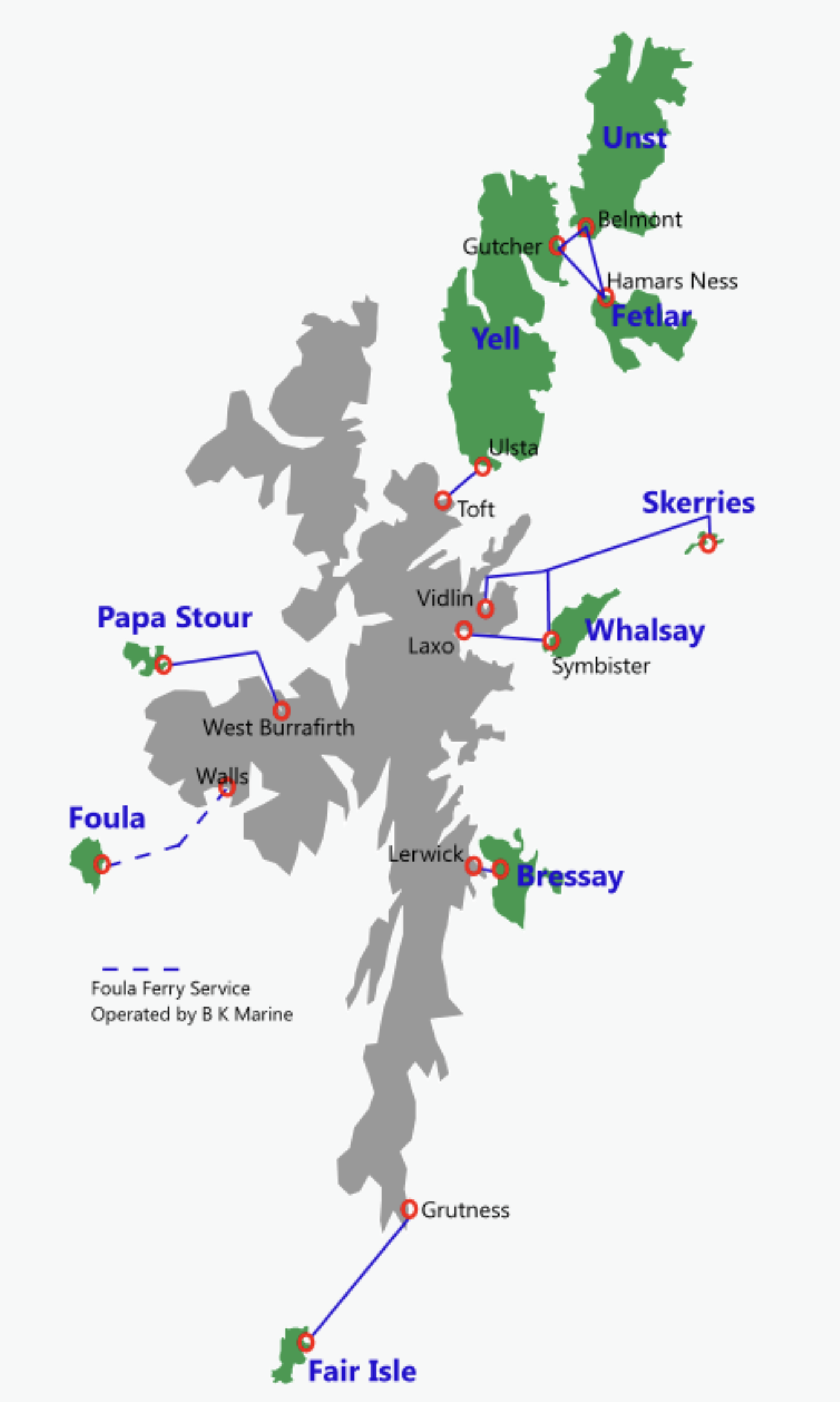
Looking at this map, I would suspect that not all ferries could be replaced by road tunnels.
But if a decision was made to replace ferries with tunnels, thorough cost-benefit analysis would probably show which would be the best value to do first.
These are my further thoughts.
The Faroes
This Google Map shows the Faroes.
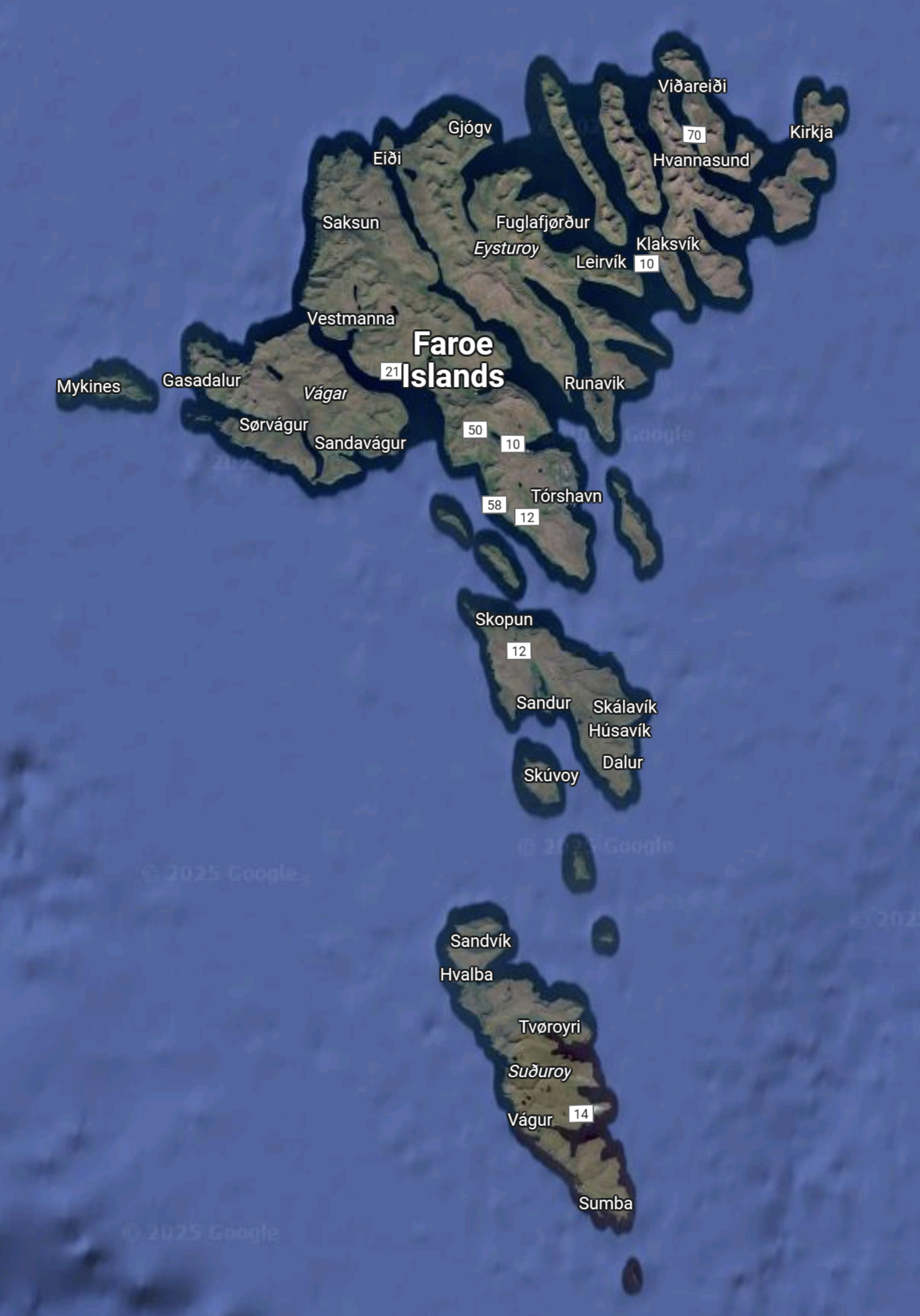
It appears that there may be more land in proportion on the Faroes.
Some Routes Would Not Be Suitable For Tunnels
I would suspect that Grutness and Fair Isle could fall into this category.
These paragraphs on the Shetland web site describe how to get to Fair Isle.
The ferry ‘Good Shepherd IV’ carries 12 passengers and takes 2.5 hours. It leaves from Grutness Pier at the southern tip of Shetland and once a fortnight (summer only) from Lerwick. Please note that this is not a car ferry. View the timetable on the Ferry Services website.
Most flights leave from Tingwall Airport, six miles west of Lerwick, and takes around 25 minutes. The flights operate three times a week and, from April to October, there is also weekly service from Sumburgh (April – Oct). View the timetable on the Airtask website.
Yachts can tie up at the North Haven, with a small nightly charge for use of the harbour.
The Wikipedia entry for the Good Shepherd IV gives more details of the thirty-one year old ferry and its replacement which is due next year, after being funded by the UK Government.
It seems to me that the correct course of action has been taken for the Fair Isle ferry.
Building The Tunnels
These paragraphs from the BBC article, describe how the Faroese tunnels were built and discuss how the same techniques could be used in Shetland.
“It’s about ambition,” says tunnel builder Andy Sloan, whose company worked on part of the Faroese tunnel project.
He adds the islands have led the world “in connecting an archipelago in the middle of the North Atlantic through blood, sweat and tears – and focus.
“They have delivered a remarkable piece of infrastructure,” says Mr Sloan, who is executive vice-president of engineering firm COWI.
It is now advising Shetland Islands Council on the technicalities and financing of tunnels.
The Faroese tunnels were constructed using a technique known as drill and blast – where holes are drilled in rock, explosives are dropped in, and the rubble is then cleared away – which Mr Sloan says could also be used in Scotland.
“Without doubt, Shetland can copy what has been achieved in these islands,” he adds.
I would add, that in recent years, we have successfully built many tunnels in the UK.
At the present time, we are building the 23 mile Woodsmith Mine Tunnel, through rock near Whitby.
This will surely be bigger than anything needed on Shetland.
Haventus, Sarens PSG Unveil ‘On-Land to Launch’ Floating Wind Solution
The title of this post, is the same as that of this article on offshoreWIND.biz.
This is the sub-heading.
UK companies Haventus and Sarens PSG have developed a low-cost solution for the integration and launch of floating offshore wind turbines.
These two introductory paragraphs add more details.
Haventus said that it is working to enable offshore wind project developers to acquire fully assembled floating bases and turbines at Ardersier, Scotland, as well as providing dry storage which does not require complex licensing.
A heavy-lift solution will enable safe on-land integration and launch to the harbour of fully integrated floating offshore wind turbines.
Note.
- Haventus introduce themselves on their web site, as an energy transition facilities provider, offering pivotal infrastructure for the offshore wind industry. The first facility, they are developing is the Port of Ardesier in the North of Scotland, to the North-East of Inverness.
- Sarens PSG introduce themselves on their web site, as specialists in turnkey heavy lifting and transportation solutions for offshore wind component load-in, marshalling, assembly, deployment, and integration.
It looks to me that the two companies are ideal partners to put together flotillas of large floating wind turbines.
These two paragraphs seem to describe the objectives of the partnership.
This should shorten supply chains through single-site sourcing of key components and remove the operational, safety, logistical, and engineering complexity that comes with storage and integration activities in the marine environment.
The companies also said that the solution can also drive down the costs and accelerate floating offshore wind deployment by simplifying transport and installation requirements and remove the obstacles of weather and design life variables that must be considered with ‘wet’ storage and integration.
I was always told as a young engineer to define your objectives first, as you might find this helps with the design and costs of the project.
I do wonder sometimes, if the objectives of High Speed Two smelt too much of a project designed by lots of parties, who all had different objectives.
The Location Of The Port Of Ardesier
This Google Map shows the location of the Port of Ardesier in relation to Inverness, the Orkneys and Shetlands, and Norway.
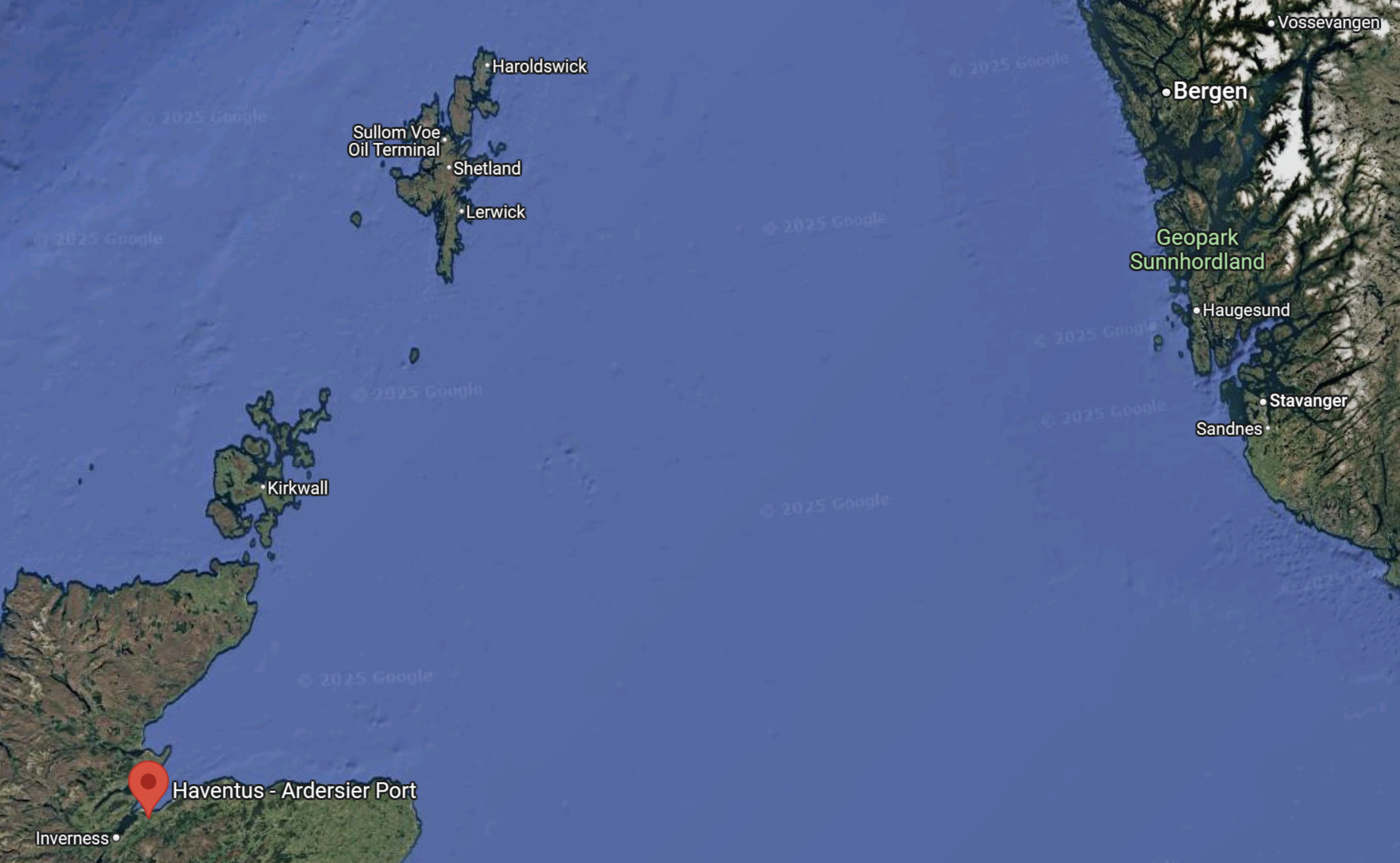
The Port of Ardesier would appear to be ideally placed to bring in business for the partnership.
SaxaVord ‘A Real Spaceport Now’ After First Rocket Explosion
The title of this post, is the same as that of the title of this article on The Times.
This is the sub-heading.
Despite the disappointment of last Monday’s fire engineers remain confident that the Unst site is ready for launch
These are the first two paragraphs.
Nothing could look more ominous for the European space industry than the tower of flame lighting up the skies over Shetland’s SaxaVord spaceport when a prototype engine suddenly and spectacularly caught fire on the launchpad last week.
The blaze was certainly “a nightmare” for the engineers of Rocket Factory Augsburg (RFA), the German company that hoped to conduct its first vertical rocket launch this year.
These are my thoughts and some from the article.
- I can remember a headline of Ike’s Phutnik, in a tabloid, when the United States tried to launch their first satellite.
- The safety systems seem to have worked well and no-one was hurt.
- The Chief Operating Officer of Rocket Factory Augsburg, still seems to have the ambition to make the project succeed.
- The operators are confident that SaxaVord will be ready for the next trials, whenever they are required.
- There is interest from Malaysia, to launch earth observation satellites.
- Scotland also offers other opportunities to southeast Asian tech businesses, as there are no launch sites in the region.
But most importantly, SaxaVord is generating interest from a wide range of users, as this paragraph indicates.
Others have already decided. SaxaVord has struck launch agreements with Lockheed Martin, the US aerospace giant and the German company HyImpulse as well as the UK’s Skyrora. Another four deals with international satellite companies are said to be in the offing.
If an established company were to launch a successful satellite, it could make all the difference to SaxaVord.
Conclusion
These are the last two paragraphs of the article.
Interest on this global scale enables the Scottish space pioneers to shrug off Monday’s blaze and the bad publicity it entailed. For anyone thinking the fire was bad news, emails from colleagues in the US told an altogether different story.
“You’re a real spaceport now,” read one message to a Shetland engineer. “You can’t call yourself a spaceport until you’ve had a rocket blow up!”
I have been to a party at NASA in Houston and they wouldn’t have been as successful, as they have, if they gave up on a failure. They try, try and try again.
‘Windiest Part Of The UK’ Could Power Nearly 500,000 Homes
The title of this post, is the same as that of this article on the BBC.
This is the sub-heading.
Power is flowing from the Shetland Isles to mainland Britain for the first time as the UK’s most productive onshore windfarm comes on stream.
These are the first two paragraphs.
SSE says its 103-turbine project, known as Viking, can generate 443 megawatts (MW) of electricity, enough to power nearly 500,000 homes.
Shetland is the windiest part of the UK, which means it will be rare for the blades, which reach a massive 155m at their tip, not to be spinning.
Note.
- SSE has built a 160-mile long undersea cable to carry the power from Viking to Noss Head, near Wick, on the Scottish mainland.
- The company said it has invested more than £1bn in the windfarm and cable projects.
- SSE plans to plough another £20bn into renewables by the end of the decade.
Companies don’t invest billions and banks don’t lend billions, unless they know they’ll get a return, so the finance for this billion pound project must be sound.
A simple calculation, shows why they do.
- According to Google, the electricity for the average house costs £1926.24 per year.
- 500,000 houses would spend £963,120,000 per year.
Google says this about the life of a wind farm.
The average operational lifespan of a wind turbine is 20–25 years, but some turbines can last up to 30 years.
If the wind farm lasts 25 years, then it will generate something like £24 billion over its lifetime.
It looks to me, that SSE have borrowed a billion and will get almost as much as that back every year.
SSE also have the experience to keep the turbines turning and the distribution network sending electricity to the Scottish mainland.
I have some further thoughts.
What Happens If Scotland Can Get Cheaper Electricity From Its Own Wind Farms?
Shetland’s turbines can be switched off, but that is effectively throwing away electricity that can be generated.
Any spare electricity can also be diverted to an electrolyser, so that the following is produced.
- Hydrogen for transport, rocket fuel for SaxaVord Spaceport and to decarbonise houses and businesses.
- Oxygen for rocket fuel for SaxaVord Spaceport and for fish farms.
Hydrogen may also be exported to those that need it.
Project Orion
Project Orion is Shetland’s master plan to bring all the energy in and around the Shetland Islands together.
This document on the APSE web site is entitled Future Hydrogen Production In Shetland.
This diagram from the report shows the flow of electricity and hydrogen around the islands, terminals and platforms.
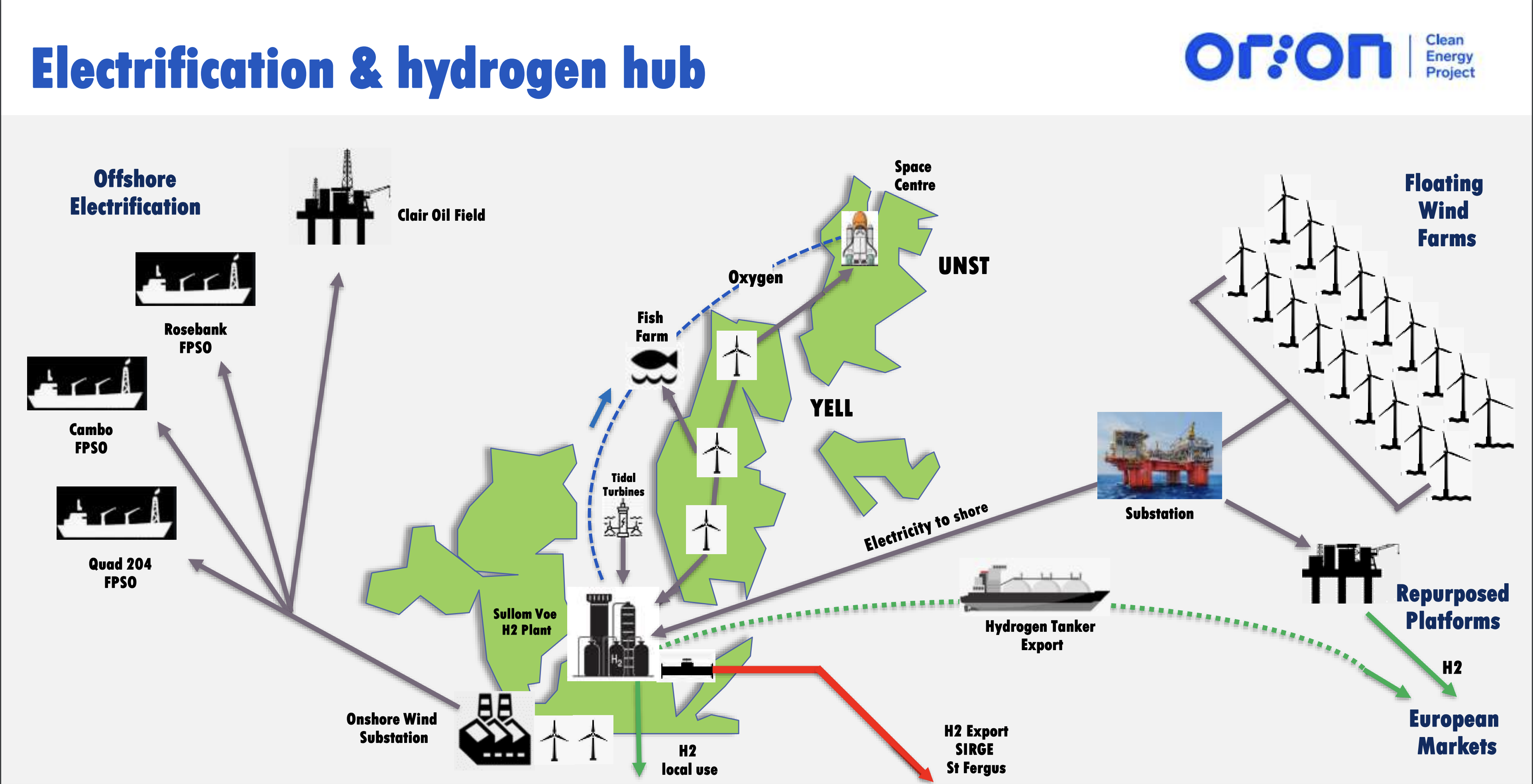
Note these points about what the Shetlanders call the Orion Project.
- Offshore installations are electrified.
- There are wind turbines on the islands
- Hydrogen is provided for local energy uses like transport and shipping.
- Oxygen is provided for the fish farms and a future space centre.
- There is tidal power between the islands.
- There are armadas of floating wind turbines to the East of the islands.
- Repurposed oil platforms are used to generate hydrogen.
- Hydrogen can be exported by pipeline to St. Fergus near Aberdeen, which is a distance of about 200 miles.
- Hydrogen can be exported by pipeline to Rotterdam, which is a distance of about 600 miles.
- Hydrogen can be exported by tanker to Rotterdam and other parts of Europe.
It looks a very comprehensive plan, which will turn the islands into a massive hydrogen producer.
Orion And AquaVentus
This video shows the structure of AquaVentus, which is the German North Sea network to collect hydrogen for H2ercules.
I clipped this map from the video.

Note.
- There is a link to Denmark.
- There appears to be a undeveloped link to Norway.
- There appears to be a link to Peterhead in Scotland.
- There appears to be a link to just North of the Humber in England.
- Just North of the Humber are the two massive gas storage sites of Aldbrough owned by SSE and Rough owned by Centrica.
- There appear to be small ships sailing up and down the East Coast of the UK. Are these small coastal tankers distributing the hydrogen to where it is needed?
In the last century, the oil industry, built a substantial oil and gas network in the North Sea. It appears now the Germans are leading the building of a substantial hydrogen network.
This map is only the start and I feel, there would be nothing to stop the connection of the Orion and AquaVentus networks.
SaxaVord Spaceport
SaxaVord Spaceport is now a reality, in that it licensed and tests are being undertaken.
Meet The British ‘Space Inspectors’ Working For A Safe Blast-Off
The title of this post, is the same as that of this article on the Daily Telegraph.
This is the sub-heading.
A small band of professionals is keeping Britain’s £65 billion space economy in good working order
The article talks about how the Civil Aviation Authority will make sure we boldly go, with a high degree of safety, starting with these three paragraphs.
With Britain’s first vertical launch expected to lift off from Shetland this year, the UK could soon become the go-to European destination for space missions.
But behind the scenes, an army of ‘space inspectors’ is ensuring that, despite reaching for the stars, companies have their feet planted firmly on the ground.
It is the job of the Civil Aviation Authority (CAA) to make sure that things go off with a bang – but only at the right time.
Having lived through all the excitement of space exploration from Sputnik 1 in 1957 onwards.
A few decades ago, when I was in Florida, I saw a launch of the Space Shuttle.
Hopefully, I’ll be lucky enough to get to Shetland or Cornwall to see a space launch from the UK.
The Daily Telegraph article also has this paragraph.
There are more than 2,200 companies working in Britain’s £65 billion space economy from satellite manufacturers to spaceports, from software to observation. The industry has grown significantly in recent years, and is aiming to capture 10 per cent of the global space market by 2030.
I don’t think, the ten-year-old boy, that my father woke in 1957 to tell about Sputnik 1, really ever thought ever thought there would be a chance that he’d see a space launch from the UK.
But now it appears to be happening! Fingers crossed!
Energy / Sullom Voe Terminal To Be Connected To The Grid By The End Of Next Year
The title of this post, is the same as that of this article on Shetland News.
This is the sub-heading.
POWER supply to the Sullom Voe Terminal is set to be provided by two 43-kilometre underground power lines from the Gremista substation by the end of next year.
These four paragraphs outline some of EnQuest’s plans.
The on-site gas-fired power station, operated by Equans, is due to be switched off in the fourth quarter of 2025 as it no longer meets stringent carbon emission standards.
EnQuest, the operator of the terminal, gave an update on its plans for the 1,000-acre site during a Shetland suppliers forum held at Mareel on Wednesday morning.
The company was keen to present itself as one that is seeking collaborative working with the local businesses and the community as Sullom Voe transitions from an oil terminal to a green energy hub.
The company is in the middle of a “right-sizing” project that involves some significant decommissioning of equipment no longer needed to make space for long-term aspiration such as carbon capture and storage, green hydrogen production and offshore electrification.
Note.
- Two underground cables will be coming from Gremista to Sullom Voe.
- Up to seven wind turbines could fit on the site to produce power needed for green hydrogen production.
- Shetland is set to be connected to the UK national grid later this year thanks to a new 600MW HVDC subsea transmission link which will run to Caithness.
- The Sullom Voe power station, once switched off, could be “repurposed” to continue producing energy using clean fuels.
- EnQuest are certainly doing a comprehensive job on the transition.
- It looks to be a well-thought out plan to convert existing oil and gas infrastructure to a modern green asset.
This Google map shows Gremista to Sullom Voe.

Note.
- Sullum Voe is at the top of the map.
- Gremista is marked by the red arrow.
- It looks like the cable could take mainly a straight North-South route.
This second Google map shows Sullum Voe

Note.
- The Sullum Voe terminal is at the top of the map.
- Sullum Voe is a 1,000-acre site.
- In the South-West corner is the closed Scatsta airport.
This third Google map shows Lerwick.
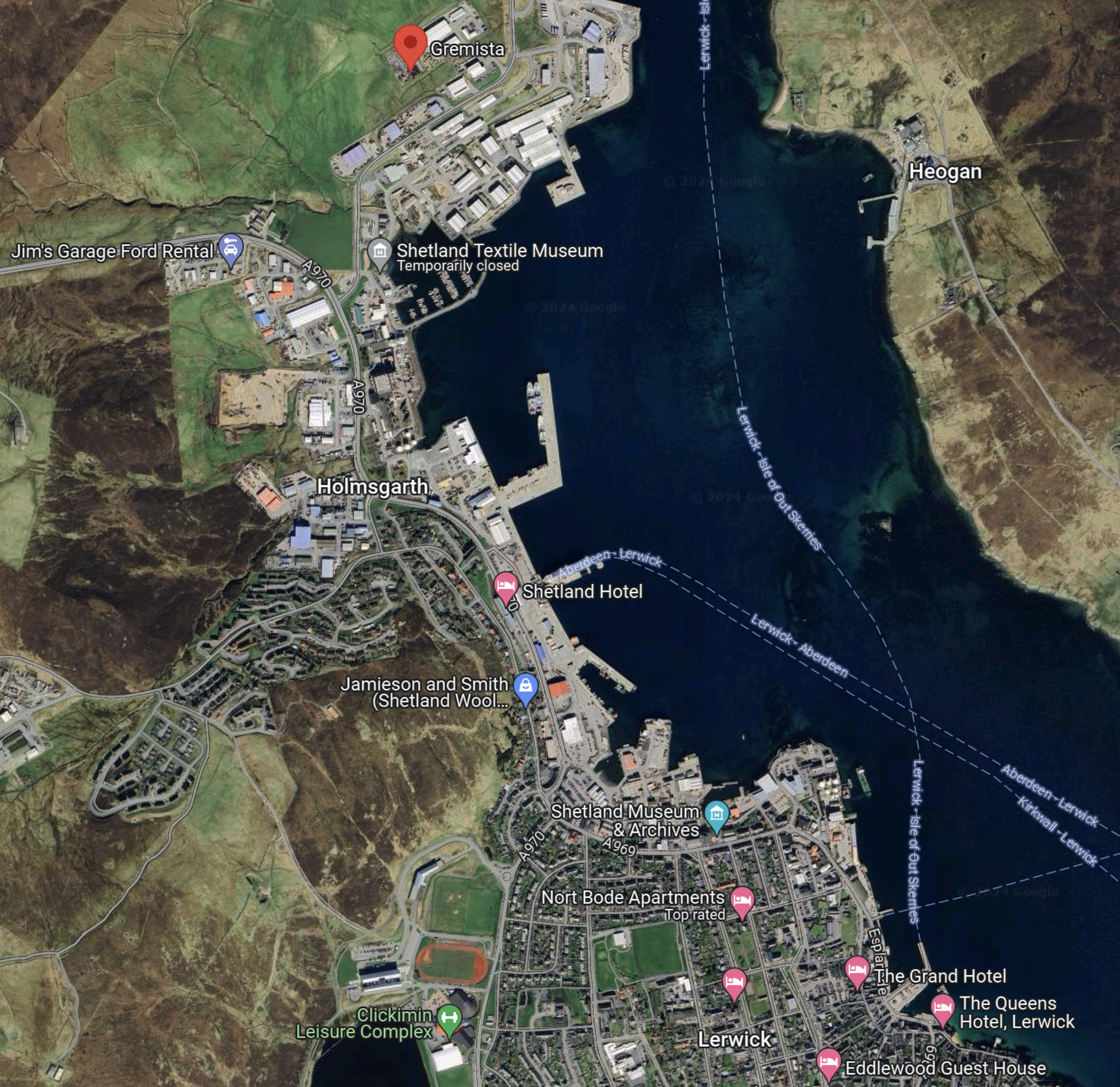
Gremista is marked by the red arrow.
I do have some thoughts.
Scatsta Airport
Consider.
- It takes takes over three hours on a bus between Lerwick and Sullum Voe
- Scatsta Airport only closed in 2020.
Is there an opportunity for an air taxi between Lerwick and Scatsta?
Thoughts On The Future Of Orkney
This article on the BBC is entitled Orkney Votes To Explore ‘Alternative Governance‘
This is the sub-heading.
Orkney councillors have voted to investigate alternative methods of governance amid deep frustrations over funding and opportunities.
These paragraphs outline the story.
Council leader James Stockan said the islands had been “held down” and accused the Scottish and UK governments of discrimination.
His motion led to media speculation that Orkney could leave the UK or become a self-governing territory of Norway.
It was supported by 15 votes to six.
It means council officers have been asked to publish a report to Orkney’s chief executive on options of governance.
This includes looking at the “Nordic connections” of the archipelago and crown dependencies such as Jersey and Guernsey.
A further change which would see the revival of a consultative group on constitutional reform for the islands was accepted without the need for a vote.
My Thoughts On The Economic Future Of The Islands
The economic future of Orkney looks good.
Tourism and the traditional industries are on the up, but the islands could play a large part in renewable energy.
The West of Orkney offshore wind farm, which will be a 2 GW wind farm with fixed foundations, is being developed and a large hydrogen production hub at Flotta is being proposed, along with the development of a large quay in Scapa Flow for the assembly of floating wind farms.
The West of Orkney wind farm could be the first of several.
If the future wind farms are further from shore, they will most likely be based on floating technology, with the turbines and their floats assembled in Scapa Flow, from components shipped in from mainland UK and Europe.
Political Future
With a good financial future assured, I believe that Orkney will be able to choose where its political future lies. It could be a Crown Dependency or join Norway.
Whichever way it goes, it could be an island that effectively prints money, by turning electricity into hydrogen and shipping it to countries like Germany, The Netherlands, Poland and Sweden!
From a UK point of view, a Crown Dependency could be a favourable move.
Would Shetland follow the same route?
Offshore Hydrogen Production And Storage
Orkney is not a large archipelago and is just under a thousand square kilometres in area.
It strikes me, that rather than using up scarce land to host the large electrolysers and hydrogen storage, perhaps it would be better, if hydrogen production and storage was performed offshore.
Aker Northern Horizons
In Is This The World’s Most Ambitious Green Energy Solution?, I talk about Northern Horizons, which is an ambitious project for a 10 GW floating wind farm, which would be built a hundred kilometres to the North-East of Shetland, that would be used to produce hydrogen on Shetland.
Other companies will propose similar projects to the West and East of the Northern islands.
This map shows the sea, that could be carpeted with armadas of floating wind farms.

Consider.
- There are thousands of square miles of sea available.
- As the crow flies, the distance between Bergen Airport and Sumburgh Airport in Shetland is 226 miles.
- A hundred mile square is 10,000 square miles or 2590 square kilometres.
- In ScotWind Offshore Wind Leasing Delivers Major Boost To Scotland’s Net Zero Aspirations, I calculated that the floating wind farms of the Scotwind leasing round had an energy density of 3.5 MW per km².
- It would appear that a hundred mile square could generate, as much as nine GW of green electricity.
How many hundred mile squares can be fitted in around the UK’s Northern islands?
Orkney Council To Look At Proposals To Become Territory Of Norway
The title of this post, is the same as that of this article on the BBC.
This is the sub-heading.
The Orkney Islands could change their status in the UK or even become a self-governing territory of Norway under new proposals.
These paragraphs outline their possible strategy.
A motion will go before the council next week to investigate “alternative forms of governance”.
Council leader James Stockan said Orkney does not get fair funding with its current relationship within the UK.
He wants to look at Crown Dependencies like the Channel Islands and overseas territories like the Falkland Islands.
He suggested another possible future could be like the Faroe Islands – which is a self-governing territory of Denmark.
Councillor Stockan told BBC Radio Scotland there were many areas where Orkney was being “failed dreadfully” by both the UK and Scottish governments.
These are my thoughts.
Has Orkney Been Failed Dreadfully By The UK And Scottish Governments?
I wouldn’t be surprised, if the legal and economic framework between the Orkney, Scotland and the UK, dates back hundreds of years and didn’t really expect to see a more independent Scotland.
This is a quote from Council leader James Stockan.
And the funding we get from the Scottish government is significantly less per head than Shetland and the Western Isles to run the same services – we can’t go on as we are.
I could argue, they should be similar.
Orkney’s Income From Oil, Gas And Wind
Orkney doesn’t have Shetland’s oil, gas and wind infrastructure, so perhaps Scotland and the UK, think Orkney is the other’s problem.
Wind Development In Orkney, Shetland And The Western Isles
This map from Cross Estate Scotland shows all the wind contracts for Orkney, Shetland and The Western Isles.

These wind farms could send wind power to Orkney.
- 7 – Ayre – 1008 MW
- 13 – West of Orkney – 2000 MW
That is a total of 3008 MW.
These wind farms could send wind power to Shetland.
- 18 – Ocean Winds – 500 MW
- 19 – Arven – 1800 MW
- 20 – ESB Asset Development – 500 MW
That is a total of 2800 MW.
These wind farms could send wind power to the Western Isles.
- 14 – Havbredey – 1400 MW
- 15 – N3 Project – 495 MW
- 16 – Spiorad na Mara – 840 MW
That is a total of 2735 MW.
On this quick look, it does appear that there is a fair balance of investment in wind power between Orkney, Shetland and The Western Isles.
The Flotta Hydrogen Hub
The Flotta Hydrogen Hub is being planned and it has its own web site.
It looks like it will be linked to the West of Orkney wind farm.
The Ferries
CouncilStockan says this about the ferries.
We are really struggling at the moment, we have to replace the whole ferry fleet which is older than the CalMac fleet.
And it is well-known, that the Scottish Nationalist Party got into a muddle with ferries.
Conclusion
If you read the Wikipedia entry for Orkney, the islands would appear to have a sound future, based on hydrogen, tourism and wind.
I would hope that a discussion around some good local food and the local whisky could sort out Otkney’s worries.
Green Hydrogen Project Win
The title of this post, is the same as that of this news item from Nova Innovation.
These are the first two paragraphs.
Nova and consortium partners The University of Strathclyde, Shetland Islands Council and Ricardo Energy, have been awarded funding from the Scottish Government’s Emerging Energy Technologies Fund – Hydrogen Innovation Scheme for their GHOST project.
The GHOST project (Green Hydrogen and Oxygen Supply from Tidal Energy) will look at the potential of producing green hydrogen and oxygen from Nova’s tidal energy projects in Shetland.
They plan to generate hydrogen from tidal energy around the island of Yell. The oxygen, which is often just released into the air, will be used in aquaculture and possibly as rocket fuel at SaxaVord Spaceport.
This map shows Shetland.
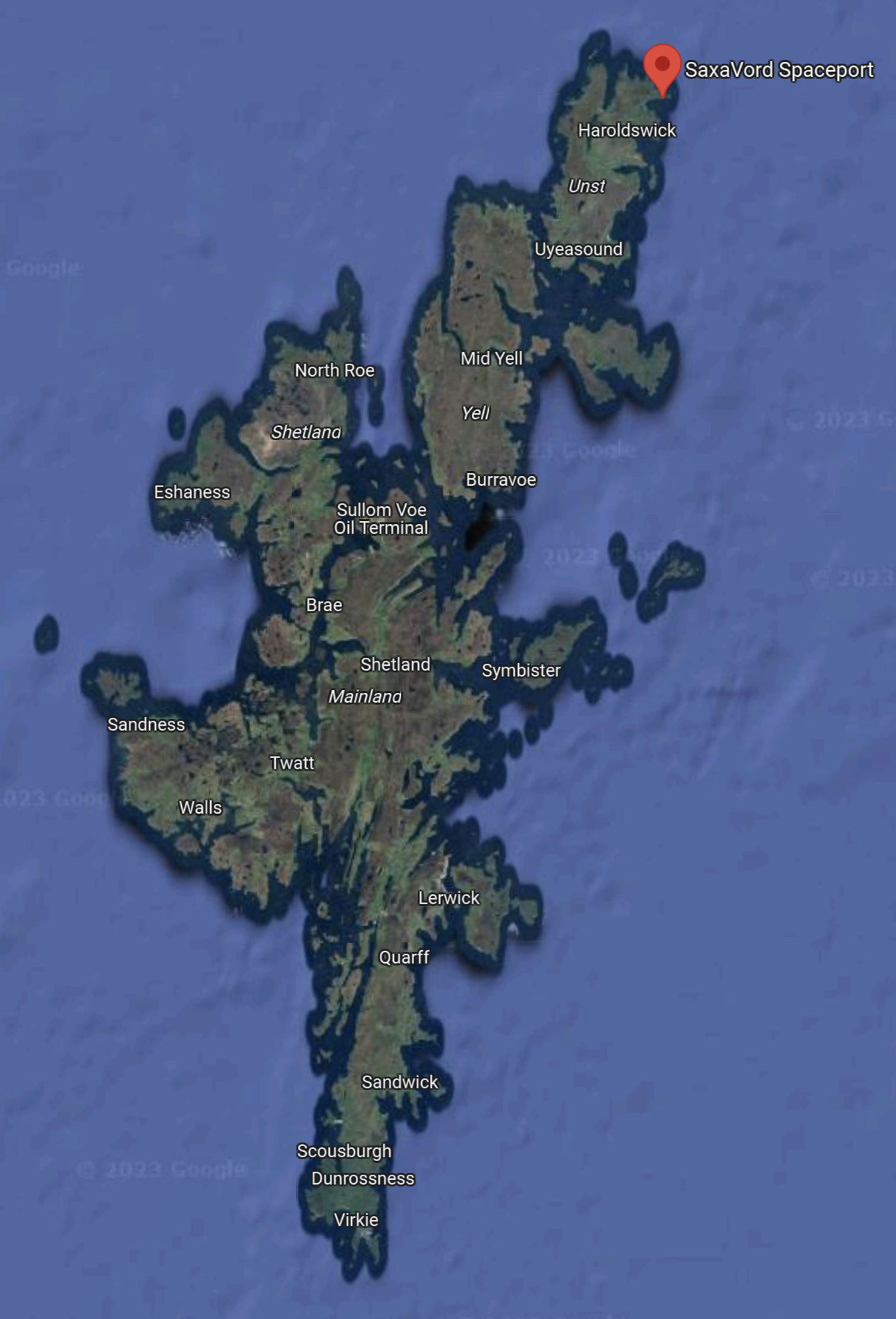
SaxaVord Spaceport is marked by the red arrow at the North end of the archipelago on the island of Unst and Yell is the next island to the South.
If GHOST is successful, it looks like they will have a ready market for their fuel.
Irish ESB Joins Northland Power On Two Scottish Offshore Wind Projects
The title of this post, is the same as that of this article on offshoreWIND.biz.
This is the sub-heading.
ESB will acquire a 24.5 per cent interest in Northland Power’s ScotWind projects, the fixed-bottom offshore wind farm Spiorad na Mara and the floating wind project Havbredey. Northland will retain 75.5 per cent in each project and continue to lead their development, construction, and operation
This is the first paragraph.
The companies have signed definitive agreements on ESB’s purchase of project stakes, with all commitments made prior to the agreements to remain in place.
Last month, I wrote ESB Invests In Floating Offshore Wind Mooring Tech. so are they in acquisitive mode?
This map from Cross Estate Scotland shows all the ScotWind contracts.
ESB now lrasr the following stakes in ScotWind.
Their details are as follows.
- 14 – Havbredey – Floating – 1500 MW – 25 %
- 16 – Spiorad na Mara – Fixed – 840 MW – 25 %
- 20 – Unnamed – Floating – 500 MW – 100 %
These figures mean they lease about a GW.
I have my thoughts.
Will There Be A Multi-Purpose Interconnector between Ireland And Scotland?
Nothing has been mentioned yet, but could new wind farms om the future to the West of the Hebrides be connected to both the North of Scotland and the North of Ireland by a multi-purpose interconnector?
 The Anonymous Widower