US Judge Overturns Trump’s Ban On Wind Energy Project Permits
The title of this post, is the same as that of this article on offshoreWIND.biz.
This is the sub-heading.
A federal judge has struck down the US President Donald Trump’s indefinite halt of all federal approvals and permitting for new wind energy projects.
Trump is obviously very strong in his opposition to wind power, as he issued the ”Wind Order” on his first day back in office.
He received this robust reply from Oceantic Network CEO Liz Burdock.
Today’s decision is welcome news, not just for the thousands of American workers and businesses across 40 states supporting offshore wind in the U.S., but also for the critical relief the wind industry will provide to lower skyrocketing electricity prices for millions of American families with reliable, affordable power.
Overturning the unlawful blanket halt to offshore wind permitting activities is needed to achieve our nation’s energy and economic priorities of bringing more power online quickly, improving grid reliability, and driving billions of new American steel manufacturing and shipbuilding investments. We thank the Attorneys General and the Alliance for Clean Energy New York for taking this case forward to protect American business interests against the politicization of our energy sector.
I don’t think we’ve heard the last of this legal argument.
UK’s ‘Largest’ Floating Solar Farm Given Go-ahead
The title of this post, is the same as that of this article on the BBC.
This is the sub-heading.
A floating solar farm described as the UK’s largest is to be built in the north of England after planning permission was approved.
These three paragraphs add more details.
The 46,500-panel array will be installed at the Port of Barrow’s Cavendish Dock in Cumbria and will be capable of producing enough energy to power 14,000 homes a year.
It will be built by Associated British Ports (ABP) and will be used to power the area’s advanced manufacturing sector, including submarine-maker BAE Systems.
The company’s divisional port manager Bryan Davies said the solar farm would “drive economic growth” and was a major milestone in the company’s plans to develop Port of Barrow.
This Google Map shows Cavendish Dock in the centre of Barrow-in-Furness.
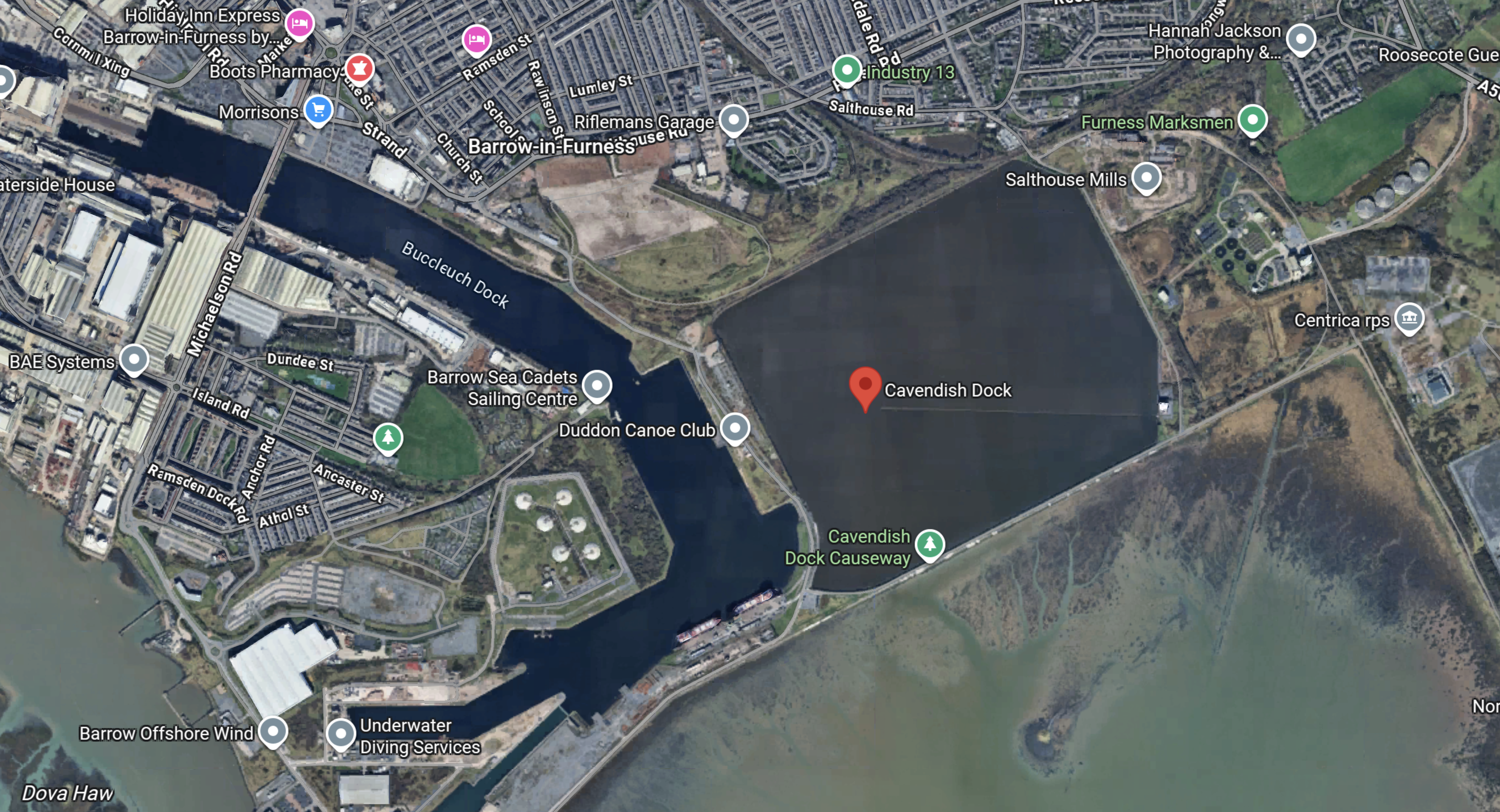
Note.
- BAe Systems are in the West side of the map.
- It looks like the picture on the BBC article was taken from the East.
- In the picture the Cavendish Causeway runs across the bottom-left Corner.
- The solar array appears to be in the North side of the dock.
The solar array will be an impressive structure, when it is complete.
SNP Ban On ‘Munitions’ Funds Puts Scottish Shipbuilding On The Line
The title of this post is the same as that of this article on The Times.
This is the sub-heading.
The president of Rolls-Royce submarines says plans for a world-class welding centre on the Clyde are at risk of being cancelled within days
These three paragraphs add more details to the story.
Ambitious plans to reverse a historic decline in Scottish shipbuilding are at risk after a £2.5 million taxpayer grant was axed due to an SNP ban on “munitions” funding.
A plan to build a specialist welding centre on the banks of the Clyde is now in grave doubt after Scottish Enterprise, the national economic development agency, was accused of reneging on a pledge to fund a building for the world-class facility.
Rolls-Royce, which is ready to support the project by providing £11 million worth of specialist equipment, expressed “dismay” at the news, saying the project had been classified as a “munitions” scheme solely on the basis that it would “support the construction of naval vessels”.
Given the experience of the Scottish Government in building ferries is documented in this Wikipedia entry, which is entitled Scottish Ferry Fiasco, the SNP must know something about how not to build ships.
The comments from readers of the Times Article are scathing, with many coming from those with Scottish names.
Welding And Nuclear Power
It doesn’t mention the other big use for welding in this article and that is in the manufacture of nuclear reactors. In fact one of the members of the Rolls-Royce consortium, that will build their small modular nuclear reactors is The Welding Institute – No prizes for guessing what they do!
Does that mean that Scotland won’t have anything to do with small modular nuclear reactors? Either in their manufacture or use.
This article in New Civil Engineer is entitled UK Plans New Nuclear Plant In Scotland Despite Scottish Government Opposition.
So if the Scottish Government wants nothing to do with making expensive, quality vessels for the nuclear industry, Rolls-Royce would surely be better building the welding centre in an area of the UK that would appreciate it.
Scots In High Positions Of Power
I like Scotland and the Scots and possibly, at one time, with all the North Sea Oil and Gas, I could have thought about relocating North of the Border. But I’m very glad I didn’t!
It does seem to me though, that when some Scots get to high positions of power, that they lose all sense of reason.
I would nominate.
- Fred the Shred
- The SNP
- That half-Scot, who was lucky enough to be elected US President twice.
There must be a few others.
Cammell Laird To Study Market Opportunities For UK-Built SOVs
The title of this post, is the same as that of this article on offshoreWIND.biz.
This is the sub-heading.
The Offshore Renewable Energy (ORE) Catapult, in partnership with the National Shipbuilding Office and The Crown Estate, has appointed Cammell Laird, part of APCL Group, to carry out a detailed analysis of the future market opportunity for UK-built service operation vessels (SOVs) for offshore wind.
These two paragraphs explain the plan.
According to an ORE Catapult analysis, hundreds of SOVs will likely be in operation worldwide in the coming years as global offshore wind capacity is expected to grow to over 850 GW by 2050. To support the capacity expansion, the global SOV fleet will need to grow as well, with an associated global market of nearly GBP 35 billion (approximately EUR 41.6 billion) expected between now and 2050.
The UK SOV Manufacturing Business Case Development study for which Cammell Laird has been commissioned will help to develop knowledge of how the UK can provide vessel manufacturing to support offshore wind, delivering jobs and economic investment to communities around the country, according to ORE Catapult.
These are my thoughts.
Cammell Laird Are Also To Build A New Mersey Ferry
I wrote about this in Sail Into The Future In Style With Super-Realistic Virtual Tour Of The New Mersey Ferry.
I wouldn’t put it past Liverpool, to use one of the City’s famous icons to sell UK-built service operation vessels (SOVs) for offshore wind.
Will Rolls-Royce Get Involved?
In Rolls-Royce Powers World’s Fastest Offshore Crew Transfer Vessels, I describe how Rolls-Royce mtu are providing powerful engines for Italian Crew Offshore Vessels.
Will Rolls-Royce mtu provide the power for Cammell Laird’s service operation vessels?
Sail Into The Future In Style With Super-Realistic Virtual Tour Of The New Mersey Ferry
The title of this post is the same as this page on the Liverpool Region web site.
These five bullet points act as sub-headings.
- Immersive, interactive VR tour offers stunning detail of new Mersey Ferry
- Vessel designed to reflect Mersey Ferries’ world-famous new vessel will feature event spaces, bars, bike storage and improved accessibility
- Offers world-class experience to passengers and unique, stylish venue for conferences and private events
- Built by Cammell Laird and part of £26m investment in modernising ferries
- Due to set sail in summer 2026
Good to see, that it will be a locally-built ferry.
The current ferries were there, when I first went to the city in the 1960s.
Click here to take a tour on the new vessel.
Rolls-Royce Powers World’s Fastest Offshore Crew Transfer Vessels
The title of this post, is the same as that of this news item from Rolls-Royce.
These three bullet points, act as sub-headings.
- Sea trials demonstrate maximum speed exceeding 53 knots under operational load.
- Each of the three ships is powered by four 16-cylinder mtu Series 2000 engines.
- 35-meter ships are designed as “Surface Effect Ships” (SES)
This is the introductory paragraph.
The Singapore shipbuilder Strategic Marine has commissioned three new offshore supply vessels that, with a maximum speed of over 53 knots, are the fastest of their kind in the world. Each vessel is powered by four 16-cylinder mtu Series 2000M72 engines from Rolls-Royce. The vessels will be used by a national oil company in Africa for passenger transfer to offshore platforms. To enable fast and safe transfer, the 35-meter-long vessels were designed as so-called “Surface Effect Ships”.
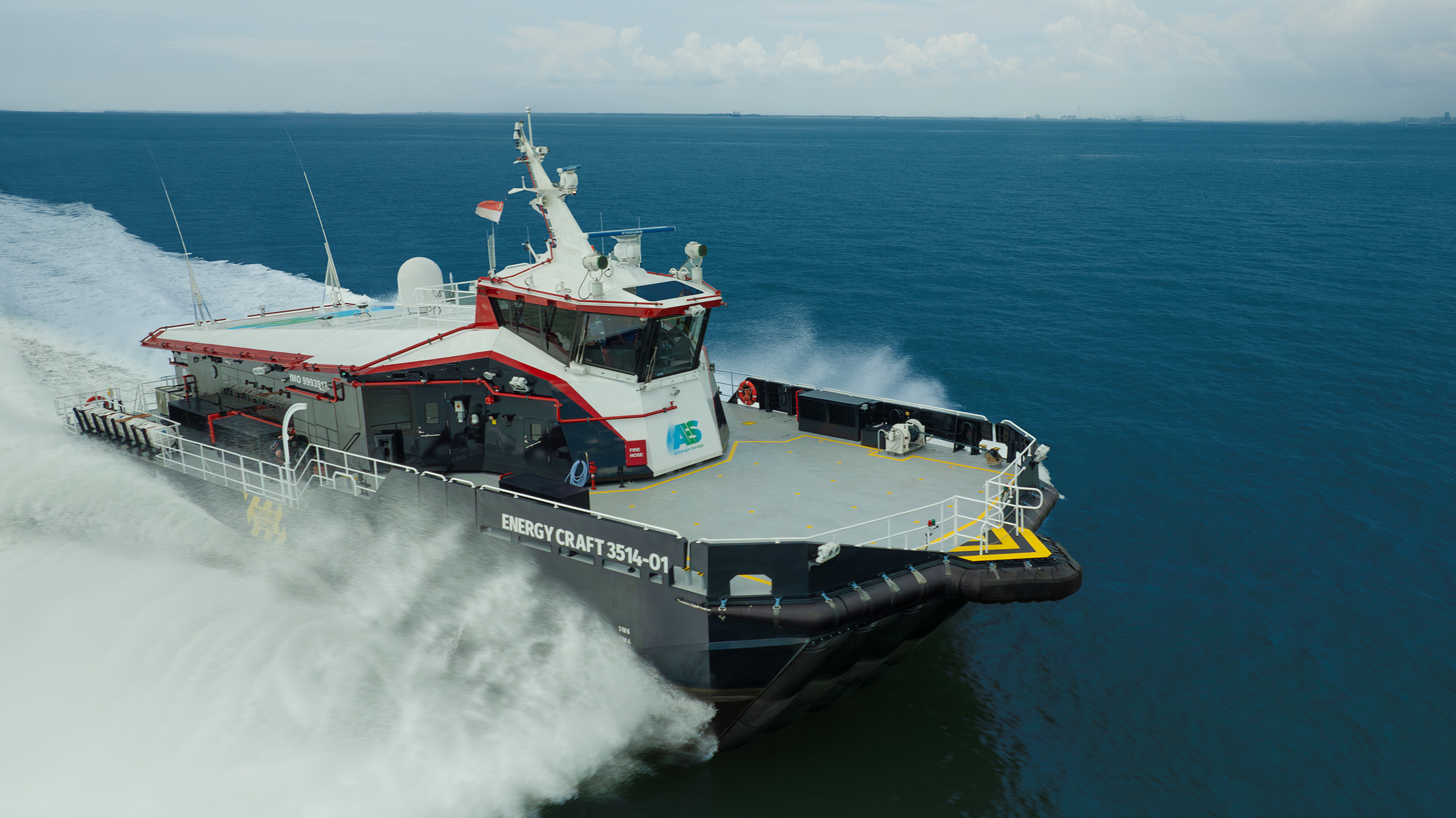
This Rolls-Royce image shows one of the Crew Transfer Vessels at 50 knots.
On a slightly different tack, this Rolls-Royce image shows The Spirit of Innovation.

Rolls-Royce described it in this press release which is entitled ‘Spirit of Innovation’ Stakes Claim To Be The World’s Fastest All-Electric Vehicle, using these words.
During its record-breaking runs, the aircraft clocked up a maximum speed of 623 km/h (387.4 mph) which we believe makes the ‘Spirit of Innovation’ the world’s fastest all-electric vehicle.
I’ve probably been over 1,300 mph in Concorde.
So are the three offshore supply vessels, the fastest of their kind in the world?
This video shows one of the Crew Transfer Vessels doing, what they are intended to do.
Rolls-Royce seem to be borrowing a philosophy from their past, where they showed in the Schneider Trophy, just what their engines could do.
These two paragraphs describe the design of the Crew Transfer Vessels.
To enable fast and safe passenger transfer to offshore platforms, the 35-meter-long vessels have been designed as so-called “Surface Effect Ships” (SES). SES uses air-cushion technology within a catamaran hull form. This design was used for the first time in the offshore oil and gas industry.
The boats have an optimized power-to-weight ratio and use powerful fans to generate an air cushion between the hulls that minimizes hull drag and resistance. Combined with the mtu propulsion package (each delivering 5,760 kW of power), the vessels can travel at much higher speeds than conventional monohulls and catamarans, with consumption remaining at the same per hour of operations. The high speed of well over 50 knots (more than 90 km/h) ensures shorter transit times, while the low hull resistance saves fuel and reduces emissions.
I believe, that the Rolls-Royce mtu diesel engines used in these vessels can also be fueled by hydrogen, so is that the next development?
Could we be seeing hydrogen-powered fast ferries on short sea routes around the world?
Flotation Energy, Cobra File Onshore Planning Application For 100 MW Celtic Floater
The title of this post, is the same as that of this article on offshoreWIND.biz.
This is the sub-heading.
Flotation Energy and Cobra have submitted an onshore planning application to North Devon Council for their 100 MW White Cross floating offshore wind farm in the Celtic Sea.
These two paragraphs outline the project.
The proposed White Cross floating offshore wind farm will feature six to eight floating wind turbines installed some 52 kilometres off the North Devon coast.
The project’s associated cable route is proposed to make landfall at Saunton Sands, connecting to the electricity grid at the East Yelland substation.
The wind farm has its own web site.
This Google Map shows Saunton Sands and the village of Yelland
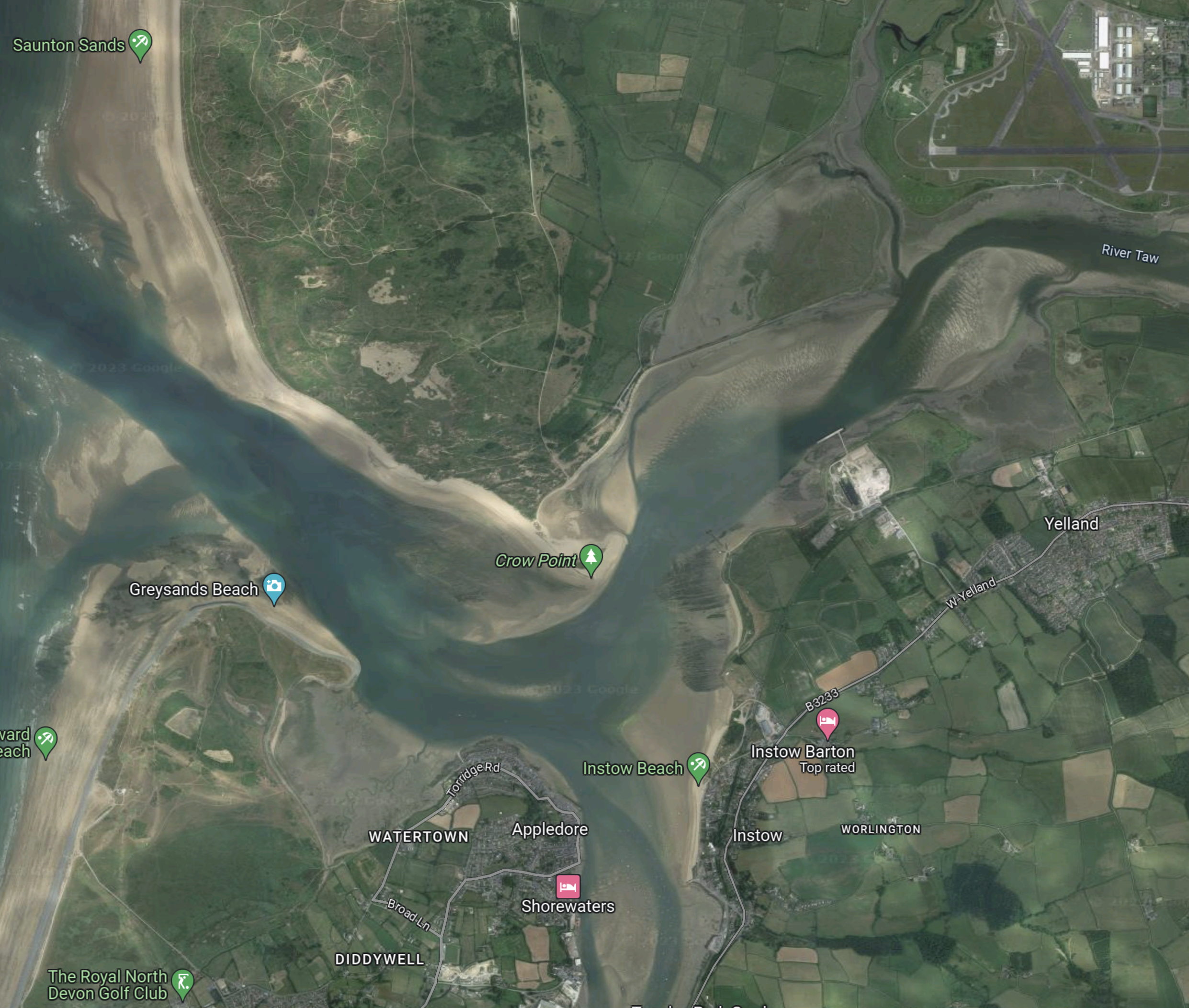
Note.
- Saunton Sands is indicated by the green marker in North-West corner of the map.
- Yelland is in the middle of the Eastern side of the map.
- I suspect there are innovative ways to connect the White Cross wind farm to the substation at East Yelland.
- The town of Appledore is on the estuary at the bottom of the map.
This second Google Map shows the town of Appledore.
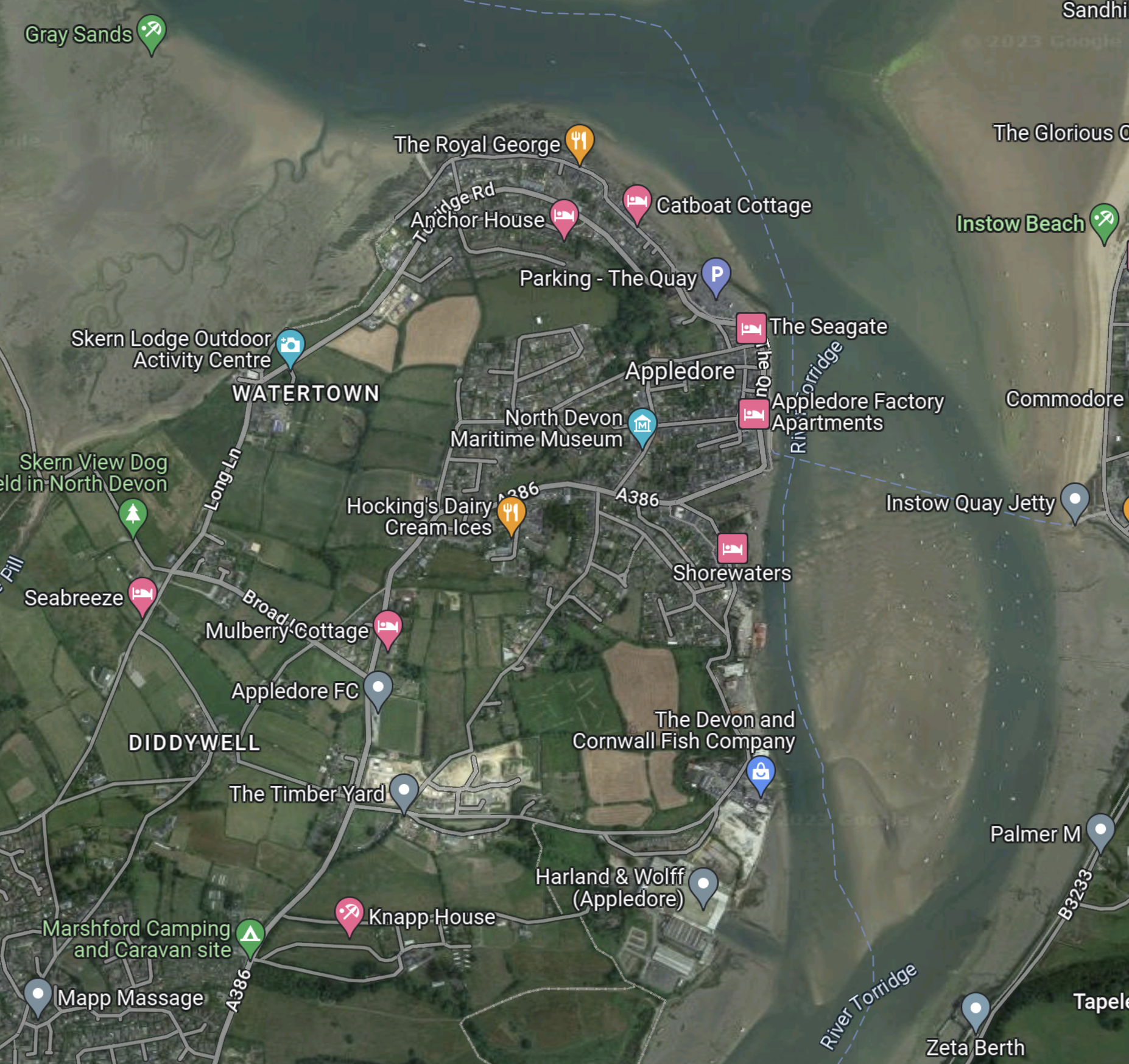
At the bottom of the map is a marker labelled Harland & Wolff (Appledore).
Harland & Wolff (Appledore) has a web site, with these introductory paragraphs.
Located in North Devon at the mouth of the River Torridge, Harland & Wolff (Appledore) has a rich history of shipbuilding. More than 300 vessels have been built here including military craft, bulk carriers, LPG carriers, superyachts, ferries, and oil-industry support vessels.
The site features a 119m long covered drydock as part of the main building yard as well as the adjacent repair, commissioning and outfitting quay.
The Appledore Yard was founded in 1855. It constructed elements of the two Queen Elizabeth class aircraft carriers, bow sections for HMS Queen Elizabeth and built two Róisín class patrol boats for the Irish Naval Service.
The web site then lists an impressive list of facilities, which it underlines with this statement.
An expert team that is perfectly positioned to support the needs of the shipping and offshore industry.
I wouldn’t be surprised to see that Harland & Wolff (Appledore) will bid for the eight floaters for White Cross wind farm.
US Offshore Wind Pipeline Blows Past 51 GW, Report Says
The title of this post, is the same as that of this article on offshoreWIND.biz.
This is the sub-heading.
The American Clean Power Association (ACP) has released a report on the US offshore wind market, outlining a rapidly growing pipeline of projects across 32 leases totaling 51,377 MW of expected capacity which is enough to power the equivalent of more than 20 million homes.
The American wind market seems to be powering ahead.
If the pattern of offshore oil and gas from the last century, repeats itself, there’s going to be a lot of money made and jobs created.
The report talks of the following.
- 83,000 jobs by 2030.
- $25 billion of economic output.
- Thirty new ships built in domestic shipyards.
Are we geared up for proportionate numbers in the UK?
A Massive Task For Ukraine?
After the Russians are thrown out of Ukraine, it will be a massive task to rebuild Ukraine.
But one of Ukraine’s traditional industries can also be used to transform the world.
The Transformation Of Energy Production To Floating Offshore Wind
I believe that over the next few years, we will see an enormous transformation of zero-carbon energy to floating offshore wind.
- The floating offshore wind industry is planning to use the next-generation of larger wind turbines of up to 20 MW.
- These turbines are too large and intrusive to install onshore.
- Floating wind turbines generally have a higher capacity factor of over 50 %, than onshore turbines.
- Each wind turbine will be mounted on a substantial semi-submersible float, which is built out of large-diameter steel tubes
- The wind turbines are of the same design, as those installed onshore.
- There are several designs for the floats and they are usually based on designs that have worked in the oil and gas industry.
The world will need millions of floating turbines and an equivalent number of floats to fully decarbonise.
Could The Ukrainians Build The Floats?
Consider.
- The Russians have destroyed Mariupol, whilst the Ukrainians have defended the city in the steelworks.
- Mariupol used to have a large shipbuilding industry.
- Ukraine is in the world’s top ten of iron ore producers.
- There is a lot of scrap steel available in the Ukraine, that the Russians have left behind.
- The Ukrainians probably have a lot of workers, who have the skills to build the floats.
I’m sure something could be arranged for the benefit of everybody.
 The Anonymous Widower