It is also one of the best articles, I’ve read on the economics of liquid-air energy storage.
This is the sub-heading.
An overlooked technology for nearly 50 years, the world’s largest liquid air energy storage facility is finally set to power up in 2026. It’s hoping to compete with grid-scale lithium batteries and hydro to store clean power, and reduce the need to fall back on fossil fuels.
These three introductory paragraphs add detail to the project.
As the world’s use of renewable electricity soars, surpassing coal for the first time, the need to store that energy when the Sun isn’t shining and the wind isn’t blowing is growing in step. While some turn to grid-scale lithium batteries and others to pumped hydro, a small but growing industry is convinced there’s a better solution still: batteries that rely on air.
Near the village of Carrington in north-west England, the foundations are being laid for the world’s largest commercial-scale liquid air energy storage facility, one of the first of its kind. The site will eventually become an array of industrial machinery and a number of large storage tanks, filled with air that has been compressed and cooled so much it has become a liquid, using renewable energy surplus to demand. The stored energy can be discharged later when demand exceeds supply.
If the project succeeds, more will follow. The site’s developers Highview Power are confident that liquid air energy storage will make it easier for countries to replace fossil fuels with clean renewable energy – though at present, the technology is expensive. But as the need for clean energy storage surges, they’re betting the balance will tip in favour of liquid air.
The BBC article, seems to have been written with input from Shaylin Cetegen, a chemical engineer at the Massachusetts Institute of Technology (MIT), who studies energy storage systems.
Topics discussed include.
The intermittency problem of renewables and how this gives problems for the stability of electricity grids.
The switchable nature of fossil-fuel power generation.
A big part of the solution is to store the surplus energy so that it can be released when it’s needed. Think of it like an electricity deposit account!
For decades, the main form of energy storage has been pumped hydro. In 2021, the world had 160 GW of pumped hydro capacity. The UK has a total of just 3 GW in Scotland and Wales! But more is on the way!
Recently, large-scale battery storage systems have risen to the challenge and installed capacity has risen from 55.7 GW in 2023 to 150 GW / 348 GWh in 2025.
The liquid air solution is then explained.
A grid-scale stop-gap, that is the 30 MW/300 MWh Manchester hybrid liquid-air battery, is then described.
In August 2026, the battery is set to begin operating.
An alternative way of stabilising the grid will be provided.
It will come online in two stages, says Highview Power CEO Richard Butland.
Then in 2027 the liquid air storage is expected to begin fully operating.
Highview Power will make money by trading electricity, as pumped storage operators do.
The penultimate section of the article looks at the bottom line and comes to these conclusions.
Instead, she says governments could support the technology. In her study, subsidising the initial capital costs to set up the systems “could be a viable approach to achieve economic viability in the short term”, she says.
Furthermore, faster uptake of renewables would increase energy price volatility, making energy storage more economically viable.
Cetegen makes a final point in favour of liquid air energy storage: it’s cheap. Energy storage technologies are often assessed using a metric called the “levelised cost of storage”, which estimates how much each unit of stored energy costs over the lifespan of the project. For liquid air, this can be as low as $45 (£34) per megawatt-hour – compared to $120 (£89) for pumped hydro and $175 (£130) for lithium-ion batteries.
“While none of these storage methods are likely economically viable right now without policy support, liquid air energy storage stands out as a particularly cost-effective option for large-scale storage,” Cotegen says.
Ultimately, Butland expects electricity grids to rely on a mix of storage technologies. Pumped hydro is extremely effective and works for decades, but it’s location-dependent because it needs a water supply. Meanwhile, batteries are highly efficient and can be placed anywhere, but need to be replaced after about 10 years. Liquid air has the advantage that it can store energy for longer than batteries, with minimal losses.
As any country enters the green transition, its electricity grid needs to be remodelled to cope. “We’re rebuilding all grids globally, based on new generation,” says Butland. And that could well mean a lot of liquid air energy storage.
As part of the reset, NextEnergy said it will increase its energy storage exposure up to 30% of its gross asset value, a significant increase on its current rate of 10%.
These two paragraphs give more of their reasoning.
NextEnergy Solar Fund has completed a “strategic reset” of its investment strategy which will see it focus on energy storage assets and increase project sales.
As part of the reset, NextEnergy said it will increase its energy storage exposure up to 30% of its gross asset value, a significant increase on its current rate of 10%. The company said the shift would “enhance the Company’s existing stable revenues generated by its operational solar assets and support future revenues”.
A 5 MW/20 MWh Highview Power liquid-air CRYObattery.
Do Sumitomo Heavy Industries believe that a combination of energy and/or battery sources working together gives the quality of stable power, that is needed by today’s modern factories, facilities and buildings?
As a Graduate Control Engineer, I very much believe stable power supplies are a good thing and Sumitomo Heavy Industries obviously feel that Highview Power’s liquid air CRYObatteries are a good way to provide them.
The adding of a battery into a solar-powered renewable power supply, would surely, increase the amount of batteries that NextEnergy were financing.
I asked Google AI the question in the title of this post and received this comprehensive answer.
Charging a full garage of electric buses requires massive amounts of electricity, with typical, non-optimized charging for a 100-bus depot capable of drawing nearly 10 megawatts (MW) of power. To put this into perspective, a 100-bus depot might require roughly 150 Megawatt-hours (MWh) of energy to recharge over an eight-hour night.
Key Factors and Energy Requirements
Energy Consumption per Bus: A typical electric bus has a battery capacity between 300-500 kWh. Energy consumption averages around 1.11 to 1.35 kWh/km, with higher consumption in winter or with heavy A/C use.
Total Depot Power: For a 100-bus depot, power requirements can reach 10 MW, equivalent to the power output of a small hydroelectric dam.
Optimal Charging: Using smart charging, a 100-bus depot can reduce its peak demand to around 4 MW.
Daily Usage: A single, large electric bus can consume up to 500 kWh per day, with daily demand ranging from 189 to 231 kWh for typical operations.
Infrastructure and Grid Considerations
Charging Infrastructure: Depots often use 40 kW to 250 kW chargers, with 100 kW common for overnight charging.
Grid Capacity: A 34-bus depot might require a new 1000kVA transformer to handle the load.
Voltage: 11,000 volts may be required to power new substations, which are then stepped down to 400 volts for charging.
Operational Factors Affecting Energy Need
Heating and Cooling: Cold weather can increase energy consumption by up to 45% (due to electric heating).
Driving Style: Inefficient driving can increase energy consumption by 0.24 kWh/km above average.
Regenerative Braking: This can recover 37–40% of energy for 40-60 ft buses.
Cost Implications
Energy Bills: A 100-bus depot can incur monthly energy bills between $112,000 and $515,000 without optimization.
Cost Savings: Electric buses are generally cheaper to fuel, costing ~£0.21/mile compared to £0.49/mile for diesel.
Could A System Based On The Sumitomo/Highview Power System At Hiroshima Charge Electric Buses?
The optimal charging figure for a 100-bus garage would appear to be in the region of 4-5 MW.
I also state in the post, that the Hiroshima facility is designed to support grid stability and enhance renewable energy integration.
Does this all mean that if you can install enough solar panels on the roof of the garage or perhaps a wind turbine nearby, that you can have buses substantially powered by the sun and wind.
The title of this post, is the same as an article on Renewables Now.
Searching for the title of this post on Google AI gives this informative answer.
The United States installed a record 11.7 gigawatts (GW) of new utility-scale clean power capacity in the third quarter of 2025, marking a 14% increase over the same period in 2024. The data comes from the American Clean Power Association’s (ACP) latest “Clean Power Quarterly Market Report”.
Key highlights from the report:
Total Capacity: The 11.7 GW of new capacity includes utility-scale solar, energy storage, and onshore wind projects.
Storage Surge: Battery storage set a new Q3 record with 4.7 GW installed, ensuring 2025 is on pace to be the biggest year for clean power deployment yet.
Solar & Wind: Solar accounted for a large portion of new installations, and land-based wind increased 131% over Q3 2024.
Strong Year Overall: Year-to-date installations reached 30.9 GW, already surpassing the pace of the previous record-setting year of 2024.
Despite the strong performance, the report also warns of future risks due to policy and regulatory uncertainty. Leading indicators, such as power purchase agreements (PPAs), fell significantly year-over-year, which points to potential slowdowns ahead. The full report with underlying datasets is available to ACP members, while a public version can be accessed via the press release on their website.
It looks to me that members of the American Clean Power Association have more sense than their Prtesident.
A floating solar farm described as the UK’s largest is to be built in the north of England after planning permission was approved.
These three paragraphs add more details.
The 46,500-panel array will be installed at the Port of Barrow’s Cavendish Dock in Cumbria and will be capable of producing enough energy to power 14,000 homes a year.
It will be built by Associated British Ports (ABP) and will be used to power the area’s advanced manufacturing sector, including submarine-maker BAE Systems.
The company’s divisional port manager Bryan Davies said the solar farm would “drive economic growth” and was a major milestone in the company’s plans to develop Port of Barrow.
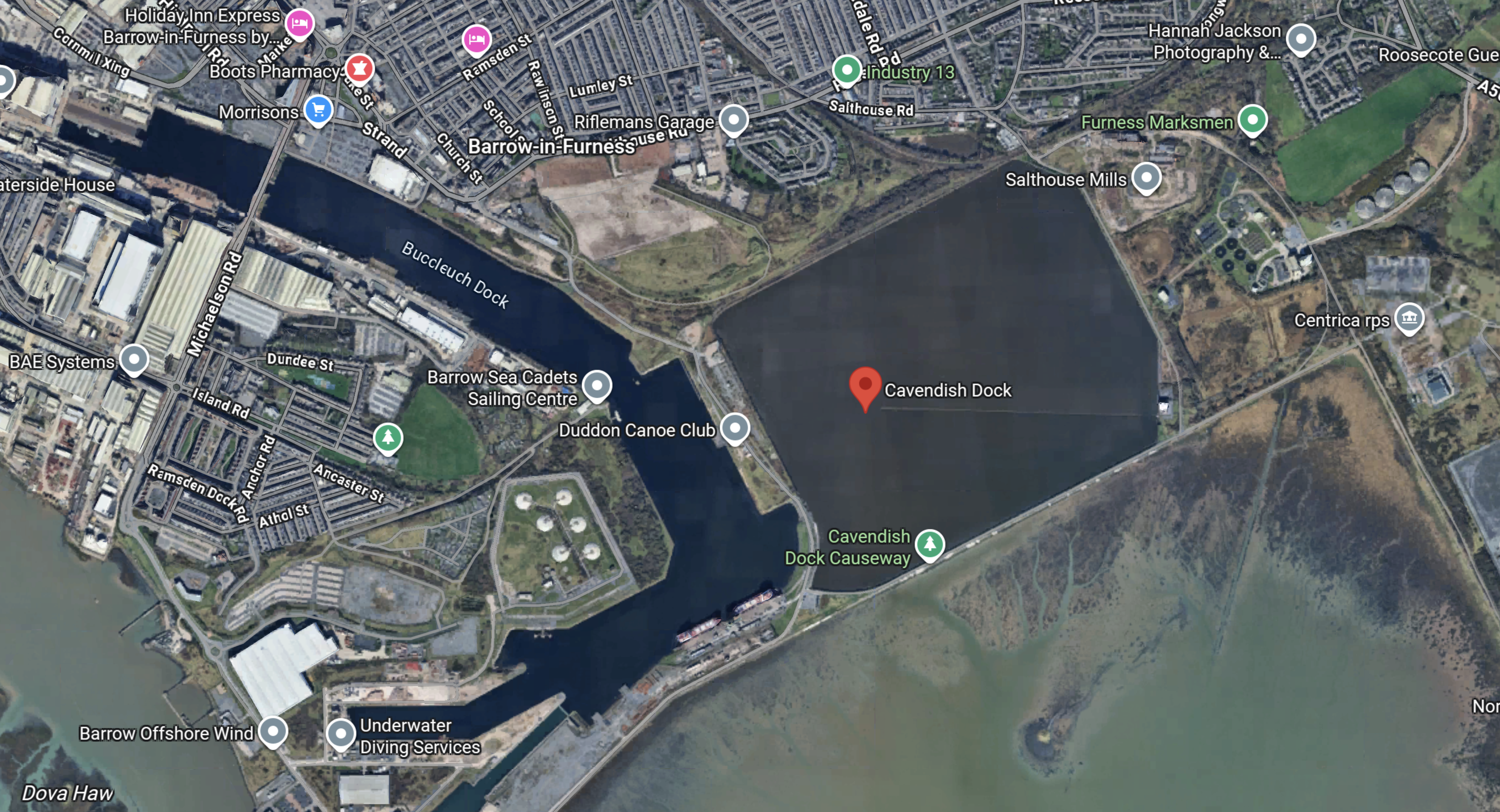
This Google Map shows Cavendish Dock in the centre of Barrow-in-Furness.
Note.
BAe Systems are in the West side of the map.
It looks like the picture on the BBC article was taken from the East.
In the picture the Cavendish Causeway runs across the bottom-left Corner.
The solar array appears to be in the North side of the dock.
The solar array will be an impressive structure, when it is complete.
The 2025 rooftop installation figures represent the fifth consecutive year of year-on-year increases in rooftop solar deployments, according to MCS.
A few nuggets from the article.
The UK has seen rooftop solar installations increase year-on-year since 2021.
UK rooftop solar PV installations have hit 206,682 so far in 2025, a record for the sector that has pushed the total number of certified small-scale solar installations in the UK to 1.85 million.
This is according to the latest figures from the Microgeneration Certification Scheme (MCS) Their web site is here.
Somerset and Cornwall leading the country in installations, with 3,741 and 3,726, respectively. North Yorkshire (2,780), County Durham (2,668) and Wiltshire (2,545) make up the rest of the top five.
Great Britain is described as a very mature market. It certainly seems healthy too!
My Solar Panels
I have solar panels on the flat roof of my house.
In the last twelve months I have been paid.
29th November 2024 – £129.66
24th February 2025 – £31.58
27th May 2025 – £46.27
29th August 2025 – £114.63
Note.
This is a total of £322.16
There has been no servicing or charges from my energy supplier.
Bus operator First Bus has launched its largest energy storage facility yet in Hampshire.
These four paragraphs add more detail.
Located at the company’s Hoeford bus depot, the 1MW battery storage unit, with a 2-hour duration, will begin operations next month.
This will be followed by a bigger battery storage unit with 2MW/4MWh capacity at its depot in Aberdeen, which will begin work by the end of the year.
The FirstGroup division said that it will explore opportunities to build more battery sites across the UK in the future.
The new battery storage facilities will be used to store surplus electricity that will be distributed back to the grid during peak demand and help maintain power supplies. It will also be used to power the company’s more than 1,200 electric bus fleet.
Note.
Hoeford’s 1MW/2MWh and Aberdeen’s 2MW/4MWh are big batteries.
They will be installed, where there is a predictable need.
Google AI says that the First Bus UK News “About Us” page lists 65 depots and outstations.
I suspect some clever data analysis is being used to optimise the size of a battery to the route structure and number of buses at a depot.
The batteries appear to come from a company called Palmer Energy Technology, who are backed by Barclays, First Bus and the University of Oxford.
Palmer Energy designs and manufactures Battery Energy Storage Systems that apply automotive‑grade principles to stationary applications. PETL specifies premium cells, uses liquid cooling as standard and focuses on intelligent control to drive down operating costs for customers in transport, industry and the grid.
Through our 100% ownership of Brill Power, a University of Oxford spin out, we incorporate Brill Power’s patented active loading BMS technology in all our BESS to increase the lifetime of systems, improve safety and remove geopolitical risks by storing all data on UK servers.
These are my further thoughts.
Electric Bus Charging Puts A Strain On The Grid
A couple of years ago, I had a drink with three bus depot managers in London. They said that some depots were having difficulty getting sufficient power from the grid.
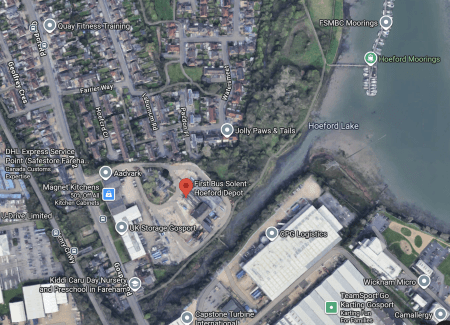
This Google Map shows Hoeford Depot where the first battery has been installed.
Note.
Hoeford Depot is by the water at Fareham.
The depot is indicated by the red arrow.
The depot is surrounded by houses and other businesses.
As an electrical engineer, I would expect that a battery of the right size could sort out any charging problems.
Bus Garage Batteries Could Mop Up Surplus Electricity
Consider.
I would expect bus garages have a predictable pattern for energy use.
Buses will often be charged at night, when solar power is low.
Do bus garages get a cheaper electricity rate at night?
There will be times, when bus garages can accept excess energy from the grid and store it until they need it.
This will mean that wind turbines won’t have to be turned off so often.
Palmer’s batteries installed in a bus garage seem to be a simple way to increase renewable energy efficiency and possibly reduce the cost of battery charging.
Would A Bank Finance The Batteries?
I am not a banker or an accountant, but I have worked with some of the very best. One banker, who sadly has now passed on, would have surely backed this company if the technology and the forecasts stacked up, just as he backed the company, that I helped to start.
It does look as if Barclays are backing the company.
Quinbrook Infrastructure Partners has completed construction and started commercial operations of the 373MW Cleve Hill Solar Park, now the largest operational in the UK.
Note.
According to Quinbrook, during the commissioning phase in May, electricity exports from Cleve Hill peaked at a level equivalent to 0.7% of the UK’s national power demand.
Construction of the 373 MW solar project began in 2023, and Quinbrook said construction is now underway on a 150 MW co-located battery energy storage system (BESS).
The gas-fired power stations at Coolkeeragh, Corby, Enfield, Great Yarmouth and Shoreham are all around 410-420 MW for comparison.
On completion of the BESS, Cleve Hill will go from the largest solar plant in the UK to the largest co-located solar plus storage project constructed in the UK.
The solar and storage plant was the first solar power project to be consented as a nationally significant infrastructure project (NSIP) and is supported by the largest solar + BESS project financing undertaken in the UK.
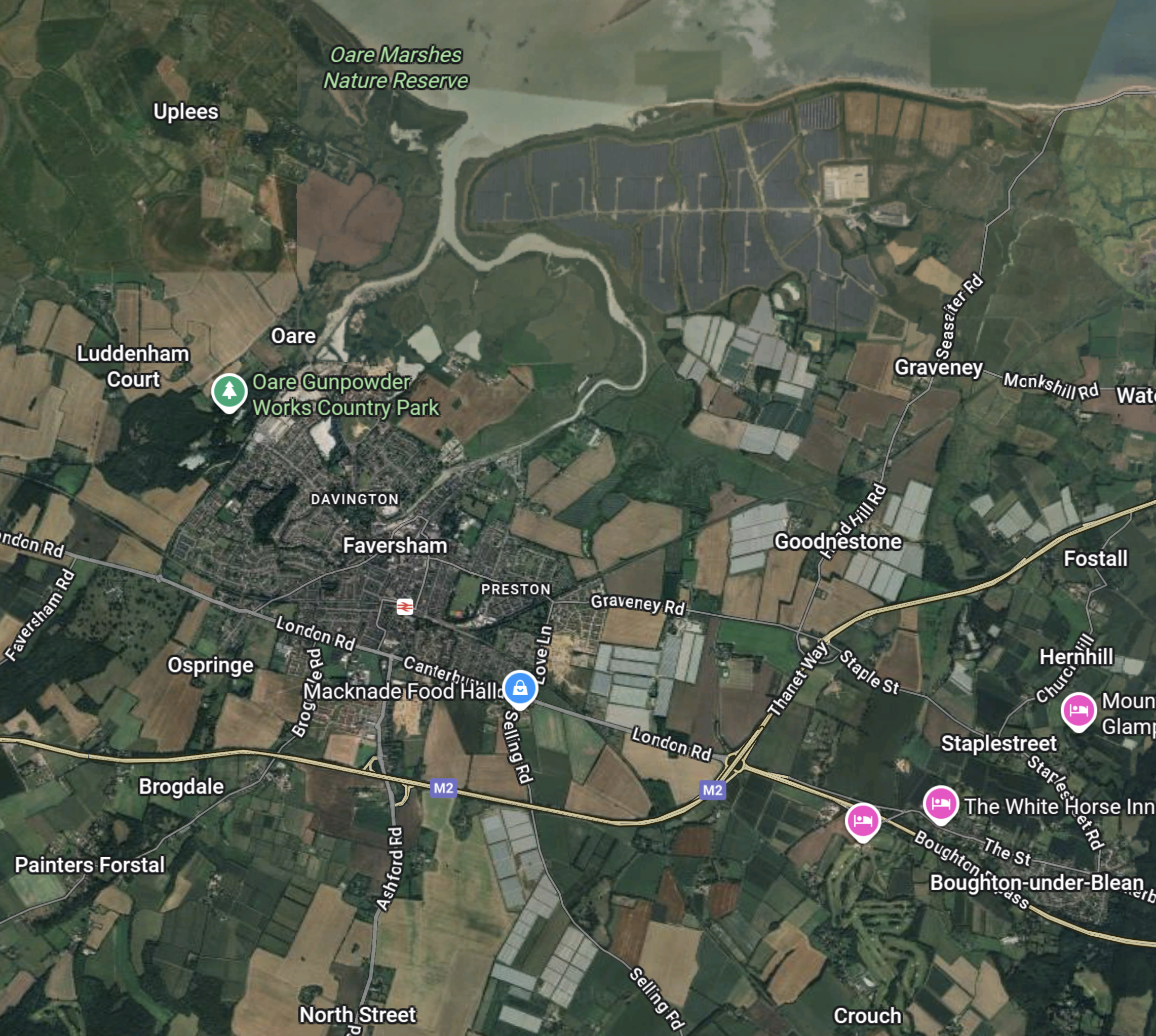
This Google Map shows the location of the solar farm with respect to Faversham.
Note.
The town of Faversham to the left of the middle of the map.
Faversham station has the usual railway station logo.
The North Kent coast is at the top of the map.
Cleve Hill Solar Park is on the coast to the East of the River Swale.
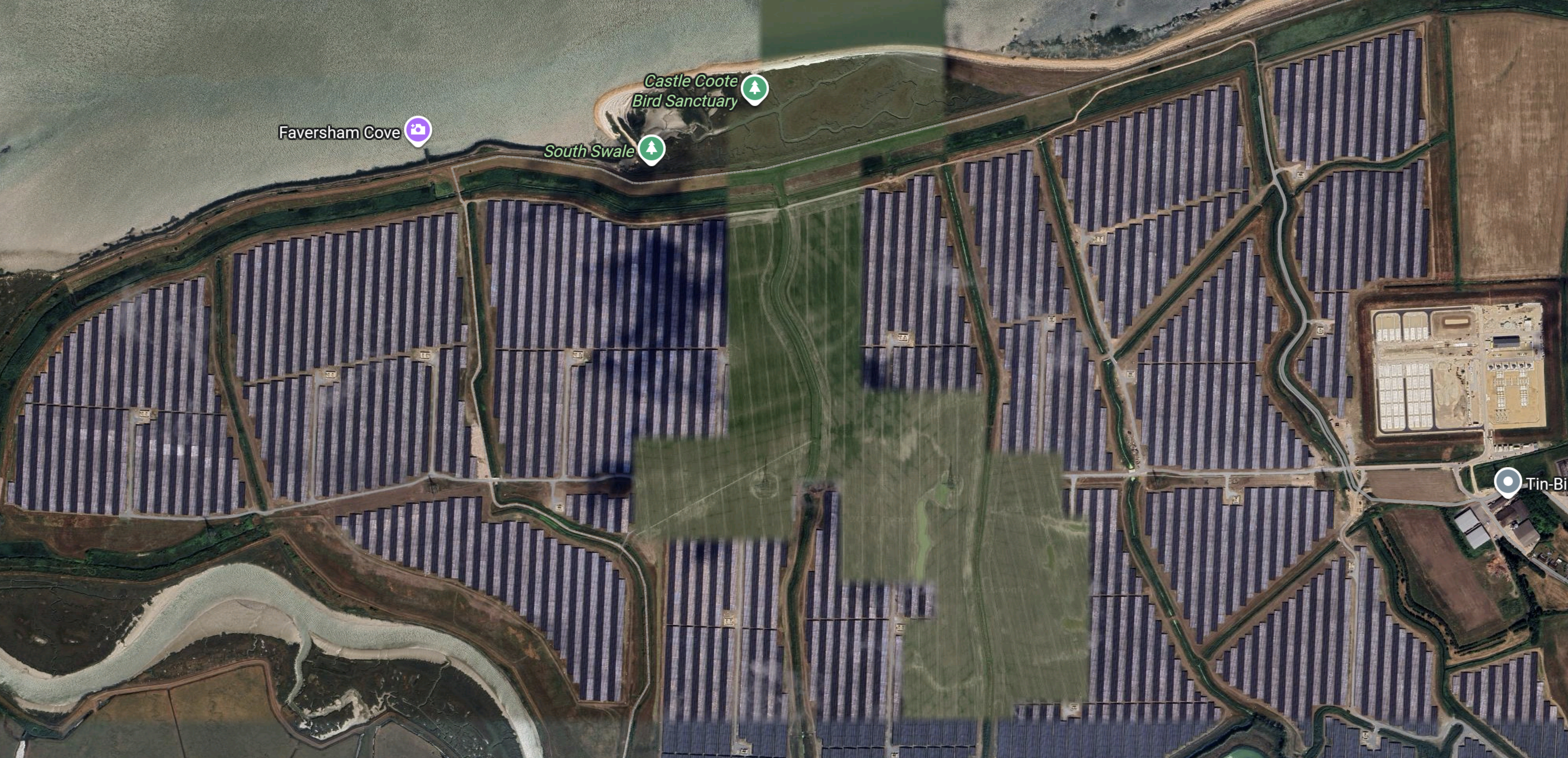
This second Google Map shows a close up of the solar farm.
Note.
The large number of solar panels.
The North Kent coast is at the top of the map.
The River Swale in the South-West corner of the map.
It appears that Cleve Hill substation is at the right edge of the map.
The boxes at the left of the substation appear to be the batteries.
The 630 MW London Array wind farm, which has been operational since 2013, also connects to the grid at Cleeve Hill substation.
When completed, the London Array was the largest offshore wind farm in the world.
As a Control Engineer, I do like these Battery+Solar+Wind power stations, as they probably provide at least a reliable 500 MW electricity supply.
Could A System Like Cleeve Hill Solar Park Replace A 410 MW Gas-Fired Power Station?
The three elements of Cleeve Hill are as follows.
Solar Farm – 373 MW
BESS – 150 MW
Wind Farm – 630 MW
That is a total of only 1,153 MW, which means a capacity factor of only 35.6 % would be needed.
How Much Power Does A Large Solar Roof Generate?
Some people don’t like solar panels on farmland, so how much energy do solar panels on a warehouse roof generate?
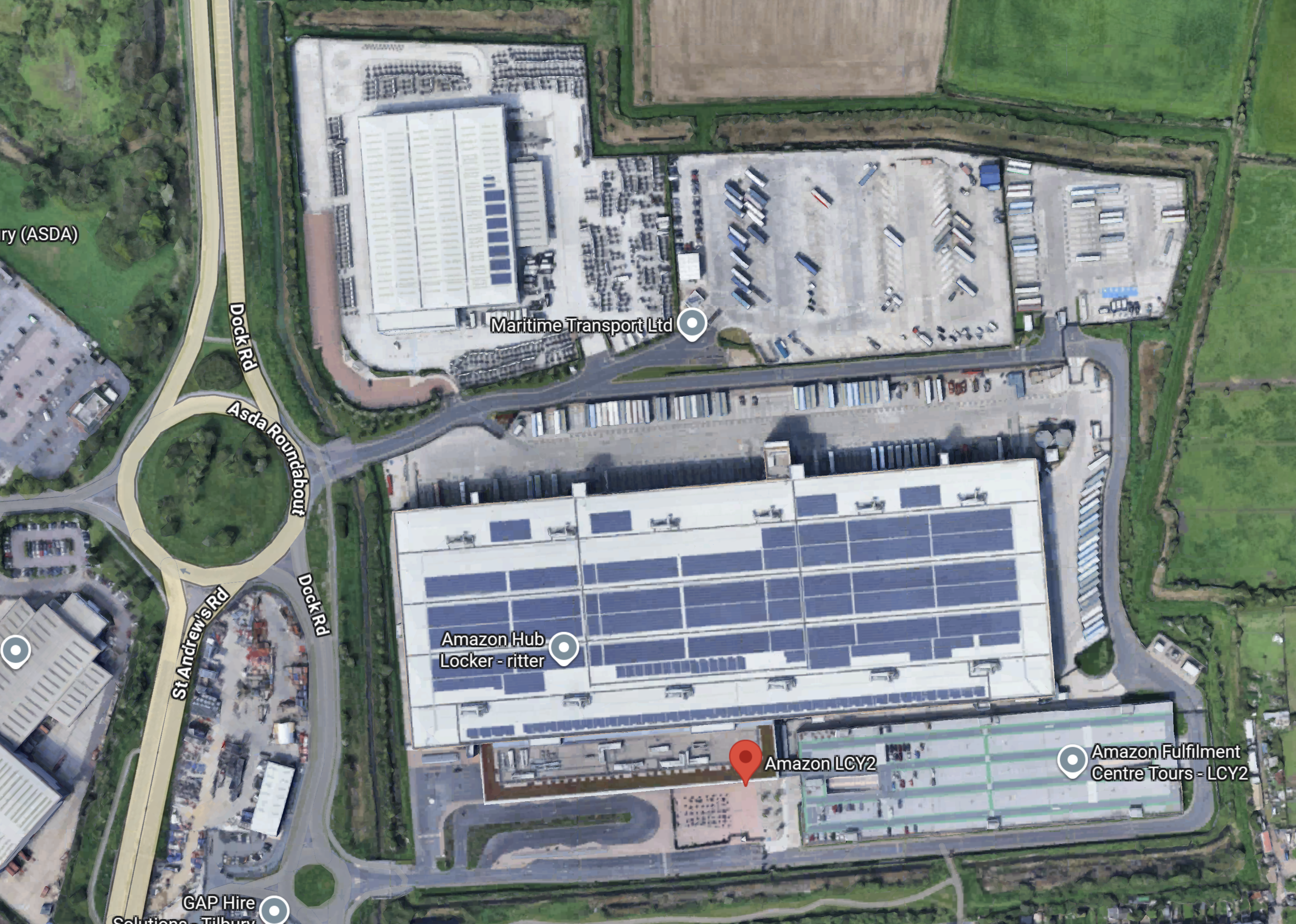
This Google Map shows Amazon’s warehouse at Tilbury.
I asked Google AI to tell me about Amazon’s solar roof at Tilbury and it said this.
Amazon’s solar roof at the Tilbury fulfillment center is the largest rooftop solar installation at any Amazon site in Europe, featuring 11,500 panels across the two-million-square-foot roof. Unveiled in 2020, it is part of Amazon’s larger goal to power its operations with 100% renewable energy by 2025 and reduce its emissions, contributing to its Climate Pledge to be net-zero carbon by 2040.
It generates 3.4 MW, which is less that one percent of Cleeve Hill Solar Park.
On Wednesday, a cardiologist friend asked me if we have enough power to do Trump’s UK AI, so I felt this post might be a good idea.
Artificial Intelligence Gave This Answer
I first asked Google AI, the title of this post and received this reply.
The UK will power proposed data centres using a mix of grid-supplied low-carbon electricity from sources like offshore wind and through on-site renewable generation, such as rooftop solar panels. Data centre operators are also exploring behind-the-meter options, including battery storage and potential future nuclear power, to meet their significant and growing energy demands. However, the UK’s grid infrastructure and high energy prices present challenges, with industry calls for grid reform and inclusion in energy-intensive industry support schemes to facilitate sustainable growth.
Google also pointed me at the article on the BBC, which is entitled Data Centres To Be Expanded Across UK As Concerns Mount.
This is the sub-heading.
The number of data centres in the UK is set to increase by almost a fifth, according to figures shared with BBC News.
These are the first three paragraphs.
Data centres are giant warehouses full of powerful computers used to run digital services from movie streaming to online banking – there are currently an estimated 477 of them in the UK.
Construction researchers Barbour ABI have analysed planning documents and say that number is set to jump by almost 100, as the growth in artificial intelligence (AI) increases the need for processing power.
The majority are due to be built in the next five years. However, there are concerns about the huge amount of energy and water the new data centres will consume.
Where Are The Data Centres To Be Built?
The BBC article gives this summary of the locations.
More than half of the new data centres would be in London and neighbouring counties.
Many are privately funded by US tech giants such as Google and Microsoft and major investment firms.
A further nine are planned in Wales, one in Scotland, five in Greater Manchester and a handful in other parts of the UK, the data shows.
While the new data centres are mostly due for completion by 2030, the biggest single one planned would come later – a £10bn AI data centre in Blyth, near Newcastle, for the American private investment and wealth management company Blackstone Group.
It would involve building 10 giant buildings covering 540,000 square metres – the size of several large shopping centres – on the site of the former Blyth Power Station.
Work is set to begin in 2031 and last for more than three years.
Microsoft is planning four new data centres in the UK at a total cost of £330m, with an estimated completion between 2027 and 2029 – two in the Leeds area, one near Newport in Wales, and a five-storey site in Acton, north-west London.
And Google is building a data centre in Hertfordshire, an investment worth £740m, which it says will use air to cool its servers rather than water.
There is a map of the UK, with dots showing data centres everywhere.
One will certainly be coming to a suitable space near you.
Concerns Over Energy Needs
These three paragraphs from the BBC article, talk about the concerns about energy needs.
According to the National Energy System Operator, NESO, the projected growth of data centres in Great Britain could “add up to 71 TWh of electricity demand” in the next 25 years, which it says redoubles the need for clean power – such as offshore wind.
Bruce Owen, regional president of data centre operator Equinix, said the UK’s high energy costs, as well as concerns around lengthy planning processes, were prompting some operators to consider building elsewhere.
“If I want to build a new data centre here within the UK, we’re talking five to seven years before I even have planning permission or access to power in order to do that,” he told BBC Radio 4’s Today programme.
For solar power, I just asked Google AI and received this answer.
The UK government aims to have between 45 and 47 gigawatts (GW) of solar power capacity by 2030. This goal is set out in the Solar Roadmap and aims to reduce energy bills and support the UK’s clean power objectives. The roadmap includes measures like installing solar on new homes and buildings, exploring solar carports, and improving access to rooftop solar for renters.
Let’s assume that we only achieve the lowest value of 45 GW.
But that will still give us at least 100 GW of renewable zero-carbon power.
What will happen if the wind doesn’t blow and the sun doesn’t shine?
I have also written about nuclear developments, that were announced during Trump’s visit.
For pumped storage hydro, I asked Google AI and received this answer.
The UK’s pumped storage hydro (PSH) capacity is projected to more than double by 2030, with six projects in Scotland, including Coire Glas and Cruachan 2, potentially increasing capacity to around 7.7 GW from the current approximately 3 GW. This would be a significant step towards meeting the National Grid’s required 13 GW of new energy storage by 2030, though achieving this depends on policy support and investment.
There will also be smaller lithium-ion batteries and long duration energy storage from companies like Highview Power.
But I believe there will be another source of energy that will ensure that the UK achieves energy security.
SSE’s Next Generation Power Stations
So far two of these power stations have been proposed.
Ferrybridge will be 1200 MW and has this web site.
Note.
Both power stations are being designed so they can run on natural gas, 100 % hydrogen or a blend of natural gas and hydrogen.
Keadby will share a site with three natural gas-powered power stations and be connected to the hydrogen storage at Aldbrough, so both fuels will be available.
Ferrybridge will be the first gas/hydrogen power station on the Ferrybridge site and will have its own natural gas connection.
How Ferrybridge will receive hydrogen has still to be decided.
The power stations will initially run on natural gas and then gradually switch over to lower carbon fuels, once delivery of the hydrogen has been solved for each site.
In the related post, I proposed using special trains to deliver the hydrogen from where it is produced to where it is needed.
Could HiiROC Be Used At Ferrybridge?
Consider.
HiiROC use a process called thermal plasma electrolysis to split any hydrocarbon gas into hydrogen and carbon black.
Typical input gases are chemical plant off gas, biomethane and natural gas.
Carbon black has uses in manufacturing and agriculture.
HiiROC uses less energy than traditional electrolysis.
There is an independent power source at Ferrybridge from burning waste, which could be used to ower a HiiROC system to generate the hydrogen.
It might be possible to not have a separate hydrogen feed and still get worthwhile carbon emission savings.
Conclusion
I believe we will have enough electricity to power all the data centres, that will be built in the next few years in the UK.
Some of the new power stations, that are proposed to be built, like some of the SMRs and SSE’s Next Generation power stations could even be co-located with data centres or other high energy users.
In Nuclear Plan For Decommissioned Coal Power Station, I describe how at the former site of Cottam coal-fired power station, it is proposed that two Holtec SMR-300 SMRs will be installed to power advanced data centres. If the locals are objecting to nuclear stations, I’m sure that an SSE Next Generation power station, that was burning clean hydrogen, would be more acceptable.
What this blog will eventually be about I do not know.
But it will be about how I’m coping with the loss of my wife and son to cancer in recent years and how I manage with being a coeliac and recovering from a stroke. It will be about travel, sport, engineering, food, art, computers, large projects and London, that are some of the passions that fill my life.
And hopefully, it will get rid of the lonely times, from which I still suffer.
 The Anonymous Widower