The Power Of Three!
I went to Ipswich for the football yesterday with a friend.
We travelled both ways in one of Greater Anglia’s refurbished rakes of Mark 3 coaches.
My friend doesn’t travel by long distance train that often and remarked both ways, that the ride was exceptionally smooth!
The design of Terry Miller and his team has worn well in the forty years they have been in service.
We might think of railway coaches as rather mundane everyday objects, but this design will outlive us all!
Crossrail 2 ‘Cannot Go Ahead’ Without Four-Tracking Of West Anglia Line
This is the title of an article in Rail Technology Magazine.
This is the first paragraph.
MPs for constituencies along the West Anglia line called for the route to be four-tracked in order to accommodate new rolling stock and Crossrail 2 at a Westminster Hall debate yesterday.
I know the West Anglia Main Line very well, as for perhaps fifteen years, I used to travel on it, regularly to get between Cambridge and London.
The Problems Of The West Anglia Main Line
Summarising its shortcomings, I would include.
- Trains are too slow.
- Capacity on the line is too small.
- There are lots of level crossings, which cause problems.
- With the development of the port at London Gateway, there could be pressure to put more freight trains on this line, to go to and from the North.
- Services from London, should be better integrated with Peterborough and Norwich services.
- Ipswich and Bury St. Edmunds to Stansted Airport, is not easy by train.
This Infrastructure section in Wikipedia describes the West Anglia Main Line.
The line was initially 5 ft (1,524 mm) gauge, but between 5 September and 7 October 1844 it was converted to 1,435 mm (4 ft 8 1⁄2 in) standard gauge.
In 2013 the line was double track for most of its length, with small sections of single track on the Stansted branch and at Ware and quadruple track between Hackney Downs and Liverpool Street. The line is electrified at 25 kV AC and has a loading gauge of W8 except for the Stansted branch, which is W6.
The line is very much inferior to the Great Eastern Main Line.
The New Greater Anglia Franchise
The new Greater Anglia Franchise, will go a long way to sorting points 5 and 6, by introducing hourly services on the following routes.
- Norwich to Stansred Airport via Ely, Cambridge North and Cambridge stations.
- Colchester to Peterborough via Ipswich, Bury St. Edmunds, and Ely.
With improved services from London to Stansted, this will help sort out a lot of the problems on the line.
But these changes will only put more pressure on capacity on the West Anglia Main Line.
Freight
The West Anglia Main Line doesn’t carry large numbers of freight trains, but there could be pressure to increase freight on the line in the future.
Once the Gospel Oak to Barking Line is electrified, there will be another electrified route from London Gateway to Peteborough.
It might be decided to reinstate the rail line from March to Spalding and the Great Northern Great Eastern Joint Line, to take freight away from the East Coast Main Line.
If thiese routes get to be used for freight, it will put extra pressure for more capacity on the West Anglia Main Line.
More Capacity On The West Anglia Main Line
With demand for more capacity on the West Anglia Main Line, I think it is inevitable that the line will be improved.
This Future Developments section in Wikipedia, outlines what might happen.
If Stansted Airport’s expansion is authorised it is planned that the line will see many further changes. Long term proposals include four-tracking between Coppermill Junction and Broxbourne junction; an additional tunnel and platform edge on the Stansted Airport branch; one additional train per hour serving Stansted and up to six further trains per hour at peak times, including four into Stratford as a terminus. More stations, such as Broxbourne, will also have platform extensions to accommodate 12-car trains.
It seems likely that two tracks will be built alongside the line to Cheshunt as part of Crossrail 2. Intermediate stations from Tottenham Hale will transfer to Crossrail 2 releasing capacity on the main line for additional trains
Stansted Airport have certainly been a forceful advocate of four-tracking the West Anglia Main Line.
Four-tracking of the twelve or so miles between Coppermill and Broxbourne Junctions would allow the following.
- The possibility of at least 100 mph running on the fast lines.
- Separation of slow and fast services.
- Stansted and Cambridge Express services, that would be worthy of the name.
- The possibility of more freight trains.
Four-tracking would certainly do the following.
- Get the line ready to connect to Crossrail 2.
- Probably make all stations between Tottenham Hale and Broxbourne step-free.
- Add the station at Meridian Water to the line.
- Improve the freight gauge from W8 to W10, where needed.
I suspect that four-tracking will also remove some of the notorious level crossings on the line.
I have this feeling that the four-tracking of this line could be one of those projects, where the existing infrastructure works normally, whilst the new tracks are built alongside.
Fast Services To Stansted, Cambridge And Norwich
South of Broxbourne station, fast services to and from Cambridge, only stop at Cheshunt and Tottenham Hale.
Given that the Flirts, that will be running Cambridge and Stansted services in a few years will be 125 mph trains, would it be worth it to save a few minutes building the new fast lines to allow running at this speed?
But should the four-track section of railway stop at Broxbourne Junction?
Between Broxbourne and Bishops Strtford, the West Anglia Main Line, has wide margins and I think that there are possibilities of extending the four-track section further North, perhaps even to Bishops Stortford station.
As an example, this Google Map shows Roydon station.
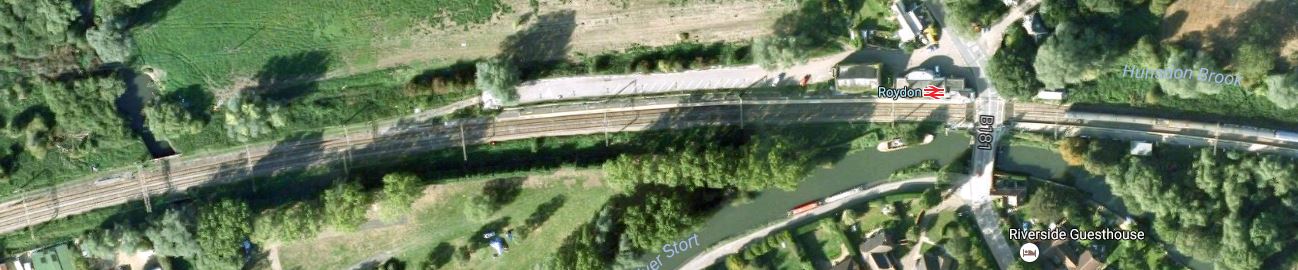
Roydon Station
The biggest problem at Roydon is the level crossing, but on a quick look, it would appear that four-tracking would be possible.
From my memories of driving past and going through Bishops Stortford station, I thought this station would be a major problem to four-tracking.
But look at this Google Map of the station.

Bishops Stortford Station
It would appear that space is not the premium I expected.
I think it would be possible to expand the station, to take advantage of two slow and two fast lines South of the station.
Surely, the fast lines, even if a good proportion of trains stopped at the station could accommodate twelve or more trains per hour (tph) to Stansted Airport, Cambridge and the North.
North of Bishops Stortford, all of the trains would be modern trains with the following characteristics.
- The ability to cruise at 100 mph or more.
- The ability to stop and start extremely fast.
So I suspect, that if the current infrastructure was improved, consistent 100 mph running would be possible to Cambridge.
Cambridge could be a problem with all the work going on.
- The expansion of the existing Cambridge station
- The building of the new Cambridge North station
- The reorganisation of services to cope with the new Greater Anglia franchise.
- The arrival of the East West Rail Link in the mid-2020s.
But I suspect Network Rail and Greater Anglia are working together on the solutions, to raise speeds all the way to Ely.
North of Ely, the Breckland Line has a lower speed limit of 75-90 mph, but if it were to be upgraded for 100 mph running, this would mean that the new Norwich to Stansted service via Cambridge using bi-mode Flirt trains, would be considerably faster, than the ten minutes short of two hours now possible with a change at Cambridge.
One thing, that I suspect will happen is that the following services will arrive and leave in a convenient pattern at Cambridge.
- Cambridge to/from Ipswich
- Stansted Airport to/from Norwich
- Cambridge to/from Kings Lynn
- Kings Cross to/from Cambridge
- Liverpool Street to/from Cambridge
- Peterborough to/from Cambridge
- Thameslink to/from Cambridge
Cambridge will become an increasingly busy interchange.
As an example, I think we could see a Norwich to Kings Cross time of under two hours, with a change at Cambridge. Perhaps not ninety minutes, but with an upgraded Breckland Line running 100 mph plus bi-mode Flirts, it wouldn’t be far off.
Coppermill Junction
Four-tracking is proposed to start at Coppermill Junction, just South of Tottenham Hale station.
This map from carto.metro.free.fr shows Coppermill Junction.
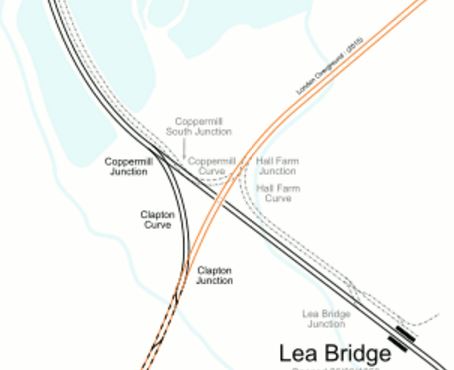
Coppermill Junction
Note.
- The tunnels for Crossrail 2 will emerge to the North-West of this junction.
- Rail access to the Crossrail 2 worksite would be a necessity.
- I talked about plans to reinstate the Coppermill and Hall Farm Curves in Rumours Of Curves In Walthamstow.
- The only inhabitants of the area are probably foxes, great crested newts and other sundry wildlife.
Surely, the creation of an upgraded track layout at Coppermill Junction, that allows Crossrail 2 to be built without disrupting services on the West Anglia Main Line and the Chingford Branch is important.
The reinstated Hall Farm Curve would also allow Chingford Branch services to run to Stratford for Crossrail and alternative Underground services.
The work to this junction, further emphasises that four-tracking of the West Anglia Main Line must be done before Crossrail 2 is built.
Crossrail 2
Politics, public relations and good project management all probably say, that when Crossrail 2 gets the go-ahead, four-tracking of the West Anglia Main Line, should be done first.
In a related and parallel project, the branch lines in South West London, should also be upgraded as early as possible to bring visible benefits.
- Longer platforms at stations where needed.
- Step-free access at all stations.
- Sorting of level crossings and bottle-necks.
These improvements are needed, even if Crossrail 2 is not built.
If I have a criticism of the current Crossrail and Thameslink projects, it is that they are big-bang projects, where nothing appears to have happened except disruption for years and then it will all come together in a great splurge in 2018-2019.
With Crossrail 2, there is possibly a chance to build the line, so that the benefits come in a steady stream.
Is The Levenmouth Rail Link Going To Be Scotland’s Next New Railway?
I ask this question as this article in Global Rail News was asking the same question, with a title of Levenmouth – Scotland’s next railway?.
According to the article, the figures look good, for the reopening of the Levenouth Rail Link, with a Benefit Cost Ration of 1.3, which compares well with the figure of 0.96 for the successful Borders Railway.
This is also said in the Wikipedia entry for the Fife Circle Line under Future Services.
A Leven rail link would provide better services to support major industrial sites at Fife Energy Park, Methil Docks, the Low Carbon Park (under construction), Diageo, the businesses along the Leven Valley (including Donaldsons) and major retailers in Leven located close to the line (Sainsbury, B&Q, Argos, etc.). Levenmouth is an area of high deprivation and Fife Council estimates that an hourly train link (using the Fife Circle services)to Edinburgh would increase job vacancies by 500% since commuting for work would become possible.
There is one big difference between the Borders Railway and the Levenmouth Rail Link.
On a journey to Scotland’s capital from Leven, the travellers have to cross the large water.barrier of the Firth of Forth.
Is The Firth Of Forth A Psychological Barrier?
Does the Forth act as both a psychological batter, as well as a physical barrier to travel?
I don’t know for sure, but I hear the same sort of comments from my friends in Edinburgh about Fife, as North Londoners make about South London and probably South Londoners make about the North.
The much larger Thameslink project may get all the publicity and criticism, but London’s most modern cross-river link just keeps on giving.
The East London Line And The Levenmouth Rail Link
You might argue, what has the East London Line got to do with the Levenmouth Rail Link?
I believe that because of the geography of the two areas, with a major waterway between two centres of population, that the massive underestimation of passenger numbers, that occurred in East London could also happen across the Forth.
Luckily, that just as Marc Brunel provided a high-quality crossing under the Thames, the Victorians did this for the Firth of Forth.
Although, it could be argued that the Scottish crossing is more iconic and you get a better view.
As an aside, if the Forth Bridge, which opened in 1890 is a UNESCO World Heritage Site, surely Marc Brunel’s much older Thames Tunnel, should be similarly acknowledged.
Local Rail Services Across The Firth Of Forth
At present the local services across the bridge are four trains per hour on the Fife Circle Line.
That is not a high capacity service, given the line is not electrified.
If the Levenmouth Rail Link were to be rebuilt, it would connect to the Fife Circle and surely, it would mean that more trains could be timetabled to and from Edinburgh, via the new station at Edinburgh Gateway, which gives access to Edinburgh’s trams, the Airport and services to Glasgow and the West of Scotland.
Would those along the Levenmouth Rail Link respond to a new railway, as those who live in Hackney did to the East London Line?
I would be very surprised if they didn’t!
Rebuilding The Levenmouth Rail Link
The Levenmouth Rail Link is a classic branch line, with not much complication. Published plans show the following.
- It would be about five miles long.
- It would branch off the main Edinburgh to Aberdeen Line to the North-East of Glenrothes with Thornton station.
- It would terminate at Leven station.
- A branch would serve the large Diageo distillery.
This Google Map shows the junction with the main line.

Glenrothes with Thornton station is in the South-West corner of the map on the Fife Circle Line.
- Trains go West from the station to Edinburgh on the Fife Circle Line via Cowdenbeath and Dunfermline.
- There is a triangular junction to the East of the station.
- Trains go South from this junction to Edinburgh via Kirkcaldy.
- Trains go North from this junction to Perth, Dundee and Aberdeen.
To the North of this junction, the line splits, with trains for Leven, branching off to the East.
This map from Wikipedia shows the stations on the Fife Circle Line
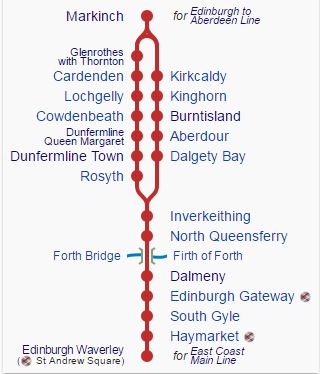
Note that the junction where the Fife Circle Line splits South of Markinch station, is the one shown in the Google Map.
Electrification
The Fife Circle and the Edinburgh to Aberdeen Line are not electrified and there are no scheduled plans to do so, other than the aspiration of having more lines with electric services.
But various factors will effect the types of trains between Edinburgh and Perth, Dundee and Aberdeen.
- Distances are not hundreds of miles.
- Virgin’s electro-diesel Class 800 trains will be working between Edinburgh and Aberdeen.
- Could Hitachi build electro-diesel versions of their Class 385 trains, as they share design features with the Class 800 trains?
- Will Hitachi add energy storage to Class 385 trains?
- Abellio are rumoured to be introducing trains with energy storage in East Anglia. Would this expertise be used by Abellio ScotRail?
I think we could see a cost-effective strategy implemented, that included electric trains, but a limited amount of overhead wiring.
- Edinburgh to Dalmeny – Electrified
- The Forth Bridge could be left without wires, if it were thought too sensitive for the Heritage Taliban.
- North Queensferry to Perth – Electrified
- Ladybank to Dundee – Not electrified
- Fife Circle via Cowdenbeath and Dunfermline – Electrified
- Levenmouth Rail Link – Not electrified
Note.
- As Stirling and/or Dunblane will be electrified, will Stirling to Perth be electrified?
- Between Dalmeny and North Queensferry, diesel or battery power would be used on local services.
- I have flown my virtual helicopter round the Fife Circle and it doesn’t look that electrification would be a nightmare.
- The Levenmouth Rail Link could be run by battery trains, with a charging station, like a Railbaar, at Leven station.
Appropriate trains would provide all services.
Services
Obviously, what services are introduced depends on passenger traffic.
But after a quick look at the lines, I suspect that the Levenmouth Rail Link fits well with current services on the Fife Circle.
Bear in mind too, that reopening the St. Andrews Rail Link , could be a possibility.
Conclusion
The railways North from the Forth Bridge in the East and Stirling and Dunblane in the West to Perth and Dundee could be much improved. I would do the following.
- Some short lengths of electrification.
- Bi-mode or battery versions of Class 385 trains.
All trains going over the Forth Bridge, should have large windows. The Bridge Visitor Centre must also have easy access with perhaps a free shuttle bus from Dalmeny station.
One of Scotland’s major assets, must be made to work for its living.
How Do You Get Round This One, Donald?
This article from Global Rail News is entitled Request for California high-speed train parts to be exempt from domestic content rules.
This is said.
The California High-Speed Rail Authority (CHSRA) has requested several key components of its trains be exempt from the USA’s strict local content requirements because there is nowhere in the country that can currently manufacture them.
So what parts are involved?
It appears to be body shells, braking systems and bogies.
Aren’t they fairly crucial?
Seamless Interchangeability
At several places on the UK rail network, two trains running as a pair will split, with one train going to one destination and another going to another.
I wrote about trains splitting and joining in Trains Uncoupling and Coupling at Cambridge.
In the past, UK railways used to use the concept of slip coaches, so that coaches could be dropped from an express without stopping. But the last time it was used in the UK was in September 1960 at Bicester North station.
I have just read this article on the Rail Engineer web site, which is entitled Seamless Interchangeability.
The article talks about a concept of dynamic coupling, where trains are automatically coupled and uncoupled at line speed.
It also talks about the issues this would raise.
As a Control Engineer, I’m fairly certain, that it would be very easy to create a system, where say an eight-car Kings Lynn train could split just before Cambridge station, with the front four-car train going to Kings Lynn and the other four-car train stopping in Cambridge station.
It could either be done using two drivers or by driver-less trains. Although the unions would have a lot to say about the latter.
I also believe that if the trains could uncouple, then coupling at line speed would also be possible.
So what is the point?
An Example From The Brighton Main Line
To make full use of the capacity available, Southern serve Littlehampton and Ore, with a train that divides at Haywards Heath. It is a well-proven technique that has been used for decades.
Automatically splitting the two trains at line-speed, can give journey time advantages.
Take the 19:47 from Victoria, which arrives at Haywards Heath at 20:30 as an example.
The following is taken from the timetable.
- The front portion to Ore leaves at 20:34.
- The rear portion to Littlehampton leaves at 20:36.
- Stops at East Croydon and Gatwick Airport take about a minute.
This leads to the following, if the two trains split immediately after stopping at Haywards Heath and before the trains take different directions after Keymer Junction where the East Coastway Line divides from the Brighton Main Line, a few miles South.
- The Ore train performs a one-minute stop instead of one of four minutes, thus saving three minutes.
- The Littlehampton train performs a one-minute stop instead of one of six minutes, thus saving five minutes.
- The platform at Haywards Heath is only occupied for a minute, as opposed to six.
- The Littlehampton and Ore portions must be capable of providing enough capacity for their route.
For those worried about driver-less trains, the driver of the second train for Littlehampton, would probably step up at the previous stop at Gatwick Airport or at Haywards Heath.
But the outcome would be a small increase in capacity on the line, due to the platform at Haywards Heath being occupied for five minutes less.
Coming North, take the 09:47 from Littlehampton as an example.
The following is taken from the timetable.
- The first train arrives at Haywards Heath at 10:35 and leaves at 10:45.
- The second train arrives at Haywards Heath at 10:41.
The pattern of the trains would be different.
- Whatever was the front portion of the train would go through Keymer Junction first
- The train forming the rear portion would be the next train through the junction.
- The rear portion could catch the front portion and the two trains would be automatically coupled together before Haywards Heath.
- The joined train would stop at Haywards Heath for a minute.
- The driver of the second train could step-down at Gatwick Airport or Haywards Heath.
In some ways the mathematics involved in the coupling, are not unlike those for a fighter jet connecting with a tanker aircraft. Except that speeds are a lot lower and there is no need to control direction only closing speed.
Haywards Heath station would be occupied for up to nine minutes less, thus creating capacity.
This simplistic analysis, shows how automatically coupling and uncoupling trains at line speed can create capacity and decrease journey times.
- Journey time from Victoria to Ore would be reduced by three minutes.
- Journey time from Victoria to Littlehampton would be reduced by five minutes.
- In the Down direction the platform at Haywards Heath station would be occupied for just one minute instead of six.
- Journey time from Littlehampton to Victoria would be reduced by nine minutes.
- Journey time from Ore to Victoria would be reduced by three minutes.
- In the Up direction the platform at Haywards Heath station would be occupied for just one minute instead of ten.
Obviously strategies would have to be developed for various eventualities including.
- Unsuccessful coupling or uncoupling.
- Late trains.
- Signalling and train failures.
- Leaves on the line.
- Extreme weather.
But as during all coupling and uncoupling operations, both trains would have a driver in the cab, keeping an expert eye over the procedure and each train could be driven independently, I think all safety issues could be overcome, to the satisfaction of all parties.
If you read the full article, you’ll see that there are some much more exciting possibilities, than the simple ones I have outlined here.
But I do believe that line speed uncoupling and coupling of trains with a driver in the cab of both trains involved, can be a very powerful tool in creating capacity on the UK’s railways.
The Great Eastern Main Line
I know the Great Eastern Main Line well and several trains are coupled and uncoupled regularly on this line.
As Greater Anglia has ordered new five-car Aventra trains and nearly all platforms can take 12 -car trains, running these trains in pairs and coupling and uncoupling appropriately, is probably in their plans for the line.
As on the Brighton Main Line, could coupling and uncoupling at line speed, unlock capacity on the line?
A few weeks ago, I caught a train from Chelmsford to Manningtree, that divided at Colchester, with the front four-car train going to Clacton and the rear four-car train going to Harwich.
The 16:44 from Liverpool street is a train that divides at Colchester, when it arrives at 17:40. These timinings are from the timetable.
- The Clacton portion of the train leaves at 16:44.
- The Harwich portion of the train leaves at 16:47.
As the Sunshine Coast Line for Clacton leaves the Great Eastern Main Line immediately after Colchester station, it would appear that the two trains must uncouple during the stop at Colchester.
Surely, an improved and well-designed automatic uncoupling system could separate the trains faster, saving minutes on both services.
Towards London, two trains leave Harwich and Clacton at 07:16. The timetable shows.
- The Harwich train arrives at Colchester at 07:47 and leaves at 07:54.
- The Clacton train arrives at Colchester at 07:50 and leaves at 07:54.
Surely, an improved coupling system, could join the trains faster, saving minutes on both services.
The time savings will not be as great as those at Haywards Heath, but automatic coupling and uncoupling must be a worthwhile feature of the new trains.
|As Bombardier are adding automation to the Aventra, could they be adding the ability to automatically couple and uncouple trains, both in the station and at line speed?
The West Coast Main Line
I have seen Class 221 Trains, join at Crewe, but I don’t think this is done any more.
However, with the need for direct services from London to places like Blackpool, Burnley and Huddersfield, the ability to be to couple and uncouple trains quickly must be something that would be useful to make optimal use of the valuable train paths on the line.
The East Coast Main Line, Midland Main Line, Great Western Main Line And South West Main Line
If the West Coast Main Line could benefit, then surely these lines could as well.
Class 800/801 Trains
The Class 395 train is very much related to the Class 800 and Class 801 trains, that are being built by Hitachi for the East Coast Main Line, Great Western Railway and other routes.
In The Impressive Coupling And Uncoupling Of Class 395 Trains, I talked about the design of the coupling system for the Class 395 trains.
I would be very surprised if this feature was not incorporated in the Class 800 and Class 801 trains.
So will we be seeing two five-car Class 800/801 trains dividing and joining at a convenient station and then running as a ten-car train to and from London?
Class 385 Trains
What about the Class 385 trains for Scotland?
- These are another version of Hitachi’s A-Train, like 395s, 800s and 801s.
- These will come in two lengths; three-car and four-car.
- Edinburgh-Glasgow services will need at least two units to be coupled together.
- The trains are being introduced from Autumn next year.
It seems to me, that Scotrail are acquiring a very flexible fleet that can run in various lengths.
Will they have the ability of the 395s to couple and uncouple in under a minute?
And if they do, will Scotrail use this ability to adjust train formation to the traffic?
Aventras
There are three definite orders for Bombardier’s new Aventra train at the present time.
- Class 345 trains for Crossrail.
- Class 710 trains for London Overground.
- Five and ten car units for Greater Anglia.
All trains are fixed formations in a mixture of lengths.
Will Aventras have similar coupling and uncoupling performance to Hitachi’s Class 395 trains?
I suspect normally, the Crossrail trains will never be coupled together, as where are platforms for a four-hundred metre long train?
But suppose a train fails in the central tunnel, will the quickest way to remove it, be to attach it to another train and drag it out?
The routes where the London Overground trains will run, are currently served by a mixture of four-car and eight-car trains. So will London Overground, adjust train length to the known traffic patterns?
Greater Anglia do couple and uncouple trains at present to serve Harwich. So I suspect, we’ll see use of an automatic and fast coupling and uncoupling feature to create a more efficient timetable.
Cross City Lines
There are several cross-city lines in the UK.
- Cross-City Line – Birmingham
- Crossrail
- North Berwick Line – Edinburgh
- Northern Line – Merseyrail
- Snow Hill Lines – Birmingham
- Thameslink
One of the characteristics of cross-city lines, is they are busiest in the centre of the city, where passengers tend to use the trains for short hops , as well as longer distances. Then in the suburbs, outside of Peak hours the trains could run almost empty.
Crossrail’s trains are designed so that hopefully they could cope with the variable traffic, but would it be possible to have half trains, which join and split at outer stations.
Thameslink
I think that Thameslink could be the line that might benefit most, as it would probably want to serve more places.
In All Change On Thameslink, I detailed the current proposed schedule of trains.
- 4 trains per hour (tph) – Sutton to St. Albans (2 tph via Wimbledon, 2tph via Mitcham)
- 2tph – Brighton to Bedford
- 2 tph – Three Bridges/Gatwick Airport to Bedford
- 2 tph – Brighton to Cambridge North
- 2 tph – Horsham to Peterborough
- 2 tph – Maidstone East to Cambridge
- 2 tph – Sevenoaks to Blackfriars
- 2 tph -Orpington to Kentish Town/West Hampstead
- 2 tph – Rainham to Luton (via Dartford and Greenwich)
- 2 tph – East Grinstead to Bedford
- 2 tph – Littlehampton to Bedford
This makes a total of twenty-four tph, which is the design limit for the central tunnel.
In this schedule 4 tph go to Cambridge and 2 tph go to Peterborough. Suppose, it was decided that Peterborough needed 4 tph.
The path limit of 24 tph through the central tunnel makes this impossible, but if Peterborough and Cambridge services joined and split at perhaps Stevenage, then both Cambridge and Peterborough would get 6 tph through the core tunnel.
It would need new six-car trains, that could couple and uncouple quickly.
Conclusion
I believe that improving the coupling and uncoupling of all modern trains to the standard of that of the Class 395 trains could be very beneficial, to train operators, staff and customers.
If coupling and uncoupling could be done at line speed, this might bring extra benefits.
Is It Bi-Modes And Battery Trains To The Rescue?
This article in Rail Technology Magazine is entitled Further delays to GWML electrification as schemes deferred indefinitely.
The delayed schemes include.
- Bristol Parkway to Bristol Temple Meads
- Bath Spa to Bristol Temple Meads
- Oxford to Didcot Parkway
- Henley Branch
- Windsor Branch
There is no mention of the Marlow Branch or the Greenford Branch.
The article also quotes the Rail Minister; Paul Maynard, as saying.
Introducing newer trains with more capacity in these areas could be done without costly and disruptive electrification,
Is this a meaningless platitude or is there substance behind it?
A mix of Class 801 electric trains and Class 800 bi-mode electro-diesel trains were originally ordered for GWR.
But this is said in the Wikipedia entry for the Class 800 train.
In July 2016, it was announced that GWR’s intended fleet of Class 801s were to be converted from pure EMUs to bi-mode units. Subsequently these were reclassified as Class 800s.
So will we see bi-mode trains working the Bristol Temple Meads routes, which are numbered 1 and 2 above?
That would certainly allow the Minister to bathe in the glory of a run to Bristol via Bath and back via Bristol Parkway.
Five-car Class 800 trains could also work route 3, thus giving Oxford trains, that would increase capacity and run on electric power between Didcot and Paddington.
But what about the four branch lines; Greenford, Henley, Marlow and Windsor?
Note.
- The Minister used the word newer not new.
- He also said capacity would be greater.
- When I passed the Marlow branch a few weeks ago, it appeared electrification had started.
- All branches are short, with the Marlow Branch the longest at 7.25 miles.
- The Henley Branch has a 50 mph speed limit.
It should also be noted that the Mayflower Line, where the battery train trial was conducted in 2015 is just over eleven miles long.
So would it be possible to fit batteries to the Class 387 trains to fulfil the Minister’s statement?
- The Class 387 trains are very similar to the Class 379 trains used in the trial on the Mayflower Line.
- They are newer with greater capacity, than the current trains on the branch lines.
The answer could be yes! I reported on Rumours Of Battery-Powered Trains in August 2015. At that time Network Rail were calling the trains Independently Powered Electric Multiple Units or IPEMUs.
The possibility also exists that Class 387 trains with batteries could also work the lines between Didcot Parkway and Oxford, Reading and Basingstoke and Reading and Bedwyn.
Network Rail needs to convert a serious loss of face into at least a score-draw!
If the Great Western does use this approach, they’ll only be taking a similar route to the Germans, as I wrote about in German Trains With Batteries.
Crawling Home From Gatwick
Getting home from Gatwick for me, should be an easy process.
- Touch in with my American Express card at Gatwick Airport station.
- Train to East Croydon station.
- Touch out to close the transaction.
- Train to London Bridge.
- 141 bus to home.
But there was trouble in this simple plan.
- Thameslink services appeared to have problems.
- The tragic Croydon tram accident.
- There appeared to be a shortage pf trains to East Croydon.
- Staff weren’t very numerous.
- The closure of ower Bridge.
I eventually got to East Croydon and touched out without going through the barrier, so I was now in Freedom Pass territory. The train from Gatwick was a Class 377 train, which although brilliant for commuters, is not designed for anybody with a suitcase.
There needs to be a reader on the platform at East Croydon, so that passengers with Freedom Passes can touch in and out, without going to the barrier. But sorting this minor irritation, is probably the least of Southern’s worries.
After a wait of about thirty minutes, I got on a trainto London Bridge and although, I’d intended to get the Overground from Brockley, I missed the stop as in the dark, I missed the stop, so I went to London Bridge, which should be quicker anyway.
But it wasn’t, as on arrival at the station, there were no buses and only a couple of taxis.
I took the taxi and the amiable driver immediately turned off the meter.
It was all due to the total gridlock created by works on both Tower and London bridges.
After crossing the river, it was more or less plain sailing.
It could be argued that my journey would have been easier, if I hadn’t wanted to go via East Croydon, so that I could save a few pounds.
I don’t need the money but other travellers do! The system certainly doesn’t cope well with those, who want to change from using their Freedom Pass to a ticket at East Croydon station.
If I’m going out and back through Gatwick, the problem can also be solved by buying a return ticket from East Croydon to Gatwick Airport from a ticket machine from certain companies like the Overground and Thameslink.
I
Why Not Hydrogen-Powered Trains?
I regularly use the London bus route RV1 which runs along the South Bank between Tower Gateway and Covent Garden.
This article on the Rail Engineer web site is entitled And now Hydrogen Power – Alstom’s new fuel cell powered train.
The article is worth reading and gives a good review of what might be possible with a hydrogen-powered train.
I have a couple of reservations about hydrogen-powered vehicles.
- In the late 1960s, I worked at ICI Plastics. The Division had had a serious accident with a polythene plant a couple of years previously and there was a distinct lack of enthusiasm for highly-compressed flasmmable gases, that I share to this day.
- I also feel that, if the technology is so good, why aren’t all city buses and taxis hydrogen-powered?
Hydrogen could be the fuel of the future, but we’re possibly nowhere near its time.
This is an extract from the article.
The efficiency of the system relies on the storage of energy in the lithium-ion batteries. Fuel cells tend to work at their best if they are run continuously at reasonably constant performance. The battery stores energy from the fuel cell when not needed for traction and from regenerative braking when the train’s motors turn kinetic energy into electrical energy. In short, the batteries store the energy not immediately required, in order to supply it later, as needed.
So wouldn’t it be better to have a decent charging system for the batteries?
- Overhead electric
- Protected third rail electric
- Small diesel engine.
A system appropriate to the location could be used.
Crossrail’s Park-And-Ride Facilities
Crossrail is costing upwards of around fifteen billion pounds, but when it comes to providing Park-and-Ride facilities for passengers, it probably scores a massive zero-out-of-ten.
Consider.
- Parking at Shenfield station is no more than adequate for current customers.
- Abbey Wood station‘s restricted site, may well be getting a flagship station, but where will passengers park?
- Crossrail’s South-Eastern branch doesn’t serve Ebbsfleet International stastion, which has masses of parking.
- Of the three branches, only Reading station can probably increase its parking to cope.
- Where are the Park-and-Ride sites , where Crossrail and the M25 intersect?
It is certainly not good enough.
A Park-and-Ride At Brentwood
This Google Map shows where Crossrail crosses the M25, just South of the junction between the M25 and the A12.
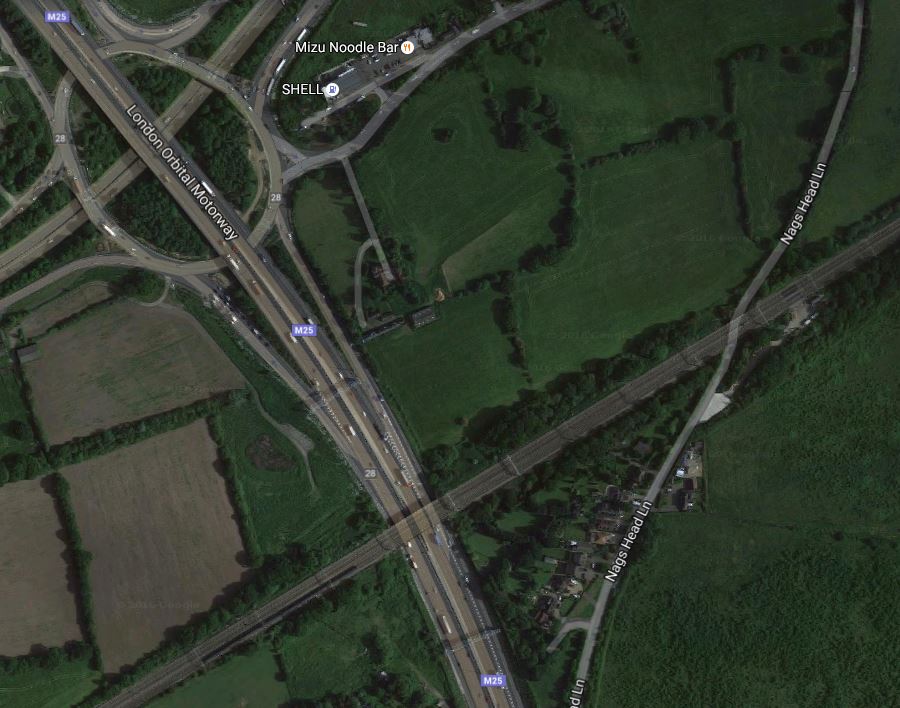
Crossrail And The M25 And A12 At Brentwood
I feel that this would be a logical site for a station with large and efficient Park-and-Ride facilities.
- It would be about thirty minutes from Liverpool Street station and seventy minutes from Heathrow.
- There would be over a dozen trains per hour (tph) to and from Central London.
- Long-distance trains to and from Chelmsford, Colchester, Ipswich, Norwich and Southend could call and have cross-platform interchange with Crossrail.
I suspect that there would be massive opposition to building the station.
A Park-and-Ride At Iver
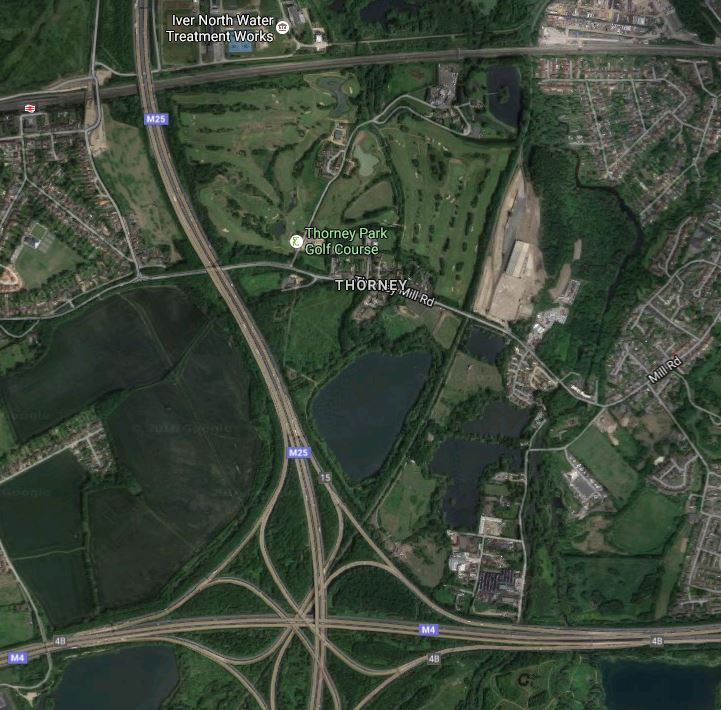
This Google Map shows Iver station and the M25 as it goes South from the M40 to the M4.
Crossrail And The M25 At Iver
I feel that this would be another logical site for a station with Park-and-Ride facilities.
In Network Rail Plans Another Tunnel Into Heathrow, I talked about plans to create a Western Rail Approach to Heathrow.
- The route starts between Langley and Iver stations, goes South roughly parallel with the M25 and then goes into Terminal 5 from the West.
- Much of the route is in tunnel.
Surely, if a Park-and-Ride site was to be built in the West of London, then these two projects should be combined.
Since I wrote about the PRT System in A Visit To Heathrow Terminal 5, I’ve met someone, who’s had a ride. Their view was totally positive on this new technology.
So I think there could be possibilities for a very futuristic transport system to Heathrow linked to Crossrail at Iver, in addition to the full rail option.
A Park-and-Ride At Abbey Wood
Abbey Wood Station
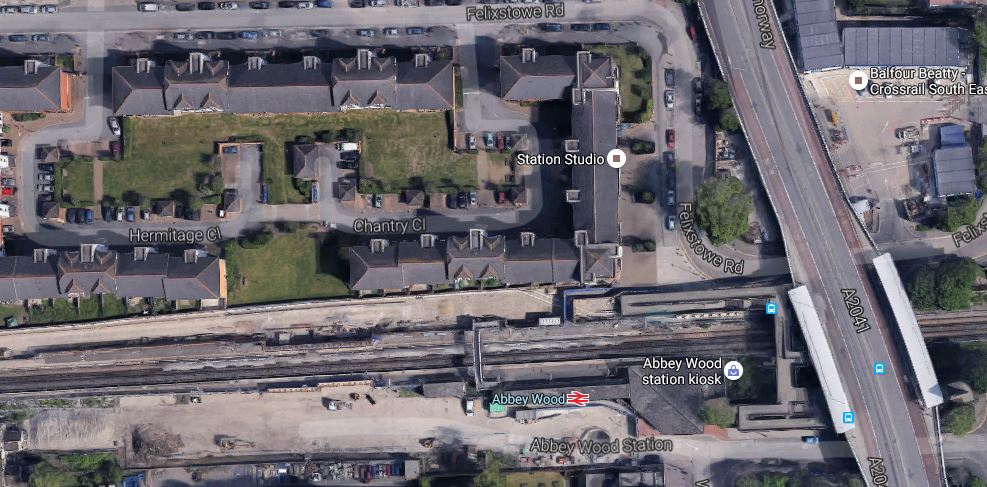
This Google Map shows the area of South East London around Crossrail’s terminus at Abbey Wood station..
There doesn’t appear to be much space around the station for a Park-and-Ride site.
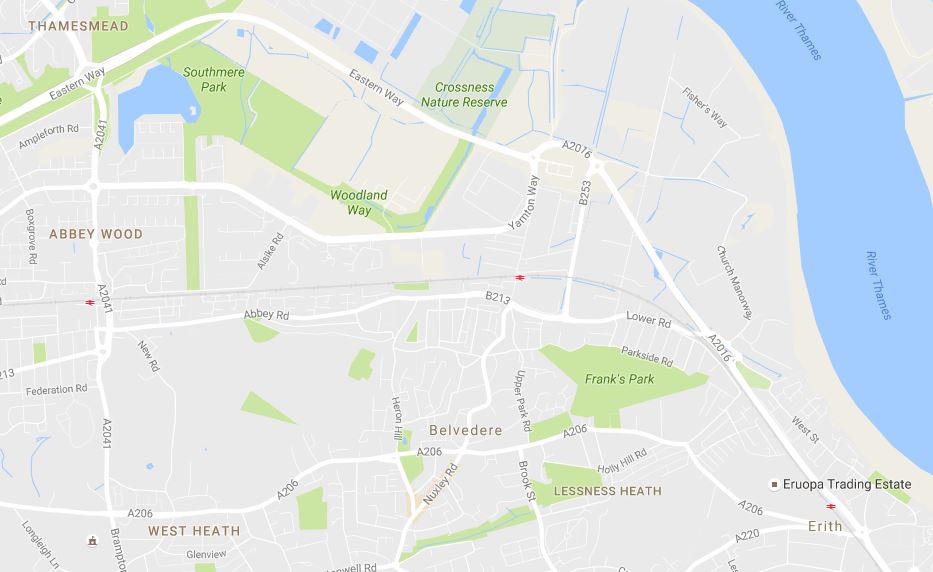
This Google Map shows the roads in the area.
Roads Around Abbey Wood Station
Abbey Road station is on Harrow Manor Way, which links two East-West routes; the A2016 and the A206.
As Abbey Wood is the only surface station on the South-Eastern branch, I don’t think that there is a great probability, that a large Park-and-Ride site can be built on the South-astern branch of Crossrail.
A Park-and-Ride On An Extended South-Eastern Branch
Crossrail have safeguarded an extension Gravesend, which is described in this section in Wikipedia.
The route to Gravesend has been safeguarded by the Department for Transport, although it was made clear that as at February 2008 there was no plan to extend Crossrail beyond the then-current scheme. The following stations are on the protected route extension to Gravesend: Belvedere, Erith, Slade Green, Dartford, Stone Crossing, Greenhithe for Bluewater, Swanscombe, Northfleet, and Gravesend
So does this route give possibilities for a large Park-and-Ride?
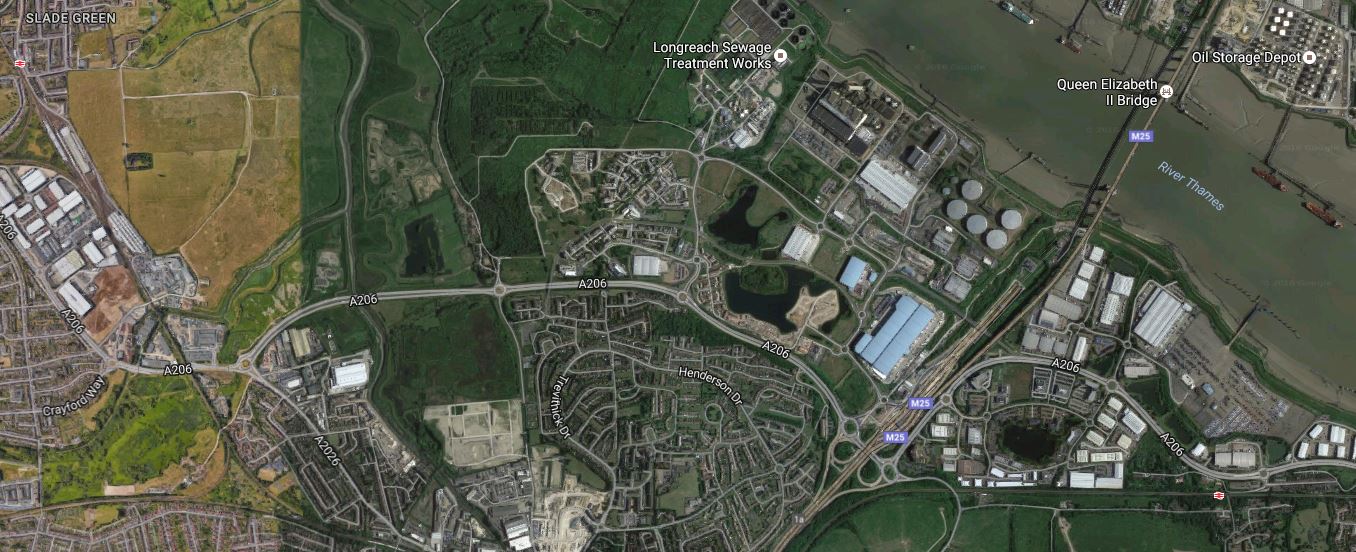
This Google Map shows how the proposed extended route of Crossrail, runs under the Queen Elizabeth II Bridge.
Crossrail, And The QE2 Bridge
Slade Green station is to the West of the bridge and the M25, in the top-left corner of the map, whilst Stone Crossing station is to the East, in the bottom right corner of the map.
This Google Map shows the route between Slade Green station and the Southern end of the bridge using the A206.
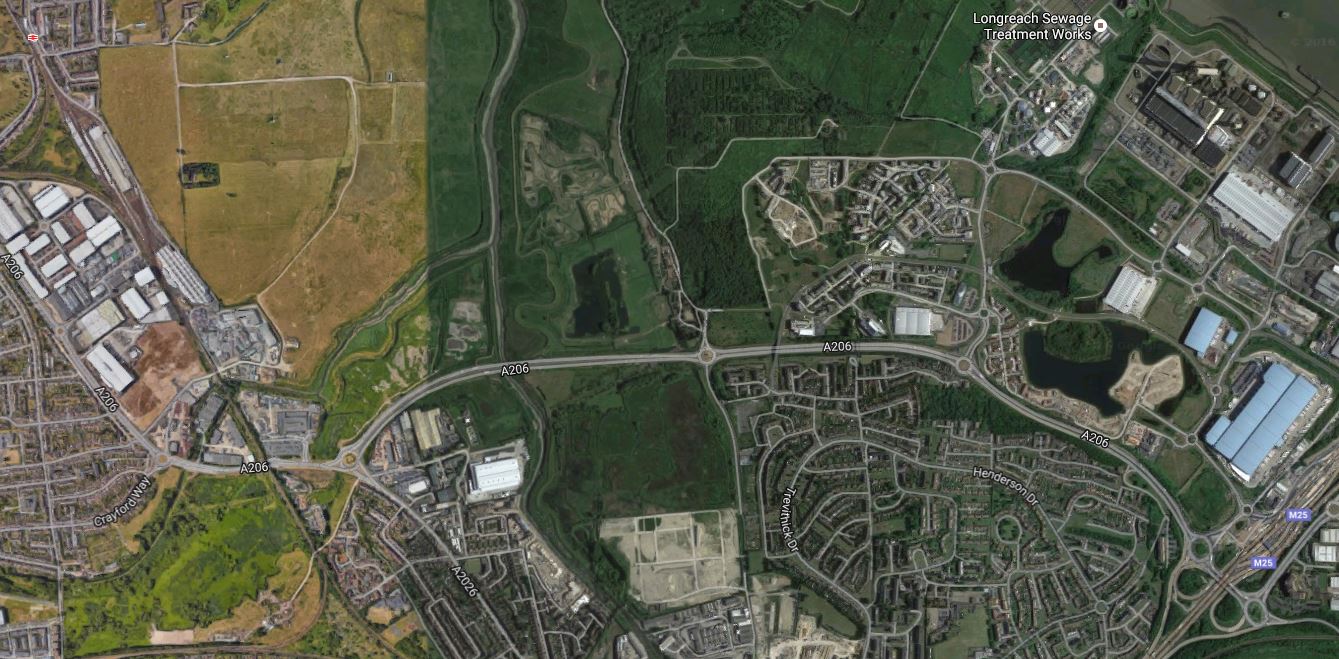
Slade Green Station To The QE2 Bridge
Slade Green station is in the top-left corner of the map and the Southern approach of the bridge in the bottom-right.
This Google Map shows between the bridge and Stone Crossing station.
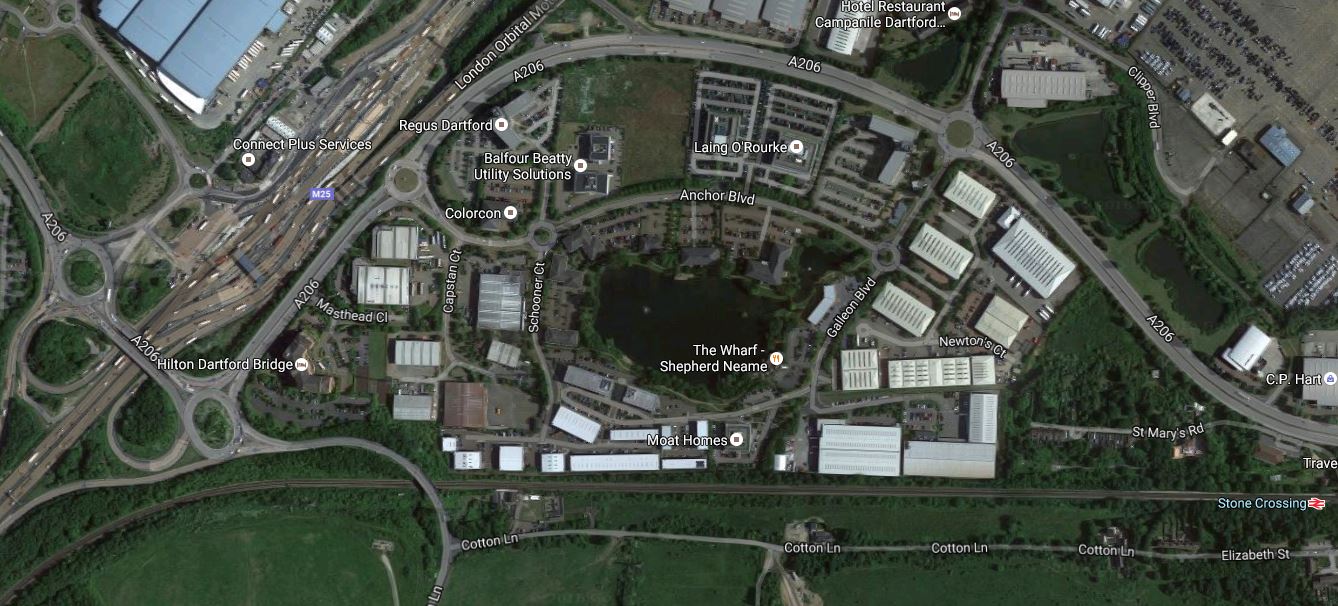
The QE2 Bridge To Stone Crossing Station
The Southern approach to the bridge is in the bottom-left with Stone Crossing station in the bottom-right.
After a brief look at both stations, using Wikipedia and Google Maps, the following can be said.
- Both stations are on the A206 road.
- The links to the M25 and M2 could probably be improved.
- There would appear to be space at both stations to build substantial parking.
- Both have at least two tph to and from Abbey Wood at the present time.
- From 2018, Thameslink will be running two tph will run from Rainham to Luton stopping at Stone Crossing, Slade Green and Abbey Wood stations.
- Nearly all the trains on the line will be 12-car trains.
Could the Park-and-Ride needs on the Abbey Wood branch be solved by increasing the parking at stations like Stone Crossing and Slade Green, with passengers using local trains and Thameslink to access Crossrail?
- There should be sufficient capacity in the 12-car trains to fit in a few short-distance travellers.
- The frequency between Abbey Wood and Rochester should be at least four tph.
- These trains will call at Slade Green, Dartford, Stone Crossing, Greenhithe, and Gravesend.
- The Crossrail frequency at Abbey Wood will be at least eight tph.
- Because of these frequencies, there shouldn’t be too much time wasted, waiting for a train at Abbey Wood.
I think that this shows that if the connecting trains to Abbey Wood have a medium to high frequency and there is plenty of parking along the line, then loyts of parking doesn’t need to be provided at Abbey Wood.
The more that I look at the lines and services in North Kent, it does appear that running Thameslink between Rainham and Luton via Greenwich, Abbey Wood and Dartford was a piece of very high-class thinking.
How Can We Deal With Air Pollution In The UK?
This article on the BBC is entitled Green group wins air pollution court battle.
This is the start of the article.
Campaigners have won the latest battle in legal action against the UK Government over levels of air pollution.
A judge at the High Court in London ruled in favour of environmental lawyers ClientEarth.
The group called air pollution a “public health crisis” and said the government has failed to tackle it.
The ruling in the judicial review called the government’s plan “woefully inadequate”.
As my mate Brian would have said, the \government has been screwed, glued and tattooed, by the Judge.
Does Pollution Affect Me?
I feel very strongly about this, as in the 1940s and 1950s, I suffered badly from the pollution of the time.
Now pollution levels are cutting out the vitamin D producing UVB rays of the sun. Could this be the rason for my low vitamin D levels?
No Magic Bullet
So what can the Government do to meet the European Emission Standards?
There is no magic bullet, but I believe that a raft of measures can gradually bring the levels of pollution down.
Reduction Of All Road Transport
One of London’s problems is that the amount of traffic in the city, means that a lot of the vehicles are stationery and just causing pollution.
I suspect this is a problem in many other cities.
So measures must be taken to reduce the level of all traffic.
- London needs more Park-and-Ride sites. Do other cities?
- Differential congestion charging and residents parking, so the polluter pays.
- More cycling superhighways to encourage cycling.
- City centre parking must be taxed, with the money funding public transport.
- Aggressive illegal parking control.
- Automatic box junction enforcement.
- 20 mph speed limit to make walking easier.
- Area average speed control.
- Reduction of the number of taxis and mini-cabs.
I particularly like the concept of having a grid of linked speed cameras in a city and then issuing a ticket automatically, if the limit is exceeded between two cameras.
Reduction Of Diesel-Powered Transport
As nitrogen dioxide from diesels is the main source of the pollution, we should aim to eliminate as many diesel-powered vehicles, as is practical.
- Reduction of diesel vehicles will need legislation, probably backed up with government money.
- Buses, taxis and local delivery vehicles will need to be hybrid or electric.
- There must be progressive bans for diesel vehicles not meeting the latest standards.
- Diesel scrapping schemes have been introduced in certain places.
I particularly like the idea, where in an experiment involving Sainsburys, supplies for the supermarkets were delivered by train into Euston at three in the morning and then delivered around Central London by low-emission vehicles.
Increase In Electrically-Powered Transport
This is the key to reducing a lot of pollution in cities.
- Electric and hybrid vehicles.
- Trams to replace buses.
- Development of electric rail lines.
- More cross-city rail lines like Crossrail 2 and the Camp Hill Line.
I also think we’ll see some innovative solutions, like the PRT system, I wrote about in A Visit To Heathrow Terminal 5.
The problem of improving transport systems is well-illustrated in Chelsea, where some selfish locals don’t want Crossrail 2, as it might hinder them driving their tractors.
More Details
I shall now expand a few of those topics and add a few more ideas.
They are in alphabetical order.
Battery Trains
Battery trains are an alternative to full electrification, where one or both ends of the line to be electrified, already have electrification.
The Greenford Branch is an obvious possibility.
- The line is only 4.3 km. long.
- The bay platform at West Ealing station could be easily electrified to charge the trains.
- Either a new train or a refurbished one with batteries could work the line.
- Two trains would be needed to run the promised four trains per hour service.
- Little new infrastructure would be needed.
I believe that battery trains are an affordable alternative to full electrification.
Battery Trams
Battery trams are being introduced into Birmingham to extend the Midland Metro. This article in the Railway Gazette, which is entitled Midland Metro trams to be converted for catenary-free operation, gives full details.
- The only construction required is to lay the rails, build the stops and install the signalling.
- Putting up overhead wires in a historic or sensitive city centre can be a legal and logistical nightmare and very expensive.
- Battery trams work in Seville and Nanjing.
- Trams charge the battery at either a charging station or when running under wires outside of the centre.
I can see a time, when in city centres, most trams will be battery-powered.
It will be interesting to see how Brummies take to their battery trams.
Connectivity Improvements
Compare arriving in Birmingham New Street and Euston stations, needing to go a few miles to say Centenary or Trafalgar Squares respectively.
At Euston, you go to the nearest bus stop, look up the spider map with all the destinations from Euston and it tells you how to get to about a hundred locations. Job done!
But in Birmingham, the brand new station doesn’t have that information on display in an easy-to-understand form.
Birmingham isn’t too bad and is certainly better than Manchester, but why can’t cities copy the London system.
You may get to these places easily, but the connecting and ticketing arrangements, tell you to bring your car next time.
Contactless Bank Card Ticketing
London now allows anybody to use their contactless bank card, as a ticket on all modes of public transport.
I don’t have the figures, but I believe that every time a new feature is added, like the new Bus Hopper, there is an increase in public transport usage.
After London’s experiences, I have no doubt, that contactless bank card ticketing increases the use of public transport and removes traffic from the roads.
Introducing contactless bank card ticketing, should be a condition of Central Government finance for public transport projects.
But every city in the world will introduce this form of ticketing!
Not doing it, will make sure visitors don’t come back and tell their friends what a crap place they’ve visited.
Cross-City Railways And Trams
A lot of cities and conurbations have a lot more traffic and the resulting pollution, as getting from one side of the city to the other is not easy, without driving through the city centre.
As an example, Crossrail will improve access to Heathrow from East and South-East London, where the alternative is a drive round the M25 or through the city centre, on congested roads. But Crossrail is only one of many successful cross-city routes in the UK.
- The Central, District, Jubilee, Metropolitan, Northern, Piccadilly and Victoria Lines of the London Underground.
- The East, North and West London Lines and the Gospel Oak to Barking Line of the London Overground.
- Thameslink in London
- The Northern Line in Liverpool.
- The Cross-City Line and Snow Hill Lines in Birmingham
- The East and West Coastway Lines in Brighton.
- The Metro in Newcastle.
- The Nottingham Express Transit in Nottingham.
- The Valley Lines in Cardiff
All of these lines are well-used and there are plans to upgrade those, not to the standard of the London Overground.
Efficient Deliveries
If I have my window open, I can sometimes hear several delivery trucks call at my various neighbours in a short period of time.
This is not efficient and surely something better can be done.
I was once offered delivery of a small parcel to my Local Sainsburys, which is about a hundred metres away.
Organised properly with enough drop points, that must be more efficient and convenient.
This is one we don’t need to worry about, as the big shopping groups will make it happen as they go for greater sales and more profits.
Park-And-Ride
Park-and-Ride is a good way of keeping, passenger cars away from City Centres.
Nottingham may be a lot smaller than London, but it is a city that has designed the Nottingham Express Transit with several Park-and-Ride sites, at the edges of the city.
Compare that with the non-existent Park-and-Ride provision on Crossrail, which I wrote about in Crossrail’s Park-And-Ride Facilities.
Railway Electrification
Electrification of rail routes across cities and replacing diesel trains with electric ones, is always an option to cut pollution.
Consider.
- London is currently electrifying the Gospel Oak to Barking Line and this will also allow noisy and polluting Class 66 diesel locomotives to replaced with electric ones on freight trains on this route.
- Lines in Liverpool and Birmingham are also being electrified.
- Electric trains also seem to be passenger magnets as the Class 378 trains of the London Overground have shown.
But remember, that every passenger on an electric train, can’t be using their car and is rteducing their pollution footprint.
Rewards For Going Car-Free
I have met several people recently, who have given up owning a car in Central London.
So could those, who don’t bring their car into the congested area, receive some form of reward.
 The Anonymous Widower