A Twelve-Car Ready Railway
On my trip to Rainham station in Kent, I went through numerous stations.
I took this picture.

A Twelve-Car Ready Railway
Note the blue 10-12 sign, which indicates the stopping point for trains between ten and twelve cars.
I’m pretty certain that all stations between London Bridge and Rainham can accommodate trains of this length, as there were blue twelves everywhere.
To the East of Rainham, a good proportion of the services are run by six-car Class 395 trains. As these can run in 12-car formations, I suspect that most platforms have been made long enough.
This railway is probably future-proofed with regards to train length.
It will certainly accept.
- Crossrail’s Class 345 trains.
- Highspeed’s Class 395 trains running as a twelve-car.
- Thameslink’s Class 700 trains, running as eight-car or twelve-car.
- Electrostars in various lengths.
Sadly, not all rail lines in the UK have been built with long enough platforms and extending some will be difficult.
Related Posts
A Design Crime – Ebbsfleet International Station
Between Abbey Wood And Belvedere Stations
Connecting North Kent And The Medway Towns To Ebbsfleet International Station
The Great Northern Metro
Govia Thameslink Railway have just announced their proposals to create a Great Northern Metro.
This was something I speculated about in A North London Metro.
GTR’s Proposals
This document on their web site gives these outline proposals.
- 2018 timetable will provide new connections and increase capacity.
- More frequent trains to provide a ‘true’ metro service.
- New air-conditioned trains from 2018.
It looks like I got those right
These are other proposals.
14 Trains Per Hour To/From Moorgate in The High Peak
Currently, a maximum of 12 trains per hour (tph) can get in and out from Moorgate station in the High Peak.
Raising it by two to 14 tph surprised me, but it says that they have found a way with the new trains to save time possibly by using better technology to change the voltage quicker at Drayton Park.
Effectively, the headway between trains is being reduced from five minutes to four and a half minutes.
One big advantage for people like me, who live close to a Southern station on the line, as I do with Essex Road station, is that going North in the morning rush and South in the evening rush, will be easy.
Services To/From Moorgate in The Off Peak
This is a summary of the changes in the Off Peak.
- 6 tph to Hertford North – Up from 3 tph
- 4 tph to Welwyn Garden City – Up from 3 tph
- 2 tph to Stevenage – Up from 1 tph
- Sunday services are 4 tph to both branches and 2 tph to Stevenage.
On the other hand, it appears there will now be no direct trains between Moorgate and Letchworth Garden City.
My local station is Essex Road and I regularly use the line to go North and South between Moorgate and Alexandra Palace.
Instead of a measly six tph, I’ll now be getting 10 tph all day, with 8 tph on Sundays.
I thought it would be four tph to Hertford North and Welwyn Garden City, so they’re actually going to do better than I thought they would.
An Eastward Shift In Services
The two branches used to be treated fairly equally with 3 tph on each.
But now it appears that Hertford North gets preference.
But then the East Coast Main Line will be getting Thameslink services.
- 6 tph stopping at Finsbury Park
- 0 tph stopping at Alexandra Palace
- 2 tph stopping at Potters Bar
- 2 tph stopping at Welwyn Garden City
- 6 tph stopping at Stevenage
Note that these are very much a summary.
Problem! – Will Thameslink Stop At Alexandra Palace?
,I do hope that Thameslink services not stopping at Alexandra Palace, when they stop at places like Oakleigh Park is a typo.
Consider.
- Alexandra Palace is the last station before the Hertford Loop Line splits from the East Coast Main Line.
- Alexandra Palace has an attraction that passengers might want to visit.
- Alexandra Palace station may well be served by Crossrail 2.
But most importantly, Alexandra Palace could have a cross-platform and/or same-platform interchange between Great Northern Metro services on both routes and Thameslink.
So it would be a good interchange for eighty-year-old Aunt Mabel going from Enfield Chase to Gatwick Airport with her suitacse full of presents for her grandchildren.
My Link To Thameslink Going North
I laid this out in My Links to Thameslink and I suspect from 2018, I’ll take bus to Essex Road station and then take the Great Northern Metro to Finsbury Park.
I don’t think I’ll be alone, in using the Great Northern Metro to get access to Thameslink to go North.
My Link To Thameslink Going South
I laid this out in My Links to Thameslink and I suspect from 2018, I accept what GTR offer or take the Essex Road and Finsbury Park route.
- Highbury And Islington Station
But what would help everybody within a couple of miles or so of Highbury and Islington station, is to upgrade the station to the Twentieth Century.
- Provide a second entrance on the North side of Highbury Corner roundabout, where there is a disused station entrance.
- Provide a better connection between the Northbound and Southbound deep-level platforms.
- Provide full step-free access to the deep-level platforms.
- Improve the lighting and ambience in the deep-level platforms.
Talking to someone who works in the station and is obviously familiar with the tunnels, he felt, as I do, that there are fairly simple solutions to sorting out the deep-level platforms.
I would do the following.
- Open up the second entrance.
- Create a subway under Holloway Road.
- Improve the walking routes and access to buses outside the station.
- Put lift access from the new entrance to a passage that would cross all four deep-level lines.
- Provide step-free access from the cross-passage to the four deep-level lines.
- Replace the stairs connecting the two Southbound platforms
Unfortunately, I suspect that the new road bridge over the railway in front of the station has probably been built without leaving space for the subway.
The Link To Crossrail
In Liverpool Street Crossrail Station Disentangled, I showed that changing between Crossrail and the Northern City Line at Moorgate could be easy.
Now that the service into Moorgate will be 10 tph all day, with 8 tph on Sundays, the line will become an important link to Crossrail for a large area of North London.
Consider.
- The Piccadlly Line has no connection with Crossrail, so changing at Finsbury Park for Moorgate might be the quickest way to get to the new line.
- The Victoria Line has no connection with Crossrail, but there is cross-platform interchange at Highbury and Islington with the Great Northern Metro.
- The North London Line connects to the Great Northern Metro at Highbury and Islington.
Taken together, the Piccadilly Line, Victoria Line and the Great Northern Metro, with help from more local transport methods like bikes and buses, will certainly improve the link to Crossrail for a large area of Enfield, Hackney, Haringey, Islington and Waltham Forest.
My only worry, is that as the Great Northern Metro gives such good access to Crossrail for such a wide area of London and South Hertfordshire, that the planned 10 tph into Moorgate all day, with 8 tph on Sundays, will be too low.
At least the improvements to the service are coming in around 2018, which would be before Crossrail opens in 2019.
Once Crossrail opens, I suspect, it will give me a better link to Thameslink, especially when I need to go South.
Conclusions
The service is a great improvement on the current one. But I predicted that!
The service is going to meet what I suspect, GTR hope it will.
As an average punter on the Northern City route from Essex Road, I will get a lot more trains.
I shall certainly use Essex Road and Finsbury Park to get to Cambridge.
It’s a pity it doesn’t help to use Thameslink in the difficult direction to the South.
Related Posts
GTR’s 2018 Timetable Consultation
Liverpool Street Crossrail Station Disentangled
German Trains With Batteries
One of my Google alerts found this article on Rail Journal, which is entitled DB to convert DMUs to bi-mode hybrid trains.
This is said.
GERMAN Rail (DB) has announced it is working with technical universities in Chemnitz and Dresden to develop bi-mode (diesel and electric) trains with lithium-ion battery storage. Between 2017 and 2021 DB intends to convert 13 existing Siemens class 642 Desiro Classic DMUs to hybrid bi-mode configuration.
It seems the Germans share my belief that trains with batteries are the future.
Along The North Kent Line
The North Kent Line has seen some changes in the last few years and could see some more in the next few.
Starting from the terminal in London Bridge, which itself is going through a massive upgrade, these improvements have been done or will happen.
Woolwich Arsenal
Woolwich Arsenal station has from 2009 provided a direct link to the Docklands Light Railway, giving a direct connection to London City Airport and Bank.
In 2019, Woolwich station on Crossrail will open, which will be two hundred metres away from Woolwich Arsenal station. This will probably not have a direct effect on Woolwich Arsenal station, but two stations will certainly stimulate development in the area.
I doubt many will use this station to interchange between the North Kent Line and Crossrail, as it looks like the connection at Abbey Wood station could be easier.
Abbey Wood
Abbey Wood station is being rebuilt and in December 2018, Crossrail will start services at the station to Paddington via Canary Wharf and the central tunnel.
Wikipedia says this about Crossrail services at Abbey Wood station.
Abbey Wood is the terminus of one of two eastern branches of Crossrail and will offer cross-platform interchange between terminating Crossrail services (at 12 trains per hour on new line) and existing Southeastern services (along existing tracks)
Plans are always being talked about to link Abbey Wood station to the North Bank of the Thames at either Gallions Reach or Barking Riverside.
I doubt it will happen in the next ten years.
Dartford
Dartford station has from the beginning of this year been one of London’s contactless ticketing stations, as is reported in Oyster and Contactless Bank Cards, under the station’s Wikipedia entry.
Don’t be surprised if this creeps outwards from London.
Greenhithe
Greenhithe station was rebuilt in 2008 and is the station for Bluewater.
Because of the Shopping Centre, Greenhithe will probably be a station that could benefit from contactless ticketing.
Northfleet
Northfleet station is the closest to Ebbsfleet International and we could see an improved link between the two stations.
As Northfleet could have upwards of four trains per hour (tph) stopping in both directions, a frequent shuttle bus, could be an affordable option.
Smaller Stations
There are several smaller stations between London Bridge and Gravesend.
I’m obviously not sure, but on a quick look all of them seem ready to accept the long trains, that will be used by both Thameslink and Crossrail.
Gravesend
Gravesend station was remodelled in 2013 and now has two long through platforms and a bay platform.
Crossrail to Gravesend
Under Future in the Wikipedia for Gravesend station, this is said.
In December 2008, the local authority for Gravesend (Gravesham Council), was formally requested by Crossrail and the Department for Transport, to sanction the revised Crossrail Safeguarding. This safeguarding provides for a potential service extension, from the current south of Thames terminus at Abbey Wood, to continue via the North Kent Line to Gravesend station. The Crossrail route extension from Abbey Wood to Gravesend and Hoo Junction, remains on statute. With current services from Gravesend to London Bridge, Waterloo East and London Charing Cross being supplemented by highspeed trains from the end of 2009 to St Pancras, the potential in having Crossrail services from central London, London Heathrow, Maidenhead and/or Reading, terminating at Gravesend, would not only raise the station to hub status but greatly contribute towards the town’s regeneration.
At present, Gravesend station has the following services.
Typical off-peak services are:
- 2 tph Highspeed services in each direction between London St. Pancras, Ebbsfleet intewrnation and Faversham and the East.
- 2 tph Southeastern services between London Charing Cross and Gillingham.
- 4 tph Southeastern services between London Charing Cross and Gravesend.
From 2019, Thameslink are saying that they will be running two tph between Rainham and Luton via Dartford and Greenwich.
This will mean that eight tph in each direction will go between Gravesend and Dartford, with another two tph going between Gravesend and Ebbsfleet International.
Because of the new Thameslink service, the train frequency between Gravesend and Gillingham will increase from the current four tph to six tph.
I think that although Gravesend will be the nominated terninal for Crossrail, the trains will actually reverse direction at Hoo Junction, so there will no need to use any platform space at Gravesend to prepare the train for its return journey.
At present, Wikipedia is saying this will be the Morning Peak service from Abbey Wood station.
- 4 tph to Heathrow Terminal 4
- 6 tph to Paddington
- 2 tph to West Drayton
With this Off Peak service.
- 4 tph to Heathrow Terminal 4
- 4 tph to Paddington
What the current North Kent Line can handle would probably determine how many Croosrail trains went to Gravesend and Hoo Junction.
But Crossrail won’t be short of seats to really provide a superb service to and from the Medway Towns.
I have a feeling that once Crossrail is running successfully, the traffic will define, if, when and how any extension to Gravesend is built.
But the creation of the extension to Gravesend and Hoo Junction will not be a massive undertaking.
- The depot and other facilities at Hoo Junction will have to be built.
- Could the depot at Hoo Junction be without electrification? If the Class 345 trains have sufficient onboard energy storage, which I believe could be the case and I wrote about in Bombardier’s Plug-and-Play Train, then this is a serious possibility, which would save money and time in building the depot.
- All platforms are probably long enough for the Class 345 trains.
- The Crossrail train specification says that trains must have the potential to be converted for third rail operation. The similar Class 710 trains will have this capability.
- Judging by my observations in Between Abbey Wood And Belvedere Stations, I feel that Abbey Wood station is probably capable of handling the same number of trains going further down the line.
- The signalling would have to be adjusted for the new service pattern.
But there would be no tunnelling and no major electrification on the North Kent Line.
Perhaps, the only major expenses would be.
- Building the depot/reversing sidings and facilities at Hoo Junction.
- Any extra trains needed.
- The cost of any rail link into Ebbsfleet International station.
So I doubt, we’ll be talking large numbers of billions.
Class 395 Trains
The Class 395 trains are normally six-car trains, but they can work in pairs as twelve-cars.
This probably means that any station, where the Highspeed service calls can handle a twelve-car train.
Strood
Strood station was updated in 2009 for the Highspeed service. Ready for Crossrail/Thameslink.
Rochester
Rochester station was rebuilt in 2016. Ready for Crossrail/Thameslink.
Chatham
Chatham station accepts twelve-car trains. Ready for Crossrail/Thameslink.
Gillingham
Ready for Crossrail/Thameslink.
Gillingham station is an interchange with two long platforms and a bay platform.
Five tph including two Highspeed services pass through the station and two tph go to and from London Charing Cross.
From 2019, there will be another two Thameslink tph between Luton and Rainham stopping at the station.
All this adds up to comprehensive service which stretches out to several London termini and the Kent Coast.
London Bridge, Abbey Wood and Gravesend all have at least four tph from Gillingham.
Rainham
Ready for Crossrail/Thameslink.
Rainham station has been updated in the last couple of years. An Update section in the Wikipedia entry, says this.
As part of the rebuild of Rochester Station, a new Up Bay Platform has been added.
Trains are now able to use this new platform as the East Kent Resignalling Project has been completed. At present, only a couple of trains use it in the evening rush hour.
The East Kent Resignalling Project is described on this page of the Southeastern web site.
These improvements are noted.
- New £26 million station at Rochester
- 250 new signals to replace old signalling equipment
- Disabled access at Strood station
- New bay platform at Rainham
- Safer level crossings fitted with obstacle detection technology at Aylesford, Yalding, Beltring, Wateringbury, East Farleigh, Cuxton and Snodland
- Centralisation of signalling control to Gillingham and the decommissioning of several signal boxes.
It would appear that a updated railway and a short series of good stations through the Medway Towns has been created, that can handle the increased frequencies.
Thameslink To Rainham
Modern Railways in August 2016, said that Thameslink would be running a two tph service between Luton and Rainham via Greenwich and Dartford.
The new bay platform at Rainham would be ideal for this service.
Onward From Rainham
There doesn’t seem to be many changes to what services are run now.
Conclusions
Everything seems to fit together rather well.
- Twelve-car platforms seem universal or at least where needed.
- The signalling is up to scratch.
- The new bay platform at Rainham makes the new two tph Thameslink service to Luton deliverable.
- To extend Crossrail to Gravesend probably just needs the new depot at Hoo Junction.
- Dartford to Rainham gets at least a four tph service with six car or longer trains.
The only area, where nothing has been published, is how to incorporate Ebbsfleet International station into the network.
I think it could suffer from London Overground Syndrome. This is my definition of the disease.
This disease, which is probably a modern version of the Victorian railway mania, was first identified in East London in 2011, when it was found that the newly-refurbished East London Line and North London Line were inadequate due to high passenger satisfaction and much increased usage. It has now spread across other parts of the capital and across the UK, despite various eradication programs.
It is usually solved by adding more capacity.
Related Posts
A Design Crime – Ebbsfleet International Station
Between Abbey Wood And Belvedere Stations
Connecting North Kent And The Medway Towns To Ebbsfleet International Station
Extending Crossrail To Gravesend
What Do You Do With A Problem Like Sheppey?
Liverpool Street Crossrail Station Disentangled
Liverpool Street station on Crossrail is a massive double-ended beast that stretches as far as Moorgate station, where it has a second entrance.
At the Liverpool Street end, it will connect to the following in addition the the Main Line services out of the station.
- Central Line
- Circle Line
- Hammersmith and City Line
- Metropolitan Line
At the Moorgate end, it will connect to the following lines.
- Circle Line
- Hammersmith and City Line
- Metropolitan Line
- Northern Line
- Northern City Line
This is a visualisation of how Moorgate station will look after it has been rebuilt for Crossrail, that I found on this web page from May 2009, so it may be out-of-date and wrong.
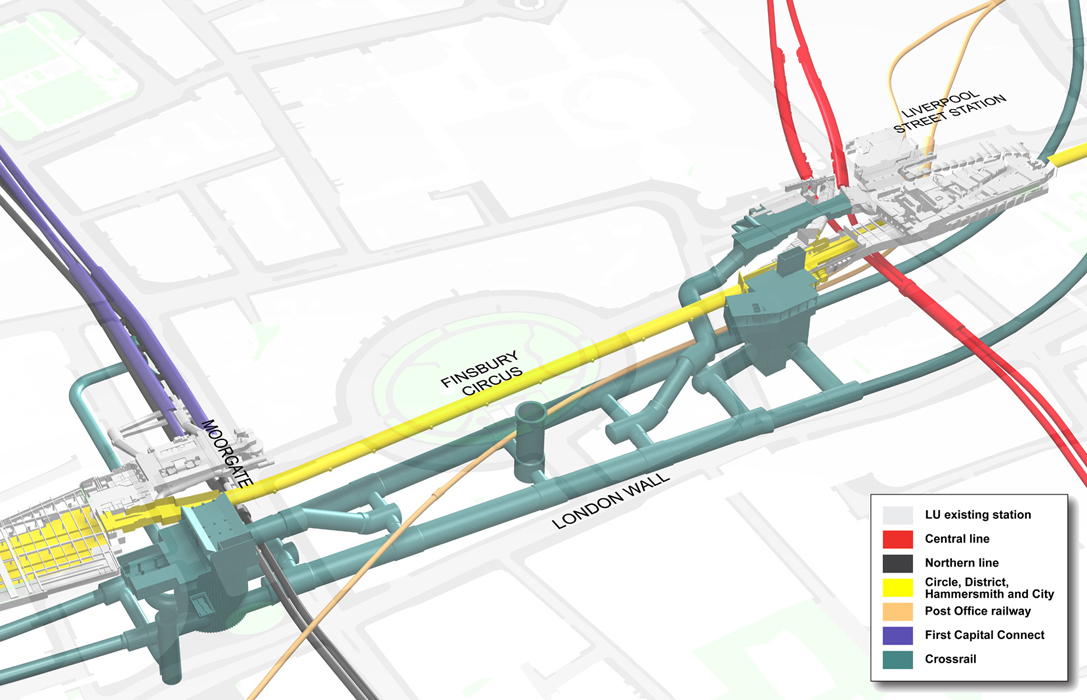
Liverpool Street-Moorgate Station Schematic
Note.
- The royal blue line is labelled at First Capital Connect, for which I use the term Northern City Line.
- Turquoise is used for new Crossrail work, with red and yellow for the Central and sub-surface lines.
- If you enlarge the image by clicking on it, you can clearly see the escalators, that currently connect the Northern City and Northern Lines to the ticket hall.
- Crossrail appears to have an escalator connection to an enlarged Moorgate ticket hall
- The deep level Northern Line, which is shown in black, passes over Crossrail, but underneath the escalators that lead down.
I have since seen a cross-section of the station from Liverpool Street to Moorgate and it would appear that a few improvements have been made.
- A pedestrian tunnel is now planned to run between the Crossrail platforms, which will effectively link the escalators at both ends, which connect into the station entrances and ticket halls upstairs.
- It could be possible that the entrance to the station has been moved towards the East.
The interchanges possible at the combined station are best described as comprehensive.
Changing Between Crossrail And The Northern Line
The Northern Line crosses the Moorgate end of the Crossrail platforms at a right angle and it would appear to have a short escalator or step connection to a cross-passage between the two Crossrail platforms.
The only problem, is that you’ll have to make sure, you’re at the Western end of the Crossrail train.
Changing Between Crossrail And The Northern City Line
It would appear that Crossrail and the Northern City Lines are at roughly the same level and are very well connected.
- Passengers would appear to be able to take an escalator or lift from one set of platforms to the ticket hall and then take another set down to the other line.
- There also appears to be another independent passage, which starts midway down the Northern City Line platforms and takes a circuitous route to the Crossrail platforms.
- There may be another convenient route, where you go via the Northern Line and reappear on the other set of platforms.
It certainly won’t be a difficult interchange for passengers, although you’ll have to remember to position yourself at the Western end of the Crossrail train.
Changing Between Crossrail And The Central Line
The Central Line crosses the Liverpool Street end of the Crossrail platforms at a right angle and it would appear to have a short escalator or step connection to a cross-passage between the two Crossrail platforms.
The connection is not as neat as the Northern Line one at the other end of the Crossrail platforms
The only problem, is that you’ll have to make sure, you’re at the Eastern end of the Crossrail train.
Changing Between Liverpool Street And Moorgate
I’ve read somewhere, that the double-ended station is designed so that passengers can walk easily between the two ends of the station.
My view of the cross-section of the station from Liverpool Street to Moorgate confirms it is a feasble route.
- Passengers at Liverpool Street will descend to an intermediate level, from where the Central Line can be accessed.
- A walk of perhaps fifty metres will take you under the Central Line tunnels and to an escalator, that will descend to a wide passage between the Crossrail platforms.
- A walk of perhaps a hundred metres will give several entrances to the Crossrail platforms and take you to an escalator, which takes you to the intermediate level at Moorgate station.
- A level walk of perhaps thirty metres or so, will take you over the Northern Line tunnels and to an escalator, that gives direct access to the booking hall at Moorgate.
So a passenger from perhaps Ipswich to Hatfield on a very wet day, will dive on arrival at Liverpool Street into the Crossrail station and use it as a dry walking route to the Northern City platforms at Moorgate.
I suspect that an Oyster card or a contactless bank card will give free access to the route.
The same route will give Moorgate passengers access to the Central Line and Liverpool Street passengers access to the Northern Line.
Related Posts
A Numerical Analysis Of Great Northern’s Class 717 Trains
Could A Reversing Siding Be Built At Alexandra Palace?
Could A Reversing Siding Be Built At Alexandra Palace?
Could Passenger Services Be Run On The Canonbury Curve?
A Numerical Analysis Of Great Northern’s New Class 717 Trains
Great Northern is replacing forty-four Class 313 trains of three-cars with twenty-five Class 717 trains of six-cars to work all services out of Moorgate station and probably some out of Kings Cross station.
So 132 carriages are being replaced with 150, which increases the space by about six percent.
But how many trains are actually needed to work the various routes?
Moorgate To Welwyn Garden City
Moorgate to Welwyn Garden City is a 3 trains per hour (tph) service.
The trip takes 51 minutes, so this means a train can go from Welwyn Garden City to Moorgate and back in under two hours.
We get the number of trains as follows.
- 3 tph needs 6 trains.
- 4 tph needs 8 trains.
- 6 tph needs 12 trains.
Moorgate To Hertford North
Moorgate to Hertford North is a 3 tph service.
,The trip takes 50 minutes, so the needs for the Hertford North are as follows.
- 3 tph needs 6 trains.
- 4 tph needs 8 trains.
- 6 tph needs 12 trains.
Moorgate To Letchworth Garden City
As the extended train to Letrhworth Garden City takes 25 minutes from Hertford North, this probably means that the trains needed for the extended service are as follows.
- 1 extended tph needs another train.
- 2 extended tph needs another 2 trains.
Total Trains On The Northern City Line
So this gives the following totals for trains on the Northern City line.
- 3 tph on each route with 1 tph to Letchworth Garden City needs 13 trains.
- 4 tph on each route with 1 tph to Letchworth Garden City needs 17 trains.
- 4 tph on each route with 2 tph to Letchworth Garden City needs 18 trains.
- 6 tph on each route with 1 tph to Letchworth Garden City needs 25 trains.
I don’t think we’ll see six tph on both routes, as that could be too many trains for the tunnel to Moorgate, which probably has a capacity of less than 10 tph.
Kings Cross To Foxton
In addition, Great Northern run an hourly service between Kings Cross and Foxton, which could use the new trains.
The service takes 75 minutes.
So as the service actually starts and finishes at Cambridge, this probably means the round trip is three hours, so the service will require the following number of trains.
- 1 tph would require 3 trains.
- 2 tph would require 6 trains.
Conclusion
The mathematics say to me, that the number of trains ordered is enough for the following services.
- 4 tph from Moorgate to Welwyn Garden City – 8 trains
- 4 tph from Moorgate to Hertford North – 8 trains
- 2 tph extended from Hertford North to Letchworth Garden City. – 2 trains
- 2 tph from Kings Cross to Foxton and Cambridge – 6 trains.
Although this doesn’t mean that this will be the service pattern.
It’s just if Great Northern wanted to go from 3 tph to 4 tph on the Northern City routes and increase other services, they have ordered enough trains.
Related Posts
Could A Reversing Siding Be Built At Alexandra Palace?
The Level Crossing At Lydney
This article in Rail News talks about the closure of the Severn Tunnel for electrification and the effects, that this will have locally.
This is said.
The closure means many more passenger and freight trains running through the Cotswolds and the Forest of Dean via Stroud, Gloucester and Lydney, and the extra rail traffic means that a number of level crossings will be much busier, with an extra 44 passenger trains and 27 freight using the diversion from Swindon on an average day.
So I searched and found this Google Map of Lydney station and the adjacent level crossing.
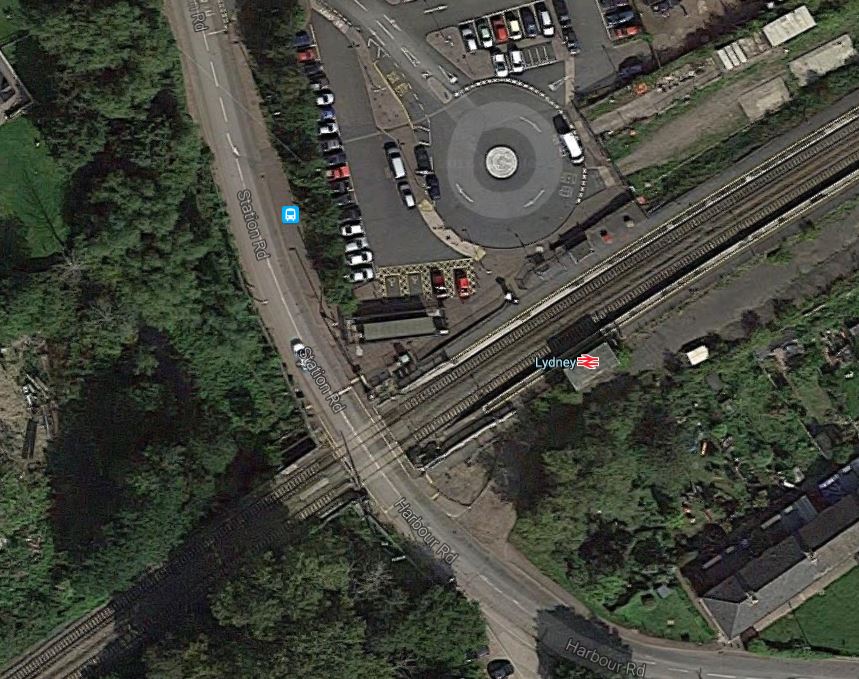
Lydney Station and Level Crossing
It looks like they’ll be having an interesting time during the closure.
A Level Crossing That Should Be Closed
One of my Google Alerts found this article in the Bicester Advertiser, which is entitled Tunnel could be dug under Bicester London Road railway line to keep route open.
So I found a Google Map of the crossing and Bicester Village station.
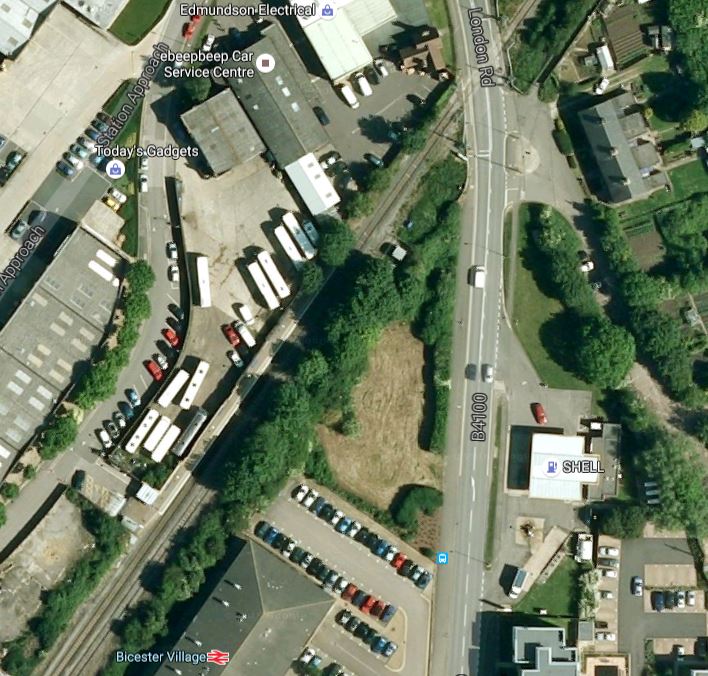
Bicester Village Station And The London Road Level Crossing
If you consider that when the next phase of the East West Rail Link opens in a few years time, the following passenger trains will be going through the station.
- 2 trains per hour (tph) from London Marylebone to Oxford
- 2 tph from Oxford to London Marylebone
- 2 tph from Reading to Bedford/Milton Keynes
- 2 tph from Bedford/Milton Keynes to Reading
That is 8 tph for a start and when you add in a few long freight trains, it is surely a good idea to close the level crossing and dig a road tunnel under the rail line.
Sometimes You Win Slow
Announcements on the East West Rail Link, haven’t exactly come thick and fast, the last one being the route of the section between Bedford and Cambridge, that I talked about in Is Cambridge University Being Pragmatic About The East West Rail Link?, was published in March 2016.
This article on Mix96 is entitled Winslow’s Station Is One Step Closer.
This is said.
Now a station for the town is one step nearer as Bucks County Council has paid £900,000 for a site to build it.
That looks like nine hundred thousand small steps to me.
Winslow station is to be built to the North-West of the town and this Google Map shows the location.
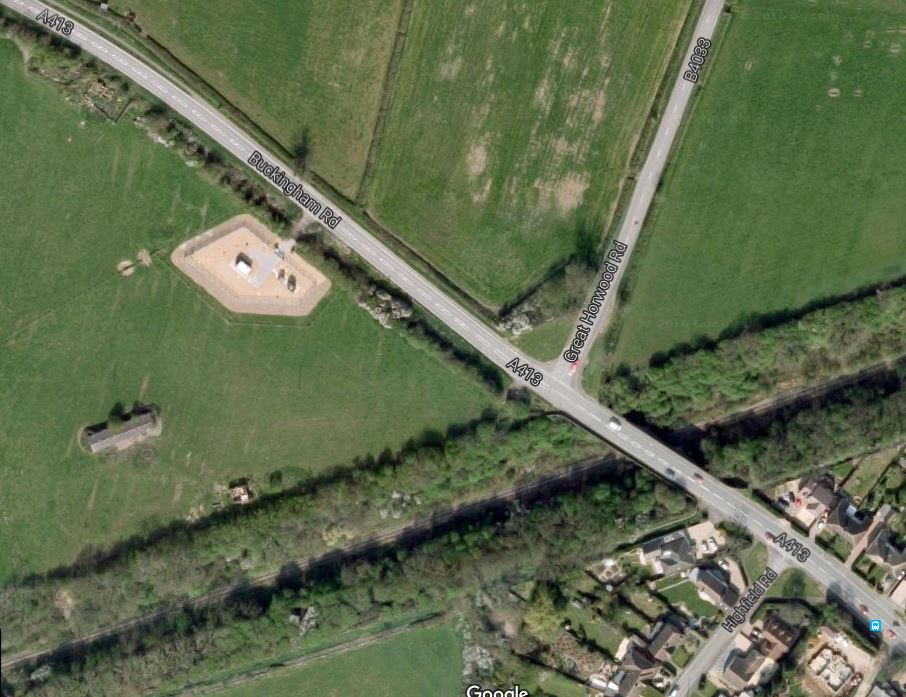
Winslow Station Site
The lower black scar contains a rusty single-track and is all that remains of the original Varsity Line
When open the station will have two services.
- London Marylebone to Milton Keynes Central via Aylesbury, Winslow and Bletchley
- Reading-to Bedford via Oxford, Winslow, Bletchley and possibly Milton Keynes Central.
Wikipedia talks about opening one train per hour on both services in 2019.
Crossrail 2 And The Chingford Branch Line
The Chingford Branch Line will be effected both during construction and after opening by Crossrail 2..
In Rumours Of Curves In Walthamstow, I said this.
But with the design stage of Crossrail 2 well underway, I do wonder, if connecting Chingford station and the related sidings to the West Anglia Main Line, might give Crossrail 2 better options to build the line or provide alternative services, whilst the West Anglia Main Line is rebuilt through the area.
I still think that the Chingford Branch Line will be an invaluable resource to help get the Northern end of Crossrail 2 built.
If the Coppermill Curve is built in the near future, I feel the main reason will be to help build Crossrail 2 and rebuild the West Anglia Main Line to four-tracks.
Once Crossrail 2 is open, I think that the two lines will be connected together at Seven Sisters/South Tottenham. There is a lot of scope for a major passenger-friendly interchange and as it will be a few years after Crossrail, the design will draw on the experience of theearlier line.
Conclusion
The Chingford Branch Line will end up being tightly linked to Crossrail 2.
Related Posts
Improving The Chingford Branch Line
Could Reversing Sidings Be Used On The Chingford Branch Line?
Could The Hall Farm Curve Be Built Without Electrification?
New Stations On The Chingford Branch Line
Rumours Of Curves In Walthamstow
Will Walthamstow Central Station On The Victoria Line Be Expanded?
 The Anonymous Widower