Ambitious £3bn Pumped Hydro Project At Loch Ness Moves Forward
The title of this post is the same as that of this article on Sustainable Times.
These are the two introductory paragraphs.
A £3 billion pumped storage hydro (PSH) project near Scotland’s iconic Loch Ness is one step closer to becoming a reality. Glen Earrach Energy (GEE) confirmed on April 25th that it has officially submitted the planning application for its ambitious 2gw scheme.
If greenlit, this project would represent nearly three-quarters of the total PSH capacity planned for Loch Ness, contributing 34 GWh of the region’s 46 GWh storage goal. But it’s not just the storage that stands out. This development would also account for two-thirds of the generating capacity, all while using just half of the water previously considered. To put it into perspective, the project’s capacity would be on par with the combined output of around 800 onshore wind turbines scattered throughout the Highland Council area.
Note.
- The generating and pumping capacity for this ambitious scheme is given as 2 GW. Only three in China and one in the United States are larger.
- The storage capacity of 34 GWh will make it the largest in the UK, possibly the second largest in Europe to Ulla-Førre in Norway and one of the ten largest in the world.
- A projected 10% reduction in the UK grid’s carbon footprint is claimed.
- The cost of three billion is high, but compare that with the tens of billions quoted for the 3.26 GW Hinckley Point C.
The Glen Earrach scheme is not short on superlatives and the article in Sustainable Times is worth a thorough read.
Fifth Hydro Project Proposed At Loch Ness, is based on a BBC article of the same name.
These were my thoughts in the related post.
The Existing Hydro Schemes On Loch Ness
According to the BBC article, there are two existing hydro schemes on Loch Ness.
- Foyers is described on this web site and is a reasonably modern 305 MW/6.3 GWh pumped storage hydroelectric power station, that was built by SSE Renewables in the last fifty years.
- Glendoe is described on this web site and is a modern 106.5 MW conventional hydroelectric power station, that was built by SSE Renewables in the last twenty years.
Foyers and Glendoe may not be the biggest hydroelectric power stations, but they’re up there in size with most solar and onshore wind farms. Perhaps we should look for sites to develop 100 MW hydroelectric power stations?
The Proposed Hydro Schemes On Loch Ness
According to the BBC article, there are four proposed hydro schemes on Loch Ness.
- Coire Glas is described on this web site and will be a 1.5GW/30 GWh pumped storage hydroelectric power station, that is being developed by SSE Renewables.
- Fearna is described on this web site and will be a 1.8GW/37 GWh pumped storage hydroelectric power station, that is being developed by Gilkes Energy.
- Loch Kemp is described on this web site and will be a 600MW/9 GWh pumped storage hydroelectric power station, that is being developed by Statera.
- Loch Na Cathrach is described on this web site and will be a 450MW/2.8 GWh pumped storage hydroelectric power station, that is being developed by Statktaft.
In addition there is, there is the recently announced Glen Earrach.
- Glen Earrach is described on this web site and will be a 2GW/34 GWh pumped storage hydroelectric power station, that is being developed by Glen Earrach Energy.
Note.
- The total power of the seven pumped storage hydroelectric power stations is 4.76 GW.
- The total storage capacity is 89.1 GWh.
- The storage capacity is enough to run all turbines flat out for nearly nineteen hours.
I estimate that if 2 GW/34 GWh of pumped storage will cost £3 billion, then 4.76 GW/89.1 GWh of pumped storage will cost around £7-8 billion.
How Is The XLinks Project Progressing?
The Wikipedia entry for the XLinks project has this introductory paragraph.
The Xlinks Morocco-UK Power Project is a proposal to create 10.5 GW of renewable generation, 20 GWh of battery storage and a 3.6 GW high-voltage direct current interconnector to carry solar and wind-generated electricity from Morocco to the United Kingdom. Morocco has far more consistent weather, and so should provide consistent solar power even in midwinter.
I ask the question in the title of this post, as there are two articles about the XLinks project in The Times today.
This article is optimistic and is entitled Xlinks Morocco Project Could Throw Britain A Renewable Energy Lifeline.
On the other hand this article is more pessimistic and is entitled Britain ‘Risks Losing Out’ On Green Energy From The Sahara.
This is the first paragraph of the second article.
Sir Dave Lewis has complained of “frustratingly slow” talks with the government over an £18 billion plan to generate power in the Sahara and cable it to Britain. The former Tesco chief executive has warned that the energy could be routed elsewhere unless ministers commit to the scheme.
It appears there have been little agreement on the price.
I have some thoughts.
Will XLinks Get Funding?
Xlinks is going to be privately funded, but I have doubts about whether the funding will be made available.
As an engineer, who was involved in many of the major offshore projects of the last forty years of the last century, I believe that the XLinks project is feasible, but it is only 3.6 GW.
These wind farm projects are also likely to be privately funded.
- SSE’s Berwick Bank project opposite Berwick is 4.1 GW
- Aker’s Northern Horizon off Shetland is 10 GW.
- The Scotwind Leasing Round is 25 GW.
- There is talk of 10 GW being possible off East Anglia.
- 50 GW may be being possible in the Celtic Sea.
- BP is planning 3 GW in Morecambe Bay.
Many of these enormous wind power projects are looking for completion on or before 2030, which is the date given for the Morocco cable.
I do wonder, if those financing these energy projects will find these and other projects better value than a link to Morocco.
Is the Project Bold Enough?
Consider.
- Spain has high levels of solar, wind and hydro power.
- France is developing wind to go with their nuclear.
- Both countries and Portugal, also have mountains for sensibly-sized pumped-storage hydroelectric power stations.
- France, Spain, Portugal and Ireland also have the Atlantic for wind, tidal and wave power.
Perhaps, the solution, is an Atlantic interconnector linking the UK, Ireland, France, Spain, Portugal and Gibraltar to West Africa.
Any excess power would be stored in the pumped-storage hydroelectric power stations and withdrawn as required.
In the UK, the National Grid are already using the huge 7800 GWh Ulla-Førre pumped-storage hydroelectric power station to store excess wind-generated energy using the North Sea Link from Blyth.
To my mind XLinks is just a UK-Morocco project.
BP’s Project In Mauretania
In bp And Mauritania To Explore Green Hydrogen At Scale, I discussed BP’s deal to create green hydrogen in Mauretania.
Is this a better plan, as hydrogen can be taken by tanker to where it is needed And for the best price.
Conclusion
I wouldn’t be surprised to see the XLinks project change direction.
National Grid’s North Sea Link Strengthens Electricity Supply And Repays Its Carbon Cost In Just Six Months
The title of this post, is the same as that of this press release from National Grid.
These are three bullet points from the press release.
- World’s longest subsea electricity cable has been in operation since Oct 2021.
- 5.7 terawatt (TWh) hours of clean power have been shared between GB and Norway, strengthening security of supply for consumers in both countries.
- It has saved 800,000 tonnes of carbon in the first year, paying off its carbon cost after only six months of operation.
This must surely be considered a good start.
These two paragraphs describe the operation in the first year.
During its first year of operation, the link has imported 4.6 TWh of clean electricity – enough to power 1.5 million British homes for a year.
North Sea Link has also exported 1.1 TWh to Norway, demonstrating the vital role that interconnectors play in strengthening energy security and maximising the benefits of clean energy sources for consumers across the UK and Europe.
In The Monster In The Mountains That Could Save Europe’s Winter, I describe what makes the North Sea Link so important.
It gives the UK access to the Norwegian Bank Of Electricity or Ulla-Førre, which is a complex of five hydroelectric power stations and a massive lake in the Norwegian mountains to the East of Stavanger.
- The power stations have a total generating capacity of 2.1 GW.
- Lake Blåsjø is able to hold enough water to generate 7800 GWh of electricity.
- Ulla-Førre can also supply electricity to Germany, through the 1.4 GW NordLink.
If Ulla-Førre has a problem, it is that if Norwegian weather is dry, the filling of Lake Blåsjø could be difficult, which is where the interconnector comes into its own, as excess UK wind power or the 1,185 MW Hartlepool nuclear power station, can be used to send electricity to Norway for storage.
In An Update To Will We Run Out Of Power This Winter?, I predicted we will add the following capacity to our renewable generation in the next three years.
- 2023 – 2925 MW
- 3024 – 3726 MW
- 2025 – 6476 MW
This is a total of 13,127 MW.
As a Control Engineer, I can see the following happening.
- Several of the UK’s gas-fired power stations will be mothballed.
- Some of the UK’s gas-fired power stations will be fitted with advanced control systems so they can supply more precise amounts of electricity.
- Some UK electricity is stored in Ulla-Førre for onward sale to Germany.
- Some UK electricity is stored in Ulla-Førre for withdrawal back to the UK, when needed.
One of Ulla-Førre’s main tasks could be to ensure that no UK electricity is wasted.
Conclusion
With all these wind generated electricity and electricity transfers, the Crown Estate, National Grid and the Treasury should be coining it.
The Germans are already building the 1.4 GW NeuConnect between the Isle of Grain and Wilhelmshaven to import more electricity.
But I do believe that another interconnector will be needed.
The Monster In The Mountains That Could Save Europe’s Winter
Ulla-Førre is a complex of five hydroelectric power stations and a massive lake in the Norwegian mountains to the East of Stavanger.
- The power stations have a total generating capacity of 2.1 GW.
- Lake Blåsjø is able to hold enough water to generate 7800 GWh of electricity.
- The complex is at the Norwegian end of the North Sea Link to Blyth in England.
This YouTube video from Statkraft, explains how Ulla-Førre was built.
I have some further explanation and thoughts.
What Is The Operating Philosophy Of The North Sea Link?
This press release from National Grid says this.
The Norwegian power generation is sourced from hydropower plants connected to large reservoirs, which can respond faster to fluctuations in demand compared to other major generation technologies. However, as the water level in reservoirs is subject to weather conditions, production varies throughout seasons and years.
When wind generation is high and electricity demand low in Britain, NSL will enable renewable power to be exported from the UK, conserving water in Norway’s reservoirs. When demand is high in Britain and there is low wind generation, hydro power can be imported from Norway, helping to ensure secure, affordable and sustainable electricity supplies for UK consumers.
It almost seems to me, that the North Sea Link is part of a massive pumped-storage system, where we can bank some of our wind-generated electricity in Norway and draw it out when we need it.
Suppose There Is No Wind In The UK And Norway’s Giant Reservoirs Need Filling?
We could always throw on a substitute, which is the 1,185 MW Hartlepool nuclear power station.
- Unfortunately, this will close in 2024.
- Wikipedia indicates that Hartlepool’s closure has been on and off several years, so I don’t think it will be delayed again.
- A new station probably couldn’t be commissioned until 2029, at the earliest.
But over the next few years these wind farms will be connected to the North-East.
- Sofia wind farm should commission the 1.4 GW Phase 1, which connects to Teesside in 2023.
- Dogger Bank wind farm should commission 3.6 GW, which connects to Teesside and Humberside in 2025.
- The 4.1 GW Berwick Bank wind farm will have a second connection to Blyth by 2030. Say 2 GW!
There’s more than enough wind there to fill up Norway’s reservoirs and replace Hartlepool nuclear station.
Will Ulla-Førre Be Expanded?
It does sound to me that the video does imply that Ulla-Førre could be expanded.
Will Norwegian Pumped Storage Hydro Help Us Through The Winter?
In UK To Norway Sub-Sea Green Power Cable Operational, I discussed the North Sea Link interconnector to Norway.
The North Sea Link is no ordinary interconnector, as it is a lot more than a 1.4 GW cable linking the electricity grids of the UK and Norway.
- At the UK end, there is an increasing amount of wind power. The UK has added 3.5 GW in 2022.
- At the Norway end, there is the 2.1 GW Ulla-Førre hydropower complex.
- The water to generate electricity at Ulla-Førre comes from the artificial Lake Blåsjø, which contains enough water to generate 7.8 TWh of electricity.
- The storage capacity at Ulla-Førre is 857 times greater than that at the UK’s largest pumped storage hydroelectric power station at Dinorwig in North Wales.
- The power complex consists of five power stations and some can also be used as a pump powered by UK electricity to fill Lake Blåsjø with water.
Effectively, the North Sea Link, the Ulla-Førre power complex and Lake Blåsjø are a giant pumped storage hydro battery, that can either be filled by Norwegian precipitation and water flows or by using surplus UK electricity, through the North Sea Link, which opened a year ago.
If the Norwegian precipitation goes on strike, the only way to fill Lake Blåsjø is to use surplus UK power, which I suspect will be British wind and nuclear in the middle of the night!
But then I thought we will be short of electricity this winter.
- I suspect we will be at times, but then at others there will be a surplus.
- So the surplus will be pumped to Norway to top up the reservoir at Lake Blåsjø.
- When we are short of electricity, the Norwegians will turn water back into electricity and send it back through the North Sea Link.
It will be more sophisticated than that, but basically, I believe it provides us with the electricity we need, at the times, when we need it.
I wouldn’t be surprised to be told, that we’ve been squirreling away overnight wind energy to Norway over the last few months.
I have written more about Ulla-Førre in The Monster In The Mountains That Could Save Europe’s Winter.
It includes a video about the building of the complex.
UK To Norway Sub-Sea Green Power Cable Operational
The title of this post is the same as that of this article on the BBC.
This is the first two paragraphs.
The world’s longest under-sea electricity cable, transferring green power between Norway and the UK, has begun operation.
The 450-mile (725km) cable connects Blyth in Northumberland with the Norwegian village of Kvilldal.
The BBC article is based on this press release from National Grid.
The link has been called the North Sea Link (NSL).
These are some thoughts.
What Is The Capacity Of The North Sea Link?
The National Grid press release says this.
[The link] will start with a maximum capacity of 700 megawatts (MW) and gradually increase to the link’s full capacity of 1400MW over a three-month period.
It also says this.
Once at full capacity, NSL will provide enough clean electricity to power 1.4 million homes.
It is more or less equivalent to two or three gas-fired power stations.
What Is The Operating Philosophy Of The North Sea Link?
The National Grid press release says this.
The Norwegian power generation is sourced from hydropower plants connected to large reservoirs, which can respond faster to fluctuations in demand compared to other major generation technologies. However, as the water level in reservoirs is subject to weather conditions, production varies throughout seasons and years.
When wind generation is high and electricity demand low in Britain, NSL will enable renewable power to be exported from the UK, conserving water in Norway’s reservoirs. When demand is high in Britain and there is low wind generation, hydro power can be imported from Norway, helping to ensure secure, affordable and sustainable electricity supplies for UK consumers.
It almost seems to me, that the North Sea Link is part of a massive pumped-storage system, where we can bank some of our wind-generated electricity in Norway and draw it out when we need it.
I would suspect that the rate and direction of electricity transfer is driven by a very sophisticated algorithm, that uses detailed demand and weather forecasting.
As an example, if we are generating a lot of wind power at night, any excess that the Norwegians can accept will be used to fill their reservoirs.
The Blyth Connection
This page on the North Sea Link web site, describes the location of the UK end of the North Sea Link.
These three paragraphs describe the connection.
The convertor station will be located just off Brock Lane in East Sleekburn. The site forms part of the wider Blyth Estuary Renewable Energy Zone and falls within the Cambois Zone of Economic Opportunity.
The converter station will involve construction of a series of buildings within a securely fenced compound. The buildings will be constructed with a steel frame and clad with grey insulated metal panels. Some additional outdoor electrical equipment may also be required, but most of the equipment will be indoors.
Onshore underground cables will be required to connect the subsea cables to the converter station. Underground electricity cables will then connect the converter station to a new 400kV substation at Blyth (located next to the existing substation) which will be owned and operated by National Grid Electricity Transmission PLC.
This Google Map shows the area.

Note.
- The light grey buildings in the North-West corner of the map are labelled as the NSL Converter Station.
- Underground cables appear to have been dug between the converter station and the River Blyth.
- Is the long silver building to the West of the triangular jetty, the 400 KV substation, where connection is made to the grid?
The cables appear to enter the river from the Southern point of the triangular jetty. Is the next stop Norway?
Britishvolt And The North Sea Link
Britishvolt are are building a factory at Blyth and this Google Map shows are to the North and East of the NSL Converter Station.
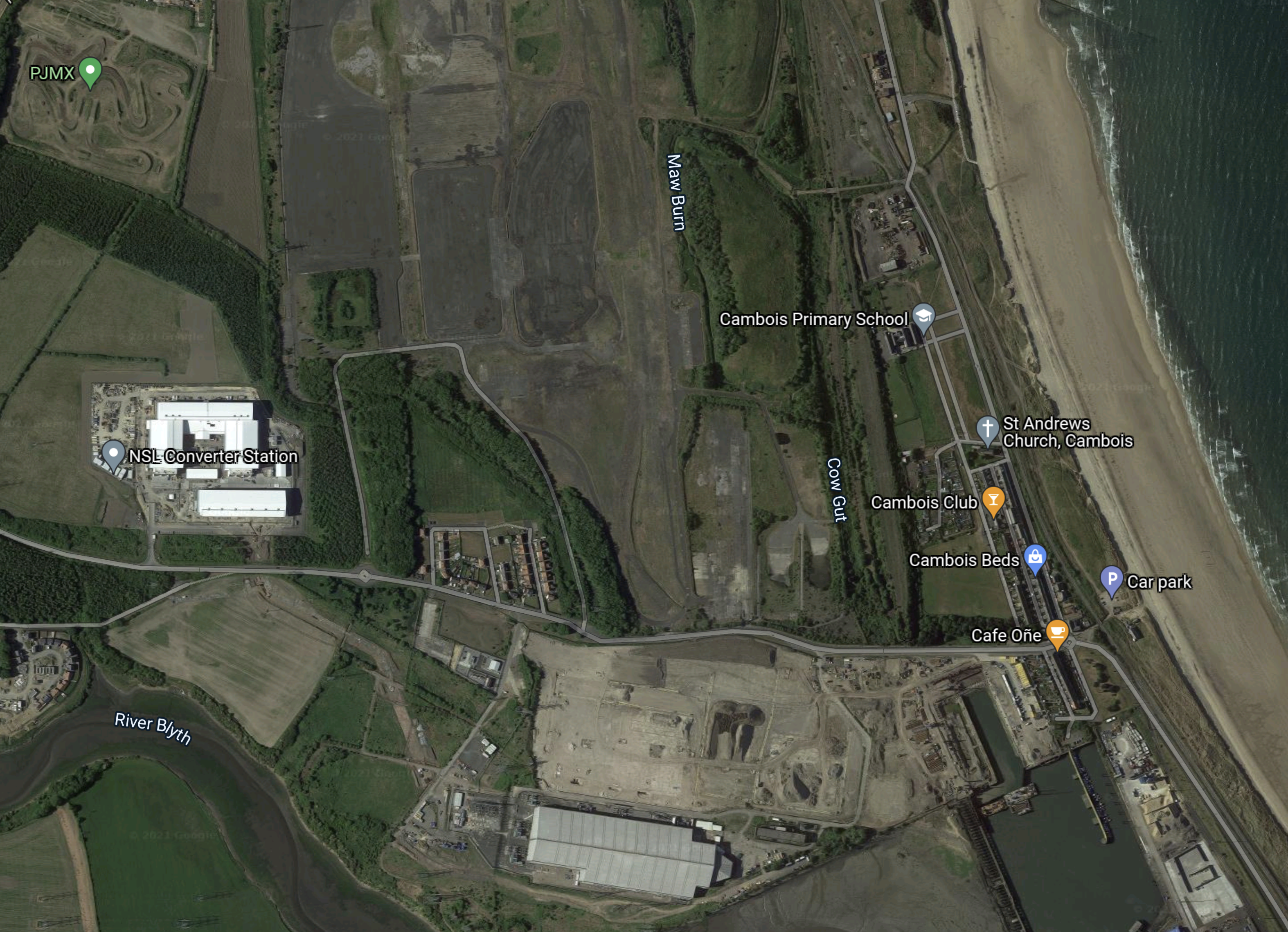
Note the light-coloured buildings of the NSL Converter Station.
I suspect there’s plenty of space to put Britishvolt’s gigafactory between the converter station and the coast.
As the gigafactory will need a lot of electricity and preferably green, I would assume this location gives Britishvolt all they need.
Where Is Kvilldal?
This Google Map shows the area of Norway between Bergen and Oslo.
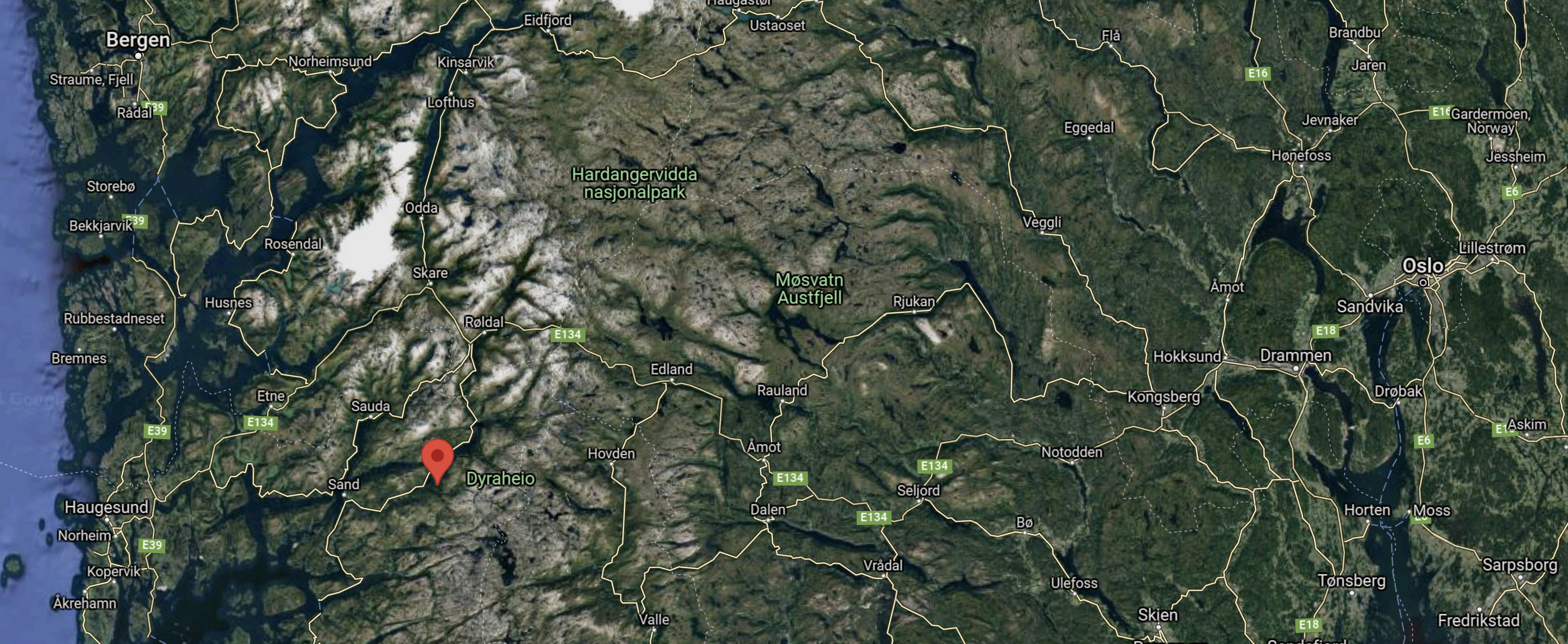
Note.
- Bergen is in the North-West corner of the map.
- Oslo is at the Eastern edge of the map about a third of the way down.
- Kvilldal is marked by the red arrow.
This second Google Map shows the lake to the North of Kvilldal.
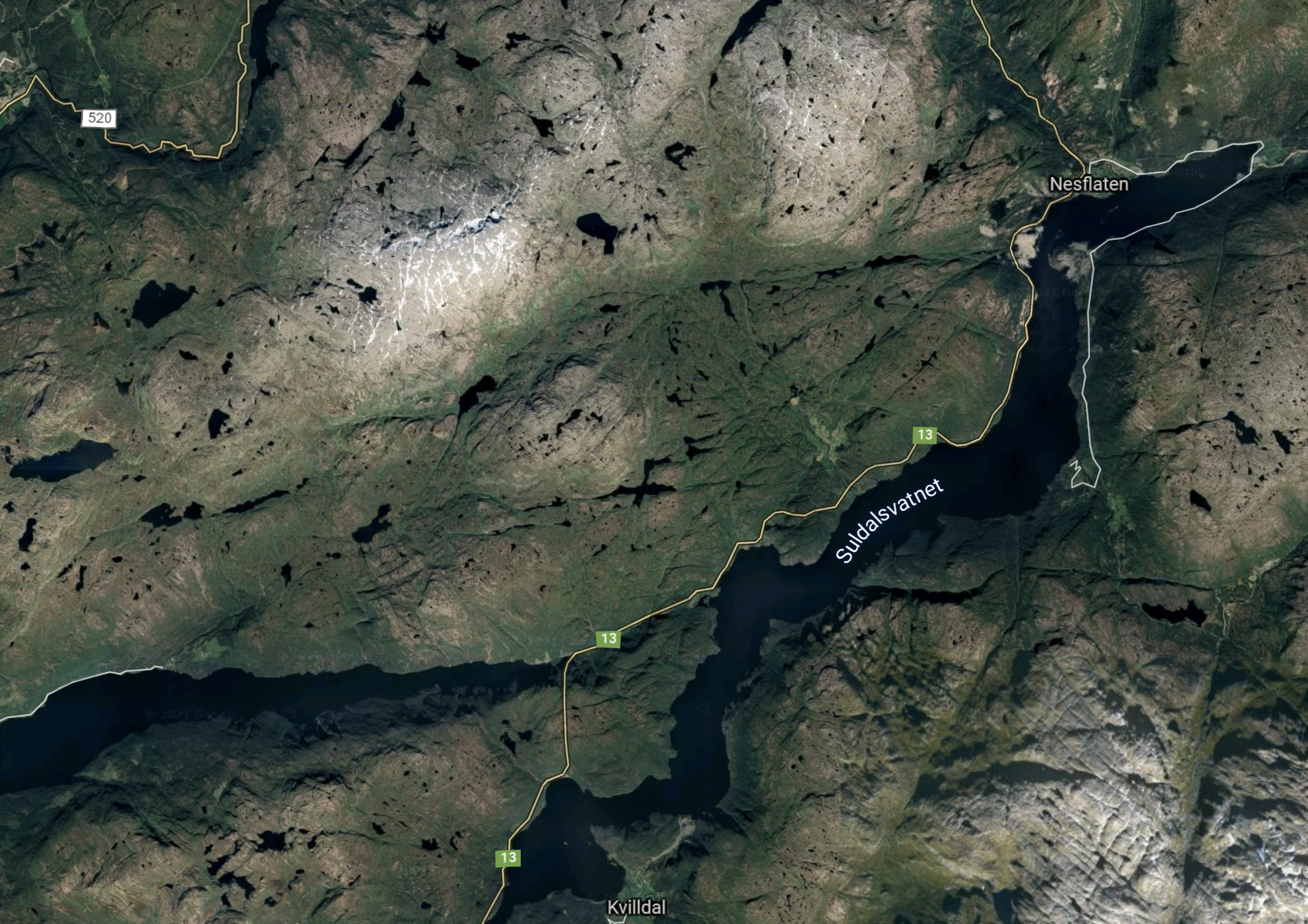
Note.
- Suldalsvatnet is the sixth deepest lake in Norway and has a volume of 4.49 cubic kilometres.
- Kvilldal is at the South of the map in the middle.
This third Google Map shows Kvilldal.
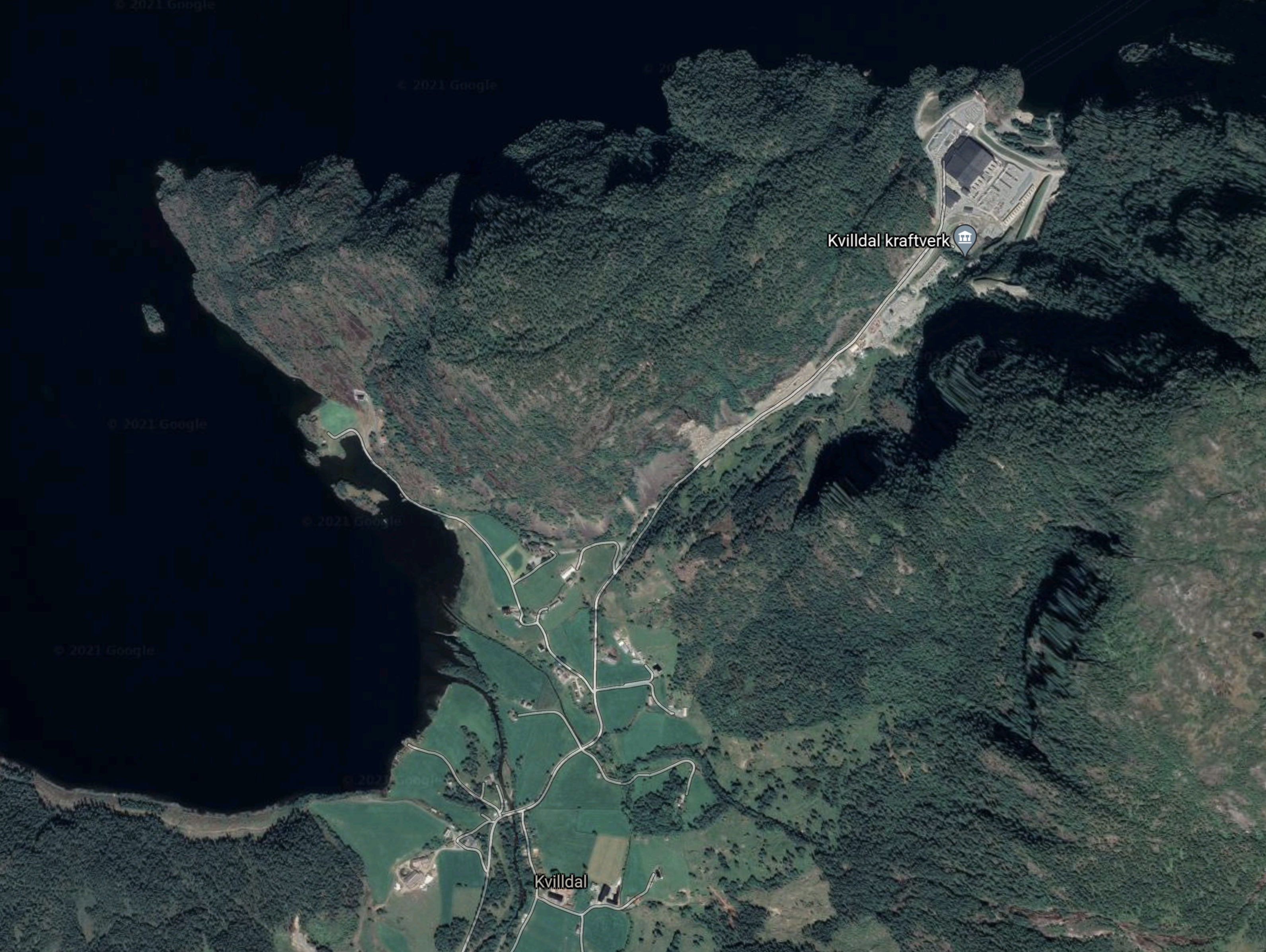
Note.
- Suldalsvatnet is the dark area across the top of the map.
- The Kvilldal hydro-electric power station on the shore of the lake.
- Kvilldal is to the South-West of the power station.
Kvilldal doesn’t seem to be the biggest and most populous of villages. But they shouldn’t have electricity supply problems.
Kvilldal Power Station And The North Sea Link
The Wikipedia entry for Kvilldal power station gives this information.
The Kvilldal Power Station is a located in the municipality of Suldal. The facility operates at an installed capacity of 1,240 megawatts (1,660,000 hp), making it the largest power station in Norway in terms of capacity. Statnett plans to upgrade the western grid from 300 kV to 420 kV at a cost of 8 billion kr, partly to accommodate the NSN Link cable] from Kvilldal to England.
This power station is almost large enough to power the North Sea Link on its own.
The Kvilldal power station is part of the Ulla-Førre complex of power stations and lakes, which include the artificial Lake Blåsjø.
Lake Blåsjø
Lake Blåsjø would appear to be a lake designed to be the upper reservoir for a pumped-storage scheme.
- The lake can contain 3,105,000,000 cubic metres of water at its fullest.
- The surface is between 930 and 1055 metres above sea level.
- It has a shoreline of about 200 kilometres.
This Google Map shows the Lake.
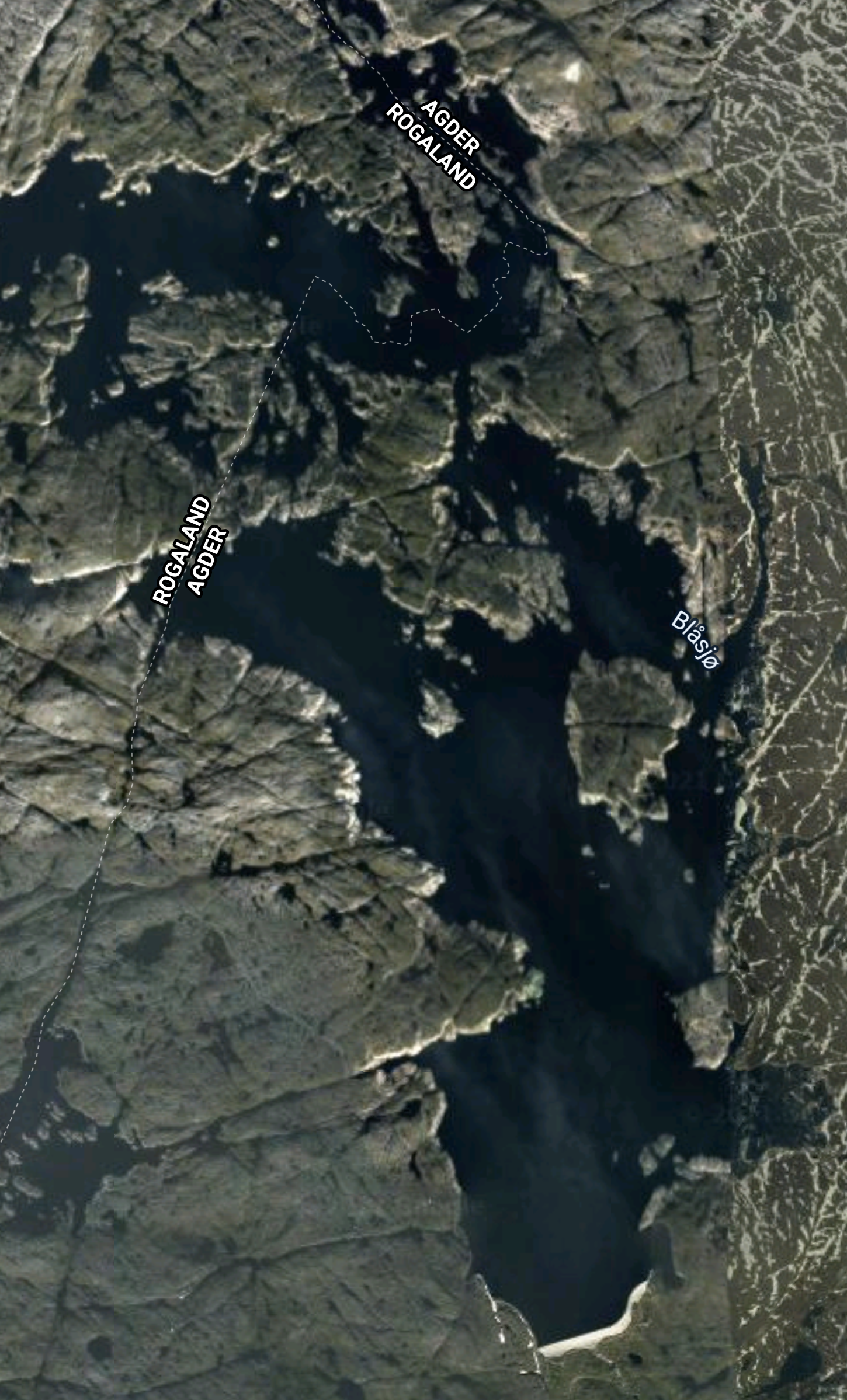
Note the dam at the South end of the lake.
Using Omni’s Potential Energy Calculator, it appears that the lake can hold around 8 TWh of electricity.
A rough calculation indicates that this could supply the UK with 1400 MW for over eight months.
The Wikipedia entry for Saurdal power station gives this information.
The Saurdal Power Station is a hydroelectric and pumped-storage power station located in the municipality of Suldal. The facility operates at an installed capacity of 674 megawatts (904,000 hp) (in 2015). The average energy absorbed by pumps per year is 1,189 GWh (4,280 TJ) (in 2009 to 2012). The average annual production is 1,335 GWh (4,810 TJ) (up to 2012)
This Google Map shows the area between Kvilldal and Lake Blåsjø.
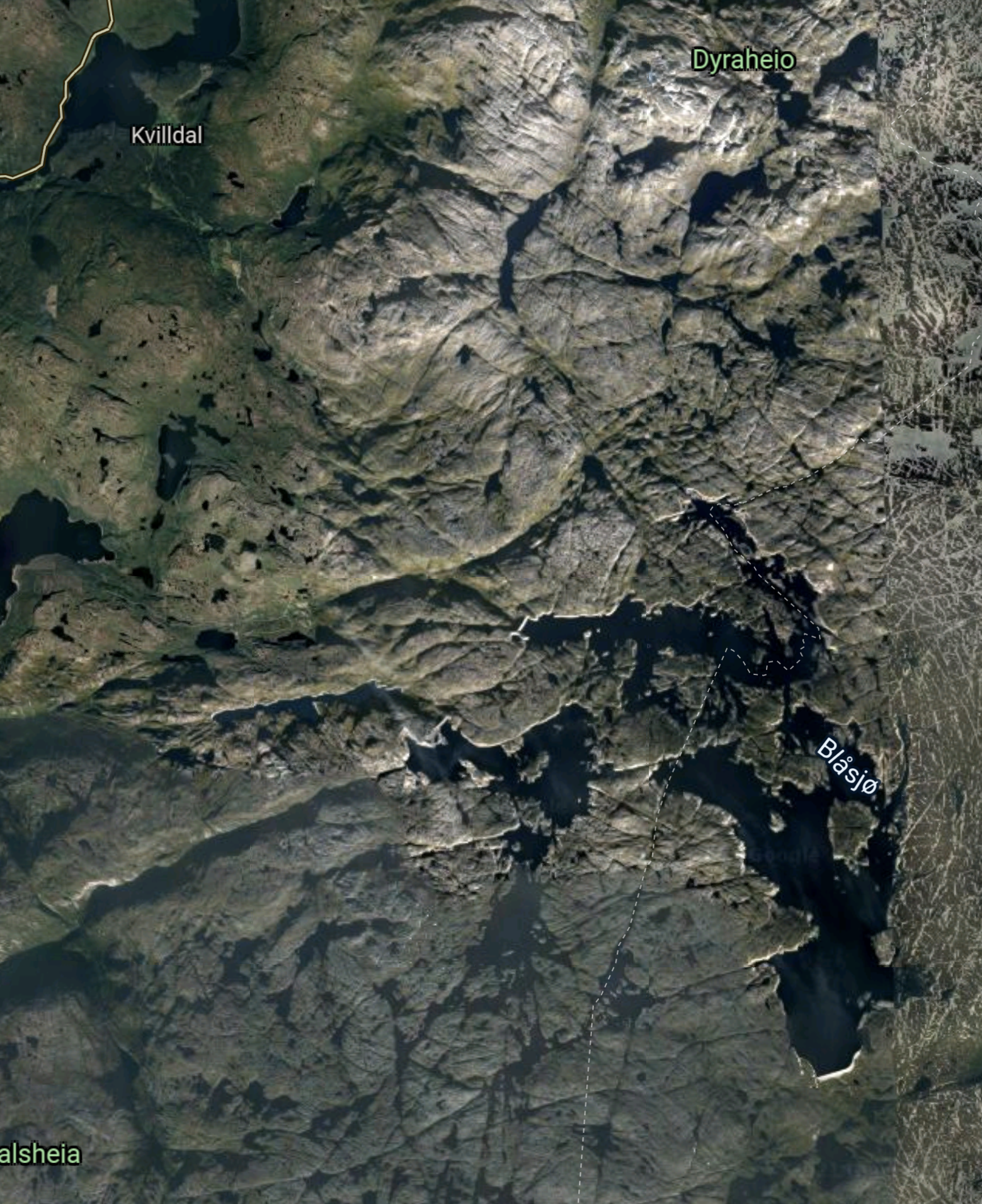
Note
- Kvilldal is in the North West of the map.
- Lake Blåsjø is in South East of the map.
This second Google Map shows the area to the South-East of Kvilldal.
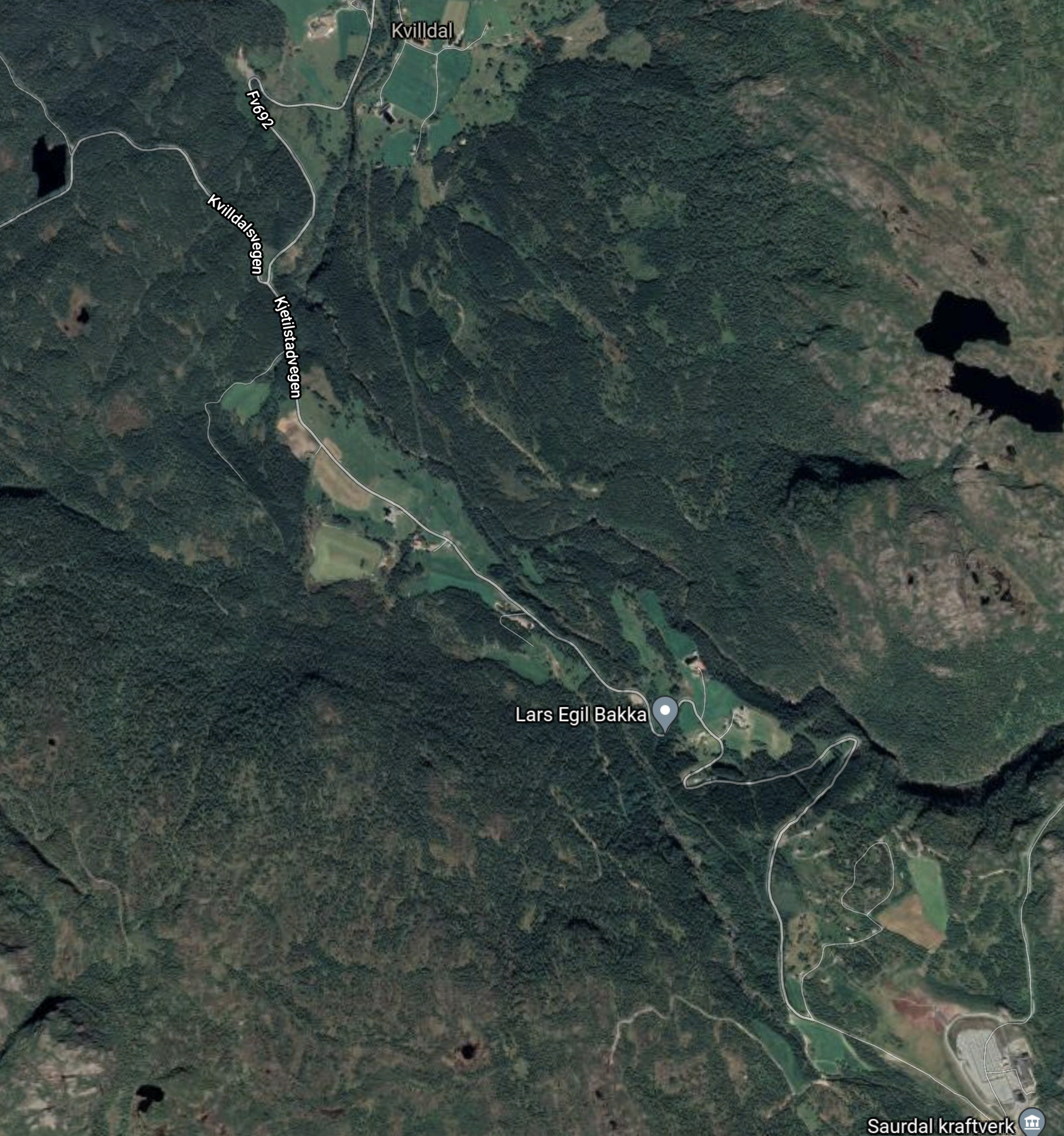
Note.
- Kvilldal is in the North-West of the map.
- The Saurdal power station is tight in the South-East corner of the map.
This third Google Map shows a close-up of Saurdal power station.

Saurdal power station is no ordinary power station.
This page on the Statkraft web site, gives a brief description of the station.
The power plant was commissioned during 1985-1986 and uses water resources and the height of fall from Lake Blåsjø, Norway’s largest reservoir.
The power plant has four generating units, two of which can be reversed to pump water back up into the reservoir instead of producing electricity.
The reversible generating units can thus be used to store surplus energy in Lake Blåsjø.
Is Lake Blåsjø and all the power stations just a giant battery?
Economic Effect
The economic effect of the North Sea Link to both the UK and Norway is laid out in a section called Economic Effect in the Wikipedia entry for the North Sea Link.
Some points from the section.
- According to analysis by the United Kingdom market regulator Ofgem, in the base case scenario the cable would contribute around £490 million to the welfare of the United Kingdom and around £330 million to the welfare of Norway.
- This could reduce the average domestic consumer bill in the United Kingdom by around £2 per year.
- A 2016 study expects the two cables to increase price in South Norway by 2 øre/kWh, less than other factors.
This Economic Effect section also talks of a similar cable between Norway and Germany called NorGer.
It should be noted, that whereas the UK has opportunities for wind farms in areas to the North, South, East and West of the islands, Germany doesn’t have the space in the South to build enough wind power for the area.
There is also talk elsewhere of an interconnector between Scotland and Norway called NorthConnect.
It certainly looks like Norway is positioning itself as Northern Europe’s battery, that will be charged from the country’s extensive hydropower and surplus wind energy from the UK and Germany.
Could The Engineering Be Repeated?
I mentioned NorthConnect earlier.
- The cable will run between Peterhead in Scotland and Samnanger in Norway.
- The HVDC cable will be approximately 665 km long.
- The cable will be the same capacity as the North Sea Link at 1400 MW.
- According to Wikipedia construction started in 2019.
- The cable is planned to be operational in 2022.
- The budget is €1.7 billion.
Note.
- Samnager is close to Bergen.
- NorthConnect is a Scandinavian company.
- The project is supported by the European Union, despite Scotland and Norway not being members.
- National Grid is not involved in the project, although, they will be providing the connection in Scotland.
The project appears to be paused at the moment, awaiting how North Sea Link and NordLink between Norway and Germany are received.
There is an English web site, where this is the mission statement on the home page.
NorthConnect will provide an electrical link between Scotland and Norway, allowing the two nations to exchange power and increase the use of renewable energy.
This sounds very much like North Sea Link 2.
And then there is Icelink.
- This would be a 1000-1200 km link between Iceland and the UK.
- It would have a capacity of 1200 MW.
- National Grid are a shareholder in the venture.
- It would be the longest interconnector in the world.
The project appears to have stalled.
Conclusion
I can see these three interconnectors coming together to help the UK’s electricity generation become carbon-free by 2035.
 The Anonymous Widower