World’s First 16 MW Offshore Wind Turbine Rolls Off Production Line
The title of this post, is the same as that of this article on offshoreWIND.biz.
This is the subtitle and the first paragraph, that add some detail.
The first nacelle for a 16 MW offshore wind turbine jointly developed by China Three Gorges Corporation and Goldwind Technology has rolled off the production line at Fujian Three Gorges Offshore Wind Power International Industrial Park in China.
According to China Three Gorges, the unit has the largest single capacity, the largest rotor diameter, and the lightest weight per megawatt in the world.
The West, is going to push hard to make sure, we don’t give away another industry to the Chinese.
France’s First Offshore Wind Farm Fully Up And Running
The title of this post, is the same as that of this article on offshoreWIND.biz.
This is the sub-title.
France’s first commercial-scale offshore wind farm, the 480 MW Saint-Nazaire, has been fully commissioned.
Does this mean, that this is France’s only operational offshore wind farm?
It does appear so, whereas the UK has 13,628 MW of offshore wind.
With onshore wind, the French have 15,000 MW and England has 14,000 MW.So we’re ahead in offshore and total, but behind in onshore.
100 MW Scottish Floating Wind Project To Deliver Lifetime Expenditure Of GBP 419 Million
The title of this post, is the same as that of this article on offshoreWIND.biz.
This is the sub heading, that gives more details on lifetime expenditure and full-time equivalent (FTE) jobs created.
The 100 MW Pentland Floating Offshore Wind Farm in Scotland is estimated to deliver lifetime expenditure of GBP 419 million in the UK and to support the creation of up to 1,385 full-time equivalent (FTE) jobs.
It does seem these figures have been compiled using the rules that will apply to all ScotWind leases and have used methods laid down by Crown Estate Scotland. So they should be representative!
Does it mean that a 1 GW floating wind farm would have a lifetime expenditure of £4.19 billion and create 13, 850 full-time equivalent (FTE) jobs?
This article from Reuters is entitled UK Grid Reforms Critical To Hitting Offshore Wind Targets and contains this paragraph.
The government aims to increase offshore wind capacity from 11 GW in 2021 to 50 GW by 2030, requiring huge investment in onshore and offshore infrastructure in England, Wales and Scotland.
If I assume that of the extra 39 GW, half has fixed foundations and half will float, that means that there will be 19.5 GW of new floating wind.
Will that mean £81.7 billion of lifetime expenditure and 270,075 full-time equivalent (FTE) jobs?
Conclusion
It does seem to me, that building floating offshore wind farms is a good way to bring in investment and create full time jobs.
Dogger Bank – The Joke That Is Growing Up To Be A Wind Powerhouse
The Wikipedia entry for the Dogger Bank, describes it like this.
Dogger Bank is a large sandbank in a shallow area of the North Sea about 100 kilometres (62 mi) off the east coast of England.
But many of my generation remember it from its use in the Shipping Forecast and as a joke place like the Balls Pond Road, Knotty Ash and East Cheam, in radio and TV comedy from the 1950s and 1960s.
But now it is being turned into one of the largest wind powerhouses!
According to Wikipedia’s list of the UK’s offshore wind farms, these wind farms are being developed on the Dogger Bank.
- Sofia Offshore Wind Farm – 1400 MW – Under Construction – Commissioning in 2023/26 – £39.65/MWh – RWE
- Dogger Bank A – 1235 MW – Under Construction – Commissioning in 2023/24 – £39.65/MWh – SSE/Equinor
- Dogger Bank B – 1235 MW – Pre-Construction – Commissioning in 2024/25 – £41.61/MWh – SSE/Equinor
- Dogger Bank C – 1218 MW – Pre-Construction – Commissioning in 2024/25 – £41.61/MWh – SSE/Equinor
- Dogger Bank D – 1320 MW – Early Planning – SSE/Equinor
- Dogger Bank South – 3000 MW – Early Planning – RWE
Note.
- These total up to 9408 MW.
- The Dogger Bank wind farms have their own web site.
- The Sofia offshore wind farm has its own web site.
- The Dogger Bank South wind farms have their own web site.
- Dogger Bank A and Dogger Bank B will connect to the National Grid at Creyke Beck to the North of Hull.
- Sofia and Dogger Bank C will connect to the National Grid at Lazenby on Teesside.
But this is only the start on the British section of the Dogger Bank.
This map, which comes courtesy of Energy Network Magazine and 4C Offshore is entitled 2001 UK Offshore Windfarm Map shows all UK offshore wind farms and their status. It looks to my naive mind, that there could be space for more wind farms to the North and West of the cluster of Digger Bank wind farms.
The North Sea Wind Power Hub
The UK doesn’t have full territorial rights to the Dogger Bank we share the bank with the Danes, Dutch and Germans.
In the Wikipedia entry for the Dogger Bank wind farm, this is said about the North Sea Wind Power Hub.
Dutch, German, and Danish electrical grid operators are cooperating in a project to build a North Sea Wind Power Hub complex on one or more artificial islands to be constructed on Dogger Bank as part of a European system for sustainable electricity. The power hub would interconnect the three national power grids with each other and with the Dogger Bank Wind Farm.
A study commissioned by Dutch electrical grid operator TenneT reported in February 2017 that as much as 110 gigawatts of wind energy generating capacity could ultimately be developed at the Dogger Bank location.
Note.
- 110 GW shared equally would be 27.5 GW.
- As we already have 9.4 GW of wind power, under construction or in planning around the Dogger Bank, could we find space for the other 18.1 GW?
- I suspect we could squeeze it in.
If we can and the Danes, Dutch and Germans can generate their share, the four countries would each have a 27.5 GW wind farm.
What would put the icing on the cake, would be if there could be a massive battery on the Dogger Bank. It wouldn’t be possible now and many would consider it a joke. But who knows what the capacity of an underwater battery based on concrete, steel, seawater and masses of ingenuity will be in a few years time.
Where Does Norway Fit In To The North Sea Wind Power Hub?
It could be argued that Norway could also connect to the North Sea Wind Power Hub.
- 110 GW shared equally would be 22 GW.
- Norway can build massive pumped storage hydroelectric power stations close to the landfall of an interconnector to the North Sea Wind Power Hub.
- the British, Danes, Dutch and Germans can’t do that, as they don’t have any handy mountains.
- Norway is a richer country the others involved in the project.
I can see Norway signing up to the North Sea Wind Power Hub.
The North Sea Link
The Wikipedia entry for the North Sea Link, introduces it like this.
The North Sea Link is a 1,400 MW high-voltage direct current submarine power cable between Norway and the United Kingdom.
At 720 km (450 mi) it is the longest subsea interconnector in the world. The cable became operational on 1 October 2021.
It runs between Kvilldal in Norway and Blyth in Northumberland.
I wouldn’t be surprised to see that the North Sea Link is modified, so that it has a connection to the North Sea Wind Power Hub.
The Lincolnshire Wind Powerhouse
In August 2022, reports started to appear about the Outer Dowsing Wind Farm, like this article on offshoreWIND.biz, which is entitled Corio, Total Submit Scoping Report For 1.5 GW Outer Dowsing Offshore Wind Project.
There is now a web site.
- Outer Dowsing Offshore Wind is a 1.5GW project located approximately 54km off the Lincolnshire coast.
- It is a joint project between TotalEnergies and Corio Generation.
This map from the Outer Dowsing Wind Farm web site, shows the location of the wind farm.
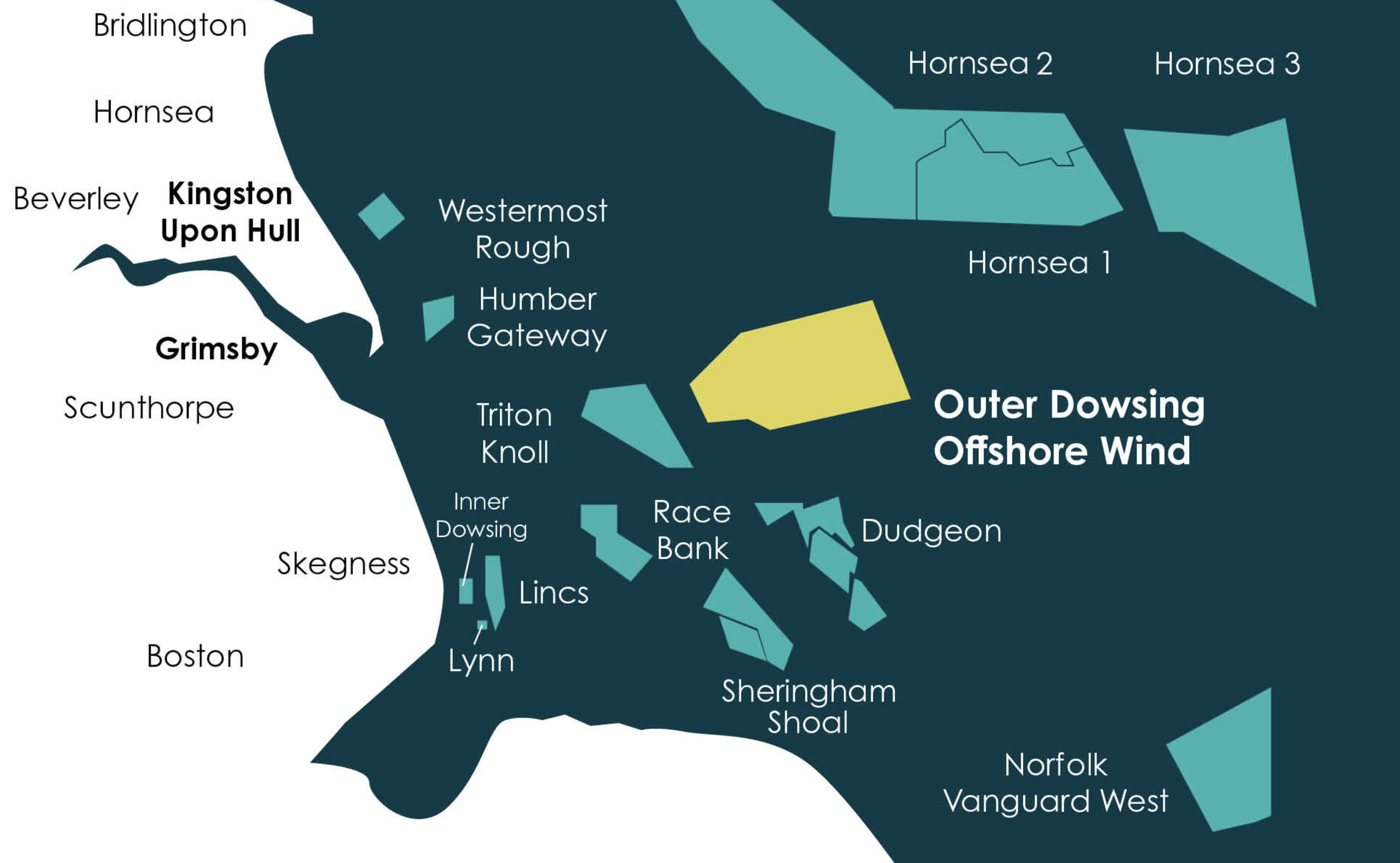
These are the sizes of the various windfarms, that are shown on the map.
- Dudgeon – 402 MW
- Hornsea 1 – 1218 MW
- Hornsea 2 – 1386 MW
- Hornsea 3 – 2852 MW
- Hornsea 4 – 1000 MW – Not shown on map.
- Humber Gateway – 219 MW
- Lincs – 270 MW
- Lynn and Inner Dowsing – 194 MW
- Norfolk Vanguard West – No information, but Norfolk Vanguard is 1800 MW
- Outer Dowsing – 1500 MW
- Race Bank – 580 MW
- Sheringham Shoal – 317 MW
- Sheringham Shoal and Dudgeon Extensions – 719 MW
- Triton Knoll – 857 MW
- Westernmost Rough – 210 MW
Note that these total up to 11724 MW, but with Norfolk Vanguard the total is 135224 MW.
Gas-Fired Power Stations
There are also several active gas-fired power stations.
- Immingham – 1240 MW
- Keadby – 734 MW
- Keadby 2 – 893 MW
- Keadby 3 – 910 MW – Planned to be fitted with carbon capture.
- Saltend – 1200 MW
- South Humber Bank – 1365 MW
- Spalding – 860 MW
- Sutton Bridge – 819 MW
Note that these total up to 8021 MW.
Viking Link
The Viking Link is a 1.4 GW interconnector, that links Bicker Fen in Lincolnshire and Denmark, that should be operational at the end of 2023.
Gas Storage
There are two major gas storage facilities in the rea.
- Aldbrough Gas Storage is formed of salt caverns to the North of the Humber.
- Rough Gas Storage is to the East of the Humber in a depleted gas field.
Both will eventually be converted to store hydrogen, which could be used by local industrial users or the proposed hydrogen power station at Keadby.
The Caledonia Wind Farm
Another of the ScotWind wind farms, that I described in ScotWind Offshore Wind Leasing Delivers Major Boost To Scotland’s Net Zero Aspirations, has been given a name and a web site.
This map shows the various ScotWind leases.

Note, that the numbers are Scotwind’s lease number in their documents.
9 is now Caledonia.
- It has grown from a 1,000 MW fixed foundation wind farm and is now 2,000 MW.
- A completion date of 2030 is now given.
The wind farm will be the fourth development in the area, after the 598 MW Beatrice, the 950 MW Moray East and the 882 MW Moray West wind farms. That is a total of nearly 4,500 MW.
Caledonia’s Unique Advantages
On the About Caledonia page on the Caledonia Wind Farm web site, there is a section called Caledonia’s Unique Advantages, which has four sections.
Water Depths
Caledonia’s water depths are 40 to 100 m. Three-quarters of the site is at depths that allow for fixed (rather than floating) foundations.
This means the majority of the site can be built using the same type of jacket foundations which Ocean Winds optimised at Moray East, seeing Caledonia implement a proven, low-risk, low-cost engineering solution.
Wind
The wind resource at Caledonia is proven through the experience of previous projects and is of a magnitude more usually associated with deeper waters, further from shore. This means Caledonia will benefit from an excellent wind resource, yielding a higher output at lower costs.
Distance from Shore
Caledonia is around 40km from shore and 70km from the nearest National Grid connection point. Beyond distances of approx 120km, DC technology becomes a necessity for subsea transmission. This means the additional costs associated with installing AC-DC convertors offshore and DC-AC convertors onshore can be avoided and the onshore substation will be smaller so will require less land and have a lesser impact on the surrounding environment.
Environment
The Moray Firth is the home of commercial-scale offshore wind generation in Scotland. Caledonia neighbours the Moray East, Moray West, and Beatrice sites, and Ocean Winds have had a presence here from the beginning of the area’s offshore wind development.
Conclusion
It does appear that if you do your planning well on projects like these, there are benefits to be reaped in terms of size, construction, capacity and financial returns.
MingYang Turbines to Spin on Hexicon’s Floating Offshore Wind Project
The title of this post, is the same as that of this article on offshoreWIND.biz.
This is the sub-heading.
Hexicon has selected China-headquartered Mingyang Smart Energy (Mingyang) as the preferred turbine supplier for its flagship 32 MW TwinHub floating offshore wind project in the UK.
These two paragraphs add a bit more detail.
Hexicon has also awarded Mingyang the wind turbine generator Front-End Engineering Design (FEED) contract for the project, which is located 16 kilometres off the coast of Cornwall, England.
TwinHub will use Hexicon’s TwinWind floating foundation technology which will allow two of Mingyang’s MySE 8.0-180 wind turbines to be placed on a single foundation, which could enable more energy to be generated in a given area while reducing the environmental impact compared with a single foundation.
Hexicon’s flagship project secured a Contract for Difference (CfD) in the UK Government’s most recent allocation round.
Hydrogen-Powered Turbines May Help Clean And Improve Electrical Grid Reliability
The title of this post, is the same as that of this article on Hydrogen Fuel News.
This is the first paragraph.
In less than three years, one or more hydrogen-powered turbines are expected to be up and running at or near New Jersey’s Bayonne Energy Center power plant, which feeds power to New York City.
Note.
- The Bayonne Energy Center is a peaker plant with ten gas turbines, with a total capacity of 640 MW.
- Peaker plants automatically cut in, when power demand is high, but power generation is low.
- The Bayonne Energy Centre transfers power to New York, through an underwater cable.
- The electrolyzers will be made by Ohmium International Inc and I suspect they will be powered by offshore wind.
- The hydrogen that is created will be stored. As Bayonne has a history of chemical manufacturing, there may be salt caverns that can be used or the hydrogen could be stored as a compressed gas or liquid in tanks.
I can see hydrogen being used in peaker plants elsewhere in the world, where there is lots of renewable energy and suitable hydrogen storage.
The hydrogen can also be used to decarbonise local industries and transportation.
The Potential For Wind Power In New Jersey
Wikipedia says this about the potential of wind power in the state.
New Jersey has the potential to generate 373 GWh/year from 132 MW of 80 m high wind turbines or 997 GWh/year from 349 MW of 100 m high wind turbines located onshore as well as 430,000 GWh/year from 102,000 MW of offshore wind turbines.
Note.
- New Jersey used 76,759 GWh in 2011
- It appears that most of these turbines would be located along the coast.
There is also a worry about hurricanes. But solving that is an engineering problem.
From my experience of modelling floating structures, I believe they may stand up to high winds better. But I’m not sure!
An Analysis Of UK Offshore Wind Farms
This analysis is based on this Wikipedia entry which is entitled A List Of Offshore Wind Farms In The United Kingdom.
The page has these sections.
Operational Offshore Wind Farms
October 2022 – 13628 MW
October 2022 – 4160 MW
October 2022 – 2453 MW
Proposed Wind Farms – Contracts for Difference Round 3
October 2022 – 12 MW
Proposed Wind Farms – Contracts for Difference Round 4
October 2022 – 7614 MW
Proposed Wind Farms – Early Planning (England)
October 2022 – 15723 MW
Proposed Wind Farms – Early Planning (Wales)
October 2022 – 500 MW
Proposed Wind Farms – Early Planning (Scotland)
October 2022 – 30326 MW
Total of Operational, Under Construction And Proposed Wind Farms
October 2022 – 60788 MW
Possible Wind Farms
In addition, these wind farms have been talked about and could possibly be developed.
- Celtic Sea – Erebus – 100 MW Demonstration Project
- Celtic Sea – Valorus – 300 MW Early-Commercial Project
- Celtic Sea – Petroc – 300 MW Project
- Celtic Sea – Llywelyn – 300 MW Project
- Celtic Sea – Llŷr Wind – 100 MW Project
- Celtic Sea – Llŷr Wind – 100 MW Project
- Celtic Sea – Gwynt Glas – 1000 MW Project
- Scotland – Salamander – 100 MW Project
- Scotland – West of Orkney – 2000 MW Project
- East Of Shetland – Map Reference 18 – 500 MW Project
- East Of Shetland – Map Reference 19 – 1800 MW Project
- East Of Shetland – Map Reference 20 – 500 MW Project
- Shetland – Northern Horizon – 10000 MW Project
- INTOG – Cerulean Winds – 6000 MW Project
These figures total 8700 MW, so by the early 2030s, it would not be unreasonable to see an offshore wind capacity of nearly 9000 MW or 90 GW.
Hywind Tampen
In Equinor Sets Sights On Gigawatt-Scale Floating Offshore Wind Projects In Celtic Sea, I said this about Hywind Tampen.
Equinor is also currently constructing the 88 MW Hywind Tampen project in Norway, which will be the largest floating offshore wind farm in the world when completed in 2023.
This page on the Equinor web site gives more details of Hywind Tampen.
- Hywind Tampen is a floating wind farm under construction that will provide electricity for the Snorre and Gullfaks oil and gas fields in the Norwegian North Sea.
- It will be the world’s first renewable power for offshore oil and gas.
- With a system capacity of 88 MW it will also be the world’s largest floating offshore wind farm.
- The wind farm will consist of eleven 8 MW turbines.
When Hywind Tampen is operational, Equinor will operate nearly half (47 percent) of the world’s floating wind capacity.
This paragraph from the Equinor web page is significant.
The wind farm is estimated to meet about 35% of the annual electricity power demand of the five Snorre A and B, and Gullfaks A, B and C platforms. In periods of higher wind speed this percentage will be significantly higher.
I take this to mean that the gas turbines that currently supply the five platforms will be left in place and that their output will be replaced by wind power, when it is available.
The INTOG Program
I described this in What Is INTOG?, and it is the UK’s program, that includes electrification of rigs and platforms.
The first leases under INTOG would appear to be expected in March 2023.
Decarbonisation Of Offshore Operations Around The World
I’m sure that if Hywind Tampen and/or INTOG is successful, that the technology will be used where possible around the world.
 The Anonymous Widower