Trenitalia To Buy c2c
There are several several articles like this one in Railway Gazette, which is entitled Trenitalia buys c2c to enter UK rail market.
So what will it mean?
Ultimate Ownership
The ultimate ownership of a train operating company seems to have very little difference to the quality of trains and customer service.
I will look at a recent journey I made from Leipzig to Brussels on Deutche Bahn, that I wrote about in Deutsche Bahn’s Idea Of Customer Service.
It was not a good journey and in the post, I say that eutche Bahn is nowhere as good as Chiltern.
And who owns Chiltern? – Deutsche Bahn.
So I suspect we’ll see very few changes on c2c because of the change of ownership, with perhaps the following provisos.
When successful companies are taken over, the Senior Management Team often depart to pastures or in this case railways, new.
The article also says this.
Mick Cash, General Secretary of pro-nationalisation trade union RMT, was less enthusiastic about the announcement. ‘This is yet another part of Britain’s rail operations being sold off to a European state-owned outfit’, he said. ‘This time it is Trenitalia, an Italian operator, that is being given an open door to plunder passengers and the public purse to subsidise rail services in their own country.’
Looking at the mess, that the RMT and its fellow travellers have got Southern into, this could be omnious.
The Future For c2c’s Services
Look at the route map of most rail franchises and a twelve-year-old with a pencil could suggest obvious places where the network could be expanded.
But there are few places , where c2c could expand.
- Reinstate the Tilbury Riverside Branch.
- Direct access to Crossrail at Stratford.
- A Canvey Island Branch
So much of the growth will come from more frequent and faster services to existing destinations, more and better trains and improvements to stations.
There must be scope for Automatic Train Operation (ATO) at the London end of the route to improve capacity and reduce journey times.
Conclusion
I had to scrape together a scenario for the future and it leads me to the conclusion that c2c is virtually fully developed. So have National Express decided to sell c2c, as it is a mature asset, that is worth more to xomebody else. Especially, a new entrant to the UK rail market, who wants to know how to run a UK train franchise.
In some ways it’s a bit like a bank selling on a long-term loan to a blue-chip company, to another back.
A Personal Vitamin D Tester
I’ve thought that the ability to purchase one of these over-the-counter in your local Boots, Superdrug or any or the umpteen pharmacies, would be very worthwhile for some time. But I’ve nver found anything on the web.
Tonight I found this article on the Natural News web site, which is entitled Over-the-counter vitamin D tester would be a boon to public health, cancer prevention.
The writer makes some good points and would be very in favour of the sale of such a device.
Read the article and see what you think.
With my engineering hat on, I can only think that no-one has come up with a simple method akin to the one I use to test my INR.
I also believe there are a lot of doctors, who believe patients doing their own testing is a no-no! Possibly becuase it blows a hole in his staff needs and therefor reduces their budget. Nurses doing lots of testing gives the feel-good factor of a busy surgery.
But then the Healthcare Industry all over the World, is the last one to start using Twentieth Century managenment methods. In private medicine, it is a sensible way to inflate the bill and in the NHS, it means you don’t have to make unnecessary staff redundant.
A Design Crime – Train Platform Interface At St. Pancras Thameslink
Frank Grdner has been complaining at the problems of travelling on planes in a wheelchair.
I took these pictures of the step between platform and train at St. Pancras Thameslink station.
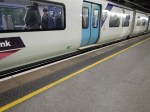


All of the trains including the 1980s built Class 319 trains seem to require the same step-up into the train.
As the Platforms at the station were built after the Class 319 trains became the most numerous trains on the route, this a real design crime of the highest order.
It would appear that Merseyrail will offer roll-across access with their new trains, so why isn’t Thameslink.
But then in an ideal world, St. Pancras station needs a substantial rebuild underground.
All Of Scotland Is Now Twinned With Marlow
This article on the BBC, is entitled Winds close Forth Road Bridge and cut power to homes.
At two this morning a truck overturned on the Forth Road Bridge and the bridge has been closed since.
This is the full story from the BBC report.
The lorry on the Forth Road Bridge blew over at about 02:00 GMT. A spokesman for the bridge-operating company said the bridge had been closed to HGVs from 00:30 GMT.
The truck was travelling north from the Edinburgh side towards Fife, but was blown on to the southbound carriageway, damaging a 40-metre stretch of the central grilling, he said.
It had been lifted off the central grilling by a crane by mid-morning, but it could not be completely cleared from the scene until the weather improves.
The bridge remains closed both north and south-bound.
The driver of the lorry has been charged with dangerous driving, police said.
What an idiot!
But there was also the incident on the historic Marlow Bridge over the Thames. This is from Wikipedia.
On 24 September 2016 the bridge suffered ‘potential structural damage’ following an incident where 37-tonne Lithuanian haulage lorry exceeding the weight limit attempted to pass over the bridge. The bridge was closed for two months to allow Buckinghamshire County Council to undertake a series of stress tests on the suspension bridge hangers and pins, together with ultrasound and magnetic particle tests. No significant damage to the bridge was found, and had given the all-clear to reopen the bridge on Friday 25 November following restoration of sections exposed for weld testing with three coats of paint, removal of scaffolding surrounding the bridge’s two towers, and reinstatement of timber work removed for inspection. To the applause of around 100 onlookers, Marlow Bridge was reopened to traffic at 10am on Friday, 25 November.
Consider that Marlow Bridge was built in 1832, it has survived the better part bof two centruries well.
However Marlow Bridge was built by Bristolian; William Tierney Clark, who was also responsible for Hammersmith Bridge on the Thames.
Internationally, Clark was also responsible for the iconic Széchenyi Chain Bridge across the Danube in Budapest.
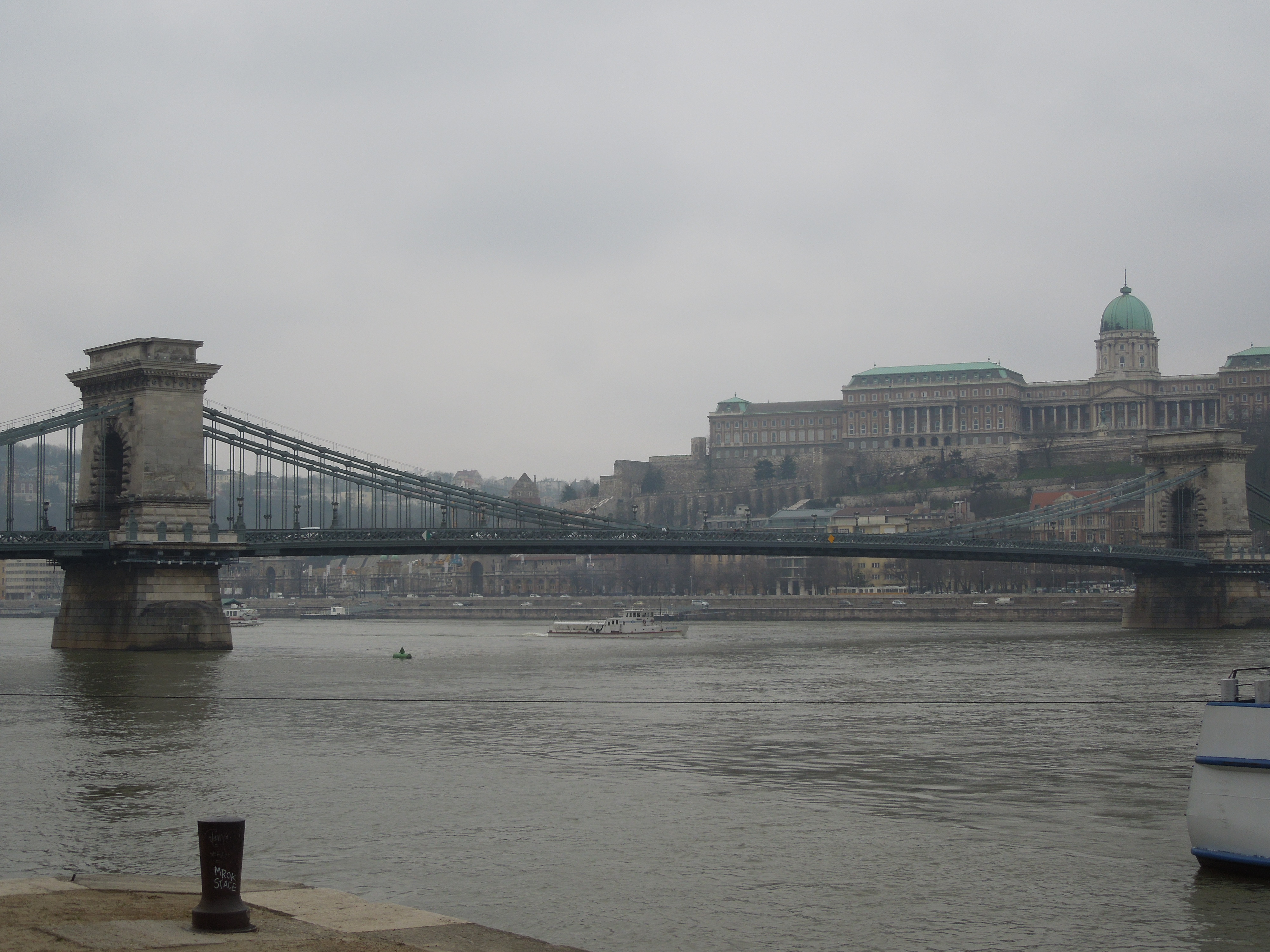
Bada Castle And The Chain Bridge
I took the picture, when I did my Home Run From Budapest in 2013. What you see is not wholly the original, as that was blown up by the Nazis in the Siege of Budapest in 1945.
Incidentally, the engineer who supervised the construction of the bridge from parts sent out from the UK, was the Scot; Adam Clark.
As Adam Clark was born in Edinburgh, I’ve concluded by bringing the narrative back to the Forth Bridge.
Gas-Lighting
This article on CNN is called Donald Trump is ‘gaslighting’ all of us.
It introduced me to term gas-lighting, which all goes back to a 1940 British film and an earlier play.
This is said about the term in the Wikipedia entry for the film.
The psychological term gaslighting, which describes a form of psychological abuse in which the victim is gradually manipulated into doubting his or her own reality, originated from the play and its two film adaptations.[7] Gaslighting, today, mostly refers to one of the methods of abuse used by a narcissist to emotionally control a victim, through which the narcissist gains pleasure.
Now CNN is accusing Trump of doing this to us all.
This is an extract.
After mimicking a disabled reporter and seeing the video used as evidence against him, he repeatedly denied it, claiming his opponents should be embarrassed to say he did. “I would NEVER mock disabled. Shame!” The denials continued after Meryl Streep brought up the subject this week at the Golden Globes. With the video easily available, Trump’s argument boiled down to “Who do you trust, me or your lying eyes?”
Here’s the video.
Trmp is going to gove the World’s comedians more material, than any other politician in history.
Kempton Park Racecourse Could Close For Housing
This article on the BBC is entitled Kempton Park racecourse faces closure to make way for housing.
This Google Map shows Kempton Park racecourse and the surrounding area.
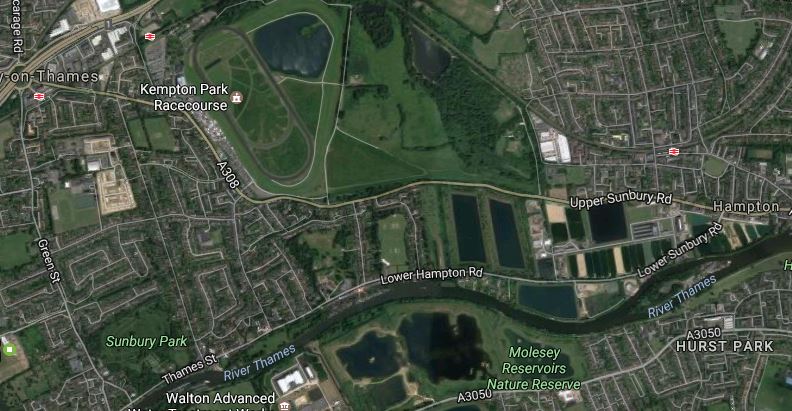
Kempton Park
It is a large site of about a third of a square mile, bounded on the Southern side by the Thames, with the Shepperton Branch to Waterloo on the Northern side.
Note.
- London needs lots of quality housing and it would certainly provide that.
- Kempton Park station currently has two trains per hour (tph) taking 44 minutes to and from Waterloo.
- As I said in An Analysis Of Waterloo Suburban Services Proposed To Move To Crossrail 2, whether Crossrail 2 is built or not, four tph could run on the Shepperton Branch to Waterloo in perhaps 30 minutes.
- There might be space for a section station on the London side of Kempton Park station.
- Road connections are good to the M3 and M25.
- A black-cab or mini-cab to Heathrow wouldn’t be outrageous.
On this rough look it certainly looks to be a good site for housing.
It is also possibly the only site owned by The Jockey Club, whose sale would create enough cash for thei improvements to go ahead.
But as on Radio 5 tonight, not all horse racing participants and fans will like this decision.
Class 230 And Class 319 Flex Fight It Out
The Class 319 Flex train and the Class 230 train share a lot of objectives.
- They involve re manufacturing of redundant trains.
- They feature new interiors.
- They feature on-board diesel power-packs.
- They would be capable of serving short to medium routes.
Some advantages of the Class 319 Flex are.
- The ability to work on all main lines with electrification in the UK.
- The trains have proven fairly reliable and they are getting more so, according to Modern Railways.
- The trains are based on Mark 3 coaches, so are as tough as teak.
- There are a total of 86 trains of which 47 are yet to be released by Thameslink.
- The Class 319 is already certified for main line running at 100 mph.
- Those behind the project have very deep pockets.
As an Electrical and Control Engineer, Ifeel that fitting the power packs under a Class 319, would be easier than on a Class 230.
I also think that a modified hybrid bus power unit could be used. The diesel engine would charge a battery, which then feeds into the main electrical bus as required. The battery could also be charged from the overhead wires or third rail.
A decent control system linked to a pantograph that could raise and lower at line speed automatically, could have great fun getting from A to B, using the smallest possible amount of diesel.
But the biggest problem for the Class 230 is the fire it suffered, which is described in this article on the BBC.
Since then because of time issues with the new London Midland Franchise, the Local Authorities, who were backing the trial on the Coventry to Nuneaton Line have backed out of the project.
As this came just eight days after Porterbrook announced the Class 319 Flex, the timing couldn’t have been worse.
London Midland must be a prime target for a Class 319 Flex.
- They already run seven Class 319 trains.
- They need a 100 mph train for running on the West Coast Main Line.
- The train would be ideal for extending some of their routes over perhaps a dozen miles.
- If the trains had a hybrid transmission, Routes like NUCKLE (Nuneaton – Coventry – Kenilworth – Leamington Spa) could be handled.
- Extra services from London to new destinations without electrification, might be possible.
There are probably other companies on Porterbrook’s list of prospects.
Conclusion
Vivarail will have a struggle to sell large numbers of trains, against a larger, faster, more capable train of proven reliability.
Summoned By Bells
When I saw the pictures of the new bells for Southwark Cathedral, I just had to go and have a look.
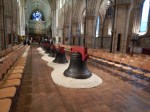

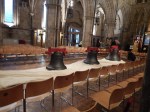
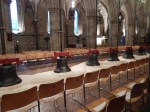
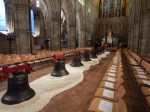
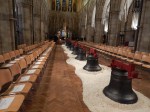
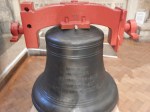
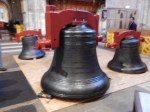
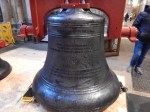
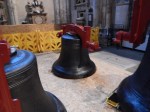
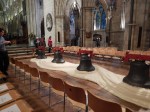

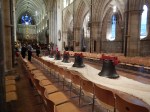
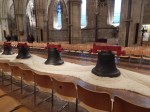

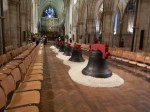
It was just as well I did, as after the dedication yesterday, they will not be on view, but hanging in the belfry.
Vitamin D Problems
I found this post in the MedHelp web site.
Under a heading of Huge Problems With Vision, this is said.
Hi at all,
at first sorry for my english. – I´m from Germany and will try my best! I go diagnosesed with a low vitamin D level from 20 and I´m glad to found this forum because I never thought that all theses symptomse could be yust because of a low Vitamin D level. I´m taking 50.000 iU once a week since 3 weeks now. I have most of the symtomse the most of you have like,– tick with the eye,
-consistently feeling dizzy, like I’ve shifted a couple of inches one direction or the other, without really moving at all – short on air.
-Muscle pain in both sides of the rib area,
-Problems swallowing,
-Joints in my feet and legs were very painful, making it very hard to walk up and down stairs
-Constant buzzing sensation on the souls of my feet now
– Cramps in my legs
– not sleeping well
– sweating during the night
– cant concentrate or even thinking
– allmost dizzy all the timeWhat bothered me the most right know is my vision. I can´t drive or do my grocery anymore. I´m allmost at home now for over 2 month. Dos somebody else has problems with their vision too? Do you know how long i takes to get better?
They could be describing my problems.
After my stroke, I had my eyes tested and was banned from driving. As I’d been in hospital for a couple of months, I suspect my vitamin D levels were rock bottom.
Will Platforms 15 And 16 At Manchester Piccadilly Ever Be Built?
I ask this question, as I have read this article on the Manchester Evening News, which is entitled Doubts cast over plans for two new platforms at Manchester Piccadilly train station.
This is said.
A shadow of doubt is looming over plans to expand Manchester Piccadilly after Network Rail’s boss admitted they are looking at the ‘cost-benefit ratio’.
The words of Mark Carne, chief executive at Network Rail, will raise fears of delay – or even cancellation – of the building of platforms 15 and 16.
For myself, I dread when I see my train is leaving or arriving at the current Platforms 13 or 14 at Manchester Piccadilly station.
The architect who designed this mess was a total idiot.
- Access is terrible.
- There needs to be escalator and lift access between the platforms and the street below.
- The platform is not wide enough for safety.
I just wonder if there could be an interim solution to Platforms 15 and 16 at Manchester Piccadilly.
- Rebuild Platforms 13 and 14 to a modern safe standard.
- Provide a second access route to the platforms from the main station.
- Provide direct access to the platforms from the street.
- Provide direct escalator access to the trams.
- Future-proof Platforms 13 and 14 for decent access from the proposed HS2 platforms.
Obviously, a design would be used, that can be expanded to add Platforms 15 and 16.
To be fair, since the platforms were built in 1960, station and railway design has moved on.
In London, we have Thameslink, that will handle 24 main line trains per hour (tph) at four stations in Central London. Soon, Thameslink will be joined by Crossrail, which will handle the same frequency of trains on an East-West axis across London.
I’ve stood on that crowded island platform at Manchester Piccadilly, many times and certainly the frequency of trains is nowhere near 24 tph and perhaps just half that figure.
If they can do it on Thameslink and Crossrail, then surely they can do it on Platforms 13 and 14 at Manchester Piccadilly.
To accommodate, an increased number of trains would require.
- Rebuilding of Platforms 13 and 14 to a modern standard with better access to the main station, the street and the Metrolink.
- Updating of Oxford Road and Deansgate stations to safely handle the increased number of trains and passengers.
- Installation of Automatic Train Control (ATO) as on Thameslink and Crossrail, through Piccadilly, Oxford Road and Deansgate.
Get it right and it could bring more than just the obvious benefits of more capacity, less cost, earlier implementation and future-proofing.
Could Platforms 13 And 14 Become A Separate Station?
I ask this question, as Platforms 13 and 14 have a similar relationship to the main Piccadilly station, as Waterloo East station has to Waterloo station.
Waterloo East station is certainly nor perfect, but after the installation of the balcony at Waterloo and a better bridge between the two stations, it is getting there.
In my view Waterloo East still needs.
- Direct access to and from street level.
- Better access to Waterloo tube station.
Perhaps it could all be funded by sympathetic development on top of a new station.
I can’t see why a similar approach couldn’t be taken at Platform 13 and 14 at Manchester Piccadilly.
The new station would have.
- Walk-in access from the street.
- Easy access from the Metrolink.
- A ticket hall.
- Step-free access to the platforms.
- Appropriate oversite development,like perhaps a hotel, offices and housing.
I shall call it Manchester Piccadilly South in the rest of this post.
I think that making the station separate could be the best way to go. Especially, if the developer of the oversite development could be persuaded to contribute to the station.
A Station For Manchester Airport
Most of the current nine trains per hour ( tph) to and from Manchester Airport use Platforms 13 and 14.
So if a Manchester Piccadilly South station is created, this would make it easier for travellers using the train to get to the airport.
It would also be more convenient if all Manchester Airport services called at these platforms.
Through Trains Only
Some trains appear to start from Platform 13B at Manchester Piccadilly..
If services were reorganised, surely this will stop, as you don’t use through platforms to terminate services.
Could The Development Of Platforms 13 and 14 Be Done Without Halting Train Services?
I suspect, that Network Rail’s contractors have a lot of experience of rebuilding platforms like these, whilst keeping the trains running.
Conclusion
I can certainly understand Network Rail’s thinking on perhaps cancelling Platforms 15 and 16.
 The Anonymous Widower